
Psychometric Properties of an Acculturation Scale Exploring Dimensions


- Slides: 30
Psychometric Properties of an Acculturation Scale: Exploring Dimensions of Marginality of a Diverse Latino Population Melissa A. Gutierrez, MS APHA 135 th Annual Meeting Immigration and Health November 6, 2007
Overview of Presentation n n n Background of Acculturation Rating Scale for Mexican Americans -II Aim of the study Methods Results Discussion Directions for future research 2
What is Acculturation? n n Acculturation involves the changes that result when two distinctly different cultures come into first hand contact with each other and involves the social, attitudinal, and psychological changes that transpire (Berry, Trimble, & Olmedo 1986; Redfield et al. , 1936) ¡ Focuses on how minority cultures are affected by dominant cultures Although it is widely accepted that acculturation is an important part of cross-cultural interactions and research, there is disagreement about how to conceptualize and measure it (Berry, 2003). 3
Acculturation Measures n Proxy Variables ¡ n Acculturation Scales ¡ ¡ ¡ n Language Use, Generation Status, Nativity, or a some combination A tool used to measure a theory of acculturation Numerous, varying in length, context, and theory used May be invalidated (in differing contexts) If theory of acculturation and its effects are of importance, the need for a valid and reliable measure to accurately capture acculturation is vital to research 4
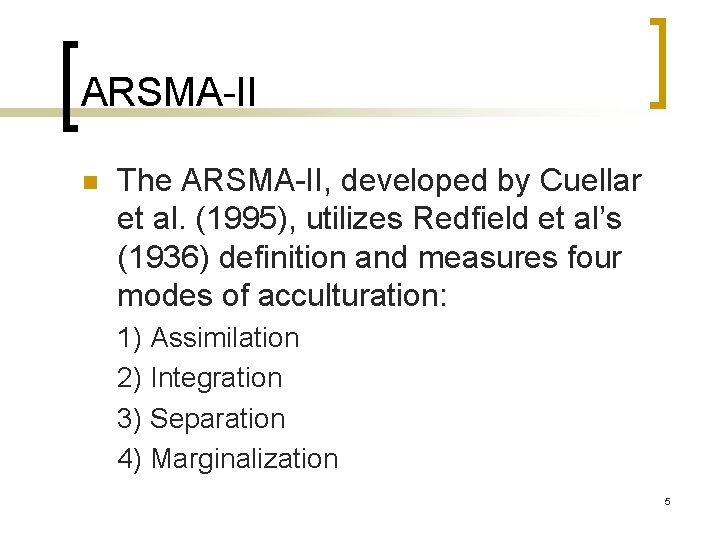
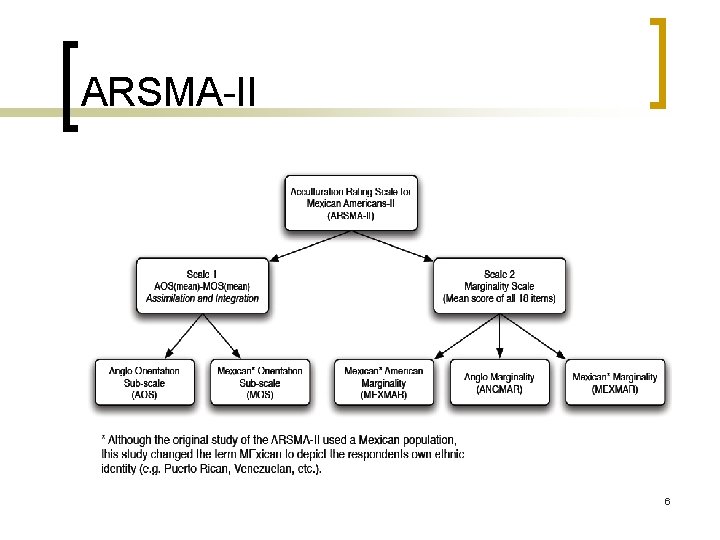
ARSMA-II n The ARSMA-II, developed by Cuellar et al. (1995), utilizes Redfield et al’s (1936) definition and measures four modes of acculturation: 1) Assimilation 2) Integration 3) Separation 4) Marginalization 5
ARSMA-II 6
The Marginality Scale n n n Scale 1 was validated in the original study among Mexican / Mexican Americans Scale 2, the Marginality Scale, lacks validation Validating the Marginality Scale is a vital next step to further understanding the concept of marginality, its relationship to acculturation 7
Aim of Study n To analyze the underlying structure of the Marginality Scale of the ARSMA-II n To examine the relationship between the underlying structure of the measure and a set of theoretically relevant variables 8
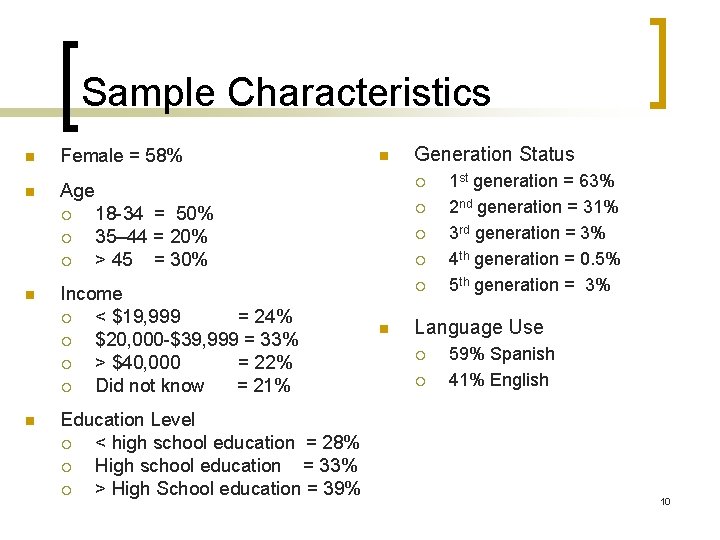
Methods: Sample n Participants were part of a larger community needs assessment study conducted in a large Northeast U. S. city n This study used only participants who identified themselves as Hispanic (n=193) n Using standard telephone interviewing techniques, participants were interviewed either in English or Spanish depending on their preference 9
Sample Characteristics n n Female = 58% ¡ ¡ n Generation Status ¡ Age ¡ n n ¡ 18 -34 = 50% 35– 44 = 20% > 45 = 30% Income ¡ < $19, 999 = 24% ¡ $20, 000 -$39, 999 = 33% ¡ > $40, 000 = 22% ¡ Did not know = 21% Education Level ¡ < high school education = 28% ¡ High school education = 33% ¡ > High School education = 39% ¡ ¡ ¡ n 1 st generation = 63% 2 nd generation = 31% 3 rd generation = 3% 4 th generation = 0. 5% 5 th generation = 3% Language Use ¡ ¡ 59% Spanish 41% English 10
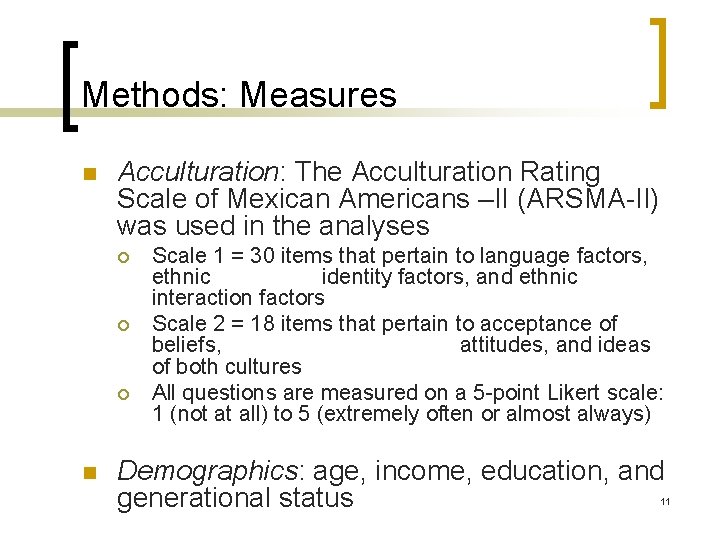
Methods: Measures n Acculturation: The Acculturation Rating Scale of Mexican Americans –II (ARSMA-II) was used in the analyses ¡ ¡ ¡ n Scale 1 = 30 items that pertain to language factors, ethnic identity factors, and ethnic interaction factors Scale 2 = 18 items that pertain to acceptance of beliefs, attitudes, and ideas of both cultures All questions are measured on a 5 -point Likert scale: 1 (not at all) to 5 (extremely often or almost always) Demographics: age, income, education, and generational status 11
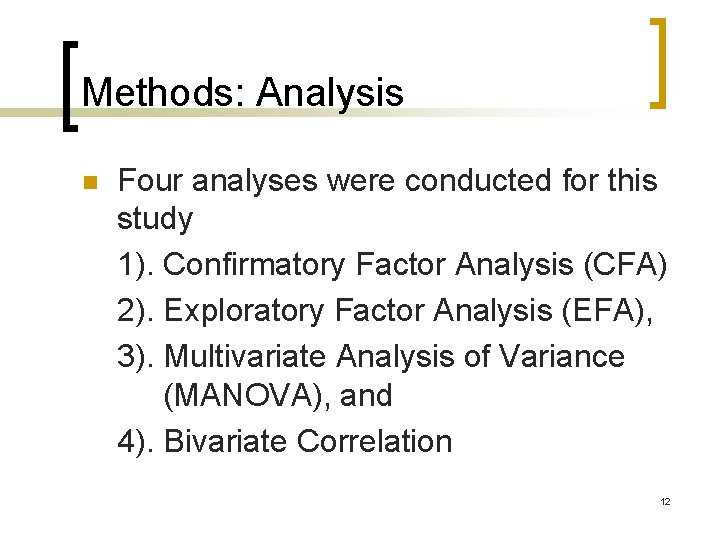
Methods: Analysis n Four analyses were conducted for this study 1). Confirmatory Factor Analysis (CFA) 2). Exploratory Factor Analysis (EFA), 3). Multivariate Analysis of Variance (MANOVA), and 4). Bivariate Correlation 12
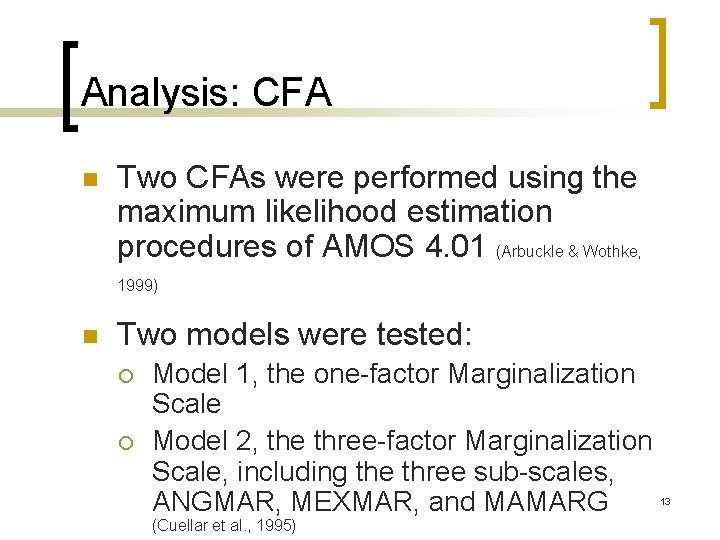
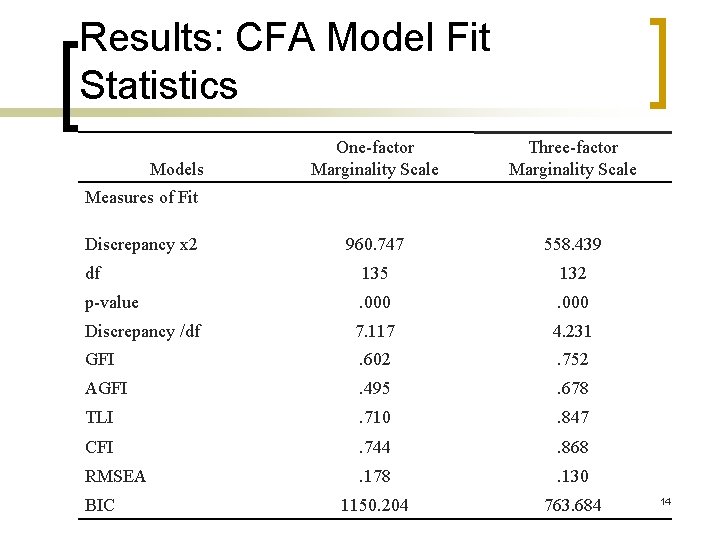
Analysis: CFA n Two CFAs were performed using the maximum likelihood estimation procedures of AMOS 4. 01 (Arbuckle & Wothke, 1999) n Two models were tested: ¡ ¡ Model 1, the one-factor Marginalization Scale Model 2, the three-factor Marginalization Scale, including the three sub-scales, ANGMAR, MEXMAR, and MAMARG (Cuellar et al. , 1995) 13
Results: CFA Model Fit Statistics One-factor Marginality Scale Three-factor Marginality Scale 960. 747 558. 439 df 135 132 p-value . 000 Discrepancy /df 7. 117 4. 231 GFI . 602 . 752 AGFI . 495 . 678 TLI . 710 . 847 CFI . 744 . 868 RMSEA . 178 . 130 1150. 204 763. 684 Models Measures of Fit Discrepancy x 2 BIC 14
Results: EFA n Failing to confirm the hypothesized structure of the Marginality Scale of the ARMSA-II n An EFA was conducted in search of a reasonable multifactor solution 15
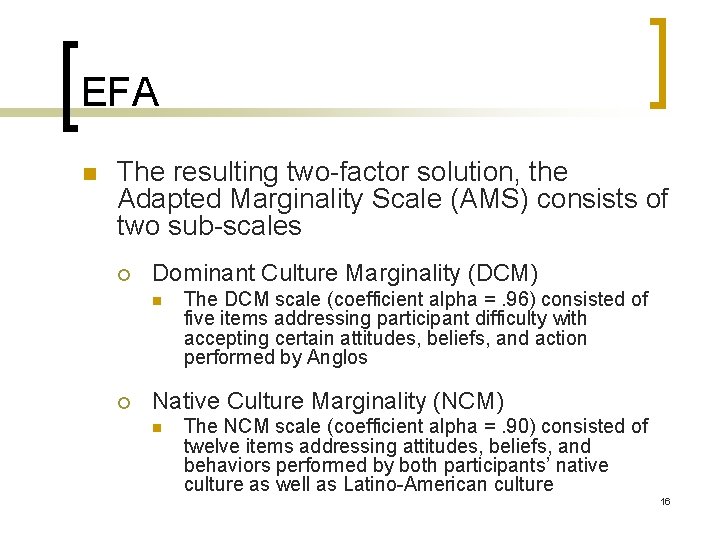
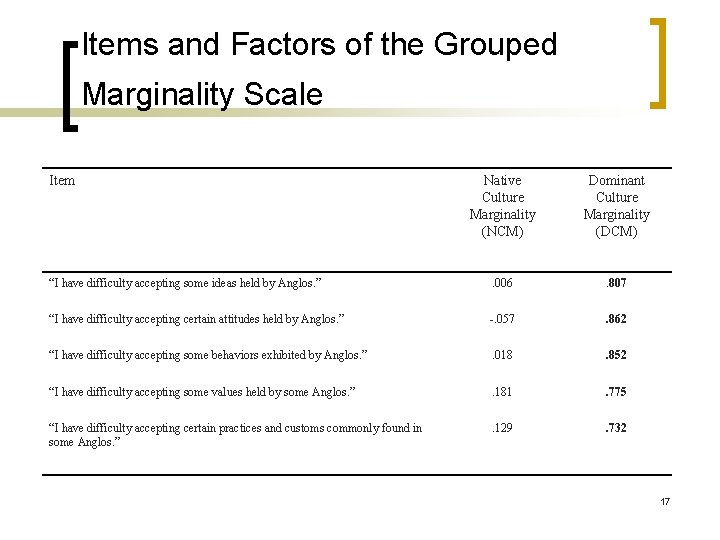
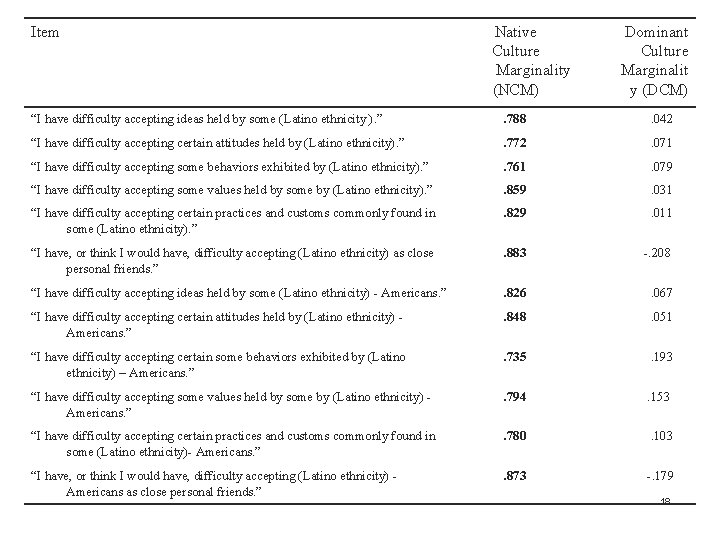
EFA n The resulting two-factor solution, the Adapted Marginality Scale (AMS) consists of two sub-scales ¡ Dominant Culture Marginality (DCM) n ¡ The DCM scale (coefficient alpha =. 96) consisted of five items addressing participant difficulty with accepting certain attitudes, beliefs, and action performed by Anglos Native Culture Marginality (NCM) n The NCM scale (coefficient alpha =. 90) consisted of twelve items addressing attitudes, beliefs, and behaviors performed by both participants’ native culture as well as Latino-American culture 16
Items and Factors of the Grouped Marginality Scale Item Native Culture Marginality (NCM) Dominant Culture Marginality (DCM) “I have difficulty accepting some ideas held by Anglos. ” . 006 . 807 “I have difficulty accepting certain attitudes held by Anglos. ” -. 057 . 862 “I have difficulty accepting some behaviors exhibited by Anglos. ” . 018 . 852 “I have difficulty accepting some values held by some Anglos. ” . 181 . 775 “I have difficulty accepting certain practices and customs commonly found in some Anglos. ” . 129 . 732 17
Item Native Culture Marginality (NCM) Dominant Culture Marginalit y (DCM) “I have difficulty accepting ideas held by some (Latino ethnicity ). ” . 788 . 042 “I have difficulty accepting certain attitudes held by (Latino ethnicity). ” . 772 . 071 “I have difficulty accepting some behaviors exhibited by (Latino ethnicity). ” . 761 . 079 “I have difficulty accepting some values held by some by (Latino ethnicity). ” . 859 . 031 “I have difficulty accepting certain practices and customs commonly found in some (Latino ethnicity). ” . 829 . 011 “I have, or think I would have, difficulty accepting (Latino ethnicity) as close personal friends. ” . 883 -. 208 “I have difficulty accepting ideas held by some (Latino ethnicity) - Americans. ” . 826 . 067 “I have difficulty accepting certain attitudes held by (Latino ethnicity) Americans. ” . 848 . 051 “I have difficulty accepting certain some behaviors exhibited by (Latino ethnicity) – Americans. ” . 735 . 193 “I have difficulty accepting some values held by some by (Latino ethnicity) Americans. ” . 794 . 153 “I have difficulty accepting certain practices and customs commonly found in some (Latino ethnicity)- Americans. ” . 780 . 103 “I have, or think I would have, difficulty accepting (Latino ethnicity) Americans as close personal friends. ” . 873 -. 179 18
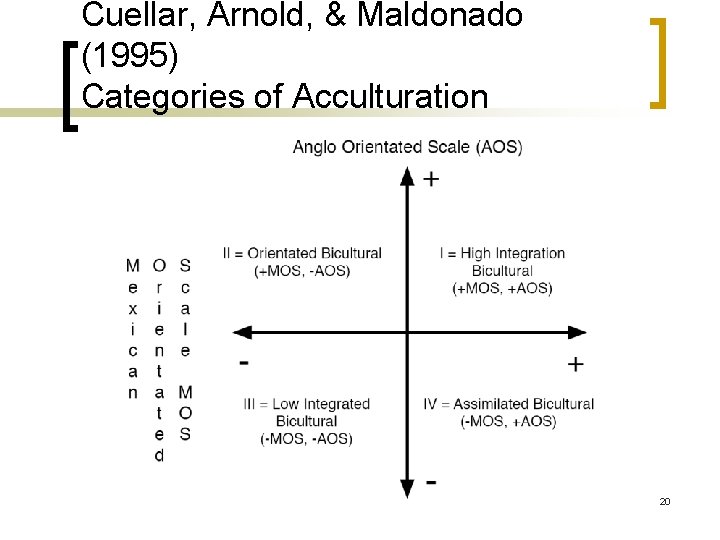
Analyses: MANOVA n Further examination of these constructs a one-way Multivariate Analysis of Variance (MANOVA) was performed to determine if individuals with varying modes of acculturation differed on their level of marginalization 19
Cuellar, Arnold, & Maldonado (1995) Categories of Acculturation 20
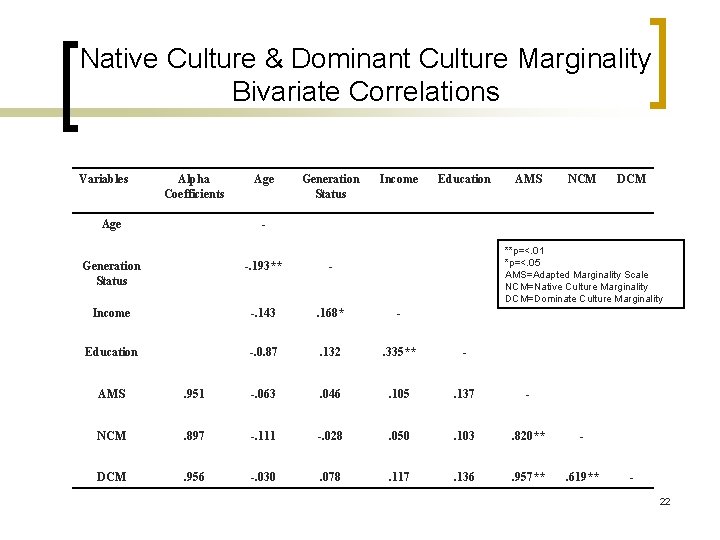
Analyses: Bivariate Correlations n Finally, bivariate correlations were used to test the relationship between the marginality sub-scales and other relevant variables (e. g. generation status, age, income, and education) 21
Native Culture & Dominant Culture Marginality Bivariate Correlations Variables Alpha Coefficients Age Generation Status Income Education AMS NCM DCM **p=<. 01 *p=<. 05 AMS=Adapted Marginality Scale NCM=Native Culture Marginality DCM=Dominate Culture Marginality Generation Status -. 193** - Income -. 143 . 168* - Education -. 0. 87 . 132 . 335** - AMS . 951 -. 063 . 046 . 105 . 137 - NCM . 897 -. 111 -. 028 . 050 . 103 . 820** - DCM . 956 -. 030 . 078 . 117 . 136 . 957** . 619** 22
Discussion n n This study is the only validation study of the Marginality Scale of the ARSMAII. It also is the only study to test the Marginality Scale of the ARSMA-II with a diverse Latino population. 23
Discussion n The original hypothesized factor structure did not fit the data The EFA suggested a new factor structure However, these new factors were not significantly related to other components of acculturation theory and other demographic variables. 24
Discussion n Failure of a construct to empirically manifest can be attributed to several factors: ¡ ¡ ¡ The measure inadequately represents the construct’s meaning Items do not demonstrate relationship with one another The items are not related as expected to the construct itself (Cronback & Meehl, 1995) 25
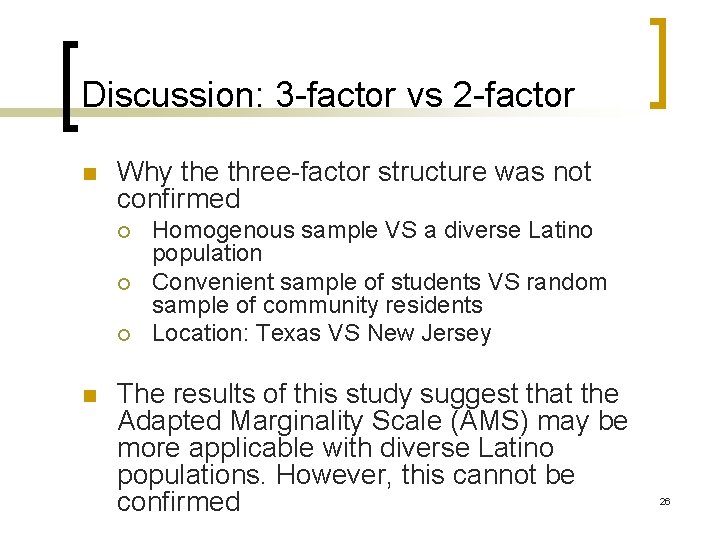
Discussion: 3 -factor vs 2 -factor n Why the three-factor structure was not confirmed ¡ ¡ ¡ n Homogenous sample VS a diverse Latino population Convenient sample of students VS random sample of community residents Location: Texas VS New Jersey The results of this study suggest that the Adapted Marginality Scale (AMS) may be more applicable with diverse Latino populations. However, this cannot be confirmed 26
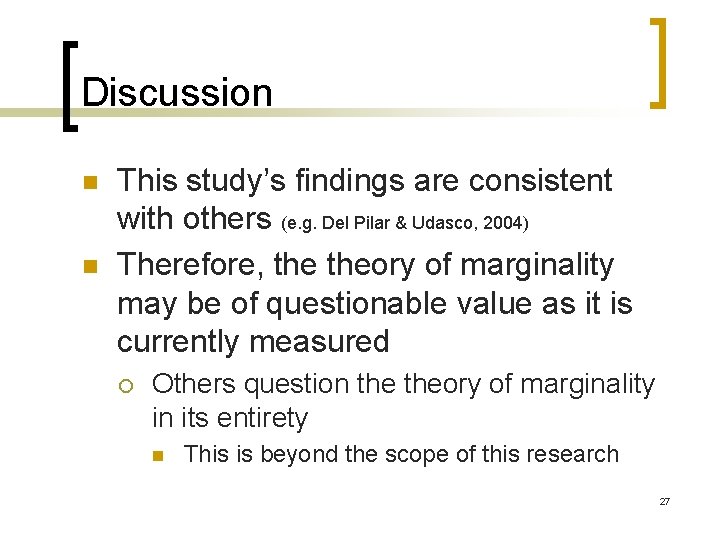
Discussion n n This study’s findings are consistent with others (e. g. Del Pilar & Udasco, 2004) Therefore, theory of marginality may be of questionable value as it is currently measured ¡ Others question theory of marginality in its entirety n This is beyond the scope of this research 27
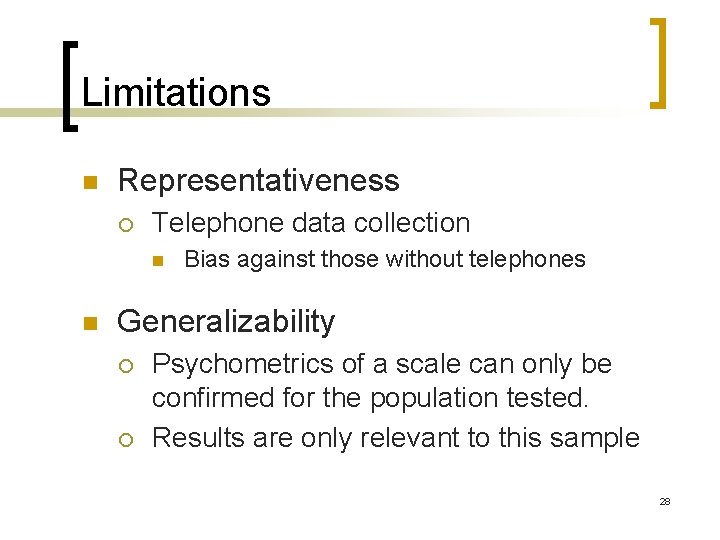
Limitations n Representativeness ¡ Telephone data collection n n Bias against those without telephones Generalizability ¡ ¡ Psychometrics of a scale can only be confirmed for the population tested. Results are only relevant to this sample 28
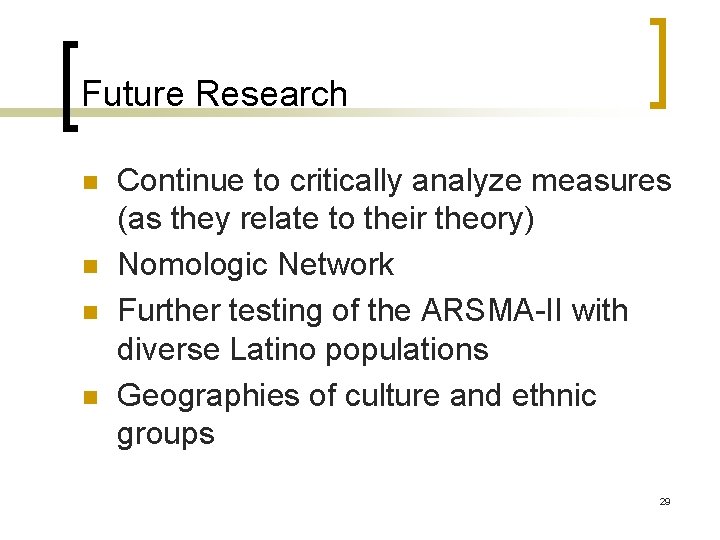
Future Research n n Continue to critically analyze measures (as they relate to their theory) Nomologic Network Further testing of the ARSMA-II with diverse Latino populations Geographies of culture and ethnic groups 29
For More Information: Melissa A. Gutierrez, MS Sinai Urban Health Institute Sinai Health System 773 -257 -5258 suhi@sinai. org www. suhichicago. org 30