
Psychology Sensation and Perception CHAPTER 4 Sensation and
- Slides: 54
Psychology, Sensation and Perception CHAPTER 4: Sensation and Perception
Sensation and Perception Measuring the Sensory Experience Sensation Perception Extrasensory Perception Psychology, 4/e by Saul Kassin © 2004 Prentice Hall
Warm Up Question § What gland is called the Master Gland? § Name one of the glands and tell what it does. Psychology, 4/e by Saul Kassin © 2004 Prentice Hall
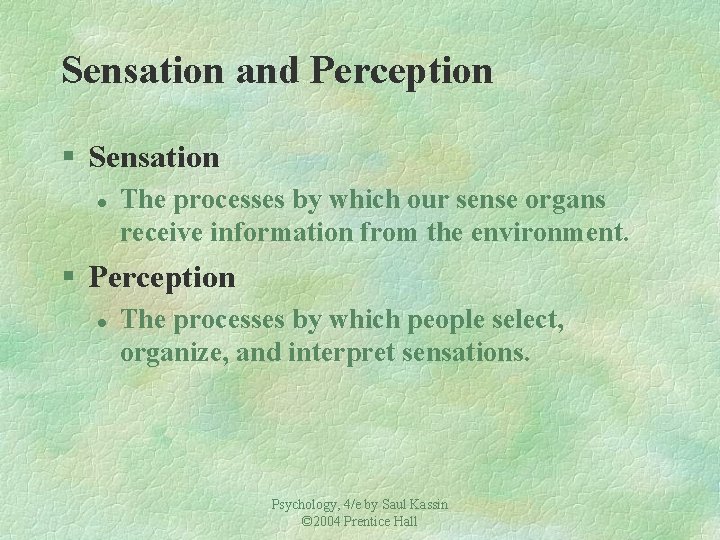
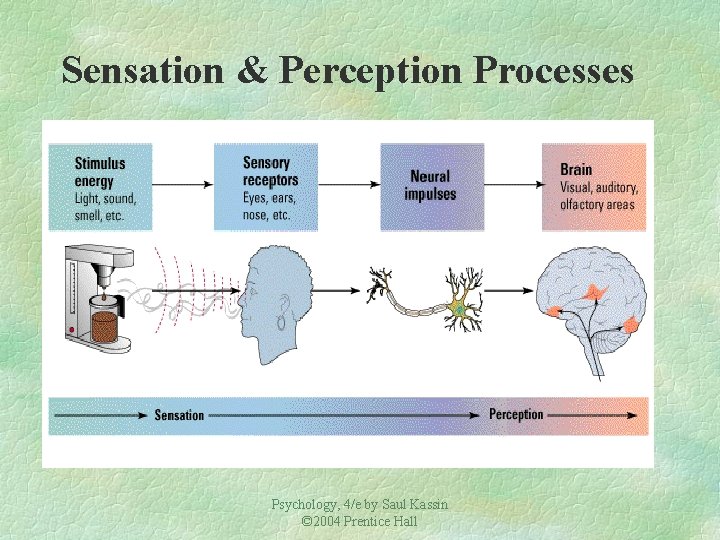
Sensation and Perception § Sensation l The processes by which our sense organs receive information from the environment. § Perception l The processes by which people select, organize, and interpret sensations. Psychology, 4/e by Saul Kassin © 2004 Prentice Hall
Sensation & Perception Processes Psychology, 4/e by Saul Kassin © 2004 Prentice Hall
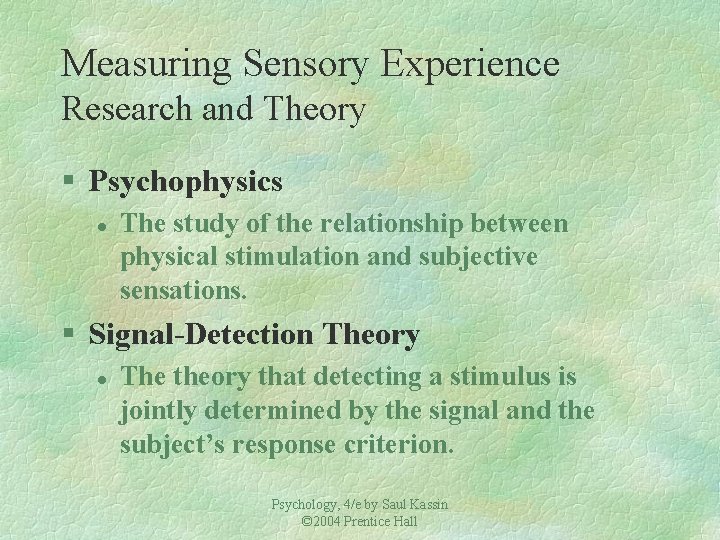
Measuring Sensory Experience Research and Theory § Psychophysics l The study of the relationship between physical stimulation and subjective sensations. § Signal-Detection Theory l The theory that detecting a stimulus is jointly determined by the signal and the subject’s response criterion. Psychology, 4/e by Saul Kassin © 2004 Prentice Hall
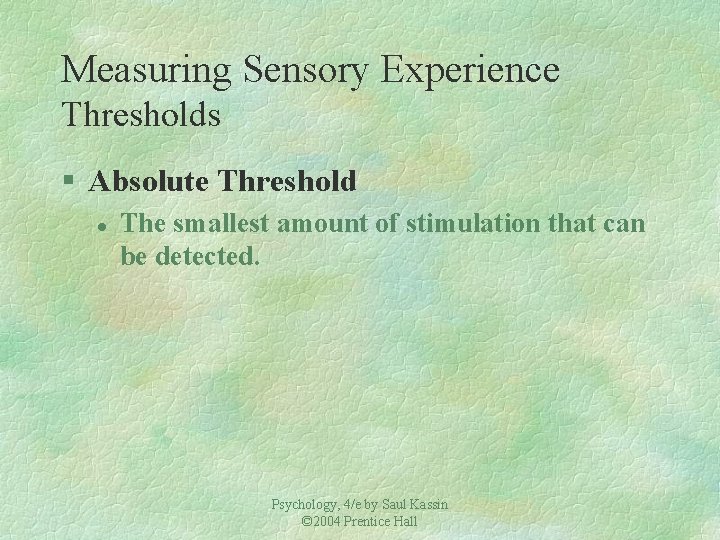
Measuring Sensory Experience Thresholds § Absolute Threshold l The smallest amount of stimulation that can be detected. Psychology, 4/e by Saul Kassin © 2004 Prentice Hall
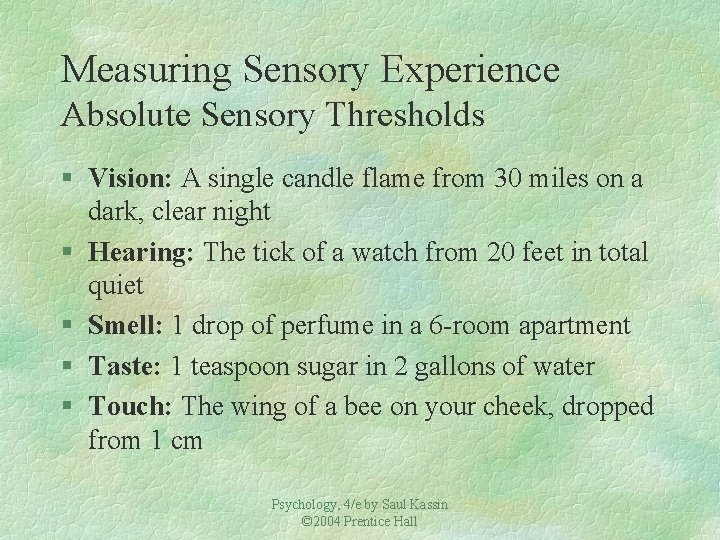
Measuring Sensory Experience Absolute Sensory Thresholds § Vision: A single candle flame from 30 miles on a dark, clear night § Hearing: The tick of a watch from 20 feet in total quiet § Smell: 1 drop of perfume in a 6 -room apartment § Taste: 1 teaspoon sugar in 2 gallons of water § Touch: The wing of a bee on your cheek, dropped from 1 cm Psychology, 4/e by Saul Kassin © 2004 Prentice Hall
Sensation § Vision § Hearing § Other Senses § Keeping the Signals Straight Psychology, 4/e by Saul Kassin © 2004 Prentice Hall
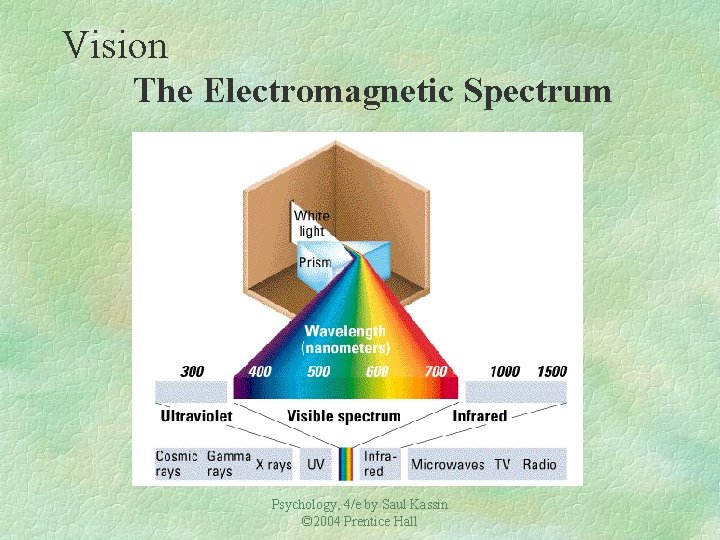
Vision The Electromagnetic Spectrum Psychology, 4/e by Saul Kassin © 2004 Prentice Hall
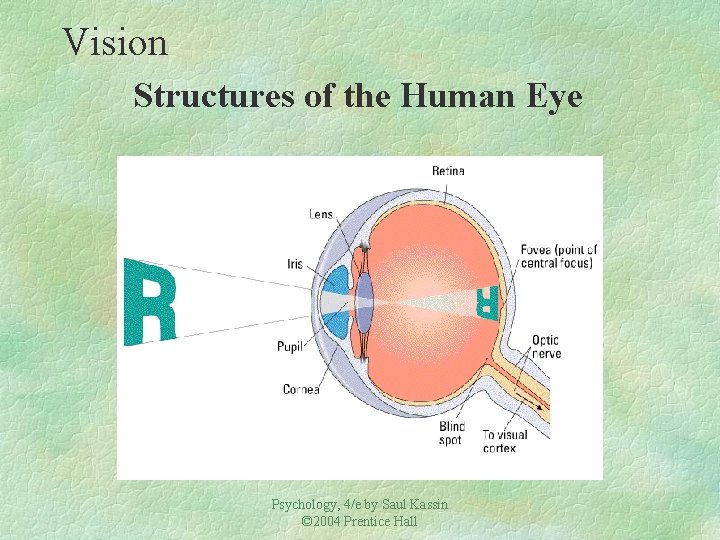
Vision Structures of the Human Eye Psychology, 4/e by Saul Kassin © 2004 Prentice Hall
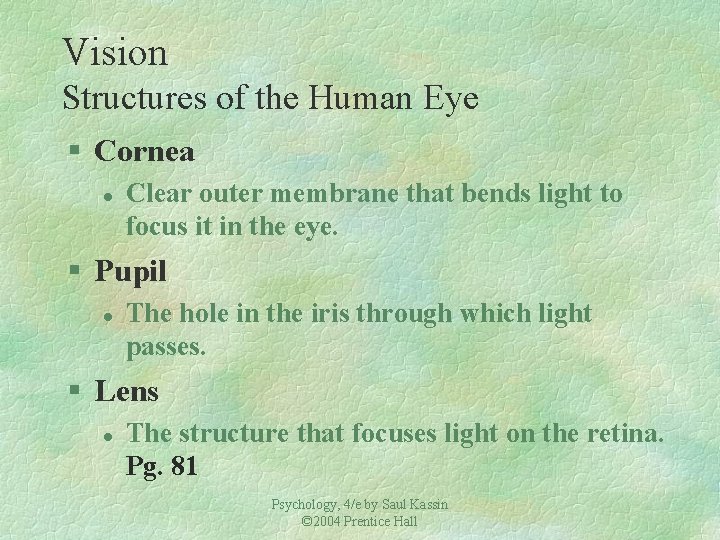
Vision Structures of the Human Eye § Cornea l Clear outer membrane that bends light to focus it in the eye. § Pupil l The hole in the iris through which light passes. § Lens l The structure that focuses light on the retina. Pg. 81 Psychology, 4/e by Saul Kassin © 2004 Prentice Hall
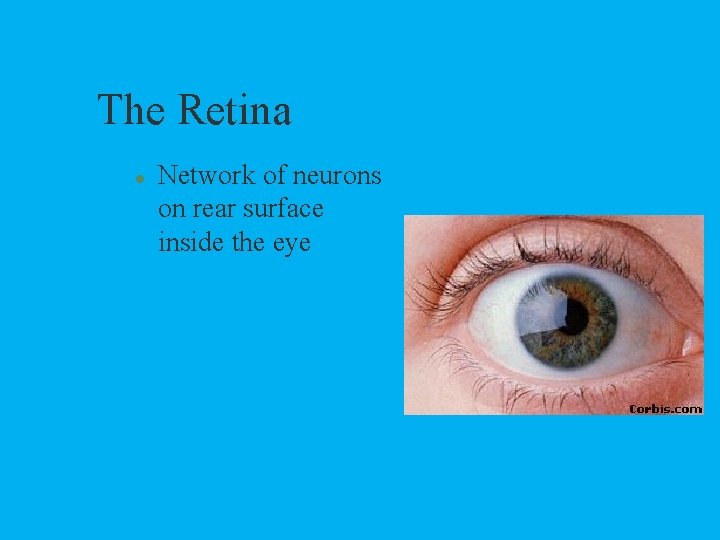
The Retina l Network of neurons on rear surface inside the eye
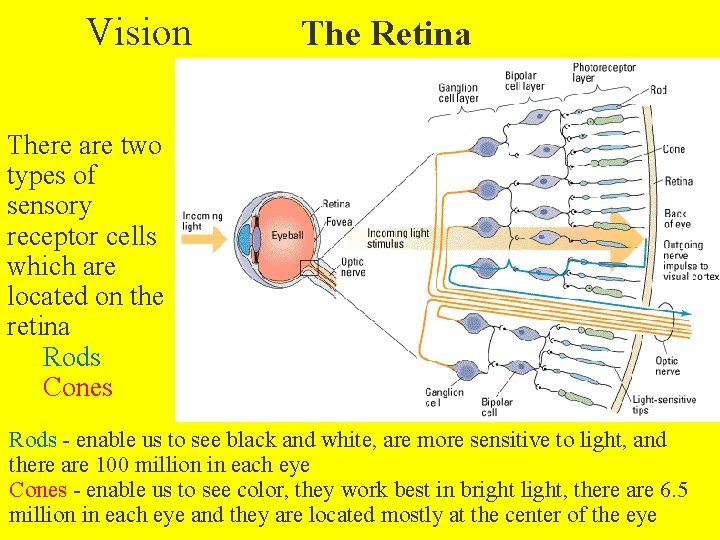
Vision The Retina There are two types of sensory receptor cells which are located on the retina Rods Cones Rods - enable us to see black and white, are more sensitive to light, and there are 100 million in each eye Cones - enable us to see color, they work best in bright light, there are 6. 5 million in each eye and they are located mostly at the center of the eye
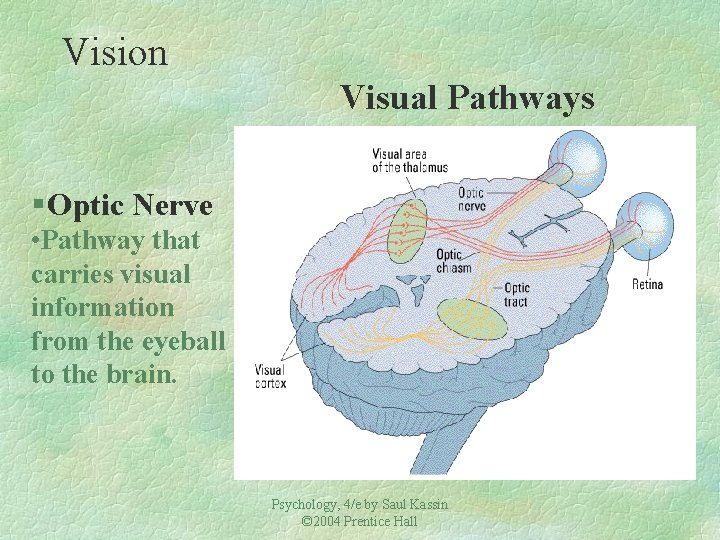
Vision Visual Pathways § Optic Nerve • Pathway that carries visual information from the eyeball to the brain. Psychology, 4/e by Saul Kassin © 2004 Prentice Hall
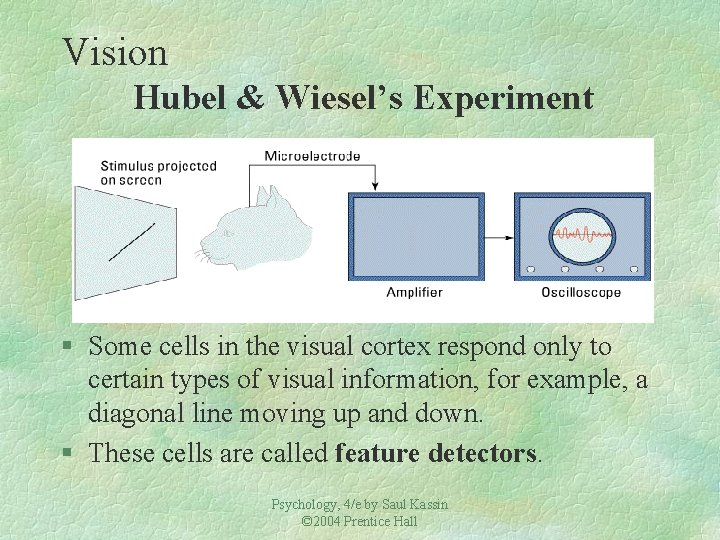
Vision Hubel & Wiesel’s Experiment § Some cells in the visual cortex respond only to certain types of visual information, for example, a diagonal line moving up and down. § These cells are called feature detectors. Psychology, 4/e by Saul Kassin © 2004 Prentice Hall
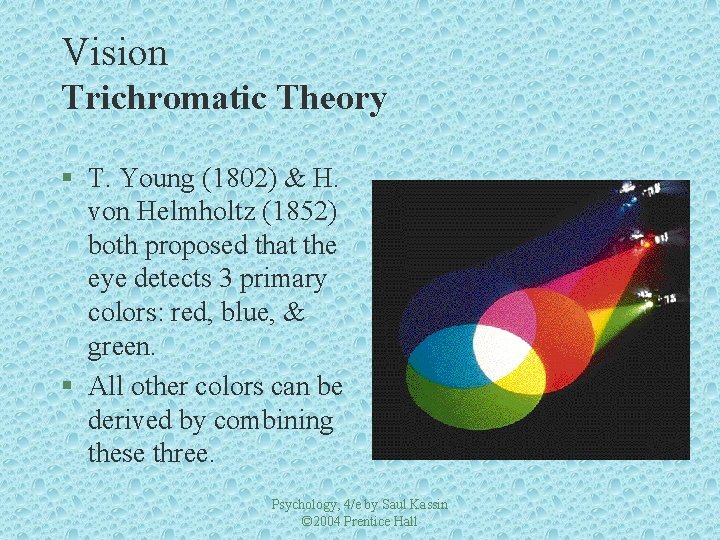
Vision Trichromatic Theory § T. Young (1802) & H. von Helmholtz (1852) both proposed that the eye detects 3 primary colors: red, blue, & green. § All other colors can be derived by combining these three. Psychology, 4/e by Saul Kassin © 2004 Prentice Hall
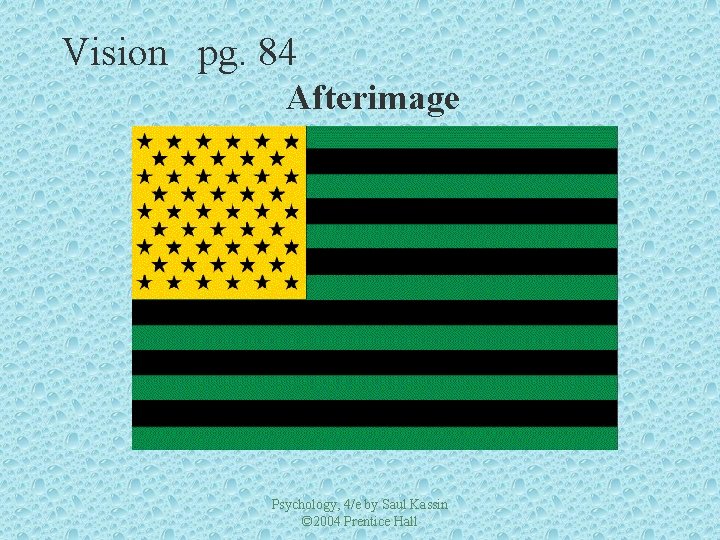
Vision pg. 84 Afterimage Psychology, 4/e by Saul Kassin © 2004 Prentice Hall
Visual Perception Picture - Look on page 97 in the Book - Hold the book close to your face focusing on the picture. - Then slowly take the picture away from your face - What do you see?
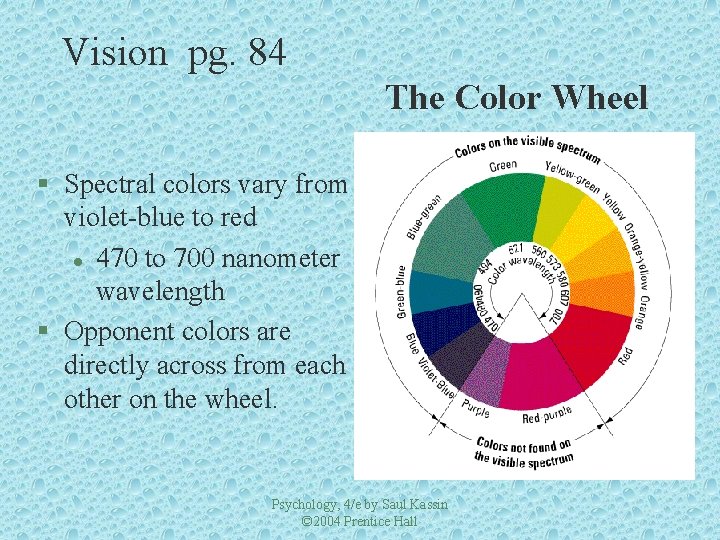
Vision pg. 84 The Color Wheel § Spectral colors vary from violet-blue to red l 470 to 700 nanometer wavelength § Opponent colors are directly across from each other on the wheel. Psychology, 4/e by Saul Kassin © 2004 Prentice Hall
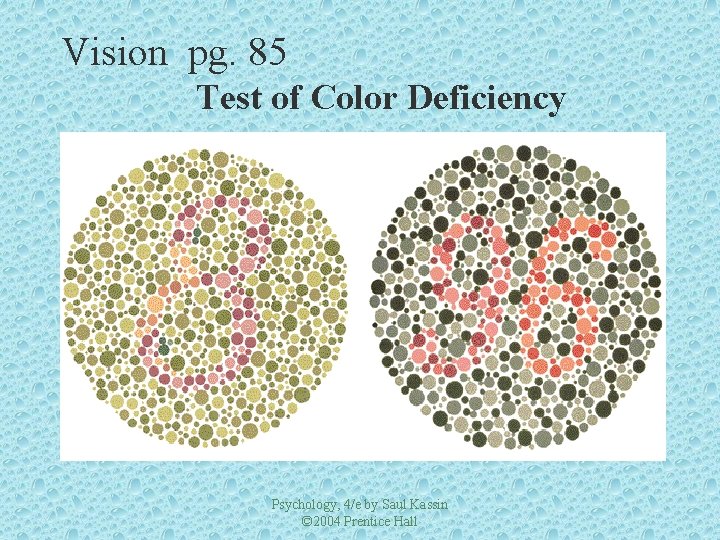
Vision pg. 85 Test of Color Deficiency Psychology, 4/e by Saul Kassin © 2004 Prentice Hall
Vision Opponent-Process Theory Color vision is derived from three pairs of opposing receptors. The opponent colors are blue and yellow, red and green, and black and white. § Theory explains afterimages and color deficiency. l Psychology, 4/e by Saul Kassin © 2004 Prentice Hall
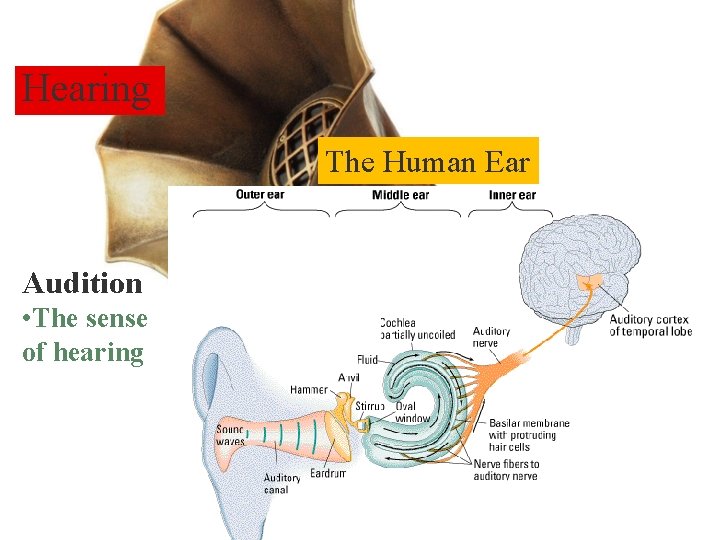
Hearing The Human Ear Audition • The sense of hearing Psychology, 4/e by Saul Kassin © 2004 Prentice Hall
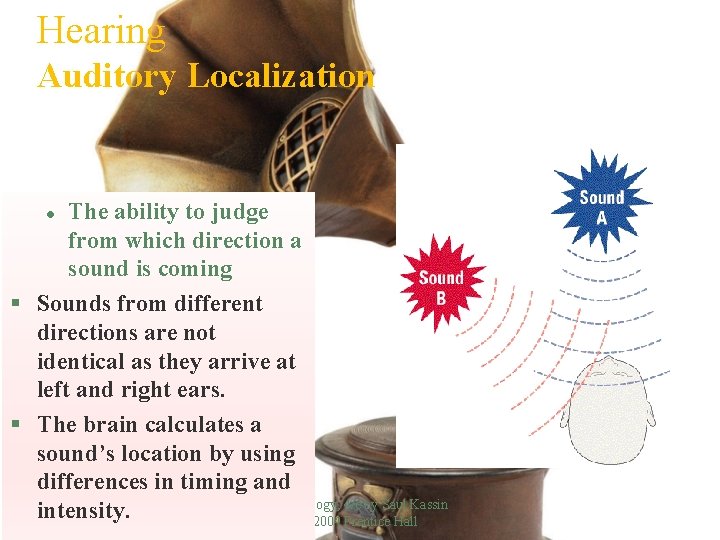
Hearing Auditory Localization The ability to judge from which direction a sound is coming § Sounds from different directions are not identical as they arrive at left and right ears. § The brain calculates a sound’s location by using differences in timing and Psychology, 4/e by Saul Kassin intensity. © 2004 Prentice Hall l
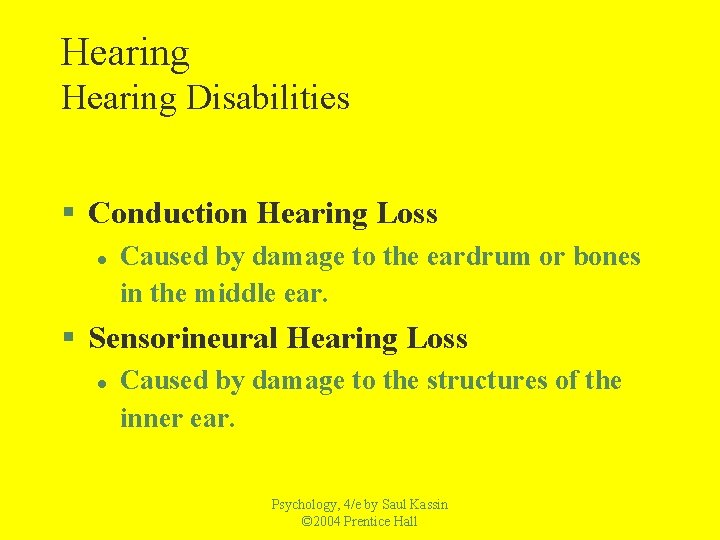
Hearing Disabilities § Conduction Hearing Loss l Caused by damage to the eardrum or bones in the middle ear. § Sensorineural Hearing Loss l Caused by damage to the structures of the inner ear. Psychology, 4/e by Saul Kassin © 2004 Prentice Hall
Exit slip § § What is perception? Describe what absolute threshold is. Name one of the parts of the eye. Name three primary colors detected by the eye. § What is Auditory Localization? § Explain what Conductive Hearing loss is. Psychology, 4/e by Saul Kassin © 2004 Prentice Hall
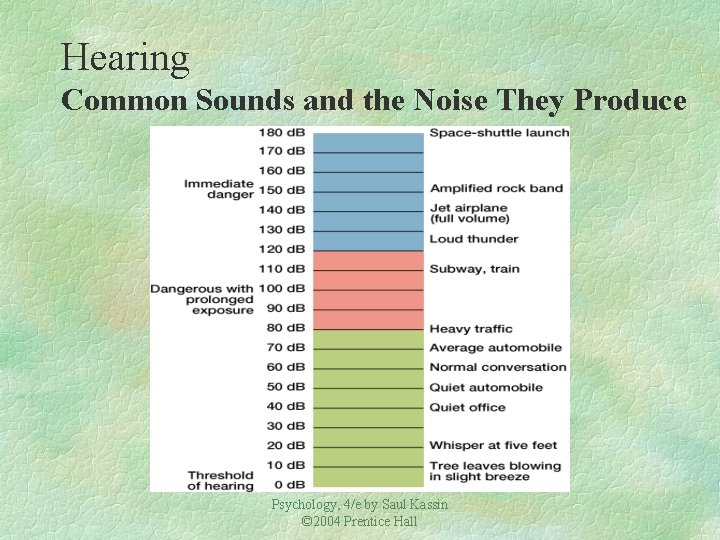
Hearing Common Sounds and the Noise They Produce Psychology, 4/e by Saul Kassin © 2004 Prentice Hall
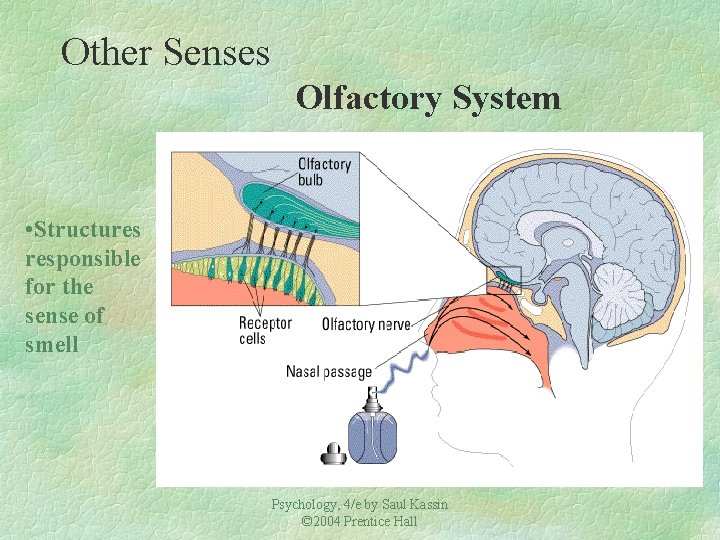
Other Senses Olfactory System • Structures responsible for the sense of smell Psychology, 4/e by Saul Kassin © 2004 Prentice Hall
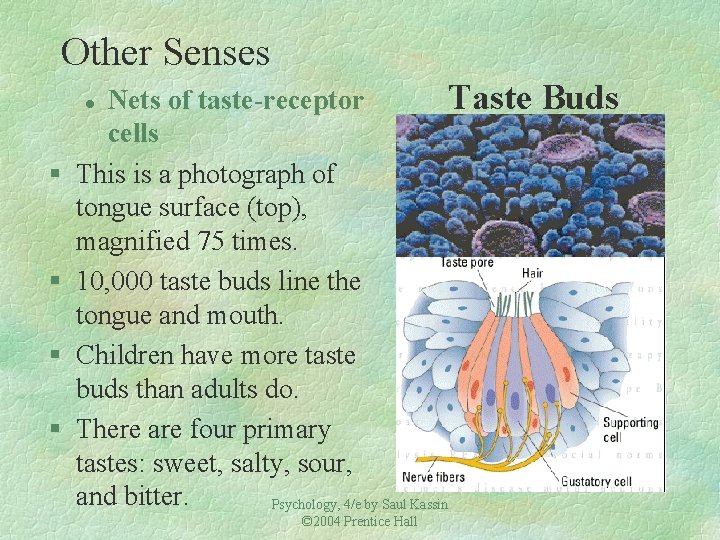
Other Senses Nets of taste-receptor Taste cells This is a photograph of tongue surface (top), magnified 75 times. 10, 000 taste buds line the tongue and mouth. Children have more taste buds than adults do. There are four primary tastes: sweet, salty, sour, and bitter. Psychology, 4/e by Saul Kassin l § § © 2004 Prentice Hall Buds
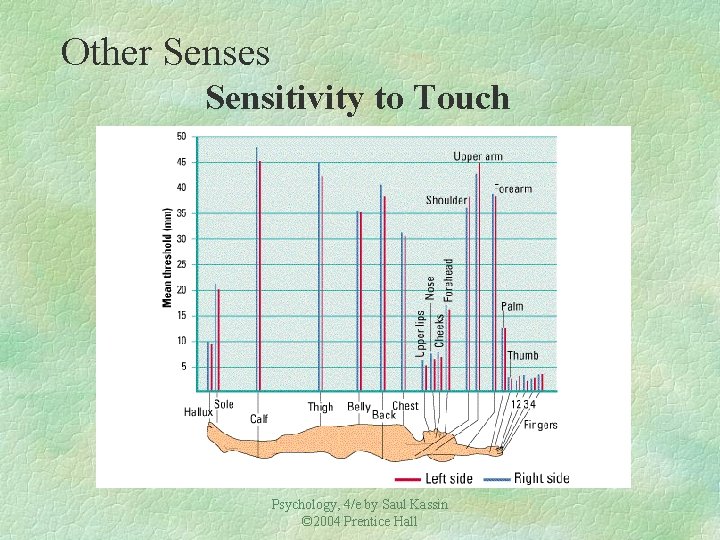
Other Senses Sensitivity to Touch Psychology, 4/e by Saul Kassin © 2004 Prentice Hall
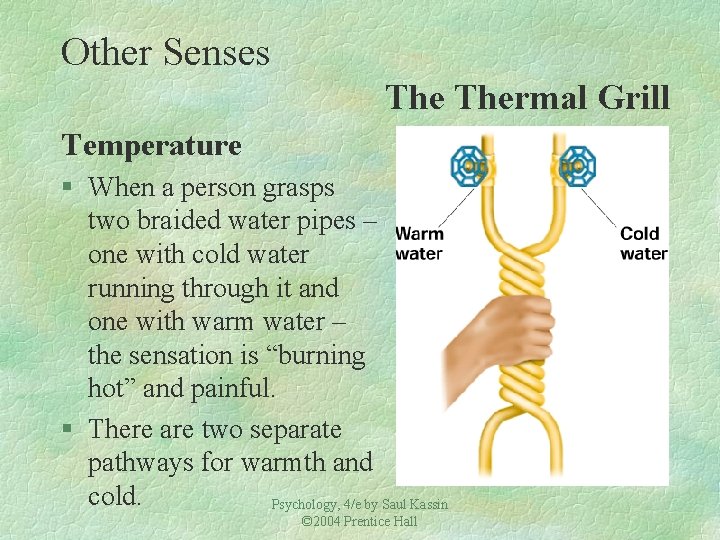
Other Senses Thermal Grill Temperature § When a person grasps two braided water pipes – one with cold water running through it and one with warm water – the sensation is “burning hot” and painful. § There are two separate pathways for warmth and cold. Psychology, 4/e by Saul Kassin © 2004 Prentice Hall
Other Senses Pain § Gate-control Theory that the spinal cord contains a neurological “gate”that blocks pain signals for the brain when flooded by competing signals. § Psychological control l Mind over sensation, distraction Psychology, 4/e by Saul Kassin © 2004 Prentice Hall
Other Senses Coordination § Kinesthetic System l Structures distributed throughout body that sense position and movement of body parts. § Vestibular System l The inner ear and brain structures that afford a sense of equilibrium. Psychology, 4/e by Saul Kassin © 2004 Prentice Hall
Keeping the Signals Straight § Synesthesia l Rare condition in which stimulation in one sensory modality triggers sensations in another sensory modality. § Each sensory system designed to operate separately from the others. § Selective Adaptation l A decline in sensitivity to a stimulus as a result of constant exposure. Psychology, 4/e by Saul Kassin © 2004 Prentice Hall
Perception § Perceptual Organization § Perceptual Constancies § Depth and Dimension § Perceptual Set § The World of Illusions
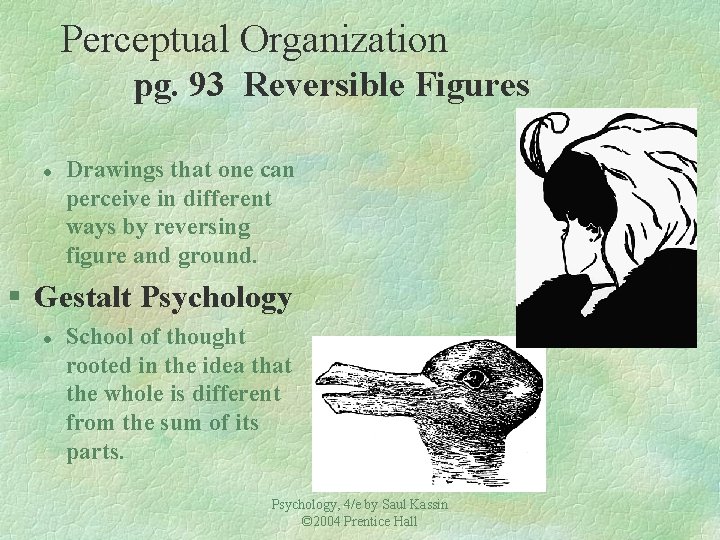
Perceptual Organization pg. 93 Reversible Figures l Drawings that one can perceive in different ways by reversing figure and ground. § Gestalt Psychology l School of thought rooted in the idea that the whole is different from the sum of its parts. Psychology, 4/e by Saul Kassin © 2004 Prentice Hall
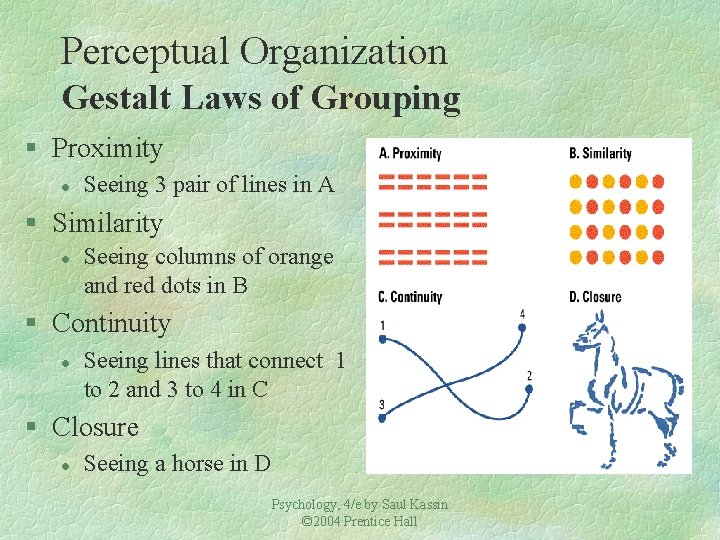
Perceptual Organization Gestalt Laws of Grouping § Proximity l Seeing 3 pair of lines in A § Similarity l Seeing columns of orange and red dots in B § Continuity l Seeing lines that connect 1 to 2 and 3 to 4 in C § Closure l Seeing a horse in D Psychology, 4/e by Saul Kassin © 2004 Prentice Hall
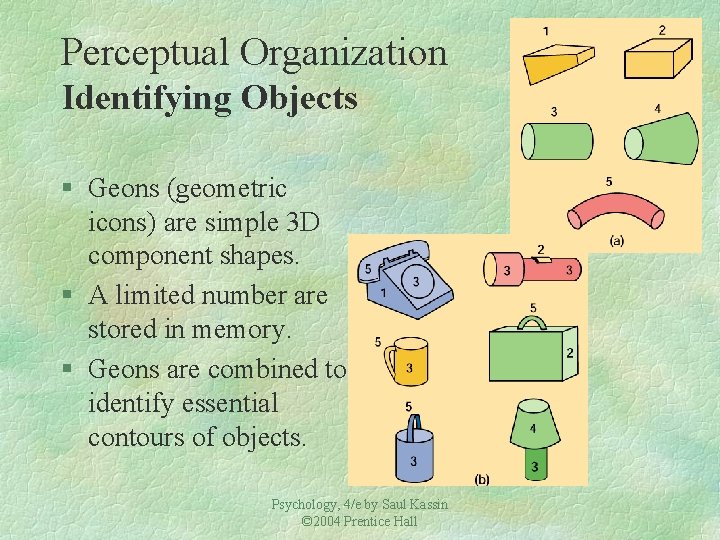
Perceptual Organization Identifying Objects § Geons (geometric icons) are simple 3 D component shapes. § A limited number are stored in memory. § Geons are combined to identify essential contours of objects. Psychology, 4/e by Saul Kassin © 2004 Prentice Hall
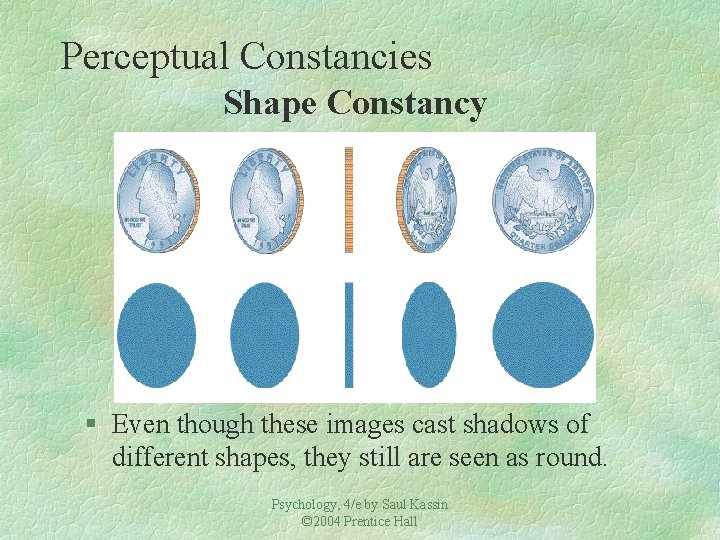
Perceptual Constancies § Size Constancy l The tendency to view an object as constant in size despite changes in the size of the retinal image. § Shape Constancy l The tendency to see an object as keeping its form despite changes in orientation. Psychology, 4/e by Saul Kassin © 2004 Prentice Hall
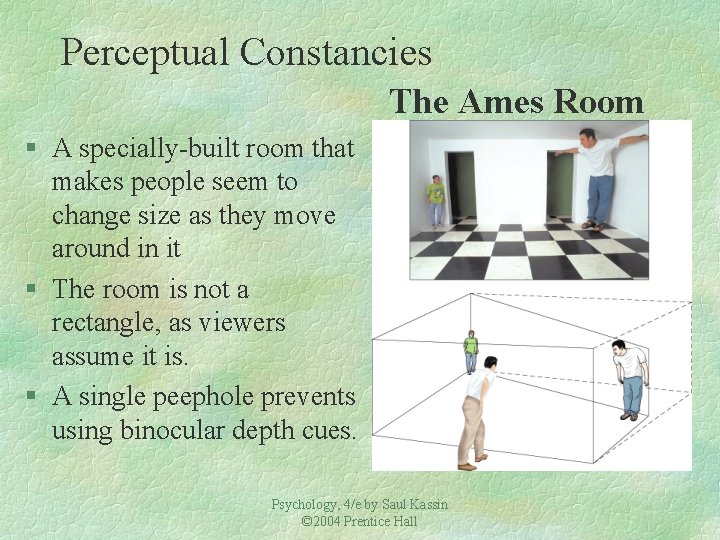
Perceptual Constancies The Ames Room § A specially-built room that makes people seem to change size as they move around in it § The room is not a rectangle, as viewers assume it is. § A single peephole prevents using binocular depth cues. Psychology, 4/e by Saul Kassin © 2004 Prentice Hall
Perceptual Constancies Shape Constancy § Even though these images cast shadows of different shapes, they still are seen as round. Psychology, 4/e by Saul Kassin © 2004 Prentice Hall
Exit Slip Psychology, 4/e by Saul Kassin © 2004 Prentice Hall
Depth and Dimension pg. 97 § Depth Perception l The use of visual cues to estimate depth and distance. § Convergence l A binocular cue involving the turning inward of the eyes as an object gets closer. § Binocular Disparity l A binocular cue whereby the closer an object is, the more different the image is in each retina. Psychology, 4/e by Saul Kassin © 2004 Prentice Hall
Depth and Dimension Monocular Depth Cues l Distance cues that enable the perception of depth with one eye. • • Relative Image Size Texture Gradient Linear Perspective Interposition Atmospheric Perspective Relative Elevation Familiarity Psychology, 4/e by Saul Kassin © 2004 Prentice Hall
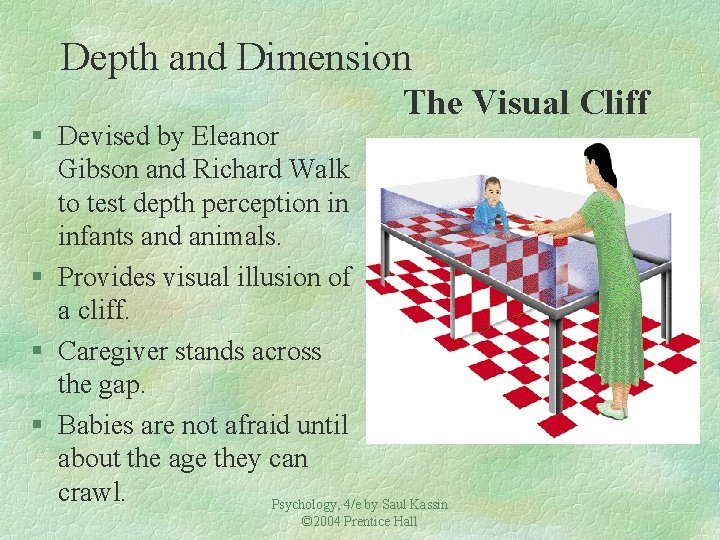
Depth and Dimension The Visual Cliff § Devised by Eleanor Gibson and Richard Walk to test depth perception in infants and animals. § Provides visual illusion of a cliff. § Caregiver stands across the gap. § Babies are not afraid until about the age they can crawl. Psychology, 4/e by Saul Kassin © 2004 Prentice Hall
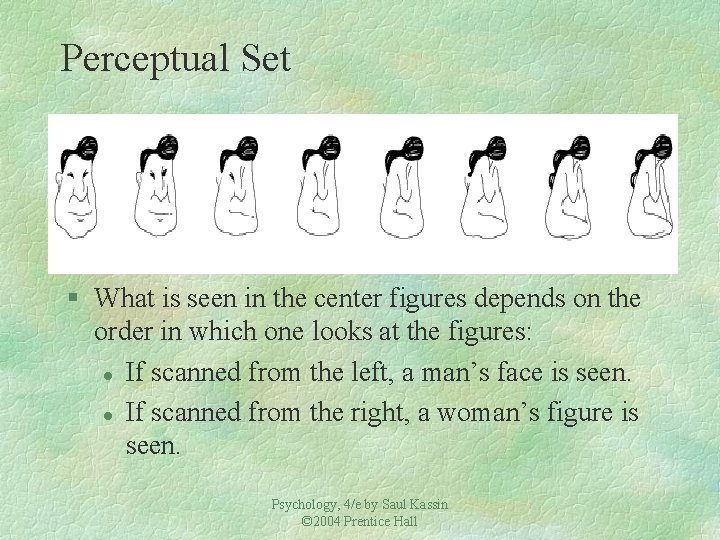
Perceptual Set § What is seen in the center figures depends on the order in which one looks at the figures: l If scanned from the left, a man’s face is seen. l If scanned from the right, a woman’s figure is seen. Psychology, 4/e by Saul Kassin © 2004 Prentice Hall
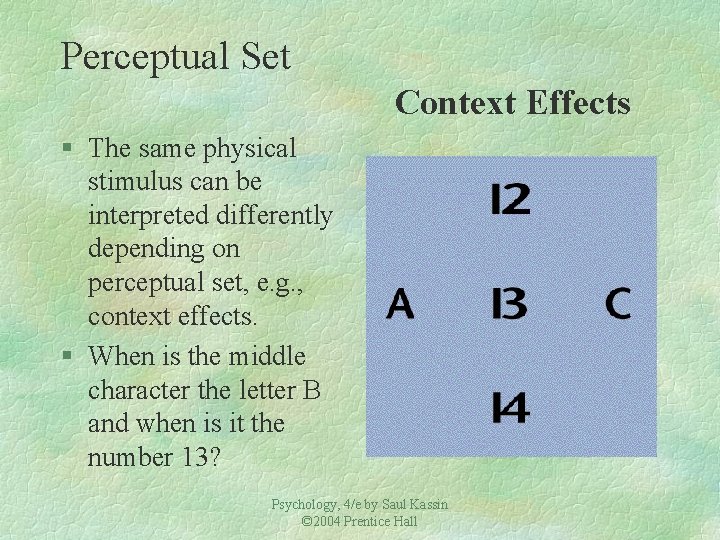
Perceptual Set Context Effects § The same physical stimulus can be interpreted differently depending on perceptual set, e. g. , context effects. § When is the middle character the letter B and when is it the number 13? Psychology, 4/e by Saul Kassin © 2004 Prentice Hall
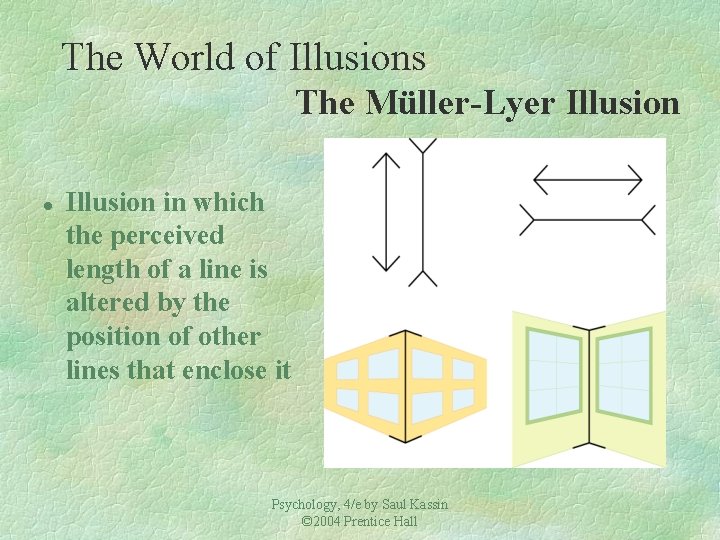
The World of Illusions The Müller-Lyer Illusion l Illusion in which the perceived length of a line is altered by the position of other lines that enclose it Psychology, 4/e by Saul Kassin © 2004 Prentice Hall
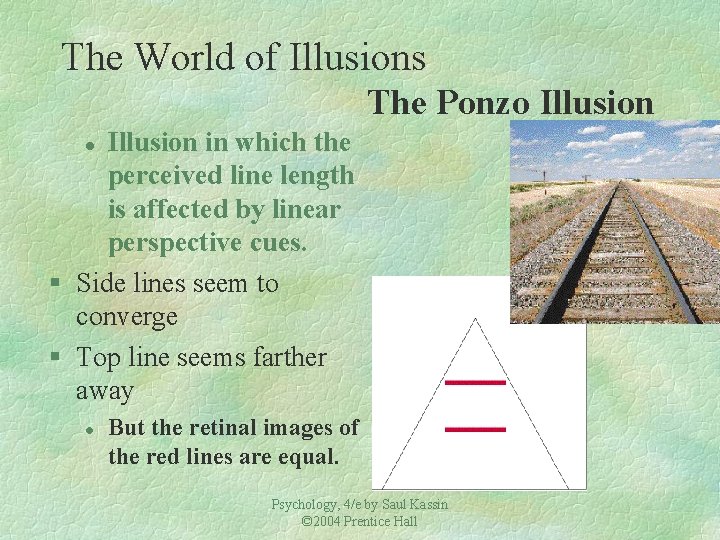
The World of Illusions The Ponzo Illusion in which the perceived line length is affected by linear perspective cues. § Side lines seem to converge § Top line seems farther away l l But the retinal images of the red lines are equal. Psychology, 4/e by Saul Kassin © 2004 Prentice Hall
Extrasensory Perception § The Case for ESP § The Case against ESP § The Continuing Controversy
The Case for ESP § Extrasensory Perception (ESP) l l The ability to perceive something without ordinary sensory information. This has not been scientifically demonstrated. § Parapsychologists distinguish between three types of ESP: l l l Telepathy – Mind-to-mind communication Clairvoyance – Perception of remote events Precognition – Ability to see future events Psychology, 4/e by Saul Kassin © 2004 Prentice Hall
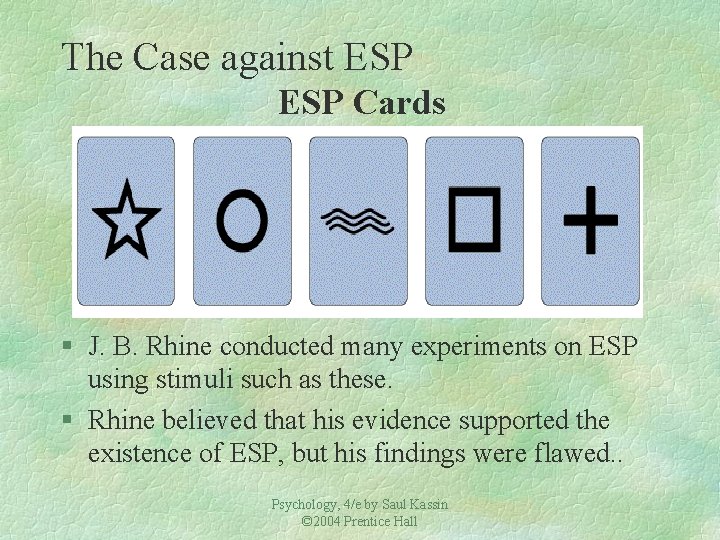
The Case against ESP Cards § J. B. Rhine conducted many experiments on ESP using stimuli such as these. § Rhine believed that his evidence supported the existence of ESP, but his findings were flawed. . Psychology, 4/e by Saul Kassin © 2004 Prentice Hall
Exit Slip Psychology, 4/e by Saul Kassin © 2004 Prentice Hall
The Continuing Controversy § The ganzfield procedure § Researchers disagree about the reliability of studies done to replicate the ganzfield test. § Visit www. randi. org/ for information about the James Randi Educational Foundation’s million-dollar paranormal challenge. Psychology, 4/e by Saul Kassin © 2004 Prentice Hall