
Psychology Second Edition Chapter 15 Therapy Copyright 2020


- Slides: 45
Psychology Second Edition Chapter 15 Therapy Copyright © 2020, 2016 Pearson Education, Inc. All Rights Reserved
Learning Objectives (1 of 4) • 15. 1 a Discuss historical trends in the treatment of disorders, including the supernatural, medical, and psychological models. 15. 1 b Discuss the current treatment approaches. Copyright © 2020, 2016 Pearson Education, Inc. All Rights Reserved
Learning Objectives (2 of 4) • 15. 2 a Describe the use of drugs for treating psychological disorders. 15. 2 b Discuss nondrug-related biological treatments for mental illness, including neurosurgery and electric and magnetic therapies. Copyright © 2020, 2016 Pearson Education, Inc. All Rights Reserved
Learning Objectives (3 of 4) • 15. 3 a Discuss how the psychodynamic approaches to psychotherapy are useful in helping clients gain insight into their feelings and problems. 15. 3 b Describe the humanistic approaches including client-centered and Gestalt therapies. 15. 3 c Identify a variety of behavioral therapies and explain how they are used to change unwanted behaviors. 15. 3 d Discuss cognitive therapies aimed at altering maladaptive thoughts. Copyright © 2020, 2016 Pearson Education, Inc. All Rights Reserved
Learning Objectives (4 of 4) • 15. 4 a Describe the benefits of group therapies, such as self-help groups and family therapy. 15. 4 b Give examples of alternative therapies and discuss their potential risks. 15. 4 c Discuss the effectiveness of treatment, including both traditional and nontraditional approaches to therapy. 15. 4 d Identify the factors that are important for therapists to consider when treating clients who have a cultural background different from their own. Copyright © 2020, 2016 Pearson Education, Inc. All Rights Reserved
Historical Trends and Models (1 of 3) • The supernatural model – view that supernatural forces were responsible for abnormal behavior • Trephination – drilling holes into the skull to treat abnormal behaviors • Abnormality was seen as a combination of both moral and religious problems Copyright © 2020, 2016 Pearson Education, Inc. All Rights Reserved
Historical Trends and Models (2 of 3) • The medical model – psychological abnormalities are caused by illness or bodily dysfunction – Not widely used until 1800 s – Many treatments cruel and ineffective due to misinformation about anatomy and physiology Copyright © 2020, 2016 Pearson Education, Inc. All Rights Reserved
Historical Trends and Models (3 of 3) • Psychological model – psychological disorders caused by problems in the mind – Psychological disorders are the result of societal stress – Treated by changing aspects of the person's environment and thought processes Copyright © 2020, 2016 Pearson Education, Inc. All Rights Reserved
Current Treatment Approaches (1 of 3) • Evidence-based treatment (EBT) • Emphasis on using scientific evidence to guide approaches to treatment • Person who needs treatment works with a trained professional on specific goals Copyright © 2020, 2016 Pearson Education, Inc. All Rights Reserved
Current Treatment Approaches (2 of 3) • Therapists receive specialized training in therapeutic techniques and procedures • Psychologists, psychiatrists, social workers, nurses, or other mental health professionals • Appropriate licensing and credentials mandatory Copyright © 2020, 2016 Pearson Education, Inc. All Rights Reserved
Current Treatment Approaches (3 of 3) Factors to consider when choosing a therapist***: • Location and Cost • Training and Experience • Comfort Level Copyright © 2020, 2016 Pearson Education, Inc. All Rights Reserved
Biological Therapies • Medical approaches to the treatment of mental disorders • Assumes mental disorders are medical problems • Includes the use of drugs, neurosurgery, and different ways of stimulating the brain Drug Therapy*** Copyright © 2020, 2016 Pearson Education, Inc. All Rights Reserved
Drug Therapies (1 of 5) • Most common form of treatment for psychological disorders • Psychotropic drugs – medications capable of affecting the mind, emotions, and behaviors • Most commonly administered as pills – antipsychotic drugs, antidepressant drugs, and antianxiety drugs Copyright © 2020, 2016 Pearson Education, Inc. All Rights Reserved
Drug Therapies (2 of 5) • Antipsychotic drugs – used to help people suffering from a psychosis – Useful in treating psychotic symptoms such as delusional thinking, hallucinations, or paranoia – Commonly used to treat schizophrenia – work by changing the balance of neurotransmitter chemicals in brain – Most interfere with the release of dopamine Copyright © 2020, 2016 Pearson Education, Inc. All Rights Reserved
Drug Therapies (3 of 5) • Antidepressant drugs – medications used to treat symptoms related to mood disorders – Balance neurotransmitters serotonin, norepinephrine, and dopamine in brain – Most popular antidepressants are serotonin reuptake inhibitors (SSRIs) – block receptors that normally absorb serotonin Short Video on SSRI’s*** Copyright © 2020, 2016 Pearson Education, Inc. All Rights Reserved
Drug Therapies (4 of 5) • Antianxiety drugs – medications used to reduce fear, nervousness, and panic – Treatment for generalized anxiety disorder, panic disorder, and phobias – Can be physically addictive and have severe side effects Copyright © 2020, 2016 Pearson Education, Inc. All Rights Reserved
Drug Therapies (5 of 5) • Not considered a “cure” • Provide symptom relief • Limitations: – side effects – drug addiction – Noncompliance Psychotropic medication in the media*** Copyright © 2020, 2016 Pearson Education, Inc. All Rights Reserved
Neurosurgery (1 of 2) • Neurosurgery for psychiatric disorders – surgery performed on the brain to eliminate psychiatric symptoms • Prefrontal lobotomy*** – surgery in which the connections between the frontal lobes and the lower centers of the brain are severed Copyright © 2020, 2016 Pearson Education, Inc. All Rights Reserved
Neurosurgery (2 of 2) • Modern methods safer, more exact, and more diverse • Deep lesioning – precise destruction of certain areas of the brain to reduce severe symptoms Copyright © 2020, 2016 Pearson Education, Inc. All Rights Reserved
Electric and Magnetic Therapies (1 of 2) Stimulate areas of the brain in an effort to improve psychological symptoms • Electro-convulsive therapy (ECT) – passing electrical current through the brain to intentionally cause a seizure – Effective for severe depression – Seizures may rebalance hormones and chemicals in the brain How does ECT work? *** Copyright © 2020, 2016 Pearson Education, Inc. All Rights Reserved
Psychotherapies • Psychotherapies – strategies based on belief that psychological disturbances are the result of unconscious conflicts, faulty thinking patterns, or self-defeating learned behaviors – “Talk therapies” aimed to change the psychological processing of the mind – Typically involve regular meetings with a therapist – May also involve behavioral techniques Crash Course: Psychotherapy*** Copyright © 2020, 2016 Pearson Education, Inc. All Rights Reserved
Psychodynamic Therapies • Gaining insight into unconscious conflicts is critical to resolving psychological problems • Talking with a therapist to “working through” both conscious and unconscious problems and conflicts Copyright © 2020, 2016 Pearson Education, Inc. All Rights Reserved
Psychoanalysis • Psychoanalysis – Freud’s therapy involving a variety of methods to uncover the unconscious – Assumes hidden conflicts and unfulfilled wishes from childhood are driving forces behind emotional problems – Goal is to bring unconscious desires, conflicts, repressed feelings and memories to awareness Who was Freud? *** Copyright © 2020, 2016 Pearson Education, Inc. All Rights Reserved
Psychoanalysis Techniques • Free association – client asked to say anything that comes to mind • Dream interpretation – therapist assigns meaning to dreams • Transference – clients “transfer” feelings and desires in relationships with significant adults from childhood onto therapist Psychoanalysis Techniques*** Copyright © 2020, 2016 Pearson Education, Inc. All Rights Reserved
Brief psychodynamic therapy (BPT) • Shorter version of psychoanalysis – Therapists take a more active role – May probe clients with direct questions – Less time spent on exploring childhood experiences – More focused on current problems and relationships Copyright © 2020, 2016 Pearson Education, Inc. All Rights Reserved
Humanistic Therapies (1 of 4) • Goal is to help individuals find meaning, self-acceptance, and personal growth*** • Assumptions: – humans born motivated to reach full potential – problems develop when people aren’t reaching their potential or don’t live up to the view they have of themselves Copyright © 2020, 2016 Pearson Education, Inc. All Rights Reserved
Humanistic Therapies (2 of 4) • Client-centered therapy – assumes clients more equipped to solve own problems through conversation and insight • Responsibility for treatment placed on client • Therapist’s role is to help clients help themselves – ask questions and provide a positive and supportive environment Overview of Client-centered Therapy*** Copyright © 2020, 2016 Pearson Education, Inc. All Rights Reserved
Humanistic Therapies (3 of 4) Goals of client centered therapists: 1. Congruence – openness and genuineness on the part of therapist 2. Unconditional positive regard – clients accepted without judgment, criticism, or disapproval 3. Empathy – understanding of and sensitivity to clients’ feelings and situation Copyright © 2020, 2016 Pearson Education, Inc. All Rights Reserved
Humanistic Therapies (4 of 4) • Gestalt therapy – helps people to see themselves as “whole, ” by exploring and accepting their “parts, ” including inconsistencies, problems, and negative emotions – Interested in helping clients gain greater awareness, acceptance, and personal growth – Therapists take a more active role and confront or challenge clients Copyright © 2020, 2016 Pearson Education, Inc. All Rights Reserved
Behavior Therapies • Behavioral therapies – principles of learning are applied to change unwanted behaviors – Insight not necessary to change behavior – No emphasis on the origins or causes of behavior • Most common behavior therapies include exposure, aversion, and operant therapies • Highly effective in treating depression, anxiety disorders, eating disorders, and chronic pain disorders Copyright © 2020, 2016 Pearson Education, Inc. All Rights Reserved
Exposure Therapies (1 of 2) • Exposure therapies – client directly confronted with frightening stimuli in order to reduce anxiety – Used to treat anxiety disorders, especially phobias and PTSD – Treatment of PTSD using Virtual Reality*** – Exposure treatment for clown phobia*** – Basic approach for exposure therapy, snakes*** – Exposure therapy for snake phobia (longer video)*** Copyright © 2020, 2016 Pearson Education, Inc. All Rights Reserved
Exposure Therapies (2 of 2) • Flooding – person is placed in an environment filled with the thing the person is scared of • Systematic desensitization – clients slowly and with increasing intensity exposed to their fear – Relaxation Training – Anxiety Hierarchy – Gradual Exposure Copyright © 2020, 2016 Pearson Education, Inc. All Rights Reserved
Aversion Therapies • Aversion therapies – pairing of unwanted behavior with something aversive or uncomfortable • Goal is association of old behavior with something bad to stop it • Used to treat sexual deviance and substance abuse disorders • Friends and aversion therapy*** Copyright © 2020, 2016 Pearson Education, Inc. All Rights Reserved
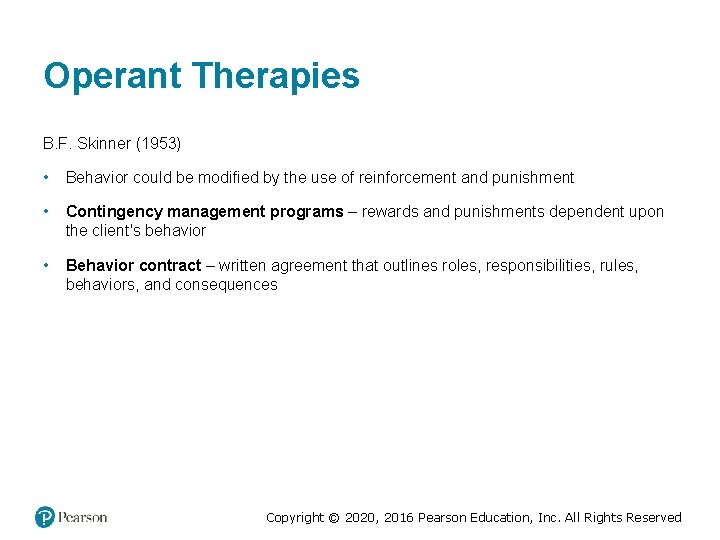
Operant Therapies B. F. Skinner (1953) • Behavior could be modified by the use of reinforcement and punishment • Contingency management programs – rewards and punishments dependent upon the client's behavior • Behavior contract – written agreement that outlines roles, responsibilities, rules, behaviors, and consequences Copyright © 2020, 2016 Pearson Education, Inc. All Rights Reserved
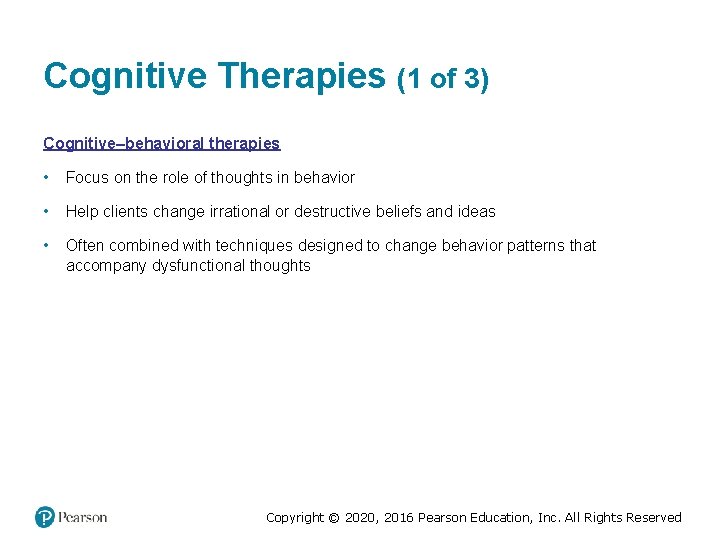
Cognitive Therapies (1 of 3) Cognitive–behavioral therapies • Focus on the role of thoughts in behavior • Help clients change irrational or destructive beliefs and ideas • Often combined with techniques designed to change behavior patterns that accompany dysfunctional thoughts Copyright © 2020, 2016 Pearson Education, Inc. All Rights Reserved
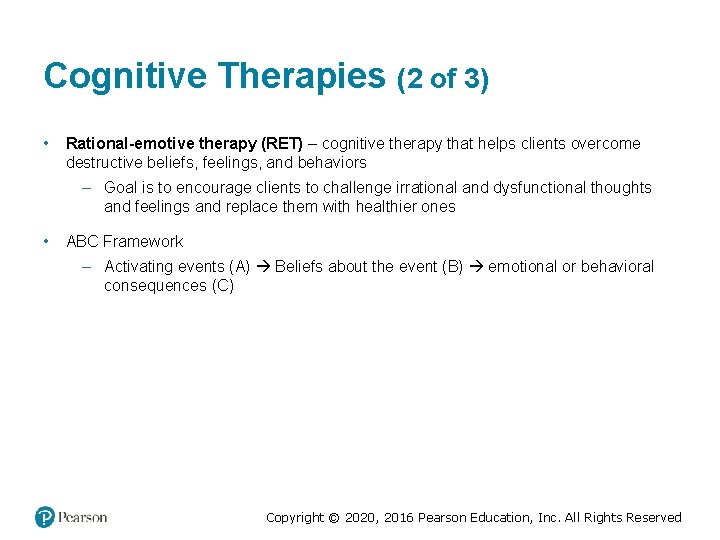
Cognitive Therapies (2 of 3) • Rational-emotive therapy (RET) – cognitive therapy that helps clients overcome destructive beliefs, feelings, and behaviors – Goal is to encourage clients to challenge irrational and dysfunctional thoughts and feelings and replace them with healthier ones • ABC Framework – Activating events (A) Beliefs about the event (B) emotional or behavioral consequences (C) Copyright © 2020, 2016 Pearson Education, Inc. All Rights Reserved
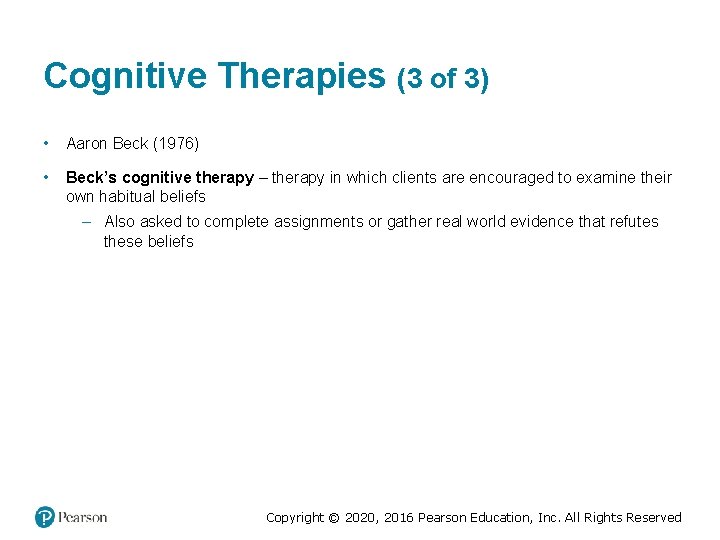
Cognitive Therapies (3 of 3) • Aaron Beck (1976) • Beck’s cognitive therapy – therapy in which clients are encouraged to examine their own habitual beliefs – Also asked to complete assignments or gather real world evidence that refutes these beliefs Copyright © 2020, 2016 Pearson Education, Inc. All Rights Reserved
Group Therapy (1 of 2) • Treatment of more than one person at the same time • Benefits – Cost – less expensive – Social support – shared experiences, reduced feelings of isolation, and coping strategies – Social skills training – opportunity to practice social interaction skills in a supportive environment Copyright © 2020, 2016 Pearson Education, Inc. All Rights Reserved
Group Therapy (2 of 2) • Family and couples therapy – all members of the family or both partners in a romantic relationship come in for treatment • Self-help groups – groups of people who meet to work through shared problems and goals • Community prevention programs – on preventing and reducing psychological problems in larger populations (communities) – Primary prevention – programs designed to stop disorders by eliminating the potential causes of the disorders – Secondary prevention – reducing the severity of a problem Copyright © 2020, 2016 Pearson Education, Inc. All Rights Reserved
Bibliotherapy • Bibliotherapy – a therapist’s selection of reading material for a client that has relevance to that person’s life situation • Many psychologists believe bibliotherapy can be an important and effective part of the process • Can be effective in treating alcoholism, anxiety disorders, stress disorders, depression Copyright © 2020, 2016 Pearson Education, Inc. All Rights Reserved
Technology-Based Therapies • Telecounseling – telephone communication to provide mental health education and services • E-therapies – Internet and/or computer-based therapies • Cybertherapy – use of simulations and virtual humans to assist in therapeutic ways • Media counseling – psychologist offering advice to a guest on radio/TV Copyright © 2020, 2016 Pearson Education, Inc. All Rights Reserved
Alternative Medicine • Complementary and alternative medicine (CAM) – medical practices and products currently not part of conventional medicine – Examples: yoga, massage, herbal supplements, acupuncture • Commonly used to treat anxiety and depression Copyright © 2020, 2016 Pearson Education, Inc. All Rights Reserved
Efficacy of Treatments • Efficacy study – well-controlled treatment protocol in which clients seen for a fixed number of sessions are compared to a control group • Effectiveness or Efficiency Studies – studies that attempt to evaluate the effectiveness of therapy in real-world settings • Therapeutic alliance – relationship between therapist and client – more important than the specific type of therapy Quick video about how to approach treatment*** Copyright © 2020, 2016 Pearson Education, Inc. All Rights Reserved
Therapy and Culture • Positive alliance between therapist and client is the foundation of good therapy • Therapists need training in multicultural awareness and sensitivity • Cultural competence – generic set of skills and knowledge that allow therapist to work in any cross-cultural therapy environment – needed for psychotherapists to work effectively with clients from a different cultural background Copyright © 2020, 2016 Pearson Education, Inc. All Rights Reserved
Copyright This work is protected by United States copyright laws and is provided solely for the use of instructors in teaching their courses and assessing student learning. Dissemination or sale of any part of this work (including on the World Wide Web) will destroy the integrity of the work and is not permitted. The work and materials from it should never be made available to students except by instructors using the accompanying text in their classes. All recipients of this work are expected to abide by these restrictions and to honor the intended pedagogical purposes and the needs of other instructors who rely on these materials. Copyright © 2020, 2016 Pearson Education, Inc. All Rights Reserved