
PSYCHOLOGY PRINCIPLES IN PRACTICE Chapter 9 INTELLIGENCE Section
- Slides: 12
PSYCHOLOGY PRINCIPLES IN PRACTICE Chapter 9 INTELLIGENCE Section 1: What Is Intelligence? Section 2: Measurement of Intelligence Section 3: Differences in Intelligence Section 4: What Influences Intelligence? 1 HOLT, RINEHART AND WINSTON
Chapter 9 Section 1: What Is Intelligence? PSYCHOLOGY PRINCIPLES IN PRACTICE Question: How is intelligence defined, and what are the various theories of intelligence? DEFINITION OF INTELLIGENCE Intelligence can be defined as the ability to learn from experience, to think rationally, and to deal effectively with others 2 HOLT, RINEHART AND WINSTON
Chapter 9 Section 1: What Is Intelligence? PSYCHOLOGY PRINCIPLES IN PRACTICE Question: How is intelligence defined, and what are the various theories of intelligence? THEORIES OF INTELLIGENCE n Spearman’s Two-Factor Theory – suggests that people have general intelligence and specific intelligence n Gardner’s Theory of Multiple Intelligence – poses that intelligence has a broader base and that people have several different kinds of intelligence 3 HOLT, RINEHART AND WINSTON
Chapter 9 PSYCHOLOGY PRINCIPLES IN PRACTICE Gardner’s Intelligences n Verbal or linguistic n Logical-mathematical n Visual-spatial n Bodily-kinesthetic n Musical rhythmic n Interpersonal (sensitivity to others) n Intrapersonal (insight into owns feelings_ 4 HOLT, RINEHART AND WINSTON
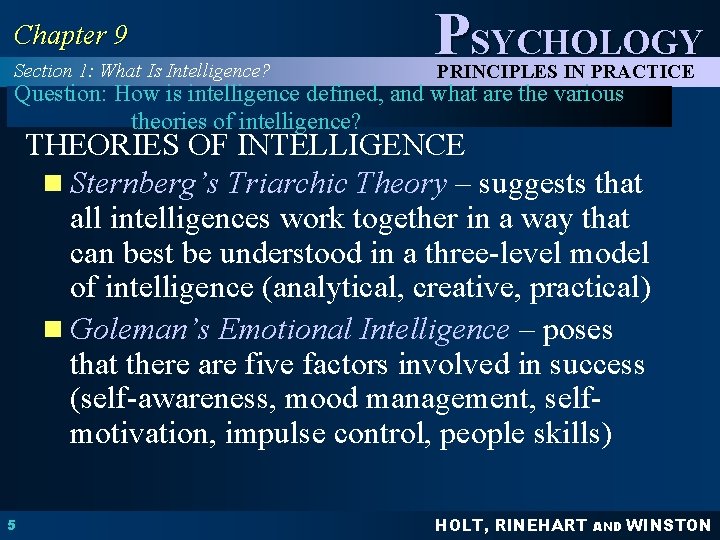
Chapter 9 Section 1: What Is Intelligence? PSYCHOLOGY PRINCIPLES IN PRACTICE Question: How is intelligence defined, and what are the various theories of intelligence? THEORIES OF INTELLIGENCE n Sternberg’s Triarchic Theory – suggests that all intelligences work together in a way that can best be understood in a three-level model of intelligence (analytical, creative, practical) n Goleman’s Emotional Intelligence – poses that there are five factors involved in success (self-awareness, mood management, selfmotivation, impulse control, people skills) 5 HOLT, RINEHART AND WINSTON
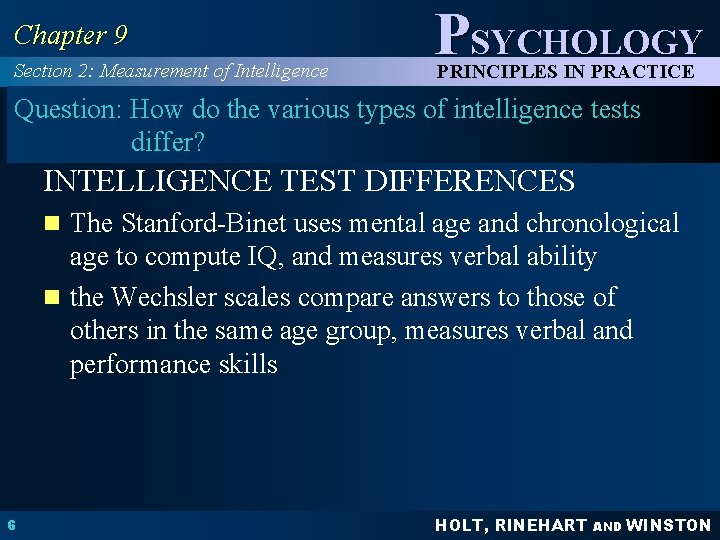
Chapter 9 Section 2: Measurement of Intelligence PSYCHOLOGY PRINCIPLES IN PRACTICE Question: How do the various types of intelligence tests differ? INTELLIGENCE TEST DIFFERENCES n The Stanford-Binet uses mental age and chronological age to compute IQ, and measures verbal ability n the Wechsler scales compare answers to those of others in the same age group, measures verbal and performance skills 6 HOLT, RINEHART AND WINSTON
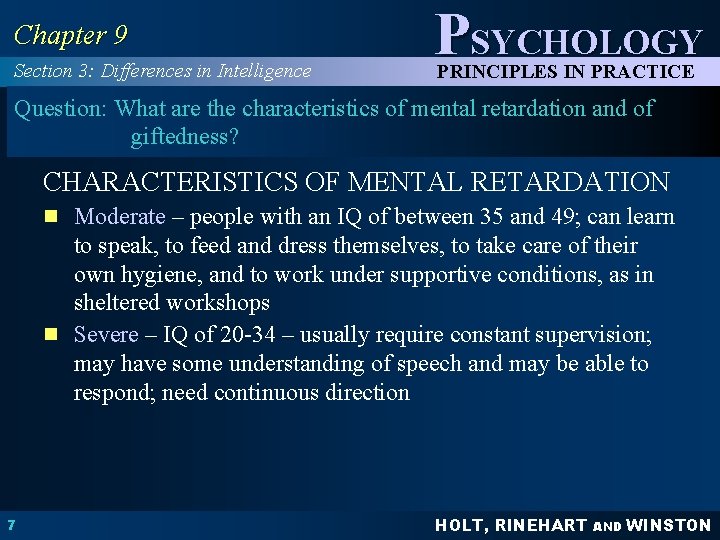
Chapter 9 Section 3: Differences in Intelligence PSYCHOLOGY PRINCIPLES IN PRACTICE Question: What are the characteristics of mental retardation and of giftedness? CHARACTERISTICS OF MENTAL RETARDATION n Moderate – people with an IQ of between 35 and 49; can learn to speak, to feed and dress themselves, to take care of their own hygiene, and to work under supportive conditions, as in sheltered workshops n Severe – IQ of 20 -34 – usually require constant supervision; may have some understanding of speech and may be able to respond; need continuous direction 7 HOLT, RINEHART AND WINSTON
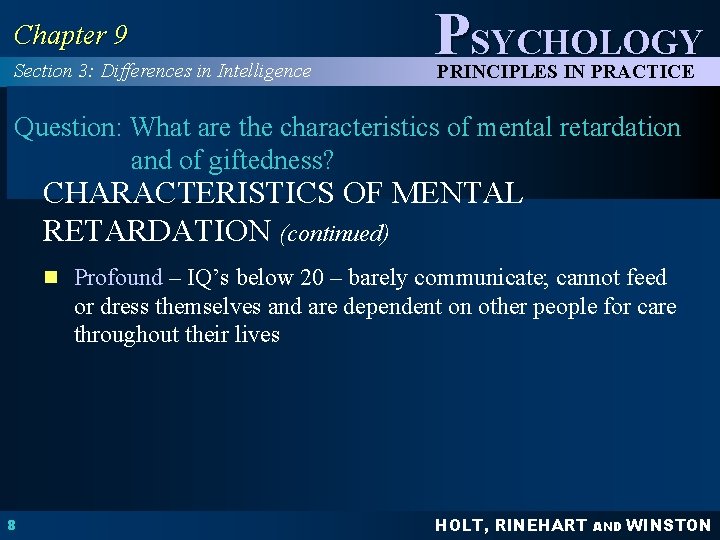
Chapter 9 Section 3: Differences in Intelligence PSYCHOLOGY PRINCIPLES IN PRACTICE Question: What are the characteristics of mental retardation and of giftedness? CHARACTERISTICS OF MENTAL RETARDATION (continued) n Profound – IQ’s below 20 – barely communicate; cannot feed or dress themselves and are dependent on other people for care throughout their lives 8 HOLT, RINEHART AND WINSTON
Chapter 9 Section 3: Differences in Intelligence PSYCHOLOGY PRINCIPLES IN PRACTICE Question: What are the characteristics of mental retardation and of giftedness? CHARACTERISTICS OF GIFTEDNESS n Possess outstanding talent or to show potential for performing at remarkably high levels of accomplishment when compared to other people of the same age, experience, or environment n Linked to creativity, which is the ability to invent new solutions to problems or to create original or ingenious materials 9 HOLT, RINEHART AND WINSTON
Chapter 9 Section 4: What Influences Intelligence? PSYCHOLOGY PRINCIPLES IN PRACTICE Question: How do heredity and environment influence intelligence? HEREDITY’S INFLUENCE n Kinship studies – closely related people should be more alike in terms of IQ scores than distantly related or unrelated people n Adoptee Studies – IQ scores are more like those of the biological parents than those of the adoptive parents 10 HOLT, RINEHART AND WINSTON
Chapter 9 Section 4: What Influences Intelligence? PSYCHOLOGY PRINCIPLES IN PRACTICE Question: How do heredity and environment influence intelligence? ENVIRONMENTAL INFLUENCES n For children, environmental factors that affect intelligence are home environment, parenting styles, and preschool programs n For adults, factors include level of income, level of education, intact family life, attendance at cultural events, travel, reading, and a flexible personality 11 HOLT, RINEHART AND WINSTON
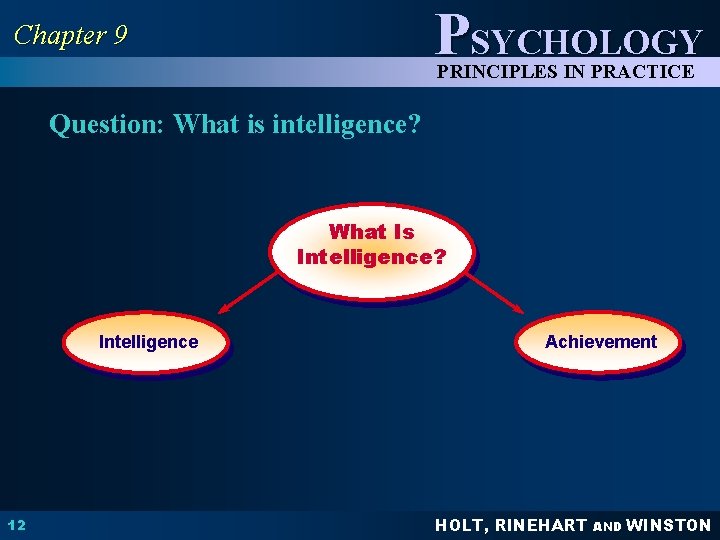
PSYCHOLOGY Chapter 9 PRINCIPLES IN PRACTICE Question: What is intelligence? What Is Intelligence? Intelligence 12 Achievement HOLT, RINEHART AND WINSTON