
PSYCHOLOGY PRINCIPLES IN PRACTICE Chapter 4 SENSATION AND
- Slides: 9
PSYCHOLOGY PRINCIPLES IN PRACTICE Chapter 4 SENSATION AND PERCEPTION Section 1: Sensation and Perception: The Basics Section 2: Vision Section 3: Hearing Section 4: Other Senses Section 5: Perception 1 HOLT, RINEHART AND WINSTON
Chapter 4 Section 1: Sensation and Perception: The Basics PSYCHOLOGY PRINCIPLES IN PRACTICE Question: In what ways do sensation and perception contribute to an understanding of our environment? SENSATION AND PERCEPTION CONTRIBUTE TO AN UNDERSTANDING OF OUR ENVIRONMENT n Sensation provides information to the central nervous system about the physical environment n Perception is the process through which people interpret sensory stimulation 2 HOLT, RINEHART AND WINSTON
Chapter 4 Section 2: Vision PSYCHOLOGY PRINCIPLES IN PRACTICE Question: How does the eye enable vision? THE EYE AND VISION n Light enters the eye and then is projected onto a surface n The amount of light that enters the eye is determined by the size of the pupil which adjusts automatically to the amount of light entering the eye n Once light enters the eye, it encounters the lens which adjusts to the distance of objects by changing its thickness 3 HOLT, RINEHART AND WINSTON
Chapter 4 Section 2: Vision PSYCHOLOGY PRINCIPLES IN PRACTICE Question: How does the eye enable vision? THE EYE AND VISION (continued) n These changes project a clear image of the object onto the retina, which consists of neurons that are sensitive to the light called photoreceptors n Once the light hits the photoreceptors, a nerve carries the visual input into the brain where the information is relayed to the visual area of the occipital lobe 4 HOLT, RINEHART AND WINSTON
Chapter 4 Section 3: Hearing PSYCHOLOGY PRINCIPLES IN PRACTICE Question: How does the ear perceive sound? HOW THE EAR PERCEIVES SOUND n Sound enters the outer ear and is funneled to the eardrum n Inside the middle ear, the hammer, anvil, and stirrup vibrate, transmitting the sound to the inner ear n Within the brain, auditory input is projected onto the hearing areas of the cerebral cortex 5 HOLT, RINEHART AND WINSTON
Chapter 4 Section 4: Other Senses PSYCHOLOGY PRINCIPLES IN PRACTICE Question: What are the chemical, skin, and body senses? CHEMICAL, SKIN, AND BODY SENSES n Smell – allows a person to taste n Taste – sweetness, sourness, saltiness, bitterness, and umami (meaty or savory) n Skin senses of pressure, temperature, and pain n Vestibular and kinesthetic body senses 6 HOLT, RINEHART AND WINSTON
Chapter 4 Section 5: Perception PSYCHOLOGY PRINCIPLES IN PRACTICE Question: What are the laws of sensory perception? LAWS OF SENSORY PERCEPTION n Closure – the tendency to perceive a complete or whole figure even when there are gaps in what your senses tell you n Figure-ground perception – the perception of a figure against a background n Proximity – the tendency to group together visual and auditory events that are near each other 7 HOLT, RINEHART AND WINSTON
Chapter 4 Section 5: Perception PSYCHOLOGY PRINCIPLES IN PRACTICE Question: What are the laws of sensory perception? LAWS OF SENSORY PERCEPTION (continued) n Similarity – thinking of similar objects as belonging together n Continuity – the tendency to group stimuli into continuous patterns 8 HOLT, RINEHART AND WINSTON
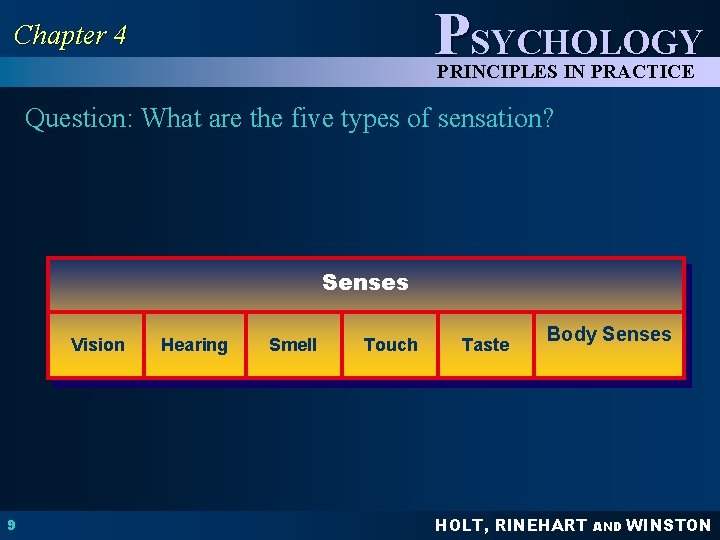
PSYCHOLOGY Chapter 4 PRINCIPLES IN PRACTICE Question: What are the five types of sensation? Senses Vision 9 Hearing Smell Touch Taste Body Senses HOLT, RINEHART AND WINSTON