
PSYCHOLOGY PRINCIPLES IN PRACTICE Chapter 1 WHAT IS
- Slides: 14
PSYCHOLOGY PRINCIPLES IN PRACTICE Chapter 1 WHAT IS PSYCHOLOGY Section 1: Why Study Psychology? Section 2: What Psychologists Do Section 3: A History of Psychology Section 4: Contemporary Perspectives 1 HOLT, RINEHART AND WINSTON
Chapter 1 PSYCHOLOGY PRINCIPLES IN PRACTICE What is Psychology? The Study of Behavior and Mental Processes-Behavior & Thinking n Behavior—any action that can be observed and measured n Cognitive activities—thinking, dreaming, memory, and perceptions n Psychological constructs—methods used to “measure” cognitive activities 2 HOLT, RINEHART AND WINSTON
Chapter 1 Section 1: Why Study Psychology? PSYCHOLOGY PRINCIPLES IN PRACTICE Question: What are the goals of psychology, and how is psychology a science? GOALS OF PSYCHOLOGY n Observe n Describe behavior n Explain n Predict n Control 3 HOLT, RINEHART AND WINSTON
Chapter 1 Section 1: Why Study Psychology? PSYCHOLOGY PRINCIPLES IN PRACTICE Question: What are the goals of psychology, and how is psychology a science? THE SCIENCE OF PSYCHOLOGY Psychology is a social science but has its foundation in the natural sciences. It deals with the structure of human society and interactions of individuals who make up society. n Research—methods used to test ideas & gather data n Psychological Theories and Principles—deal with the data gathered in research—enough evidence can change a theory into a principle 4 HOLT, RINEHART AND WINSTON
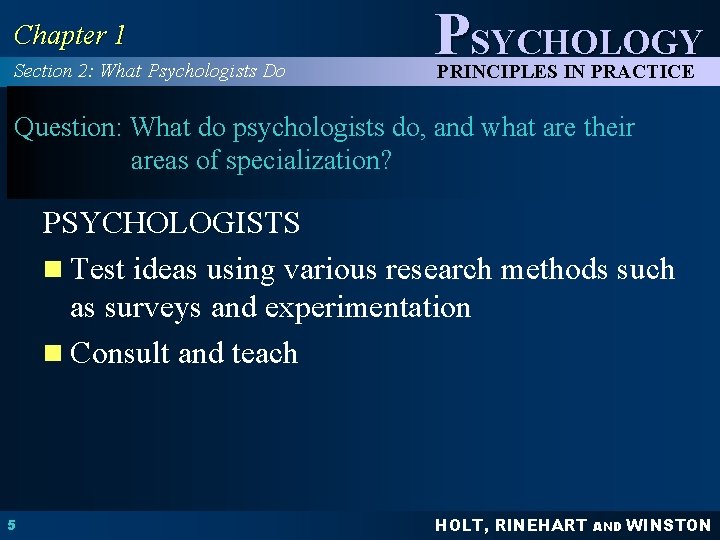
Chapter 1 Section 2: What Psychologists Do PSYCHOLOGY PRINCIPLES IN PRACTICE Question: What do psychologists do, and what are their areas of specialization? PSYCHOLOGISTS n Test ideas using various research methods such as surveys and experimentation n Consult and teach 5 HOLT, RINEHART AND WINSTON
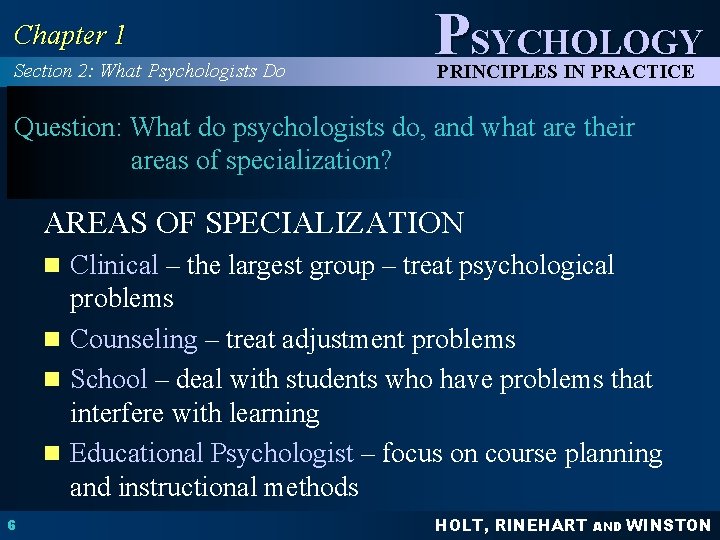
Chapter 1 Section 2: What Psychologists Do PSYCHOLOGY PRINCIPLES IN PRACTICE Question: What do psychologists do, and what are their areas of specialization? AREAS OF SPECIALIZATION n Clinical – the largest group – treat psychological problems n Counseling – treat adjustment problems n School – deal with students who have problems that interfere with learning n Educational Psychologist – focus on course planning and instructional methods 6 HOLT, RINEHART AND WINSTON
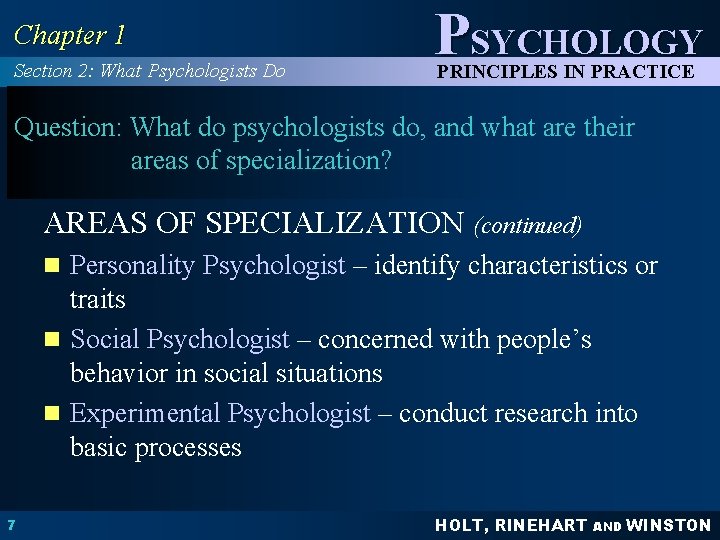
Chapter 1 Section 2: What Psychologists Do PSYCHOLOGY PRINCIPLES IN PRACTICE Question: What do psychologists do, and what are their areas of specialization? AREAS OF SPECIALIZATION (continued) n Personality Psychologist – identify characteristics or traits n Social Psychologist – concerned with people’s behavior in social situations n Experimental Psychologist – conduct research into basic processes 7 HOLT, RINEHART AND WINSTON
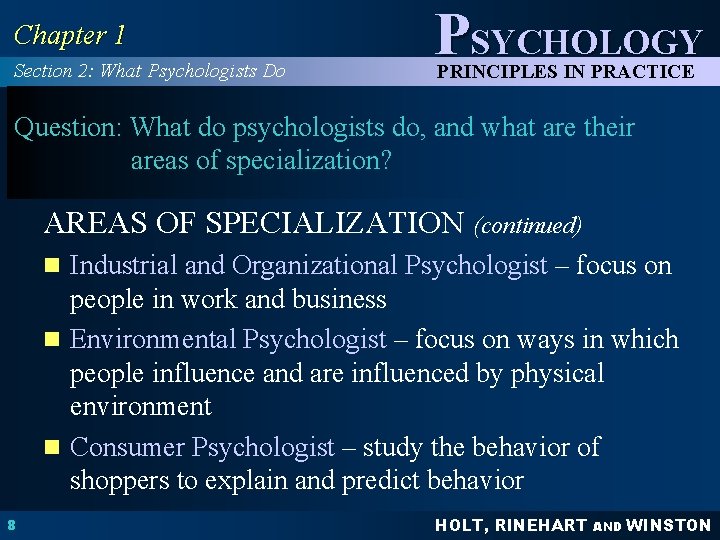
Chapter 1 Section 2: What Psychologists Do PSYCHOLOGY PRINCIPLES IN PRACTICE Question: What do psychologists do, and what are their areas of specialization? AREAS OF SPECIALIZATION (continued) n Industrial and Organizational Psychologist – focus on people in work and business n Environmental Psychologist – focus on ways in which people influence and are influenced by physical environment n Consumer Psychologist – study the behavior of shoppers to explain and predict behavior 8 HOLT, RINEHART AND WINSTON
Chapter 1 Section 2: What Psychologists Do PSYCHOLOGY PRINCIPLES IN PRACTICE Question: What do psychologists do, and what are their areas of specialization? AREAS OF SPECIALIZATION (continued) n Forensic Psychologist – are concerned with how psychological problems give rise to criminal behavior n Health Psychologist – study the ways in which behavior and mental processes are related to physical health 9 HOLT, RINEHART AND WINSTON
Chapter 1 Section 3: A History of Psychology PSYCHOLOGY PRINCIPLES IN PRACTICE Question: How has the study of psychology developed over time? PSYCHOLOGY DEVELOPED OVER TIME n Began in ancient Greece 1. Socrates & Plato—Introspection—“Know thyself” 2. Aristotle—Associationism—“Cause & Effect” 3. Hippocrates—linked physical health with emotional state—biological influence on behavior & thinking 10 HOLT, RINEHART AND WINSTON
Chapter 1 PSYCHOLOGY PRINCIPLES IN PRACTICE PSYCHOLOGY DEVELOPED OVER TIME (Cont. ) n The Middle Ages and Birth of Modern Science 1. Reflected superstitions of the times—Middle Ages (600 -1400 A. D. ) 2. Direct result of suppression of ideas by the monarchy and church leaders 3. Changed with the reformation (1500 s), renaissance (1600 s), and enlightenment (1700 s)—Freedom of expression 11 HOLT, RINEHART AND WINSTON
Chapter 1 PSYCHOLOGY PRINCIPLES IN PRACTICE PSYCHOLOGY DEVELOPED OVER TIME (Cont. ) n Contributions were made with modern scientific methods by psychologists such as: 1. Wilhelm Wundt—Structuralism 2. William James—Functionalism 3. John B. Watson—Behaviorism 4. B. F. Skinner—Reinforcement 5. Sigmund Freud—Psychoanalysis 12 HOLT, RINEHART AND WINSTON
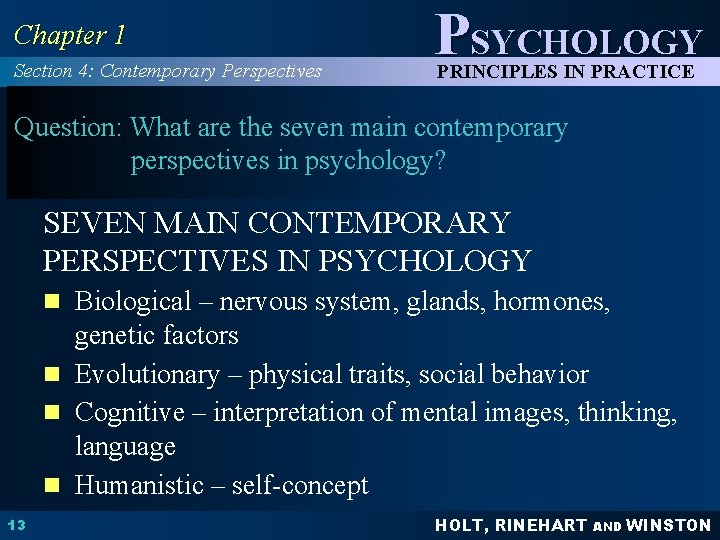
Chapter 1 Section 4: Contemporary Perspectives PSYCHOLOGY PRINCIPLES IN PRACTICE Question: What are the seven main contemporary perspectives in psychology? SEVEN MAIN CONTEMPORARY PERSPECTIVES IN PSYCHOLOGY n Biological – nervous system, glands, hormones, genetic factors n Evolutionary – physical traits, social behavior n Cognitive – interpretation of mental images, thinking, language n Humanistic – self-concept 13 HOLT, RINEHART AND WINSTON
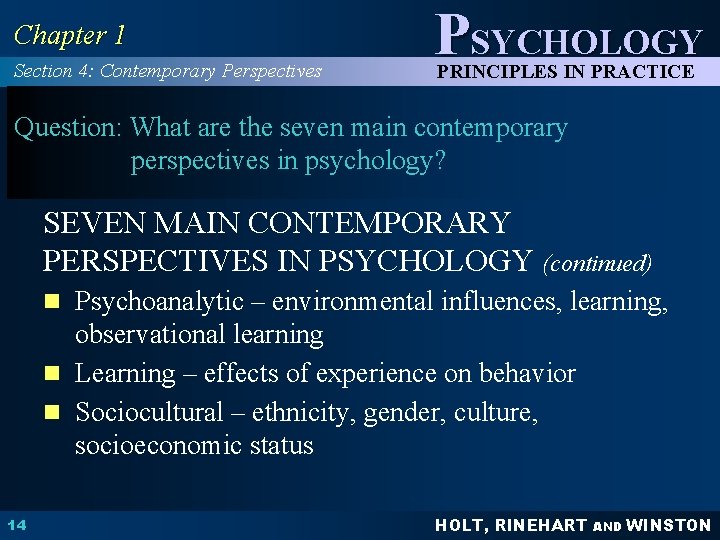
Chapter 1 Section 4: Contemporary Perspectives PSYCHOLOGY PRINCIPLES IN PRACTICE Question: What are the seven main contemporary perspectives in psychology? SEVEN MAIN CONTEMPORARY PERSPECTIVES IN PSYCHOLOGY (continued) n Psychoanalytic – environmental influences, learning, observational learning n Learning – effects of experience on behavior n Sociocultural – ethnicity, gender, culture, socioeconomic status 14 HOLT, RINEHART AND WINSTON