
Psychology Life Hack of the Week Placebo sleep
Psychology Life Hack of the Week Placebo sleep: Your brain will perform better, regardless of the actual quality of your sleep, if you convince yourself that you slept well (Draganich and Erdal, 2014)
Starter… Last week we looked at the features of science Take a few minutes to review your notes in preparation for some questions
Question 1 What is a … ? Answer: A precise, testable statement.
Question 2 True or false? The process of minimising sources of bias when recording scientific observations is known as SUBJECTIVITY. Answer: False – this process is OBJECTIVITY.
Question 3 Why should scientific investigations and findings be replicable? Answer: To ensure reliability and confidence in results.
Question 4 Collecting data through direct sensory experience is know as …what? Answer: Empiricism (or the empirical method).
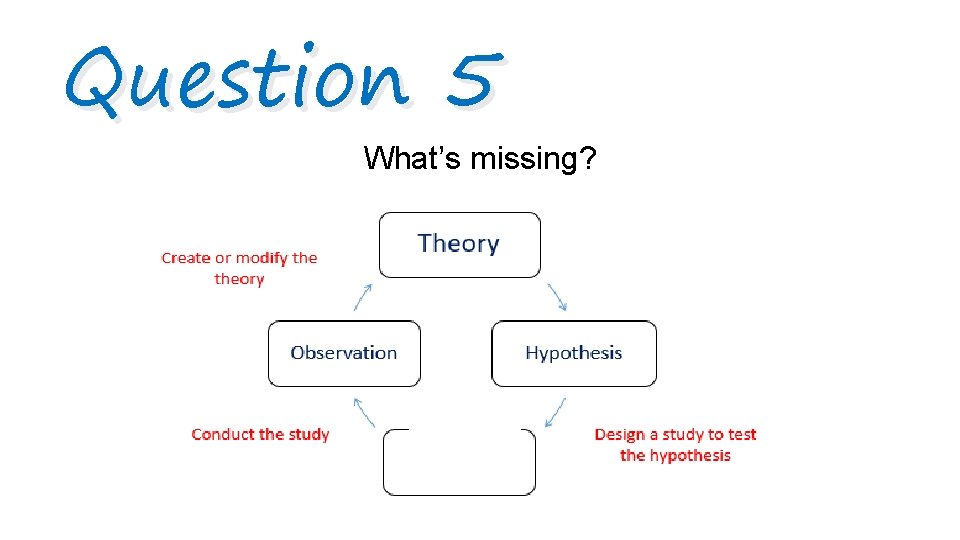
Question 5 What’s missing?
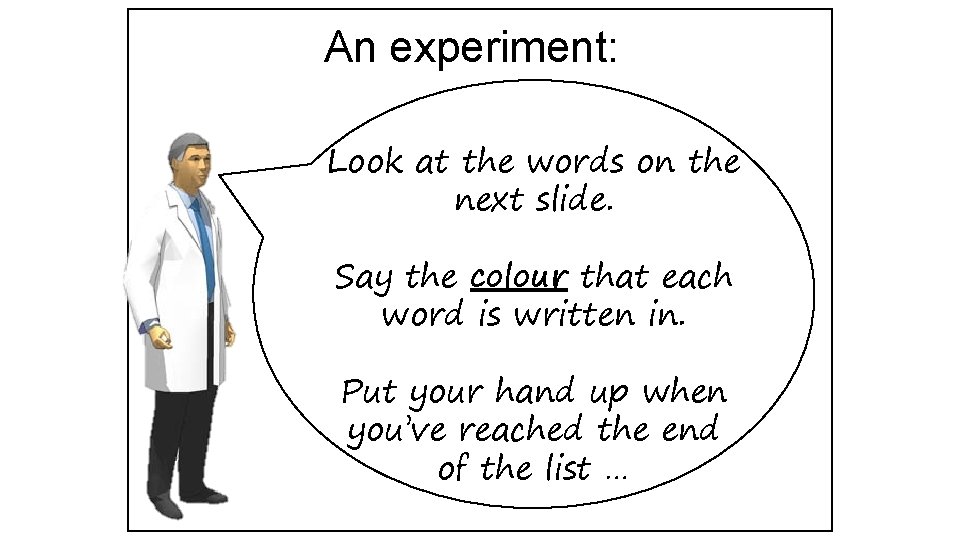
An experiment: Look at the words on the next slide. Say the colour that each word is written in. Put your hand up when you’ve reached the end of the list …
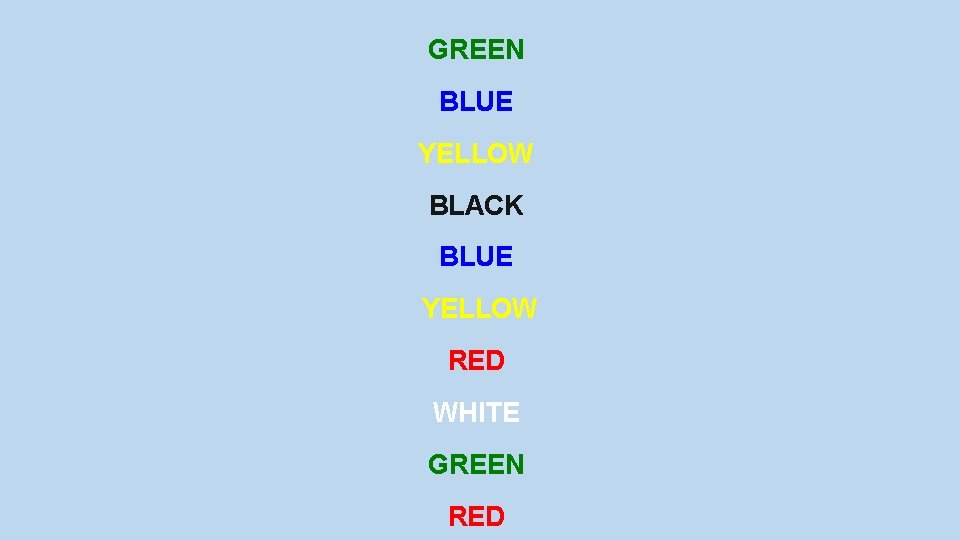
GREEN BLUE YELLOW BLACK BLUE YELLOW RED WHITE GREEN RED
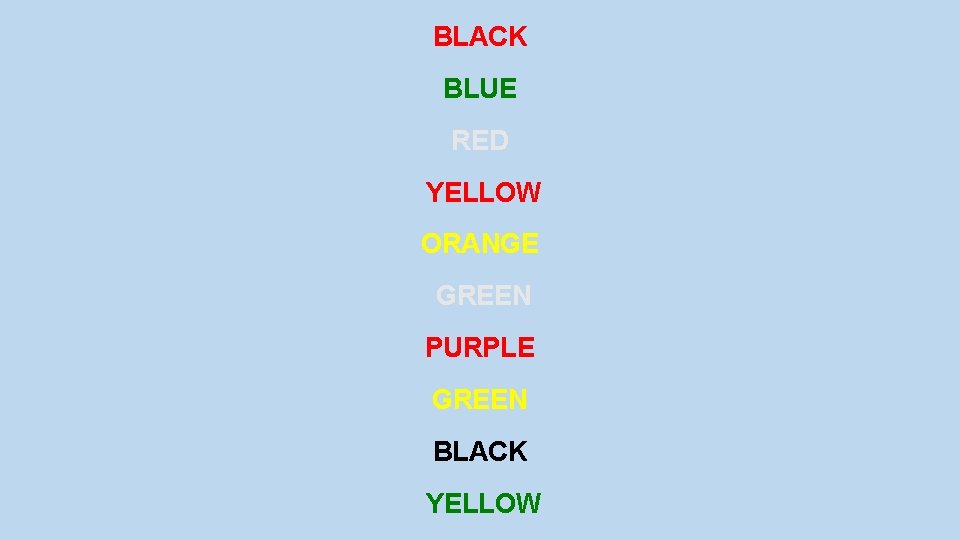
BLACK BLUE RED YELLOW ORANGE GREEN PURPLE GREEN BLACK YELLOW
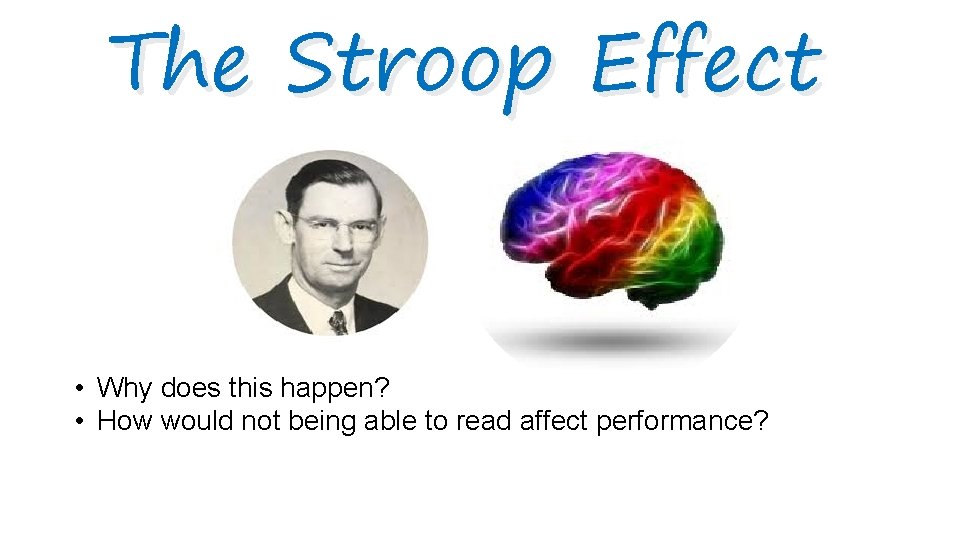
The Stroop Effect • Why does this happen? • How would not being able to read affect performance?
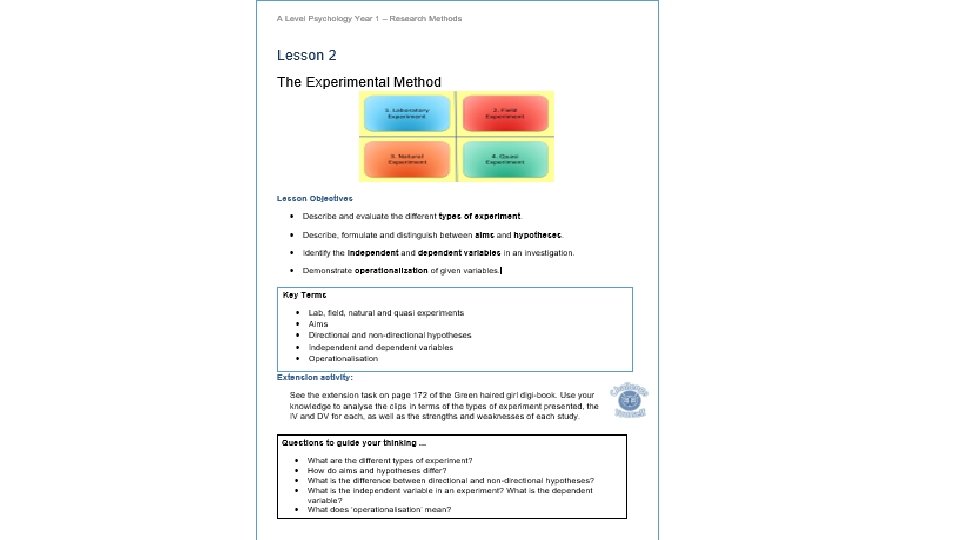
Year 1 Research Methods: The Experimental Method • Describe and evaluate the different types of experiment. • Describe, formulate and distinguish between aims and hypotheses. • Identify the independent and dependent variables in an investigation. • Demonstrate operationalisation of given variables.
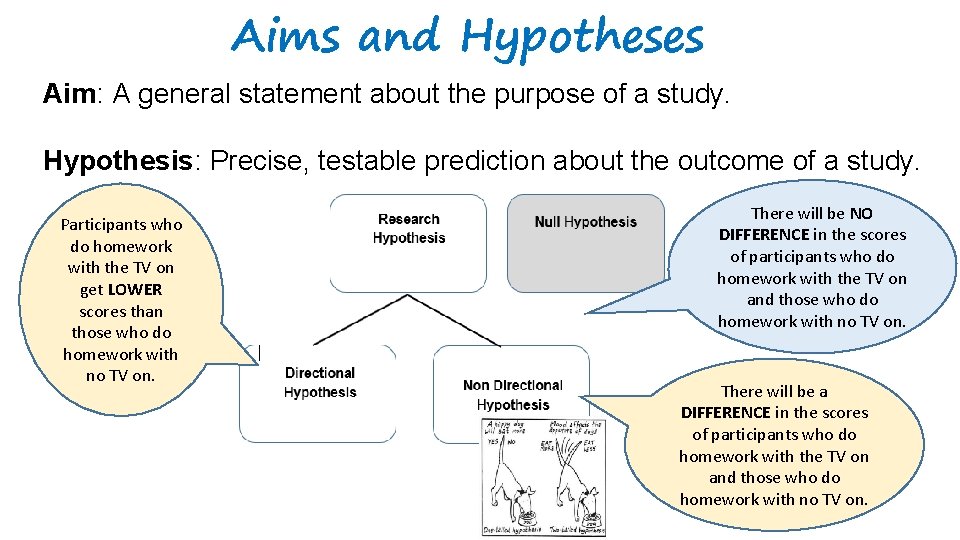
Aims and Hypotheses Aim: A general statement about the purpose of a study. Hypothesis: Precise, testable prediction about the outcome of a study. Participants who do homework with the TV on get LOWER scores than those who do homework with no TV on. There will be NO DIFFERENCE in the scores of participants who do homework with the TV on and those who do homework with no TV on. There will be a DIFFERENCE in the scores of participants who do homework with the TV on and those who do homework with no TV on.
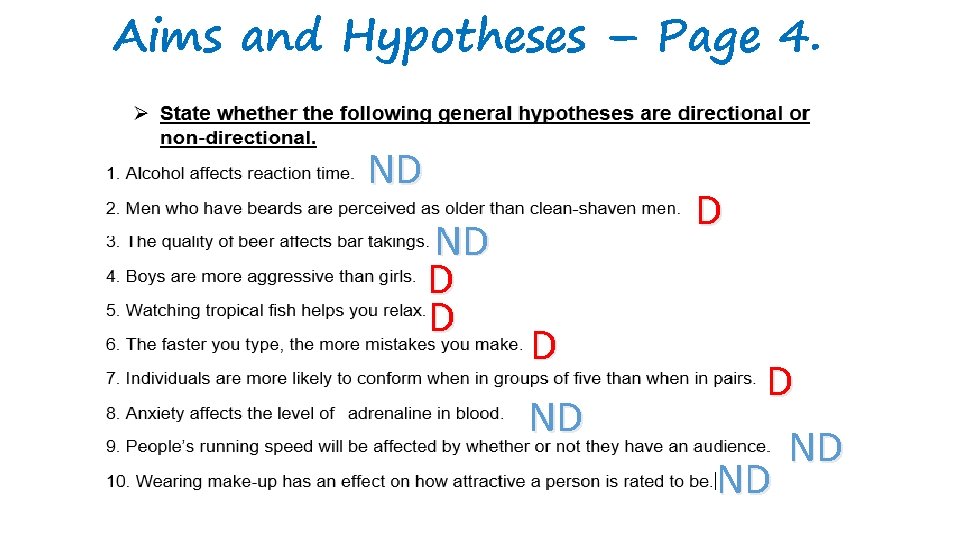
Aims and Hypotheses – Page 4. ND ND D D ND ND
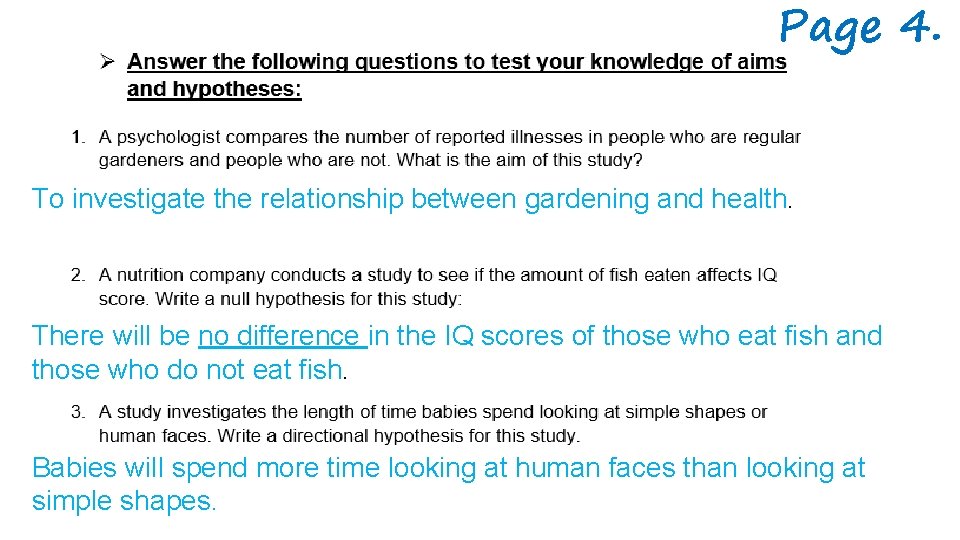
Page 4. To investigate the relationship between gardening and health. There will be no difference in the IQ scores of those who eat fish and those who do not eat fish. Babies will spend more time looking at human faces than looking at simple shapes.
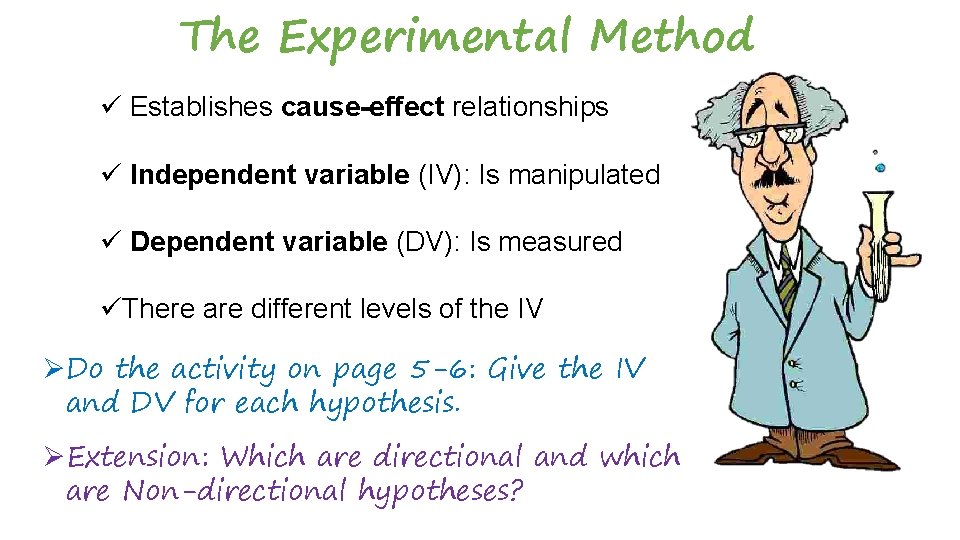
The Experimental Method ü Establishes cause-effect relationships ü Independent variable (IV): Is manipulated ü Dependent variable (DV): Is measured üThere are different levels of the IV ØDo the activity on page 5 -6: Give the IV and DV for each hypothesis. ØExtension: Which are directional and which are Non-directional hypotheses?
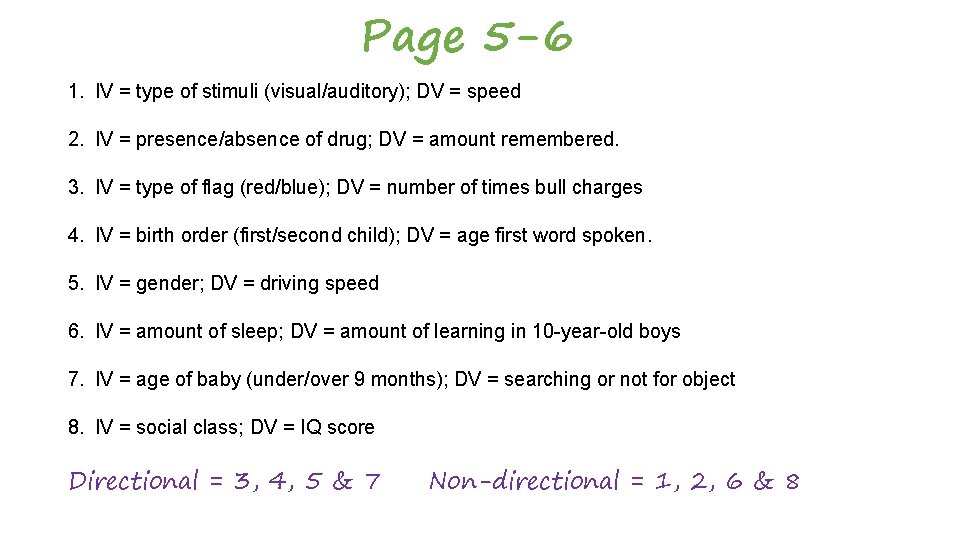
Page 5 -6 1. IV = type of stimuli (visual/auditory); DV = speed 2. IV = presence/absence of drug; DV = amount remembered. 3. IV = type of flag (red/blue); DV = number of times bull charges 4. IV = birth order (first/second child); DV = age first word spoken. 5. IV = gender; DV = driving speed 6. IV = amount of sleep; DV = amount of learning in 10 -year-old boys 7. IV = age of baby (under/over 9 months); DV = searching or not for object 8. IV = social class; DV = IQ score Directional = 3, 4, 5 & 7 Non-directional = 1, 2, 6 & 8
Thinking point … A researcher predicts that blondes have more fun than brunettes. Why might they have trouble testing this hypothesis?
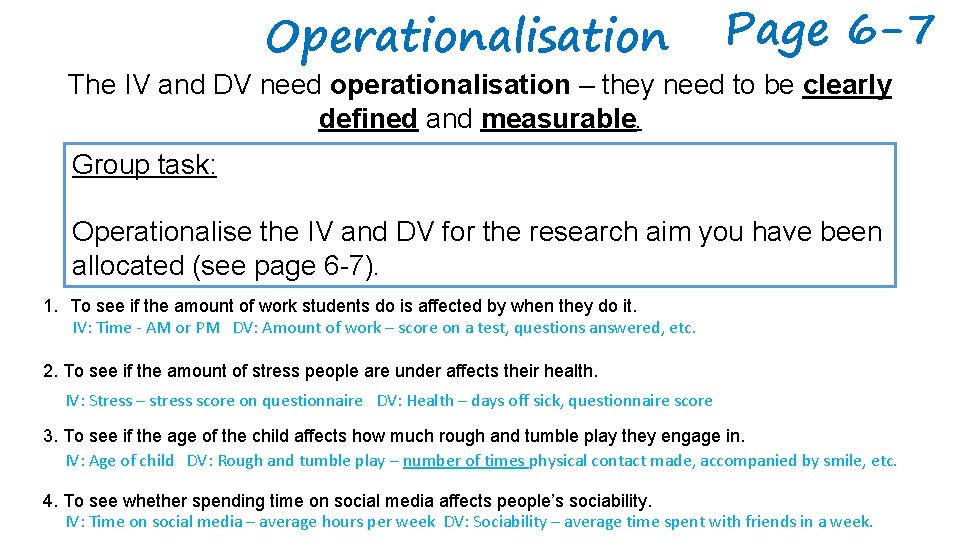
Operationalisation Page 6 -7 The IV and DV need operationalisation – they need to be clearly defined and measurable. Group task: Operationalise the IV and DV for the research aim you have been allocated (see page 6 -7). 1. To see if the amount of work students do is affected by when they do it. IV: Time - AM or PM DV: Amount of work – score on a test, questions answered, etc. 2. To see if the amount of stress people are under affects their health. IV: Stress – stress score on questionnaire DV: Health – days off sick, questionnaire score 3. To see if the age of the child affects how much rough and tumble play they engage in. IV: Age of child DV: Rough and tumble play – number of times physical contact made, accompanied by smile, etc. 4. To see whether spending time on social media affects people’s sociability. IV: Time on social media – average hours per week DV: Sociability – average time spent with friends in a week.
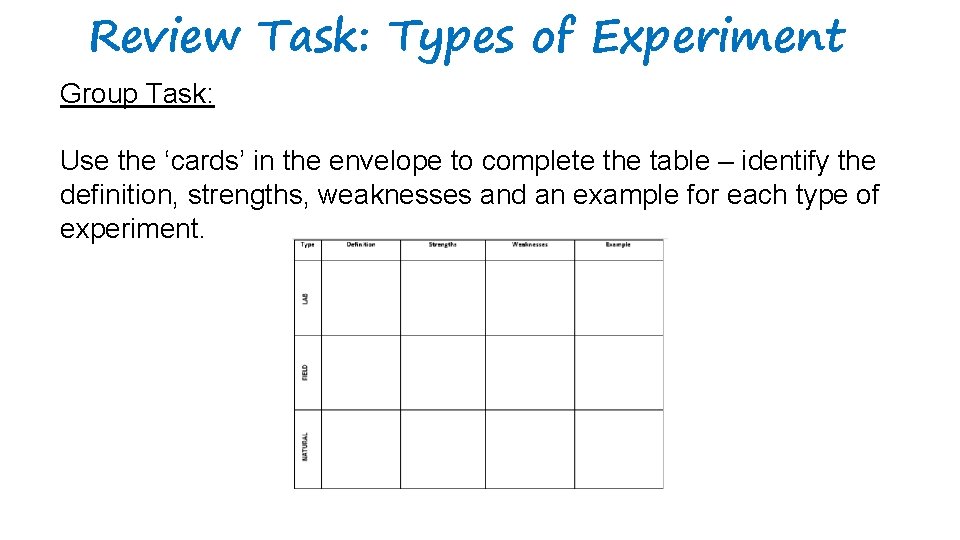
Review Task: Types of Experiment Group Task: Use the ‘cards’ in the envelope to complete the table – identify the definition, strengths, weaknesses and an example for each type of experiment.
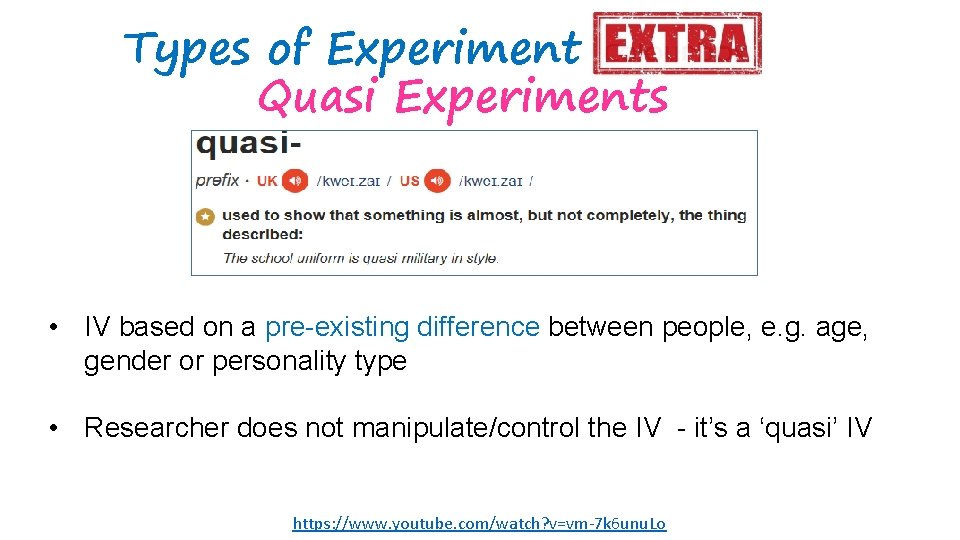
Types of Experiment Quasi Experiments • IV based on a pre-existing difference between people, e. g. age, gender or personality type • Researcher does not manipulate/control the IV - it’s a ‘quasi’ IV https: //www. youtube. com/watch? v=vm-7 k 6 unu. Lo
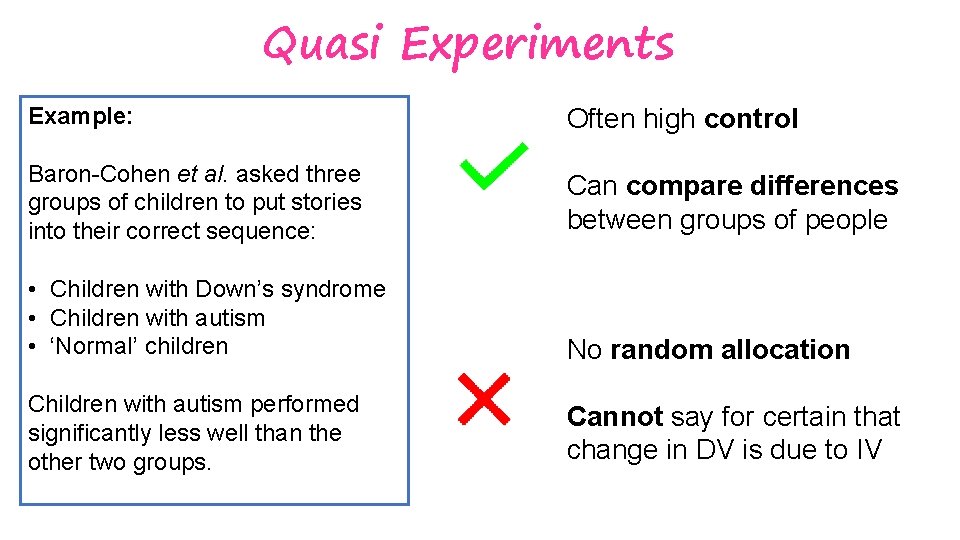
Quasi Experiments Example: Often high control Baron-Cohen et al. asked three groups of children to put stories into their correct sequence: Can compare differences between groups of people • Children with Down’s syndrome • Children with autism • ‘Normal’ children No random allocation Children with autism performed significantly less well than the other two groups. Cannot say for certain that change in DV is due to IV
Next time: Experimental design
- Slides: 26