
Psychology in Sport Option B Sport psychologists are
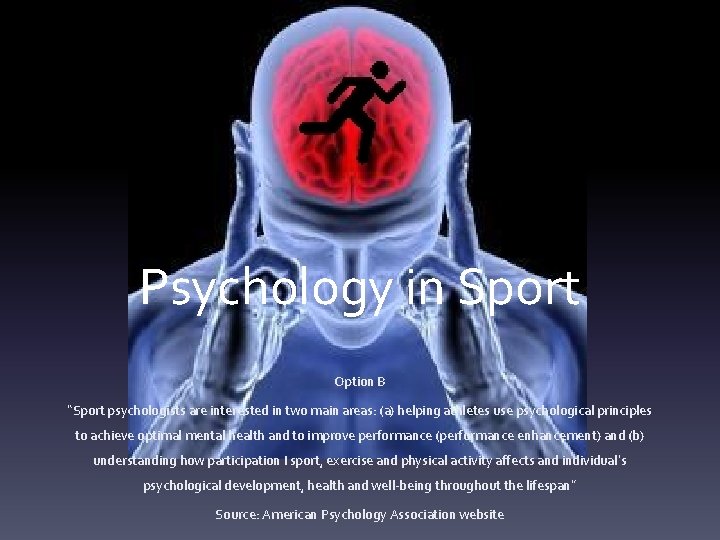
Psychology in Sport Option B “Sport psychologists are interested in two main areas: (a) helping athletes use psychological principles to achieve optimal mental health and to improve performance (performance enhancement) and (b) understanding how participation I sport, exercise and physical activity affects and individual’s psychological development, health and well-being throughout the lifespan” Source: American Psychology Association website
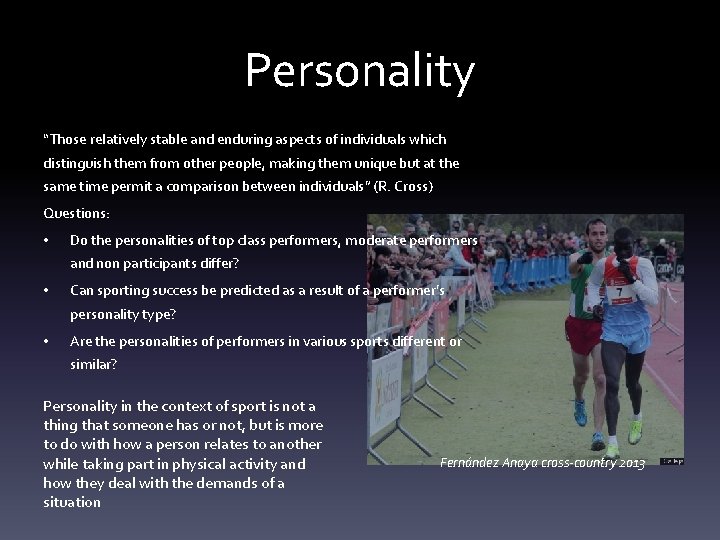
Personality “Those relatively stable and enduring aspects of individuals which distinguish them from other people, making them unique but at the same time permit a comparison between individuals” (R. Cross) Questions: • Do the personalities of top class performers, moderate performers and non participants differ? • Can sporting success be predicted as a result of a performer’s personality type? • Are the personalities of performers in various sports different or similar? Personality in the context of sport is not a thing that someone has or not, but is more to do with how a person relates to another while taking part in physical activity and how they deal with the demands of a situation Fernández Anaya cross-country 2013
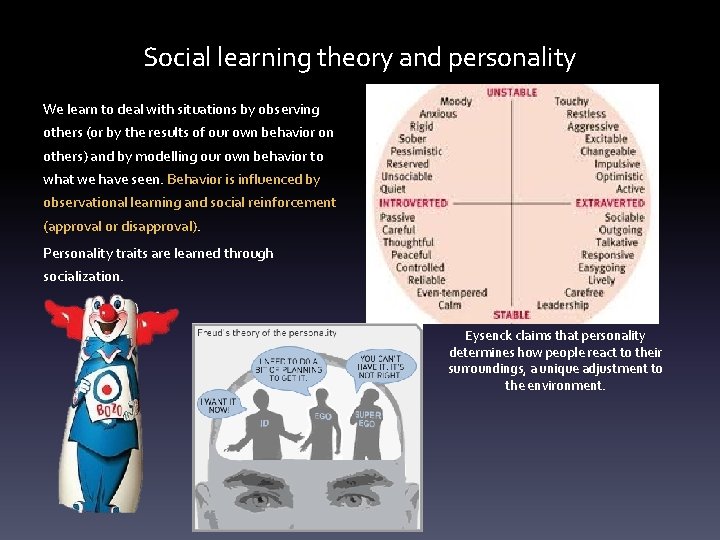
Social learning theory and personality We learn to deal with situations by observing others (or by the results of our own behavior on others) and by modelling our own behavior to what we have seen. Behavior is influenced by observational learning and social reinforcement (approval or disapproval). Personality traits are learned through socialization. Eysenck claims that personality determines how people react to their surroundings, a unique adjustment to the environment.
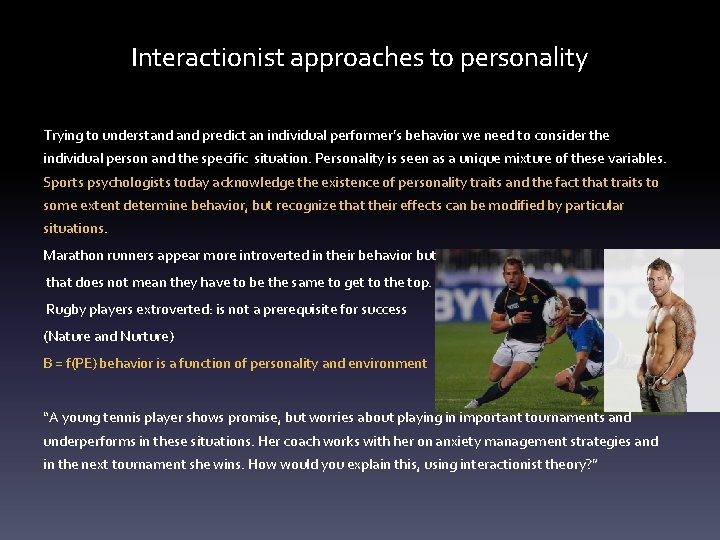
Interactionist approaches to personality Trying to understand predict an individual performer’s behavior we need to consider the individual person and the specific situation. Personality is seen as a unique mixture of these variables. Sports psychologists today acknowledge the existence of personality traits and the fact that traits to some extent determine behavior, but recognize that their effects can be modified by particular situations. Marathon runners appear more introverted in their behavior but that does not mean they have to be the same to get to the top. Rugby players extroverted: is not a prerequisite for success (Nature and Nurture) B = f(PE) behavior is a function of personality and environment “A young tennis player shows promise, but worries about playing in important tournaments and underperforms in these situations. Her coach works with her on anxiety management strategies and in the next tournament she wins. How would you explain this, using interactionist theory? ”
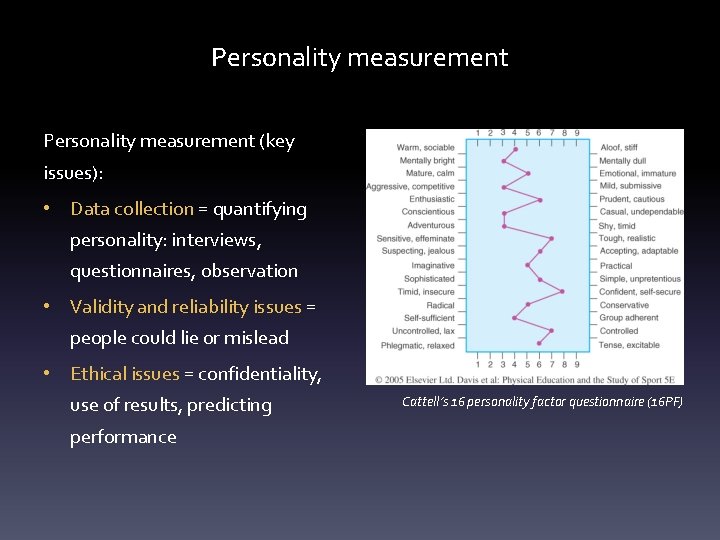
Personality measurement (key issues): • Data collection = quantifying personality: interviews, questionnaires, observation • Validity and reliability issues = people could lie or mislead • Ethical issues = confidentiality, use of results, predicting performance Cattell’s 16 personality factor questionnaire (16 PF)
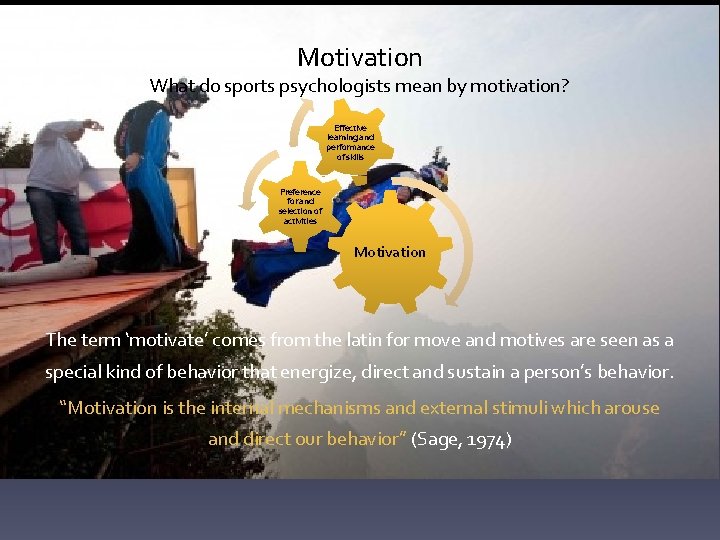
Motivation What do sports psychologists mean by motivation? Effective learning and performance of skills Preference for and selection of activities Motivation The term ‘motivate’ comes from the latin for move and motives are seen as a special kind of behavior that energize, direct and sustain a person’s behavior. “Motivation is the internal mechanisms and external stimuli which arouse and direct our behavior” (Sage, 1974)
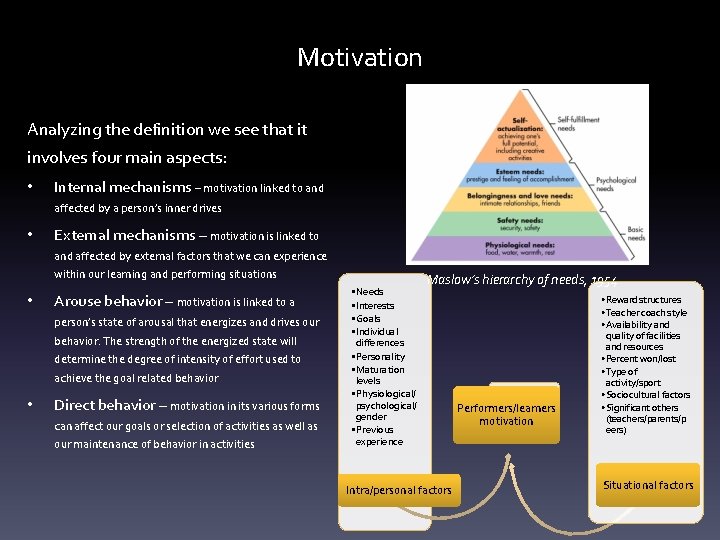
Motivation Analyzing the definition we see that it involves four main aspects: • Internal mechanisms – motivation linked to and affected by a person’s inner drives • External mechanisms – motivation is linked to and affected by external factors that we can experience within our learning and performing situations • Arouse behavior – motivation is linked to a person’s state of arousal that energizes and drives our behavior. The strength of the energized state will determine the degree of intensity of effort used to achieve the goal related behavior • Direct behavior – motivation in its various forms can affect our goals or selection of activities as well as our maintenance of behavior in activities • Needs • Interests • Goals • Individual differences • Personality • Maturation levels • Physiological/ psychological/ gender • Previous experience Maslow’s hierarchy of needs, 1954 Intra/personal factors Performers/learners motivation • Reward structures • Teacher coach style • Availability and quality of facilities and resources • Percent won/lost • Type of activity/sport • Sociocultural factors • Significant others (teachers/parents/p eers) Situational factors
Types of motivation Behavior is affected by many different kinds of motives coming from both internal and external mechanisms Intrinsic motivation: explains how learners/performers strive inwardly, being selfdetermined in trying to develop (mastery orientation). A person who is intrinsically motivated will want to take part in the activity for its own sake, for pure love of the sport. They focus on the enjoyment and fun of competition, try to develop their skills to the highest possible level and enjoy the action and excitement of seeking out new challenges and affiliations in doing so.
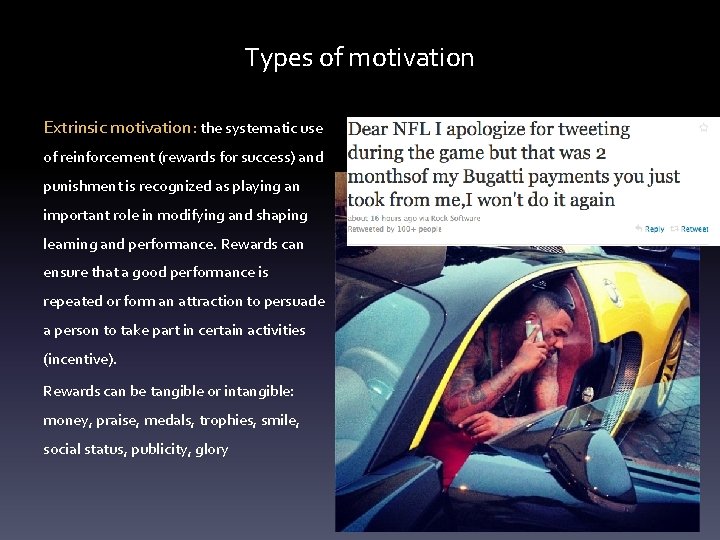
Types of motivation Extrinsic motivation: the systematic use of reinforcement (rewards for success) and punishment is recognized as playing an important role in modifying and shaping learning and performance. Rewards can ensure that a good performance is repeated or form an attraction to persuade a person to take part in certain activities (incentive). Rewards can be tangible or intangible: money, praise, medals, trophies, smile, social status, publicity, glory
Dan Pink: Drive Our motivations are unbelievably interesting
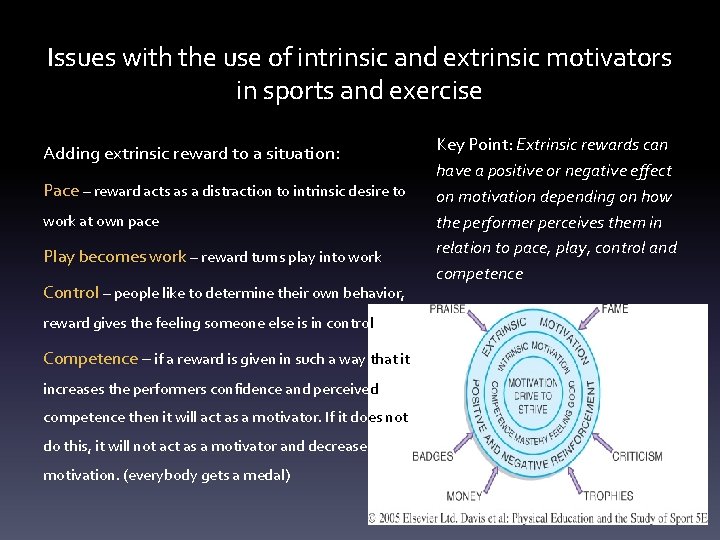
Issues with the use of intrinsic and extrinsic motivators in sports and exercise Adding extrinsic reward to a situation: Pace – reward acts as a distraction to intrinsic desire to work at own pace Play becomes work – reward turns play into work Control – people like to determine their own behavior, reward gives the feeling someone else is in control Competence – if a reward is given in such a way that it increases the performers confidence and perceived competence then it will act as a motivator. If it does not do this, it will not act as a motivator and decrease motivation. (everybody gets a medal) Key Point: Extrinsic rewards can have a positive or negative effect on motivation depending on how the performer perceives them in relation to pace, play, control and competence
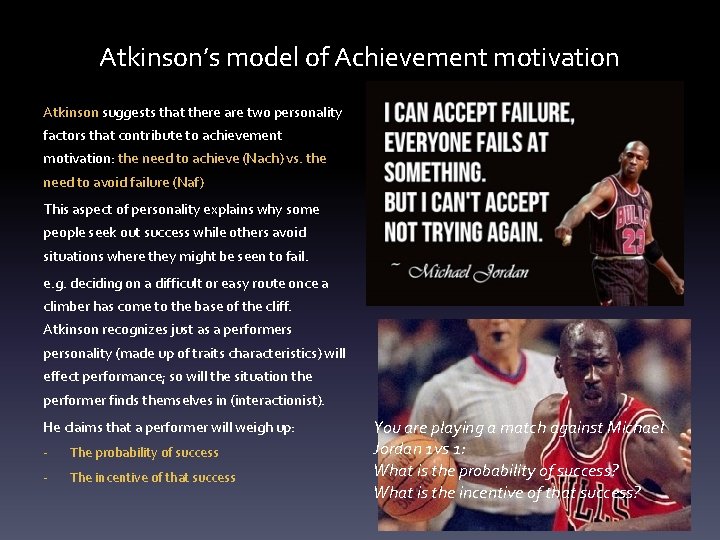
Atkinson’s model of Achievement motivation Atkinson suggests that there are two personality factors that contribute to achievement motivation: the need to achieve (Nach) vs. the need to avoid failure (Naf) This aspect of personality explains why some people seek out success while others avoid situations where they might be seen to fail. e. g. deciding on a difficult or easy route once a climber has come to the base of the cliff. Atkinson recognizes just as a performers personality (made up of traits characteristics) will effect performance; so will the situation the performer finds themselves in (interactionist). He claims that a performer will weigh up: - The probability of success - The incentive of that success You are playing a match against Michael Jordan 1 vs 1: What is the probability of success? What is the incentive of that success?
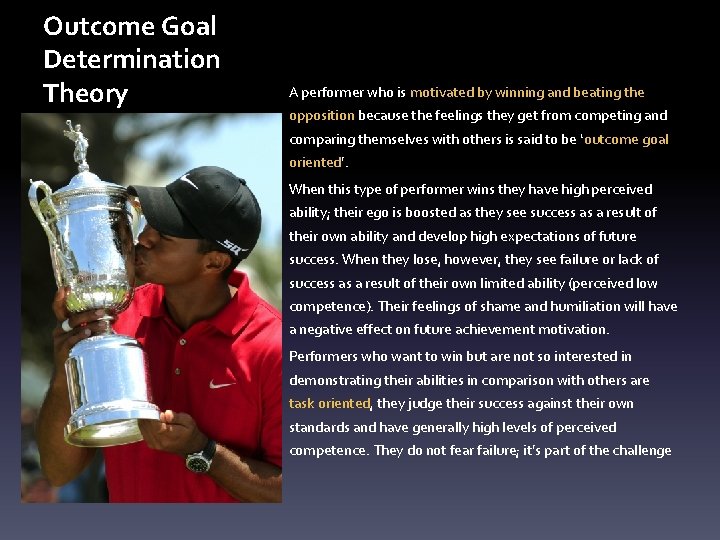
Outcome Goal Determination Theory A performer who is motivated by winning and beating the opposition because the feelings they get from competing and comparing themselves with others is said to be ‘outcome goal oriented’. When this type of performer wins they have high perceived ability; their ego is boosted as they see success as a result of their own ability and develop high expectations of future success. When they lose, however, they see failure or lack of success as a result of their own limited ability (perceived low competence). Their feelings of shame and humiliation will have a negative effect on future achievement motivation. Performers who want to win but are not so interested in demonstrating their abilities in comparison with others are task oriented, they judge their success against their own standards and have generally high levels of perceived competence. They do not fear failure; it’s part of the challenge
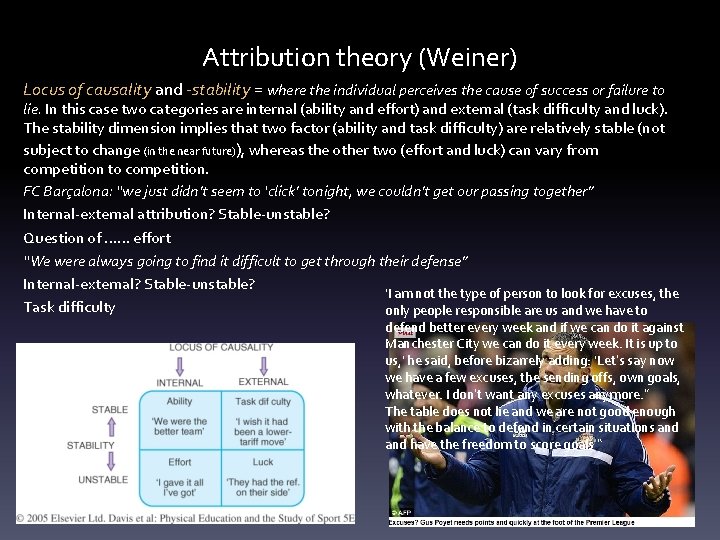
Attribution theory (Weiner) Locus of causality and -stability = where the individual perceives the cause of success or failure to lie. In this case two categories are internal (ability and effort) and external (task difficulty and luck). The stability dimension implies that two factor (ability and task difficulty) are relatively stable (not subject to change (in the near future)), whereas the other two (effort and luck) can vary from competition to competition. FC Barçalona: “we just didn’t seem to ‘click’ tonight, we couldn’t get our passing together” Internal-external attribution? Stable-unstable? Question of …… effort “We were always going to find it difficult to get through their defense” Internal-external? Stable-unstable? 'I am not the type of person to look for excuses, the Task difficulty only people responsible are us and we have to defend better every week and if we can do it against Manchester City we can do it every week. It is up to us, ' he said, before bizarrely adding: 'Let’s say now we have a few excuses, the sending offs, own goals, whatever. I don’t want any excuses anymore. ” The table does not lie and we are not good enough with the balance to defend in certain situations and have the freedom to score goals “
Attribution theory: Locus of control Following criticism of his work Weiner reformulated his model adding a further dimension: Locus of control this helped explain the effective consequences of attributions that are in or out of a person’s control. The locus of control relates to the intensity of the feelings of satisfaction and pride, shame and guilt. If the performer relates their success to internal causes and factors within control (ability and effort), rather than external and uncontrollable factors (lucky, simple task), then feelings of pride and satisfaction will be maximized -> motivation will increase If failure is attributed to internal and controllable factors the feeling of shame will be increased > decrease in motivation
Attribution theory: Self serving bias Performers have biases in common: they tend to take credit for success and dissociating themselves from failures, blaming external factors ‘a bad workman always blames his tools’
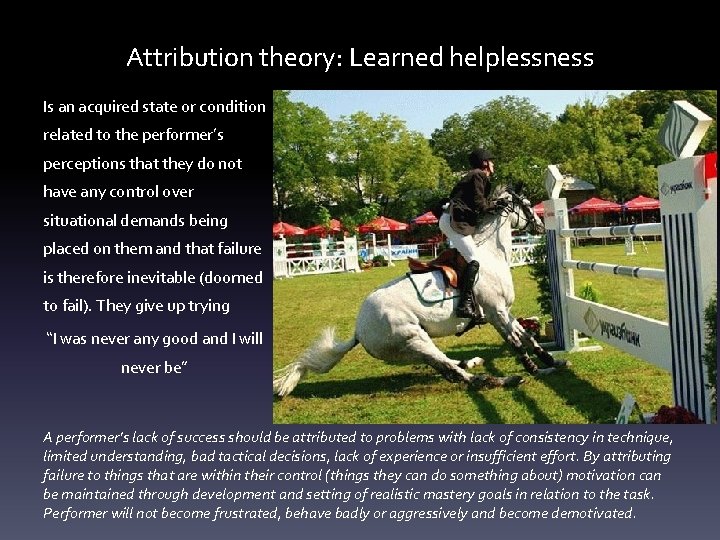
Attribution theory: Learned helplessness Is an acquired state or condition related to the performer’s perceptions that they do not have any control over situational demands being placed on them and that failure is therefore inevitable (doomed to fail). They give up trying “I was never any good and I will never be” A performer’s lack of success should be attributed to problems with lack of consistency in technique, limited understanding, bad tactical decisions, lack of experience or insufficient effort. By attributing failure to things that are within their control (things they can do something about) motivation can be maintained through development and setting of realistic mastery goals in relation to the task. Performer will not become frustrated, behave badly or aggressively and become demotivated.
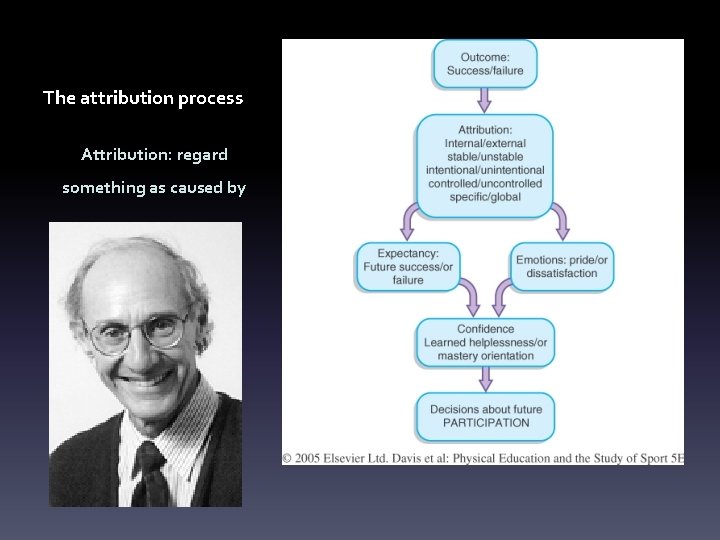
The attribution process Attribution: regard something as caused by
- Slides: 18