
Psychology in Professional Writing Identifying the Most Effective



![[There is] evidence that environments, schedules, and rituals restructure the writing process and amplify](https://slidetodoc.com/presentation_image_h2/8f36a0955e17342cf52041d3189fde74/image-8.jpg "[There is] evidence that environments, schedules, and rituals restructure the writing process and amplify")

- Slides: 10
Psychology in Professional Writing Identifying the Most Effective Methods for Delivering Effective Messages
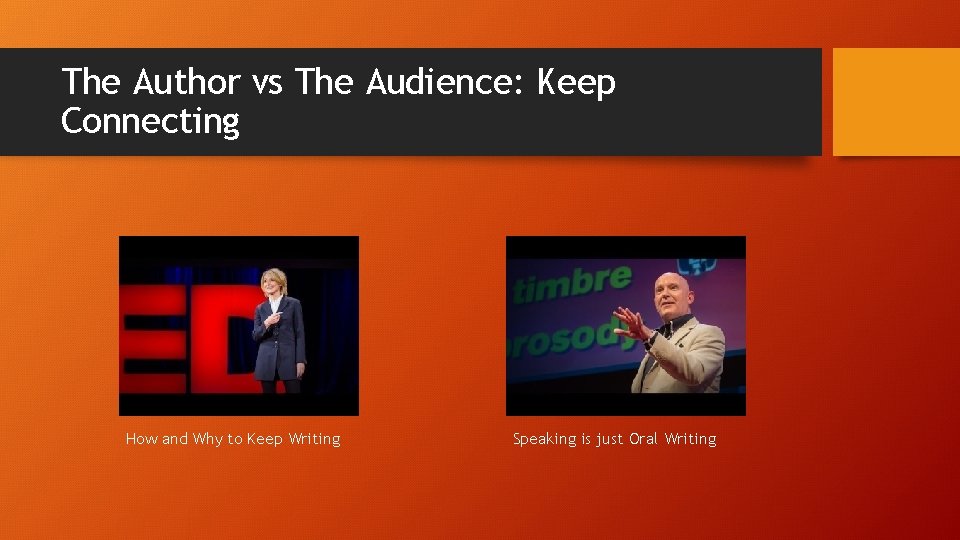
The Author vs The Audience: Keep Connecting How and Why to Keep Writing Speaking is just Oral Writing
Avoiding Writing to Avoid Embarrassment • • Why write a piece to begin with? What are the possible outcomes? Displace feelings of inadequacy on other writers. Consider the difficulty of conveying your message. Stall, stall! Hamstring the methodology intentionally. Over-prepare to the point of exhaustion. The self-fulfilled prophecy has worked! (Paraphrased from Jimmy Walkers “Writing Avoidance: A Professional Approach”)
Decide on a subject and decide to deliver a piece.
John Fowler: “Writing for professional publication Part 2: Subject Matter” • “A topic you have specialist…knowledge of. ” • “A topic that you have undertaken a detailed literature review on. ” • “An opinion on a topical subject. ” • “A perspective on a topic that is unique to your position…” • “Work that you have undertaken as part of your…role. ” • “Organized and supervised research. ” • Once a subject is chosen, the rest falls into place.
[There is] evidence that environments, schedules, and rituals restructure the writing process and amplify performance… The principles of memory retrieval suggest that certain practices should amplify performance. These practices encourage a state of flow rather than one of anxiety or boredom. Like strategies, these other aspects of a writer’s method may alleviate the difficulty of attentional overload. The room, time of day, or ritual selected for working may enable or even induce intense concentration or a favorable motivational or emotional state. Moreover, in accordance with encoding specificity, each of these aspects of method may trigger retrieval of ideas, facts, plans, and other relevant knowledge associated with the place, time, or frame of mind selected by the writer for work. -Ronald T. Kellog “The Psychology of Writing” In other words, a writer must find their “zone” in which to write, whether it be in a quiet room or after having drunk six cups of coffee. Each writer has a subjective experience before, during, and after creating a literary piece. Their ability to return to homeostasis will necessarily vary greatly, as will their preparatory rituals and thought processes.
Works Cited • Walker, Jimmy R. “Writing Avoidance: A Professional Approach” Personnel & Guidance Journal. Dec 1978, Vol. 57 Issue 4, p 218 • Fowler, John, “Writing for Professional Publication. Part 2: Subject Matter” British Journal of Nursing. 09/23/2010, Vol. 19 Issue 17, p 1121 • Kellog, Ronald T. The Psychology of Writing, Oxford University Press, 1994, p 186