
Psychology History and People A chronological look at

- Slides: 23
Psychology: History and People A chronological look at important figures in Psychology
About this section The history of psychology, referred to by College. Board as “History and Approaches” generally accounts for about 2%-4% of the yearly AP Exam.
Psychology is Old In Ancient India, the Buddha (Siddhartha Gautama) pondered how sensations and perceptions combine to form ideas. In China, Confucius stressed the powers of idea and of an educated mind. In Ancient Israel, Hebrew Scholars anticipated today’s psychology by linking mind and emotion to the body. The believed that we thought with our heart and felt with our bowels. (Think how some emotions can cause you sensations of uneasiness in your stomach/intestines).
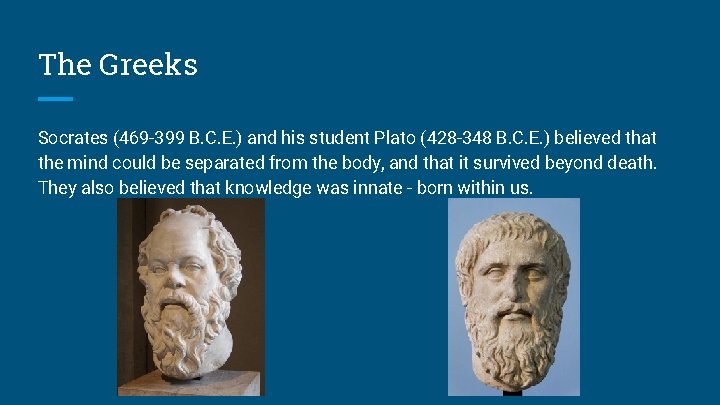
The Greeks Socrates (469 -399 B. C. E. ) and his student Plato (428 -348 B. C. E. ) believed that the mind could be separated from the body, and that it survived beyond death. They also believed that knowledge was innate - born within us.
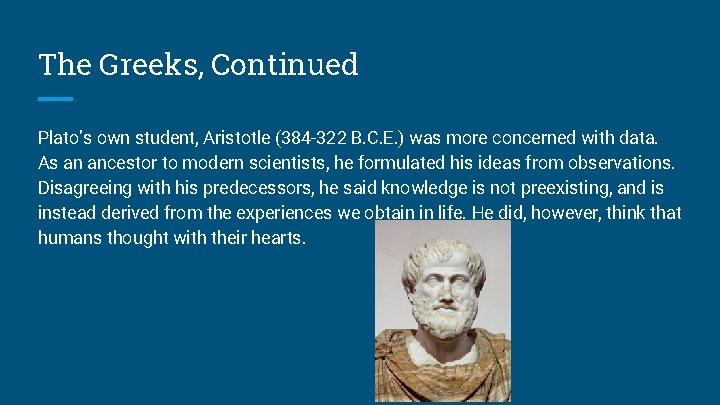
The Greeks, Continued Plato’s own student, Aristotle (384 -322 B. C. E. ) was more concerned with data. As an ancestor to modern scientists, he formulated his ideas from observations. Disagreeing with his predecessors, he said knowledge is not preexisting, and is instead derived from the experiences we obtain in life. He did, however, think that humans thought with their hearts.
Jumping ahead 2000 years There was little development in Psychology for approximately 2000 years. However, starting in the 1600 s, advances in science allowed for new research into the mind, and many new theories began to spring up.
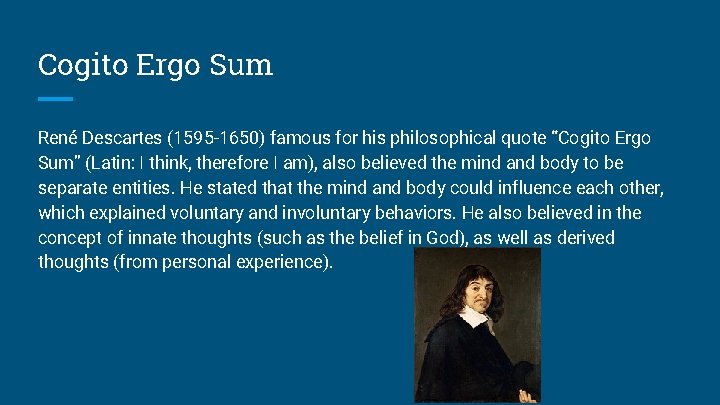
Cogito Ergo Sum René Descartes (1595 -1650) famous for his philosophical quote “Cogito Ergo Sum” (Latin: I think, therefore I am), also believed the mind and body to be separate entities. He stated that the mind and body could influence each other, which explained voluntary and involuntary behaviors. He also believed in the concept of innate thoughts (such as the belief in God), as well as derived thoughts (from personal experience).
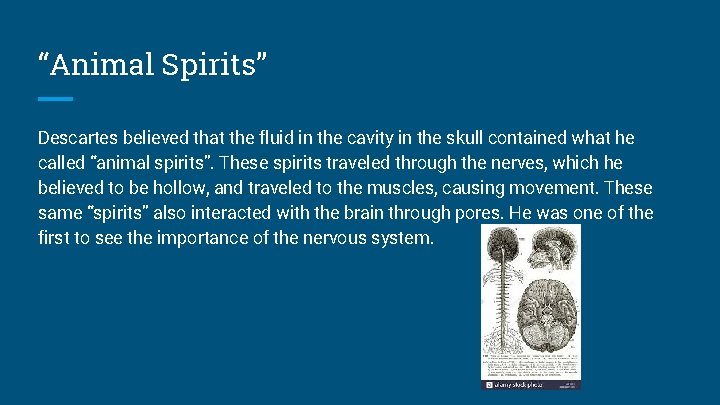
“Animal Spirits” Descartes believed that the fluid in the cavity in the skull contained what he called “animal spirits”. These spirits traveled through the nerves, which he believed to be hollow, and traveled to the muscles, causing movement. These same “spirits” also interacted with the brain through pores. He was one of the first to see the importance of the nervous system.
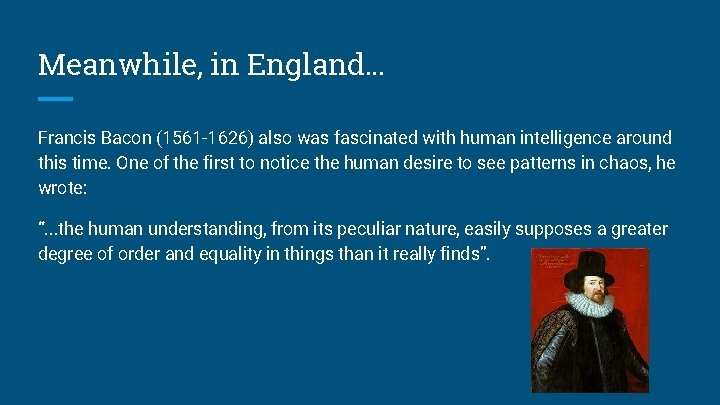
Meanwhile, in England… Francis Bacon (1561 -1626) also was fascinated with human intelligence around this time. One of the first to notice the human desire to see patterns in chaos, he wrote: “. . . the human understanding, from its peculiar nature, easily supposes a greater degree of order and equality in things than it really finds”.
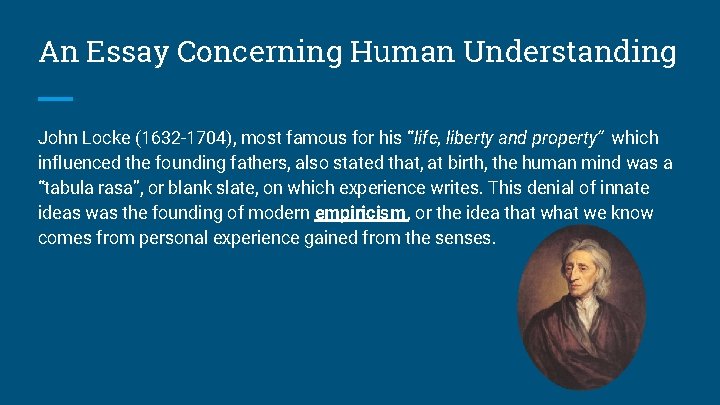
An Essay Concerning Human Understanding John Locke (1632 -1704), most famous for his “life, liberty and property” which influenced the founding fathers, also stated that, at birth, the human mind was a “tabula rasa”, or blank slate, on which experience writes. This denial of innate ideas was the founding of modern empiricism , or the idea that we know comes from personal experience gained from the senses.
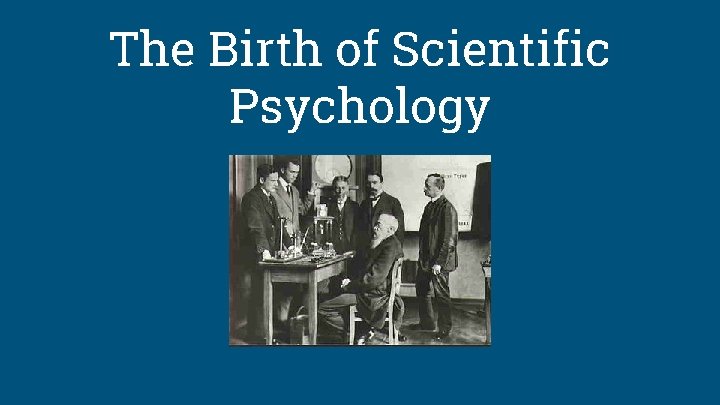
The Birth of Scientific Psychology
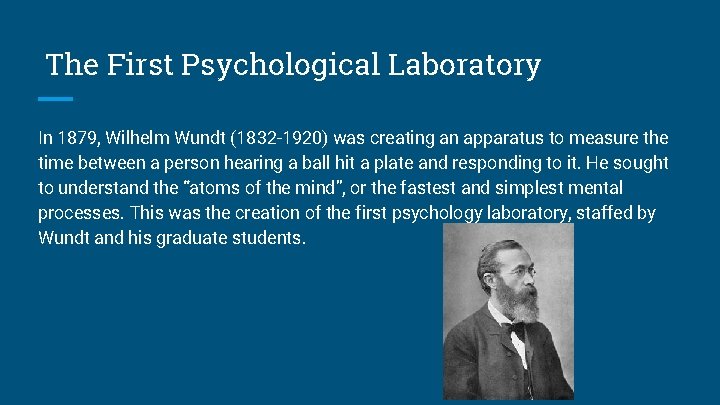
The First Psychological Laboratory In 1879, Wilhelm Wundt (1832 -1920) was creating an apparatus to measure the time between a person hearing a ball hit a plate and responding to it. He sought to understand the “atoms of the mind”, or the fastest and simplest mental processes. This was the creation of the first psychology laboratory, staffed by Wundt and his graduate students.
The Creation of Branches Shortly after Wundt’s creation of modern psychology, the field was broken up into several branches. These include: Structuralism Functionalism Psychoanalysis Behavioralism Gestalt psychology
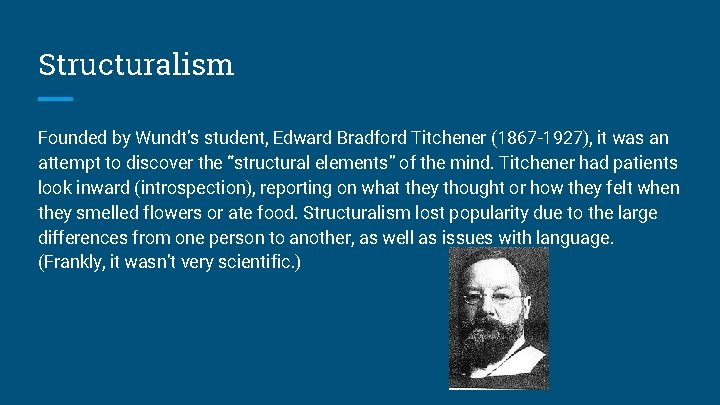
Structuralism Founded by Wundt’s student, Edward Bradford Titchener (1867 -1927), it was an attempt to discover the “structural elements” of the mind. Titchener had patients look inward (introspection), reporting on what they thought or how they felt when they smelled flowers or ate food. Structuralism lost popularity due to the large differences from one person to another, as well as issues with language. (Frankly, it wasn’t very scientific. )
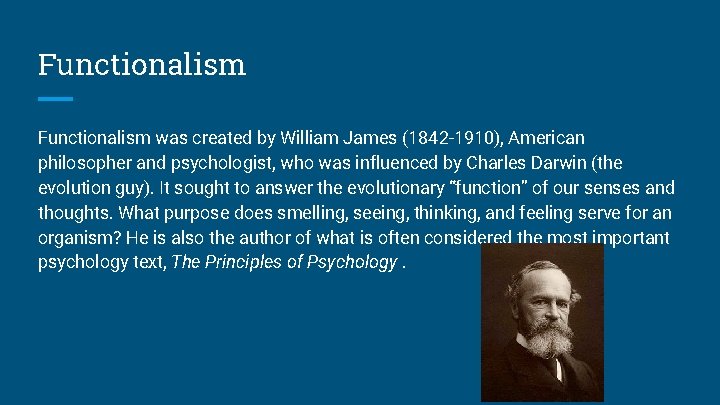
Functionalism was created by William James (1842 -1910), American philosopher and psychologist, who was influenced by Charles Darwin (the evolution guy). It sought to answer the evolutionary “function” of our senses and thoughts. What purpose does smelling, seeing, thinking, and feeling serve for an organism? He is also the author of what is often considered the most important psychology text, The Principles of Psychology.
Psychoanalysis In 1896, after trying out hypnosis as a means of therapy and discovering that he could derive significant information from what he called “free association”, or the free and uninterrupted stream of consciousness, Sigmund Freud developed what he called “Psychoanalysis”. This promoted a deep look into what Freud called the “unconscious” and the look on how childhood interactions affected adult behavior.
The theories of Dr. Freud Sigmund Freud developed a wide range of now famous (or infamous) theories and studies, including: Freud’s Seduction Theory: The belief that things like “hysteria” and obsessive disorders come from infantile sexual abuse, real or imagined. Oedipus Complex: Named after the Greek tragic hero, states that there is a suppressed desire for children to have sexual relations with their parent of the opposite sex.
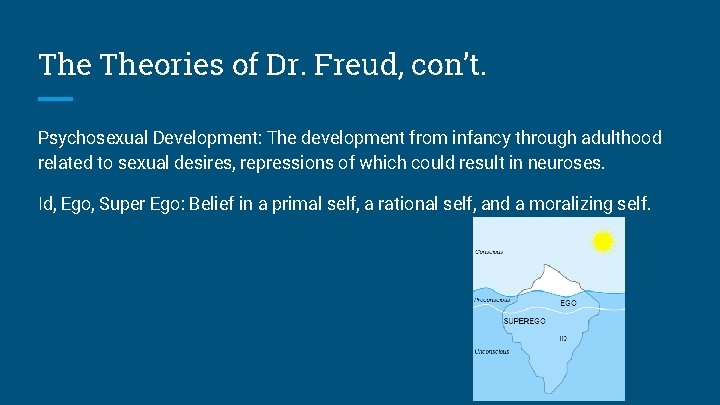
The Theories of Dr. Freud, con’t. Psychosexual Development: The development from infancy through adulthood related to sexual desires, repressions of which could result in neuroses. Id, Ego, Super Ego: Belief in a primal self, a rational self, and a moralizing self.
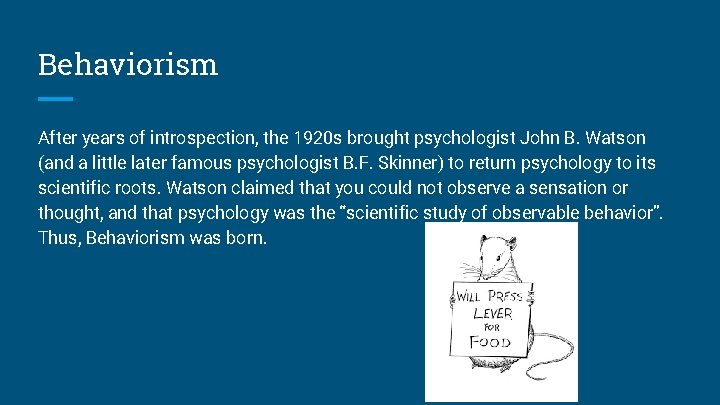
Behaviorism After years of introspection, the 1920 s brought psychologist John B. Watson (and a little later famous psychologist B. F. Skinner) to return psychology to its scientific roots. Watson claimed that you could not observe a sensation or thought, and that psychology was the “scientific study of observable behavior”. Thus, Behaviorism was born.
What is behaviorism? Short and sweet, it’s study of people’s behavior in response to different situations. Behavioral psychologists took it a step further, and said that our behavior was influenced by these repeated situations, a term called conditioning. We’ll look more at Skinner’s mice and Pavlov’s dog later.
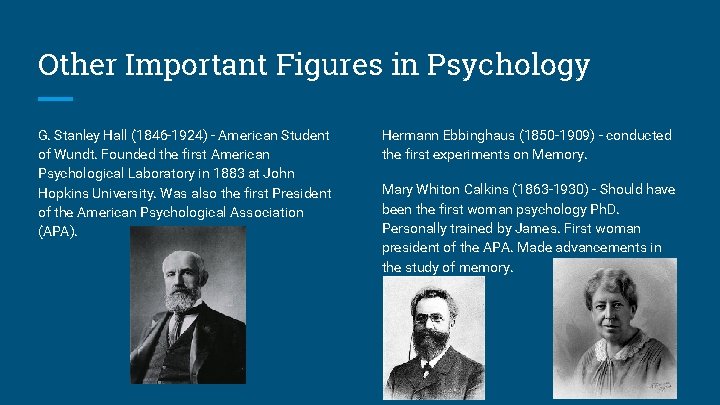
Other Important Figures in Psychology G. Stanley Hall (1846 -1924) - American Student of Wundt. Founded the first American Psychological Laboratory in 1883 at John Hopkins University. Was also the first President of the American Psychological Association (APA). Hermann Ebbinghaus (1850 -1909) - conducted the first experiments on Memory. Mary Whiton Calkins (1863 -1930) - Should have been the first woman psychology Ph. D. Personally trained by James. First woman president of the APA. Made advancements in the study of memory.
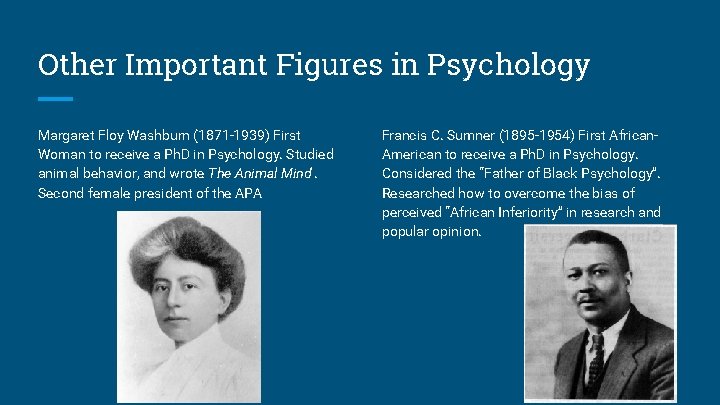
Other Important Figures in Psychology Margaret Floy Washburn (1871 -1939) First Woman to receive a Ph. D in Psychology. Studied animal behavior, and wrote The Animal Mind. Second female president of the APA Francis C. Sumner (1895 -1954) First African. American to receive a Ph. D in Psychology. Considered the “Father of Black Psychology”. Researched how to overcome the bias of perceived “African Inferiority” in research and popular opinion.
Important Things to Note! Psychology is a science. On the AP Exam, every question will be based on the psychology started by Wilhelm Wundt, and is based on research and experimentation. It will never be based on what you may assume to be “common sense” or intuition! Make Flash Cards! Each person discussed in this Power. Point should have a flash card associated with them. Psychology: the study of the behavior and mental processes.