
PSYCHOLOGY Chapter 9 LIFESPAN DEVELOPMENT Spring 2020 Irvine

- Slides: 28
PSYCHOLOGY Chapter 9 LIFESPAN DEVELOPMENT Spring 2020 Irvine Valley College PROFESSOR TRUJILLO
DEVELOPMENTAL PSYCHOLOGY • How have you changed since childhood? • How are you the same? What will your life be like 25 years from now? • Fifty years from now? • Lifespan development studies how you change as well as how you remain the same over the course of your life. • Developmental Psychologists development as a lifelong process that can be studied scientifically across three developmental domains: (credit: modification of work by Giles Cook)
DEVELOPMENTAL PSYCHOLOGY • Physical development involves growth and changes in the body and brain, the senses, motor skills, and health and wellness. • Cognitive development involves learning, attention, memory, language, thinking, reasoning, and creativity. • Psychosocial development involves emotions, personality, and social relationships. We refer to these domains throughout the chapter. (credit: modification of work by Giles Cook)
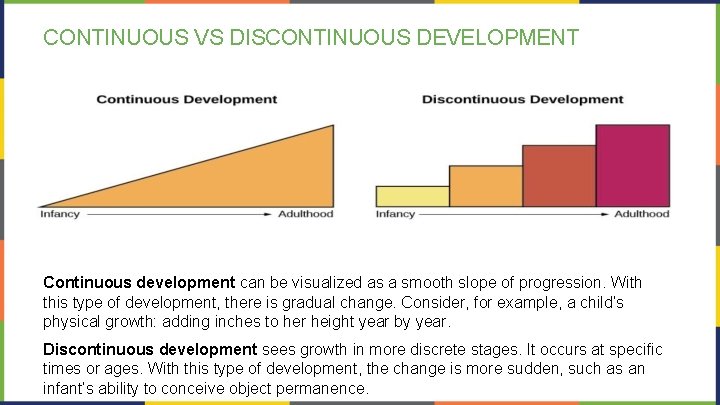
CONTINUOUS VS DISCONTINUOUS DEVELOPMENT Continuous development can be visualized as a smooth slope of progression. With this type of development, there is gradual change. Consider, for example, a child’s physical growth: adding inches to her height year by year. Discontinuous development sees growth in more discrete stages. It occurs at specific times or ages. With this type of development, the change is more sudden, such as an infant’s ability to conceive object permanence.
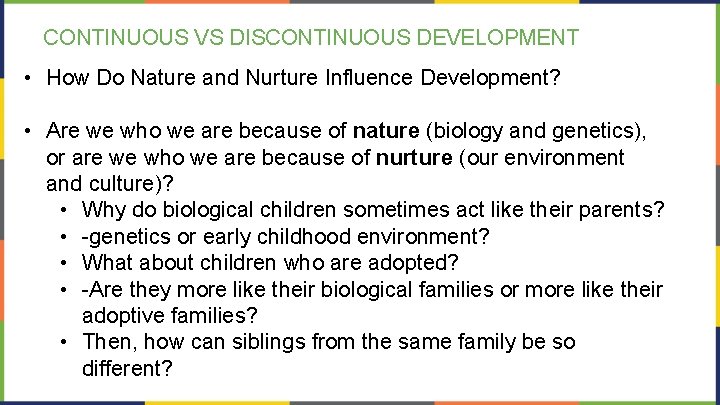
CONTINUOUS VS DISCONTINUOUS DEVELOPMENT • How Do Nature and Nurture Influence Development? • Are we who we are because of nature (biology and genetics), or are we who we are because of nurture (our environment and culture)? • Why do biological children sometimes act like their parents? • -genetics or early childhood environment? • What about children who are adopted? • -Are they more like their biological families or more like their adoptive families? • Then, how can siblings from the same family be so different?
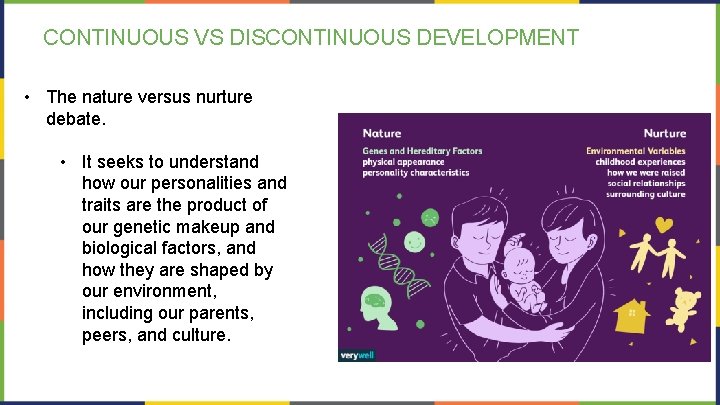
CONTINUOUS VS DISCONTINUOUS DEVELOPMENT • The nature versus nurture debate. • It seeks to understand how our personalities and traits are the product of our genetic makeup and biological factors, and how they are shaped by our environment, including our parents, peers, and culture.
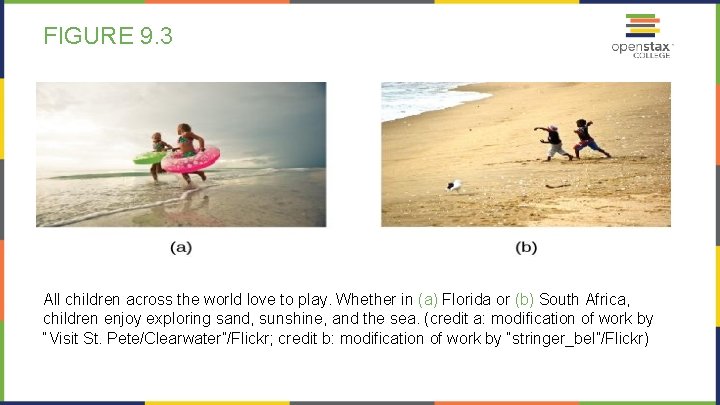
FIGURE 9. 3 All children across the world love to play. Whether in (a) Florida or (b) South Africa, children enjoy exploring sand, sunshine, and the sea. (credit a: modification of work by “Visit St. Pete/Clearwater”/Flickr; credit b: modification of work by “stringer_bel”/Flickr)
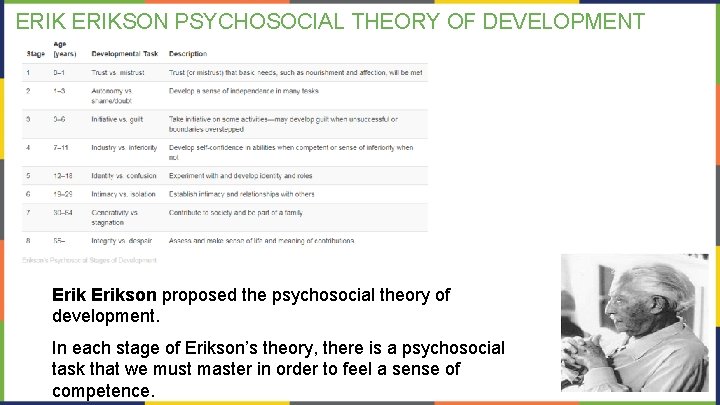
ERIKSON PSYCHOSOCIAL THEORY OF DEVELOPMENT Erikson proposed the psychosocial theory of development. In each stage of Erikson’s theory, there is a psychosocial task that we must master in order to feel a sense of competence.
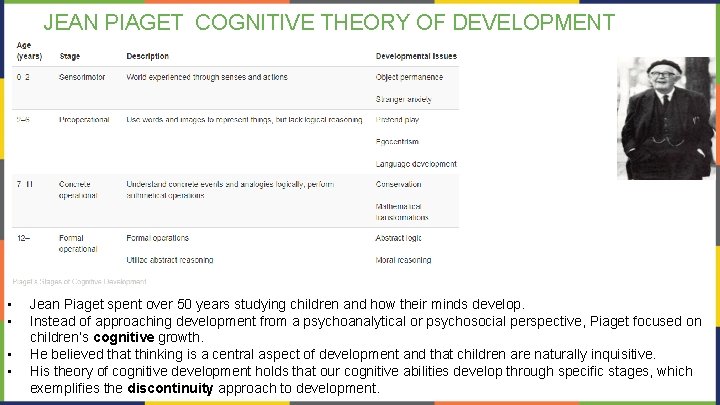
JEAN PIAGET COGNITIVE THEORY OF DEVELOPMENT • • Jean Piaget spent over 50 years studying children and how their minds develop. Instead of approaching development from a psychoanalytical or psychosocial perspective, Piaget focused on children’s cognitive growth. He believed that thinking is a central aspect of development and that children are naturally inquisitive. His theory of cognitive development holds that our cognitive abilities develop through specific stages, which exemplifies the discontinuity approach to development.
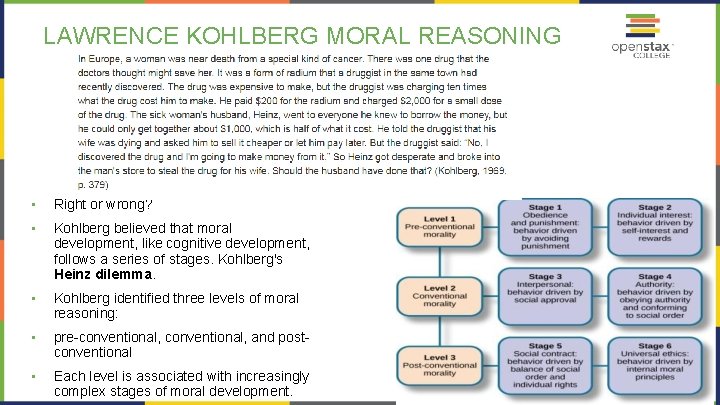
LAWRENCE KOHLBERG MORAL REASONING • Right or wrong? • Kohlberg believed that moral development, like cognitive development, follows a series of stages. Kohlberg's Heinz dilemma. • Kohlberg identified three levels of moral reasoning: • pre-conventional, and postconventional • Each level is associated with increasingly complex stages of moral development.
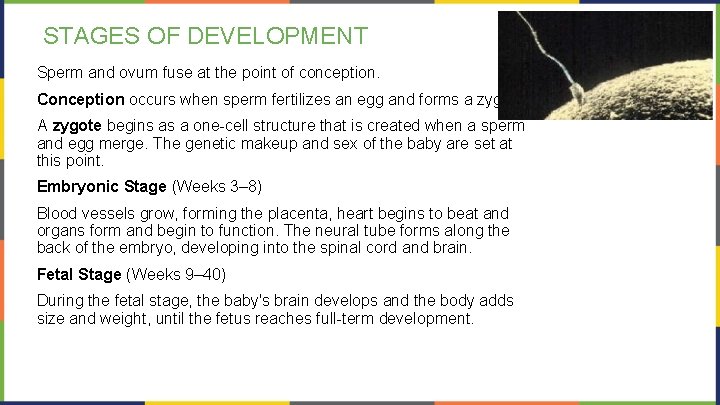
STAGES OF DEVELOPMENT Sperm and ovum fuse at the point of conception. Conception occurs when sperm fertilizes an egg and forms a zygote. A zygote begins as a one-cell structure that is created when a sperm and egg merge. The genetic makeup and sex of the baby are set at this point. Embryonic Stage (Weeks 3– 8) Blood vessels grow, forming the placenta, heart begins to beat and organs form and begin to function. The neural tube forms along the back of the embryo, developing into the spinal cord and brain. Fetal Stage (Weeks 9– 40) During the fetal stage, the baby's brain develops and the body adds size and weight, until the fetus reaches full-term development.
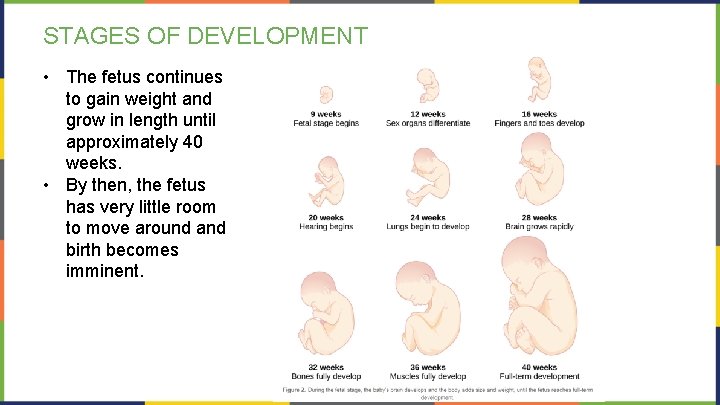
STAGES OF DEVELOPMENT • The fetus continues to gain weight and grow in length until approximately 40 weeks. • By then, the fetus has very little room to move around and birth becomes imminent.
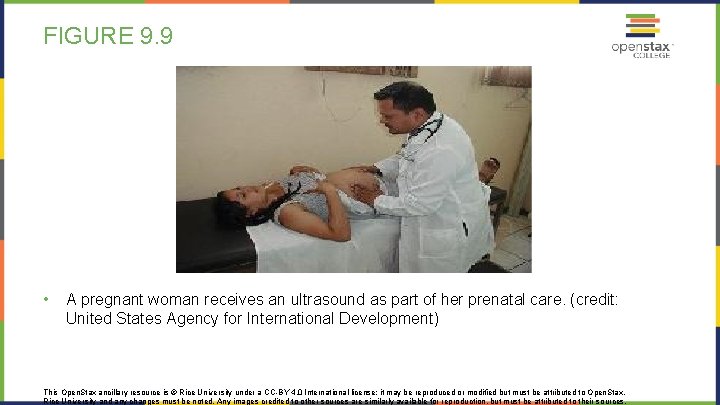
FIGURE 9. 9 • A pregnant woman receives an ultrasound as part of her prenatal care. (credit: United States Agency for International Development) This Open. Stax ancillary resource is © Rice University under a CC-BY 4. 0 International license; it may be reproduced or modified but must be attributed to Open. Stax, Rice University and any changes must be noted. Any images credited to other sources are similarly available for reproduction, but must be attributed to their sources.
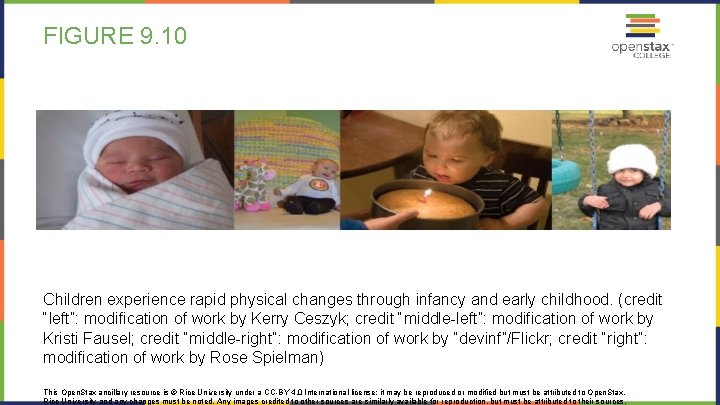
FIGURE 9. 10 Children experience rapid physical changes through infancy and early childhood. (credit “left”: modification of work by Kerry Ceszyk; credit “middle-left”: modification of work by Kristi Fausel; credit “middle-right”: modification of work by “devinf”/Flickr; credit “right”: modification of work by Rose Spielman) This Open. Stax ancillary resource is © Rice University under a CC-BY 4. 0 International license; it may be reproduced or modified but must be attributed to Open. Stax, Rice University and any changes must be noted. Any images credited to other sources are similarly available for reproduction, but must be attributed to their sources.
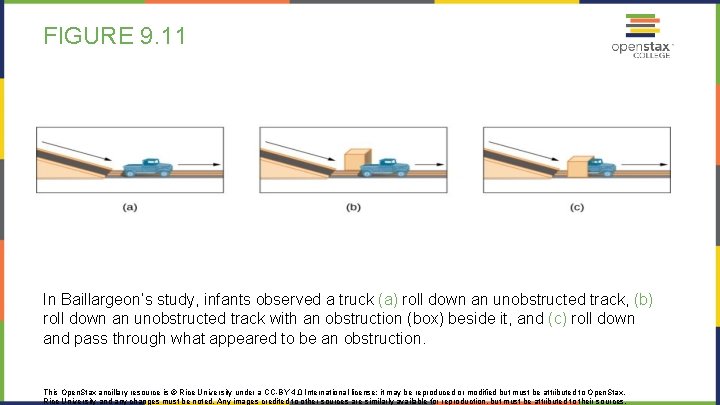
FIGURE 9. 11 In Baillargeon’s study, infants observed a truck (a) roll down an unobstructed track, (b) roll down an unobstructed track with an obstruction (box) beside it, and (c) roll down and pass through what appeared to be an obstruction. This Open. Stax ancillary resource is © Rice University under a CC-BY 4. 0 International license; it may be reproduced or modified but must be attributed to Open. Stax, Rice University and any changes must be noted. Any images credited to other sources are similarly available for reproduction, but must be attributed to their sources.
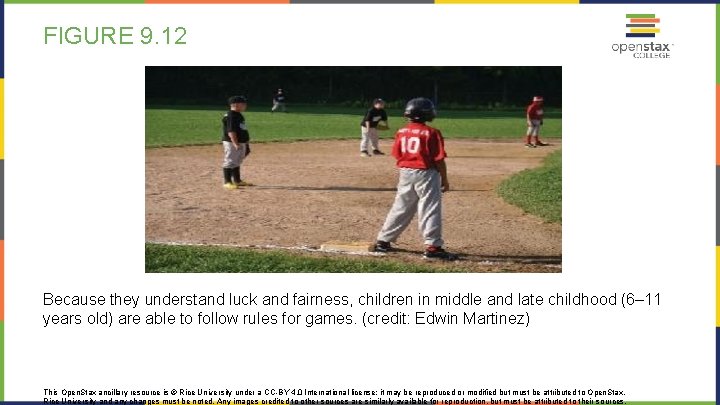
FIGURE 9. 12 Because they understand luck and fairness, children in middle and late childhood (6– 11 years old) are able to follow rules for games. (credit: Edwin Martinez) This Open. Stax ancillary resource is © Rice University under a CC-BY 4. 0 International license; it may be reproduced or modified but must be attributed to Open. Stax, Rice University and any changes must be noted. Any images credited to other sources are similarly available for reproduction, but must be attributed to their sources.
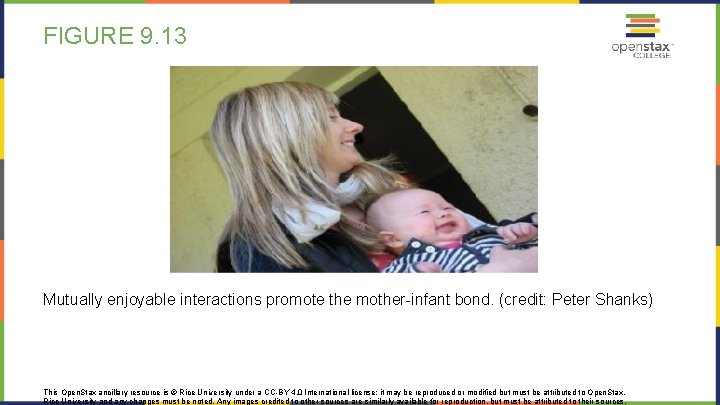
FIGURE 9. 13 Mutually enjoyable interactions promote the mother-infant bond. (credit: Peter Shanks) This Open. Stax ancillary resource is © Rice University under a CC-BY 4. 0 International license; it may be reproduced or modified but must be attributed to Open. Stax, Rice University and any changes must be noted. Any images credited to other sources are similarly available for reproduction, but must be attributed to their sources.
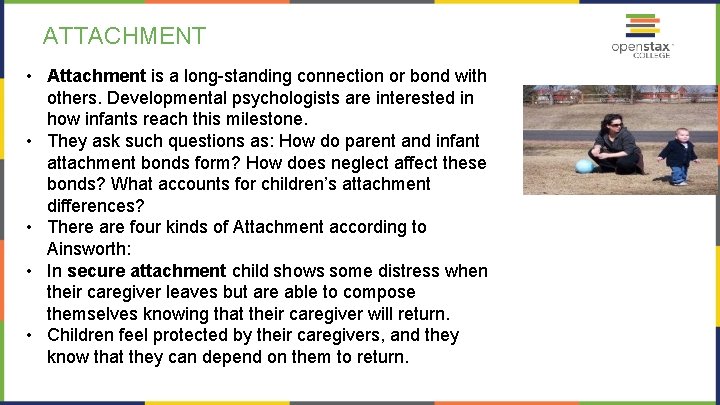
ATTACHMENT • Attachment is a long-standing connection or bond with others. Developmental psychologists are interested in how infants reach this milestone. • They ask such questions as: How do parent and infant attachment bonds form? How does neglect affect these bonds? What accounts for children’s attachment differences? • There are four kinds of Attachment according to Ainsworth: • In secure attachment child shows some distress when their caregiver leaves but are able to compose themselves knowing that their caregiver will return. • Children feel protected by their caregivers, and they know that they can depend on them to return.
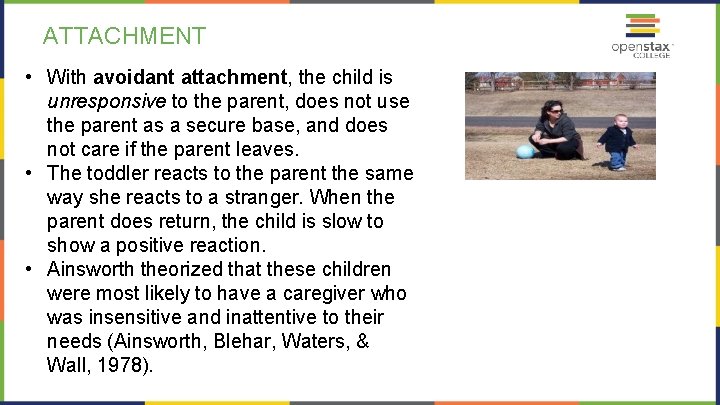
ATTACHMENT • With avoidant attachment, the child is unresponsive to the parent, does not use the parent as a secure base, and does not care if the parent leaves. • The toddler reacts to the parent the same way she reacts to a stranger. When the parent does return, the child is slow to show a positive reaction. • Ainsworth theorized that these children were most likely to have a caregiver who was insensitive and inattentive to their needs (Ainsworth, Blehar, Waters, & Wall, 1978).
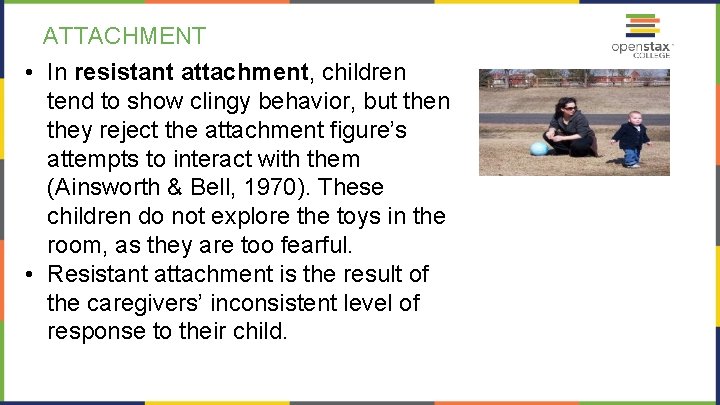
ATTACHMENT • In resistant attachment, children tend to show clingy behavior, but then they reject the attachment figure’s attempts to interact with them (Ainsworth & Bell, 1970). These children do not explore the toys in the room, as they are too fearful. • Resistant attachment is the result of the caregivers’ inconsistent level of response to their child.
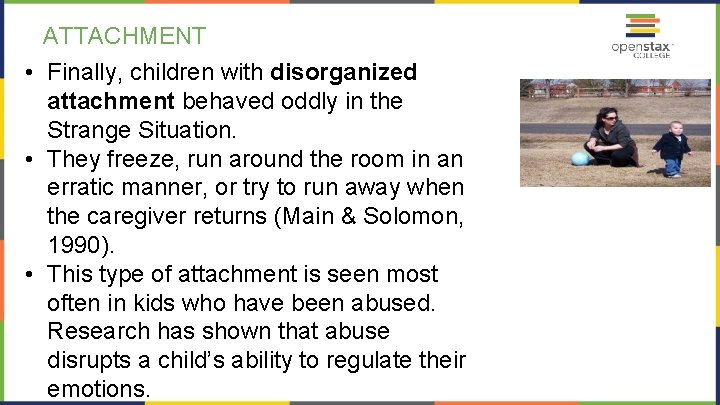
ATTACHMENT • Finally, children with disorganized attachment behaved oddly in the Strange Situation. • They freeze, run around the room in an erratic manner, or try to run away when the caregiver returns (Main & Solomon, 1990). • This type of attachment is seen most often in kids who have been abused. Research has shown that abuse disrupts a child’s ability to regulate their emotions.
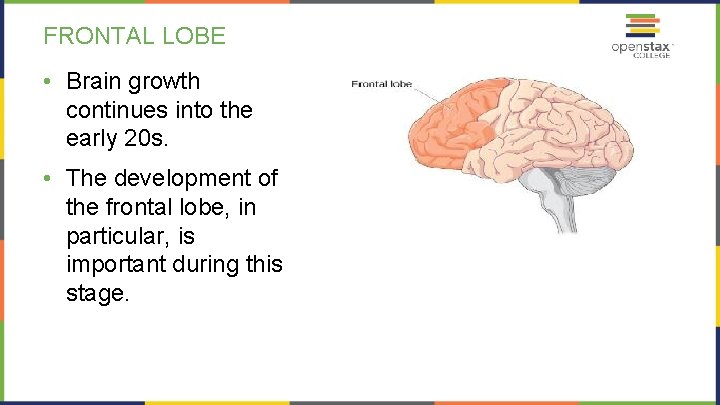
FRONTAL LOBE • Brain growth continues into the early 20 s. • The development of the frontal lobe, in particular, is important during this stage.
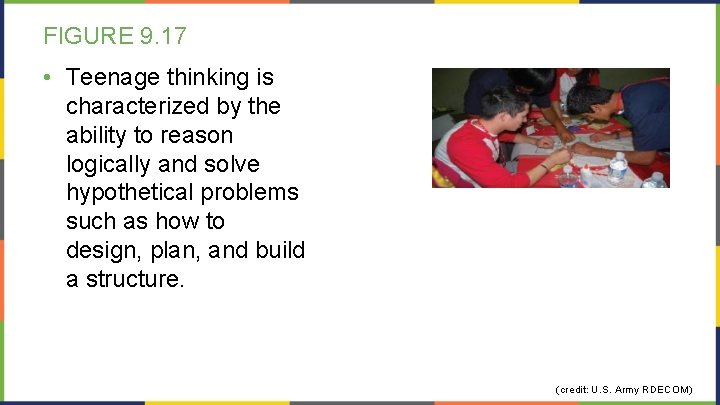
FIGURE 9. 17 • Teenage thinking is characterized by the ability to reason logically and solve hypothetical problems such as how to design, plan, and build a structure. (credit: U. S. Army RDECOM)
FIGURE 9. 18 • Physical declines of middle and late adulthood can be minimized with proper exercise, nutrition, and an active lifestyle. (credit: modification of work by Peter Stevens)
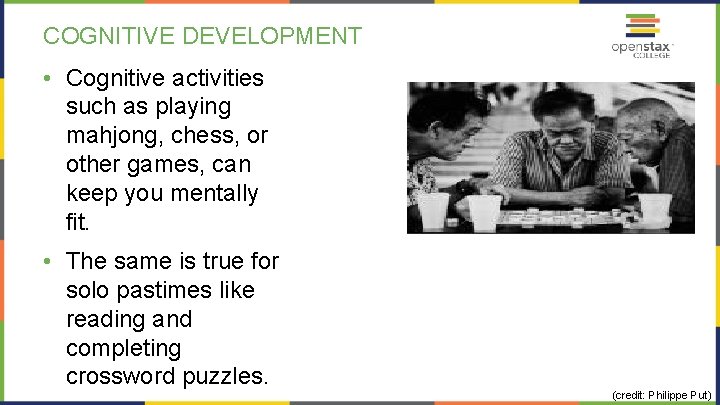
COGNITIVE DEVELOPMENT • Cognitive activities such as playing mahjong, chess, or other games, can keep you mentally fit. • The same is true for solo pastimes like reading and completing crossword puzzles. (credit: Philippe Put)
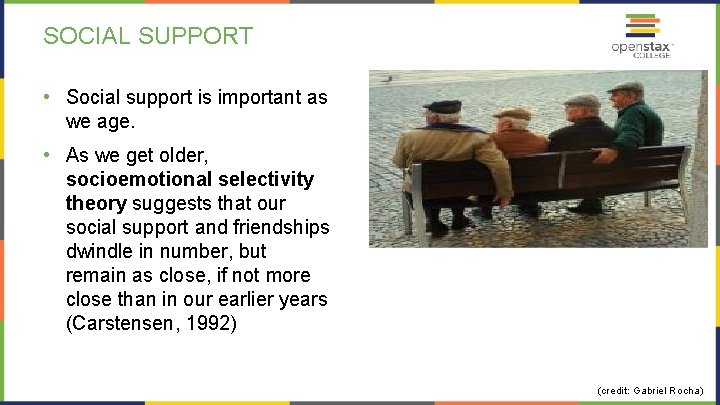
SOCIAL SUPPORT • Social support is important as we age. • As we get older, socioemotional selectivity theory suggests that our social support and friendships dwindle in number, but remain as close, if not more close than in our earlier years (Carstensen, 1992) (credit: Gabriel Rocha)
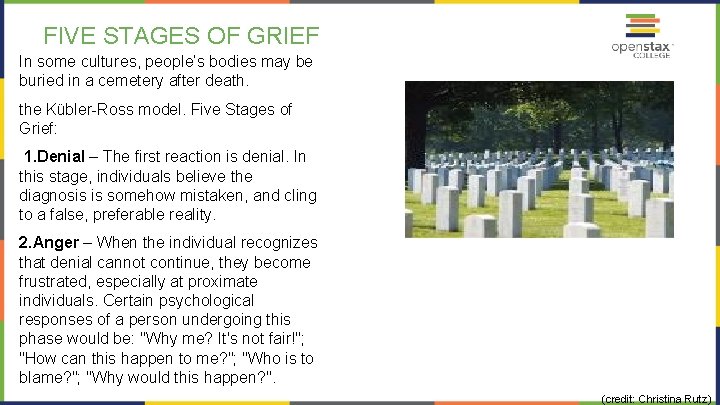
FIVE STAGES OF GRIEF In some cultures, people’s bodies may be buried in a cemetery after death. the Kübler-Ross model. Five Stages of Grief: 1. Denial – The first reaction is denial. In this stage, individuals believe the diagnosis is somehow mistaken, and cling to a false, preferable reality. 2. Anger – When the individual recognizes that denial cannot continue, they become frustrated, especially at proximate individuals. Certain psychological responses of a person undergoing this phase would be: "Why me? It's not fair!"; "How can this happen to me? "; "Who is to blame? "; "Why would this happen? ". (credit: Christina Rutz)
FIVE STAGES OF GRIEF 3. Bargaining – The third stage involves the hope that the individual can avoid a cause of grief. Usually, the negotiation for an extended life is made in exchange for a reformed lifestyle. People facing less serious trauma can bargain or seek compromise. For instance: "I'd give anything to have him back. " Or: "If only he'd come back to life, I'd promise to be a better person!" 4. Depression – "I'm so sad, why bother with anything? "; "I'm going to die soon, so what's the point? "; "I miss my loved one, why go on? " During the fourth stage, the individual despairs at the recognition of their mortality. In this state, the individual may become silent, refuse visitors and spend much of the time mournful and sullen. 5. Acceptance – "It's going to be okay. "; "I can't fight it; I may as well prepare for it. " In this last stage, individuals embrace mortality or inevitable future, or that of a loved one, or other tragic event. People dying may precede the survivors in this state, which typically comes with a calm, retrospective view for the individual, and a stable condition of emotions. (credit: Christina Rutz)