
Psychology Chapter 6 Learning and Language Development Copyright


- Slides: 66
Psychology Chapter 6 Learning and Language Development Copyright © 2016, 2012 Pearson Education, Inc. All Rights Reserved
Module 14 Classical Conditioning Copyright © 2016, 2012 Pearson Education, Inc. All Rights Reserved
Learning Objectives 14. 1 Outline the principles of classical conditioning. 14. 2 Understand clinical and experimental examples of classical conditioning. 14. 3 Explain how classical conditioning applies to everyday life. Copyright © 2016, 2012 Pearson Education, Inc. All Rights Reserved
What is Learning? Learning Objective 14. 1: Outline the principles of classical conditioning. • Learning – any relatively permanent change in behavior brought about by experience or practice – When people learn anything, some part of their brain is physically changed to record what they have learned. – Change controlled by a genetic blueprint is called maturation. – https: //www. youtube. com/watch? v=q. G 2 Sw. E_6 u. VM Copyright © 2016, 2012 Pearson Education, Inc. All Rights Reserved
Pavlov and Classical Conditioning (1 of 2) Learning Objective 14. 1: Outline the principles of classical conditioning. • Ivan Pavlov – Russian physiologist who discovered classical conditioning through his work on digestion in dogs • Classical conditioning – learning to elicit an involuntary response to a stimulus other than the original, natural stimulus that normally produces the response Copyright © 2016, 2012 Pearson Education, Inc. All Rights Reserved
Pavlov and Classical Conditioning (2 of 2) Learning Objective 14. 1: Outline the principles of classical conditioning. • Reflex – an unlearned, involuntary response that is not under personal control or choice • Stimulus – any object, event, or experience that causes a response • Response – the reaction of an organism Copyright © 2016, 2012 Pearson Education, Inc. All Rights Reserved
Classical Conditioning Concepts (1 of 8) Learning Objective 14. 1: Outline the principles of classical conditioning. • Unconditioned stimulus (UCS) – a naturally occurring stimulus that leads to an involuntary (reflex) response – Unconditioned means “unlearned” or “naturally occurring. ” Copyright © 2016, 2012 Pearson Education, Inc. All Rights Reserved
Classical Conditioning Concepts (2 of 8) Learning Objective 14. 1: Outline the principles of classical conditioning. • Unconditioned response (UCR) – an involuntary response to a naturally occurring or unconditioned stimulus • Neutral stimulus (NS) – stimulus that has no effect on the desired response Copyright © 2016, 2012 Pearson Education, Inc. All Rights Reserved
Classical Conditioning Concepts (3 of 8) Learning Objective 14. 1: Outline the principles of classical conditioning. • Conditioned stimulus (CS) – stimulus that becomes able to produce a learned response by being paired with the original unconditioned stimulus – A neutral stimulus can become a conditioned stimulus when paired with an unconditioned stimulus. Copyright © 2016, 2012 Pearson Education, Inc. All Rights Reserved
Classical Conditioning Concepts (4 of 8) Learning Objective 14. 1: Outline the principles of classical conditioning. • Conditioned response (CR) – learned reflex response to a conditioned stimulus – Sometimes called a conditioned reflex Copyright © 2016, 2012 Pearson Education, Inc. All Rights Reserved
Classical Conditioning Concepts (5 of 8) Learning Objective 14. 1: Outline the principles of classical conditioning. • Although classical conditioning happens quite easily, there a few basic principles that researchers have discovered: – The CR (conditioned response) and UCR (unconditioned response) are essentially the same – they simply differ in what they are the response to. – An unconditioned stimulus (UCS) is always followed by an unconditioned response (UCR). – A conditioned stimulus (CS) is always followed by a conditioned response (CR). Copyright © 2016, 2012 Pearson Education, Inc. All Rights Reserved
Classical Conditioning Concepts (6 of 8) Learning Objective 14. 1: Outline the principles of classical conditioning. • The repeated pairing of NS and the UCS (unconditioned stimulus) is called acquisition • Stimulus generalization – the tendency to respond to a stimulus that is only similar to the original conditioned stimulus with the conditioned response Copyright © 2016, 2012 Pearson Education, Inc. All Rights Reserved
Classical Conditioning Concepts (7 of 8) Learning Objective 14. 1: Outline the principles of classical conditioning. • Stimulus discrimination – the tendency to stop making a generalized response to a stimulus that is similar to the original conditioned stimulus because the similar stimulus is never paired with the unconditioned stimulus Copyright © 2016, 2012 Pearson Education, Inc. All Rights Reserved
Classical Conditioning Concepts (8 of 8) Learning Objective 14. 1: Outline the principles of classical conditioning. • Extinction – the disappearance or weakening of a learned response following the removal or absence of the unconditioned stimulus (in classical conditioning) or the removal of a reinforcer (in operant conditioning) • Spontaneous recovery – the reappearance of a learned response after extinction has occurred • https: //www. youtube. com/watch? v=hhqumfpxuz. I Copyright © 2016, 2012 Pearson Education, Inc. All Rights Reserved
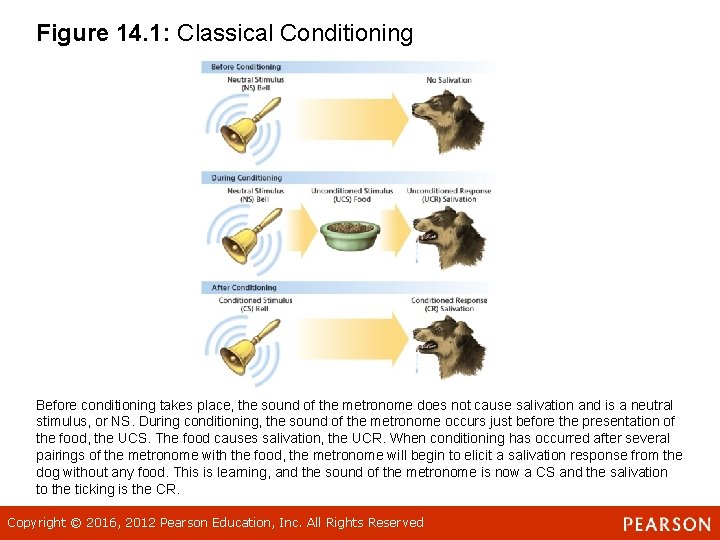
Figure 14. 1: Classical Conditioning Before conditioning takes place, the sound of the metronome does not cause salivation and is a neutral stimulus, or NS. During conditioning, the sound of the metronome occurs just before the presentation of the food, the UCS. The food causes salivation, the UCR. When conditioning has occurred after several pairings of the metronome with the food, the metronome will begin to elicit a salivation response from the dog without any food. This is learning, and the sound of the metronome is now a CS and the salivation to the ticking is the CR. Copyright © 2016, 2012 Pearson Education, Inc. All Rights Reserved
Figure 14. 2: Strength of the Generalized Response An example of stimulus generalization. The UCS was an electric shock and the UCR was the galvanic skin response (GSR), a measure associated with anxiety. The subjects had been conditioned originally to a CS tone (0) of a given frequency. When tested with the original tone, and with tones 1, 2, and 3 of differing frequencies, a clear generalization effect appeared. The closer the frequency of the test tone to the frequency of tone 0, the greater was the magnitude of the galvanic skin response to the tone. Copyright © 2016, 2012 Pearson Education, Inc. All Rights Reserved
Figure 14. 3: Extinction and Spontaneous Recovery This graph shows the acquisition, extinction, spontaneous recovery, and reacquisition of a conditioned salivary response. Typically, the measure of conditioning is the number of drops of saliva elicited by the CS on each trial. Note that on the day following extinction, the first presentation of the CS elicits quite a large response. This response is due to spontaneous recovery. Copyright © 2016, 2012 Pearson Education, Inc. All Rights Reserved
Conditioned Emotional Response (1 of 2) Learning Objective 14. 2: Understand clinical and experimental examples of classical conditioning. • Conditioned emotional response (CER) – emotional response that has become classically conditioned to occur to learned stimuli, such as a fear of dogs or the emotional reaction that occurs when seeing an attractive person – CERs may lead to phobias – irrational fear responses. Copyright © 2016, 2012 Pearson Education, Inc. All Rights Reserved
Conditioned Emotional Response (2 of 2) Learning Objective 14. 2: Understand clinical and experimental examples of classical conditioning. • Vicarious conditioning – classical conditioning of a reflex response or emotion by watching the reaction of another person Copyright © 2016, 2012 Pearson Education, Inc. All Rights Reserved
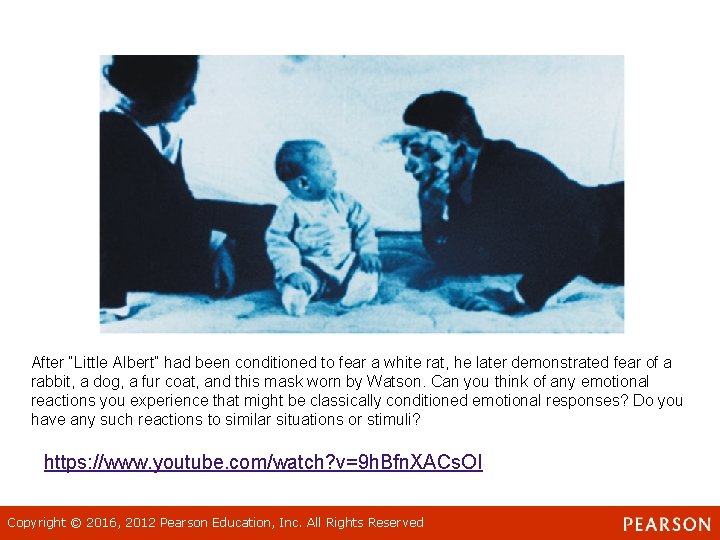
After “Little Albert” had been conditioned to fear a white rat, he later demonstrated fear of a rabbit, a dog, a fur coat, and this mask worn by Watson. Can you think of any emotional reactions you experience that might be classically conditioned emotional responses? Do you have any such reactions to similar situations or stimuli? https: //www. youtube. com/watch? v=9 h. Bfn. XACs. OI Copyright © 2016, 2012 Pearson Education, Inc. All Rights Reserved
Taste Aversion (1 of 2) Learning Objective 14. 3: Explain how classical conditioning applies to everyday life. • Conditioned taste aversion – development of a nausea or aversive response to a particular taste because that taste was followed by a nausea reaction, occurring after only one association Copyright © 2016, 2012 Pearson Education, Inc. All Rights Reserved
Taste Aversion (2 of 2) Learning Objective 14. 3: Explain how classical conditioning applies to everyday life. • Biological preparedness – the tendency of animals to learn certain associations, such as taste and nausea, with only one or few pairings due to the survival value of the learning Copyright © 2016, 2012 Pearson Education, Inc. All Rights Reserved
Module 15 Operant Conditioning Copyright © 2016, 2012 Pearson Education, Inc. All Rights Reserved
Learning Objectives 15. 1 Understand the Law of Effect. 15. 2 Explain the principles of operant conditioning. 15. 3 Describe specialized examples of operant conditioning. 15. 4 Describe how operant conditioning applies to everyday life. Copyright © 2016, 2012 Pearson Education, Inc. All Rights Reserved
Classical and Operant Conditioning Learning Objective 15. 1: Understand the Law of Effect. • Classical conditioning: occurs with automatic, involuntary behavior • Operant conditioning: applies to voluntary behavior Copyright © 2016, 2012 Pearson Education, Inc. All Rights Reserved
Law of Effect Learning Objective 15. 1: Understand the Law of Effect. • Thorndike’s “puzzle box” experiment • Principle behind learning voluntary behavior: – An action followed by a pleasurable consequence will tend to be repeated. – An action followed by an unpleasant consequence will tend not to be repeated. – https: //www. youtube. com/watch? v=BDuj. DOLre-8 Copyright © 2016, 2012 Pearson Education, Inc. All Rights Reserved
Skinner’s Contribution Learning Objective 15. 2: Explain the principles of operant conditioning. • Behaviorist; wanted to study only observable, measurable behavior • Gave “operant conditioning” its name • Operant conditioning – based on the effect of consequences on behavior • https: //www. youtube. com/watch? v=I_ct. Jqjlr. HA • https: //www. youtube. com/watch? v=MOgow. Ry 2 W C 0 Copyright © 2016, 2012 Pearson Education, Inc. All Rights Reserved
Operant Conditioning Learning Objective 15. 2: Explain the principles of operant conditioning. • In classical conditioning, learning depends on what happens before the response – Antecedent stimuli – stimuli that comes before another • In operant conditioning, learning depends on what happens after the response – the consequence Copyright © 2016, 2012 Pearson Education, Inc. All Rights Reserved
The Concept of Reinforcement (1 of 2) Learning Objective 15. 2: Explain the principles of operant conditioning. • Reinforcement – any event or stimulus that, when following a response, increases the probability that the response will occur again – Primary reinforcer: any reinforcer that is naturally reinforcing by meeting a basic biological need, such as hunger, thirst, or touch – Secondary reinforcer: any reinforcer that becomes reinforcing after being paired with a primary reinforcer, such as praise, tokens, or gold stars Copyright © 2016, 2012 Pearson Education, Inc. All Rights Reserved
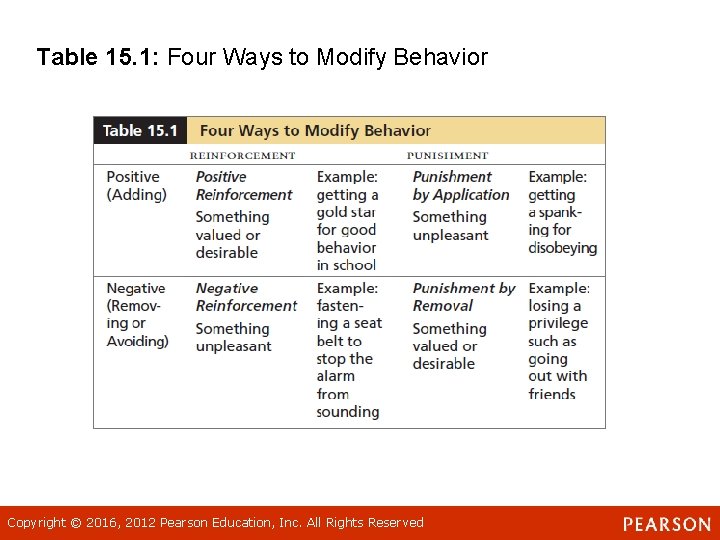
The Concept of Reinforcement (2 of 2) Learning Objective 15. 2: Explain the principles of operant conditioning. • Positive reinforcement – the reinforcement (strengthening) of a response by the addition or experience of a pleasurable stimulus • Negative reinforcement – the reinforcement (strengthening) of a response by the removal, escape from, or avoidance of an unpleasant stimulus Copyright © 2016, 2012 Pearson Education, Inc. All Rights Reserved
Schedules of Reinforcement (1 of 4) Learning Objective 15. 3: Describe specialized examples of operant conditioning. • The Partial Reinforcement Effect – Partial reinforcement – reinforcer after some but not all correct responses – Continuous reinforcement – reinforcer for each and every correct response • A response that receives partial reinforcement will be more resistant to extinction than a response that receives continuous reinforcement Copyright © 2016, 2012 Pearson Education, Inc. All Rights Reserved
Schedules of Reinforcement (2 of 4) Learning Objective 15. 3: Describe specialized examples of operant conditioning. • Partial reinforcement can be accomplished according to different patterns or schedules – Interval schedule: when the timing of the response is more important – Ratio schedule: when the number of responses is more important Copyright © 2016, 2012 Pearson Education, Inc. All Rights Reserved
Schedules of Reinforcement (3 of 4) Learning Objective 15. 3: Describe specialized examples of operant conditioning. • Fixed interval schedule of reinforcement – the interval of time that must pass before reinforcement becomes possible is always the same • Variable interval schedule of reinforcement – the interval of time that must pass before reinforcement becomes possible is different for each trial or event Copyright © 2016, 2012 Pearson Education, Inc. All Rights Reserved
Schedules of Reinforcement (4 of 4) Learning Objective 15. 3: Describe specialized examples of operant conditioning. • Fixed ratio schedule of reinforcement – the number of responses required for reinforcement is always the same • Variable ratio schedule of reinforcement – the number of responses required for reinforcement is different for each trial or event • https: //www. youtube. com/watch? v=6 Ofbt 16 AJgg Copyright © 2016, 2012 Pearson Education, Inc. All Rights Reserved
Punishment Learning Objective 15. 3: Describe specialized examples of operant conditioning. • Punishment – any event or object which, when following a response, makes that response less likely to happen again – Punishment by application (+): the punishment of a response by the addition or experience of an unpleasant stimulus – Punishment by removal (-): the punishment of a response by the removal of a pleasurable stimulus – https: //www. youtube. com/watch? v=imkbu. Kom. PXI Copyright © 2016, 2012 Pearson Education, Inc. All Rights Reserved
Table 15. 1: Four Ways to Modify Behavior Copyright © 2016, 2012 Pearson Education, Inc. All Rights Reserved
Applications of Operant Conditioning Learning Objective 15. 4: Describe how operant conditioning applies to everyday life. • Shaping – reinforcement of simple steps, leading to a desired, more complex behavior • Successive approximation – small steps, one after another, that lead to a particular goal behavior Copyright © 2016, 2012 Pearson Education, Inc. All Rights Reserved
Behavior Modification (1 of 4) Learning Objective 15. 4: Describe how operant conditioning applies to everyday life. • Behavior modification – use of operant conditioning techniques to bring about desired changes in behavior • Methods: – Token economy – Time-out – Biofeedback Copyright © 2016, 2012 Pearson Education, Inc. All Rights Reserved
Behavior Modification (2 of 4) Learning Objective 15. 4: Describe how operant conditioning applies to everyday life. • Token economy – a type of behavior modification in which desired behavior is rewarded with tokens – Tokens are secondary reinforcers that can be traded in for other kinds of reinforcers. Copyright © 2016, 2012 Pearson Education, Inc. All Rights Reserved
Behavior Modification (3 of 4) Learning Objective 15. 4: Describe how operant conditioning applies to everyday life. • Time-out – a form of mild punishment by removal in which a misbehaving animal, child, or adult is placed in a special area away from the attention of others – Essentially, the organism is being “removed” from any possibility of positive reinforcement in the form of attention. Copyright © 2016, 2012 Pearson Education, Inc. All Rights Reserved
Behavior Modification (4 of 4) Learning Objective 15. 4: Describe how operant conditioning applies to everyday life. • Biofeedback – use of feedback about biological conditions to bring involuntary responses such as blood pressure and relaxation under voluntary control – May be used to modify involuntary behavior such as blood pressure and muscle tension Copyright © 2016, 2012 Pearson Education, Inc. All Rights Reserved
Module 16 Cognitive Learning and Observational Learning Copyright © 2016, 2012 Pearson Education, Inc. All Rights Reserved
Learning Objectives 16. 1 Understand the principles of cognitive learning. 16. 2 Learn how cognitive learning applies to everyday life. 16. 3 Understand the principles of observational learning. 16. 4 Learn how observational learning applies to everyday life. Copyright © 2016, 2012 Pearson Education, Inc. All Rights Reserved
Cognitive Learning Theory Learning Objective 16. 1: Understand the principles of cognitive learning. • Deals with mind’s influence over behavior • Supplements the more traditional theories of learning • Key theorists during the early days: – Edward Tolman – Wolfgang Köhler – Martin Seligman Copyright © 2016, 2012 Pearson Education, Inc. All Rights Reserved
Concepts of Cognitive Learning Objective 16. 1: Understand the principles of cognitive learning. • Latent learning – learning that remains hidden until its application becomes useful • Insight – the sudden perception of relationships among various parts of a problem, allowing the solution to the problem to come quickly • Learned helplessness – the tendency to fail to act to escape from a situation because of a history of repeated failures in the past Copyright © 2016, 2012 Pearson Education, Inc. All Rights Reserved
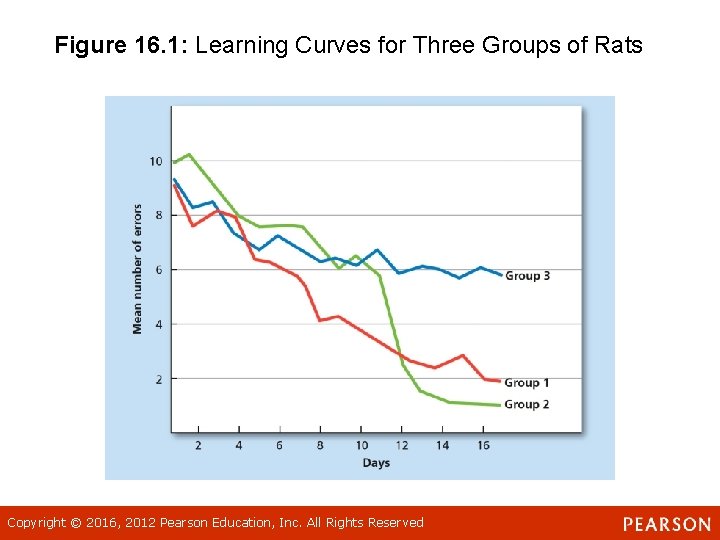
Tolman’s Maze-Running Rats: Latent Learning Objective 16. 1: Understand the principles of cognitive learning. • Three groups of rats placed in a maze – First group: Reinforced with food each day for making its way out – Second group: Did not receive any reinforcement upon exiting the maze until the tenth day – Third group: Not given reinforcement for the entire duration of the experiment • First group learned steadily, and surprisingly the second group began to solve the maze almost immediately upon reinforcement – latent learning Copyright © 2016, 2012 Pearson Education, Inc. All Rights Reserved
Figure 16. 1: Learning Curves for Three Groups of Rats Copyright © 2016, 2012 Pearson Education, Inc. All Rights Reserved
Köhler’s Smart Chimp: Insight Learning Objective 16. 1: Understand the principles of cognitive learning. • Set up a problem for one of the chimpanzees in the primate lab • “Perception of relationships” insight • Insight could not be gained through trial-and-error learning alone • https: //www. youtube. com/watch? v=6 -YWr. Pzsm. EE Copyright © 2016, 2012 Pearson Education, Inc. All Rights Reserved
Seligman’s Depressed Dogs: Learned Helplessness Learning Objective 16. 1: Understand the principles of cognitive learning. • Discovered during classical conditioning experiments on dogs • Escape and avoidance learning • https: //www. youtube. com/watch? v=Z 73 P 47 NCxo M Copyright © 2016, 2012 Pearson Education, Inc. All Rights Reserved
Cognitive Learning in Everyday Life Learning Objective 16. 2: Learn how cognitive learning applies to everyday life. • Depression explained by theory of learned helplessness • People tend to become somewhat apathetic, often staying in unpleasant environments rather than trying to escape or better their situation – Prevalence of a sense of powerlessness and hopelessness • Cognitive learning is an important part of a form of learning simplified as “monkey see, monkey do” Copyright © 2016, 2012 Pearson Education, Inc. All Rights Reserved
Observational Learning Objective 16. 3: Understand the principles of observational learning. • Observational learning – learning new behavior by watching someone else, called a “model, ” perform that behavior • The behavior might not be desirable Copyright © 2016, 2012 Pearson Education, Inc. All Rights Reserved
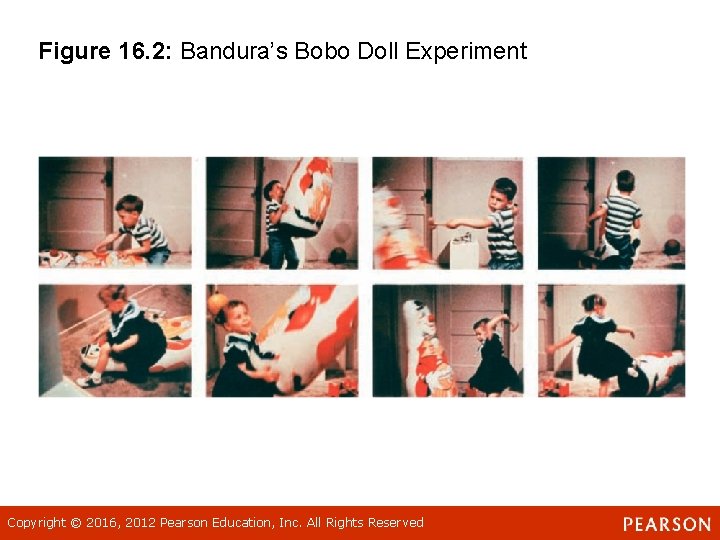
Bandura and the Bobo Doll Learning Objective 16. 3: Understand the principles of observational learning. • Experimenter and a model interacted with toys in the room in front of a child; one in an aggressive manner, the other in a nonaggressive way – Viewers of aggression played more aggressively – Model’s behavior was imitated even in absence of reward • https: //www. youtube. com/watch? v=zer. CK 0 l. Rjp 8 Copyright © 2016, 2012 Pearson Education, Inc. All Rights Reserved
Figure 16. 2: Bandura’s Bobo Doll Experiment Copyright © 2016, 2012 Pearson Education, Inc. All Rights Reserved
The Four Elements of Observational Learning Objective 16. 4: Learn how observational learning applies to everyday life. • The four elements of observational learning – Attention: learner must first pay attention to the model – Memory: learner must also be able to retain memory of what was done – Imitation: learner must be capable of reproducing the actions of the model – Desire: learner must have the motivation to perform the action Copyright © 2016, 2012 Pearson Education, Inc. All Rights Reserved
Module 17 Language Copyright © 2016, 2012 Pearson Education, Inc. All Rights Reserved
Learning Objectives 17. 1 Learn about the structure and function of language. 17. 2 Understand the relationship between language and thought. 17. 3 Describe the process of language acquisition. 17. 4 Consider theories of language acquisition. 17. 5 Describe the brain structures associated with language and understand how damage to the brain may affect language. Copyright © 2016, 2012 Pearson Education, Inc. All Rights Reserved
Language Learning Objective 17. 1: Learn about the structure and function of language. • Language – a system for combining symbols (such as words) so that an unlimited number of meaningful statements can be made for the purpose of communicating with others Copyright © 2016, 2012 Pearson Education, Inc. All Rights Reserved
Structural Features of Language (1 of 2) Learning Objective 17. 1: Learn about the structure and function of language. • Phonemes: the basic units of sound in a language • Morphemes: the smallest units of meaning within a language • Grammar: the system of rules governing the structure and use of a language Copyright © 2016, 2012 Pearson Education, Inc. All Rights Reserved
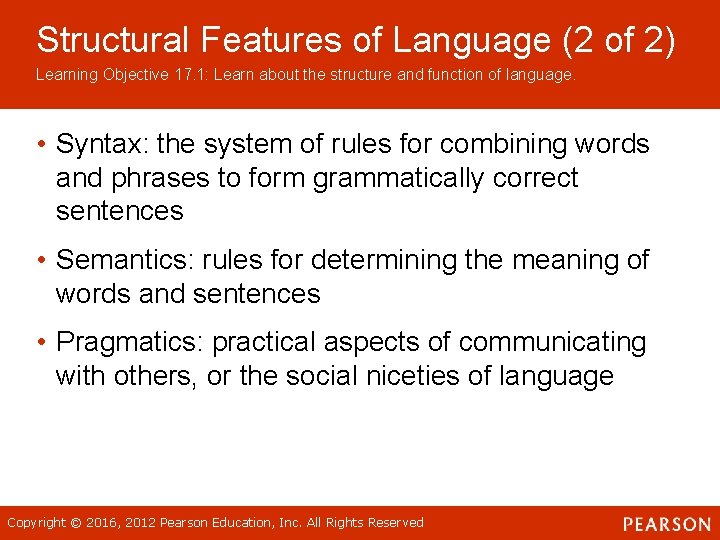
Structural Features of Language (2 of 2) Learning Objective 17. 1: Learn about the structure and function of language. • Syntax: the system of rules for combining words and phrases to form grammatically correct sentences • Semantics: rules for determining the meaning of words and sentences • Pragmatics: practical aspects of communicating with others, or the social niceties of language Copyright © 2016, 2012 Pearson Education, Inc. All Rights Reserved
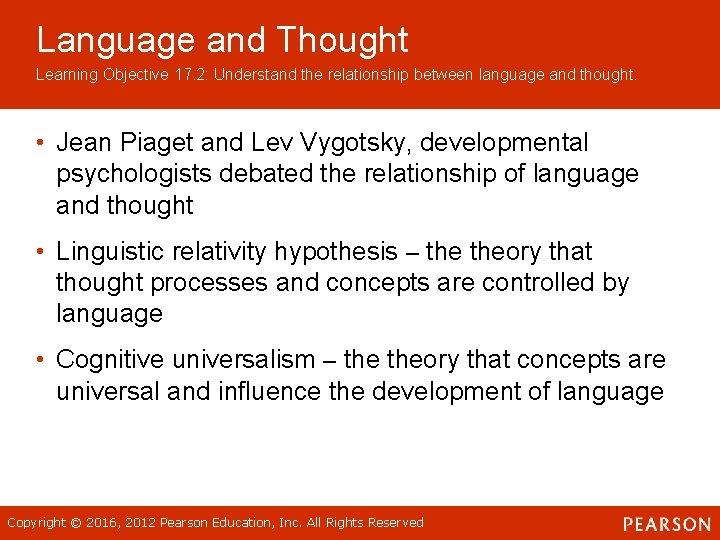
Language and Thought Learning Objective 17. 2: Understand the relationship between language and thought. • Jean Piaget and Lev Vygotsky, developmental psychologists debated the relationship of language and thought • Linguistic relativity hypothesis – theory that thought processes and concepts are controlled by language • Cognitive universalism – theory that concepts are universal and influence the development of language Copyright © 2016, 2012 Pearson Education, Inc. All Rights Reserved
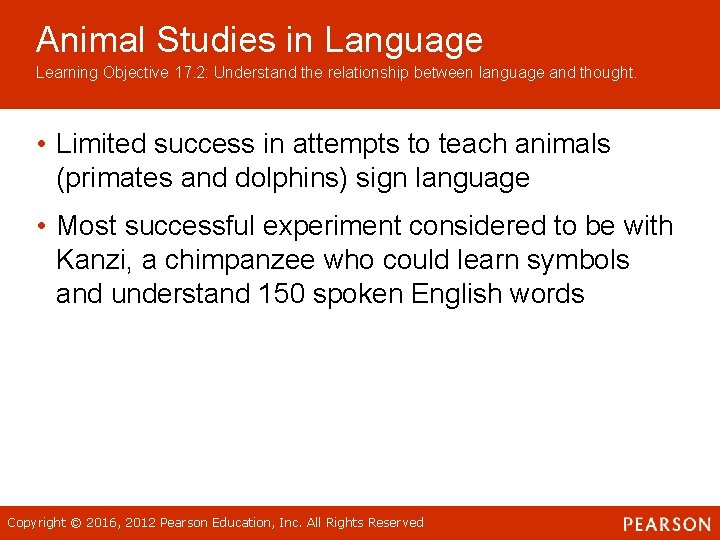
Animal Studies in Language Learning Objective 17. 2: Understand the relationship between language and thought. • Limited success in attempts to teach animals (primates and dolphins) sign language • Most successful experiment considered to be with Kanzi, a chimpanzee who could learn symbols and understand 150 spoken English words Copyright © 2016, 2012 Pearson Education, Inc. All Rights Reserved
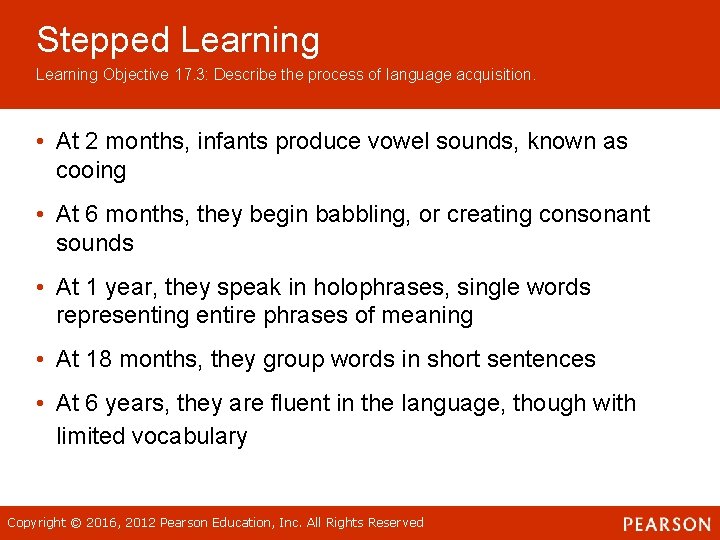
Stepped Learning Objective 17. 3: Describe the process of language acquisition. • At 2 months, infants produce vowel sounds, known as cooing • At 6 months, they begin babbling, or creating consonant sounds • At 1 year, they speak in holophrases, single words representing entire phrases of meaning • At 18 months, they group words in short sentences • At 6 years, they are fluent in the language, though with limited vocabulary Copyright © 2016, 2012 Pearson Education, Inc. All Rights Reserved
Theories of Language Acquisition (1 of 2) Learning Objective 17. 4: Consider theories of language acquisition. • Chomsky claimed that all humans are born with a language acquisition device (LAD) schema • Children use this LAD to analyze and comprehend the language they hear • They then reproduce the language sounds and eventually speak the language Copyright © 2016, 2012 Pearson Education, Inc. All Rights Reserved
Theories of Language Acquisition (2 of 2) Learning Objective 17. 4: Consider theories of language acquisition. • New theories focus on environmental factors • Use of higher pitched, repetitive sing-song voice to talk to infants • Expressive language delay in infants who use gestures and signs to communicate • Learning a second language poses challenges Copyright © 2016, 2012 Pearson Education, Inc. All Rights Reserved
Language and the Brain (1 of 2) Learning Objective 17. 5: Describe the brain structures associated with language and understand how damage to the brain may affect language. • Broca’s area: area in the left frontal lobe of the brain (in most people) devoted to the production of speech • Neurologist Paul Broca proved that damage to this area resulted in deficits in fluent and articulate speech • Broca’s aphasia: Speech is halting and words mispronounced or left out entirely – Example: saying “cot” instead of “clock” or “non” for “nine” Copyright © 2016, 2012 Pearson Education, Inc. All Rights Reserved
Language and the Brain (2 of 2) Learning Objective 17. 5: Describe the brain structures associated with language and understand how damage to the brain may affect language. • Wernicke studied problems arising from damage in an area, again in the left frontal lobe of the brain • Wernicke’s area involved understanding the meaning of words • Wernicke’s aphasia: speaking fluently and pronouncing words correctly, but saying the wrong words; also trouble in understanding what people say Copyright © 2016, 2012 Pearson Education, Inc. All Rights Reserved