
PSYCHOLOGY Chapter 4 PRINCIPLES IN PRACTICE Bellringer If
PSYCHOLOGY Chapter 4 PRINCIPLES IN PRACTICE Bellringer If you had to choose one of your senses to lose which one would it be and why? ---------------------------------- 1 HOLT, RINEHART AND WINSTON
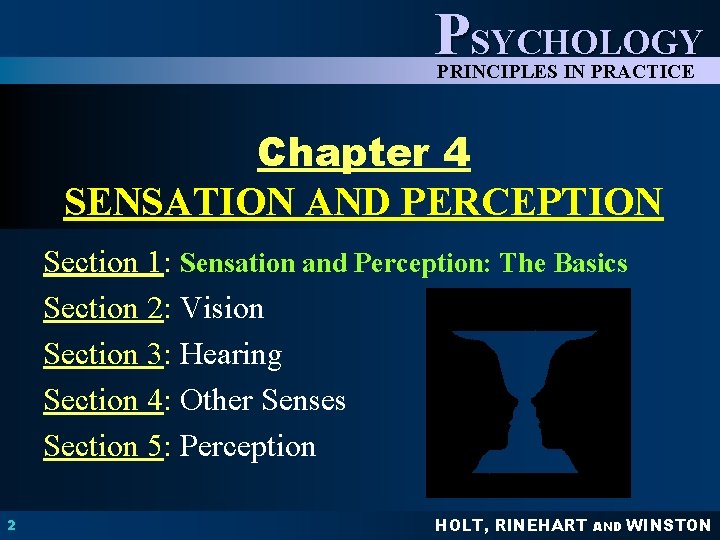
PSYCHOLOGY PRINCIPLES IN PRACTICE Chapter 4 SENSATION AND PERCEPTION Section 1: Sensation and Perception: The Basics Section 2: Vision Section 3: Hearing Section 4: Other Senses Section 5: Perception 2 HOLT, RINEHART AND WINSTON
Chapter 4 PSYCHOLOGY PRINCIPLES IN PRACTICE Chapter 4: Section 1 Sensation and Perception: The Basics 3 HOLT, RINEHART AND WINSTON
Chapter 4 PSYCHOLOGY PRINCIPLES IN PRACTICE Main Objective: n Distinguish between sensation and perception, and explain how they contribute to an understanding of our environment. 4 HOLT, RINEHART AND WINSTON
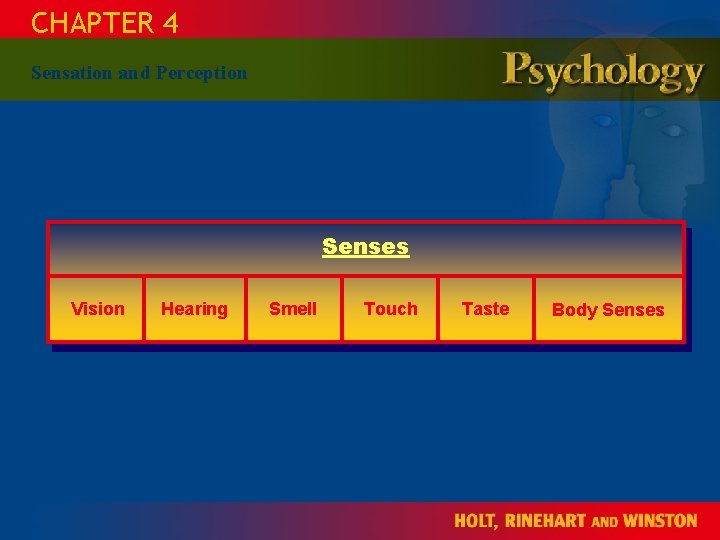
PSYCHOLOGY CHAPTER Chapter 4 4 PRINCIPLES IN PRACTICE Sensation and Perception Senses Vision 5 Hearing Smell Touch Taste Body Senses HOLT, RINEHART AND WINSTON
Chapter 4 PSYCHOLOGY PRINCIPLES IN PRACTICE What is Sensation and Perception? ? ? n Sensation: n The stimulation of sensory receptors and the transmission of sensory information to the central nervous system (the spinal cord and brain). n Perception: n Psychological process through which we interpret sensory stimulation. n EX: We realize that the people on a small TV are bigger in real life. 6 HOLT, RINEHART AND WINSTON
Chapter 4 PSYCHOLOGY PRINCIPLES IN PRACTICE Stimulation of senses and the ways in which people interpret that stimulation are affected by several concepts: n Absolute threshold n Difference Threshold n Signal-detection theory n Sensory adaptation 7 HOLT, RINEHART AND WINSTON

Chapter 4 PSYCHOLOGY PRINCIPLES IN PRACTICE Absolute Threshold: n The weakest amount of a stimulus that can be sensed. n EX: Hearing the first beep in a hearing test. n Dogs can hear and smell things that people cannot…they have a different threshold. n Thresholds differ from person to person! 8 HOLT, RINEHART AND WINSTON
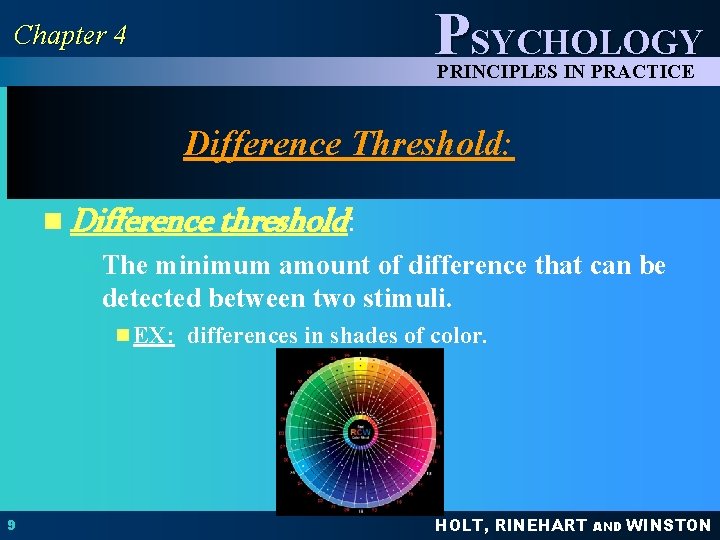
PSYCHOLOGY Chapter 4 PRINCIPLES IN PRACTICE Difference Threshold: n Difference threshold: n The minimum amount of difference that can be detected between two stimuli. n EX: differences in shades of color. 9 HOLT, RINEHART AND WINSTON
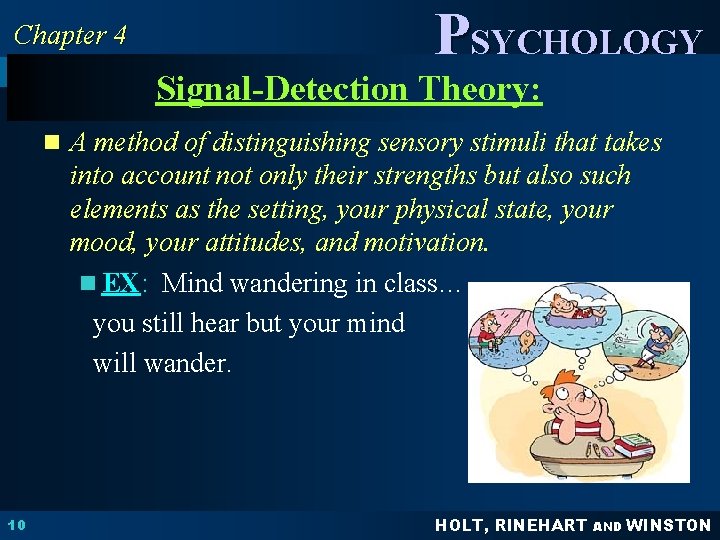
Chapter 4 PSYCHOLOGY PRINCIPLES IN PRACTICE Signal-Detection Theory: n A method of distinguishing sensory stimuli that takes into account not only their strengths but also such elements as the setting, your physical state, your mood, your attitudes, and motivation. n EX: Mind wandering in class… you still hear but your mind will wander. 10 HOLT, RINEHART AND WINSTON
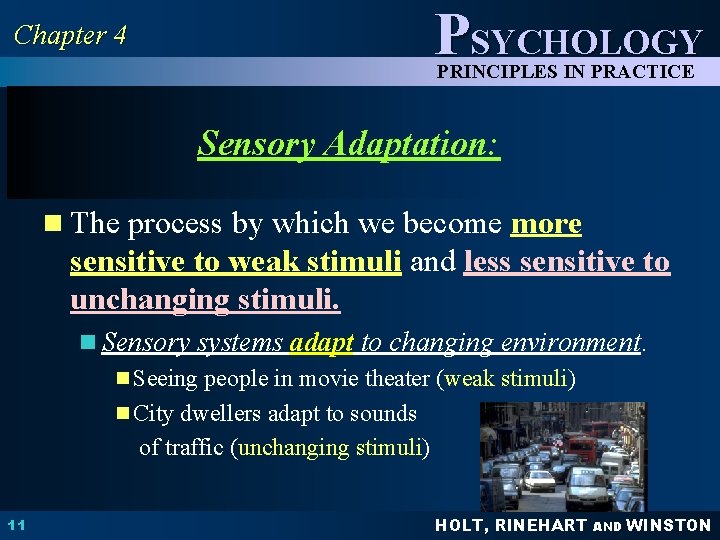
Chapter 4 PSYCHOLOGY PRINCIPLES IN PRACTICE Sensory Adaptation: n The process by which we become more sensitive to weak stimuli and less sensitive to unchanging stimuli. n Sensory systems adapt to changing environment. n Seeing people in movie theater (weak stimuli) n City dwellers adapt to sounds of traffic (unchanging stimuli) 11 HOLT, RINEHART AND WINSTON
- Slides: 11