
PSYCHOLOGY Chapter 1 PRINCIPLES IN PRACTICE Bellringer ANSWER
PSYCHOLOGY Chapter 1 PRINCIPLES IN PRACTICE Bellringer ANSWER the following questions: 1. In your opinion, what is psychology? 2. Why is the study of psychology important? 3. What would you like to learn in this class? 1 HOLT, RINEHART AND WINSTON
PSYCHOLOGY PRINCIPLES IN PRACTICE Chapter 1 WHAT IS PSYCHOLOGY Section 1: Why Study Psychology? Section 2: What Psychologists Do Section 3: A History of Psychology Section 4: Contemporary Perspectives 2 HOLT, RINEHART AND WINSTON
Chapter 1 PSYCHOLOGY PRINCIPLES IN PRACTICE Chapter 1: Section 1 Why Study Psychology? ? ? 3 HOLT, RINEHART AND WINSTON
Chapter 1 PSYCHOLOGY PRINCIPLES IN PRACTICE Main Objective: n Identify the goals of psychology, and explain how psychology is a science. 4 HOLT, RINEHART AND WINSTON
Chapter 1 PSYCHOLOGY PRINCIPLES IN PRACTICE Behavior and Mental Processes: n Psychology: n The scientific study of behavior and mental processes. n Behavior: n Any action that other people can observe or measure: n EX: Laughing, walking, heart rate. 5 HOLT, RINEHART AND WINSTON
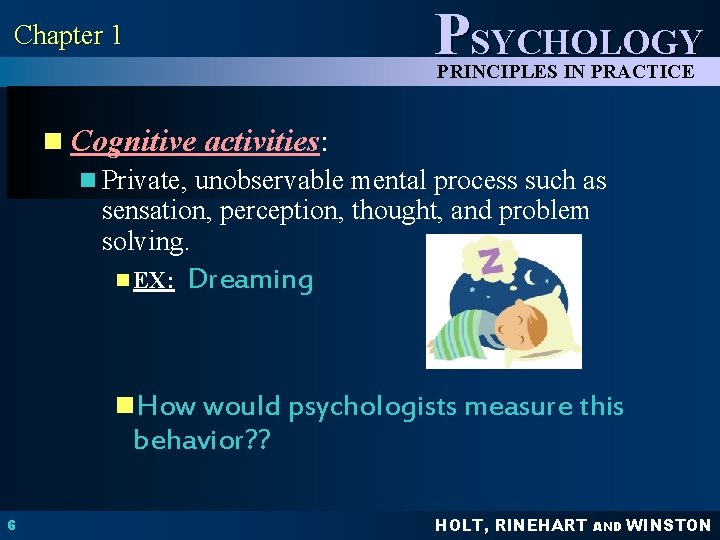
PSYCHOLOGY Chapter 1 PRINCIPLES IN PRACTICE n Cognitive activities: n Private, unobservable mental process such as sensation, perception, thought, and problem solving. n EX: Dreaming n. How would psychologists measure this behavior? ? 6 HOLT, RINEHART AND WINSTON
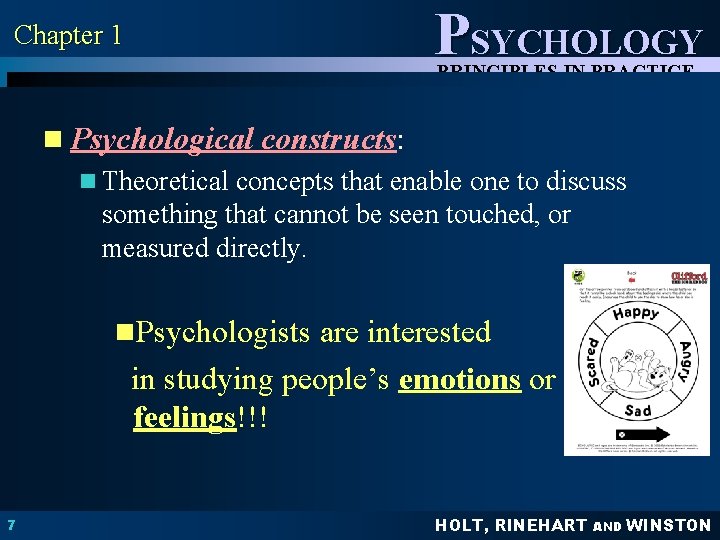
Chapter 1 PSYCHOLOGY PRINCIPLES IN PRACTICE n Psychological constructs: n Theoretical concepts that enable one to discuss something that cannot be seen touched, or measured directly. n. Psychologists are interested in studying people’s emotions or feelings!!! 7 HOLT, RINEHART AND WINSTON
Chapter 1 Section 1: Why Study Psychology? PSYCHOLOGY PRINCIPLES IN PRACTICE GOALS OF PSYCHOLOGY n Observe n Describe behavior n Explain n Predict n Control 8 HOLT, RINEHART AND WINSTON

Chapter 1 Section 1: Why Study Psychology? PSYCHOLOGY PRINCIPLES IN PRACTICE THE SCIENCE OF PSYCHOLOGY Psychology is a social science but has its foundation in the natural sciences (biology, chemistry). It deals with the structure of human society and interactions of individuals who make up society. 9 HOLT, RINEHART AND WINSTON
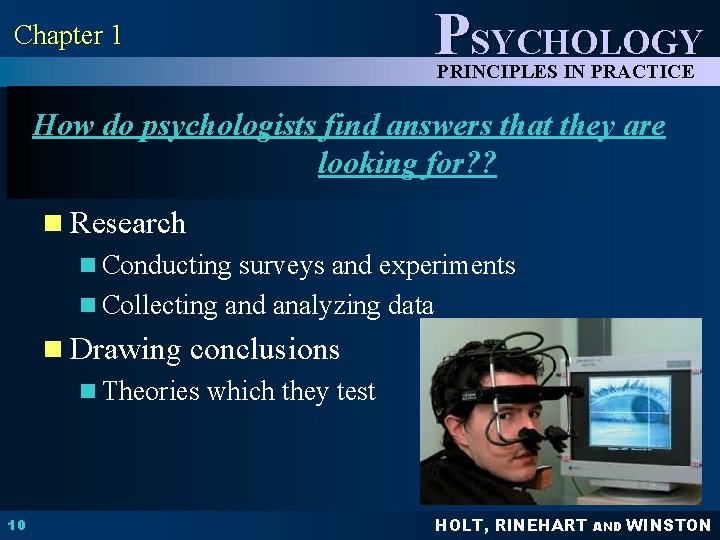
Chapter 1 PSYCHOLOGY PRINCIPLES IN PRACTICE How do psychologists find answers that they are looking for? ? n Research n Conducting surveys and experiments n Collecting and analyzing data n Drawing conclusions n Theories which they test 10 HOLT, RINEHART AND WINSTON
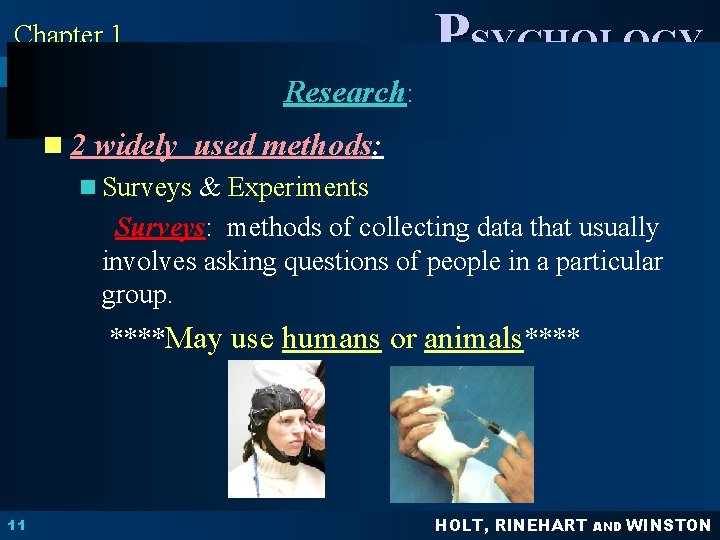
PSYCHOLOGY Chapter 1 Research: PRINCIPLES IN PRACTICE n 2 widely used methods: n Surveys & Experiments Surveys: methods of collecting data that usually involves asking questions of people in a particular group. ****May use humans or animals**** 11 HOLT, RINEHART AND WINSTON

Chapter 1 PSYCHOLOGY PRINCIPLES IN PRACTICE Psychological Theories: n Theory: a statement that attempts to explain why things are the way they are and happen the way they do. n Principle: a rule or law n EX: If you study, then you will get better grades!! 12 HOLT, RINEHART AND WINSTON
PSYCHOLOGY Chapter 1 PRINCIPLES IN PRACTICE Review 1. Give an example of a psychological construct. 2. How do psychologists find answers that they are looking for? 3. What is the difference between a theory and a principle? 13 HOLT, RINEHART AND WINSTON
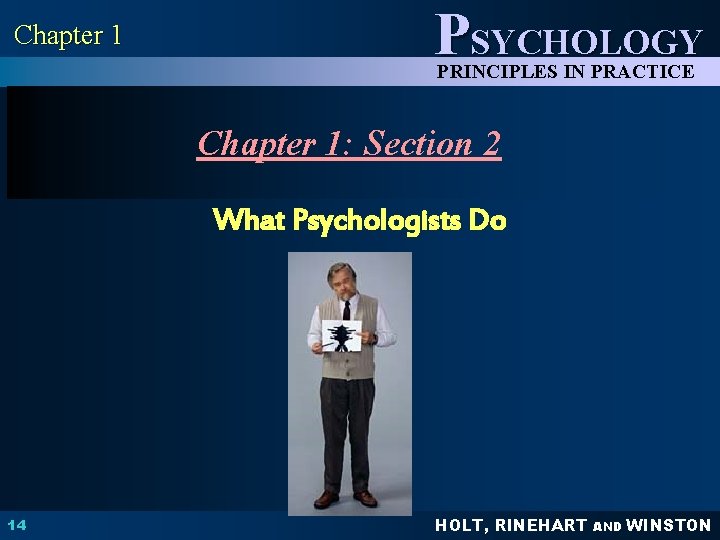
Chapter 1 PSYCHOLOGY PRINCIPLES IN PRACTICE Chapter 1: Section 2 What Psychologists Do 14 HOLT, RINEHART AND WINSTON
Chapter 1 PSYCHOLOGY PRINCIPLES IN PRACTICE Main Objective: n Describe the work done by psychologists according to their areas of specialization. n 15 HOLT, RINEHART AND WINSTON
Chapter 1 PSYCHOLOGY PRINCIPLES IN PRACTICE What do you think? ? ? n Write down movies that you have seen or books that you have read that have professional psychologists as characters. n What kinds of work did these psychologists do? n In which areas of psychology did they specialize? n How realistic were their characterizations? 16 HOLT, RINEHART AND WINSTON
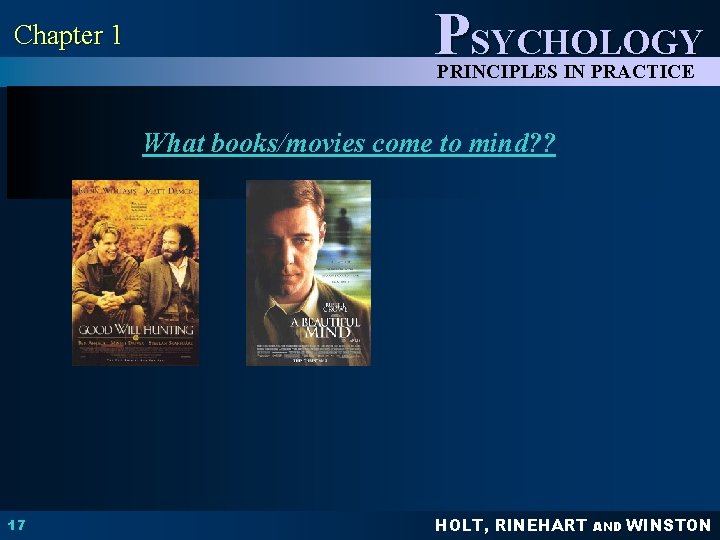
Chapter 1 PSYCHOLOGY PRINCIPLES IN PRACTICE What books/movies come to mind? ? 17 HOLT, RINEHART AND WINSTON
Chapter 1 PSYCHOLOGY PRINCIPLES IN PRACTICE 18 HOLT, RINEHART AND WINSTON
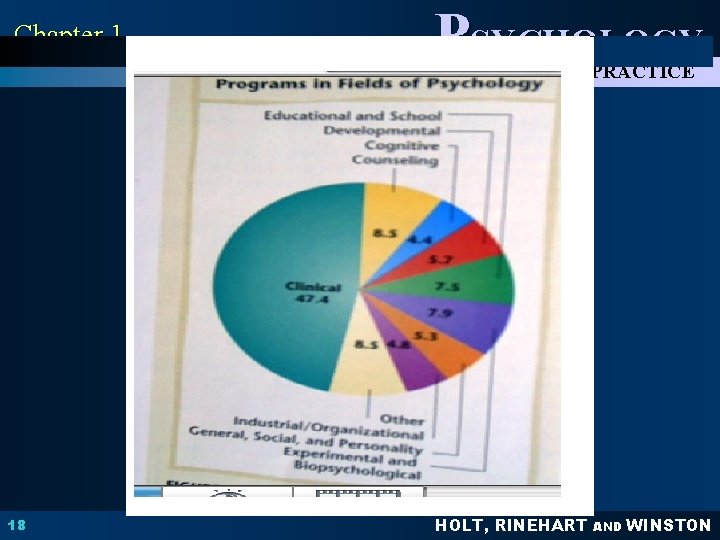
Chapter 1 Section 2: What Psychologists Do PSYCHOLOGY PRINCIPLES IN PRACTICE AREAS OF SPECIALIZATION n Clinical – the largest group – treat psychological problems. n Counseling – treat adjustment problems. n School – deal with students who have problems that interfere with learning. n Educational Psychologist – focus on course planning and instructional methods. n Help with developing SAT 19 HOLT, RINEHART AND WINSTON
Chapter 1 Section 2: What Psychologists Do PSYCHOLOGY PRINCIPLES IN PRACTICE AREAS OF SPECIALIZATION (continued) n Developmental Psychologists- study changes that occur throughout a persons’ life span. (physical, emotional, cognitive, social) n Personality Psychologist – identify characteristics or traits. (aggression; anxiety; shyness) n Social Psychologist – concerned with people’s behavior in social situations. (group behavior) n Experimental Psychologist – conduct research into basic processes, such as the nervous system. 20 HOLT, RINEHART AND WINSTON
Chapter 1 PSYCHOLOGY PRINCIPLES IN PRACTICE Experimental Psychologists (continued) n Focus on basic research: n Research that has no immediate application and is done for its own sake. n EX: Basic research into motivation has helped clinical and counseling psychologists develop ways of helping people control their eating habits. 21 HOLT, RINEHART AND WINSTON
Chapter 1 Section 2: What Psychologists Do PSYCHOLOGY PRINCIPLES IN PRACTICE AREAS OF SPECIALIZATION (continued) n Industrial and Organizational Psychologist – focus on people in work and business (assist in hiring) n Environmental Psychologist – focus on ways in which people influence and are influenced by physical environment (does crowding make people irritable? ) n Consumer Psychologist – study the behavior of shoppers to explain and predict behavior. (placement of milk) 22 HOLT, RINEHART AND WINSTON
Chapter 1 Section 2: What Psychologists Do PSYCHOLOGY PRINCIPLES IN PRACTICE AREAS OF SPECIALIZATION (continued) n Forensic Psychologist – are concerned with how psychological problems give rise to criminal behavior. n Health Psychologist – study the ways in which behavior and mental processes are related to physical health. n (Correlation with stress and heart disease) 23 HOLT, RINEHART AND WINSTON
Chapter 1 PSYCHOLOGY PRINCIPLES IN PRACTICE End of Chapter 1: 2 24 HOLT, RINEHART AND WINSTON
PSYCHOLOGY PRINCIPLES IN PRACTICE If you were to be a psychologist, what area would you choose to specialize in and why? Write a short description of a time that you watched a movie/played a video game/listened to music that you weren’t supposed to at a young age. Did your parents find out? Were you in trouble? 25 HOLT, RINEHART AND WINSTON
Chapter 1 PSYCHOLOGY PRINCIPLES IN PRACTICE Chapter 1: Section 3 A History of Psychology 26 HOLT, RINEHART AND WINSTON
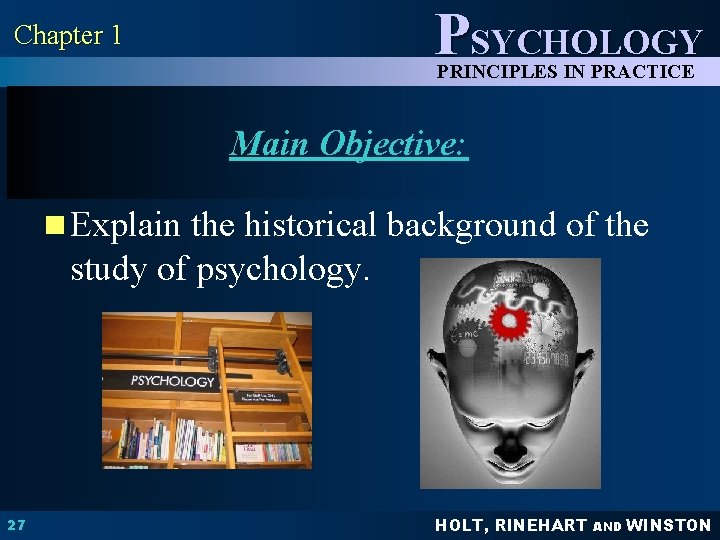
PSYCHOLOGY Chapter 1 PRINCIPLES IN PRACTICE Main Objective: n Explain the historical background of the study of psychology. 27 HOLT, RINEHART AND WINSTON
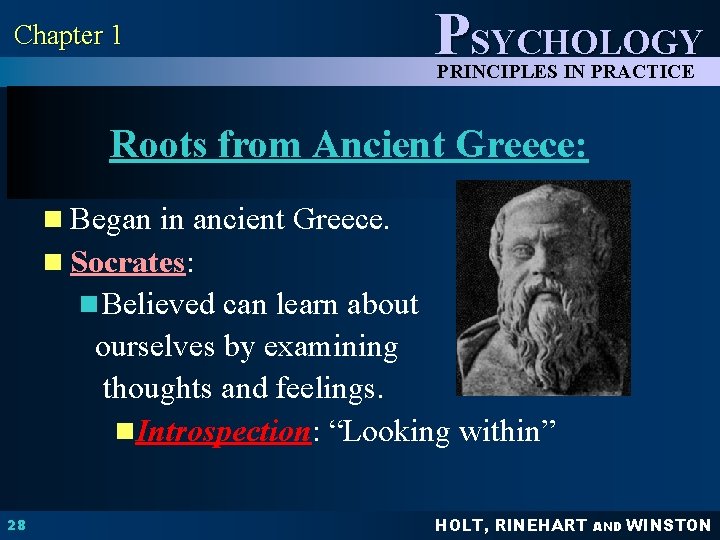
Chapter 1 PSYCHOLOGY PRINCIPLES IN PRACTICE Roots from Ancient Greece: n Began in ancient Greece. n Socrates: n Believed can learn about ourselves by examining thoughts and feelings. n. Introspection: “Looking within” 28 HOLT, RINEHART AND WINSTON
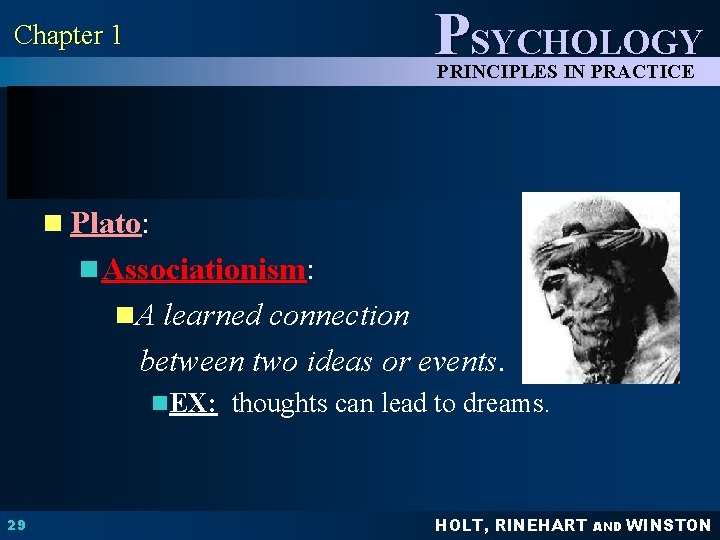
PSYCHOLOGY Chapter 1 PRINCIPLES IN PRACTICE n Plato: n Associationism: n. A learned connection between two ideas or events. n. EX: thoughts can lead to dreams. 29 HOLT, RINEHART AND WINSTON
PSYCHOLOGY Chapter 1 PRINCIPLES IN PRACTICE Middle Ages: n Europeans believed that problems were signs of possession by demons. n EX: punishment for sins n http: //youtu. be/2 h 6 QX-7 EW 2 Y 30 HOLT, RINEHART AND WINSTON
Chapter 1 Section 3: A History of Psychology PSYCHOLOGY PRINCIPLES IN PRACTICE PSYCHOLOGY DEVELOPED OVER TIME n Revived during the scientific advances of the 1500 s, 1600 s and 1700 s. n 1879: the year that many believe to be the beginning of psychology. n Considered a modern laboratory science by Wilhelm Wundt 31 HOLT, RINEHART AND WINSTON
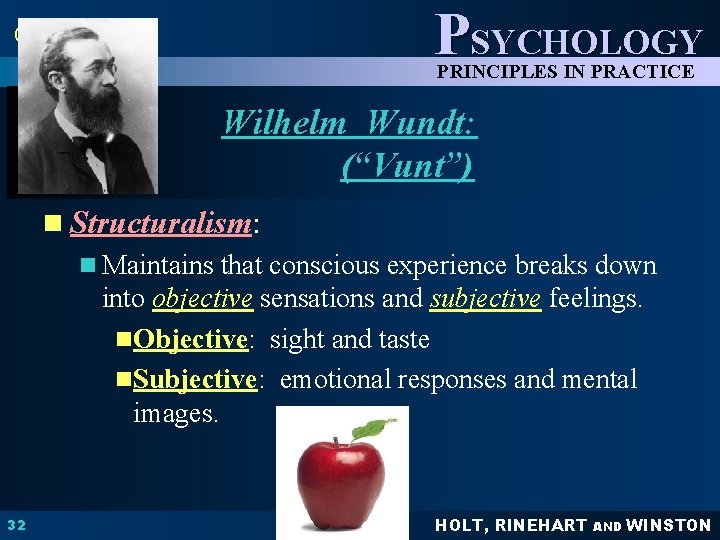
Chapter 1 PSYCHOLOGY PRINCIPLES IN PRACTICE Wilhelm Wundt: (“Vunt”) n Structuralism: n Maintains that conscious experience breaks down into objective sensations and subjective feelings. n. Objective: sight and taste n. Subjective: emotional responses and mental images. 32 HOLT, RINEHART AND WINSTON
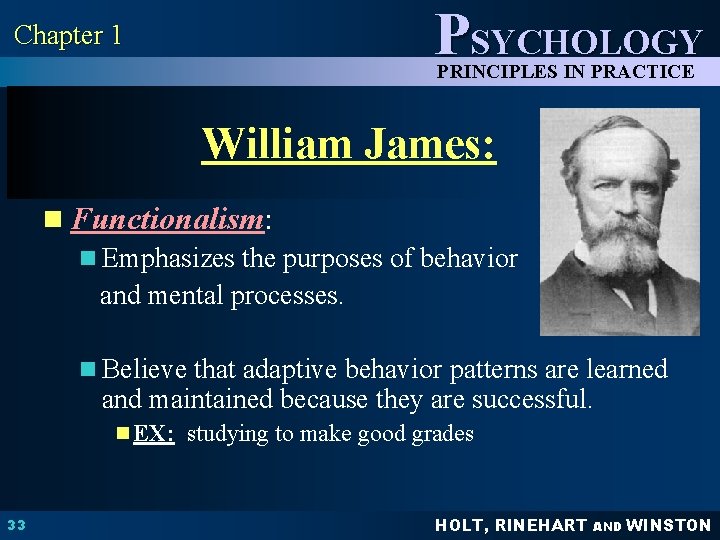
Chapter 1 PSYCHOLOGY PRINCIPLES IN PRACTICE William James: n Functionalism: n Emphasizes the purposes of behavior and mental processes. n Believe that adaptive behavior patterns are learned and maintained because they are successful. n EX: studying to make good grades 33 HOLT, RINEHART AND WINSTON
Chapter 1 PSYCHOLOGY PRINCIPLES IN PRACTICE What are the main differences between structuralism and functionalism? ? n Structuralism: What are the elements of psychological processes? n Functionalists: What are the purposes of behavior and mental processes? 34 HOLT, RINEHART AND WINSTON
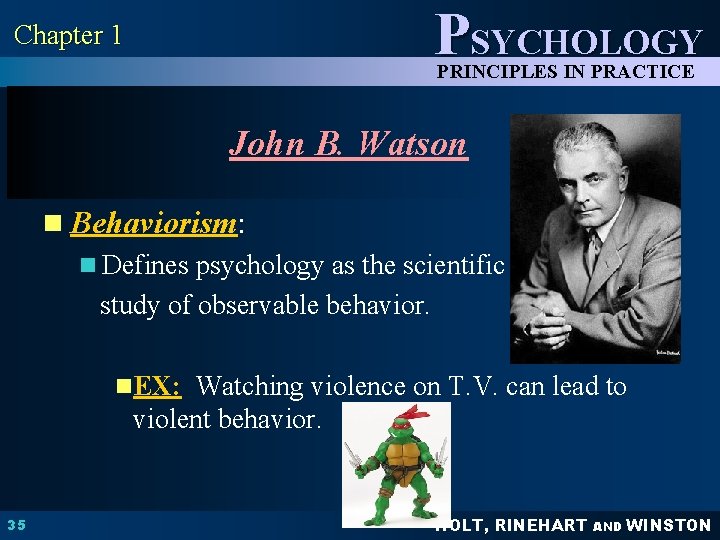
PSYCHOLOGY Chapter 1 PRINCIPLES IN PRACTICE John B. Watson n Behaviorism: n Defines psychology as the scientific study of observable behavior. n. EX: Watching violence on T. V. can lead to violent behavior. 35 HOLT, RINEHART AND WINSTON
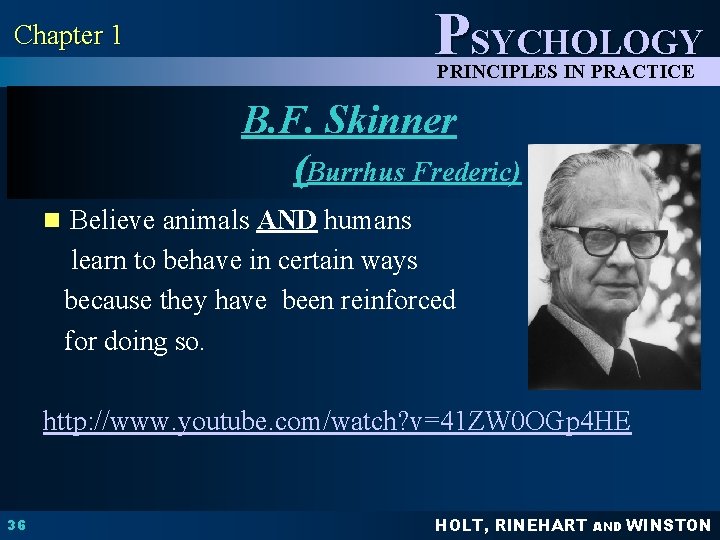
PSYCHOLOGY Chapter 1 PRINCIPLES IN PRACTICE B. F. Skinner (Burrhus Frederic) n Believe animals AND humans learn to behave in certain ways because they have been reinforced for doing so. http: //www. youtube. com/watch? v=41 ZW 0 OGp 4 HE 36 HOLT, RINEHART AND WINSTON
PSYCHOLOGY Chapter 1 PRINCIPLES IN PRACTICE The Gestalt School: n Gestalt Psychology: n Emphasizes the tendency to organize perceptions into meaningful wholes. n. Context influences perception! 37 HOLT, RINEHART AND WINSTON
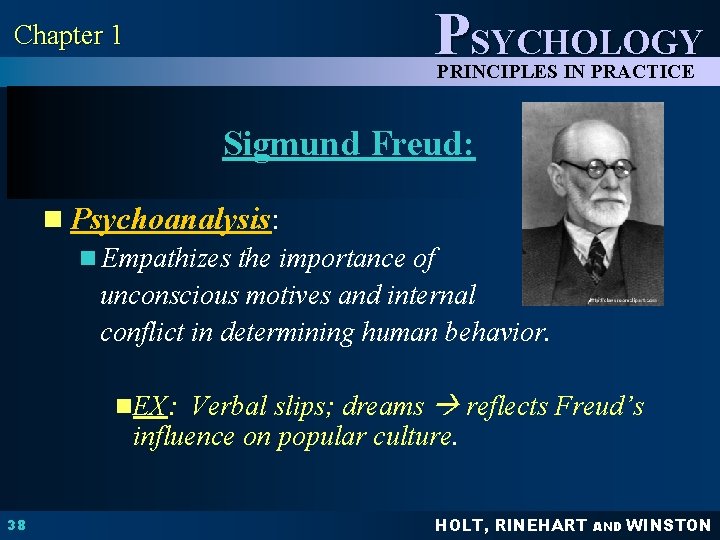
Chapter 1 PSYCHOLOGY PRINCIPLES IN PRACTICE Sigmund Freud: n Psychoanalysis: n Empathizes the importance of unconscious motives and internal conflict in determining human behavior. n. EX: Verbal slips; dreams reflects Freud’s influence on popular culture. 38 HOLT, RINEHART AND WINSTON
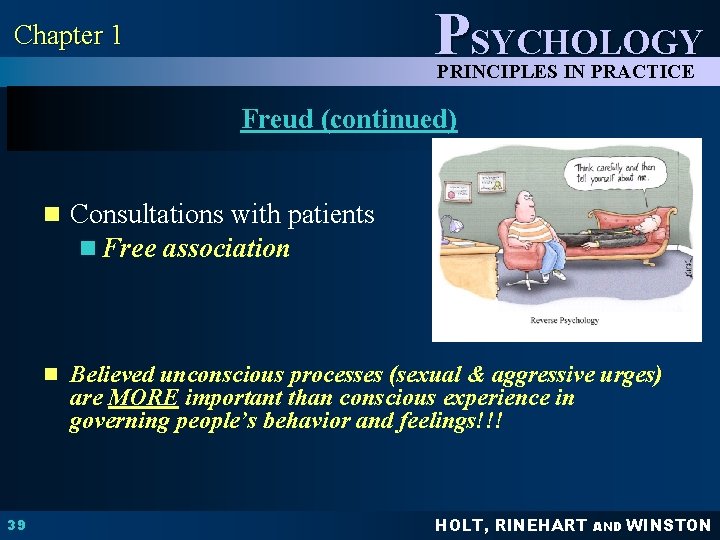
PSYCHOLOGY Chapter 1 PRINCIPLES IN PRACTICE Freud (continued) n Consultations with patients n Free association n Believed unconscious processes (sexual & aggressive urges) are MORE important than conscious experience in governing people’s behavior and feelings!!! 39 HOLT, RINEHART AND WINSTON
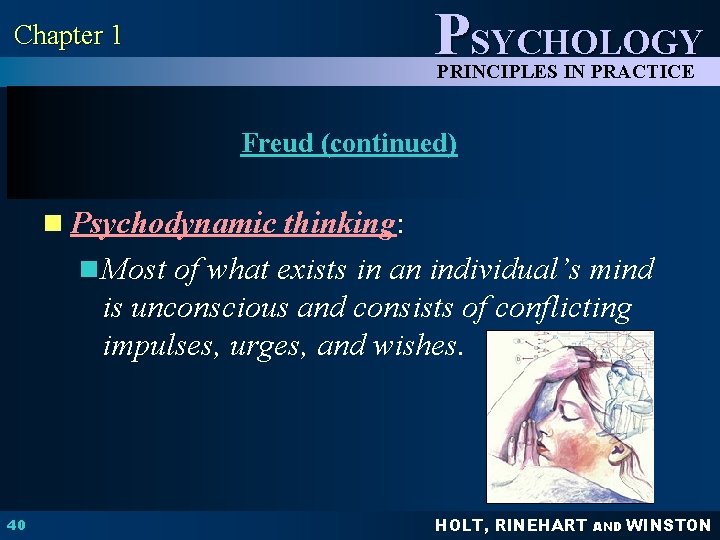
PSYCHOLOGY Chapter 1 PRINCIPLES IN PRACTICE Freud (continued) n Psychodynamic thinking: n Most of what exists in an individual’s mind is unconscious and consists of conflicting impulses, urges, and wishes. 40 HOLT, RINEHART AND WINSTON
Chapter 1 PSYCHOLOGY PRINCIPLES IN PRACTICE Freudian. Slips!Prettyfunny! n Freudian slip: n is an error in speech, memory, or physical action that is believed to be caused by the unconscious mind. n http: //www. youtube. com/watch? v=oi. Pz. M 98 h 7 NA n http: //www. youtube. com/watch? v=5 PGe. KNk 1 o. Wo 41 HOLT, RINEHART AND WINSTON
Chapter 1 PSYCHOLOGY PRINCIPLES IN PRACTICE End of Chapter 1: Section 3 42 HOLT, RINEHART AND WINSTON
PSYCHOLOGY Chapter 1 PRINCIPLES IN PRACTICE Bellringer 1. What are the main differences between structuralism and functionalism? 2. Who is responsible for developing the ideas of reinforcement? 3. In Ancient Greece, what did Socrates believe in relation to psychology? 43 HOLT, RINEHART AND WINSTON
Chapter 1 PSYCHOLOGY PRINCIPLES IN PRACTICE Chapter 1: Section 4 Contemporary Perspectives 44 HOLT, RINEHART AND WINSTON
Chapter 1 PSYCHOLOGY PRINCIPLES IN PRACTICE Main Objective: Describe the main contemporary perspectives in psychology. 45 HOLT, RINEHART AND WINSTON
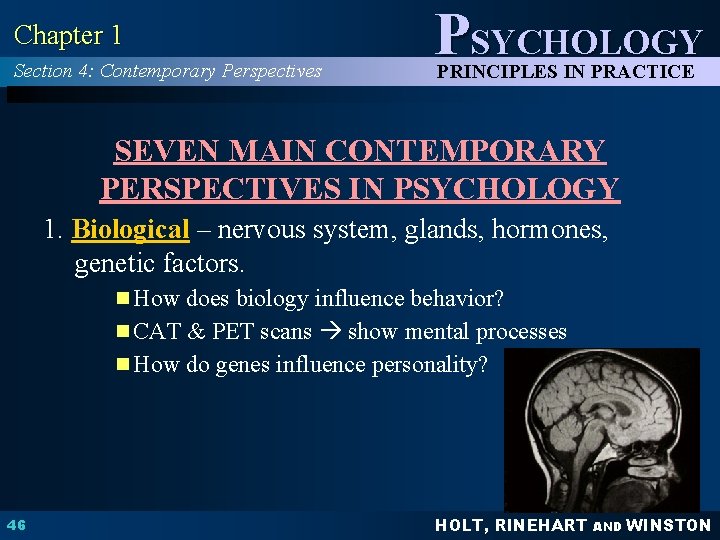
Chapter 1 Section 4: Contemporary Perspectives PSYCHOLOGY PRINCIPLES IN PRACTICE SEVEN MAIN CONTEMPORARY PERSPECTIVES IN PSYCHOLOGY 1. Biological – nervous system, glands, hormones, genetic factors. n How does biology influence behavior? n CAT & PET scans show mental processes n How do genes influence personality? 46 HOLT, RINEHART AND WINSTON
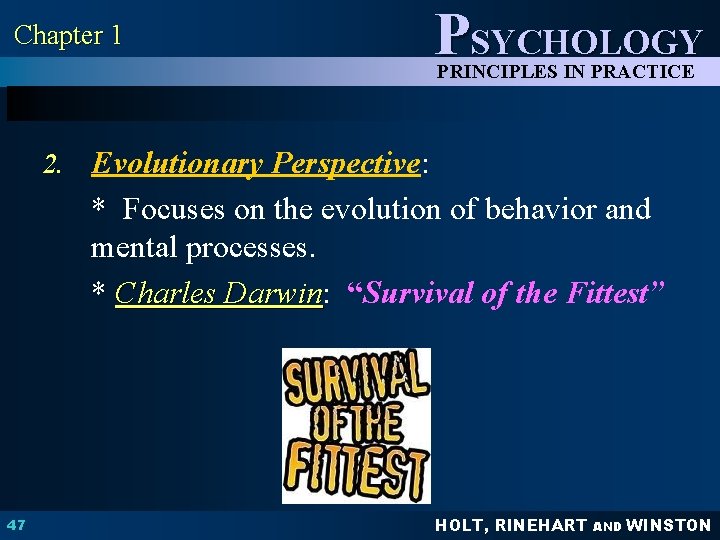
Chapter 1 PSYCHOLOGY PRINCIPLES IN PRACTICE 2. Evolutionary Perspective: * Focuses on the evolution of behavior and mental processes. * Charles Darwin: Darwin “Survival of the Fittest” 47 HOLT, RINEHART AND WINSTON
Chapter 1 PSYCHOLOGY PRINCIPLES IN PRACTICE 3. Cognitive Perspective: *Study mental processes to understand human nature. *Cognitive psychologists believe that people’s behavior is influenced by their values, their perceptions, and their choices. 48 HOLT, RINEHART AND WINSTON
Chapter 1 PSYCHOLOGY PRINCIPLES IN PRACTICE 4. Humanistic Perspective: Perspective * Stresses the human capacity for self-fulfillment and the importance of consciousness, self-awareness, and the capacity to make choices. * Believe that we are free to choose our own behavior. * View people as basically good and desiring to be helpful to others. 49 HOLT, RINEHART AND WINSTON
PSYCHOLOGY Chapter 1 PRINCIPLES IN PRACTICE Humanistic Perspective (continued) n Self-actualization: n The self-motivated striving to reach one’s potential. n Client-centered therapy: n Most widely used humanistic technique. 50 HOLT, RINEHART AND WINSTON
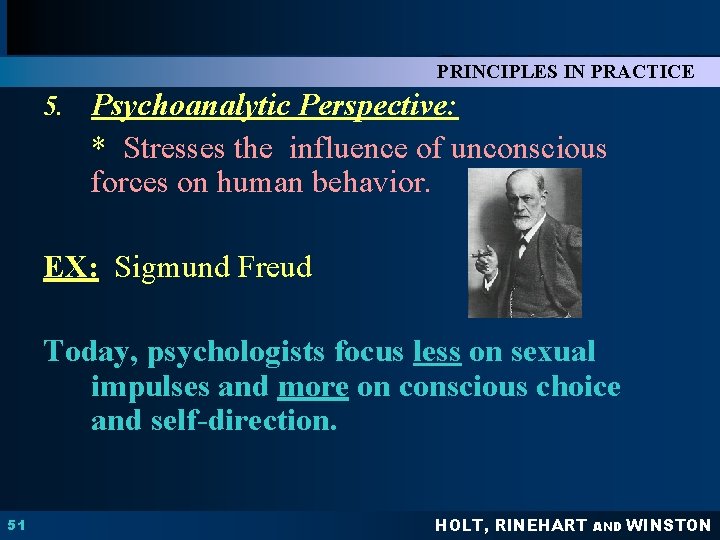
Chapter 1 PSYCHOLOGY PRINCIPLES IN PRACTICE 5. Psychoanalytic Perspective: * Stresses the influence of unconscious forces on human behavior. EX: Sigmund Freud Today, psychologists focus less on sexual impulses and more on conscious choice and self-direction. 51 HOLT, RINEHART AND WINSTON
PSYCHOLOGY Chapter 1 PRINCIPLES IN PRACTICE 6. Learning/Behavioral Perspective: n Emphasis the effects of experience on behavior. n Social-learning theory: n Suggest that people can change their environments or create new ones. n Believe behavior is learned either from direct experience or by observing other people. 52 HOLT, RINEHART AND WINSTON

Chapter 1 PSYCHOLOGY PRINCIPLES IN PRACTICE 7. Sociocultural Perspective: n Studies the influence of ethnicity, gender, culture, and socioeconomic status on behavior and mental processes. 53 HOLT, RINEHART AND WINSTON
Chapter 1 PSYCHOLOGY PRINCIPLES IN PRACTICE Sociocultural Psychologists study the following topics: n Ethnic groups: n A group united by cultural heritage, race, language, or common history. n Gender: n State of being male or being female; gender roles n Prejudice 54 HOLT, RINEHART AND WINSTON
Chapter 1 PSYCHOLOGY PRINCIPLES IN PRACTICE Out of the 7 psychological perspectives, which one do you favor the most AND explain why! 55 HOLT, RINEHART AND WINSTON
- Slides: 55