
Psychology Ch 1 2 Psychology What is it


- Slides: 56
Psychology Ch 1 -2
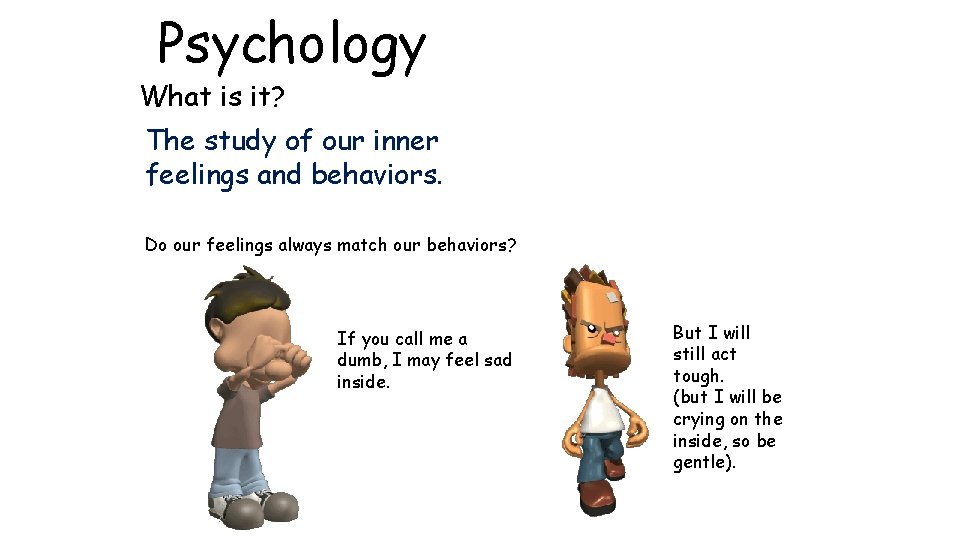
Psychology What is it? The study of our inner feelings and behaviors. Do our feelings always match our behaviors? If you call me a dumb, I may feel sad inside. But I will still act tough. (but I will be crying on the inside, so be gentle).
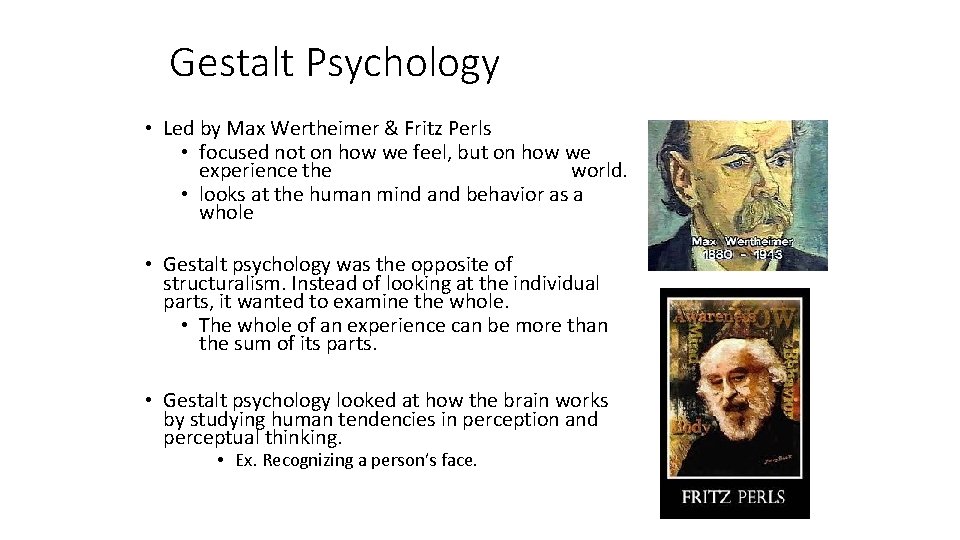
Gestalt Psychology • Led by Max Wertheimer & Fritz Perls • focused not on how we feel, but on how we experience the world. • looks at the human mind and behavior as a whole • Gestalt psychology was the opposite of structuralism. Instead of looking at the individual parts, it wanted to examine the whole. • The whole of an experience can be more than the sum of its parts. • Gestalt psychology looked at how the brain works by studying human tendencies in perception and perceptual thinking. • Ex. Recognizing a person’s face.
Why do we have to learn this stuff? Psychology is first and foremost a science. Thus it is based in research.
Case Studies • A detailed picture of one or a few subjects. • Tells us a great story…but is just descriptive research. • Does not even give us correlation data.
Applied V. Basic Research • Applied Research has clear, practical applications. • YOU CAN USE IT!!! • Basic Research explores questions that you may be curious about, but not intended to be immediately used.
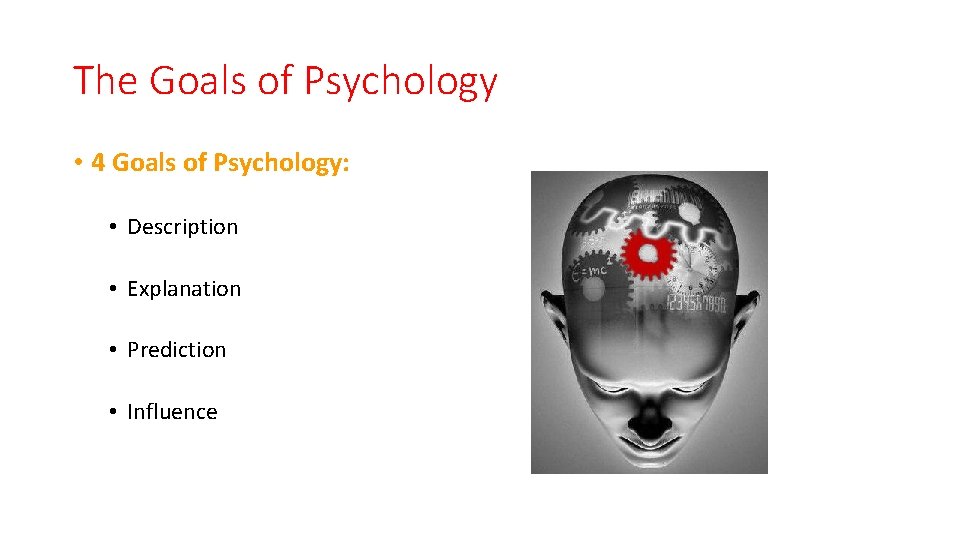
The Goals of Psychology • 4 Goals of Psychology: • Description • Explanation • Prediction • Influence
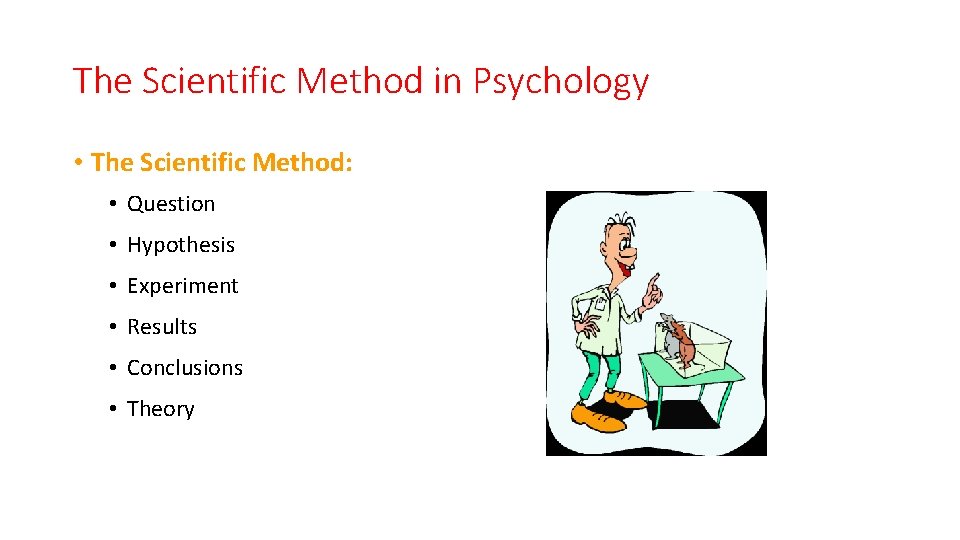
The Scientific Method in Psychology • The Scientific Method: • Question • Hypothesis • Experiment • Results • Conclusions • Theory
Hypothesis • Expresses a relationship between two variables. • A variable is anything that can vary among participants in a study. • Participating in class leads to better grades than not participating.
Method 1: Naturalistic Observation • Observing and recording behavior in naturally occurring situations without influencing or controlling the situation. • Method of observation where subjects are observed in their “natural” environment • Subjects are not aware they are being watched • Could use hidden cameras or two way mirrors
Method 2: Case Study • A research technique in which one person (or a small group of people) is studied in depth in the hope of revealing universal principles. • This technique is very open to bias • Difficulty of applying data from one person to everyone (universal)
Longitudinal Study • A research technique that follows the same group of individuals over a long period. • A type of case study • Can be very expensive and difficult to conduct • Why?
Cross-Sectional Study • A research technique that compares individuals from different age groups at one time. • Type of case study • Study a number of subjects from different age groups and then compare the results • Cheaper, easier than longitudinal studies, but group differences may be due to factors other than development.
Method 3: Survey Method • A research technique that questions a sample of people to collect information about their attitudes or behaviors. • Research method that relies on self-reports; uses surveys, questionnaires, interviews. • Usually a very efficient and inexpensive method
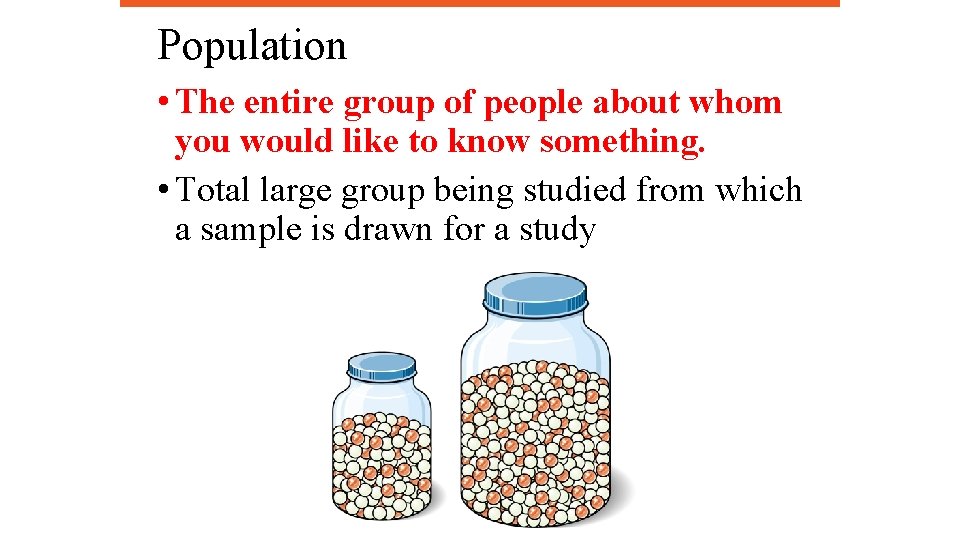
Population • The entire group of people about whom you would like to know something. • Total large group being studied from which a sample is drawn for a study
Random Sample • A sample that fairly represents a population because each member of the population has an equal chance of being included. • If a sample is not random it is said to be biased.
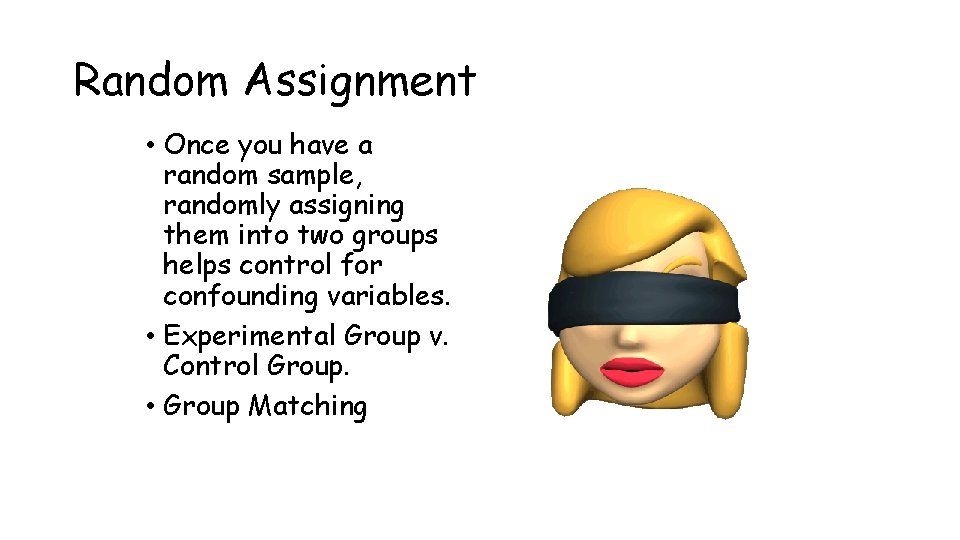
Random Assignment • Once you have a random sample, randomly assigning them into two groups helps control for confounding variables. • Experimental Group v. Control Group. • Group Matching
Statistically Significant • Possibility that the differences in results between the experimental and control groups could have occurred by chance is no more than 5 percent • Must be at least 95% certain the differences between the groups is due to the independent variable
Experiments • Experimenters divide participants into two groups: • Experimental Group: • Independent variable is applied (e. g. Coffee is given to participants) • Control Group: • Treated the same way as experimental group, but independent variable is not applied (e. g. No coffee is given to participants)
Self-Fulfilling Prophecy • Self-Fulfilling Prophecy: • Researcher’s expectations influence his/her own behavior, and thereby influence the participant’s behavior (e. g. thinking a subject will respond in a certain way, and unassumingly acting in a manner that will cause the subject to then do so)
Avoiding a Self-Fulfilling Prophecy • Single-Blind Experiment: • Participants are unaware of which participants received the treatment (e. g. participants do not know which participants received “Red Bull”) • Double-Blind Experiment: • Participants and experimenter(s) are unaware of which participants received the treatment (e. g. participants and experimenter(s) do not know which participants received “Red Bull”)
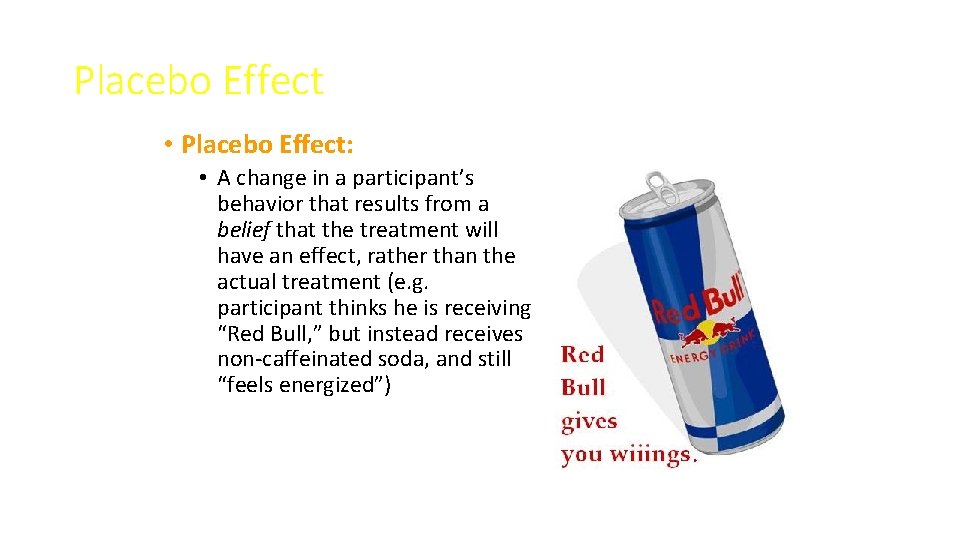
Placebo Effect • Placebo Effect: • A change in a participant’s behavior that results from a belief that the treatment will have an effect, rather than the actual treatment (e. g. participant thinks he is receiving “Red Bull, ” but instead receives non-caffeinated soda, and still “feels energized”)
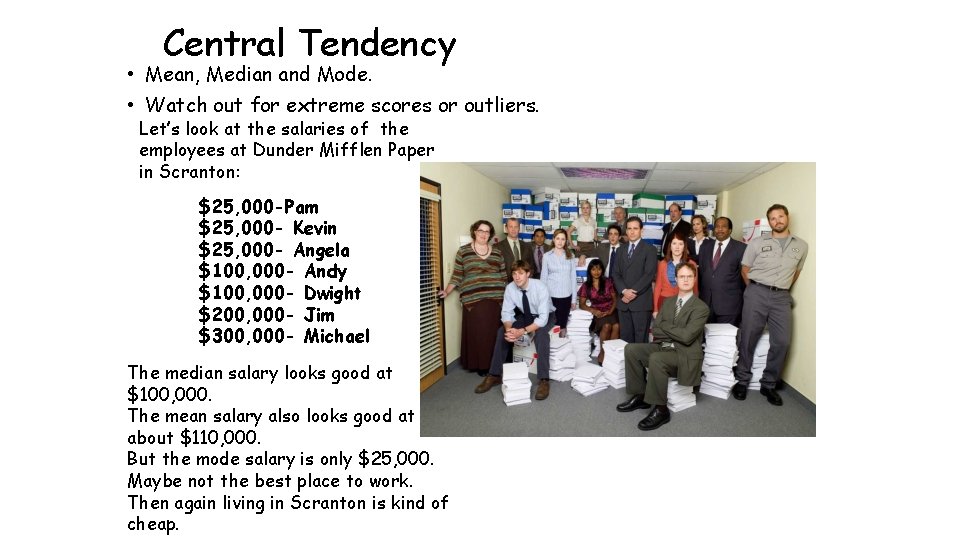
Central Tendency • Mean, Median and Mode. • Watch out for extreme scores or outliers. Let’s look at the salaries of the employees at Dunder Mifflen Paper in Scranton: $25, 000 -Pam $25, 000 - Kevin $25, 000 - Angela $100, 000 - Andy $100, 000 - Dwight $200, 000 - Jim $300, 000 - Michael The median salary looks good at $100, 000. The mean salary also looks good at about $110, 000. But the mode salary is only $25, 000. Maybe not the best place to work. Then again living in Scranton is kind of cheap.
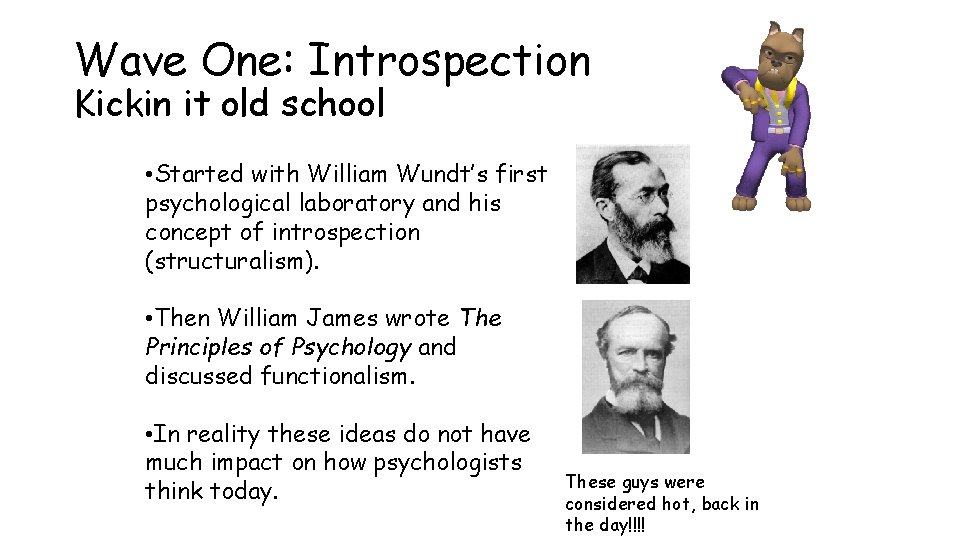
Wave One: Introspection Kickin it old school • Started with William Wundt’s first psychological laboratory and his concept of introspection (structuralism). • Then William James wrote The Principles of Psychology and discussed functionalism. • In reality these ideas do not have much impact on how psychologists think today. These guys were considered hot, back in the day!!!!
Wave Two: Gestalt Psychology • Led by Max Wertheimer, these guys focused not on how we feel, but on how we experience the world. • The whole of an experience can be more than the sum of its parts. Think for a moment of all the reasons that you love your mom. If you add all those reasons up, do they equal your love for your mom? Hopefully not!!!
Wave Three: Psychoanalysis • This wave of thinking started with Sigmund Freud (in the early 1900’s). • In a nutshell, during this time period people believed that most of your feelings come from a hidden place in your mind called the unconscious. ( free association) • We protect ourselves from our real feeling by using defense mechanisms.
Wave Four: Behaviorism • During this time period (early to mid 1900 s), people started to ignore how you feel inside. • All that mattered was how you acted. • If you they could change your behavior, who cares how you feel. • Very popular during the conservative 1950’s when social appearance mattered more than self expression.
END OF NOTES
Wave Five is made up of about 7 different perspectives. In other words, psychologists today, pick and choose from about 7 schools of thought to help you with your problems. Thus we have: THE SEVEN SCHOOLS OF PSYCHOLOGY
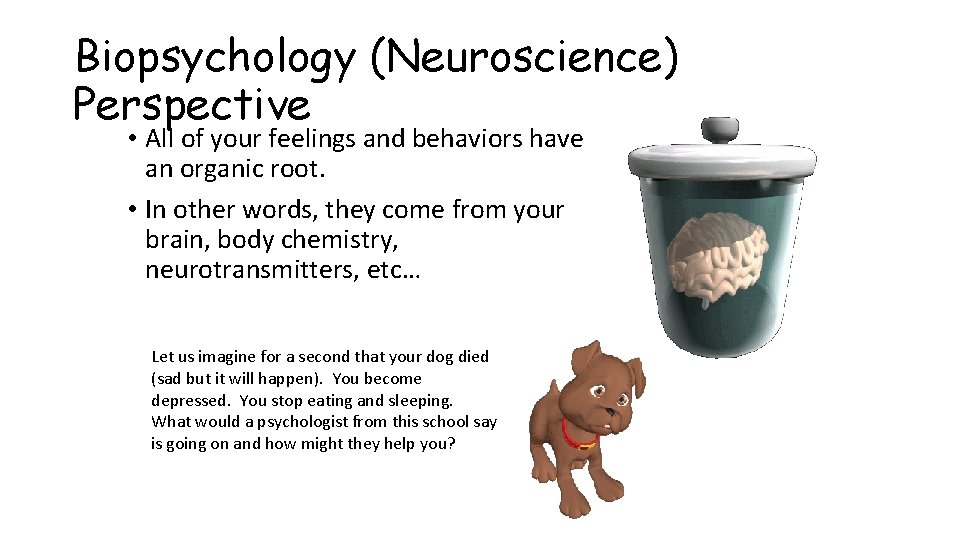
Biopsychology (Neuroscience) Perspective • All of your feelings and behaviors have an organic root. • In other words, they come from your brain, body chemistry, neurotransmitters, etc… Let us imagine for a second that your dog died (sad but it will happen). You become depressed. You stop eating and sleeping. What would a psychologist from this school say is going on and how might they help you?
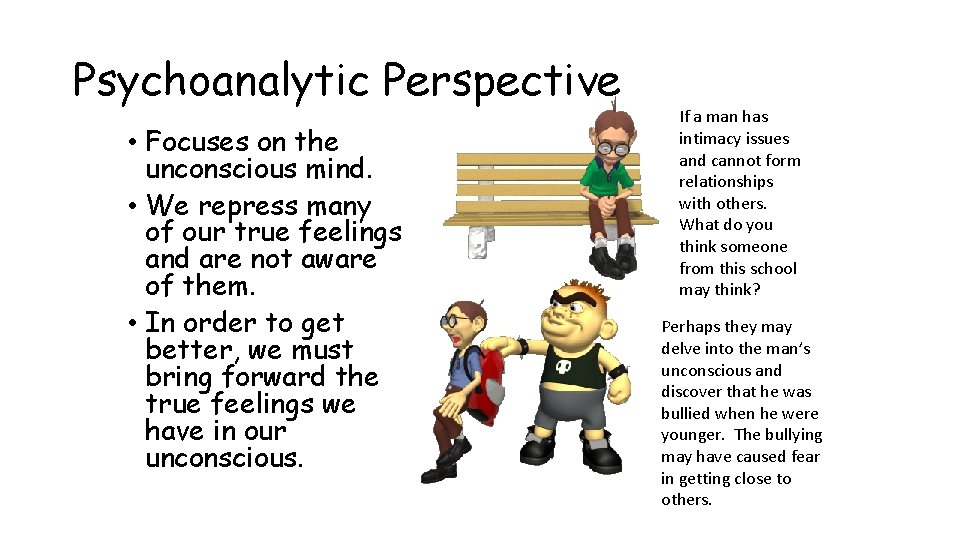
Psychoanalytic Perspective • Focuses on the unconscious mind. • We repress many of our true feelings and are not aware of them. • In order to get better, we must bring forward the true feelings we have in our unconscious. If a man has intimacy issues and cannot form relationships with others. What do you think someone from this school may think? Perhaps they may delve into the man’s unconscious and discover that he was bullied when he were younger. The bullying may have caused fear in getting close to others.
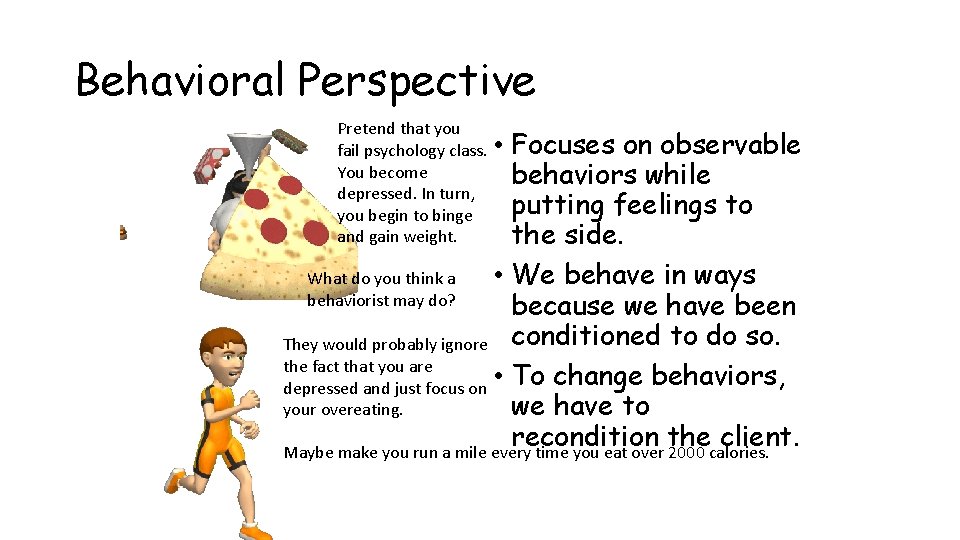
Behavioral Perspective Pretend that you fail psychology class. • You become depressed. In turn, you begin to binge and gain weight. Focuses on observable behaviors while putting feelings to the side. What do you think a • We behave in ways behaviorist may do? because we have been They would probably ignore conditioned to do so. the fact that you are depressed and just focus on • To change behaviors, your overeating. we have to recondition the client. Maybe make you run a mile every time you eat over 2000 calories.
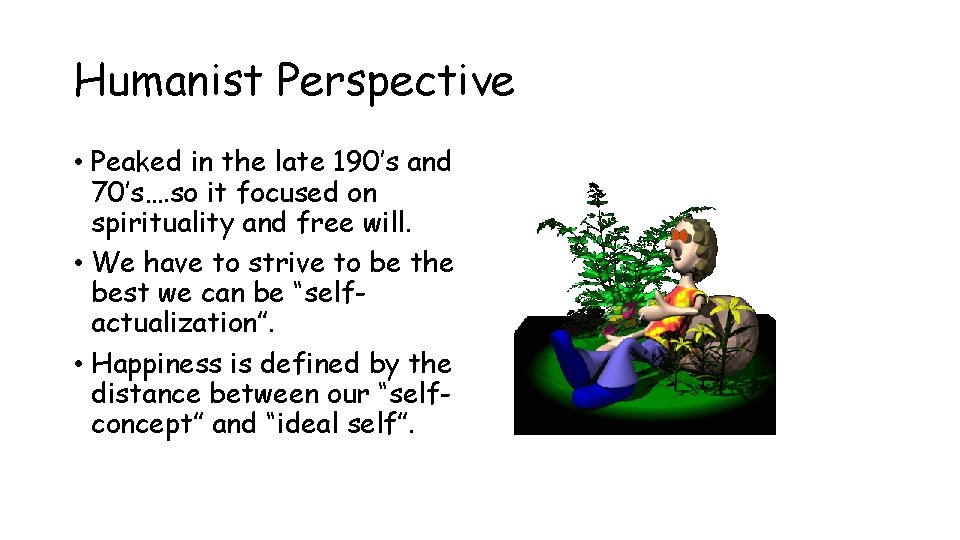
Humanist Perspective • Peaked in the late 190’s and 70’s…. so it focused on spirituality and free will. • We have to strive to be the best we can be “selfactualization”. • Happiness is defined by the distance between our “selfconcept” and “ideal self”.
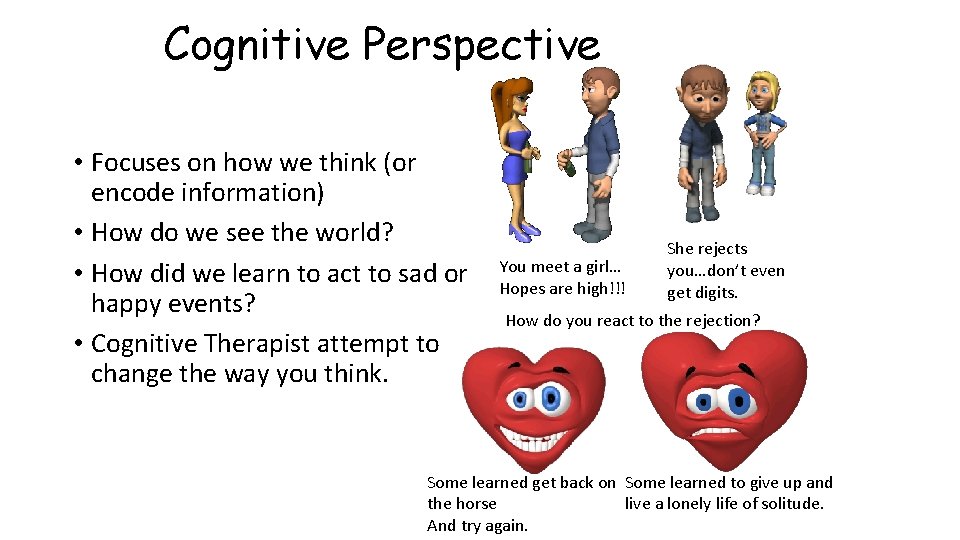
Cognitive Perspective • Focuses on how we think (or encode information) • How do we see the world? • How did we learn to act to sad or happy events? • Cognitive Therapist attempt to change the way you think. You meet a girl… Hopes are high!!! She rejects you…don’t even get digits. How do you react to the rejection? Some learned get back on Some learned to give up and the horse live a lonely life of solitude. And try again.
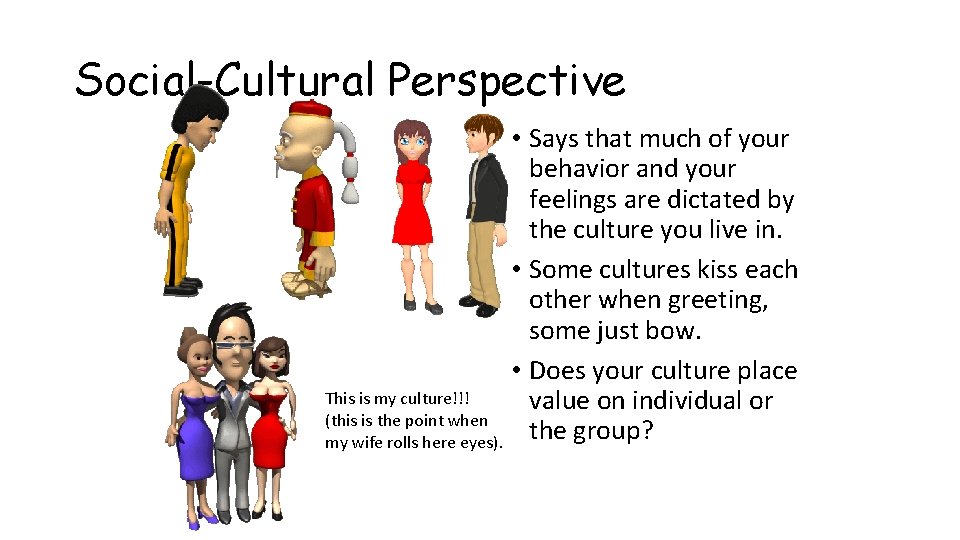
Social-Cultural Perspective • Says that much of your behavior and your feelings are dictated by the culture you live in. • Some cultures kiss each other when greeting, some just bow. • Does your culture place This is my culture!!! value on individual or (this is the point when my wife rolls here eyes). the group?
Psychology’s Three Big Debates • Nature Versus Nurture • Stability Versus Change • Continuity Versus Discontinuity
Research Methods It is actually way more exciting than it sounds!!!!
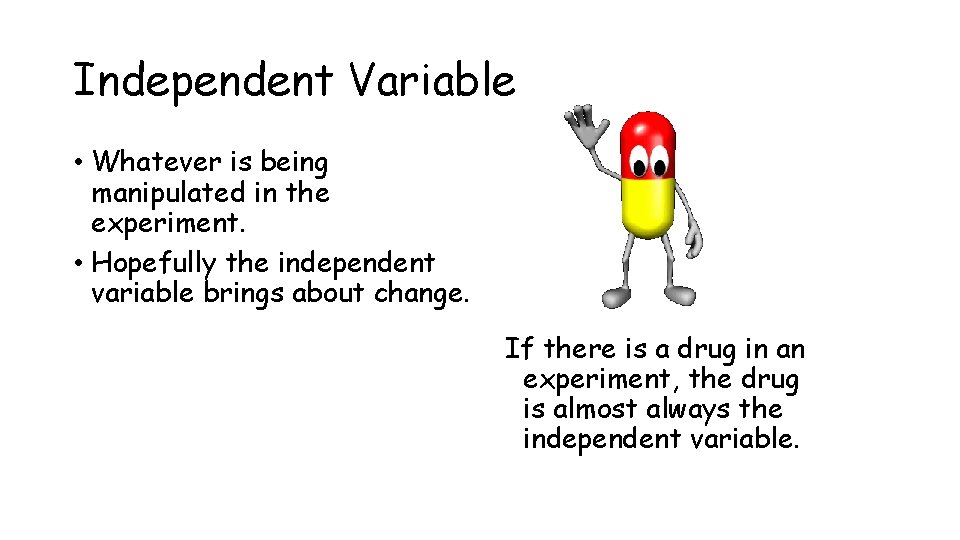
Independent Variable • Whatever is being manipulated in the experiment. • Hopefully the independent variable brings about change. If there is a drug in an experiment, the drug is almost always the independent variable.
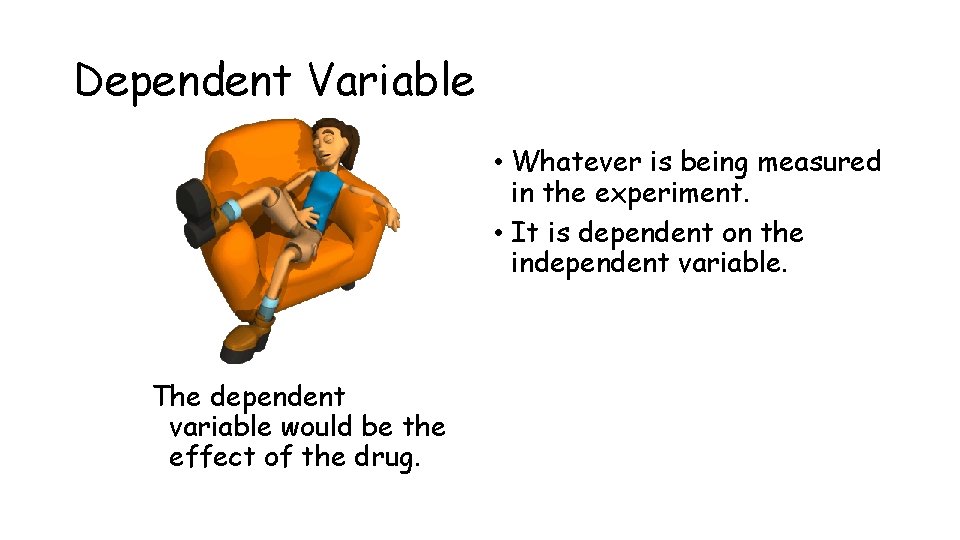
Dependent Variable • Whatever is being measured in the experiment. • It is dependent on the independent variable. The dependent variable would be the effect of the drug.
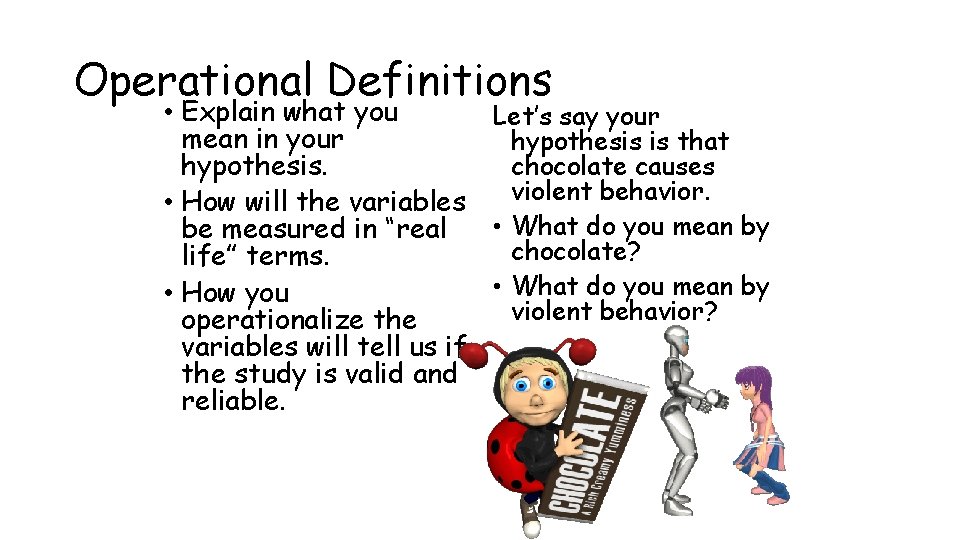
Operational Definitions • Explain what you Let’s say your mean in your hypothesis is that hypothesis. chocolate causes violent behavior. • How will the variables • What do you mean by be measured in “real chocolate? life” terms. • What do you mean by • How you violent behavior? operationalize the variables will tell us if the study is valid and reliable.
Sampling • Identify the population you want to study. • The sample must be representative of the population you want to study. • GET A RANDOM SAMPLE. • Stratified Sampling
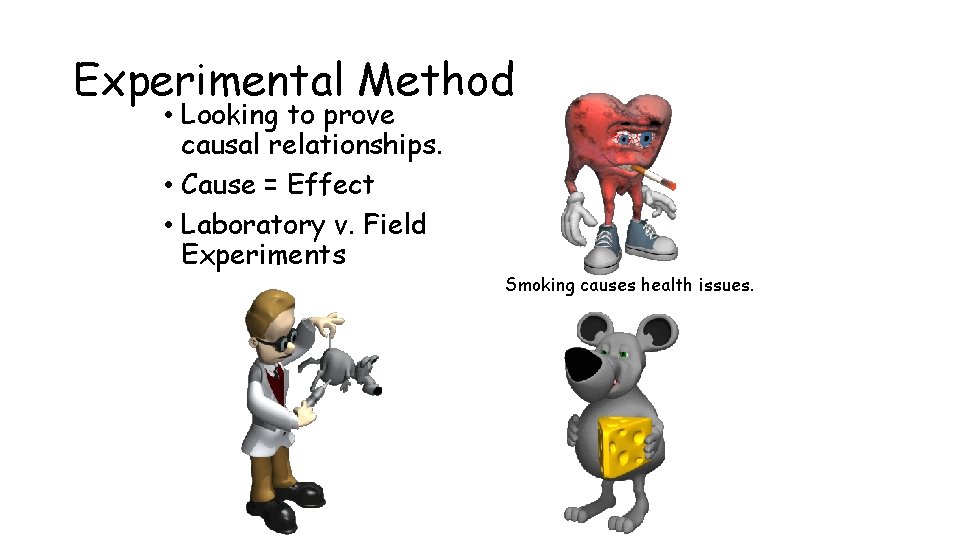
Experimental Method • Looking to prove causal relationships. • Cause = Effect • Laboratory v. Field Experiments Smoking causes health issues.
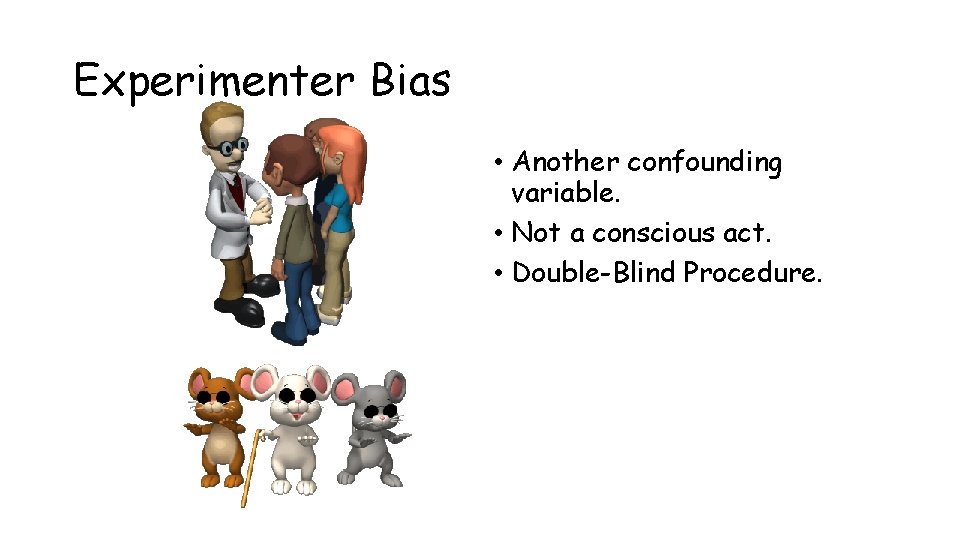
Experimenter Bias • Another confounding variable. • Not a conscious act. • Double-Blind Procedure.
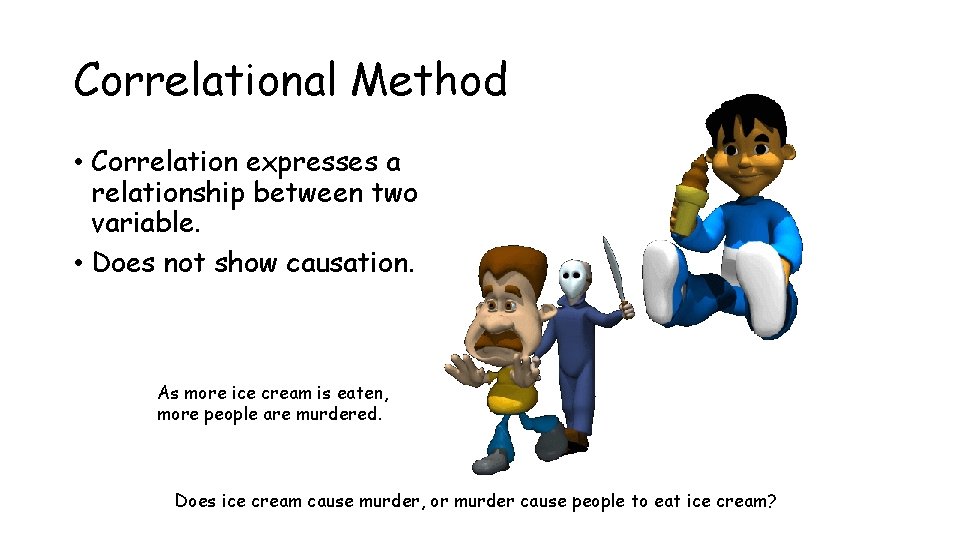
Correlational Method • Correlation expresses a relationship between two variable. • Does not show causation. As more ice cream is eaten, more people are murdered. Does ice cream cause murder, or murder cause people to eat ice cream?
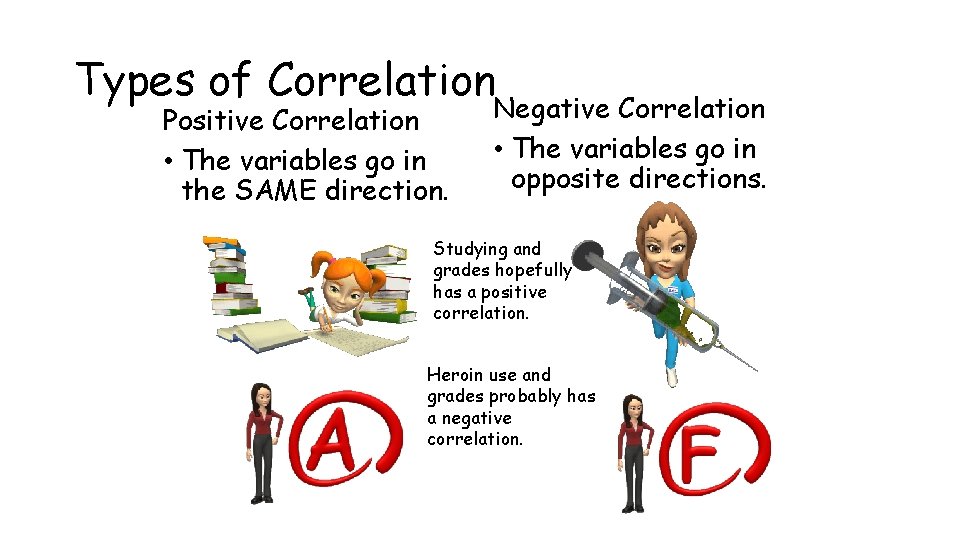
Types of Correlation Positive Correlation • The variables go in the SAME direction. Negative Correlation • The variables go in opposite directions. Studying and grades hopefully has a positive correlation. Heroin use and grades probably has a negative correlation.
Survey Method • Most common type of study in psychology • Measures correlation • Cheap and fast • Need a good random sample • Low-response rate
Naturalistic Observation • Watch subjects in their natural environment. • Do not manipulate the environment. • The good is that there is Hawthorne effect. • The bad is that we can never really show cause and effect.
Statistics • Recording the results from our studies. • Must use a common language so we all know what we are talking about.
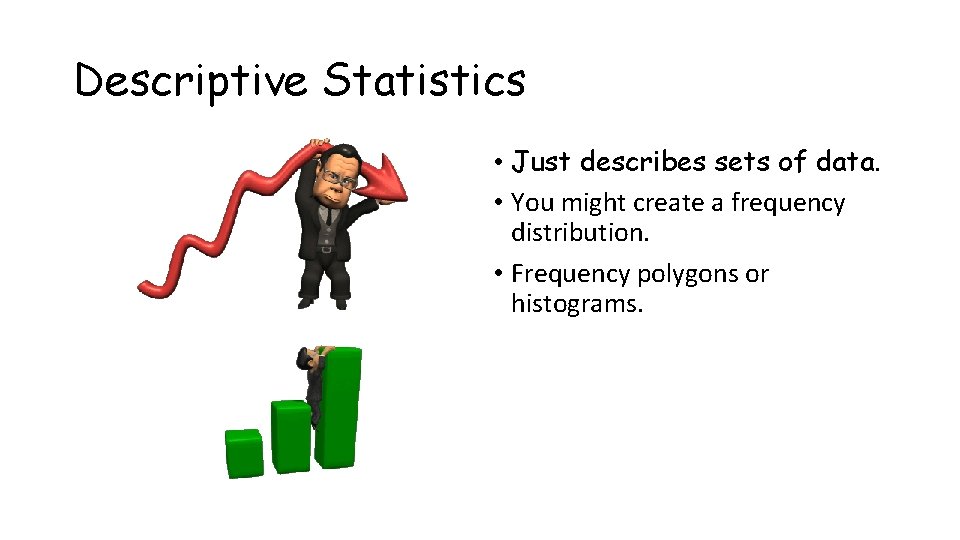
Descriptive Statistics • Just describes sets of data. • You might create a frequency distribution. • Frequency polygons or histograms.
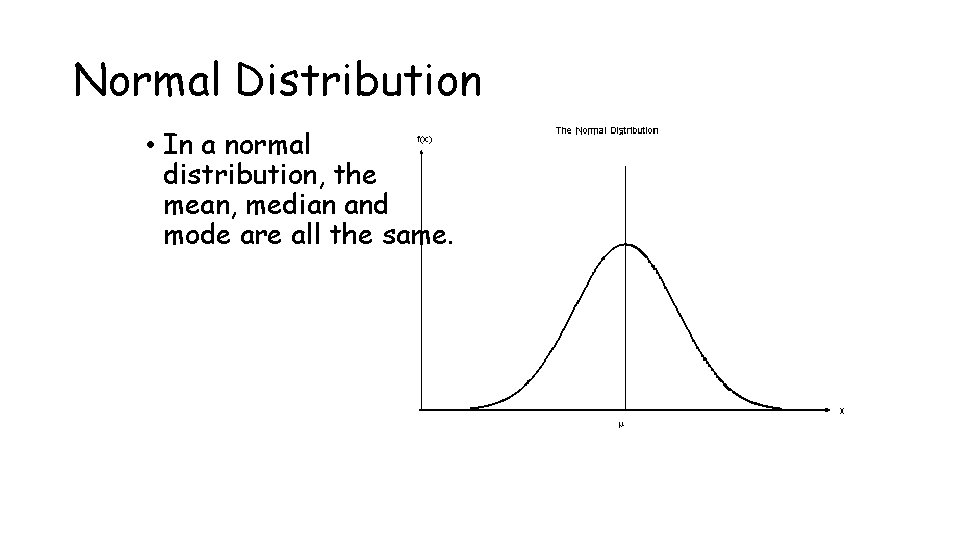
Normal Distribution • In a normal distribution, the mean, median and mode are all the same.
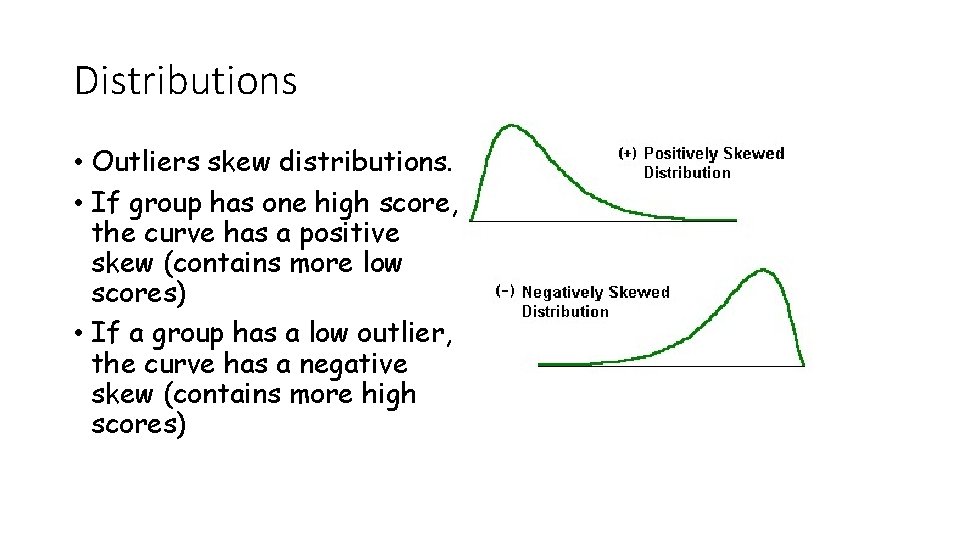
Distributions • Outliers skew distributions. • If group has one high score, the curve has a positive skew (contains more low scores) • If a group has a low outlier, the curve has a negative skew (contains more high scores)
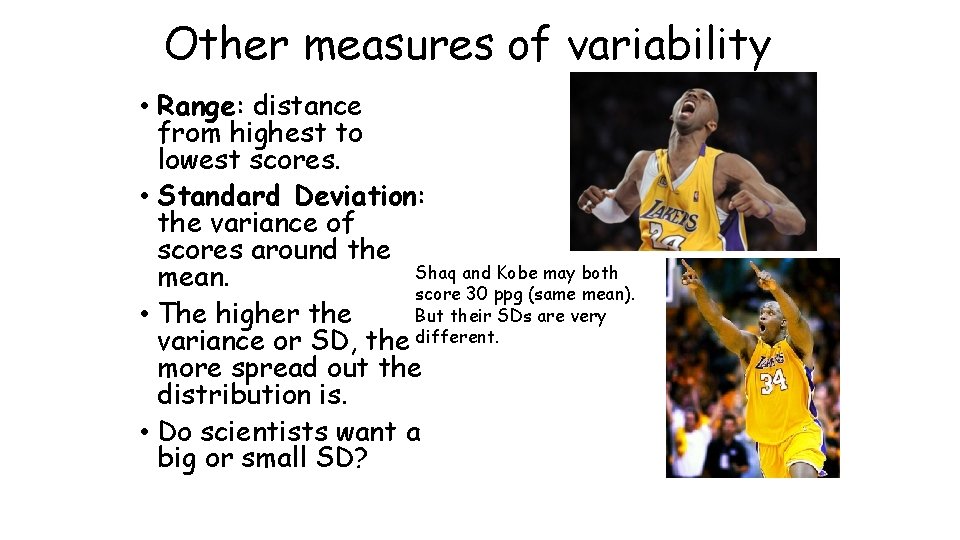
Other measures of variability • Range: distance from highest to lowest scores. • Standard Deviation: the variance of scores around the Shaq and Kobe may both mean. score 30 ppg (same mean). But their SDs are very • The higher the variance or SD, the different. more spread out the distribution is. • Do scientists want a big or small SD?
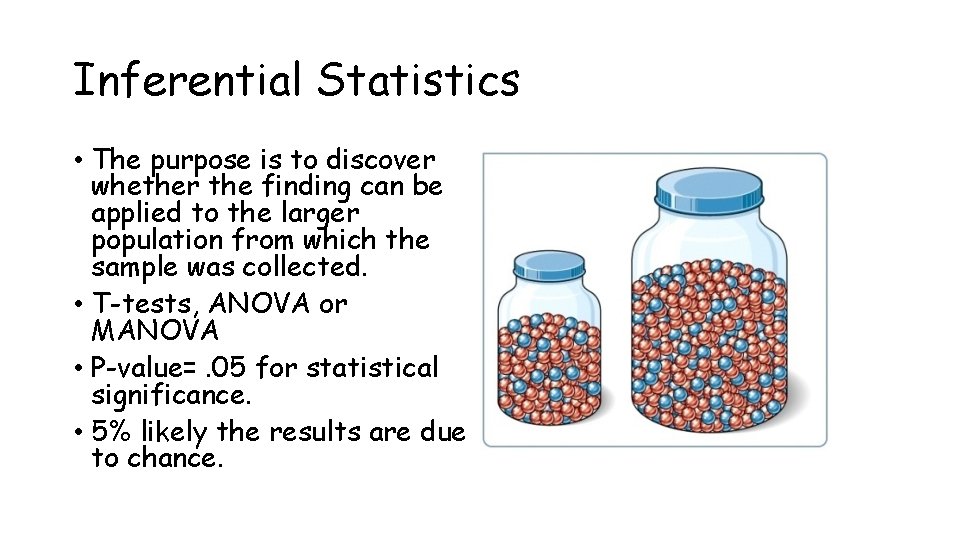
Inferential Statistics • The purpose is to discover whether the finding can be applied to the larger population from which the sample was collected. • T-tests, ANOVA or MANOVA • P-value=. 05 for statistical significance. • 5% likely the results are due to chance.
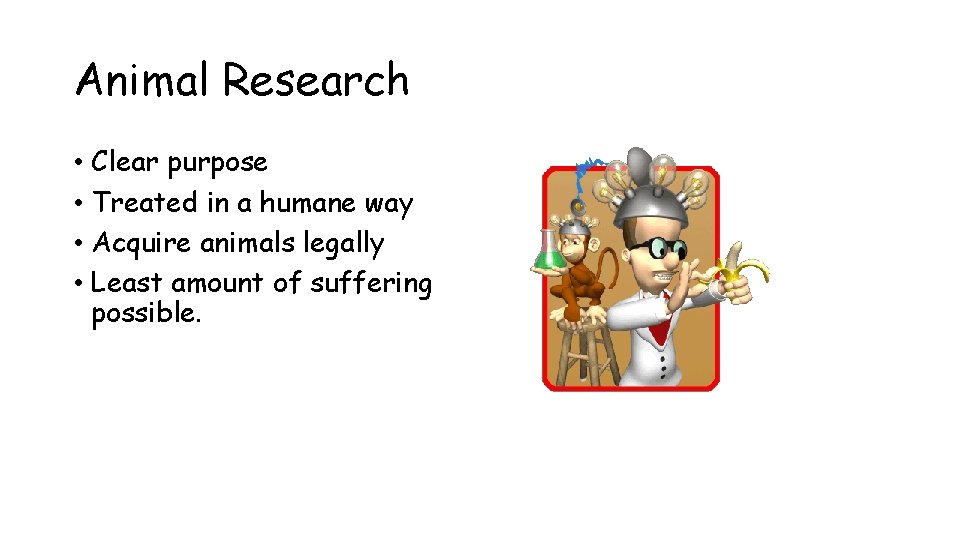
Animal Research • Clear purpose • Treated in a humane way • Acquire animals legally • Least amount of suffering possible.
Human Research • No Coercion- must be voluntary • Informed consent • Anonymity • No significant risk • Must debrief