
Psychology As Science Psychologists use the scientific method


- Slides: 18
Psychology As Science • • Psychologists use the “scientific method” Steps to the scientific method: - make observations - ask question - develop hypothesis - conduct research study - evaluate hypothesis in light of results Some Examples
The Importance of Sampling in Research • • • Sample – subset of a larger population Random sample – every subject has equal chance of being selected Representative sample – characteristics of participants correspond to larger population
Research Methods in Psychology • • • Survey Method: – Questionnaires are commonly used to collect information about attitudes, beliefs, opinions, etc. Advantages – can generate a lot of information for a fairly low cost – can provide anonymity of participants Disadvantages – cannot see participant reactions (e. g. , body language) – not everyone completes and returns survey… sample may not be “representative” – questions must be constructed carefully to provide accurate information
Research Methods in Psychology • • • Survey Method (con’t. ): – Interviews are used to gather information about attitudes, beliefs, opinions, etc. Advantages – “follow-up” questions can be asked – can see participant reactions (e. g. , body language) Disadvantages – relatively expensive and time consuming – “experimenter bias” is a potential problem – may give socially acceptable responses to sensitive issues
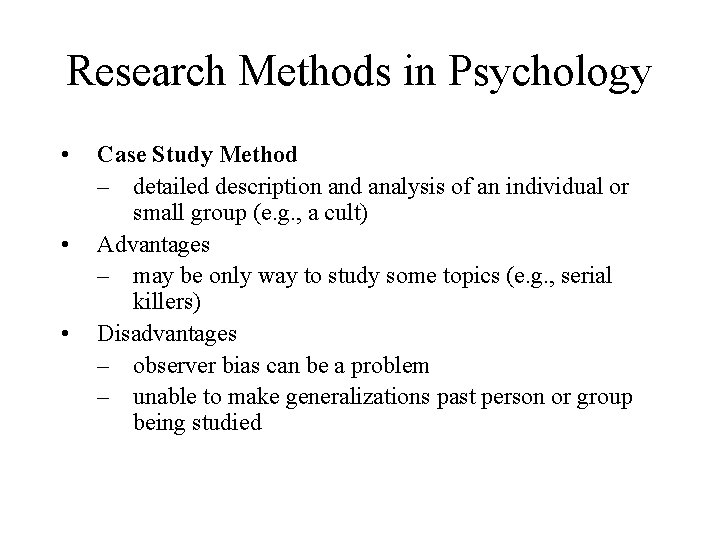
Research Methods in Psychology • • • Case Study Method – detailed description and analysis of an individual or small group (e. g. , a cult) Advantages – may be only way to study some topics (e. g. , serial killers) Disadvantages – observer bias can be a problem – unable to make generalizations past person or group being studied
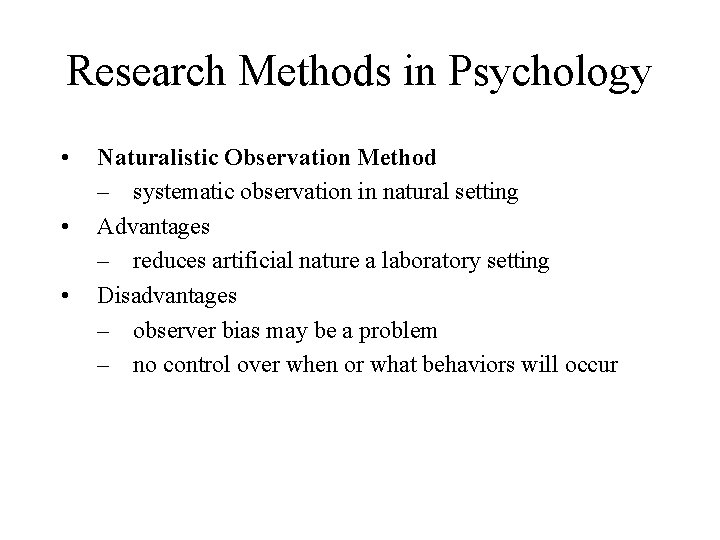
Research Methods in Psychology • • • Naturalistic Observation Method – systematic observation in natural setting Advantages – reduces artificial nature a laboratory setting Disadvantages – observer bias may be a problem – no control over when or what behaviors will occur
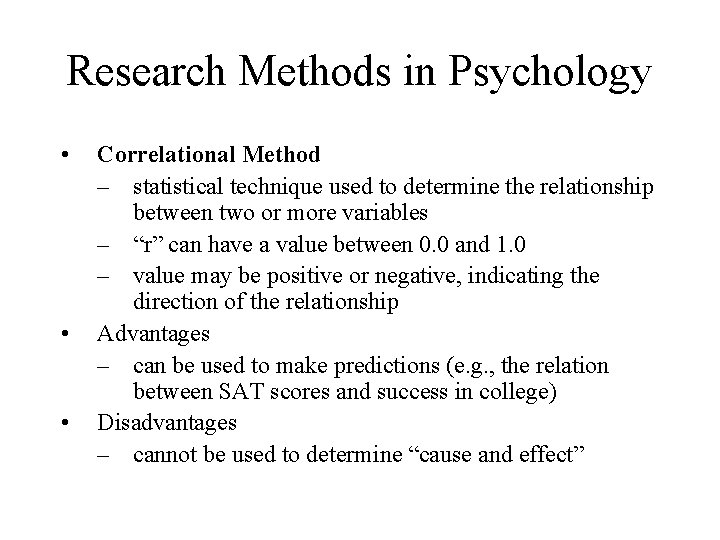
Research Methods in Psychology • • • Correlational Method – statistical technique used to determine the relationship between two or more variables – “r” can have a value between 0. 0 and 1. 0 – value may be positive or negative, indicating the direction of the relationship Advantages – can be used to make predictions (e. g. , the relation between SAT scores and success in college) Disadvantages – cannot be used to determine “cause and effect”
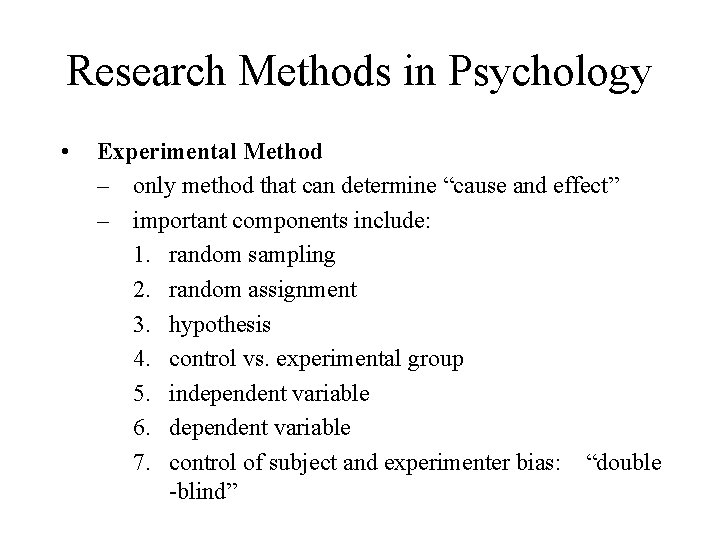
Research Methods in Psychology • Experimental Method – only method that can determine “cause and effect” – important components include: 1. random sampling 2. random assignment 3. hypothesis 4. control vs. experimental group 5. independent variable 6. dependent variable 7. control of subject and experimenter bias: “double -blind”
Research Methods in Psychology Every experiment begins by asking a question or making an observation and then stating a possible answer to that question or offering an explanation to that observation. That potential answer or explanation is call the “hypothesis. ” What hypothesis might you suggest for the following? • Do people drive less safely when talking on cell phones compared to other “driving” activities (e. g. , eating, singing with the radio, etc. )? • Can an eyewitness recall non-existent facts about an accident through “leading” questions? • Why do people watch “reality” shows, even though they say, “those shows are so stupid”?
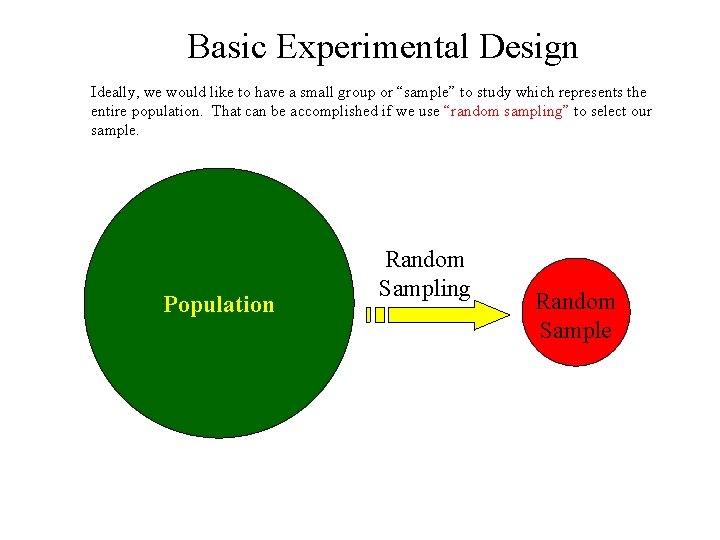
Basic Experimental Design Ideally, we would like to have a small group or “sample” to study which represents the entire population. That can be accomplished if we use “random sampling” to select our sample. Population Random Sampling Random Sample
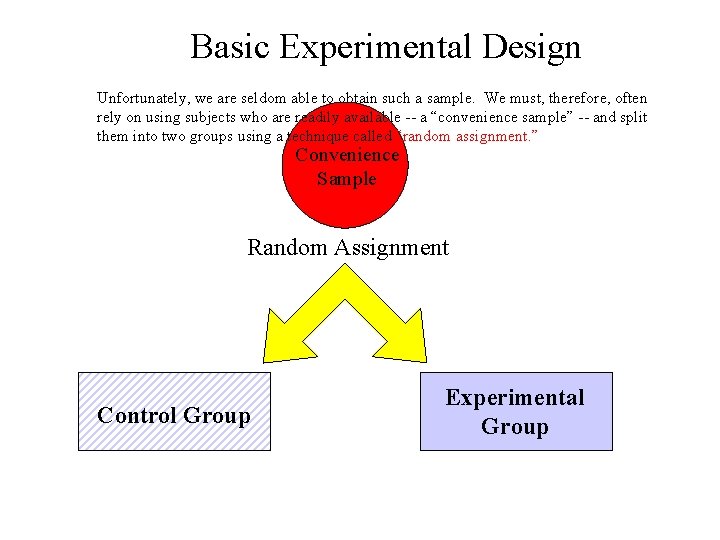
Basic Experimental Design Unfortunately, we are seldom able to obtain such a sample. We must, therefore, often rely on using subjects who are readily available -- a “convenience sample” -- and split them into two groups using a technique called “random assignment. ” Convenience Sample Random Assignment Control Group Experimental Group
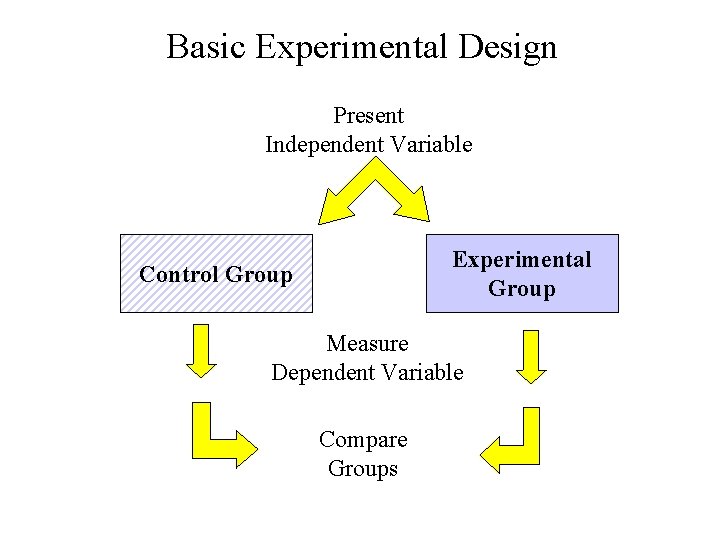
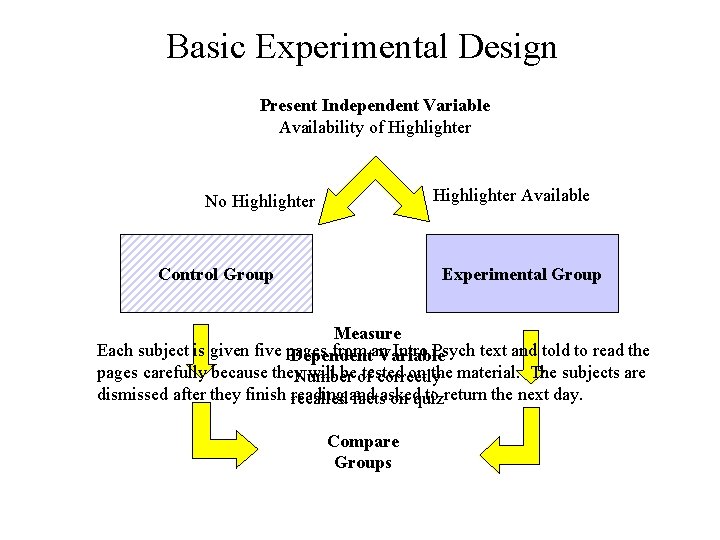
Basic Experimental Design Present Independent Variable Experimental Group Control Group Measure Dependent Variable Compare Groups
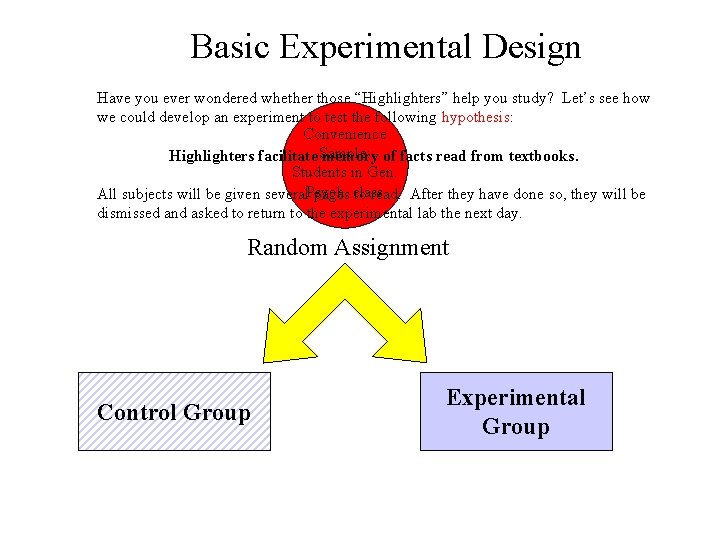
Basic Experimental Design Have you ever wondered whether those “Highlighters” help you study? Let’s see how we could develop an experiment to test the following hypothesis: Convenience Highlighters facilitate Sample: memory of facts read from textbooks. Students in Gen. All subjects will be given several. Psych. pages class to read. After they have done so, they will be dismissed and asked to return to the experimental lab the next day. Random Assignment Control Group Experimental Group
Basic Experimental Design Present Independent Variable Availability of Highlighter Available No Highlighter Control Group Experimental Group Measure Each subject is given five pages from an Intro Psych text and told to read the Dependent Variable pages carefully because they will beof tested on the material. The subjects are Number correctly dismissed after they finish recalled reading and to return the next day. factsasked on quiz Compare Groups
Extra Credit Assignment Extra credit assignment #1 is related to the preceding material.
Ethical Principles • • Conducting research always involves a consideration between the value of doing the research versus the impact on subjects: “cost/benefit analysis” The American Psychological Association (APA) requires researchers to consider the following before conducting any research: – Informed consent – Protection from harm – Confidentiality – Minimize deception – Debriefing
Ethics in Research on Humans • • • If participation is a course requirement in an academic setting, alternative activities must be offered Deception cannot be used about aspects of research that would affect participant's willingness to participate Deception about the goals of research used only when absolutely necessary
Ethics in Research on Animals • • Psychologists using animals must ensure “appropriate consideration of the animal’s comfort, health, and human treatment” Animals must not be exposed to pain, stress, or privation when alternative procedures are available