
Psychology After Freuds theories are popularized Debate between
Psychology
� After Freud’s theories are popularized � Debate between pro-Freud anti-Freud psychologists � Various theories to fit your own insights about causes of human behavior � To explain human complexity
� All behavior is reaction to stimuli from the world around you � Control the stimuli-control the behavior � John Watson: Psychologists frustrated with making assumptions about unknown mental functions � Focus only on verifiable observable behavior � Based on Ivan Pavlov’s classical conditioning research: Pavlov’s dogs
� System of stimulus-response units: cause and effects between environment and behavior � Rewarded or pleasurable responses encourage repetition of behavior �Punishment � Example: deters behavior Baby responds to mother, expects care �Food, warmth, love �Responds with cooing and waving arms �Cry when mom goes away
� Watson’s successor as leading American behaviorist � Dismisses Freud’s psychoanalytic approach � Believes development of personality is too important to leave to parents/learning experiences
� Walden Two: Invents self-sufficient community run on behaviorist principles �Trained nurses raise children �Shape personalities to maintain stable productive society � Applied theory to all of society in Beyond Freedom and Dignity �Critics accuse him of trying to solve problems by sacrificing free will and individual responsibility
� Infants born with 3 instinctive responses: love, rage, and fear � All others developed through learning � Classifies all behavior as respondent or operant: � Respondent: When stimulus causes reflexive automatic involuntary response
� Operant: Behaviors that act on environment to gain reward � Most human behavior falls into this category �Can � To be conditioned through reinforcement display: Skinner trains pigeons �Teach behaviors in small steps and reward with food pellets �Bowling, play ping pong, piano, and drop bombs �http: //www. youtube. com/watch? v=v. Gazy. H 6 f. QQ 4 �http: //www. youtube. com/watch? v=yhva. SEJt. OV 8&f eature=related
� Broken down into small steps � Desirable behavior is rewarded � Undesirable behavior is ignored � Example: Teaching a child to swim � Applied to personality: Early life experiences can condition later life behavior � Underlying cause for neurotic behavior � http: //www. youtube. com/watch? v=9 h. Bfn. XA Cs. OI
� Neurotic behavior is poorly chosen response to stimuli � Causes general anxiety that makes it impossible to cope with symptoms � Behavioral Therapy: Teaches you to form the correct response � Common Technique: Systematic Desensitization process �Example: Get over fear of heights
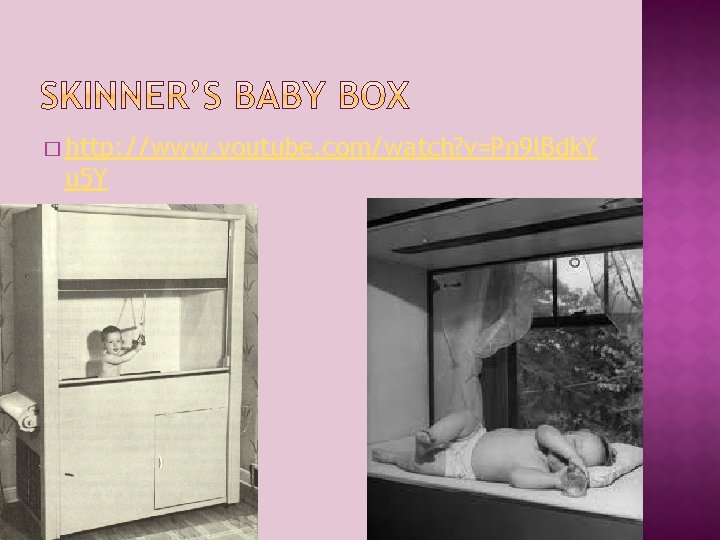
� http: //www. youtube. com/watch? v=Pn 9 l. Bdk. Y u 5 Y
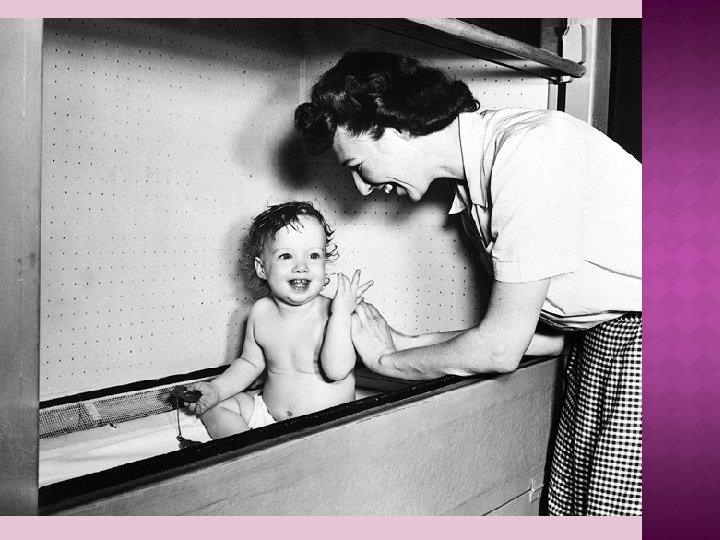
� 1940 s: Wanted her to have the best possible environment to produce healthy, happy baby �Temperature control: less restrictive clothing �Keep out noise and light so she sleeps well �Clean: Bath her less often �She grew up normal and successful �He was criticized: Why didn’t it catch on?
� New research shows humans are highly adaptable to change in environment � Psychoanalysts modify Freud’s ideas: Believe social influences play a major role in shaping personality � Think less about influence of heredity and childhood experiences
� Agree: �Unconscious has important influence �Repression used to cope with anxiety �Defense mechanisms protect ego �Early childhood is when you form basic personality � Disagree: �Sex Drive vs. �Childhood Sexuality �Woman=inferior �Id/Ego/Superego Social vs. vs. influence=more important Learned relationship skills Neither superior They don’t exist
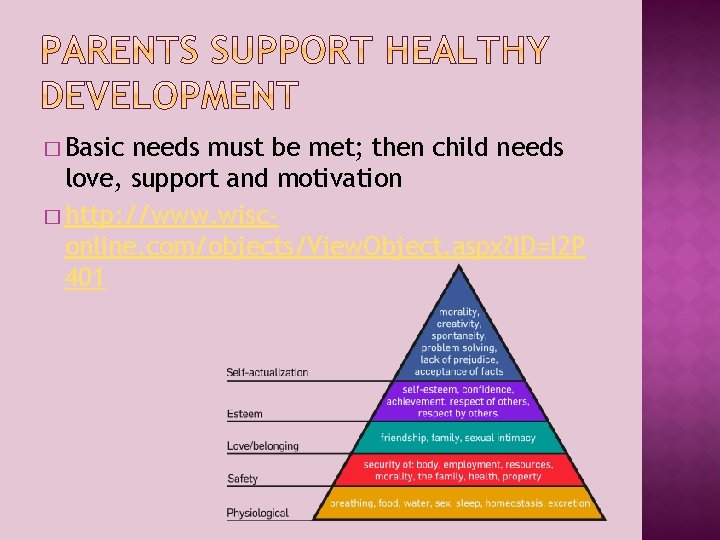
� Basic needs must be met; then child needs love, support and motivation � http: //www. wisconline. com/objects/View. Object. aspx? ID=I 2 P 401
� Broke with Freud in 1911 to form new school of “individual psychology” � Believes Freud focuses too much on sexuality’s influence on personality � Focuses on inborn social needs/urges instead � Society modifies these according to it’s own values/culture
� Inner system that guides an individual to a fulfilling style of life � It is you: it makes you the unique person you are � Each person chooses a particular role because society seems to reward that choice �Examples: happy-go-lucky, romantic, intellectual, melancholy �Fosters your drive to be a superior person �Adler contributes this to free will/choice, unlike Freud contributing it to unconscious
� Begins as child when you are helpless, adults have all the control and power � Most healthy people overcome this � Some don’t: lack social skills, have disabilities, a lack of support, or experience discrimination � Some use it as a motivation to try harder and succeed to prove themselves � Some compensate through actions that hurt others
� People driven by ideals that may be pure fiction, but are ones they pursue with great determination � Causes stress when they attempt to strictly adhere to them �Example: “Honesty is the best policy” �“If I am good, everyone will love me”
� Inborn characteristic: we want out community to be a better place � We want to believe there is good in everyone �Why some will risk their lives for a stranger �Give generously to charity for greater good �Many now are placing concern about personal safety over social interest in the modern world
� German psychiatrist � Didn’t like focus on sexual drives and inferiority of women �New ideas cost her a job and some of her support � Worked very hard to be respected as a woman in her field � Well loved for her warmth and dedication to helping people
� Believes that ability to cope with life is directly related to how well a child copes with threats to it’s security � Adult personality grows out of this success or failure in coping with this anxiety � Babies: unable to control their environment and feel helpless � Harsh/strict/negligent parents increases anxiety
� Major contribution to personality theory � Needs grow out of strategies to combat anxiety � People often make unrealistic demands on themselves on others �“I SHOULD always be understanding, helpful, sympathetic, forgiving, etc. ” �Do things because you should do them not because you necessarily feel it or want to
� Needs that move an individual toward people: �Need for affection, approval, to please others �Need for partner to run their life, fear of being alone �Need for prestige: self-confidence rests totally on receiving recognition from others �Need for personal admiration: Expects to be admired on the basis of false/inflated self-image
� Needs �Need the move an individual away from people: to restrict one’s life within narrow borders �Need for self-sufficiency and independence: relationships are painful, won’t accept love �Need for perfection: Mistakes are weakness, person tries to be infallible at all times
� Needs that move an individual against people: �Need for power: control is so important that they will do anything to attain it �Need to exploit others: Take advantage of people to relive own feelings of insecurity/helplessness �Need for personal achievement: Constantly needs more success, even if at the expense of others
� Austrian psychologist who studied with Anna Freud � Theory of Psychosocial Development: �Same age as Freud’s psychosexual development �In each stage: Achieve new way of seeing yourself in relation to society �Personality develops throughout your whole life �In each stage: Conflict develops between positive and negative ego qualities, you must resolve each crisis to move successfully through stages �If one is not resolved, it CAN be resolved later in life
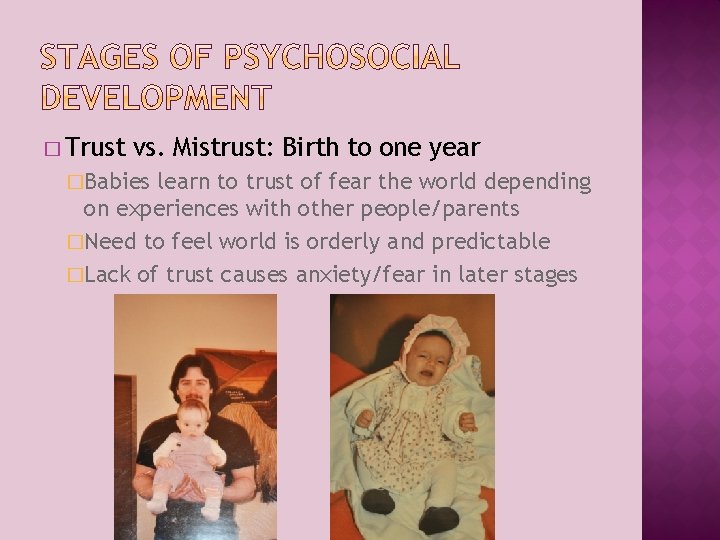
� Trust vs. Mistrust: Birth to one year �Babies learn to trust of fear the world depending on experiences with other people/parents �Need to feel world is orderly and predictable �Lack of trust causes anxiety/fear in later stages
� Autonomy �Children vs. Doubt: Early childhood age 2 -3 must develop self confidence and independence �Learn to feed and dress themselves and become toilet trained �Kids not given the opportunity to explore new skills will be full of shame and self doubt
� Initiative �Children vs. Guilt: Play age, ages 4 -5 are curious and should be encouraged to develop their intellectual resources and interests �Free to run, play, and question everything �Guilt results from overly strict parenting that hinder self-motivation
� Industry �Most vs. Inferiority: School age, 6 -11 kids enter school eager to learn and show off skills �Curious and love trying new things �Explore interpersonal relationships �Teachers/parents who push too hard can cause feelings of inferiority and lack of initiative
� Identity vs. Role Confusion: Adolescence, ages 12 -18 �Critical period where you find your own identity �Made more difficult by challenges of adolescent tasks: sex, career choices, relationships with peers and parents, etc. �Must resolve identity crisis in order to have clear goals for a happy productive adulthood
� Intimacy vs. Isolation: young adulthood, ages 19 -35 �People are looking for a partner �Find your values while your identity will be challenged by friends and lovers �Must develop strength to stick to commitments even if there is sacrifice or deferred gratification
� Generativity �Mature vs. Stagnation: Adulthood, ages 36 -60 adults begin to plan for future generations, through children or community contribution �Volunteer work, coaching, or helping your own kids succeed adds to quality of life �Stagnant adults are concerned only with themselves and try to deny aging process and concentrate on material pleasures
� Ego Integrity vs. Despair: old age, 60+ �Well-integrated elderly people can cherish their successes, learn from their failures, and accept death �Remain active and involved �Those who did not achieve ego integrity are full of anger, fear, despair and regret
� Swiss Psychoanalyst, friend of Freud � Doesn‘t agree with Freud’s focus on sex drives � Instead, places emphasis on spiritual and moral aspects of life � So influential and original that he has his own school of psychology; Analytic Psychology � Calls the human personality the psyche
� Two parts: Personal and Collective Unconscious � The Personal Unconscious: contains experiences that were once conscious but have been forgotten/repressed � Unconscious can influence conscious behavior � Complex: organized group of feelings/thoughts in the unconscious �Fixation on aspect that dominates your life that you may or may not be aware of �Examples: money complex, power complex, mother complex, etc.
� The Collective Unconscious: � Universal instincts, drives, and memories shared by the human race � Cross boundaries of time, skin color, and geography � “Memories” of history are unseen forces influencing your thoughts/feelings/perceptions � 2 million years of evolutionary experience left a mark on the human brain �Example: People still like to hunt/fish, universal behaviors across separated cultures, etc.
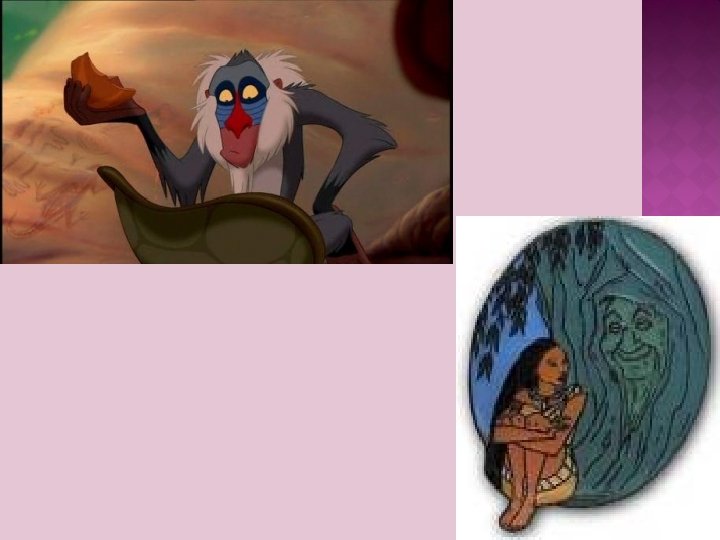
� Universal thought patterns, themes, and symbols � Appear across time in literature, religion, music, art, etc. � Create images on which you base your perception of the world � Creates your sense of wholeness, completeness, and interconnectivity �Examples: Hero archetype, mother earth archetype, the wise old man, the devil/villain
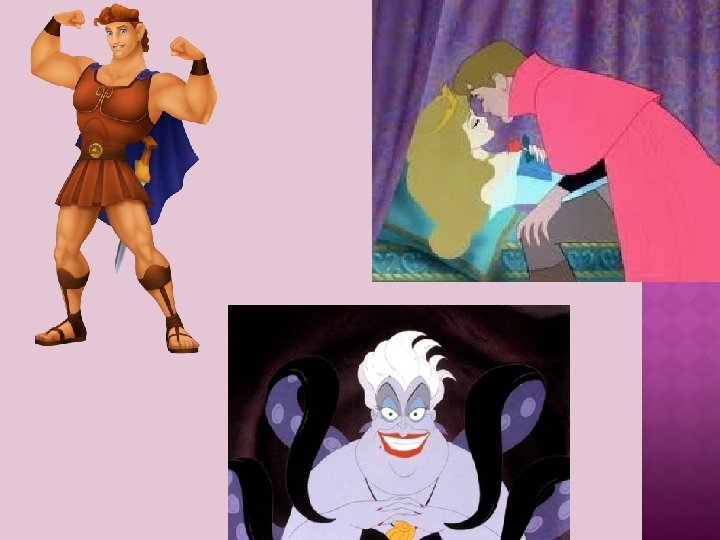
� Four become systems within personality: � 1. Persona: The “mask” you wear to hide your true self in public (your image) �In response to social pressure, traditions, and need for acceptance �Healthy if it is a choice, but can’t allow it to dominate your life �Example: the good girl, the bad boy
� Anima and Animus: � All people carry elements of the opposite sex within their personalities � Anima: Feminine image men carry � Animus: Male image women carry � Provide balance to the personality � Enable sexes to understand each other � Forms your perception/expectations of the opposite sex �Example: Ideal woman
� Shadow: Represents the primitive side of personality � Socially unacceptable thoughts/desires are repressed by personal unconscious � Most people hide the shadow behind their persona �Deep secrets, guilty pleasures, skeletons in the closet, selfish needs, etc.
� Self: Analytic psychology places great emphasis on concept of the self � Life goal, striving for unity and completeness � Few reach this because all other elements of personality must fully develop first �Example: Religious leaders or philosophers who join conscious and unconscious mind see emergence of completed self
� Introversion: look inward, find pleasure in pursuing own thoughts, shy, happiest alone � Extroversion: invest psychic energy in the outside world, need company, excitement, activity, outgoing � Everyone has both aspects, one usually dominates
� As the subject responds to a list of prepared words, repressed/concealed thoughts will slip past the mind’s censors into speech � Responses to key words admit guilt/connect them to a crime, etc. �Similar to polygraph test
� Human beings are free agents, they determine their behavior by choice � Not controlled by unconscious forces � No one is bound to the past � Rollo May: Encourages people to take responsibility for their own lives �“I learned along the way to tune in on my being, my existence in the now, because that was all there was—that and my tubular body. It was a valuable experience to face death, for in the experience I learned to face life”
� Created after WWII to aid people who felt life was empty of meaning � It is the belief in the nobility of the human spirit that gives meaning and purpose to life � Central concept of life is being: all you can know of the world is what you perceive �“You are part of the world, and the world is part of you”
� Being is becoming: Humans have potential to grow and change things � Alternative is to give in to frustration and sense of futility � To realize your potential requires that you explore your own being/consciousness/identity � Happiness found in freedom and commitment
� Humans must take responsibility of their own life, completely free will � Make choices, take action, take risks, learn from mistakes � Everyone can change for the better and has a responsibility to do so � Don’t make excuses for your problems/issues: �“My parents hit me when I was little, so it’s their fault that this is the way I am. I can’t change. ”
� Happiness is a by-product of committing yourself to the choices you have made � Make each choice in your life as if you are making it for all humanity � Anxiety and despair result when you refuse to take responsibility of your own life � Life is not fair, bad things will happen, but live your life to the fullest and make the beset of it
� Anxiety/despair are inescapable parts of the human condition � Making choices means taking chances � Each choice brings new anxiety � If you give in to this anxiety it causes neurotic behavior �Examples: Withdrawal from society, seeking pleasure by any means, conforming to the views/desires of others so they don’t have to make their own choices, etc.
� Existential vacuum: Feeling that everything is meaningless, feeling helpless to change anything successfully, give up instead � Viktor Frankl: Studied concentration camp inmates �Many were in an existential vacuum=died �Those who lived were those who had a task to complete in life: someone/something depended on them=gives them meaning and purpose
� Viktor Frankl: “I have seen the meaning of my life in helping others to see in their lives a meaning” � Rollo May: Anxiety in small doses is constructive �Sharpens your sensitivity �Spark creativity/motivation �Living up to your responsibilities strengthens you
� Psychologists still hope for an all-encompassing theory to explain personality � Family Systems Theory: Therapists should focus on the family not individuals �Family interactions can cause anxiety or happiness � Psychologists are exploring ethnic and cultural forces that shape personality � Gender theory is gaining ground in comparing roles each sex takes on which form their personalities
- Slides: 57