
Psychology A Journey Second Edition Dennis Coon Chapter




- Slides: 72
Psychology: A Journey, Second Edition, Dennis Coon Chapter 4 Sensation and Perception
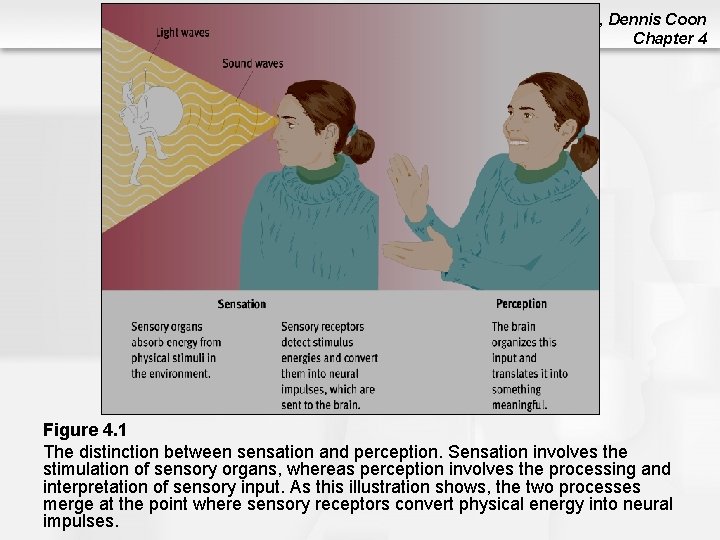
Psychology: A Journey, Second Edition, Dennis Coon Chapter 4 Figure 4. 1 The distinction between sensation and perception. Sensation involves the stimulation of sensory organs, whereas perception involves the processing and interpretation of sensory input. As this illustration shows, the two processes merge at the point where sensory receptors convert physical energy into neural impulses.
Psychology: A Journey, Second Edition, Dennis Coon Chapter 4
Psychology: A Journey, Second Edition, Dennis Coon Chapter 4 General Properties of Sensory Systems • Sensation: Process of detecting physical energies with sensory organs • Perception: Mental process of organizing sensations into meaningful patterns • Data Reduction System: Any system that selects, analyzes, and condenses information (e. g. , the sensory systems) • Transducer: A device that converts energy from one system into energy in another (e. g. , the receptors)
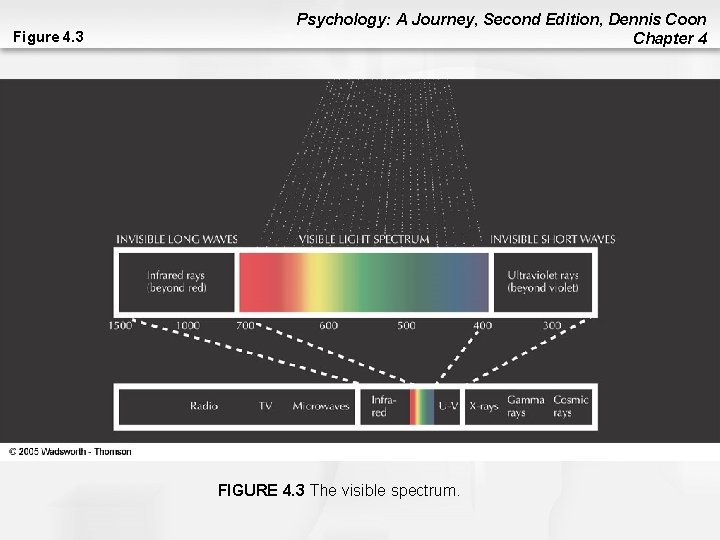
Figure 4. 3 Psychology: A Journey, Second Edition, Dennis Coon Chapter 4 FIGURE 4. 3 The visible spectrum.
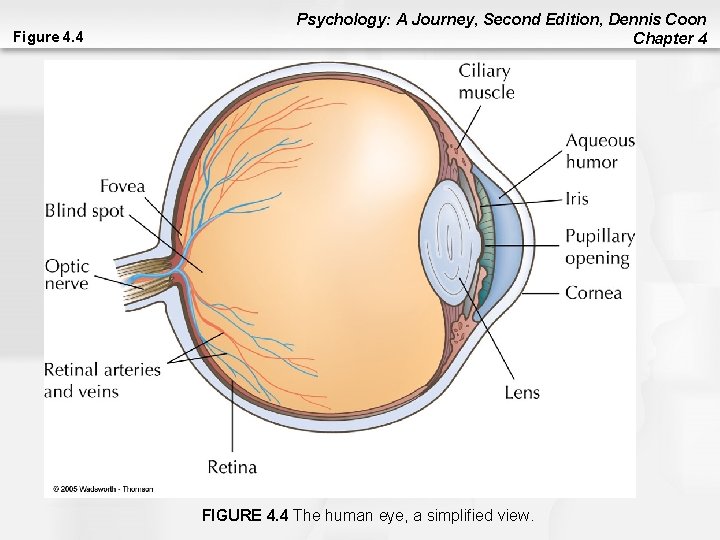
Figure 4. 4 Psychology: A Journey, Second Edition, Dennis Coon Chapter 4 FIGURE 4. 4 The human eye, a simplified view.
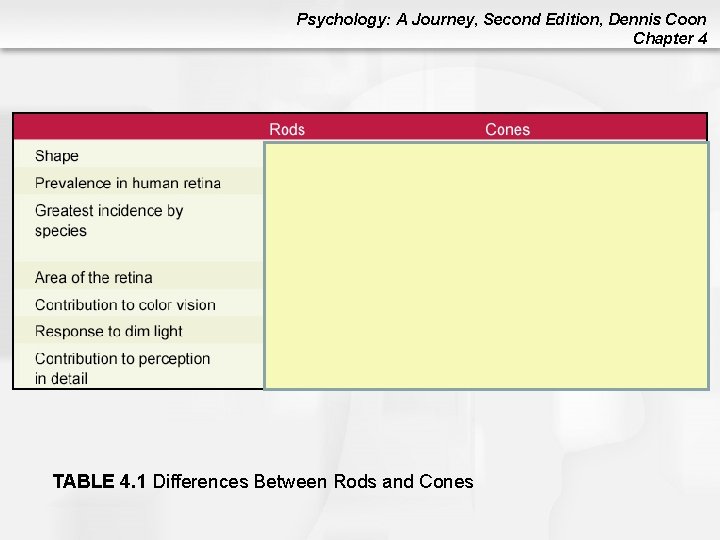
Psychology: A Journey, Second Edition, Dennis Coon Chapter 4 TABLE 4. 1 Differences Between Rods and Cones
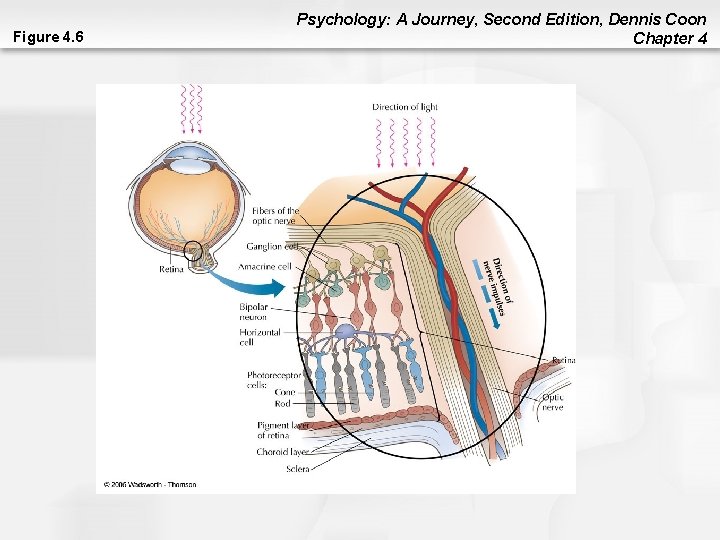
Figure 4. 6 Psychology: A Journey, Second Edition, Dennis Coon Chapter 4
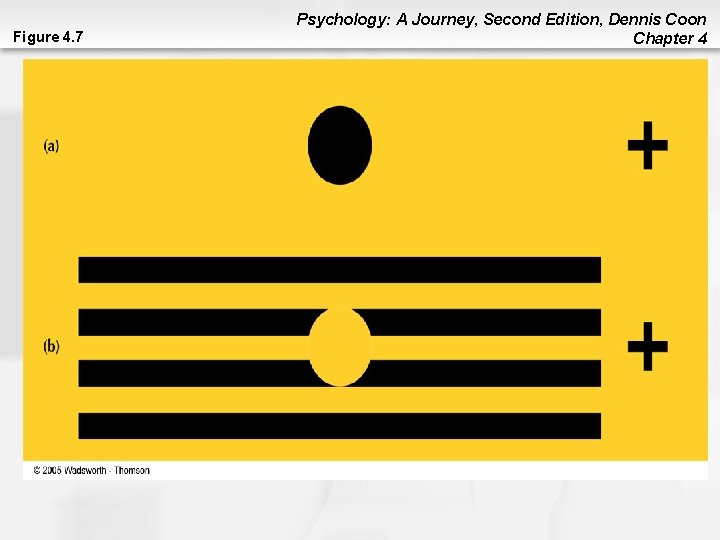
Figure 4. 7 Psychology: A Journey, Second Edition, Dennis Coon Chapter 4
Psychology: A Journey, Second Edition, Dennis Coon Chapter 4 Vision Problems • Hyperopia: Difficulty focusing nearby objects (farsightedness) • Myopia: Difficulty focusing distant objects (nearsightedness) • Astigmatism: Corneal, lens, or eye defect that causes some areas of vision to be out of focus; relatively common • Presbyopia: Farsightedness caused by aging
Figure 4. 5 Psychology: A Journey, Second Edition, Dennis Coon Chapter 4
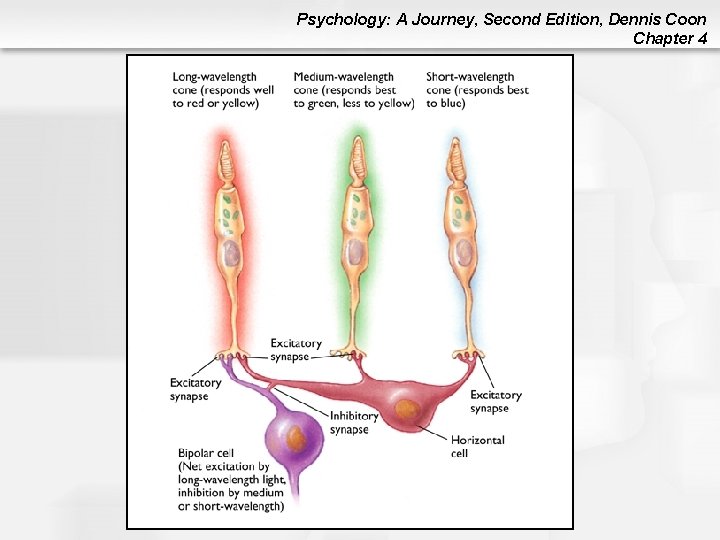
Psychology: A Journey, Second Edition, Dennis Coon Chapter 4 Color Vision • Trichromatic Theory: Color vision theory that states we have three cone types: red, green, blue – Other colors produced by a combination of these – Black and white produced by rods
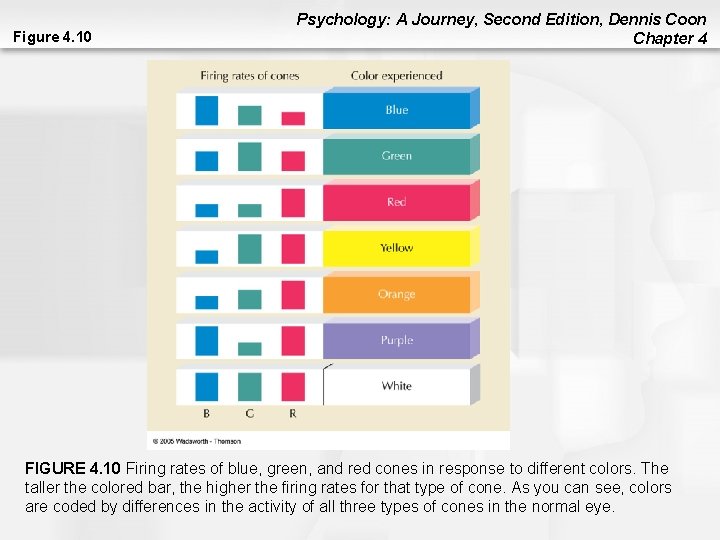
Figure 4. 10 Psychology: A Journey, Second Edition, Dennis Coon Chapter 4 FIGURE 4. 10 Firing rates of blue, green, and red cones in response to different colors. The taller the colored bar, the higher the firing rates for that type of cone. As you can see, colors are coded by differences in the activity of all three types of cones in the normal eye.
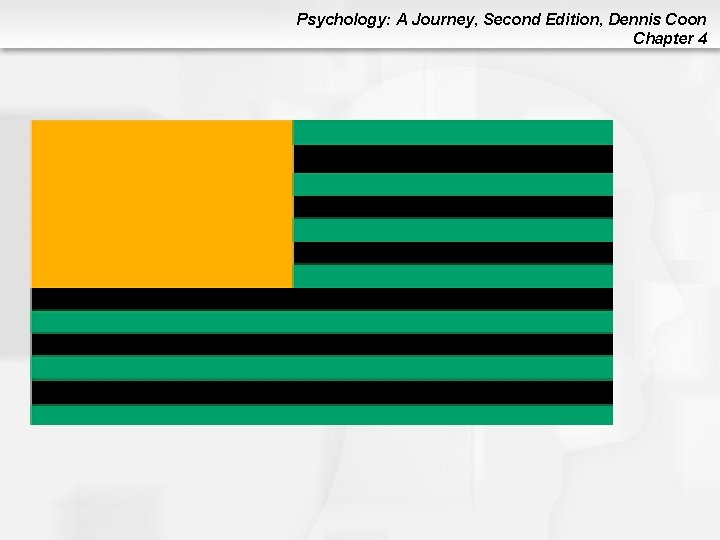
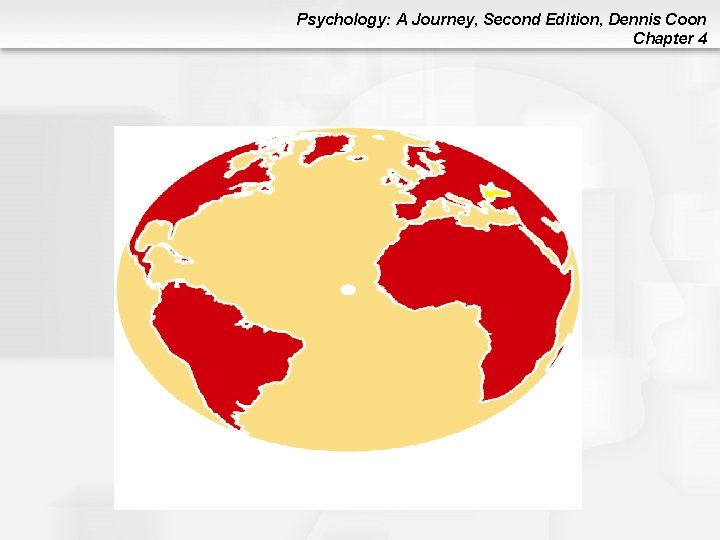
Psychology: A Journey, Second Edition, Dennis Coon Chapter 4 • Opponent Process Theory: Color vision theory based on three “systems”: red or green, blue or yellow, black or white – Exciting one color in a pair (red) blocks the excitation in the other member of the pair (green) – Afterimage: Visual sensation that remains after stimulus is removed (seeing flashbulb after the picture has been taken)
Psychology: A Journey, Second Edition, Dennis Coon Chapter 4
Psychology: A Journey, Second Edition, Dennis Coon Chapter 4
Psychology: A Journey, Second Edition, Dennis Coon Chapter 4
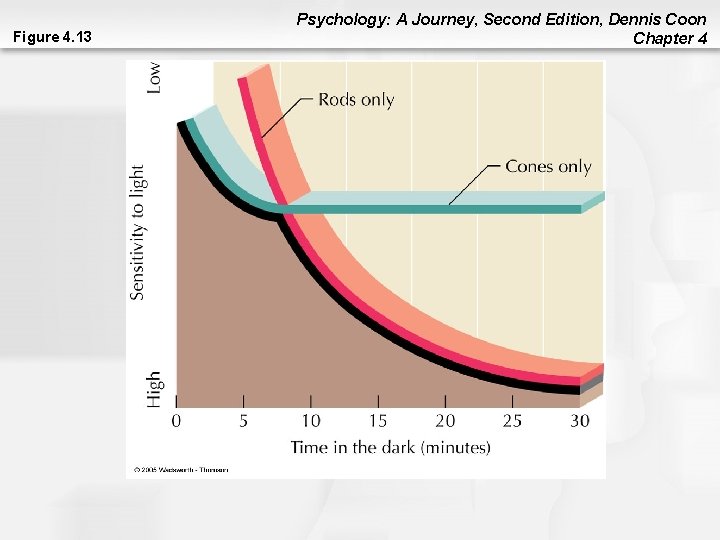
Psychology: A Journey, Second Edition, Dennis Coon Chapter 4 Dark Adaptation • Increased retinal sensitivity to light after entering the dark; similar to going from daylight into a dark movie theater • Rhodopsin: Light-sensitive pigment in the rods
Figure 4. 13 Psychology: A Journey, Second Edition, Dennis Coon Chapter 4
Psychology: A Journey, Second Edition, Dennis Coon Chapter 4 Visual Perception • How do we organize sensations into meaningful perceptions? • You experience perceptual constructions— mental representations of external events—that are actively created by your brain • Does your brain ever misconstruct (and thus misperceive) external stimuli?
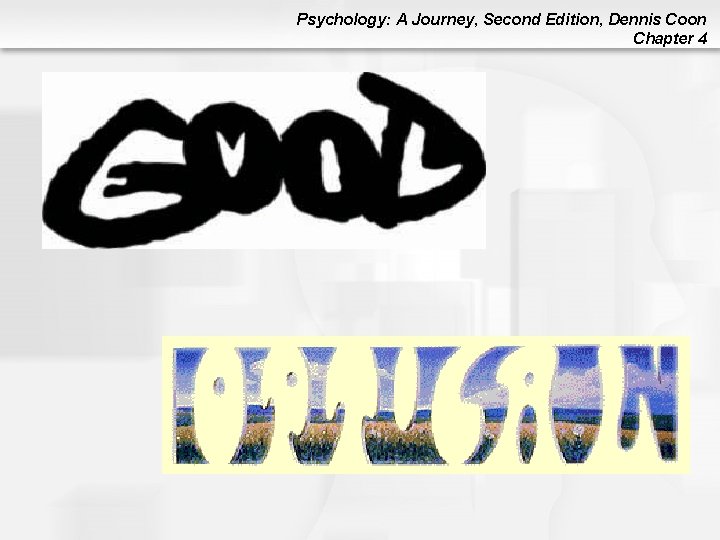
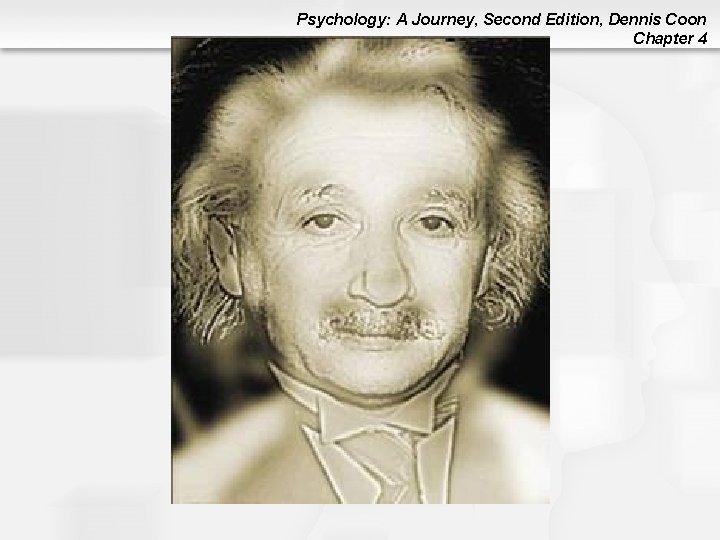
Psychology: A Journey, Second Edition, Dennis Coon Chapter 4 Impress your Friends • Mystical illusion or simply a property of your visual system? • Explain this
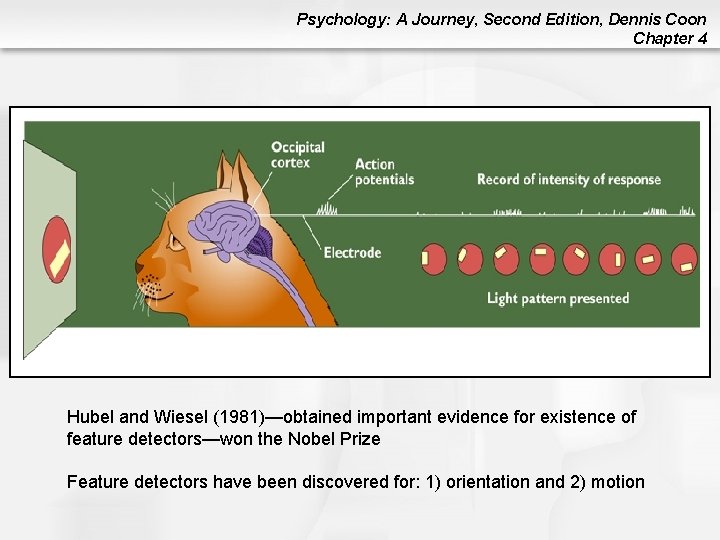
Psychology: A Journey, Second Edition, Dennis Coon Chapter 4 The Feature-Detector Approach • One explanation for how we analyze complex stimuli suggests that we break them down into component parts (low-level features, bottom-up processing) – We have feature detectors, specialized neurons that respond to the presence of certain simple features, such as angles and lines. – For example, one feature detector might be stimulated only by the presence of vertical lines, or 90 angles. – Feature detectors are essential for the first stages of analysis, but perception of complex stimuli requires other processes as well.
Psychology: A Journey, Second Edition, Dennis Coon Chapter 4 Hubel and Wiesel (1981)—obtained important evidence for existence of feature detectors—won the Nobel Prize Feature detectors have been discovered for: 1) orientation and 2) motion
Psychology: A Journey, Second Edition, Dennis Coon Chapter 4 The Feature-Detector Approach • The waterfall illusion experienced by humans is evidence that humans do indeed have feature detectors. • In this illusion, a person first stares at a waterfall for one minute or more. • If the person then looks at cliffs immediately after staring at the waterfall, the cliffs will appear to “flow upward”. • This suggests that the cells that detect downward motion have become fatigued from the act of staring at the waterfall. • Another motion aftereffect
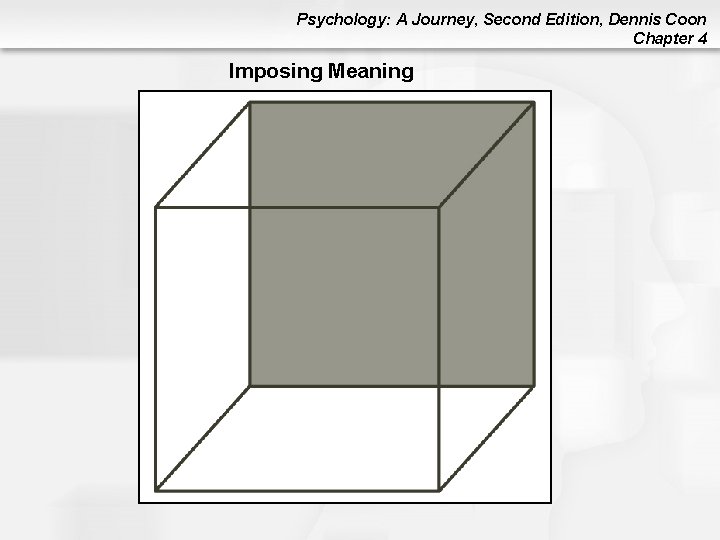
Psychology: A Journey, Second Edition, Dennis Coon Chapter 4 Imposing Meaning
Psychology: A Journey, Second Edition, Dennis Coon Chapter 4 Imposing Meaning--Gestalt Psychology • Gestalt psychology focuses on the human ability to perceive overall patterns. – The word Gestalt has no true English equivalent, but is close to synonymous with “pattern” or “configuration. ” – According to Gestalt psychologists, visual perception is an active creation, not merely the adding up of lines and movement.
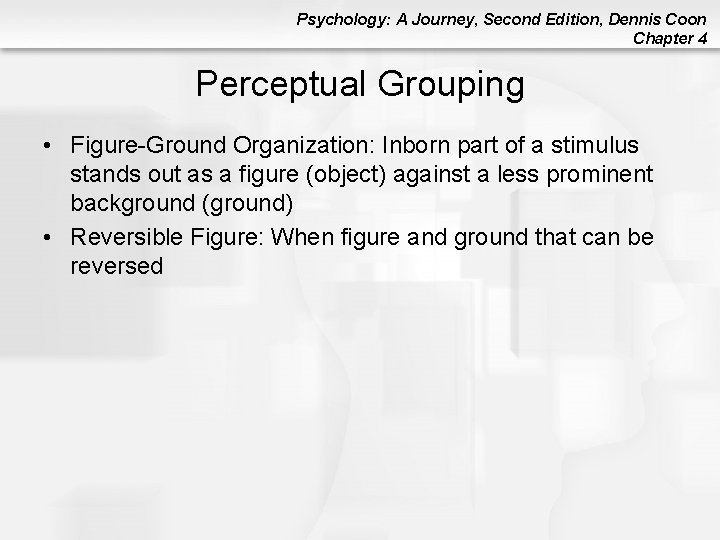
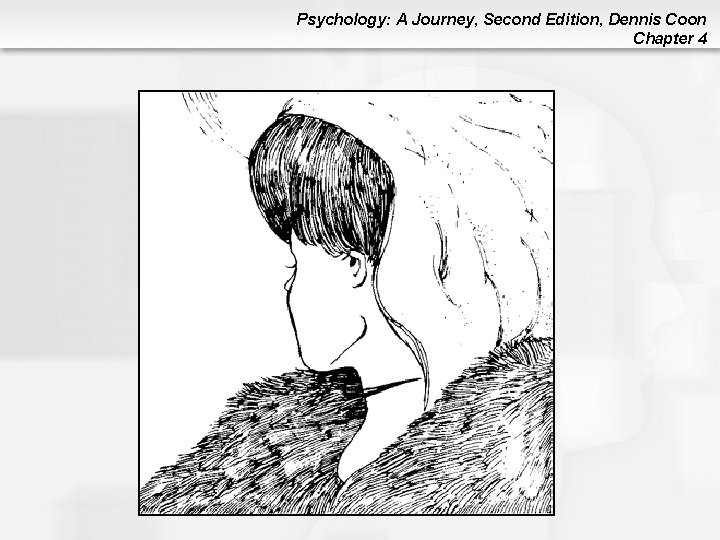
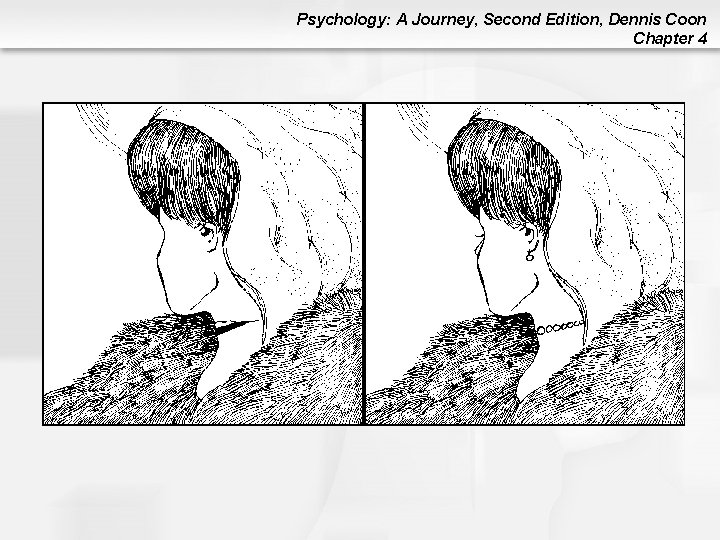
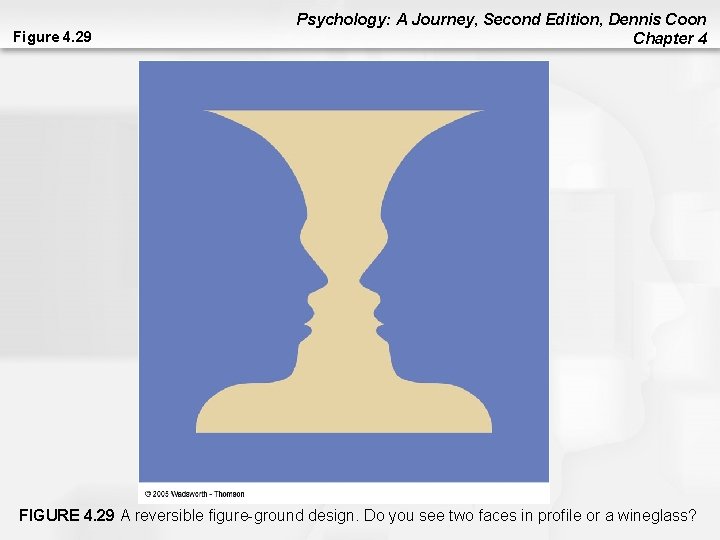
Psychology: A Journey, Second Edition, Dennis Coon Chapter 4 Perceptual Grouping • Figure-Ground Organization: Inborn part of a stimulus stands out as a figure (object) against a less prominent background (ground) • Reversible Figure: When figure and ground that can be reversed
Psychology: A Journey, Second Edition, Dennis Coon Chapter 4
Psychology: A Journey, Second Edition, Dennis Coon Chapter 4
Figure 4. 29 Psychology: A Journey, Second Edition, Dennis Coon Chapter 4 FIGURE 4. 29 A reversible figure-ground design. Do you see two faces in profile or a wineglass?
Psychology: A Journey, Second Edition, Dennis Coon Chapter 4
Psychology: A Journey, Second Edition, Dennis Coon Chapter 4
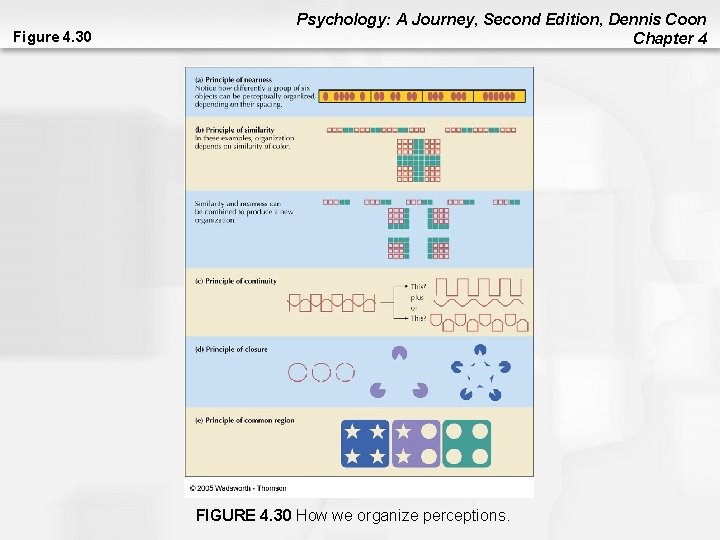
Psychology: A Journey, Second Edition, Dennis Coon Chapter 4 Gestalt Principles of Organization • Proximity (or Nearness): Stimuli that are near each other tend to be grouped together • Similarity: Stimuli that are similar in size, shape, color, or form tend to be grouped together • Closure: Tendency to complete a figure so that it has a consistent overall form • Connectedness/Common Region: Stimuli that are found within a common area tend to be seen as a group
Figure 4. 30 Psychology: A Journey, Second Edition, Dennis Coon Chapter 4 FIGURE 4. 30 How we organize perceptions.
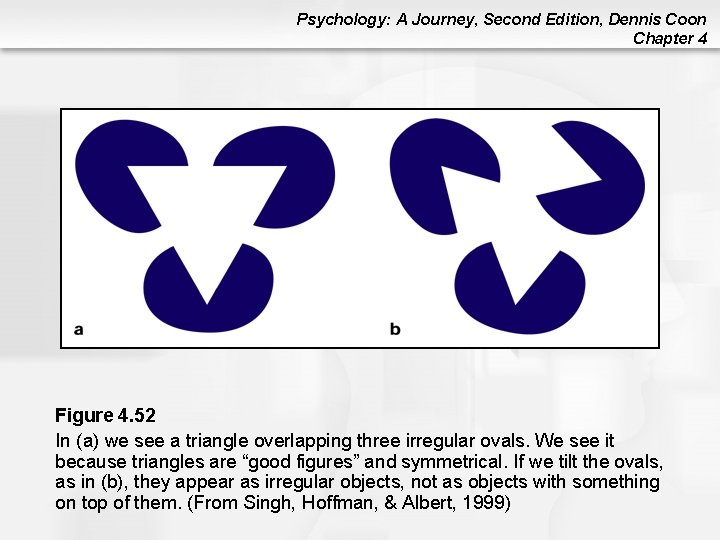
Psychology: A Journey, Second Edition, Dennis Coon Chapter 4 Figure 4. 52 In (a) we see a triangle overlapping three irregular ovals. We see it because triangles are “good figures” and symmetrical. If we tilt the ovals, as in (b), they appear as irregular objects, not as objects with something on top of them. (From Singh, Hoffman, & Albert, 1999)
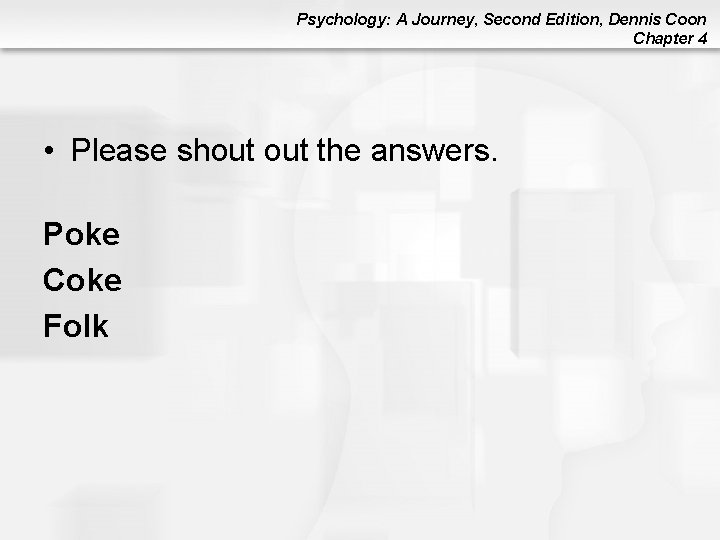
Psychology: A Journey, Second Edition, Dennis Coon Chapter 4 • Please shout the answers. Poke Coke Folk
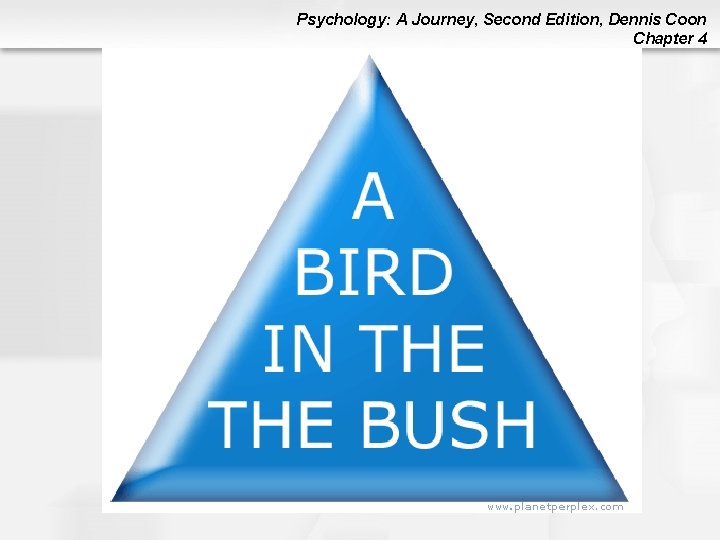
Psychology: A Journey, Second Edition, Dennis Coon Chapter 4 Perceptual Expectancies (Set) • Bottom-Up Processing: Analyzing information starting at the bottom (small units) and going upward to form a complete perception • Top-Down Processing: Preexisting knowledge that is used to rapidly organize features into a meaningful whole • Perceptual Set: Readiness to perceive in a particular manner, induced by small expectations
Psychology: A Journey, Second Edition, Dennis Coon Chapter 4
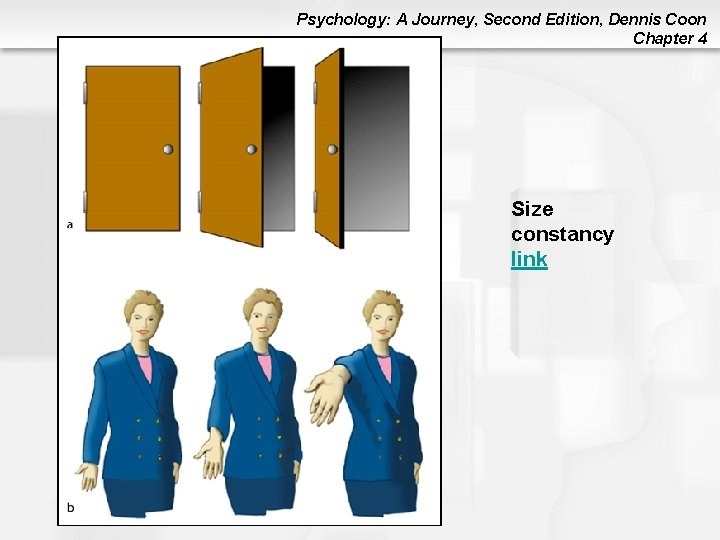
Psychology: A Journey, Second Edition, Dennis Coon Chapter 4 Perception of Movement and Depth • Visual constancy – Visual constancy is our tendency to perceive objects as keeping their size, shape and color even though the image that strikes our retina changes from moment to moment. – So an automobile that is driving away looks like it is moving away, not merely shrinking, even though the image on our two retinas is growing smaller.
Psychology: A Journey, Second Edition, Dennis Coon Chapter 4 Size constancy link
Psychology: A Journey, Second Edition, Dennis Coon Chapter 4 Depth Perception • Our retinas are two-dimensional surfaces, but they give us very good depth perception – our ability to perceive distance. – There are several factors involved in creating our depth perception. – Some are binocular cues (depending on both eyes) and others are monocular (needing only one eye. )
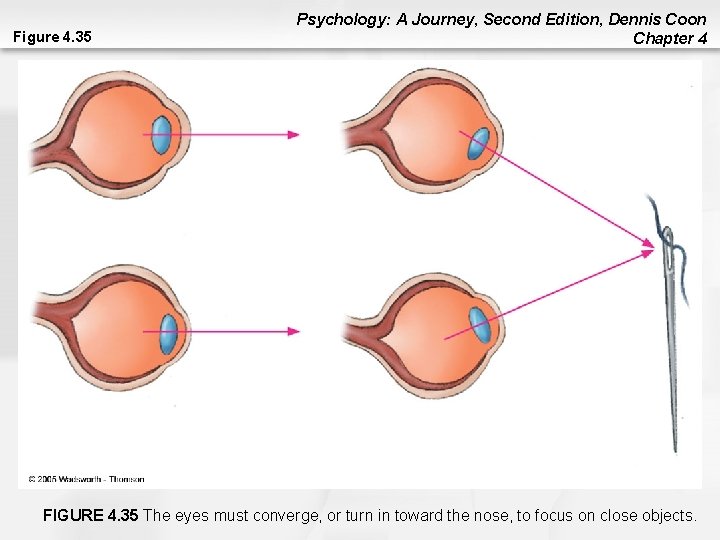
Psychology: A Journey, Second Edition, Dennis Coon Chapter 4 Depth Perception • Binocular cues – One important contributor is retinal disparity, which is the difference in apparent position of an object seen by each retina. – This discrepancy allows us to gauge distance. – Convergence is the degree to which our eyes must turn in to allow us to focus on a very close object.
Psychology: A Journey, Second Edition, Dennis Coon Chapter 4
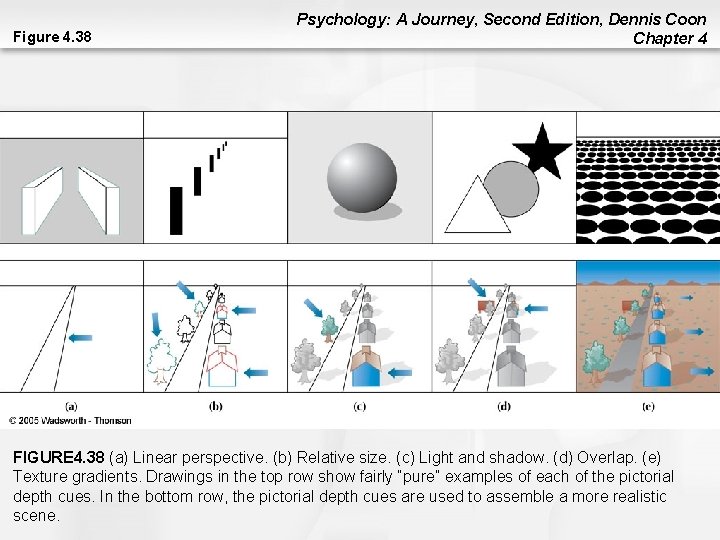
Psychology: A Journey, Second Edition, Dennis Coon Chapter 4 Depth Perception • Monocular cues allow a person to judge depth and distance accurately using only one eye. – Object size can be used if we already have an idea of the approximate size of the objects. – Linear perspective, as in the case of parallel lines that converge as they approach the horizon. – Detail – generally objects that are closer can be seen in greater detail than those that are farther away.
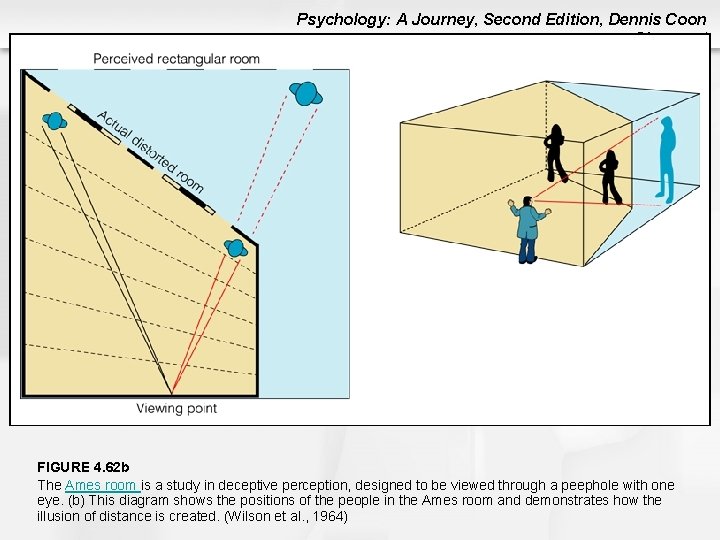
Psychology: A Journey, Second Edition, Dennis Coon Chapter 4 Optical Illusions • When we misjudge distance, we misjudge size as well. • For example, the Ames room illusion causes us to misjudge the heights of people standing in it using a powerfully misleading set of background cues.
Psychology: A Journey, Second Edition, Dennis Coon Chapter 4 FIGURE 4. 62 b The Ames room is a study in deceptive perception, designed to be viewed through a peephole with one eye. (b) This diagram shows the positions of the people in the Ames room and demonstrates how the illusion of distance is created. (Wilson et al. , 1964)
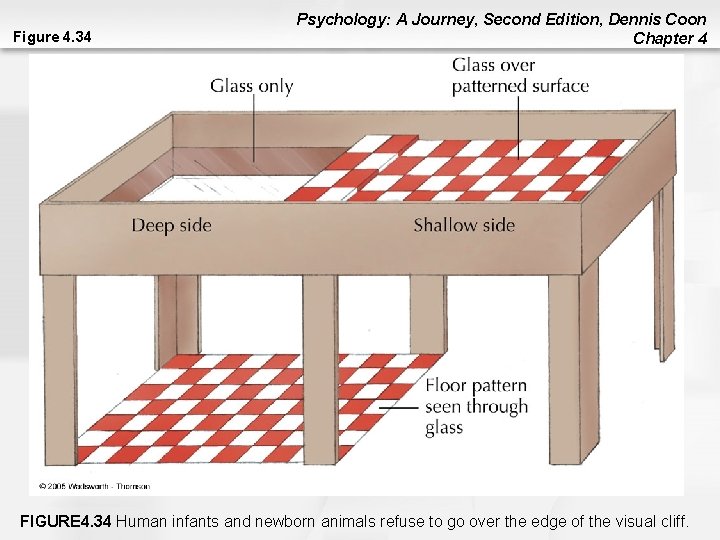
Psychology: A Journey, Second Edition, Dennis Coon Chapter 4 Depth Perception • Definition: Ability to see three-dimensional space and to accurately judge distances • Visual Cliff: Apparatus that looks like the edge of an elevated platform or cliff • Depth Cues: Features of environment, and messages, that supply information about distance and space • Monocular Depth Cue: Depth cue that can be sensed with one eye • Binocular Depth Cue: Depth cue that can be sensed with two eyes
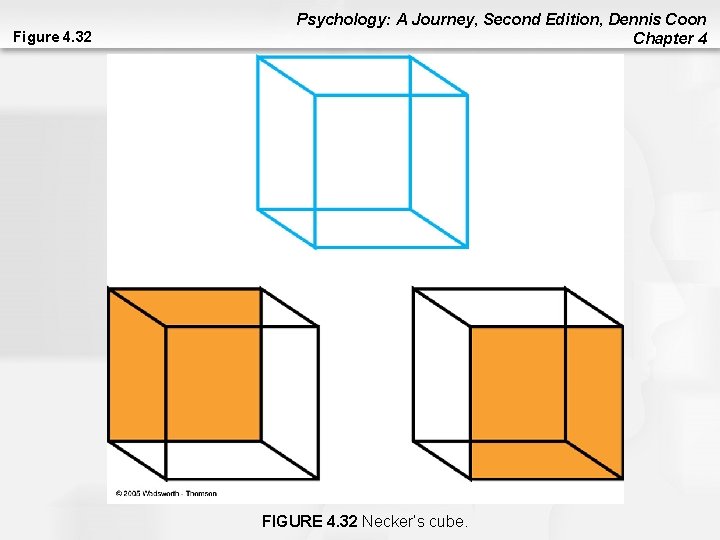
Figure 4. 32 Psychology: A Journey, Second Edition, Dennis Coon Chapter 4 FIGURE 4. 32 Necker’s cube.
Figure 4. 34 Psychology: A Journey, Second Edition, Dennis Coon Chapter 4 FIGURE 4. 34 Human infants and newborn animals refuse to go over the edge of the visual cliff.
Psychology: A Journey, Second Edition, Dennis Coon Chapter 4 Muscular Cues for Depth Perception • Accommodation: Bending of the lens of the eye to focus on nearby objects • Convergence: Binocular cue; when you look at something 50 feet or closer, your eyes must turn in (converge) to focus the object • Retinal Disparity: Discrepancy in the images that reach the right and left eyes • Stereotopic Vision: Three-dimensional sight
Figure 4. 35 Psychology: A Journey, Second Edition, Dennis Coon Chapter 4 FIGURE 4. 35 The eyes must converge, or turn in toward the nose, to focus on close objects.
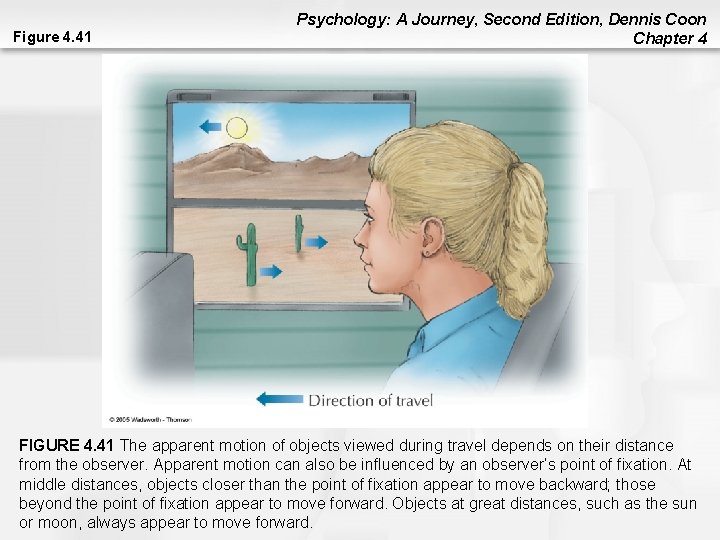
Psychology: A Journey, Second Edition, Dennis Coon Chapter 4 Pictoral Cues for Depth • Features found in paintings, drawings and photographs that supply information about space, depth, and distance – Linear Perspective: Based on apparent convergence of parallel lines in environment – Overlap (Interposition): When one object partially blocks another – Texture Gradients: Texture changes can contribute to depth perception; coarse texture implies closeness, fine texture implies distance – Relative Motion (Motion Parallax): Nearby objects move a lot as your head moves; distant objects move slightly
Figure 4. 38 Psychology: A Journey, Second Edition, Dennis Coon Chapter 4 FIGURE 4. 38 (a) Linear perspective. (b) Relative size. (c) Light and shadow. (d) Overlap. (e) Texture gradients. Drawings in the top row show fairly “pure” examples of each of the pictorial depth cues. In the bottom row, the pictorial depth cues are used to assemble a more realistic scene.
Figure 4. 41 Psychology: A Journey, Second Edition, Dennis Coon Chapter 4 FIGURE 4. 41 The apparent motion of objects viewed during travel depends on their distance from the observer. Apparent motion can also be influenced by an observer’s point of fixation. At middle distances, objects closer than the point of fixation appear to move backward; those beyond the point of fixation appear to move forward. Objects at great distances, such as the sun or moon, always appear to move forward.
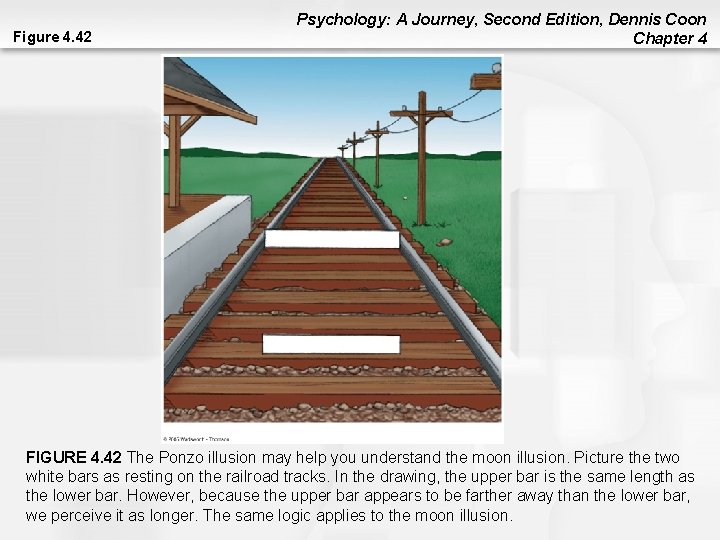
Psychology: A Journey, Second Edition, Dennis Coon Chapter 4 Some Illusions • Moon Illusion: Apparent change in size that occurs as the moon moves from the horizon (large moon) to overhead (small moon) • Apparent-Distance Hypothesis: Horizon seems more distant than the night sky
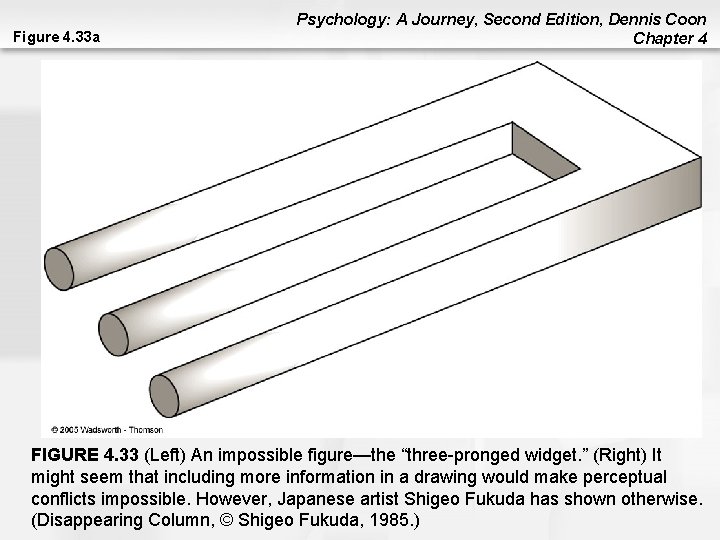
Figure 4. 33 a Psychology: A Journey, Second Edition, Dennis Coon Chapter 4 FIGURE 4. 33 (Left) An impossible figure—the “three-pronged widget. ” (Right) It might seem that including more information in a drawing would make perceptual conflicts impossible. However, Japanese artist Shigeo Fukuda has shown otherwise. (Disappearing Column, © Shigeo Fukuda, 1985. )
Figure 4. 42 Psychology: A Journey, Second Edition, Dennis Coon Chapter 4 FIGURE 4. 42 The Ponzo illusion may help you understand the moon illusion. Picture the two white bars as resting on the railroad tracks. In the drawing, the upper bar is the same length as the lower bar. However, because the upper bar appears to be farther away than the lower bar, we perceive it as longer. The same logic applies to the moon illusion.
Psychology: A Journey, Second Edition, Dennis Coon Chapter 4 Perceptual Learning • Change in the brain that alters how we process sensory information • Perceptual Reconstructions: Mental models of external events • Perceptual Habits: Ingrained patterns of organization and attention
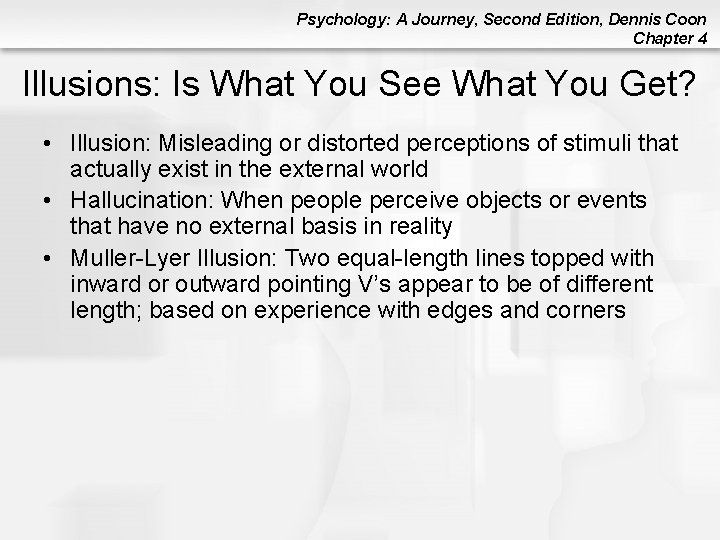
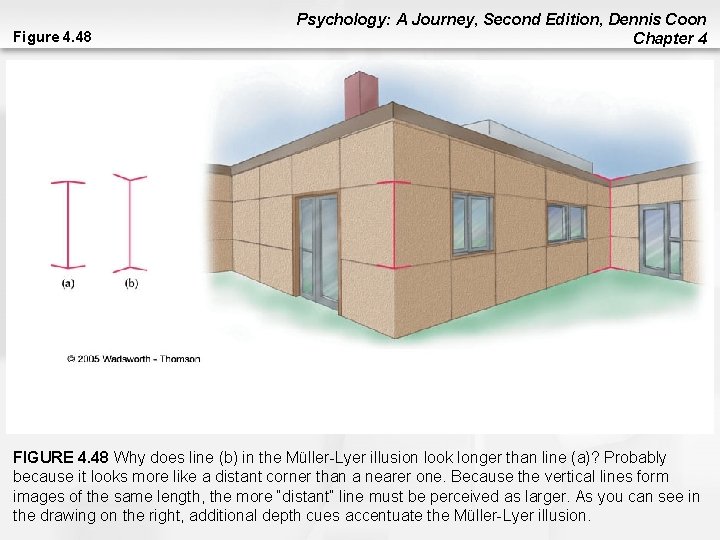
Psychology: A Journey, Second Edition, Dennis Coon Chapter 4 Illusions: Is What You See What You Get? • Illusion: Misleading or distorted perceptions of stimuli that actually exist in the external world • Hallucination: When people perceive objects or events that have no external basis in reality • Muller-Lyer Illusion: Two equal-length lines topped with inward or outward pointing V’s appear to be of different length; based on experience with edges and corners
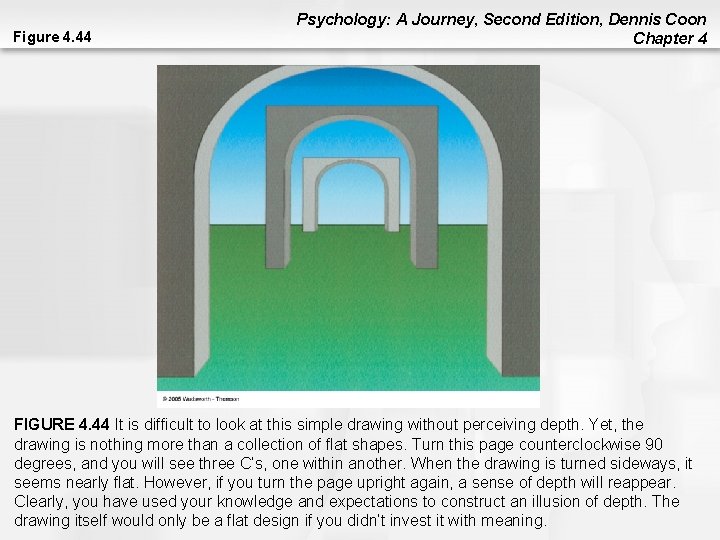
Figure 4. 44 Psychology: A Journey, Second Edition, Dennis Coon Chapter 4 FIGURE 4. 44 It is difficult to look at this simple drawing without perceiving depth. Yet, the drawing is nothing more than a collection of flat shapes. Turn this page counterclockwise 90 degrees, and you will see three C’s, one within another. When the drawing is turned sideways, it seems nearly flat. However, if you turn the page upright again, a sense of depth will reappear. Clearly, you have used your knowledge and expectations to construct an illusion of depth. The drawing itself would only be a flat design if you didn’t invest it with meaning.
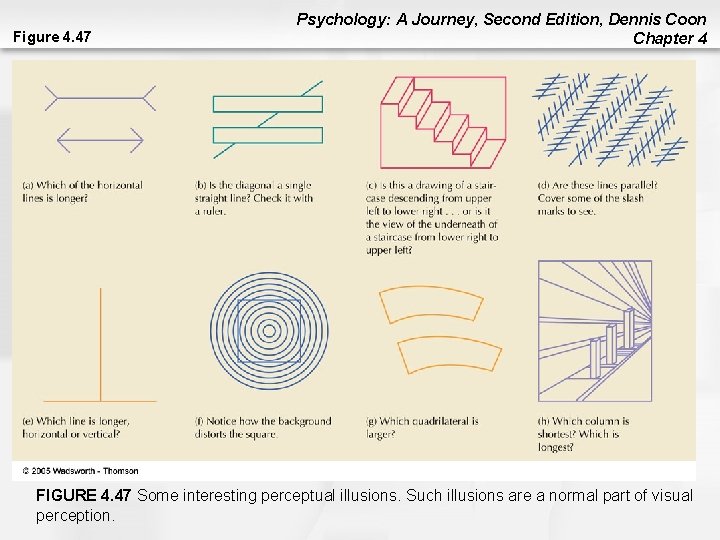
Figure 4. 47 Psychology: A Journey, Second Edition, Dennis Coon Chapter 4 FIGURE 4. 47 Some interesting perceptual illusions. Such illusions are a normal part of visual perception.
Figure 4. 48 Psychology: A Journey, Second Edition, Dennis Coon Chapter 4 FIGURE 4. 48 Why does line (b) in the Müller-Lyer illusion look longer than line (a)? Probably because it looks more like a distant corner than a nearer one. Because the vertical lines form images of the same length, the more “distant” line must be perceived as larger. As you can see in the drawing on the right, additional depth cues accentuate the Müller-Lyer illusion.
Psychology: A Journey, Second Edition, Dennis Coon Chapter 4 Extrasensory Perception (ESP): Fact or Fallacy? • Parapsychology: Study of ESP and other psi phenomena (events that seem to defy accepted scientific laws) – Clairvoyance: Purported ability to perceive events unaffected by distance or normal physical barriers – Telepathy: Purported ability to read someone else’s mind – Precognition: Purported ability to accurately predict the future – Psychokinesis (Mind Over Matter): Purported ability to influence inanimate objects by willpower
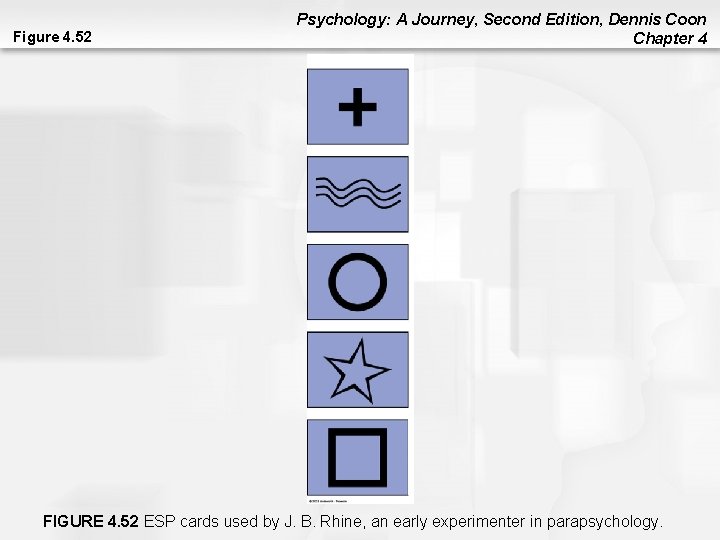
Psychology: A Journey, Second Edition, Dennis Coon Chapter 4 More ESP Issues • Zener Cards: Deck of 25 cards, each having one of five symbols • Run of Luck: Statistically unusual outcome that could occur by chance alone (e. g. , getting five heads in a row, two jackpots within six pulls of a slot machine) • Stage ESP: Simulation of ESP for entertainment purposes • Conclusion: Existence of ESP has NOT been scientifically demonstrated; positive results are usually inconclusive and easily criticized – In sum: Be skeptical! If it seems too good to be true, it probably is!
Figure 4. 52 Psychology: A Journey, Second Edition, Dennis Coon Chapter 4 FIGURE 4. 52 ESP cards used by J. B. Rhine, an early experimenter in parapsychology.
Psychology: A Journey, Second Edition, Dennis Coon Chapter 4 Factors Affecting the Accuracy of Eyewitness Perceptions • Post-Event Information: Testimony reflects not only what was actually seen but also information obtained later on • Attitudes and Expectations: May affect eyewitness’s perception of events • Cross-Racial Perceptions: Eyewitnesses are better at identifying members of their own race than of other races • Weapon Focus: Presence of a weapon impairs eyewitness’s accuracy • Accuracy-Confidence: Confidence is not a good predictor of his/her accuracy
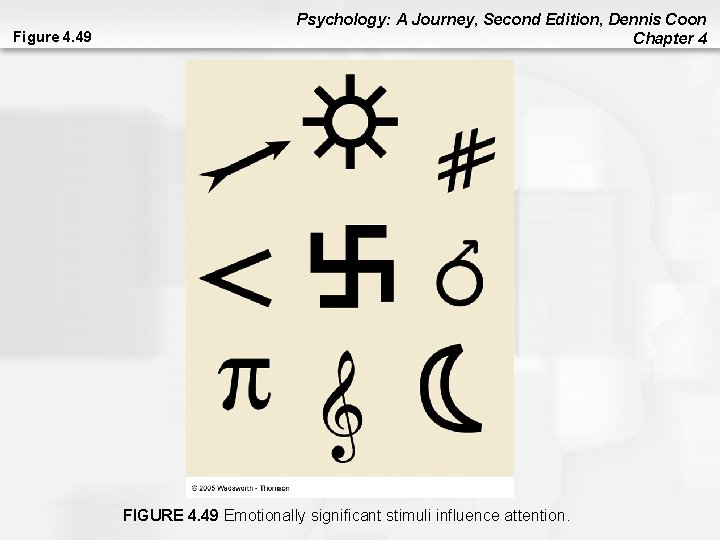
Figure 4. 49 Psychology: A Journey, Second Edition, Dennis Coon Chapter 4 FIGURE 4. 49 Emotionally significant stimuli influence attention.
Psychology: A Journey, Second Edition, Dennis Coon Chapter 4 More Factors Affecting the Accuracy of Eyewitness Perceptions Exposure Time: Less time an eyewitness has to observe an event, the less s/he will perceive and remember it Unconscious Transference: A culprit who is identified may have been seen in another situation or context Color Perception: Judgments of color made under monochromatic light are very unreliable Stress: High levels impair accuracy
Psychology: A Journey, Second Edition, Dennis Coon Chapter 4 Perceptual Awareness • Reality Testing: Obtaining additional information to check on accuracy of perceptions • Habituation: Decrease in perceptual response to a given stimulus • Dishabituation: A reversal of habituation
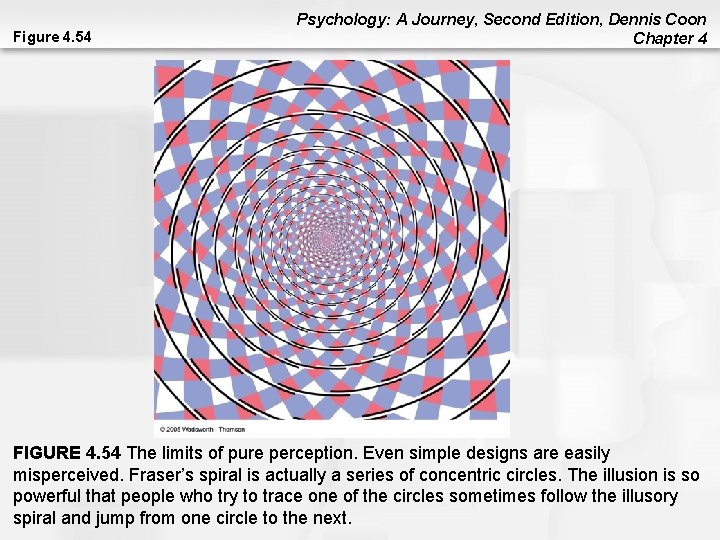
Figure 4. 54 Psychology: A Journey, Second Edition, Dennis Coon Chapter 4 FIGURE 4. 54 The limits of pure perception. Even simple designs are easily misperceived. Fraser’s spiral is actually a series of concentric circles. The illusion is so powerful that people who try to trace one of the circles sometimes follow the illusory spiral and jump from one circle to the next.