
PSYCHOLOGY 8 th Edition David Myers Power Point
- Slides: 98
PSYCHOLOGY (8 th Edition) David Myers Power. Point Slides Aneeq Ahmad Henderson State University Worth Publishers, © 2006 1
DHP’s 3 -9 3 -10 3 -11 3 -12 3 -13 3 -14 Text Ch. 12 468 -494 Text Ch. 12 -13 495 -523 Text Ch. 13 524 -547 Text Ch. 14 549 -561 Text Ch. 14 562 -575 Text Ch. 14 581 -593 3 -16 -09 TEST 2
Motivation and Work Chapter 12 3
Motivation and Work Perspectives on Motivation Instincts and Evolutionary Psychology Drives and Incentives Optimum Arousal A Hierarchy of Motivations 4
Motivation and Work Hunger The Physiology of Hunger The Psychology of Hunger Sexual Motivation The Physiology of Sex The Psychology of Sex 5
Motivation and Work Sexual Motivation Adolescent Sexuality Sexual Orientation Sex and Human Values The Need to Belong 6
Motivation and Work Motivation at Work Personnel Psychology Organizing Psychology: Motivating Achievement 7
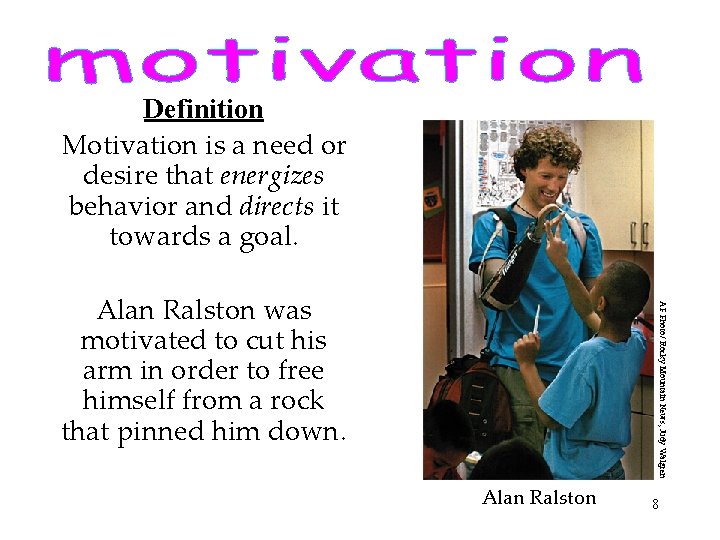
Definition Motivation is a need or desire that energizes behavior and directs it towards a goal. AP Photo/ Rocky Mountain News, Judy Walgren Alan Ralston was motivated to cut his arm in order to free himself from a rock that pinned him down. Alan Ralston 8
Help to explain motivation include the following: 1. 2. 3. 4. Instinct Theory Drive-Reduction Theory Arousal Theory Hierarchy of Motives 9
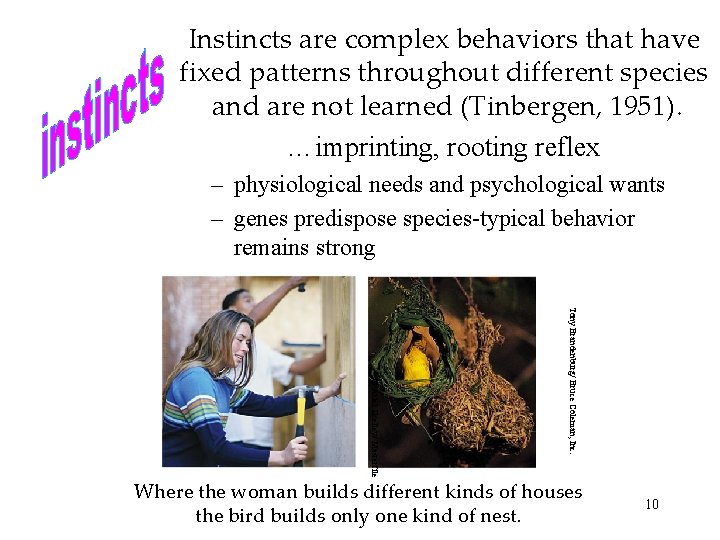
Instincts are complex behaviors that have fixed patterns throughout different species and are not learned (Tinbergen, 1951). …imprinting, rooting reflex – physiological needs and psychological wants – genes predispose species-typical behavior remains strong Tony Brandenburg/ Bruce Coleman, Inc. © Ariel Skelley/ Masterfile Where the woman builds different kinds of houses the bird builds only one kind of nest. 10
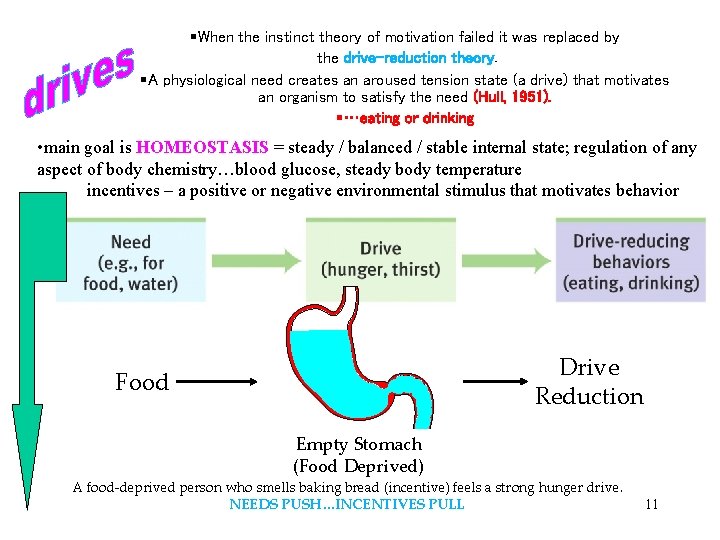
When the instinct theory of motivation failed it was replaced by the drive-reduction theory. A physiological need creates an aroused tension state (a drive) that motivates an organism to satisfy the need (Hull, 1951). …eating or drinking • main goal is HOMEOSTASIS = steady / balanced / stable internal state; regulation of any aspect of body chemistry…blood glucose, steady body temperature incentives – a positive or negative environmental stimulus that motivates behavior Drive Reduction Food Empty Stomach Full (Food Deprived) A food-deprived person who smells baking bread (incentive) feels a strong hunger drive. NEEDS PUSH…INCENTIVES PULL 11
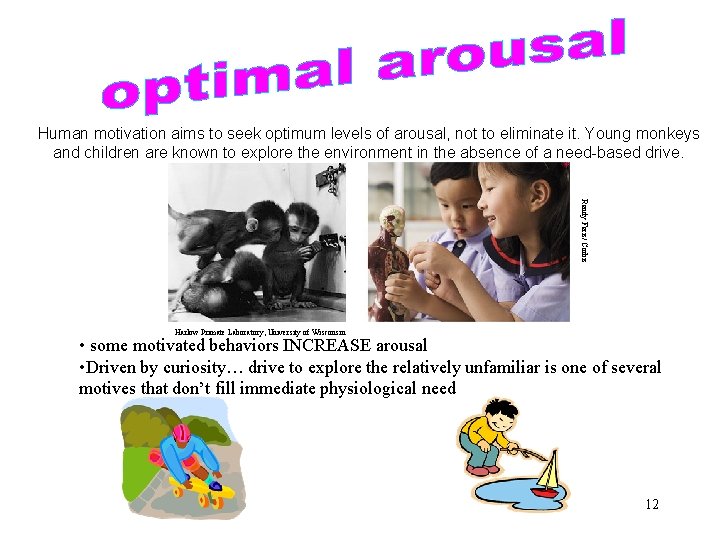
Human motivation aims to seek optimum levels of arousal, not to eliminate it. Young monkeys and children are known to explore the environment in the absence of a need-based drive. Randy Faris/ Corbis Harlow Primate Laboratory, University of Wisconsin • some motivated behaviors INCREASE arousal • Driven by curiosity… drive to explore the relatively unfamiliar is one of several motives that don’t fill immediate physiological need 12
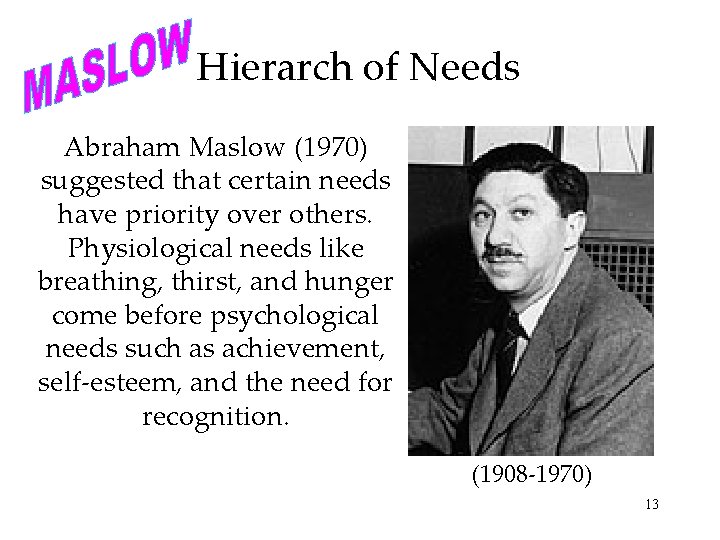
Hierarch of Needs Abraham Maslow (1970) suggested that certain needs have priority over others. Physiological needs like breathing, thirst, and hunger come before psychological needs such as achievement, self-esteem, and the need for recognition. (1908 -1970) 13
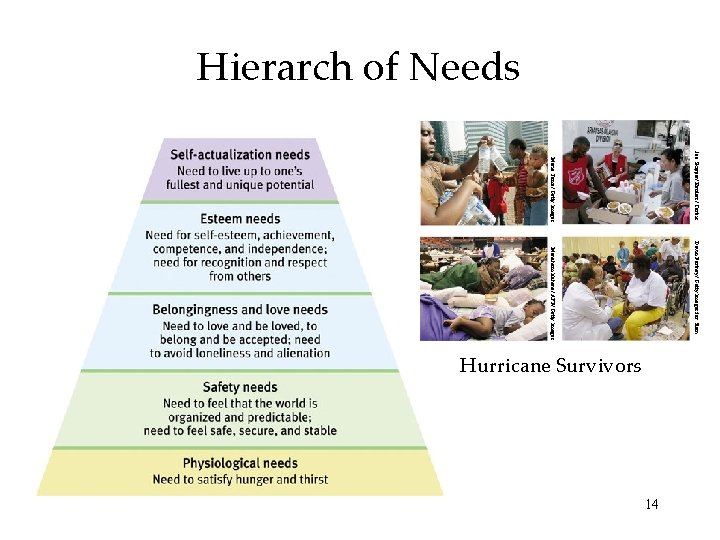
Hierarch of Needs Joe Skipper/ Reuters/ Corbis Mario Tama/ Getty Images David Portnoy/ Getty Images for Stern Menahem Kahana/ AFP/ Getty Images Hurricane Survivors 14
After completing the self –rating scale (handout 12 -3) answer the following questions. 1. Presumably, lower level needs are to some degree satisfied before higher needs become operative. Do needs lower in the hierarchy receive higher satisfaction ratings? 2. Is it easier to think of behaviors belonging to one level rather than another? What does this suggest? 3. Do certain behaviors reflect more than one motive? 4. Are there important motives not included in the hierarchy? 5. Are you failing to meet some needs in the hierarchy? If os, does this suggest changes you would like to make in your priorities? 15
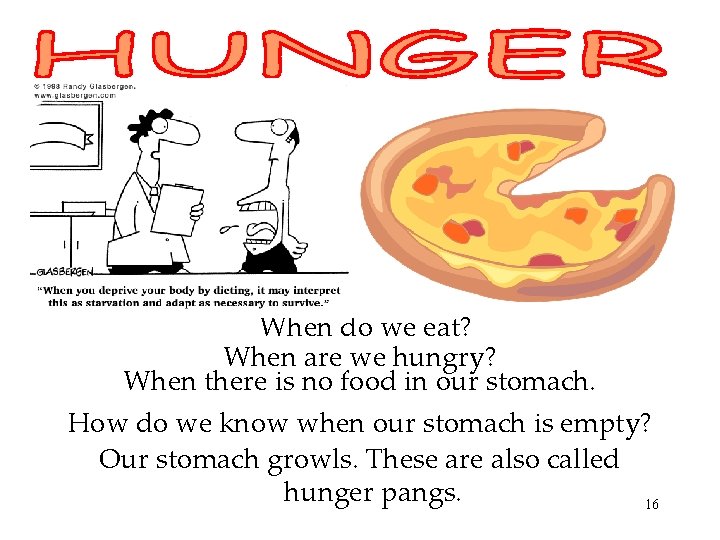
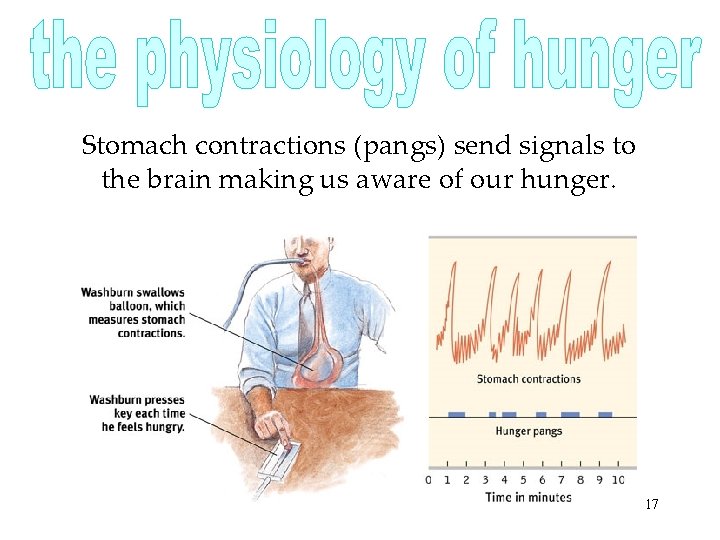
When do we eat? When are we hungry? When there is no food in our stomach. How do we know when our stomach is empty? Our stomach growls. These are also called hunger pangs. 16
Stomach contractions (pangs) send signals to the brain making us aware of our hunger. 17
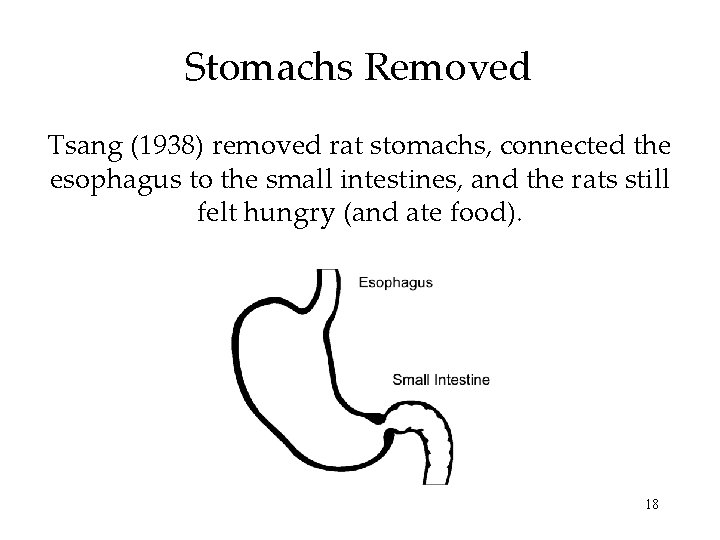
Stomachs Removed Tsang (1938) removed rat stomachs, connected the esophagus to the small intestines, and the rats still felt hungry (and ate food). 18
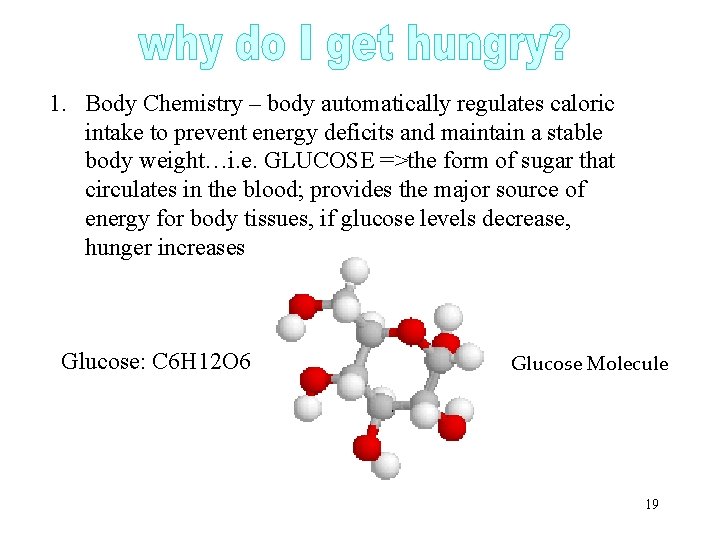
1. Body Chemistry – body automatically regulates caloric intake to prevent energy deficits and maintain a stable body weight…i. e. GLUCOSE =>the form of sugar that circulates in the blood; provides the major source of energy for body tissues, if glucose levels decrease, hunger increases Glucose: C 6 H 12 O 6 Glucose Molecule 19
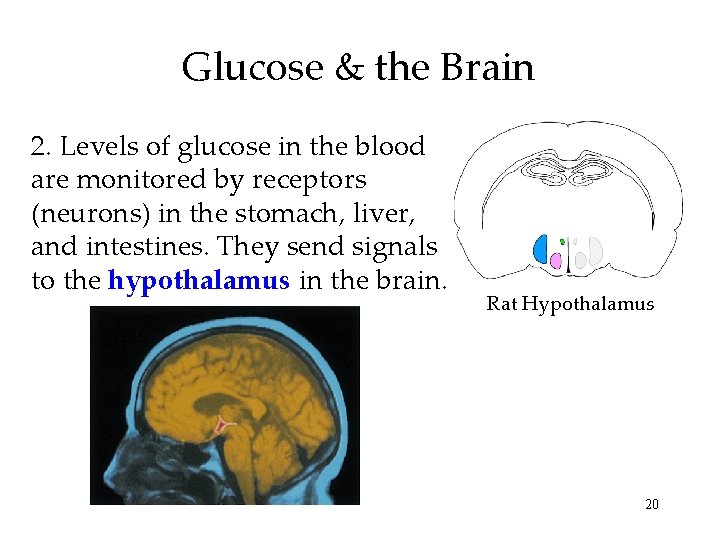
Glucose & the Brain 2. Levels of glucose in the blood are monitored by receptors (neurons) in the stomach, liver, and intestines. They send signals to the hypothalamus in the brain. Rat Hypothalamus 20
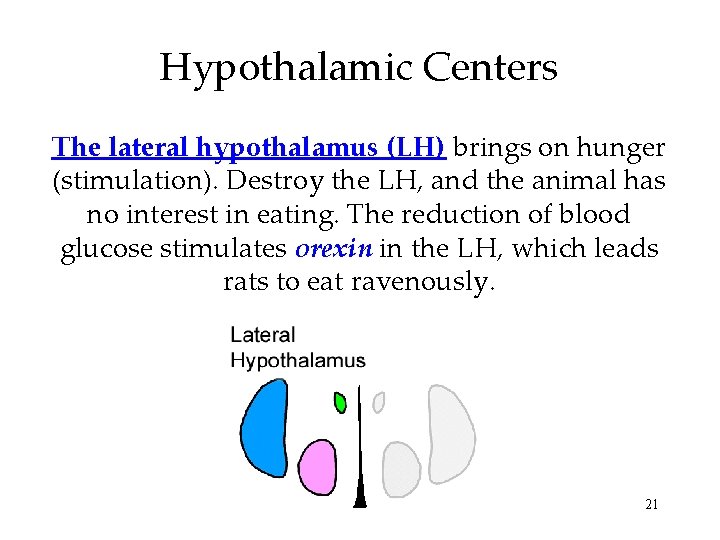
Hypothalamic Centers The lateral hypothalamus (LH) brings on hunger (stimulation). Destroy the LH, and the animal has no interest in eating. The reduction of blood glucose stimulates orexin in the LH, which leads rats to eat ravenously. 21
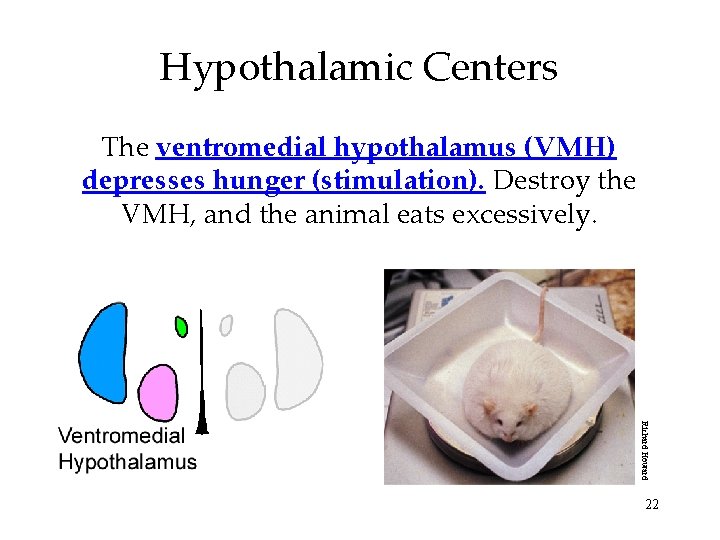
Hypothalamic Centers The ventromedial hypothalamus (VMH) depresses hunger (stimulation). Destroy the VMH, and the animal eats excessively. Richard Howard 22
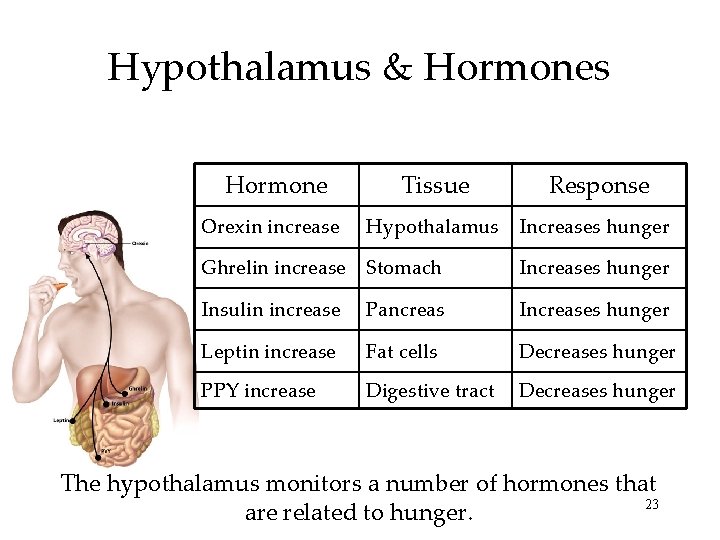
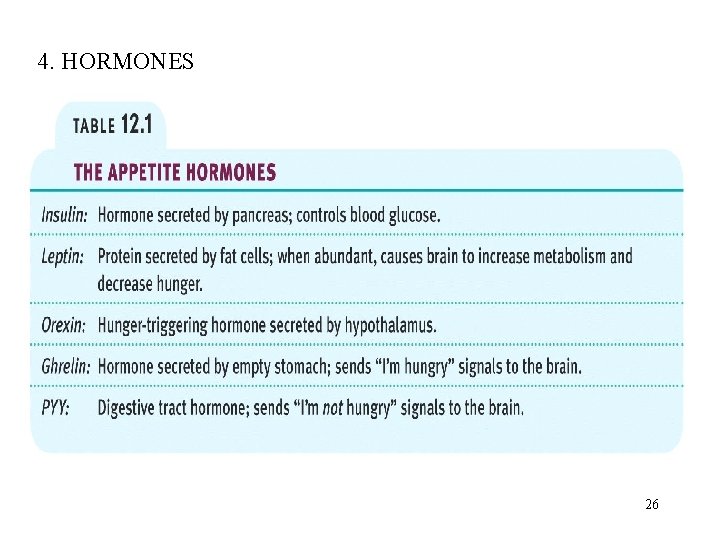
Hypothalamus & Hormones Hormone Tissue Response Orexin increase Hypothalamus Increases hunger Ghrelin increase Stomach Increases hunger Insulin increase Pancreas Increases hunger Leptin increase Fat cells Decreases hunger PPY increase Digestive tract Decreases hunger The hypothalamus monitors a number of hormones that 23 are related to hunger.
• the point at which an individual’s “weight thermostat” is supposedly set • when the body falls below this weight, an increase in hunger and a lowered metabolic rate may act to restore the lost weight Manipulating the lateral and the ventromedial hypothalamus alters the body’s “weight thermostat. ” • BASAL Metabolic Rate (BMR) body’s base rate of energy expenditure How do you control your weight? Food intake in (calories) vs. energy output (calories burned) BUT…hunger is ALSO determined by learned incentives! If weight is lost, food intake increases and energy expenditure decreases. If weight is gained, the opposite takes place. 24
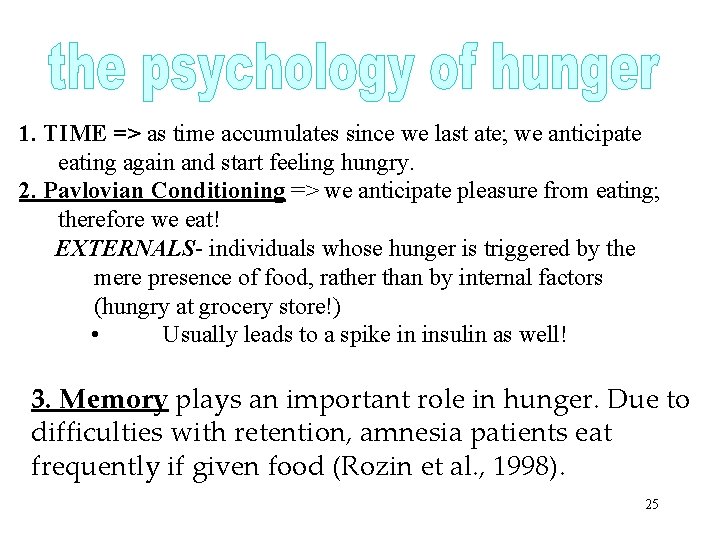
1. TIME => as time accumulates since we last ate; we anticipate eating again and start feeling hungry. 2. Pavlovian Conditioning => we anticipate pleasure from eating; therefore we eat! EXTERNALS- individuals whose hunger is triggered by the mere presence of food, rather than by internal factors (hungry at grocery store!) • Usually leads to a spike in insulin as well! 3. Memory plays an important role in hunger. Due to difficulties with retention, amnesia patients eat frequently if given food (Rozin et al. , 1998). 25
4. HORMONES 26
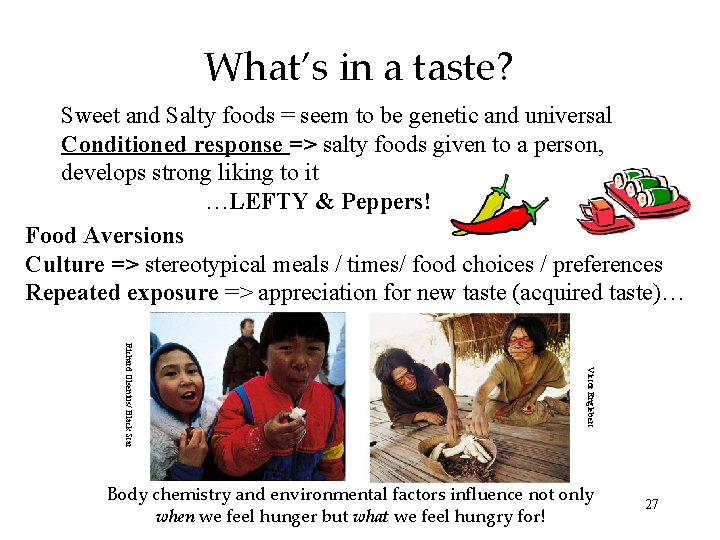
What’s in a taste? Sweet and Salty foods = seem to be genetic and universal Conditioned response => salty foods given to a person, develops strong liking to it …LEFTY & Peppers! Food Aversions Culture => stereotypical meals / times/ food choices / preferences Repeated exposure => appreciation for new taste (acquired taste)… Victor Englebert Richard Olsenius/ Black Star Body chemistry and environmental factors influence not only when we feel hunger but what we feel hungry for! 27
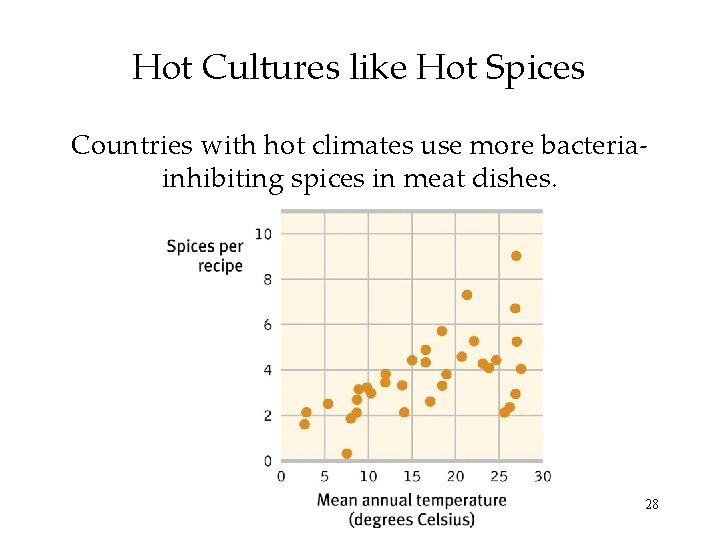
Hot Cultures like Hot Spices Countries with hot climates use more bacteriainhibiting spices in meat dishes. 28
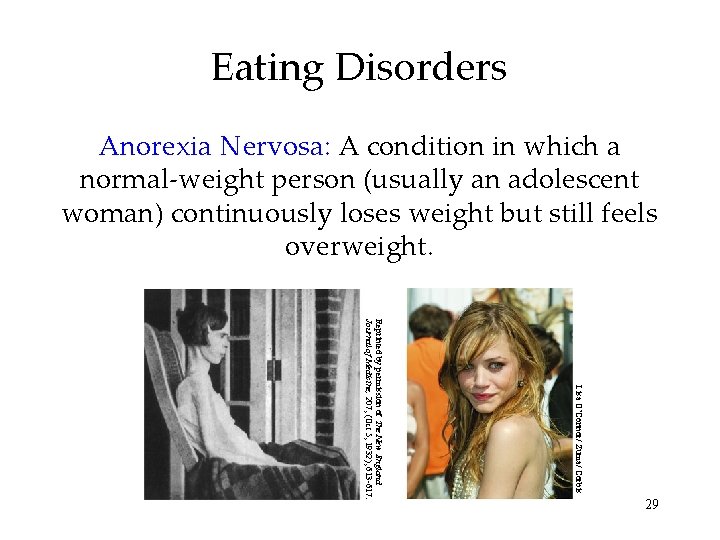
Eating Disorders Anorexia Nervosa: A condition in which a normal-weight person (usually an adolescent woman) continuously loses weight but still feels overweight. Lisa O’Connor/ Zuma/ Corbis Reprinted by permission of The New England Journal of Medicine, 207, (Oct 5, 1932), 613 -617. 29
Eating Disorders Bulimia Nervosa: A disorder characterized by episodes of overeating, usually high-calorie foods, followed by vomiting, using laxatives, fasting, or excessive exercise. 30
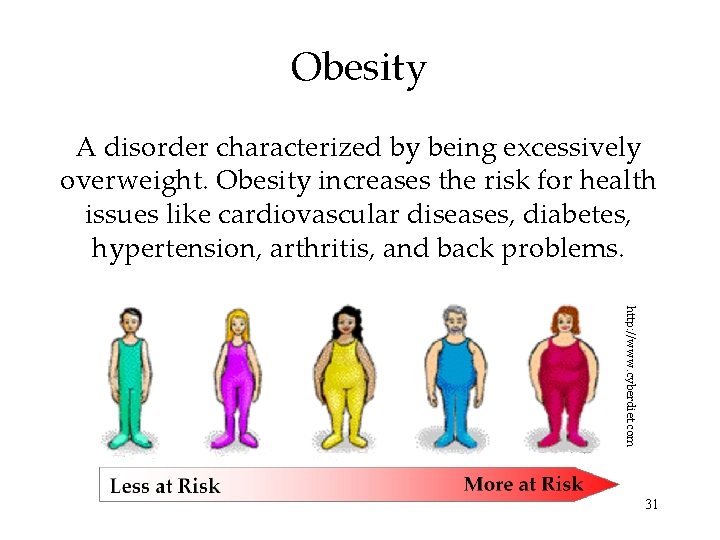
Obesity A disorder characterized by being excessively overweight. Obesity increases the risk for health issues like cardiovascular diseases, diabetes, hypertension, arthritis, and back problems. http: //www. cyberdiet. com 31
Reasons for Eating Disorders 1. Sexual Abuse: Childhood sexual abuse does not cause eating disorders. 2. Family: Younger generations develop eating disorders when raised in families in which weight is an excessive concern. 3. Genetics: Twin studies show that eating disorders are more likely to occur in identical twins rather than fraternal twins. 32
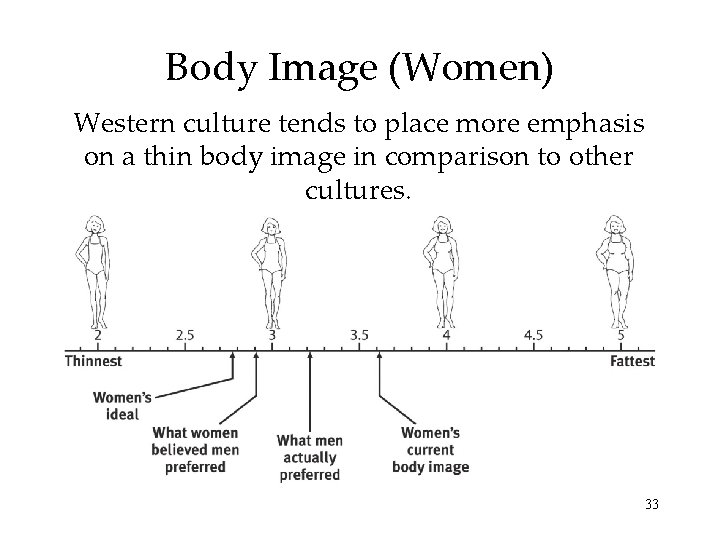
Body Image (Women) Western culture tends to place more emphasis on a thin body image in comparison to other cultures. 33
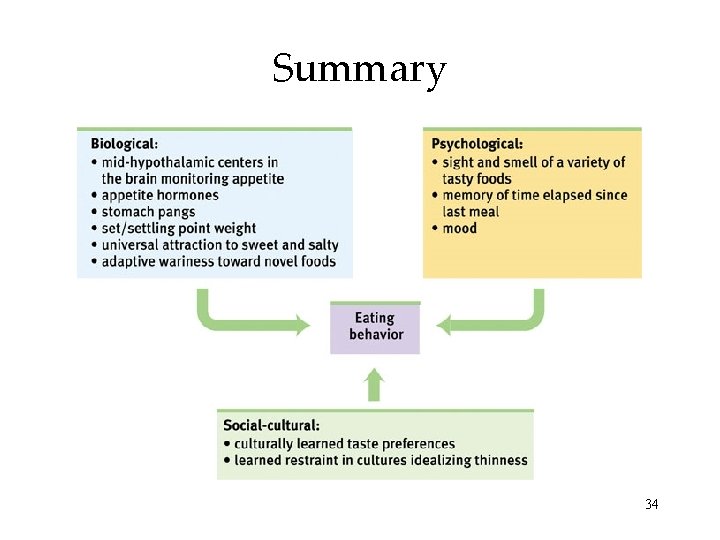
Summary 34
AP Planning Guide! Wednesday – SEX; Achievement Motivation Notes Thursday – Dr. Phil video w/ worksheet; Faces article w/ questions (pd. 2 exempt from Video, not from article! Friday – Emotions & Stress Sat/ Sun – Emotions review worksheet/ Test Review Monday – Chapter test (OPEN NOTEBOOK) Tuesday – Sr. Trip Begins/ PSSA for Jrs 35
It’s Dr. Phil time! Click on the image for the Motivation and Emotion Video! 36
Definition => a physiologically based motive, like hunger, but it is more affected by learning and values • Sexual motivation is nature’s clever way of making people procreate, enabling our species to survive. Sexual Motivation 37
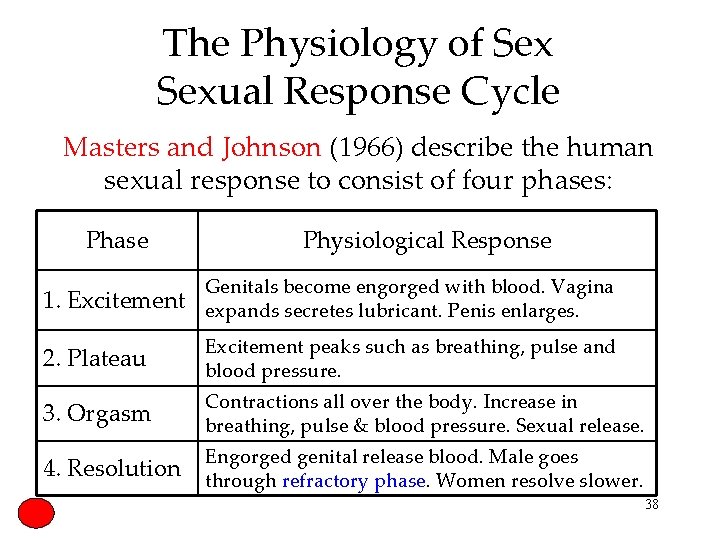
The Physiology of Sexual Response Cycle Masters and Johnson (1966) describe the human sexual response to consist of four phases: Phase Physiological Response 1. Excitement Genitals become engorged with blood. Vagina expands secretes lubricant. Penis enlarges. 2. Plateau Excitement peaks such as breathing, pulse and blood pressure. 3. Orgasm Contractions all over the body. Increase in breathing, pulse & blood pressure. Sexual release. 4. Resolution Engorged genital release blood. Male goes through refractory phase. Women resolve slower. 38
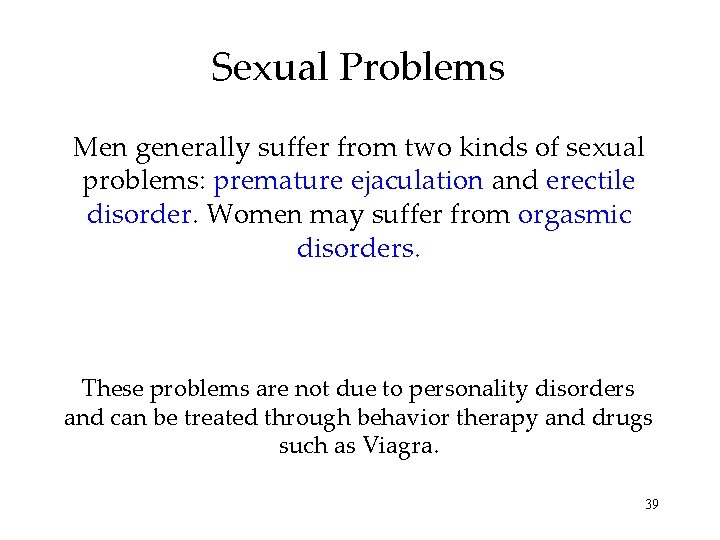
Sexual Problems Men generally suffer from two kinds of sexual problems: premature ejaculation and erectile disorder. Women may suffer from orgasmic disorders. These problems are not due to personality disorders and can be treated through behavior therapy and drugs such as Viagra. 39
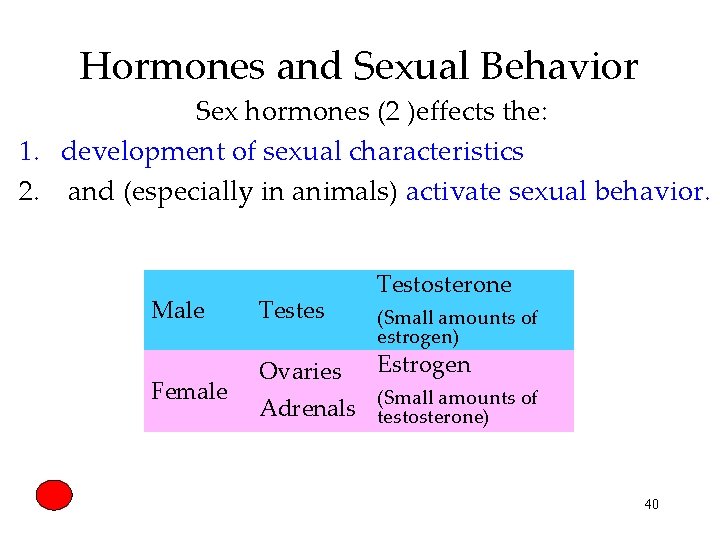
Hormones and Sexual Behavior Sex hormones (2 )effects the: 1. development of sexual characteristics 2. and (especially in animals) activate sexual behavior. Male Female Testes Ovaries Testosterone (Small amounts of estrogen) Estrogen amounts of Adrenals (Small testosterone) 40
Testosterone Levels of testosterone remain constant in males, so it is difficult to manipulate and activate sexual behavior. Castration, which reduces testosterone levels, lowers sexual interest. 41
Estrogen Female animals “in heat” express peak levels of estrogen. Female receptivity may be heightened with estrogen injections. Sex hormones may have milder affects on humans than on animals. Women are more likely to have sex when close to ovulation (increased testosterone), and men show increased testosterone levels when socializing with women. 42
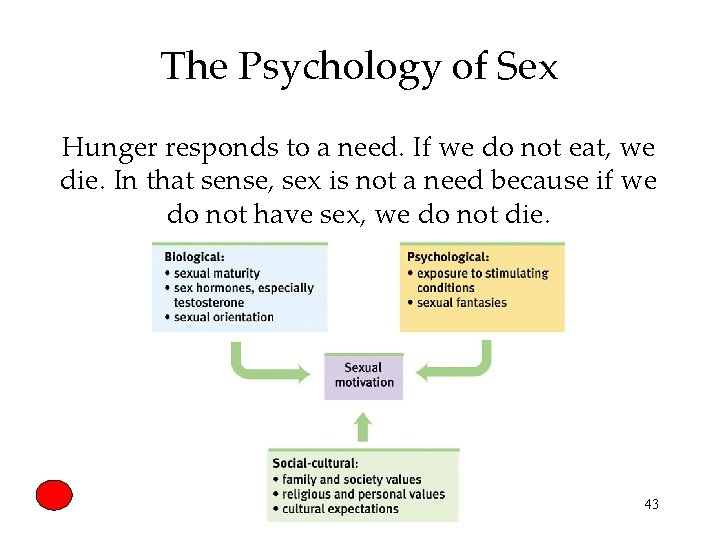
The Psychology of Sex Hunger responds to a need. If we do not eat, we die. In that sense, sex is not a need because if we do not have sex, we do not die. 43
External Stimuli It is common knowledge that men become sexually aroused when browsing through erotic material. However, women experience similar heightened arousal under controlled conditions. 44
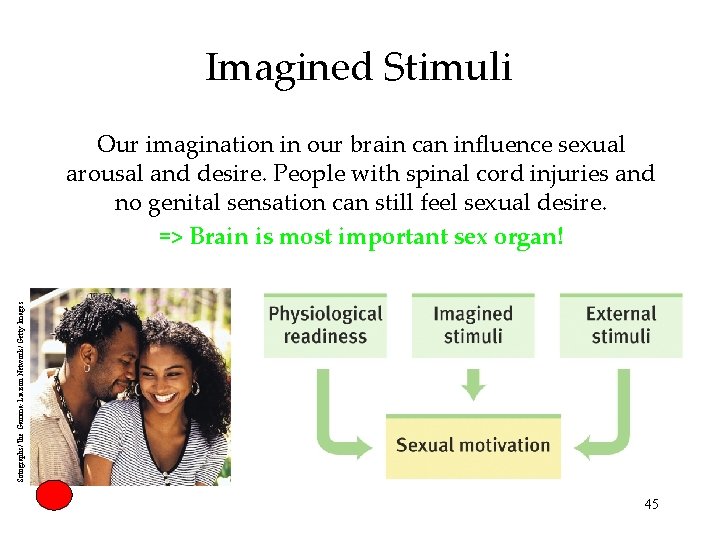
Imagined Stimuli Sotographs/The Gamma-Liaison Network/ Getty Images Our imagination in our brain can influence sexual arousal and desire. People with spinal cord injuries and no genital sensation can still feel sexual desire. => Brain is most important sex organ! 45
Dreams, another form of imagination, are also associated with sexual arousal. Genital arousal is associated with all kinds of dreams. Nearly all men and 40% of women who dream of sexual imagery end up with an orgasm (Wells, 1986). 46
Adolescent Sexuality When individuals reach adolescence, their sexual behavior develops. However, there are cultural differences. Sexual promiscuity in modern Western culture is much greater than in Arab countries and other Asian countries. 47
Contraception 1. 2. 3. 4. 5. Ignorance: Canadian teen girls do not have the right ideas about birth control methods. Guilt Related to Sexual Activity: Guilt reduces sexual activity, but it also reduces the use of contraceptives. Minimal Communication: Many teenagers feel uncomfortable about discussing contraceptives. Alcohol Use: Those who use alcohol prior to sex are less likely to use contraceptives. Mass Media: The media’s portrayal of unsafe extramarital sex decreases the use of contraceptives. 48
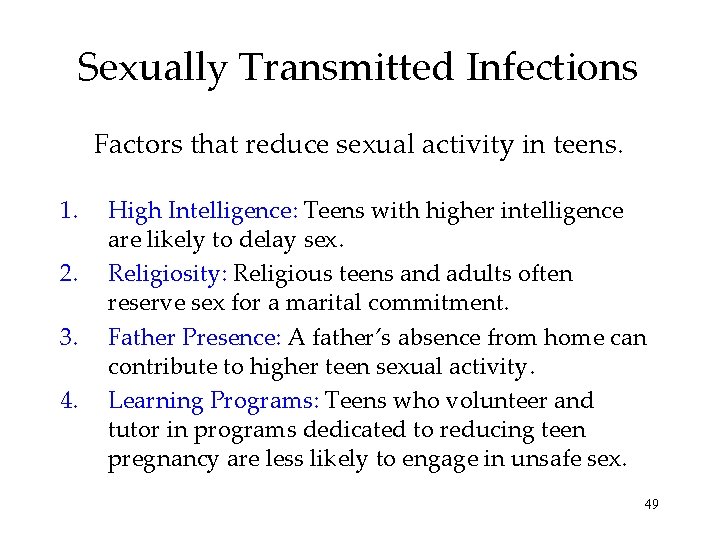
Sexually Transmitted Infections Factors that reduce sexual activity in teens. 1. 2. 3. 4. High Intelligence: Teens with higher intelligence are likely to delay sex. Religiosity: Religious teens and adults often reserve sex for a marital commitment. Father Presence: A father’s absence from home can contribute to higher teen sexual activity. Learning Programs: Teens who volunteer and tutor in programs dedicated to reducing teen pregnancy are less likely to engage in unsafe sex. 49
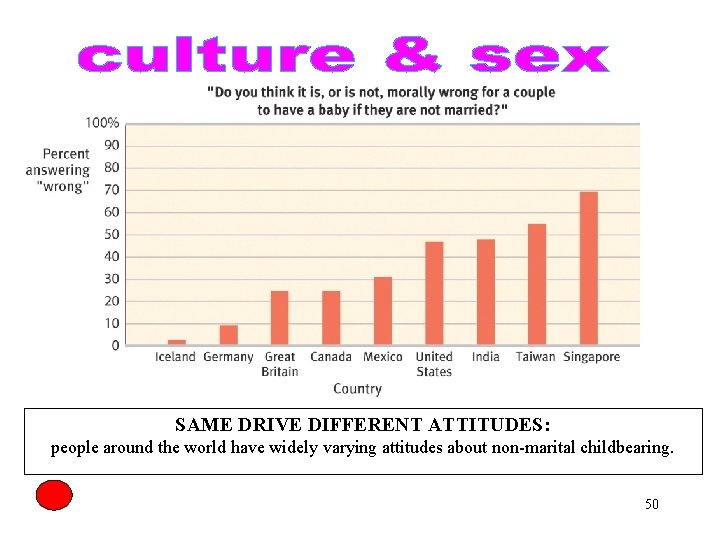
SAME DRIVE DIFFERENT ATTITUDES: people around the world have widely varying attitudes about non-marital childbearing. 50
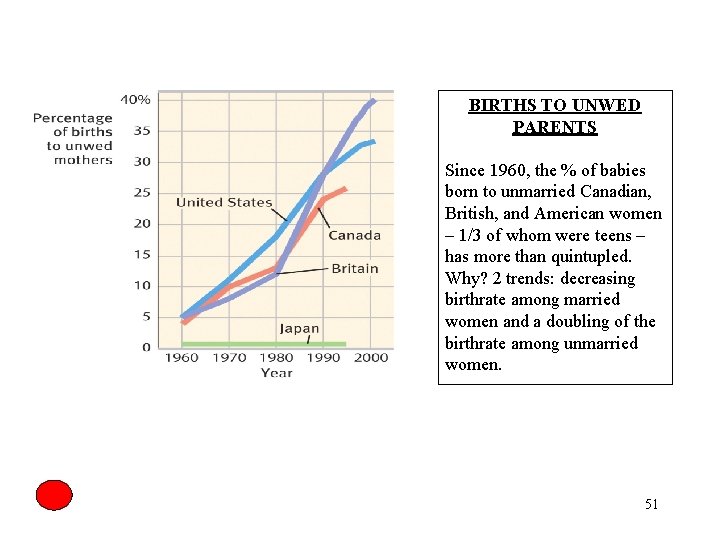
BIRTHS TO UNWED PARENTS Since 1960, the % of babies born to unmarried Canadian, British, and American women – 1/3 of whom were teens – has more than quintupled. Why? 2 trends: decreasing birthrate among married women and a doubling of the birthrate among unmarried women. 51
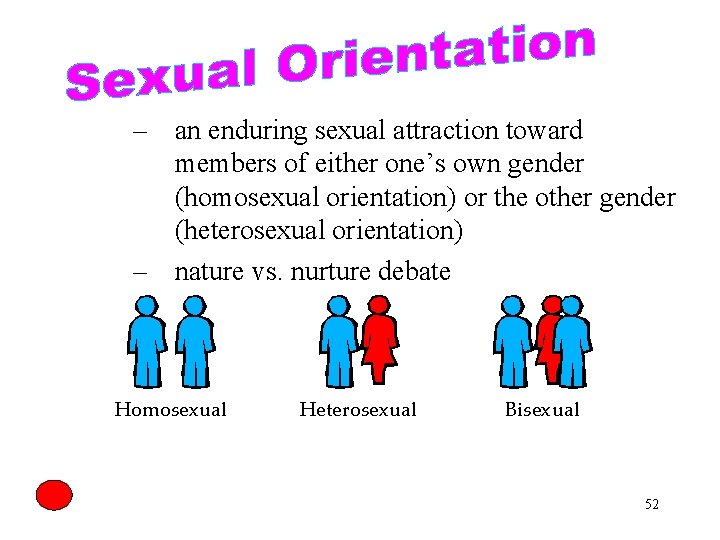
– an enduring sexual attraction toward members of either one’s own gender (homosexual orientation) or the other gender (heterosexual orientation) – nature vs. nurture debate Homosexual Heterosexual Bisexual 52
Sexual Orientation Statistics In Europe and America, based on many national surveys, homosexuality in men is 3 -4% and in women is 1 -2%. As members of a minority, homosexuals often struggle with their sexual orientation. 53
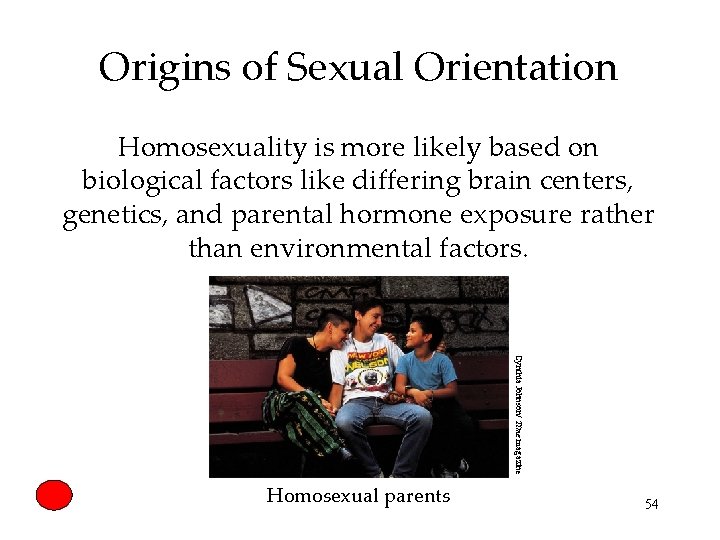
Origins of Sexual Orientation Homosexuality is more likely based on biological factors like differing brain centers, genetics, and parental hormone exposure rather than environmental factors. Cynthia Johnson/ Time magazine Homosexual parents 54
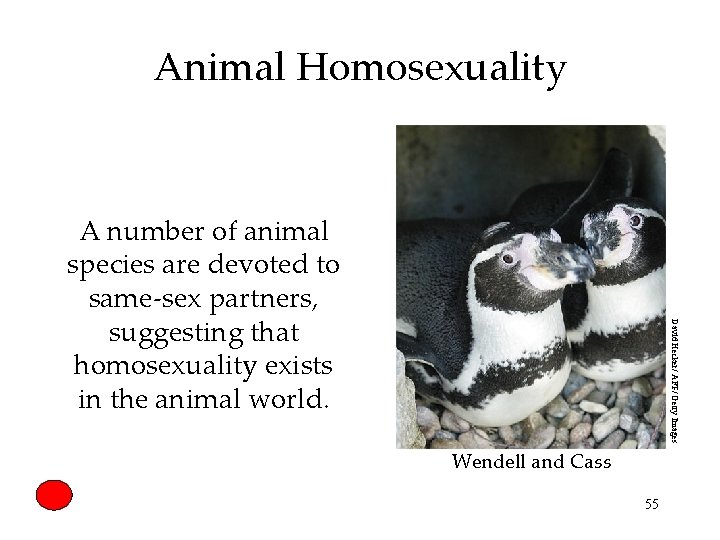
Animal Homosexuality David Hecker/ AFP/ Getty Images A number of animal species are devoted to same-sex partners, suggesting that homosexuality exists in the animal world. Wendell and Cass 55
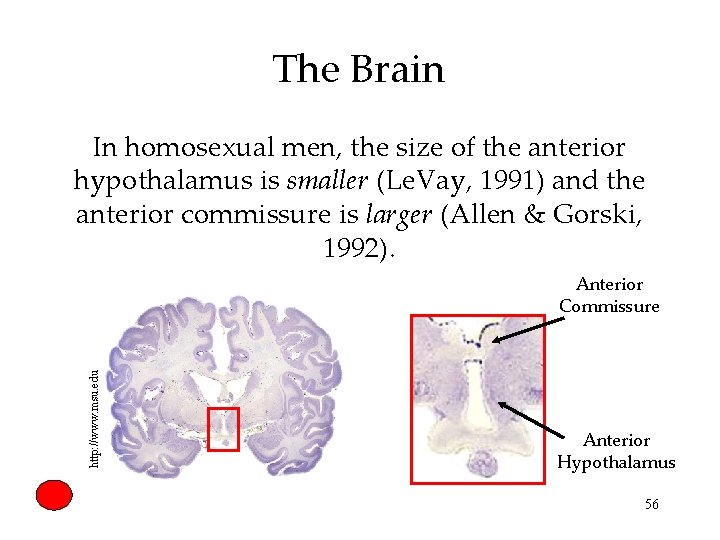
The Brain In homosexual men, the size of the anterior hypothalamus is smaller (Le. Vay, 1991) and the anterior commissure is larger (Allen & Gorski, 1992). http: //www. msu. edu Anterior Commissure Anterior Hypothalamus 56
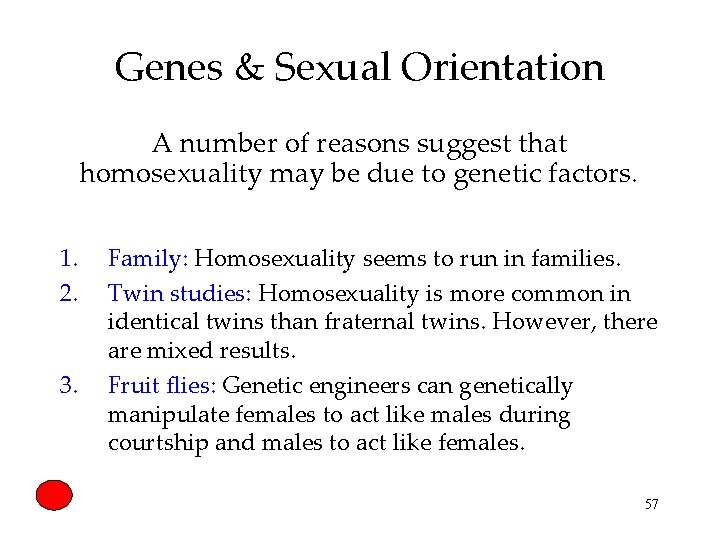
Genes & Sexual Orientation A number of reasons suggest that homosexuality may be due to genetic factors. 1. 2. 3. Family: Homosexuality seems to run in families. Twin studies: Homosexuality is more common in identical twins than fraternal twins. However, there are mixed results. Fruit flies: Genetic engineers can genetically manipulate females to act like males during courtship and males to act like females. 57
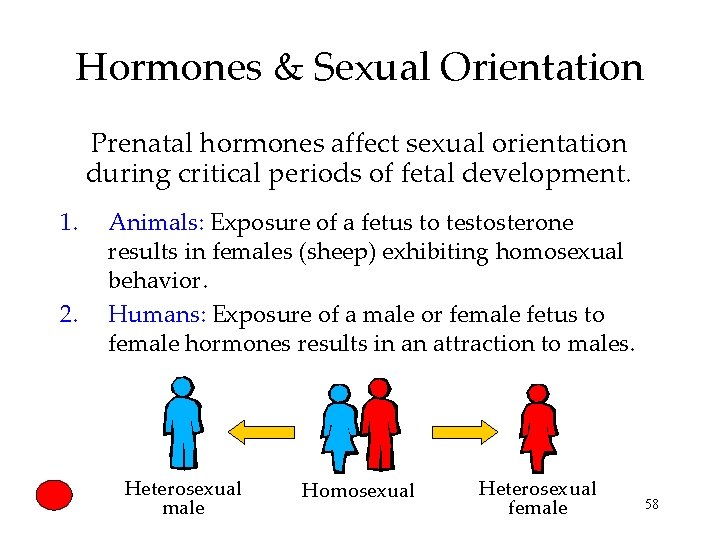
Hormones & Sexual Orientation Prenatal hormones affect sexual orientation during critical periods of fetal development. 1. 2. Animals: Exposure of a fetus to testosterone results in females (sheep) exhibiting homosexual behavior. Humans: Exposure of a male or female fetus to female hormones results in an attraction to males. Heterosexual male Homosexual Heterosexual female 58
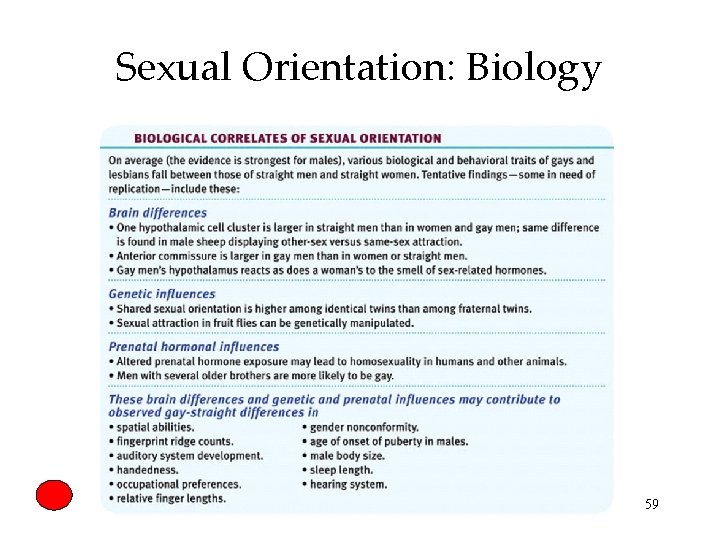
Sexual Orientation: Biology 59
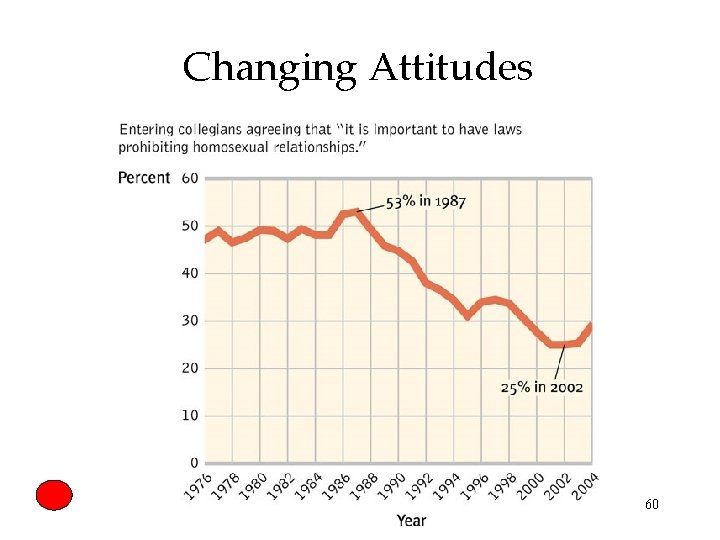
Changing Attitudes 60
Click an icon above for 60 Minutes Coverage 61
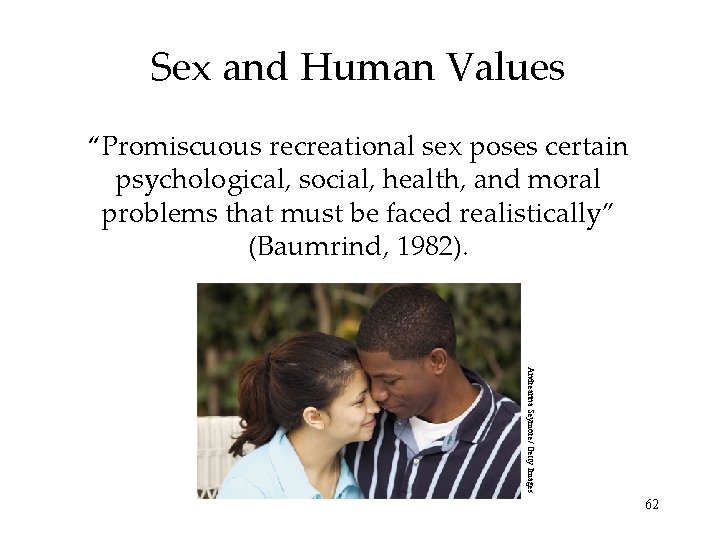
Sex and Human Values “Promiscuous recreational sex poses certain psychological, social, health, and moral problems that must be faced realistically” (Baumrind, 1982). Andreanna Seymore/ Getty Images 62
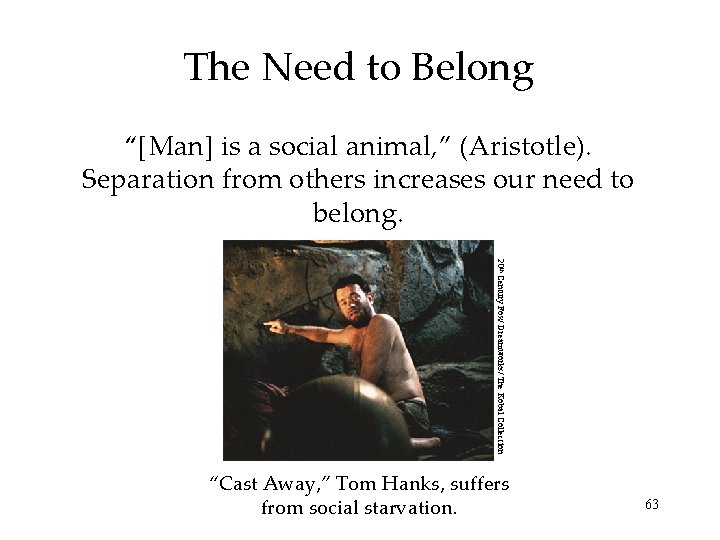
The Need to Belong “[Man] is a social animal, ” (Aristotle). Separation from others increases our need to belong. 20 th Century Fox/ Dreamworks/ The Kobal Collection “Cast Away, ” Tom Hanks, suffers from social starvation. 63
Aiding Survival Social bonds boosted our ancestors’ survival rates. These bonds led to the following: 1. 2. 3. Protecting against predators, especially for the young. Procuring food. Reproducing the next offspring. 64
Belongingness 1. 2. 3. 4. 5. Wanting to Belong: The need to belong colors our thinking and emotions. Social Acceptance: A sense of belonging with others increases our self-esteem. Social segregation decreases it. Maintaining Relationships: We resist breaking social bonds, even bad ones. Ostracism: Social exclusion leads to demoralization, depression, and at times nasty behavior. Fortifying Health: People who tend to have close friends are happier and healthier. 65
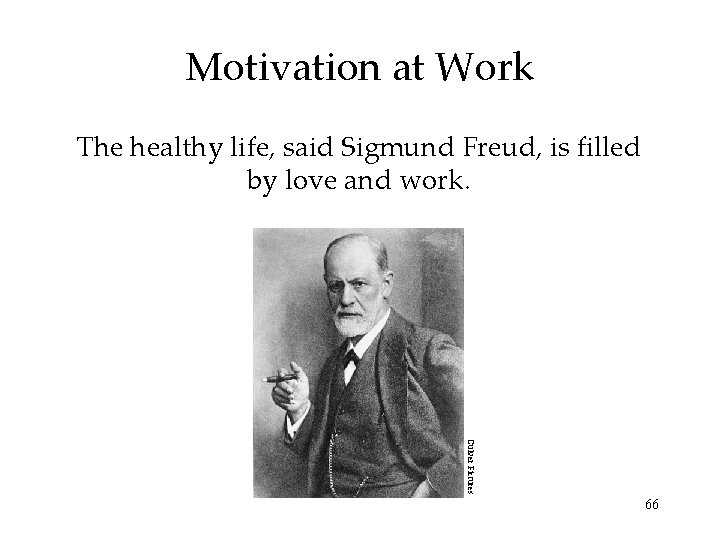
Motivation at Work The healthy life, said Sigmund Freud, is filled by love and work. Culver Pictures 66
Attitudes Towards Work People have different attitudes toward work. Some take it as a: 1. 2. 3. Job: Necessary way to make money. Career: Opportunity to advance from one position to another. Calling: Fulfilling a socially useful activity. 67
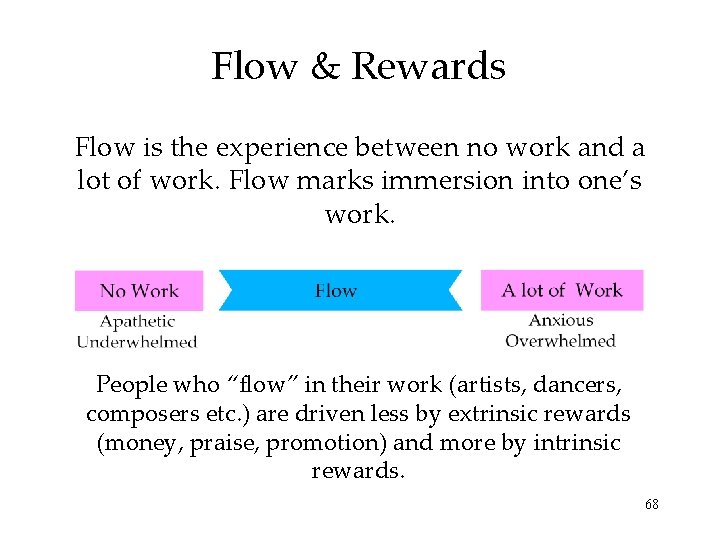
Flow & Rewards Flow is the experience between no work and a lot of work. Flow marks immersion into one’s work. People who “flow” in their work (artists, dancers, composers etc. ) are driven less by extrinsic rewards (money, praise, promotion) and more by intrinsic rewards. 68
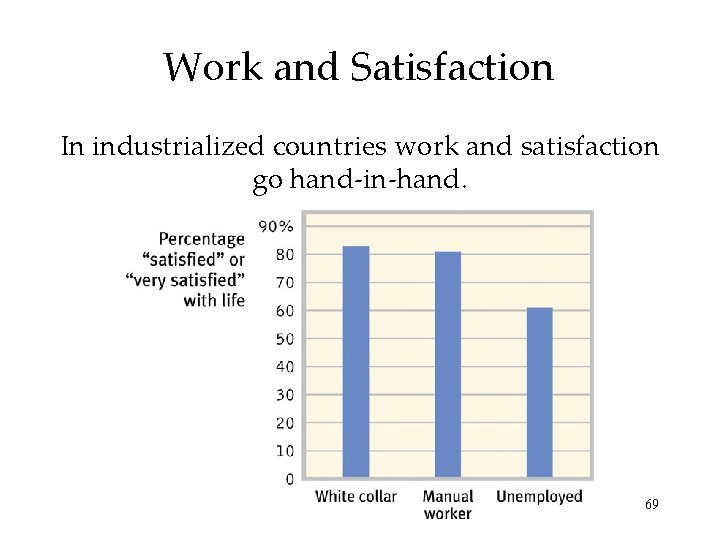
Work and Satisfaction In industrialized countries work and satisfaction go hand-in-hand. 69
Industrial-Organizational (I/O) Psychology Applies psychological principles to the workplace. 1. Personnel Psychology: Studies the principles of selecting and evaluating workers. 2. Organizational Psychology: Studies how work environments and management styles influence worker motivation, satisfaction, and productivity. 70
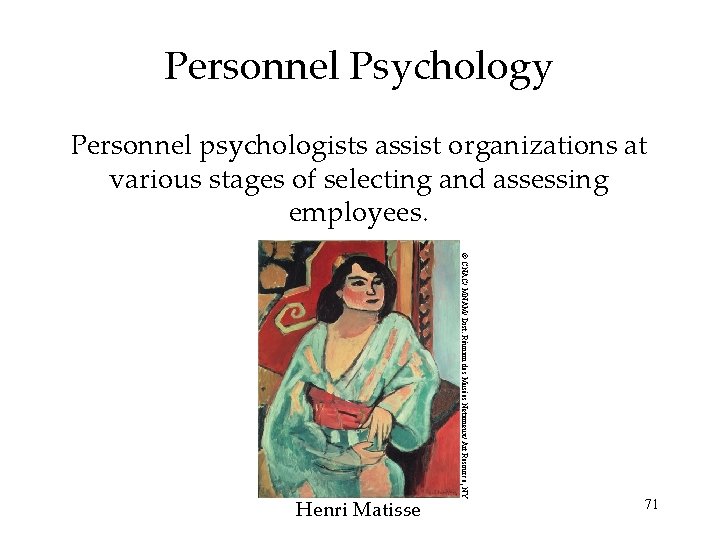
Personnel Psychology Personnel psychologists assist organizations at various stages of selecting and assessing employees. © CNAC/ MNAM/ Dist. Rèunion des Musées Nationaux/ Art Resource, NY Henri Matisse 71
Harnessing Strengths Identifying people’s strengths (analytical, disciplined, eager to learn etc. ) and matching them to a particular area of work is the first step toward workplace effectiveness. 72
Interviews & Performance Interviewers are confident in their ability to predict long-term job performance. However, informal interviews are less informative than standardized tests. 73
The Interviewer Illusion Interviewers often overrate their discernment. 1. 2. 3. 4. Intention vs. Habits: Intensions matter, but longlasting habits matter even more. Successful Employees: Interviewers are more likely to talk about those employees that turned out successful. Presumptions about Candidates: Interviewers presume (wrongly) that we see (candidate) is what we get. Preconceptions: An interviewer’s prior knowledge about the candidate may affect her judgment. 74
Structured Interview A formal and disciplined way of gathering information from the interviewee. Structured interviews pinpoint strengths (attitudes, behaviors, knowledge, and skills). The personnel psychologist may do the following: 1. 2. 3. Analyze the job. Script questions. Train the interviewer. 75
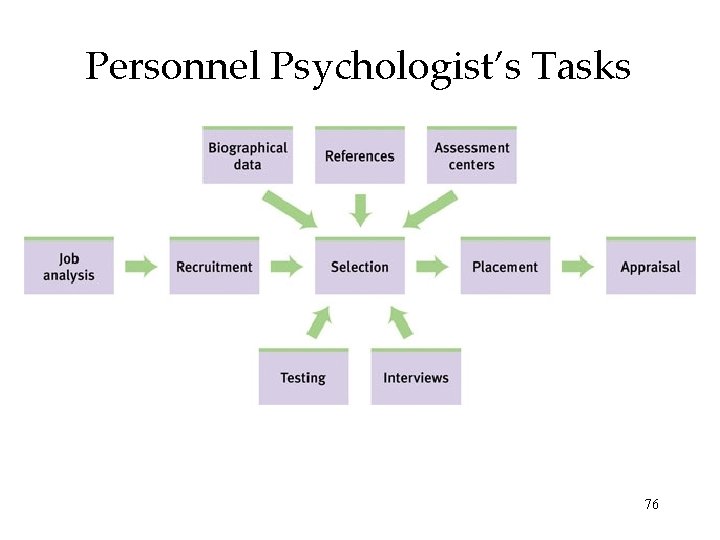
Personnel Psychologist’s Tasks 76
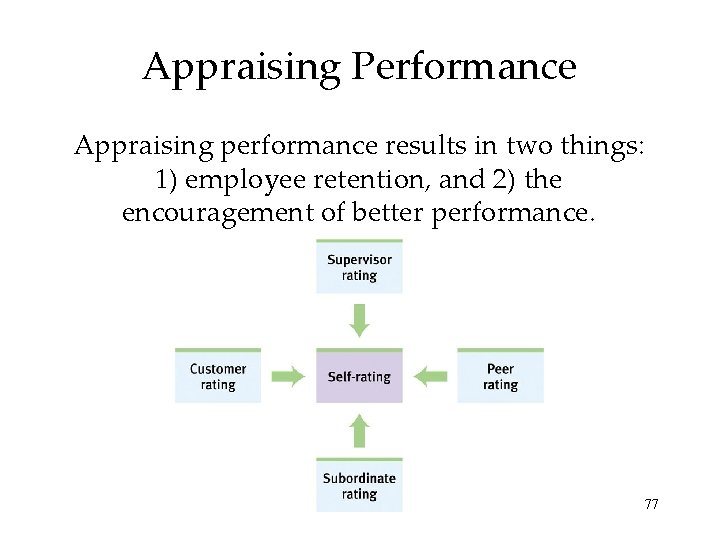
Appraising Performance Appraising performance results in two things: 1) employee retention, and 2) the encouragement of better performance. 77
Achievement motivation • a desire for significant accomplishment; for mastery of things, people, or ideas; for attaining a high standard • How do we measure this? • Murray, Mc. Clelland & Atkinson • People’s fantasies would reflect their concern for achievement • Shown ambiguous picture, asked to analyze it…heroic act, feeling pride, pursuit of goal…high need for achievement • Usually have parents / teachers who encourage independence and give positive Feedback / praise/ rewards for their success • Emotional roots => positive emotions • Cognitive roots => learn to attribute their achievements to their own competence and effort 78
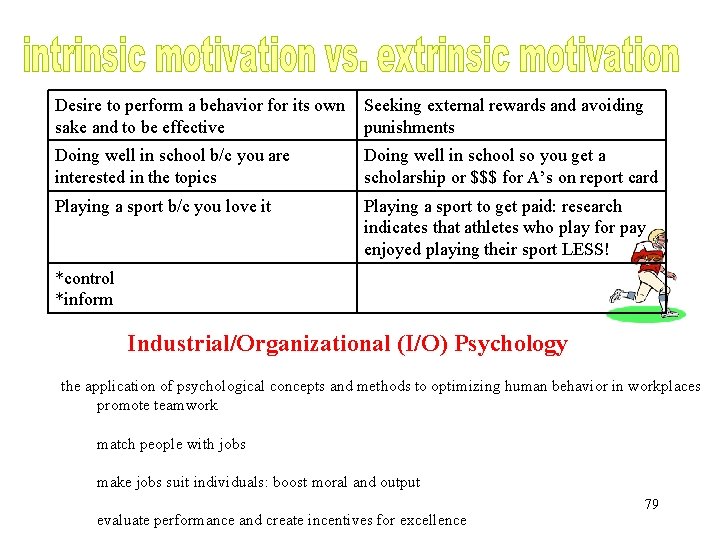
Desire to perform a behavior for its own sake and to be effective Seeking external rewards and avoiding punishments Doing well in school b/c you are interested in the topics Doing well in school so you get a scholarship or $$$ for A’s on report card Playing a sport b/c you love it Playing a sport to get paid: research indicates that athletes who play for pay enjoyed playing their sport LESS! *control *inform Industrial/Organizational (I/O) Psychology the application of psychological concepts and methods to optimizing human behavior in workplaces promote teamwork match people with jobs make jobs suit individuals: boost moral and output evaluate performance and create incentives for excellence 79
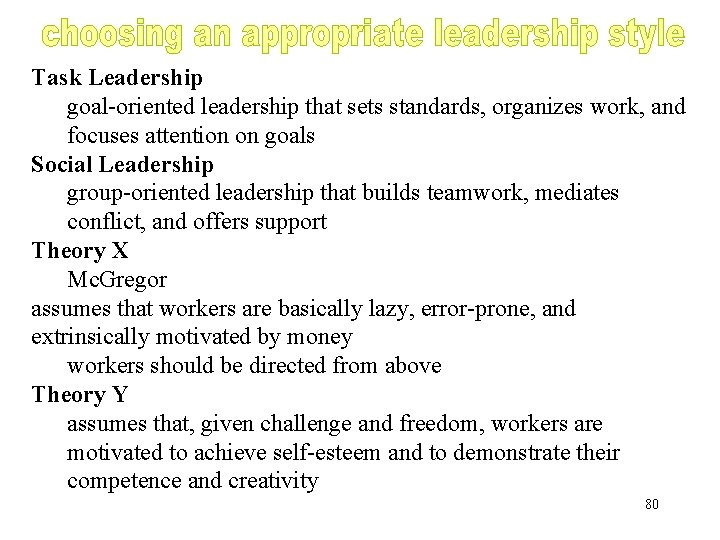
Task Leadership goal-oriented leadership that sets standards, organizes work, and focuses attention on goals Social Leadership group-oriented leadership that builds teamwork, mediates conflict, and offers support Theory X Mc. Gregor assumes that workers are basically lazy, error-prone, and extrinsically motivated by money workers should be directed from above Theory Y assumes that, given challenge and freedom, workers are motivated to achieve self-esteem and to demonstrate their competence and creativity 80
81
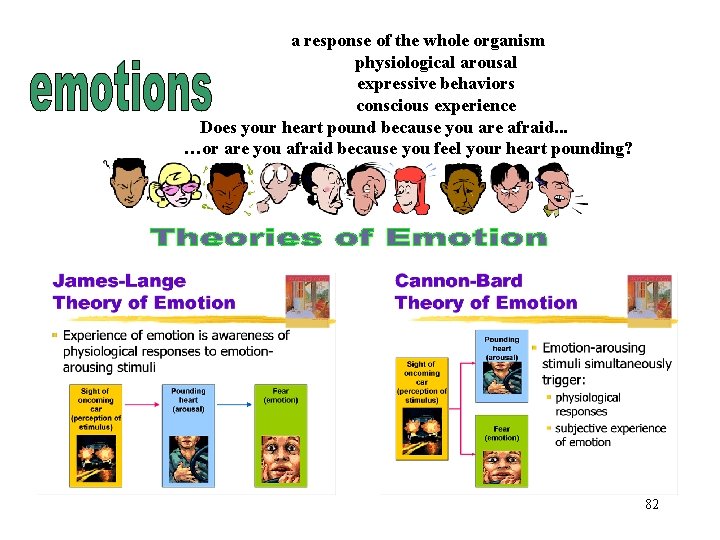
a response of the whole organism physiological arousal expressive behaviors conscious experience Does your heart pound because you are afraid. . . …or are you afraid because you feel your heart pounding? 82
83
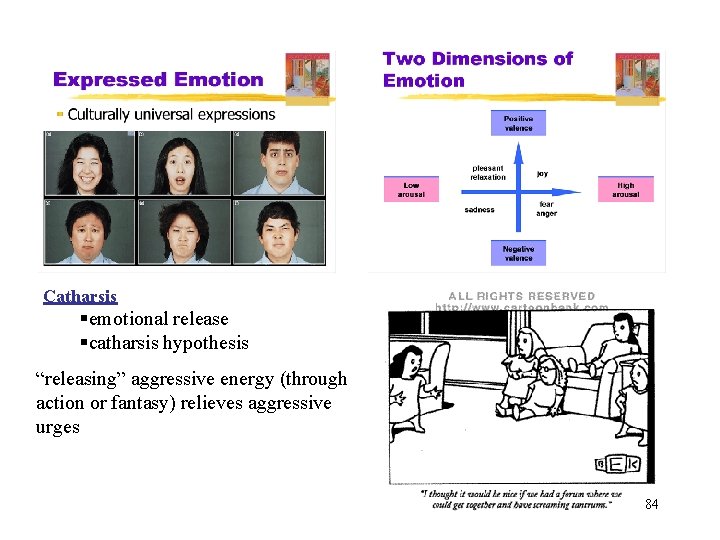
Catharsis emotional release catharsis hypothesis “releasing” aggressive energy (through action or fantasy) relieves aggressive urges 84
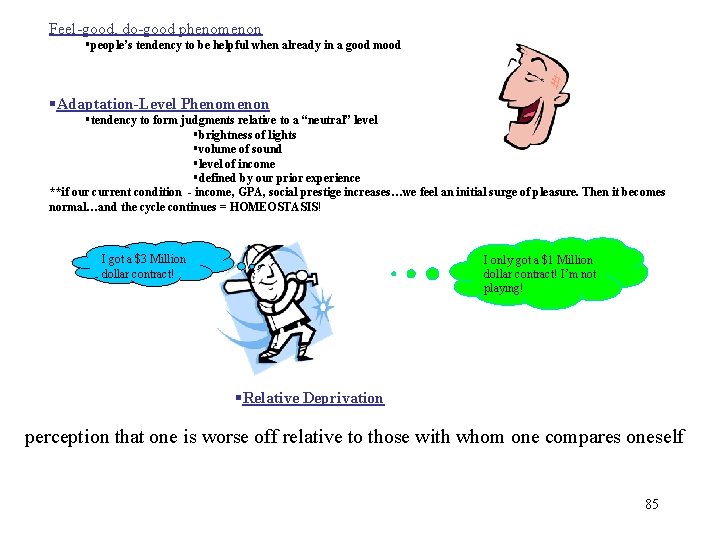
Feel-good, do-good phenomenon people’s tendency to be helpful when already in a good mood Adaptation-Level Phenomenon tendency to form judgments relative to a “neutral” level brightness of lights volume of sound level of income defined by our prior experience **if our current condition - income, GPA, social prestige increases…we feel an initial surge of pleasure. Then it becomes normal…and the cycle continues = HOMEOSTASIS! I got a $3 Million dollar contract! I only got a $1 Million dollar contract! I’m not playing! Relative Deprivation perception that one is worse off relative to those with whom one compares oneself 85
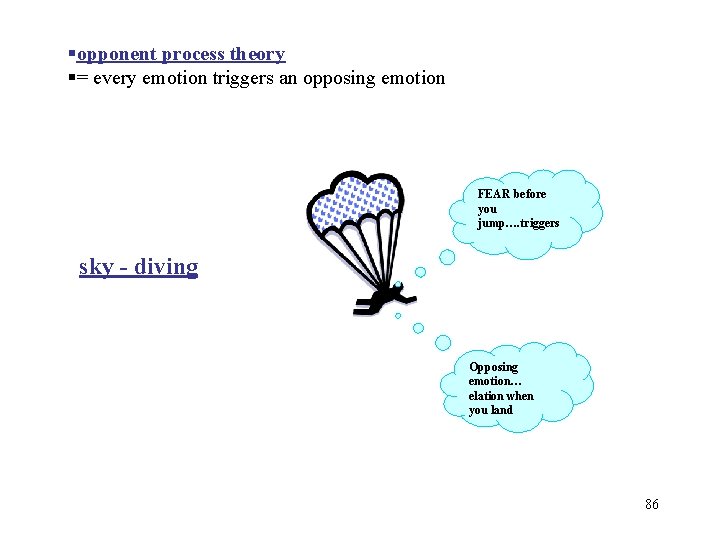
opponent process theory = every emotion triggers an opposing emotion FEAR before you jump…. triggers sky - diving Opposing emotion… elation when you land 86
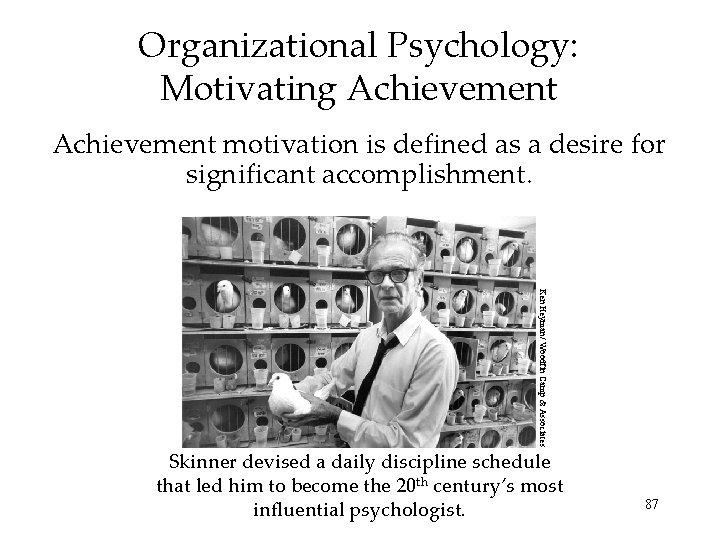
Organizational Psychology: Motivating Achievement motivation is defined as a desire for significant accomplishment. Ken Heyman/ Woodfin Camp & Associates Skinner devised a daily discipline schedule that led him to become the 20 th century’s most influential psychologist. 87
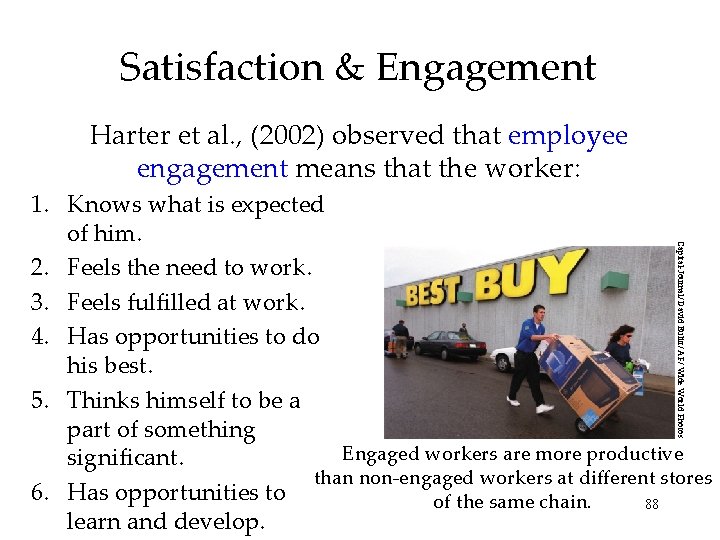
Satisfaction & Engagement Harter et al. , (2002) observed that employee engagement means that the worker: Capital-Journal/ David Eulitt/ AP/ Wide World Photos 1. Knows what is expected of him. 2. Feels the need to work. 3. Feels fulfilled at work. 4. Has opportunities to do his best. 5. Thinks himself to be a part of something Engaged workers are more productive significant. than non-engaged workers at different stores 6. Has opportunities to of the same chain. 88 learn and develop.
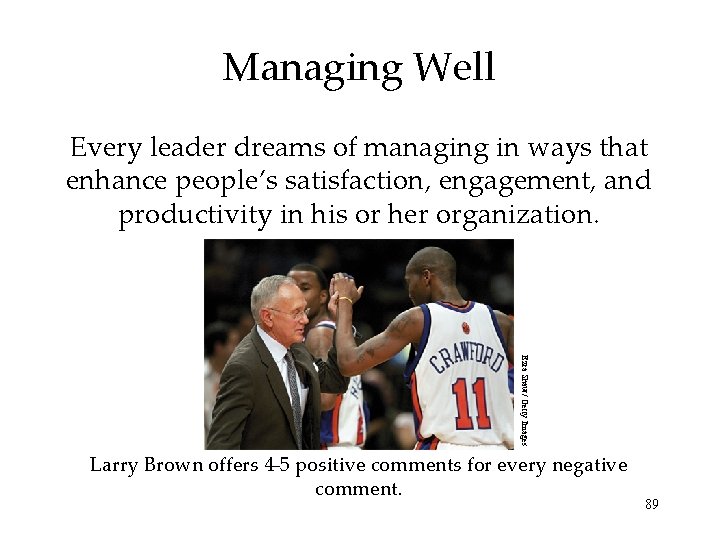
Managing Well Every leader dreams of managing in ways that enhance people’s satisfaction, engagement, and productivity in his or her organization. Ezra Shaw/ Getty Images Larry Brown offers 4 -5 positive comments for every negative comment. 89
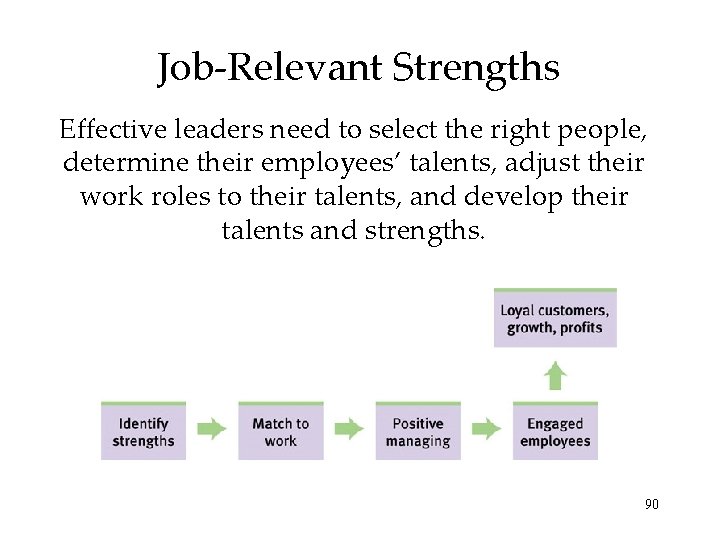
Job-Relevant Strengths Effective leaders need to select the right people, determine their employees’ talents, adjust their work roles to their talents, and develop their talents and strengths. 90
Challenging Goals Specific challenging goals motivate people to reach higher achievement levels, especially if there is feedback such as progress reports. 91
Leadership Style Different organizational demands need different kinds of leaders. Leadership varies from a bossfocused style to a democratic style. 1. 2. Task Leadership: Involves setting standards, organizing work, and focusing on goals. Social Leadership: Involves mediating conflicts and building high achieving teams. 92
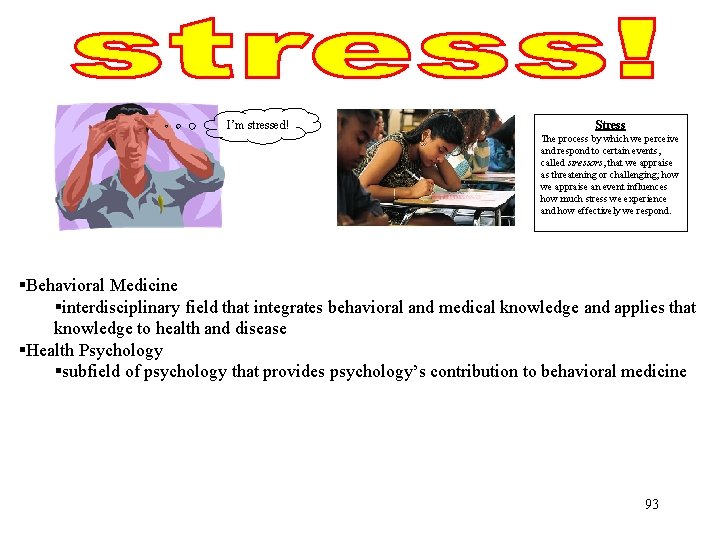
I’m stressed! Stress The process by which we perceive and respond to certain events, called stressors, that we appraise as threatening or challenging; how we appraise an event influences how much stress we experience and how effectively we respond. Behavioral Medicine interdisciplinary field that integrates behavioral and medical knowledge and applies that knowledge to health and disease Health Psychology subfield of psychology that provides psychology’s contribution to behavioral medicine 93
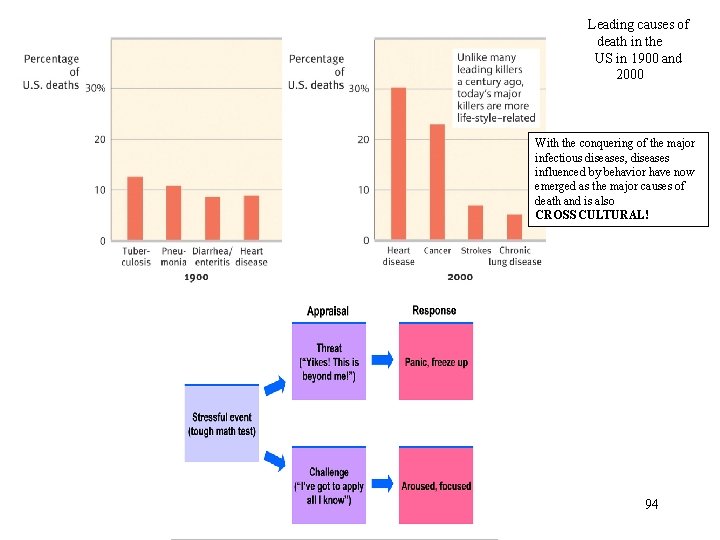
Leading causes of death in the US in 1900 and 2000 With the conquering of the major infectious diseases, diseases influenced by behavior have now emerged as the major causes of death and is also CROSS CULTURAL! 94
CANNON’S DUAL RESPONSE SYSTEM => the adrenal glands (atop the kidneys) release stress hormones on orders received through a dual tracking system. 95
After a trauma, the body enters an alarm phase of temporary shock. From this it rebounds, as stress resistance rises. If the stress is prolonged wear and tear may lead to exhaustion! Catastrophic Events earthquakes, combat stress, floods Life Changes death of a loved one, divorce, loss of job, promotion Daily Hassles rush hour traffic, long lines, job 96 stress, burnout
BURNOUT =>physical, mental, and emotional exhaustion brought on by persistent job related stress. Coronary Heart Disease clogging of the vessels that nourish the heart muscle leading cause of death in many developed countries, including the US STRESS, SMOKING, obesity, high fat diet, inactivity, high blood pressure, high cholesterol level increase risks of heart disease 97
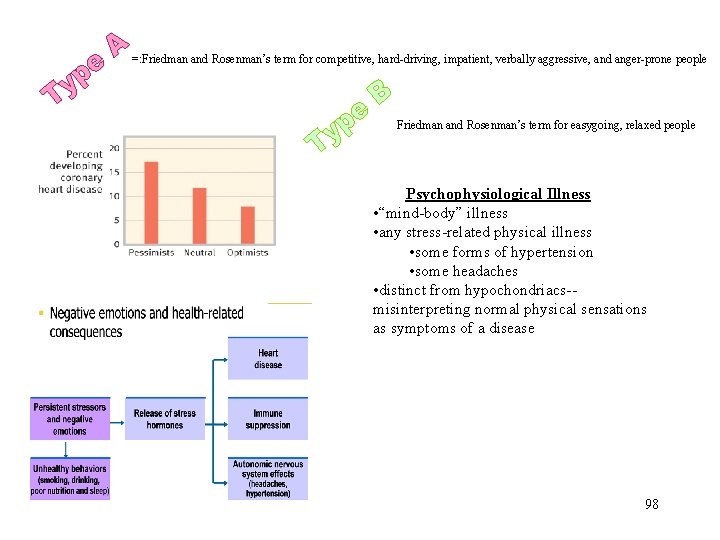
=: Friedman and Rosenman’s term for competitive, hard-driving, impatient, verbally aggressive, and anger-prone people Friedman and Rosenman’s term for easygoing, relaxed people Psychophysiological Illness • “mind-body” illness • any stress-related physical illness • some forms of hypertension • some headaches • distinct from hypochondriacs-misinterpreting normal physical sensations as symptoms of a disease 98