
Psychology 4e by Saul Kassin CHAPTER 7 Thinking
Psychology, 4/e by Saul Kassin CHAPTER 7: Thinking and Language
Thought and Language Concepts Solving Problems Making Judgments Language The Relationship Between Thought and Language Psychology, 4/e by Saul Kassin
Concepts § Concept l A mental grouping of persons, ideas, events, or objects that share common properties § Prototype l A “typical” member of a category, one that has most of the defining features of that category Psychology, 4/e by Saul Kassin
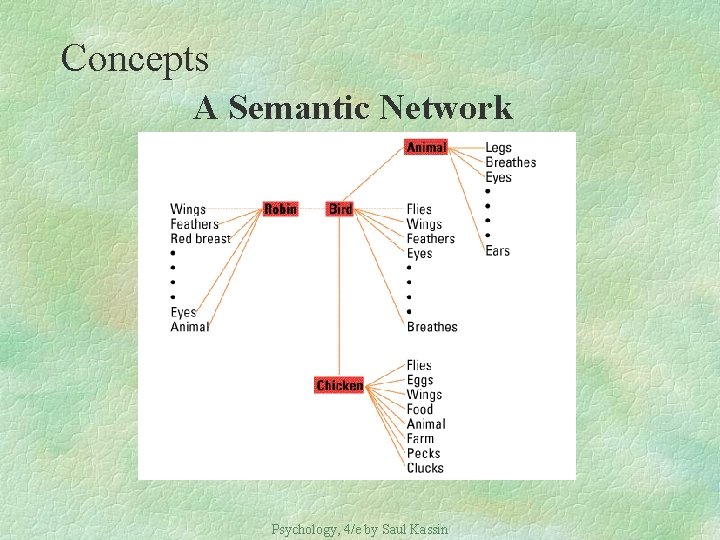
Concepts A Semantic Network Psychology, 4/e by Saul Kassin

Solving Problems Representing the Problem § Image l A mental representation of visual information § Mental Models l Intuitive theories about the way things work Psychology, 4/e by Saul Kassin
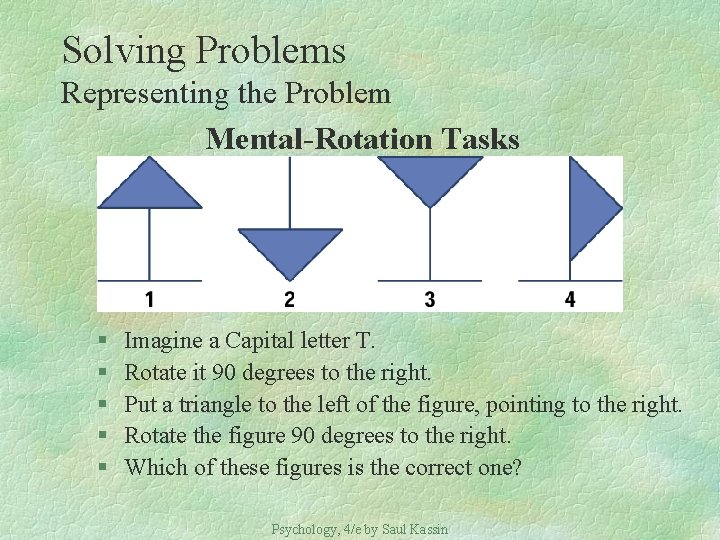
Solving Problems Representing the Problem Mental-Rotation Tasks § § § Imagine a Capital letter T. Rotate it 90 degrees to the right. Put a triangle to the left of the figure, pointing to the right. Rotate the figure 90 degrees to the right. Which of these figures is the correct one? Psychology, 4/e by Saul Kassin
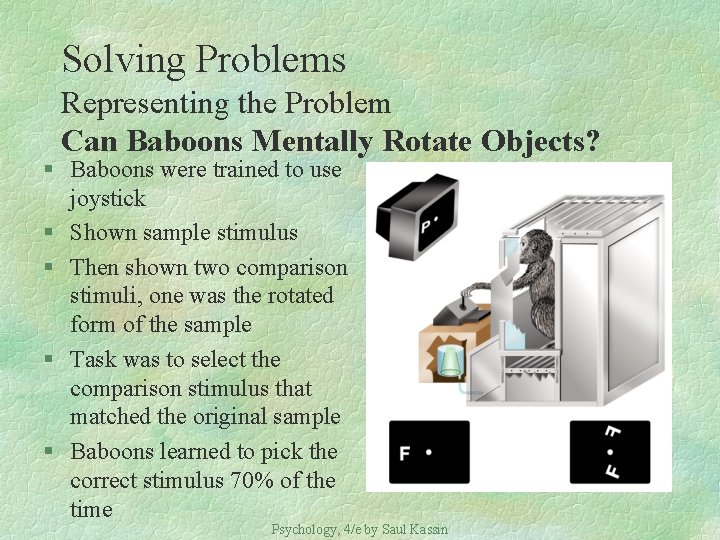
Solving Problems Representing the Problem Can Baboons Mentally Rotate Objects? § Baboons were trained to use joystick § Shown sample stimulus § Then shown two comparison stimuli, one was the rotated form of the sample § Task was to select the comparison stimulus that matched the original sample § Baboons learned to pick the correct stimulus 70% of the time Psychology, 4/e by Saul Kassin
Solving Problems Generating Solutions § Trial and Error l A problem-solving strategy in which several solutions are attempted until one is found that works § Algorithm l A problem-solving procedure that is guaranteed to produce a solution § Heuristic l A mental shortcut that allows one to make judgments that are quick but often in error Psychology, 4/e by Saul Kassin
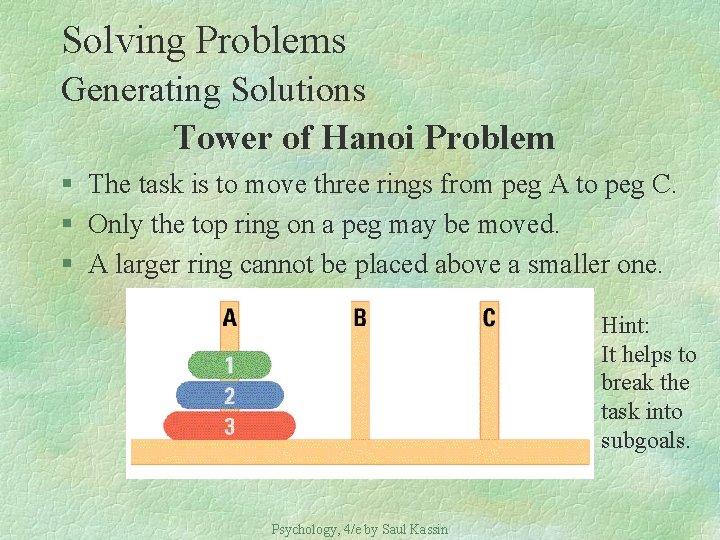
Solving Problems Generating Solutions Tower of Hanoi Problem § The task is to move three rings from peg A to peg C. § Only the top ring on a peg may be moved. § A larger ring cannot be placed above a smaller one. Hint: It helps to break the task into subgoals. Psychology, 4/e by Saul Kassin
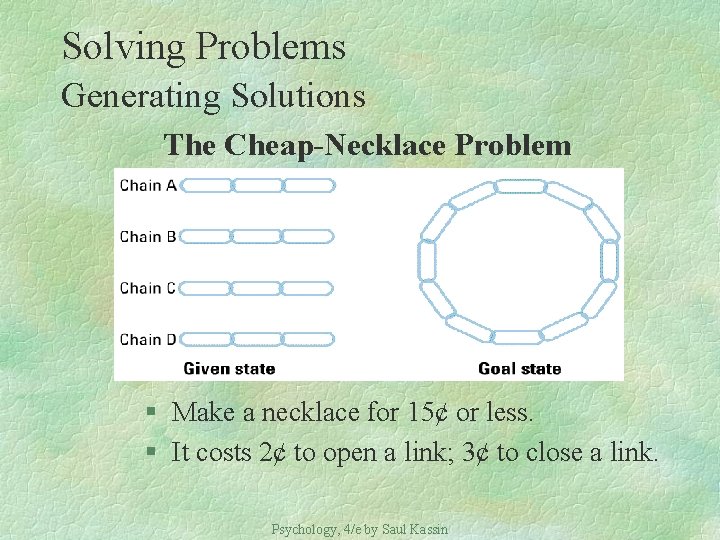
Solving Problems Generating Solutions The Cheap-Necklace Problem § Make a necklace for 15¢ or less. § It costs 2¢ to open a link; 3¢ to close a link. Psychology, 4/e by Saul Kassin
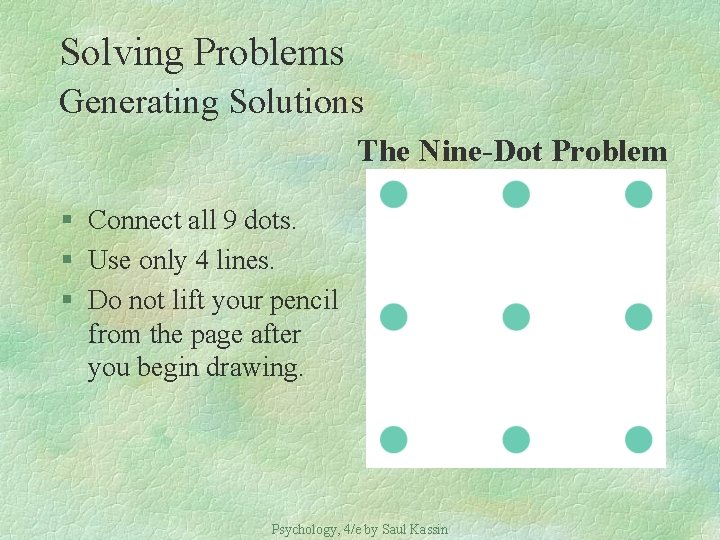
Solving Problems Generating Solutions The Nine-Dot Problem § Connect all 9 dots. § Use only 4 lines. § Do not lift your pencil from the page after you begin drawing. Psychology, 4/e by Saul Kassin
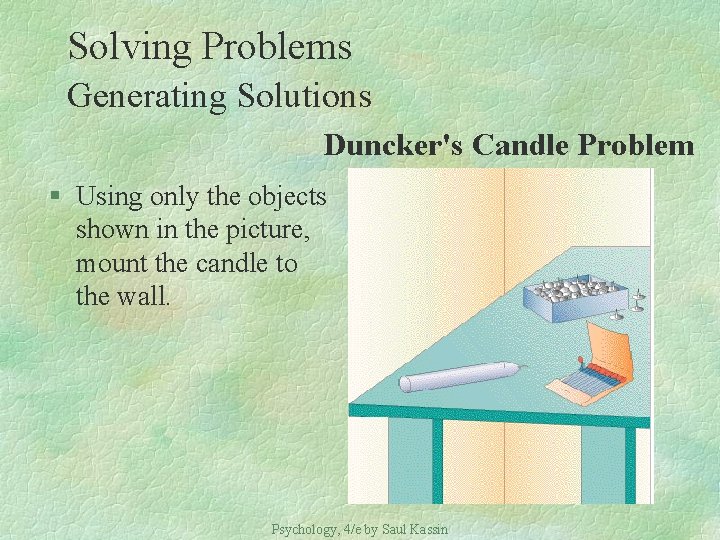
Solving Problems Generating Solutions Duncker's Candle Problem § Using only the objects shown in the picture, mount the candle to the wall. Psychology, 4/e by Saul Kassin
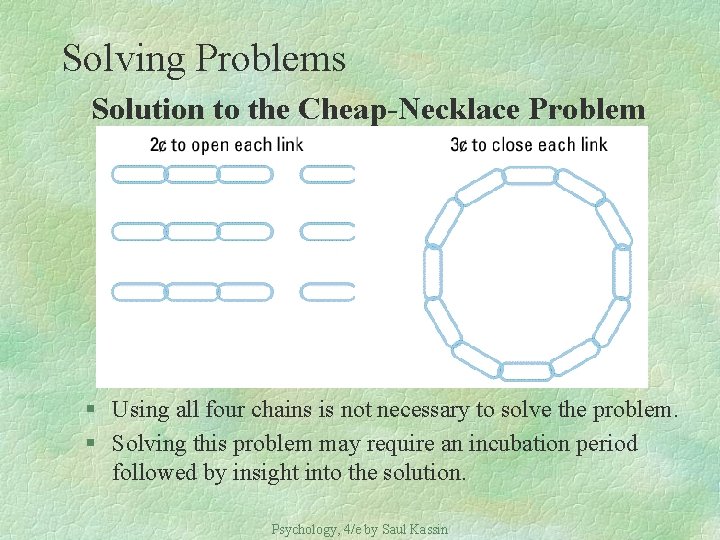
Solving Problems Solution to the Cheap-Necklace Problem § Using all four chains is not necessary to solve the problem. § Solving this problem may require an incubation period followed by insight into the solution. Psychology, 4/e by Saul Kassin
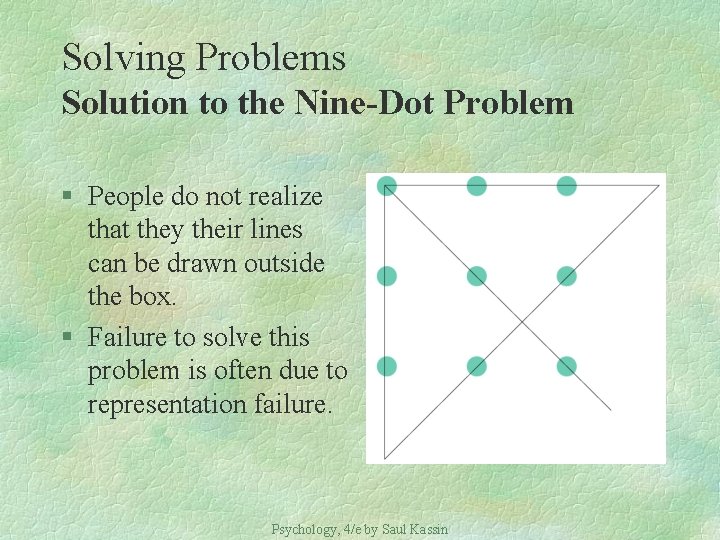
Solving Problems Solution to the Nine-Dot Problem § People do not realize that they their lines can be drawn outside the box. § Failure to solve this problem is often due to representation failure. Psychology, 4/e by Saul Kassin
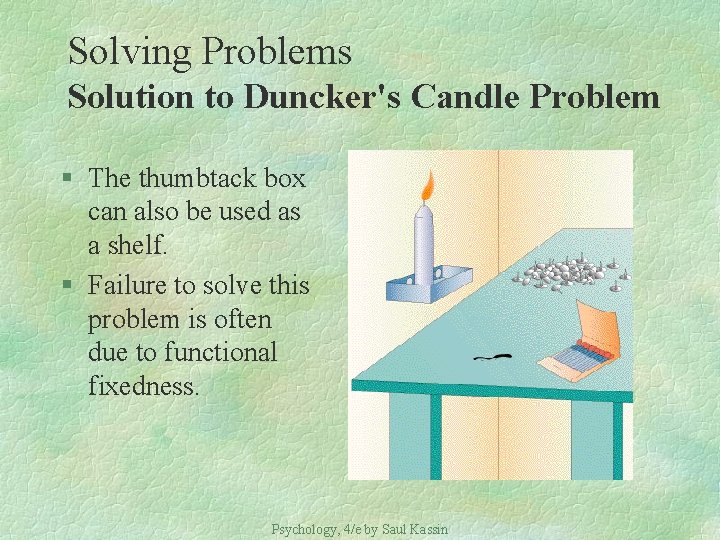
Solving Problems Solution to Duncker's Candle Problem § The thumbtack box can also be used as a shelf. § Failure to solve this problem is often due to functional fixedness. Psychology, 4/e by Saul Kassin
Solving Problems “Blind Spots” in Problem Solving § Functional Fixedness l Tendency to think of objects only in terms of their usual functions § Mental Set l Tendency to return to a problem-solving strategy that worked in the past § Confirmation Bias l Inclination to search only for evidence that will verify one’s beliefs § Belief Perseverance l Tendency to cling to beliefs even after they have been discredited Psychology, 4/e by Saul Kassin
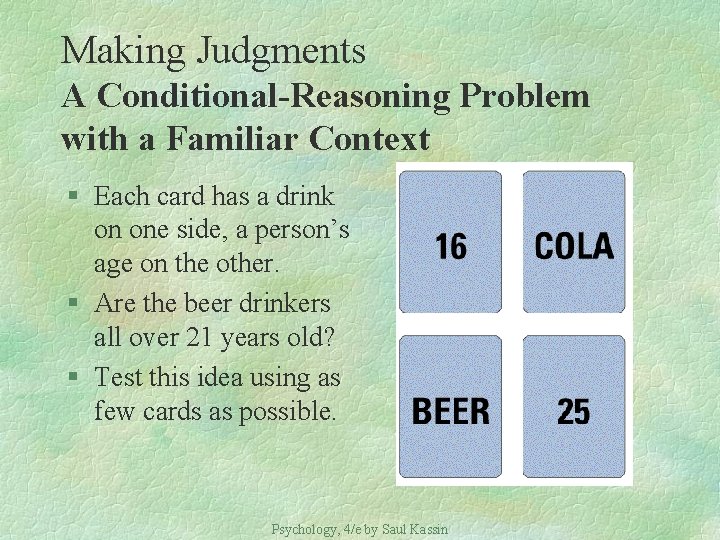
Making Judgments A Conditional-Reasoning Problem with a Familiar Context § Each card has a drink on one side, a person’s age on the other. § Are the beer drinkers all over 21 years old? § Test this idea using as few cards as possible. Psychology, 4/e by Saul Kassin
Making Judgments Biases in Judgment § Representativeness Heuristic l Tendency to estimate the likelihood of an event in terms of how typical it seems § Availability Heuristic l Tendency to estimate the likelihood of an event in terms of how easily instances of it can be recalled § Illusion of Control l l Tendency for people to believe that they can control chance events that mimic skill situations This may explain why some people gamble. Psychology, 4/e by Saul Kassin
Making Judgments Biases in Judgment, continued § Anchoring Effect l The tendency to use the initial value as a reference point in making a new numerical estimate § Framing Effect l Biasing effects on decision making due to the way in which a choice is worded Psychology, 4/e by Saul Kassin
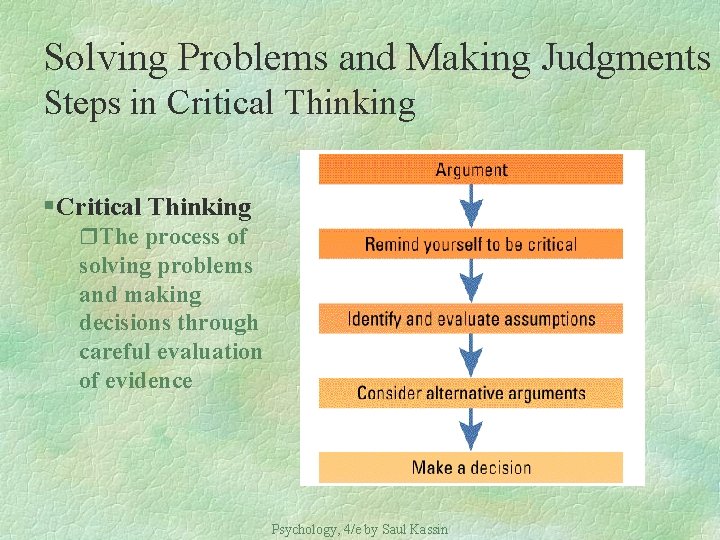
Solving Problems and Making Judgments Steps in Critical Thinking § Critical Thinking r. The process of solving problems and making decisions through careful evaluation of evidence Psychology, 4/e by Saul Kassin
Language Characteristics of Human Language I § Semanticity l l The property of language that accounts for the communication of meaning Phonemes • Basic, distinct sounds of a spoken language l Morpheme • The smallest meaningful unit of a language l Phrase • A group of words that act as a unit to convey meaning l Sentence • An organized sequence of words Psychology, 4/e by Saul Kassin
Language Characteristics of Human Language II § Generativity l l The property of language that accounts for the capacity to use a limited number of words to produce an infinite variety of expressions Syntax • Rules of grammar that govern the arrangement of words in a sentence § Displacement l The property of language that accounts for the capacity to communicate about matters that are not in the here-and-now Psychology, 4/e by Saul Kassin
Can Animals Learn Language? § Many apes of several species have learned various different signing systems. § Is it language? l l Semanticity: “Language apes” satisfy this criterion. Generativity: Apes can use the same words in different orders to initiate different actions. Displacement: Researchers say apes refer to past events, but most evidence is anecdotal. This debate continues. Psychology, 4/e by Saul Kassin
The Relationship Between Thought and Language The Linguistic-Relativity Hypothesis l l The hypothesis that language determines, or at least influences, the way we think This leads to a prediction that people of different cultures, who speak different languages, must think in different ways. § Evidence indicates that language influences but does not completely determine thought. Psychology, 4/e by Saul Kassin
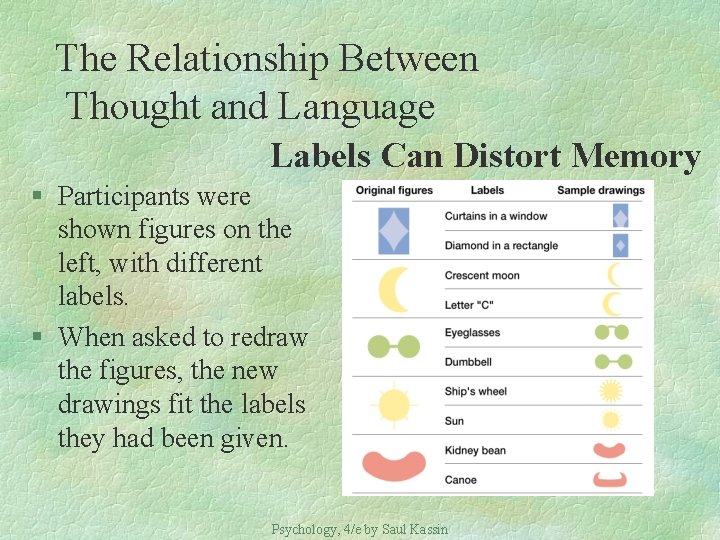
The Relationship Between Thought and Language Labels Can Distort Memory § Participants were shown figures on the left, with different labels. § When asked to redraw the figures, the new drawings fit the labels they had been given. Psychology, 4/e by Saul Kassin
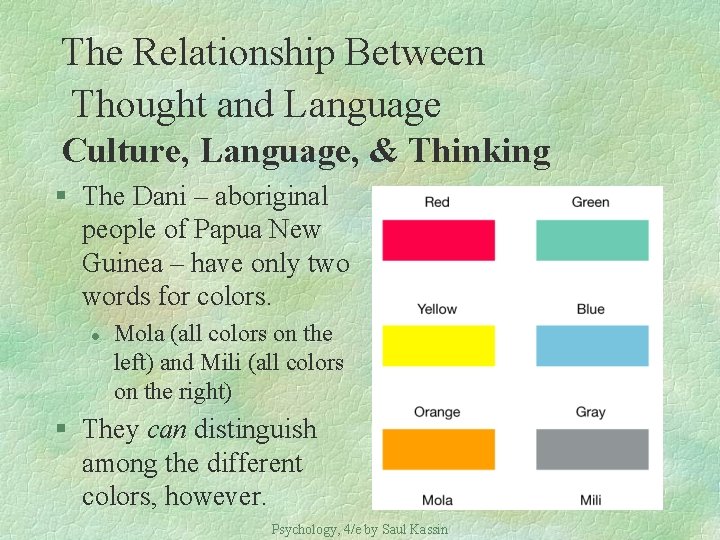
The Relationship Between Thought and Language Culture, Language, & Thinking § The Dani – aboriginal people of Papua New Guinea – have only two words for colors. l Mola (all colors on the left) and Mili (all colors on the right) § They can distinguish among the different colors, however. Psychology, 4/e by Saul Kassin
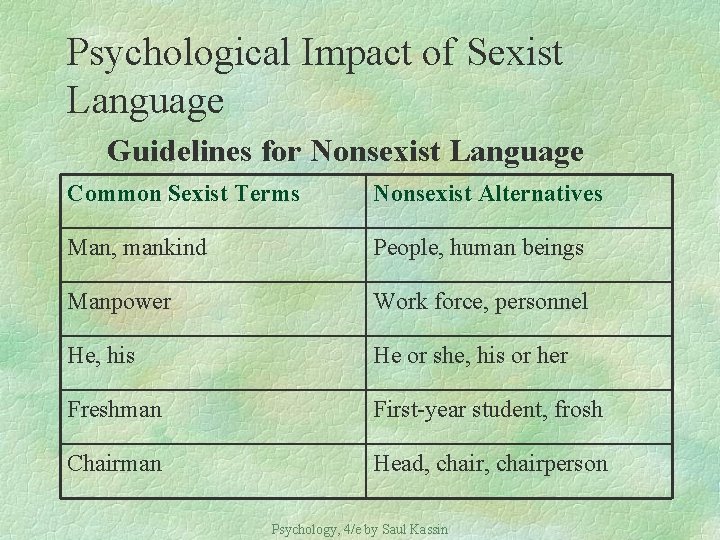
Psychological Impact of Sexist Language Guidelines for Nonsexist Language Common Sexist Terms Nonsexist Alternatives Man, mankind People, human beings Manpower Work force, personnel He, his He or she, his or her Freshman First-year student, frosh Chairman Head, chairperson Psychology, 4/e by Saul Kassin

Psychology, 4/e by Saul Kassin
- Slides: 28