
Psychology 4e by Saul Kassin CHAPTER 6 Memory
Psychology, 4/e by Saul Kassin CHAPTER 6: Memory
Memory An Information-Processing Model The Sensory Register Short-Term Memory Long-Term Memory Autobiographical Memory Psychology, 4/e by Saul Kassin
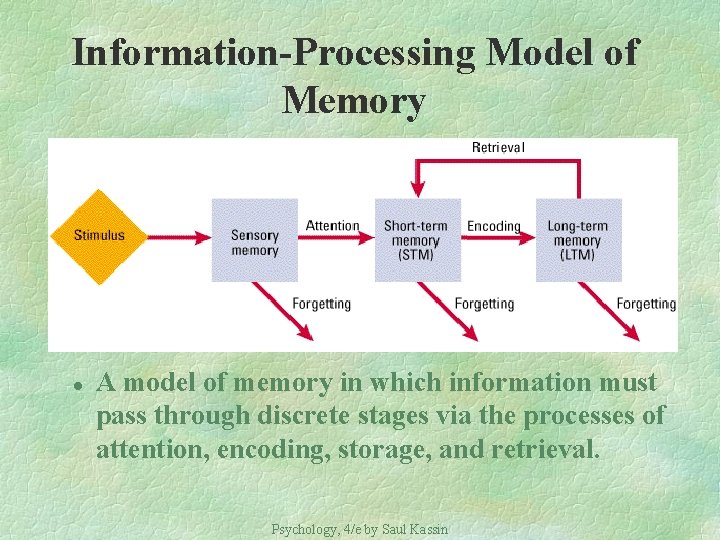
Information-Processing Model of Memory l A model of memory in which information must pass through discrete stages via the processes of attention, encoding, storage, and retrieval. Psychology, 4/e by Saul Kassin

Memory Types of Memory § Sensory Memory Records information from the senses for up to three seconds l Examples are Iconic (Visual) Memory and Echoic (Auditory) Memory l § Short-Term Memory Holds about seven items for up to twenty seconds before the material is forgotten or transferred to longterm memory l § Long-Term Memory Relatively permanent, can hold vast amounts of information l Psychology, 4/e by Saul Kassin
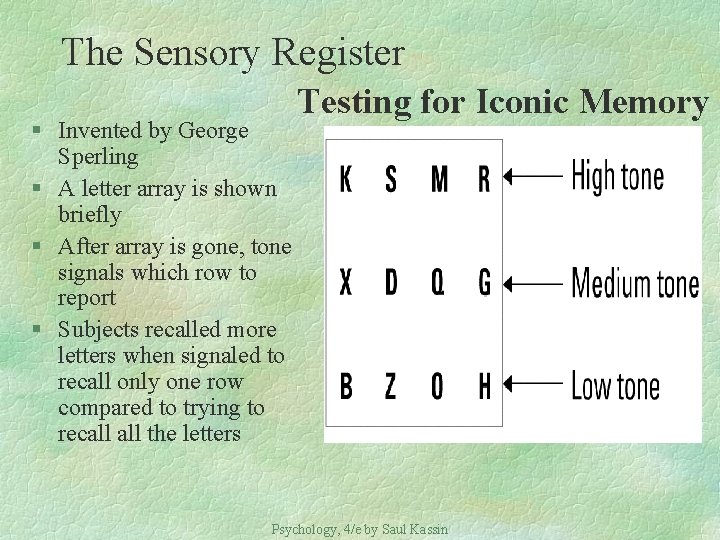
The Sensory Register § Invented by George Sperling § A letter array is shown briefly § After array is gone, tone signals which row to report § Subjects recalled more letters when signaled to recall only one row compared to trying to recall the letters Testing for Iconic Memory Psychology, 4/e by Saul Kassin
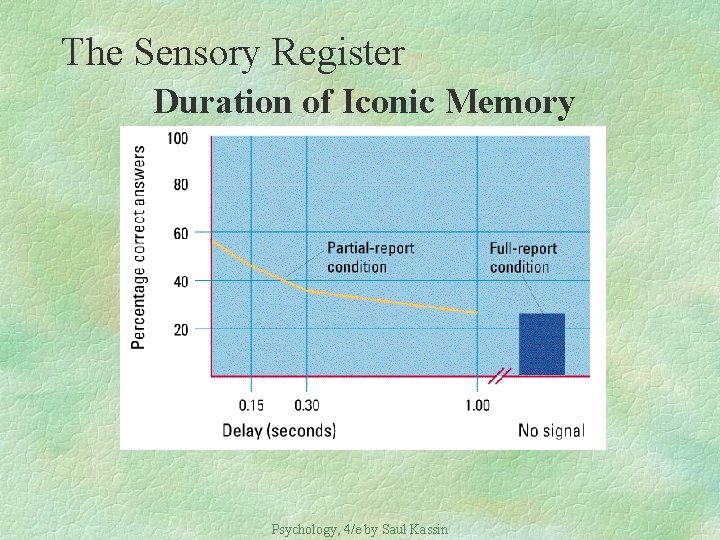
The Sensory Register Duration of Iconic Memory Psychology, 4/e by Saul Kassin
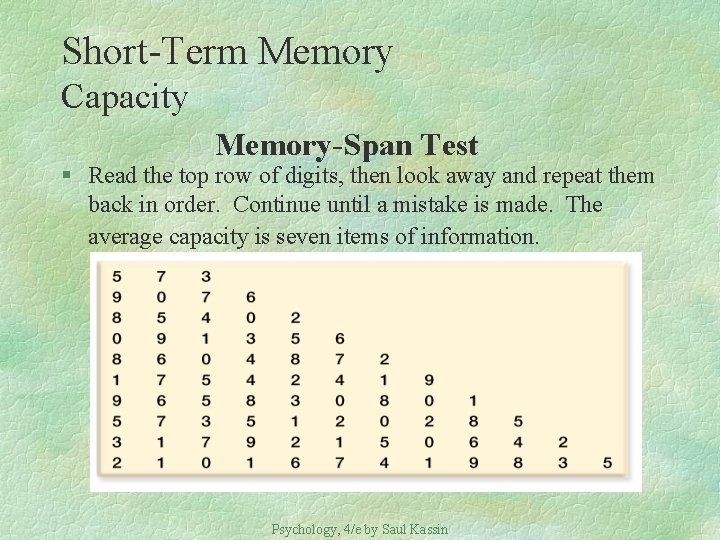
Short-Term Memory Capacity Memory-Span Test § Read the top row of digits, then look away and repeat them back in order. Continue until a mistake is made. The average capacity is seven items of information. Psychology, 4/e by Saul Kassin
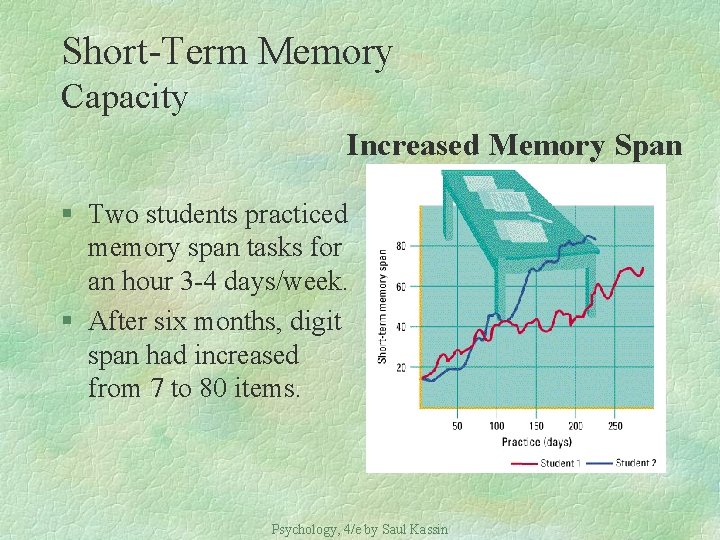
Short-Term Memory Capacity Increased Memory Span § Two students practiced memory span tasks for an hour 3 -4 days/week. § After six months, digit span had increased from 7 to 80 items. Psychology, 4/e by Saul Kassin
Short-Term Memory Capacity Chunking Process of grouping distinct bits of information into larger wholes to increase short-term memory capacity. § Take 5 seconds to memorize as much as possible on the next slide. § Then, try to reproduce the arrangement of pieces. l Psychology, 4/e by Saul Kassin
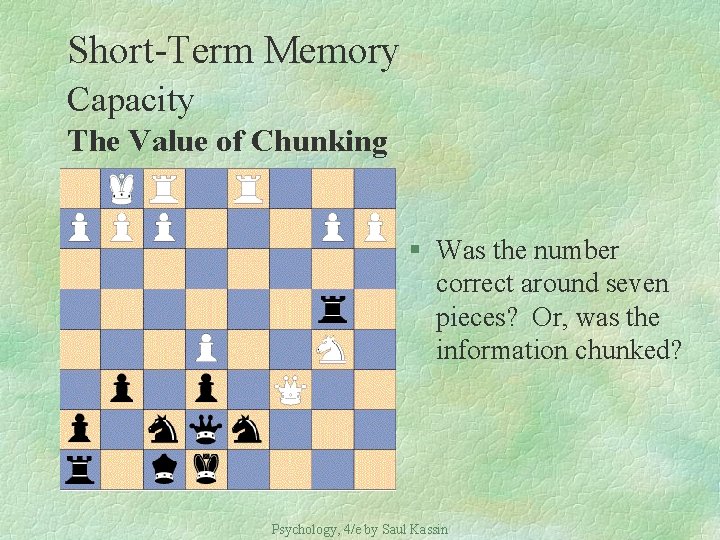
Short-Term Memory Capacity The Value of Chunking § Was the number correct around seven pieces? Or, was the information chunked? Psychology, 4/e by Saul Kassin
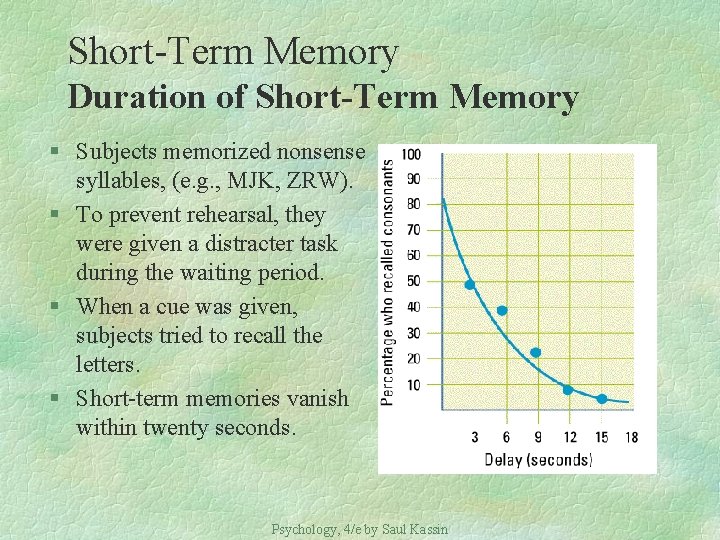
Short-Term Memory Duration of Short-Term Memory § Subjects memorized nonsense syllables, (e. g. , MJK, ZRW). § To prevent rehearsal, they were given a distracter task during the waiting period. § When a cue was given, subjects tried to recall the letters. § Short-term memories vanish within twenty seconds. Psychology, 4/e by Saul Kassin
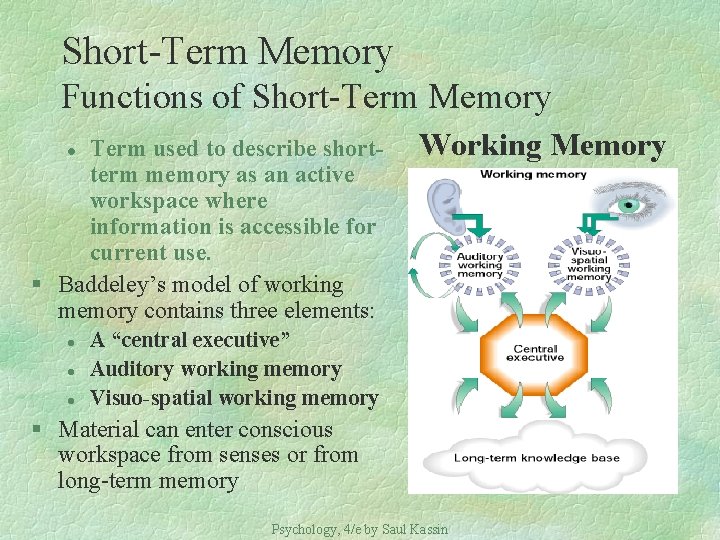
Short-Term Memory Functions of Short-Term Memory Term used to describe shortterm memory as an active workspace where information is accessible for current use. § Baddeley’s model of working memory contains three elements: l l Working Memory A “central executive” Auditory working memory Visuo-spatial working memory § Material can enter conscious workspace from senses or from long-term memory Psychology, 4/e by Saul Kassin
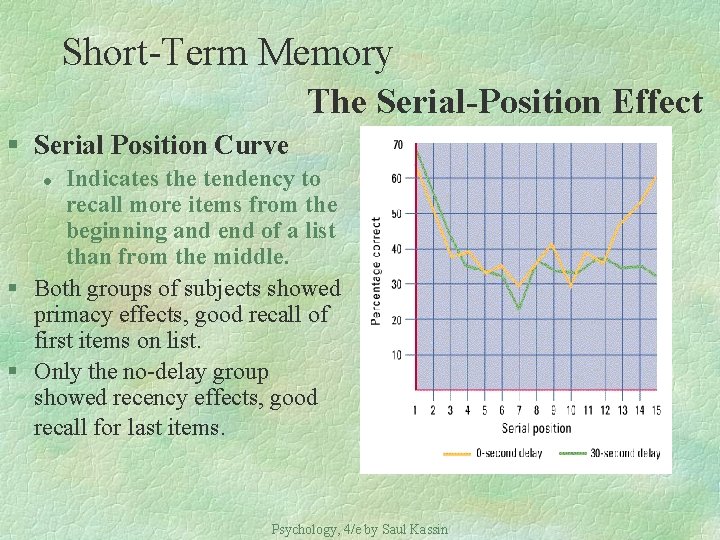
Short-Term Memory The Serial-Position Effect § Serial Position Curve Indicates the tendency to recall more items from the beginning and end of a list than from the middle. § Both groups of subjects showed primacy effects, good recall of first items on list. § Only the no-delay group showed recency effects, good recall for last items. l Psychology, 4/e by Saul Kassin
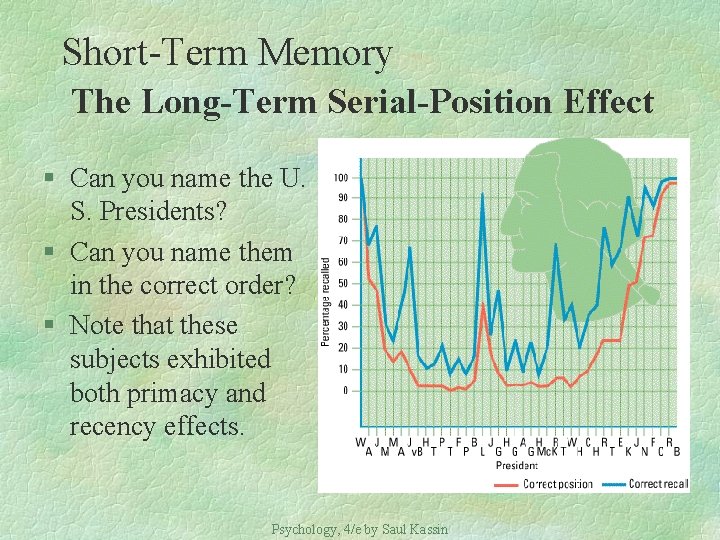
Short-Term Memory The Long-Term Serial-Position Effect § Can you name the U. S. Presidents? § Can you name them in the correct order? § Note that these subjects exhibited both primacy and recency effects. Psychology, 4/e by Saul Kassin
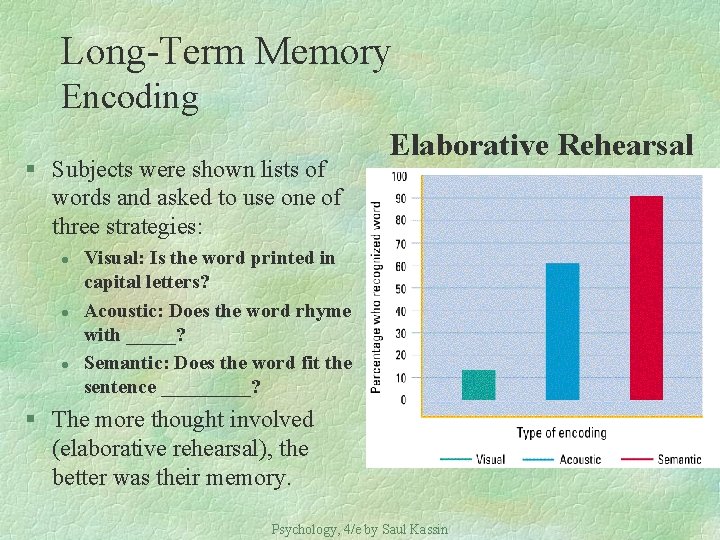
Long-Term Memory Encoding § Subjects were shown lists of words and asked to use one of three strategies: l l l Elaborative Rehearsal Visual: Is the word printed in capital letters? Acoustic: Does the word rhyme with _____? Semantic: Does the word fit the sentence _____? § The more thought involved (elaborative rehearsal), the better was their memory. Psychology, 4/e by Saul Kassin
Long-Term Memory Storage § Procedural Memory l l Stored long-term knowledge of learned habits and skills. Examples are how to drive, ride a bike, tie one’s shoes, etc. § Declarative Memory l l Stored long-term knowledge of facts about ourselves and the world. Includes both semantic (nonpersonal) and episodic (personal) memories Psychology, 4/e by Saul Kassin
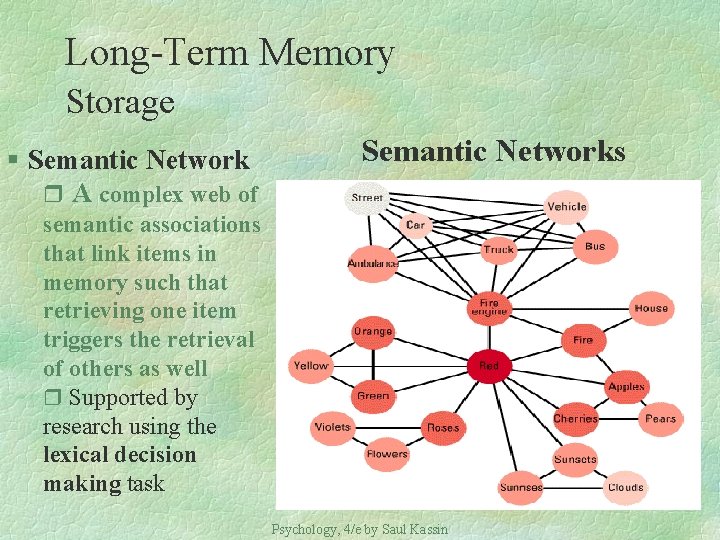
Long-Term Memory Storage § Semantic Network r A complex web of Semantic Networks semantic associations that link items in memory such that retrieving one item triggers the retrieval of others as well r Supported by research using the lexical decision making task Psychology, 4/e by Saul Kassin
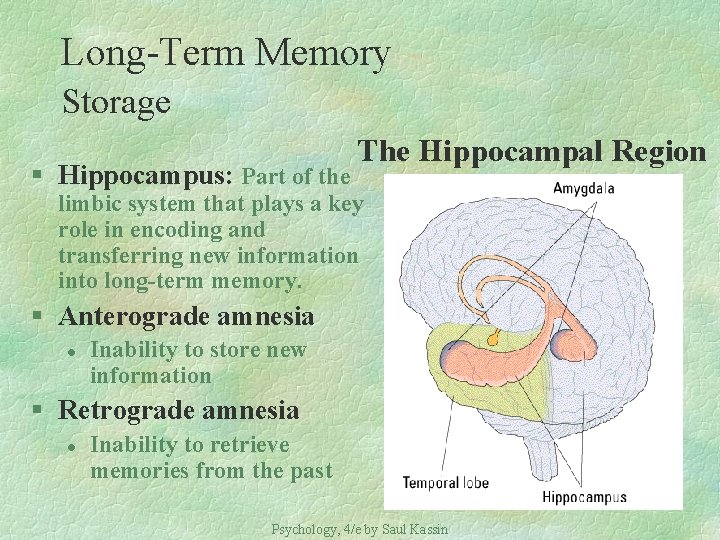
Long-Term Memory Storage § Hippocampus: Part of the The Hippocampal Region limbic system that plays a key role in encoding and transferring new information into long-term memory. § Anterograde amnesia l Inability to store new information § Retrograde amnesia l Inability to retrieve memories from the past Psychology, 4/e by Saul Kassin
Long-Term Memory Retrieval § Explicit Memory l l The types of memory elicited through the conscious retrieval of recollections in response to direct questions. Conscious retention, direct tests, disrupted by amnesia, encoded in the hippocampus § Implicit Memory l l A nonconscious recollection of a prior experience that is revealed indirectly, by its effects on performance. Nonconscious retention, indirect tests, intact with amnesia, encoded elsewhere Psychology, 4/e by Saul Kassin
Long-Term Memory Retrieval Context-Dependent Memory § Russian-English bilinguals were prompted in English and in Russian to recall stories. § They recalled more Russian-experienced events when interviewed in Russian and more English-experienced events when interviewed in English. Psychology, 4/e by Saul Kassin © 2004 Prentice Hall
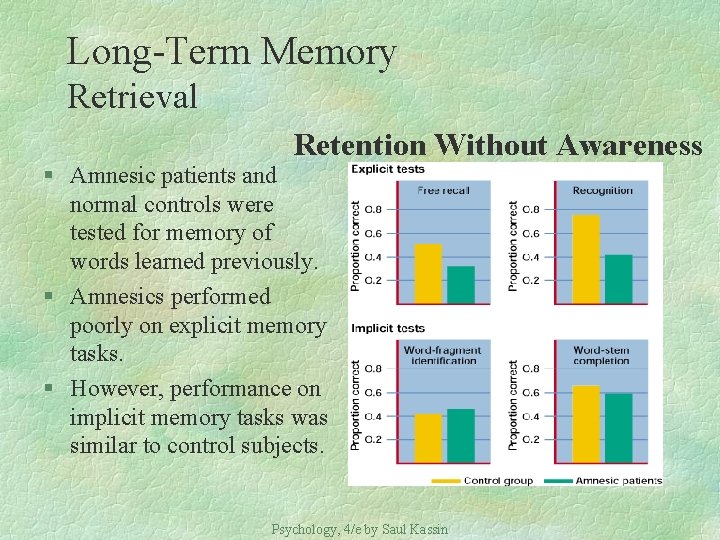
Long-Term Memory Retrieval Retention Without Awareness § Amnesic patients and normal controls were tested for memory of words learned previously. § Amnesics performed poorly on explicit memory tasks. § However, performance on implicit memory tasks was similar to control subjects. Psychology, 4/e by Saul Kassin
Long-Term Memory Retrieval Implicit Memory in Everyday Life § Déjà vu l A sense of familiarity but no real memory § The false-fame effect l Names presented only once, familiarity but no real memory, assume person is famous § Eyewitness transference l Face is familiar, but situation in which they remembering seeing face is incorrect § Unintentional plagiarism l Take credit for someone else’s ideas without awareness Psychology, 4/e by Saul Kassin
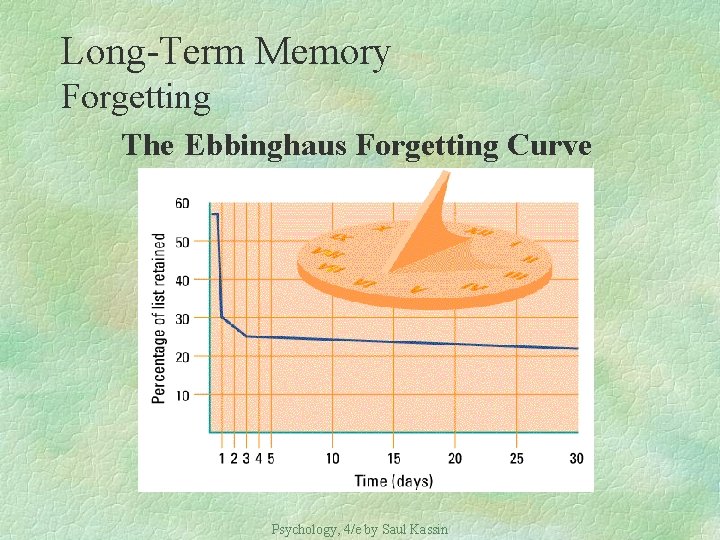
Long-Term Memory Forgetting The Ebbinghaus Forgetting Curve Psychology, 4/e by Saul Kassin
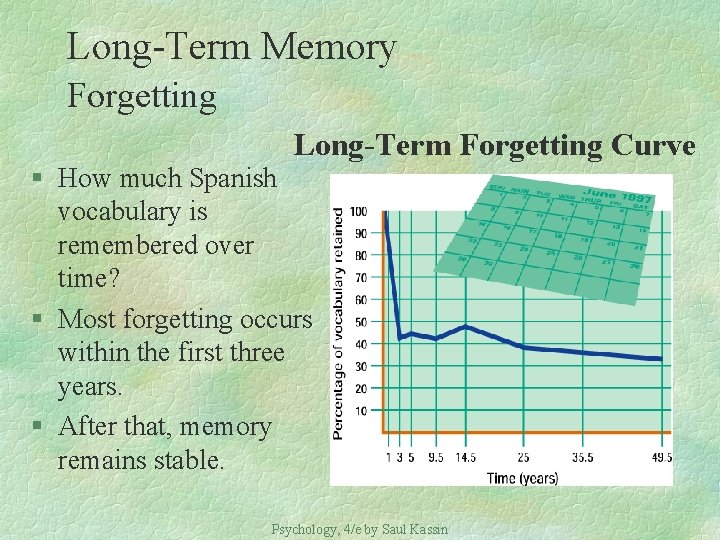
Long-Term Memory Forgetting Long-Term Forgetting Curve § How much Spanish vocabulary is remembered over time? § Most forgetting occurs within the first three years. § After that, memory remains stable. Psychology, 4/e by Saul Kassin
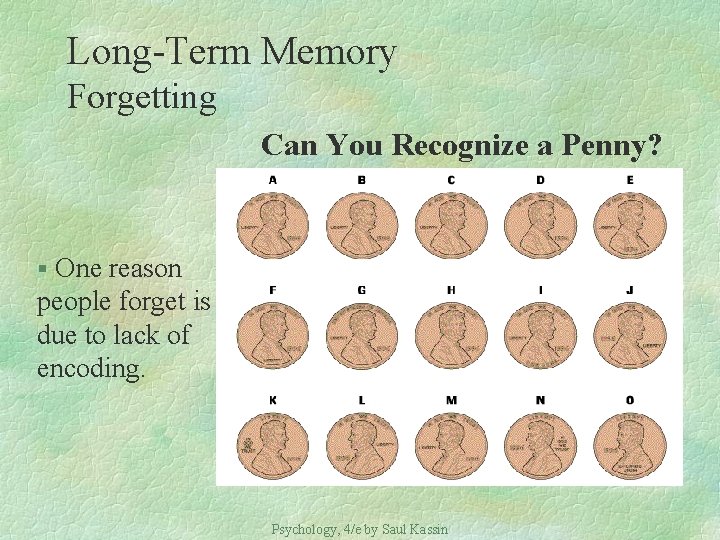
Long-Term Memory Forgetting Can You Recognize a Penny? § One reason people forget is due to lack of encoding. Psychology, 4/e by Saul Kassin
Long-Term Memory Forgetting § Proactive Interference l The tendency for previously learned material to disrupt the recall of new information § Retroactive Interference l The tendency for new information to disrupt the memory of previously learned material Psychology, 4/e by Saul Kassin
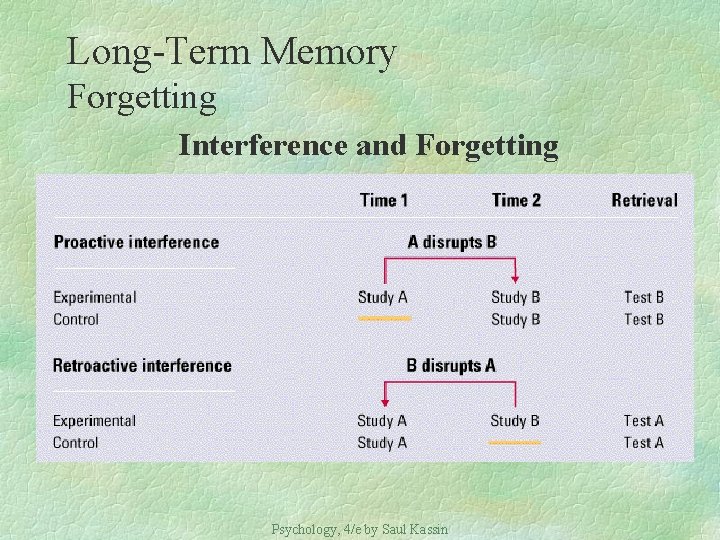
Long-Term Memory Forgetting Interference and Forgetting Psychology, 4/e by Saul Kassin
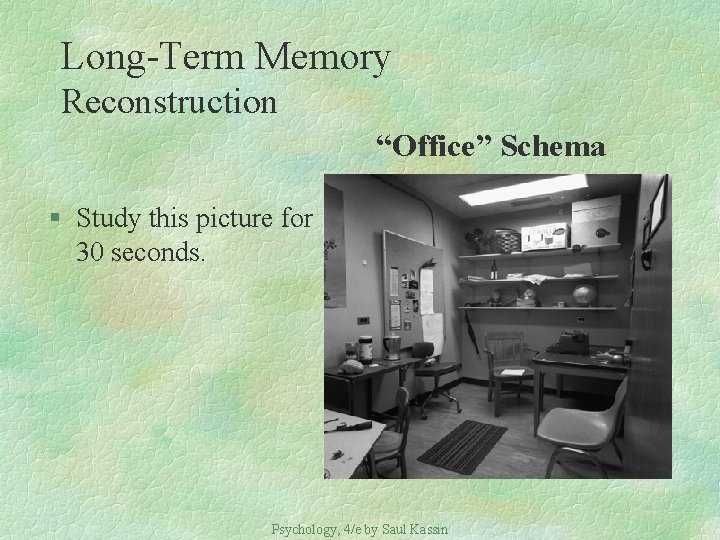
Long-Term Memory Reconstruction “Office” Schema § Study this picture for 30 seconds. Psychology, 4/e by Saul Kassin

List as many objects as you can recall from the photograph you just saw. Psychology, 4/e by Saul Kassin
How to Improve Memory § Mnemonics l § § § § Memory aids designed to facilitate the recall of new information. Increase Practice Time Increase the Depth of Processing Hierarchical Organization Verbal Mnemonics Method of Loci Peg-Word Method Minimize Interference Utilize Context Effects Psychology, 4/e by Saul Kassin
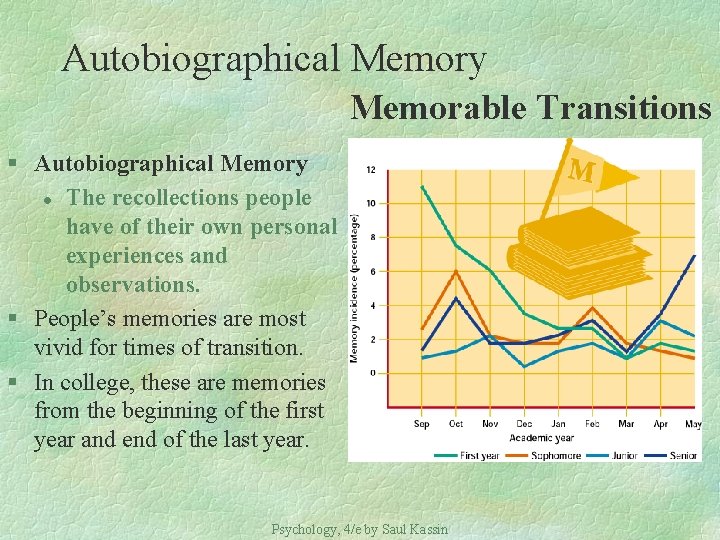
Autobiographical Memory Memorable Transitions § Autobiographical Memory l The recollections people have of their own personal experiences and observations. § People’s memories are most vivid for times of transition. § In college, these are memories from the beginning of the first year and end of the last year. Psychology, 4/e by Saul Kassin
Autobiographical Memory § Flashbulb Memories l Highly vivid and enduring memories, typically for events that are dramatic and emotional § Childhood Amnesia l The inability of most people to recall events from before the age of three or four § Hindsight Bias l The tendency to think after an event that one knew in advance what was going to happen Psychology, 4/e by Saul Kassin

- Slides: 33