
Psychology 3450 W Experimental Psychology Fall 2019 Professor
- Slides: 33
Psychology 3450 W: Experimental Psychology Fall, 2019 Professor Delamater
On the Origins of Research Ideas Where do we get ideas for research? 1. Reading the literature (search for unanswered questions) 2. Different Motivations for Conducting Research • Basic/Applied Research • Laboratory/Field Research • Empirical/Theoretical Research 3. Using Different Tactics for Conducting Research • Operational Definitions • Converging Operations Lets look at each of these in more detail…
Different Motivations for Conducting Research Basic vs Applied Research Basic Research – Attempts to understand how things work. Applied Research – Attempts to help solve immediate real-world problems.
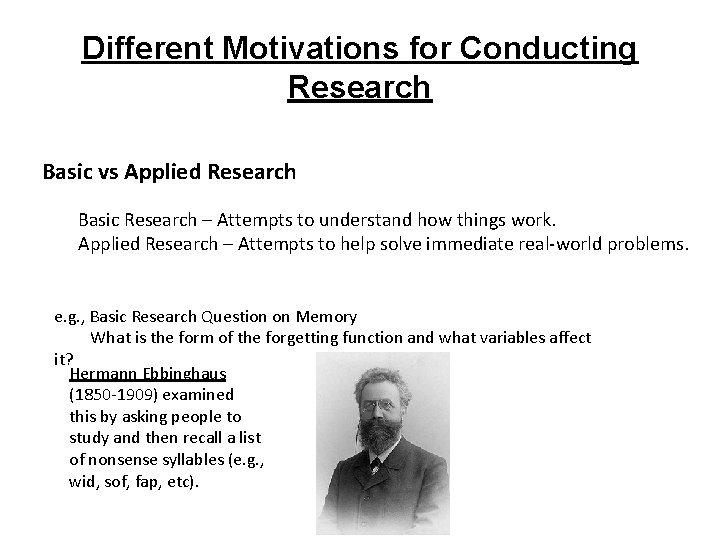
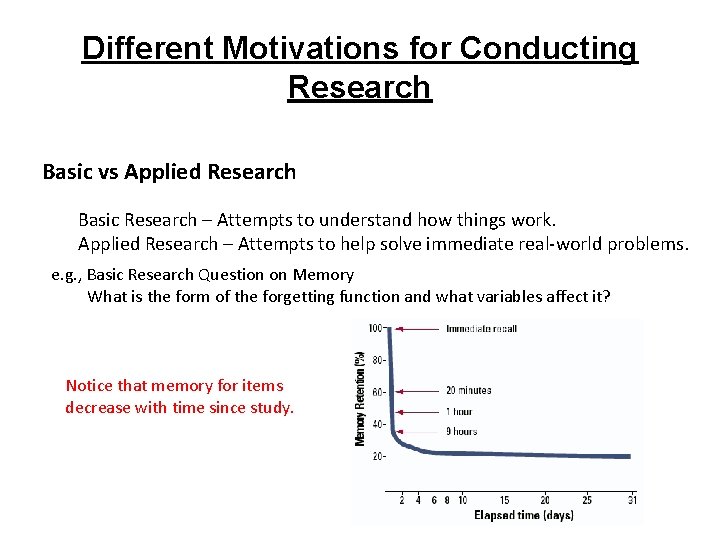
Different Motivations for Conducting Research Basic vs Applied Research Basic Research – Attempts to understand how things work. Applied Research – Attempts to help solve immediate real-world problems. e. g. , Basic Research Question on Memory What is the form of the forgetting function and what variables affect it? Hermann Ebbinghaus (1850 -1909) examined this by asking people to study and then recall a list of nonsense syllables (e. g. , wid, sof, fap, etc).
Different Motivations for Conducting Research Basic vs Applied Research Basic Research – Attempts to understand how things work. Applied Research – Attempts to help solve immediate real-world problems. e. g. , Basic Research Question on Memory What is the form of the forgetting function and what variables affect it? Notice that memory for items decrease with time since study.
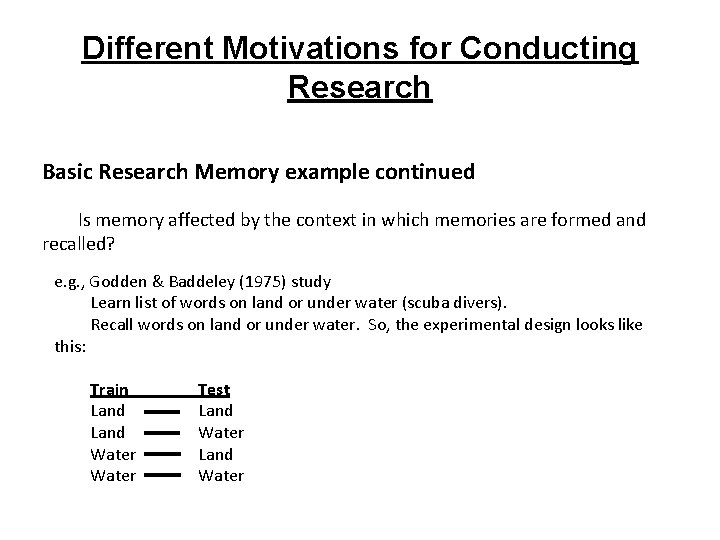
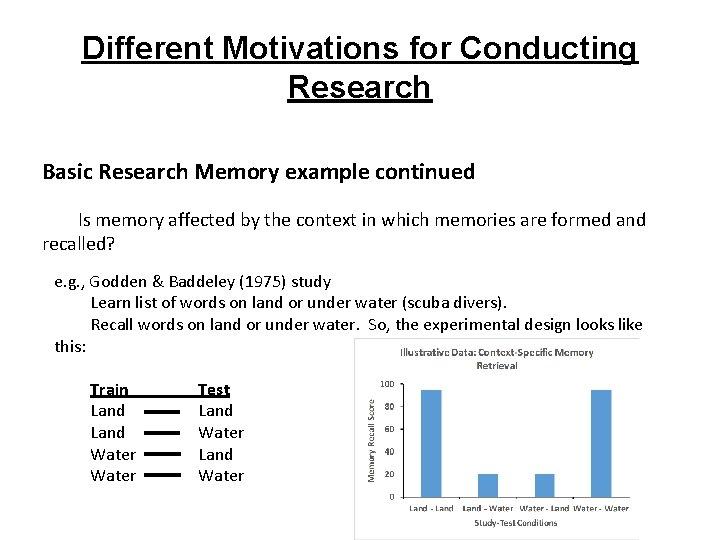
Different Motivations for Conducting Research Basic Research Memory example continued Is memory affected by the context in which memories are formed and recalled? e. g. , Godden & Baddeley (1975) study Learn list of words on land or under water (scuba divers). Recall words on land or under water. So, the experimental design looks like this: Train Land Water Test Land Water
Different Motivations for Conducting Research Basic Research Memory example continued Is memory affected by the context in which memories are formed and recalled? e. g. , Godden & Baddeley (1975) study Learn list of words on land or under water (scuba divers). Recall words on land or under water. So, the experimental design looks like this: Train Land Water Test Land Water
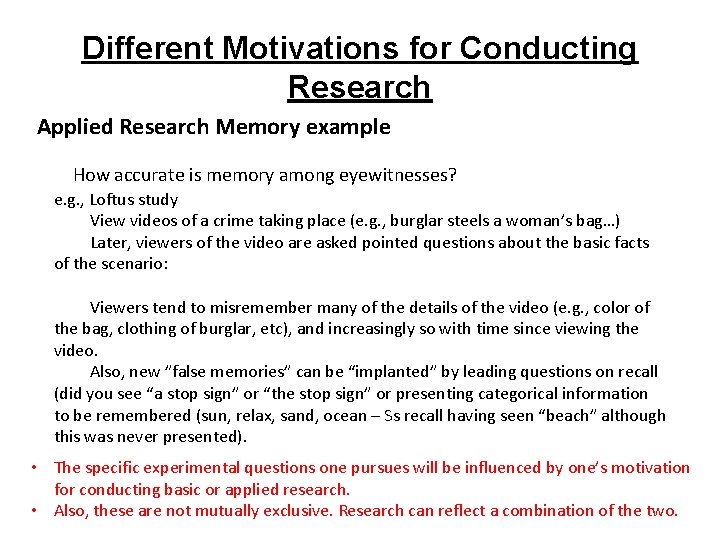
Different Motivations for Conducting Research Applied Research Memory example How accurate is memory among eyewitnesses? e. g. , Loftus study View videos of a crime taking place (e. g. , burglar steels a woman’s bag…) Later, viewers of the video are asked pointed questions about the basic facts of the scenario: Viewers tend to misremember many of the details of the video (e. g. , color of the bag, clothing of burglar, etc), and increasingly so with time since viewing the video. Also, new ”false memories” can be “implanted” by leading questions on recall (did you see “a stop sign” or “the stop sign” or presenting categorical information to be remembered (sun, relax, sand, ocean – Ss recall having seen “beach” although this was never presented). • The specific experimental questions one pursues will be influenced by one’s motivation for conducting basic or applied research. • Also, these are not mutually exclusive. Research can reflect a combination of the two.
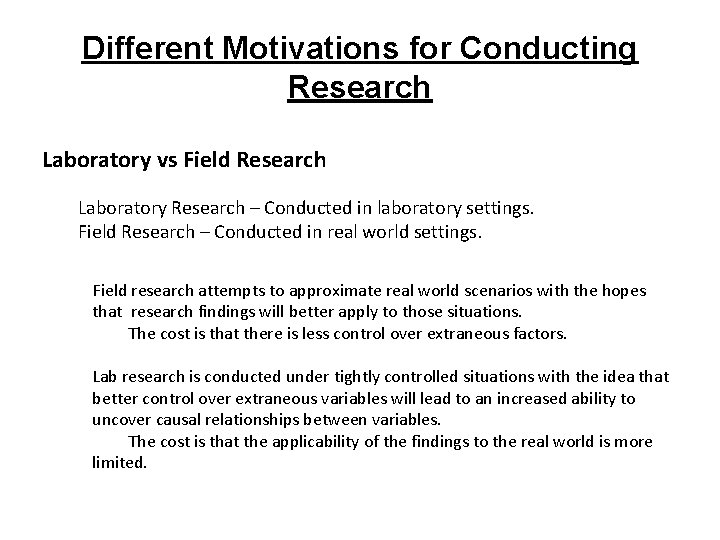
Different Motivations for Conducting Research Laboratory vs Field Research Laboratory Research – Conducted in laboratory settings. Field Research – Conducted in real world settings. Field research attempts to approximate real world scenarios with the hopes that research findings will better apply to those situations. The cost is that there is less control over extraneous factors. Lab research is conducted under tightly controlled situations with the idea that better control over extraneous variables will lead to an increased ability to uncover causal relationships between variables. The cost is that the applicability of the findings to the real world is more limited.
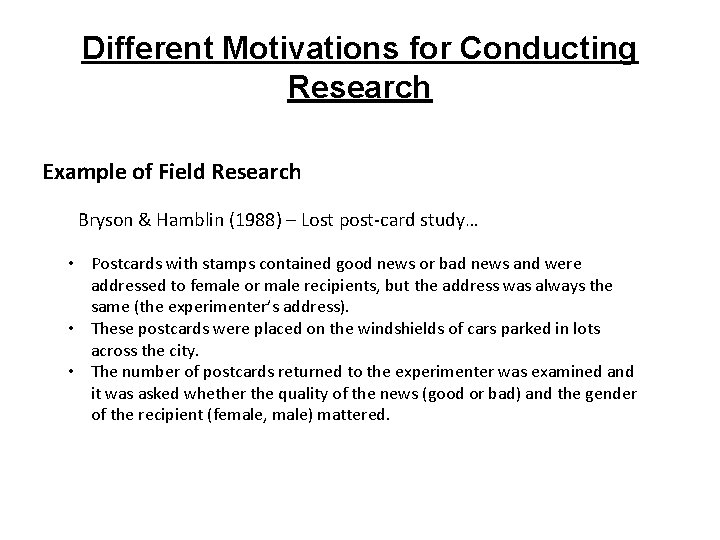
Different Motivations for Conducting Research Example of Field Research Bryson & Hamblin (1988) – Lost post-card study… • Postcards with stamps contained good news or bad news and were addressed to female or male recipients, but the address was always the same (the experimenter’s address). • These postcards were placed on the windshields of cars parked in lots across the city. • The number of postcards returned to the experimenter was examined and it was asked whether the quality of the news (good or bad) and the gender of the recipient (female, male) mattered.
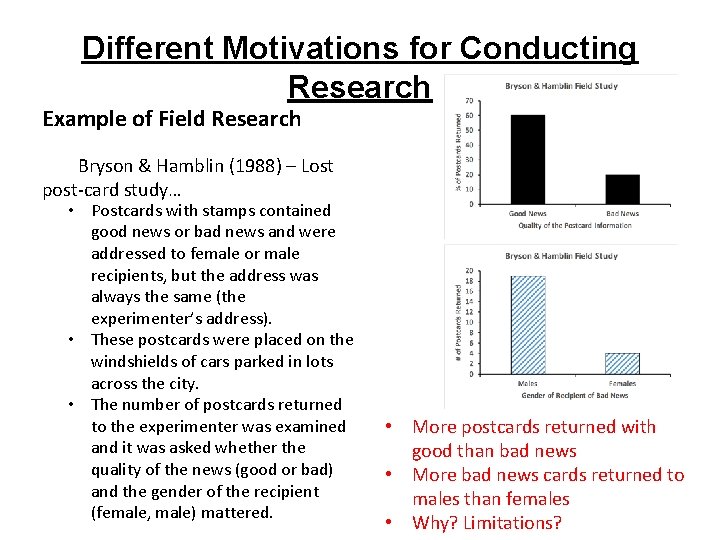
Different Motivations for Conducting Research Example of Field Research Bryson & Hamblin (1988) – Lost post-card study… • Postcards with stamps contained good news or bad news and were addressed to female or male recipients, but the address was always the same (the experimenter’s address). • These postcards were placed on the windshields of cars parked in lots across the city. • The number of postcards returned to the experimenter was examined and it was asked whether the quality of the news (good or bad) and the gender of the recipient (female, male) mattered. • More postcards returned with good than bad news • More bad news cards returned to males than females • Why? Limitations?
Different Motivations for Conducting Research Example of Lab Research Can you think of how this sort of experiment could be done in the lab, but with greater control over variables of interest?
Different Motivations for Conducting Research Example of Lab Research Can you think of how this sort of experiment could be done in the lab, but with greater control over variables of interest? • Have subjects engage in some computer task that is totally irrelevant to the question of interest. • Towards the end of the study inadvertently leave the postcard close to where their things are located…. • Gender of sender is controlled, subject variables can be assessed, etc
Different Motivations for Conducting Research Empirical vs Theoretical Research Empirical Research – The researcher is on a fact-finding mission in an attempt to more fully characterize some phenomenon – what are its boundary conditions, determinants, etc. Theoretical Research – The researcher tests specific predictions stemming from a particular theory of some phenomenon or set of phenomena.
Different Motivations for Conducting Research Empirical Research – Important Ideas • Replication – An attempt is made by the researcher to reproduce some experimental result (i. e. , some “phenomenon”) by performing the exact same experiment with the exact same procedures. By doing so, this establishes the reality of the phenomenon. Some claim that there is a “replication crisis” in various sciences where other researchers fail to replicate a previously reported result (e. g. , “marshmallow study”). This is why it is important to replicate a phenomenon once it has been discovered so that you can be sure of its reality. • Extension – The researcher replicates the experiment, but also extends the findings by exploring more variables or a greater number of levels of a specific variable for their effect on the underlying phenomenon.
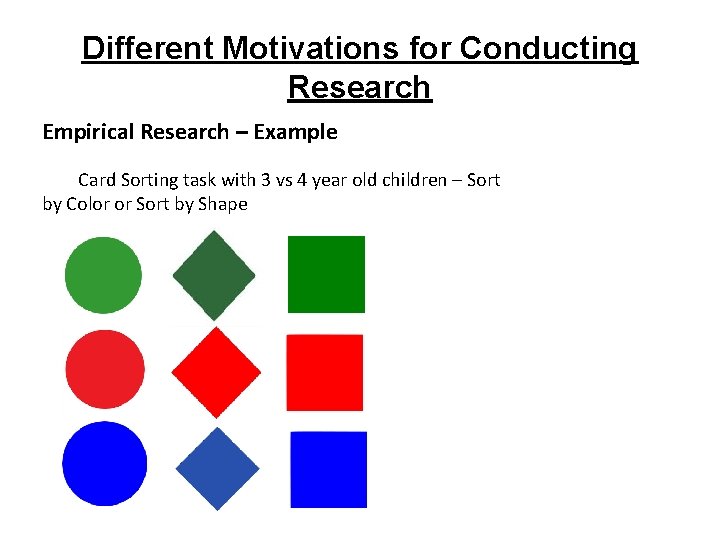
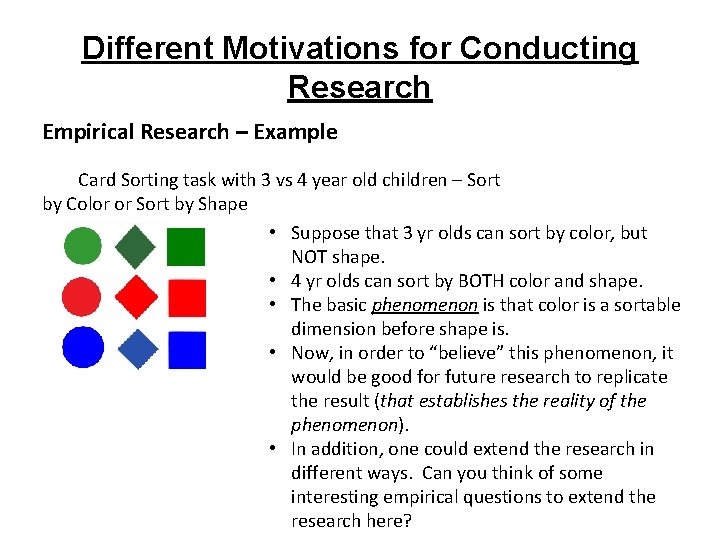
Different Motivations for Conducting Research Empirical Research – Example Card Sorting task with 3 vs 4 year old children – Sort by Color or Sort by Shape
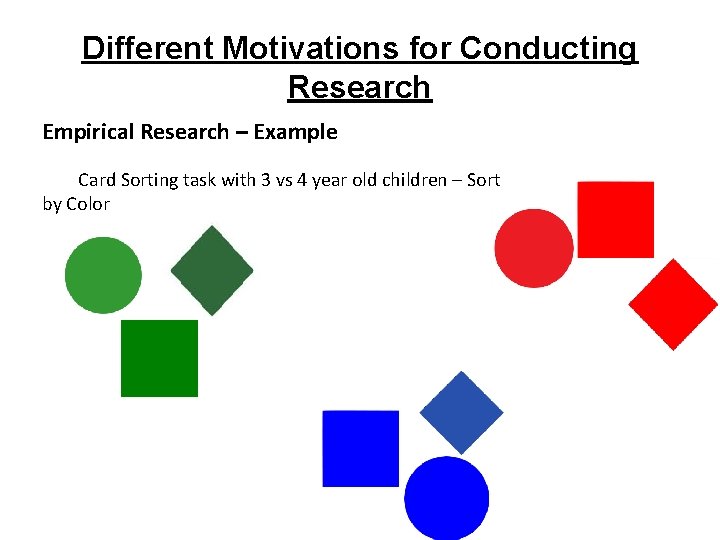
Different Motivations for Conducting Research Empirical Research – Example Card Sorting task with 3 vs 4 year old children – Sort by Color
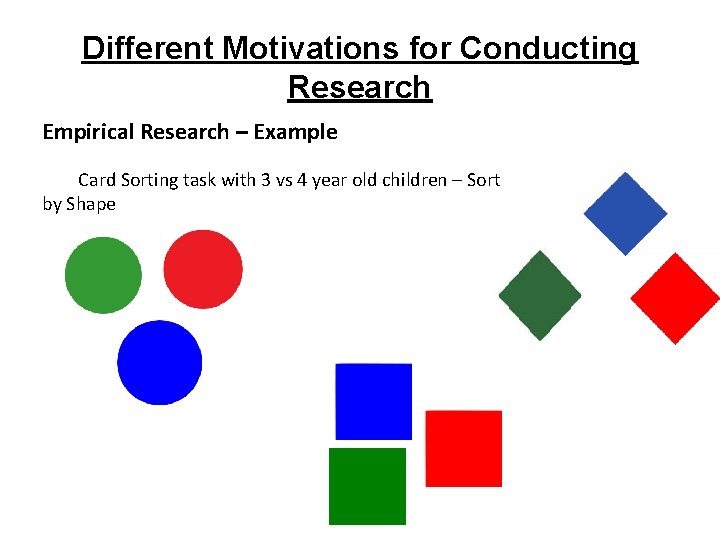
Different Motivations for Conducting Research Empirical Research – Example Card Sorting task with 3 vs 4 year old children – Sort by Shape
Different Motivations for Conducting Research Empirical Research – Example Card Sorting task with 3 vs 4 year old children – Sort by Color or Sort by Shape • Suppose that 3 yr olds can sort by color, but NOT shape. • 4 yr olds can sort by BOTH color and shape. • The basic phenomenon is that color is a sortable dimension before shape is. • Now, in order to “believe” this phenomenon, it would be good for future research to replicate the result (that establishes the reality of the phenomenon). • In addition, one could extend the research in different ways. Can you think of some interesting empirical questions to extend the research here?
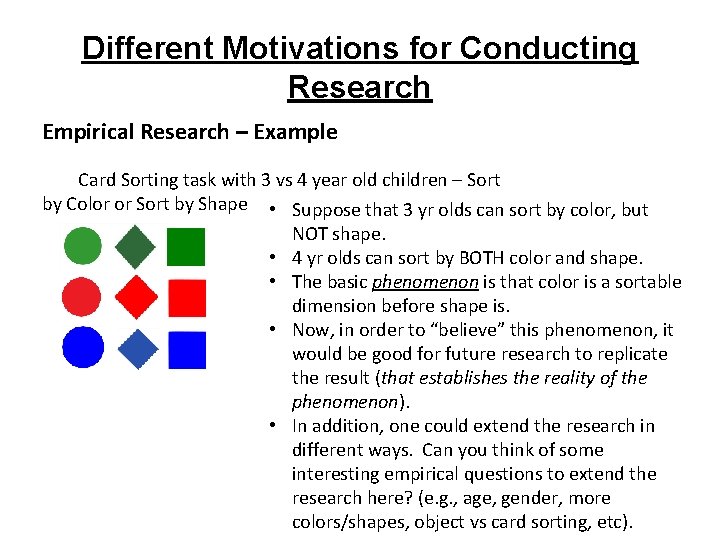
Different Motivations for Conducting Research Empirical Research – Example Card Sorting task with 3 vs 4 year old children – Sort by Color or Sort by Shape • Suppose that 3 yr olds can sort by color, but • • NOT shape. 4 yr olds can sort by BOTH color and shape. The basic phenomenon is that color is a sortable dimension before shape is. Now, in order to “believe” this phenomenon, it would be good for future research to replicate the result (that establishes the reality of the phenomenon). In addition, one could extend the research in different ways. Can you think of some interesting empirical questions to extend the research here? (e. g. , age, gender, more colors/shapes, object vs card sorting, etc).
Different Motivations for Conducting Research Theoretical Research – Important Ideas • Definition – A theory is an explanatory system consisting of hypothetical constructs (or “mechanisms”) used to account for existing phenomena and predict new phenomena. • Characteristics of a theory – Must be (1) Parsimonious, and (2) Falsifiable for it to count as a legitimate scientific theory. • Theory Testing – Confirming vs Disconfirming Evidence. Inertia and scientific revolutions. • Theory–Data Interplay – This refers to the important role data plays for theory construction, and the role that theory plays for further data collection. • Search for Truth – This is conceptualized as a closer and closer approximation whereby more and more of the natural world is explained by more complete theories (e. g. , Newtonian vs Einstein’s view of the universe vs …).
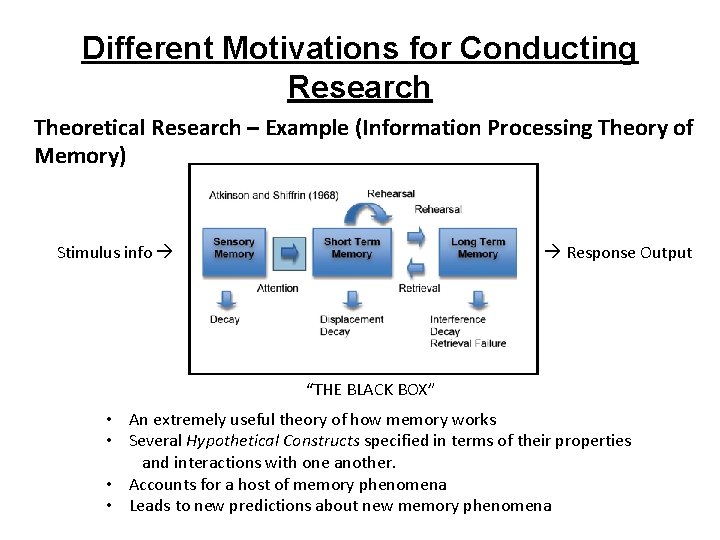
Different Motivations for Conducting Research Theoretical Research – Example (Information Processing Theory of Memory) Stimulus info Response Output “THE BLACK BOX” • An extremely useful theory of how memory works • Several Hypothetical Constructs specified in terms of their properties and interactions with one another. • Accounts for a host of memory phenomena • Leads to new predictions about new memory phenomena
Important Tactics Used in Experimental Research 2 Important Research Tactics • Operational Definitions – This is where we define our constructs in terms of the measuring instruments we use to assess them. • Converging Operations – This tactic helps to establish the reality of a hypothetical construct. It refers to the use of multiple experimental methods (approaches) to reach similar conclusions about a given psychological construct.
Important Tactics Used in Experimental Research • Operational Definitions – This is where we define our constructs in terms of the measuring instruments we use to assess them. e. g. , “Anxiety” is a psychological construct. How do we measure it? Answer: Anxiety may be operationally defined in a given experiment in terms of a detectable change in heart rate (for instance), or a change in GSR (galvanic skin response) in response to various stimuli or situations used in the experiment. Necessity of a Precise Definition: This precision is required in order to establish an objective characterization of the construct being measured that would allow other investigators to replicate our study. Limitation Argument: The particular operational definition is a very precise statement about the construct being studied, but by being so precise it may miss some important aspects of the construct. (anxiety is more than heart rate or skin conductance changes…) Further research, however, may elaborate our definitions, and this could help address this concern. For example, we may find distinct brain regions that characterize distinct forms of anxiety or its distinctions with other related constructs (like fear, anger, etc).
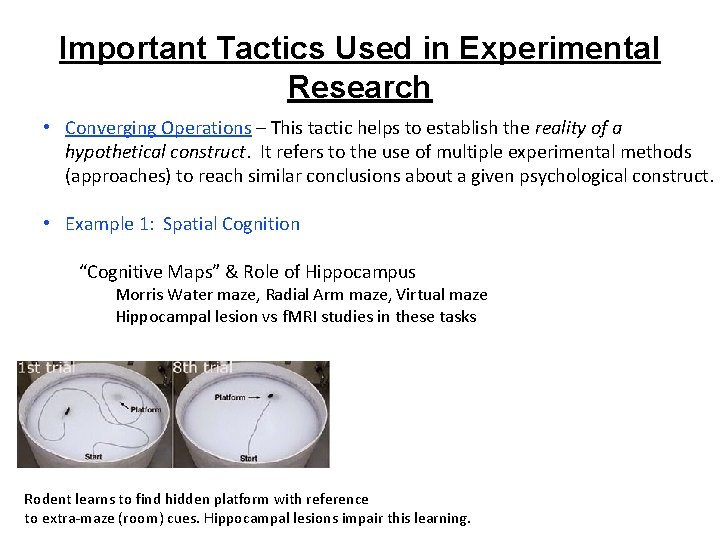
Important Tactics Used in Experimental Research • Converging Operations – This tactic helps to establish the reality of a hypothetical construct. It refers to the use of multiple experimental methods (approaches) to reach similar conclusions about a given psychological construct. • Example 1: Spatial Cognition “Cognitive Maps” & Role of Hippocampus Morris Water maze, Radial Arm maze, Virtual maze Hippocampal lesion vs f. MRI studies in these tasks Rodent learns to find hidden platform with reference to extra-maze (room) cues. Hippocampal lesions impair this learning.
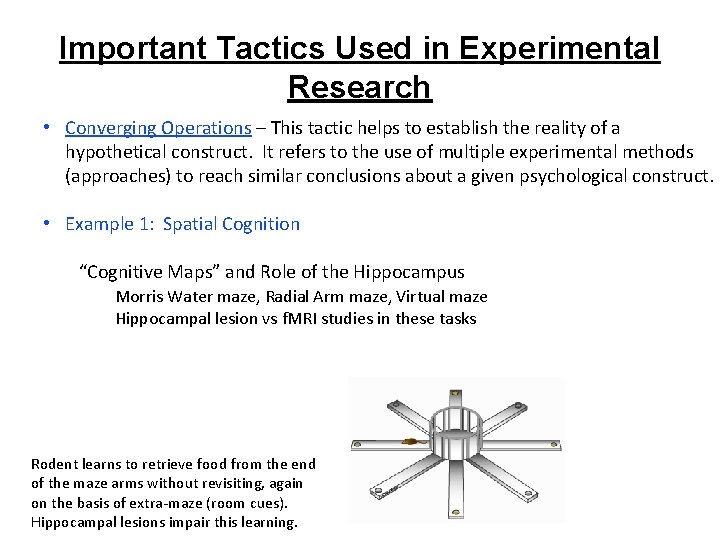
Important Tactics Used in Experimental Research • Converging Operations – This tactic helps to establish the reality of a hypothetical construct. It refers to the use of multiple experimental methods (approaches) to reach similar conclusions about a given psychological construct. • Example 1: Spatial Cognition “Cognitive Maps” and Role of the Hippocampus Morris Water maze, Radial Arm maze, Virtual maze Hippocampal lesion vs f. MRI studies in these tasks Rodent learns to retrieve food from the end of the maze arms without revisiting, again on the basis of extra-maze (room cues). Hippocampal lesions impair this learning.
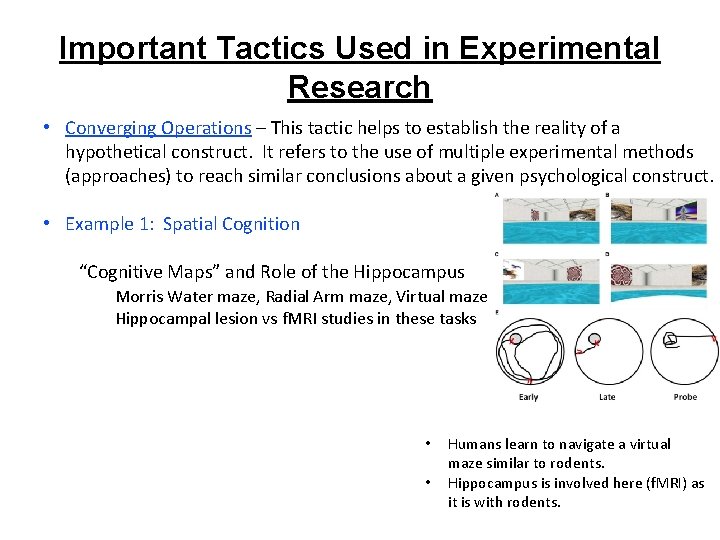
Important Tactics Used in Experimental Research • Converging Operations – This tactic helps to establish the reality of a hypothetical construct. It refers to the use of multiple experimental methods (approaches) to reach similar conclusions about a given psychological construct. • Example 1: Spatial Cognition “Cognitive Maps” and Role of the Hippocampus Morris Water maze, Radial Arm maze, Virtual maze Hippocampal lesion vs f. MRI studies in these tasks • • Humans learn to navigate a virtual maze similar to rodents. Hippocampus is involved here (f. MRI) as it is with rodents.
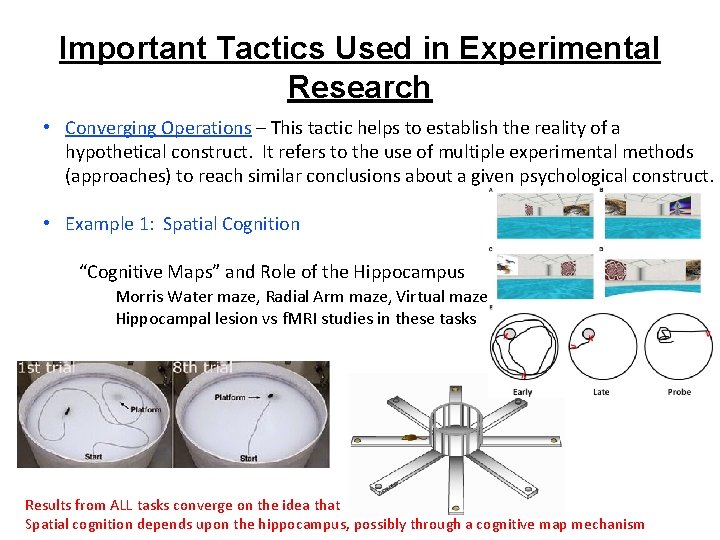
Important Tactics Used in Experimental Research • Converging Operations – This tactic helps to establish the reality of a hypothetical construct. It refers to the use of multiple experimental methods (approaches) to reach similar conclusions about a given psychological construct. • Example 1: Spatial Cognition “Cognitive Maps” and Role of the Hippocampus Morris Water maze, Radial Arm maze, Virtual maze Hippocampal lesion vs f. MRI studies in these tasks Results from ALL tasks converge on the idea that Spatial cognition depends upon the hippocampus, possibly through a cognitive map mechanism
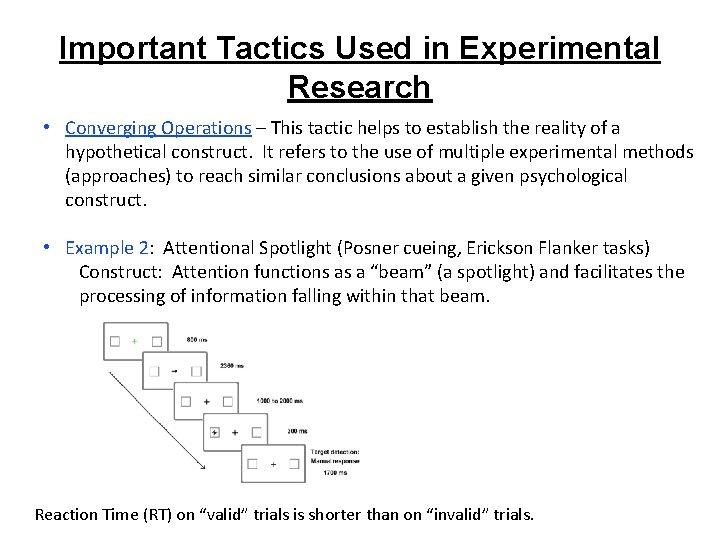
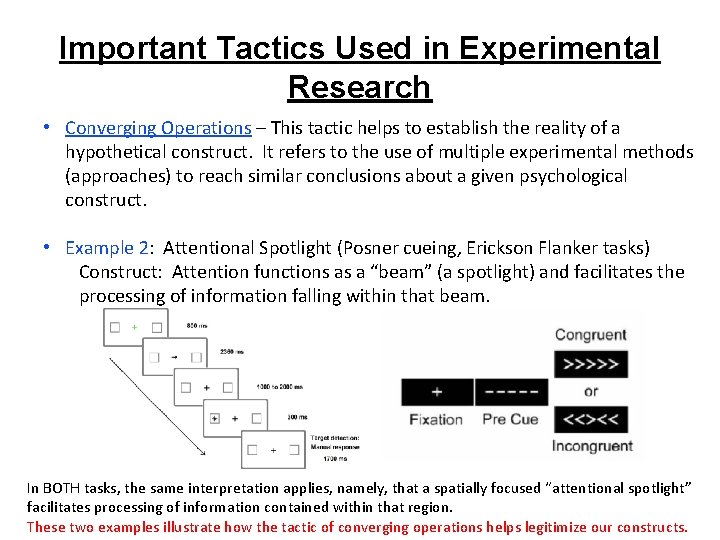
Important Tactics Used in Experimental Research • Converging Operations – This tactic helps to establish the reality of a hypothetical construct. It refers to the use of multiple experimental methods (approaches) to reach similar conclusions about a given psychological construct. • Example 2: Attentional Spotlight (Posner cueing, Erickson Flanker tasks) Construct: Attention functions as a “beam” (a spotlight) and facilitates the processing of information falling within that beam. Reaction Time (RT) on “valid” trials is shorter than on “invalid” trials.
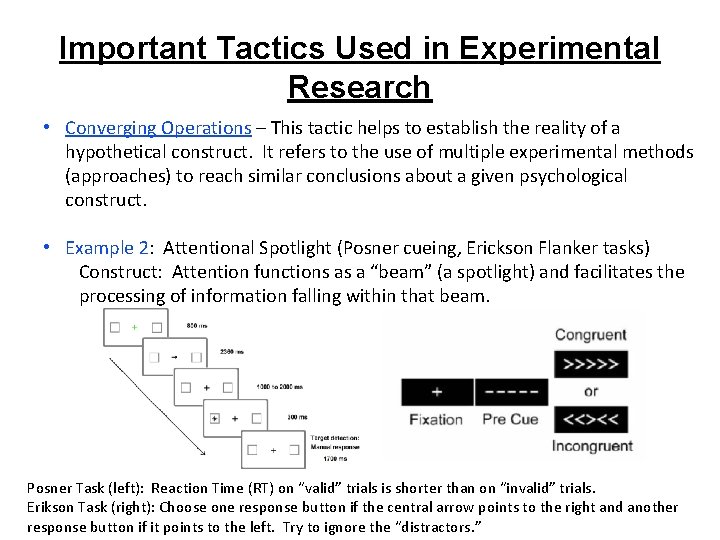
Important Tactics Used in Experimental Research • Converging Operations – This tactic helps to establish the reality of a hypothetical construct. It refers to the use of multiple experimental methods (approaches) to reach similar conclusions about a given psychological construct. • Example 2: Attentional Spotlight (Posner cueing, Erickson Flanker tasks) Construct: Attention functions as a “beam” (a spotlight) and facilitates the processing of information falling within that beam. Posner Task (left): Reaction Time (RT) on “valid” trials is shorter than on “invalid” trials. Erikson Task (right): Choose one response button if the central arrow points to the right and another response button if it points to the left. Try to ignore the “distractors. ”
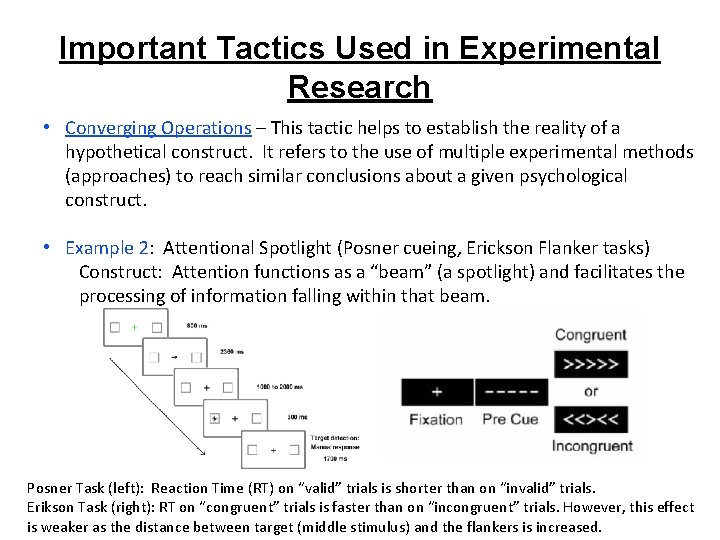
Important Tactics Used in Experimental Research • Converging Operations – This tactic helps to establish the reality of a hypothetical construct. It refers to the use of multiple experimental methods (approaches) to reach similar conclusions about a given psychological construct. • Example 2: Attentional Spotlight (Posner cueing, Erickson Flanker tasks) Construct: Attention functions as a “beam” (a spotlight) and facilitates the processing of information falling within that beam. Posner Task (left): Reaction Time (RT) on “valid” trials is shorter than on “invalid” trials. Erikson Task (right): RT on “congruent” trials is faster than on “incongruent” trials. However, this effect is weaker as the distance between target (middle stimulus) and the flankers is increased.
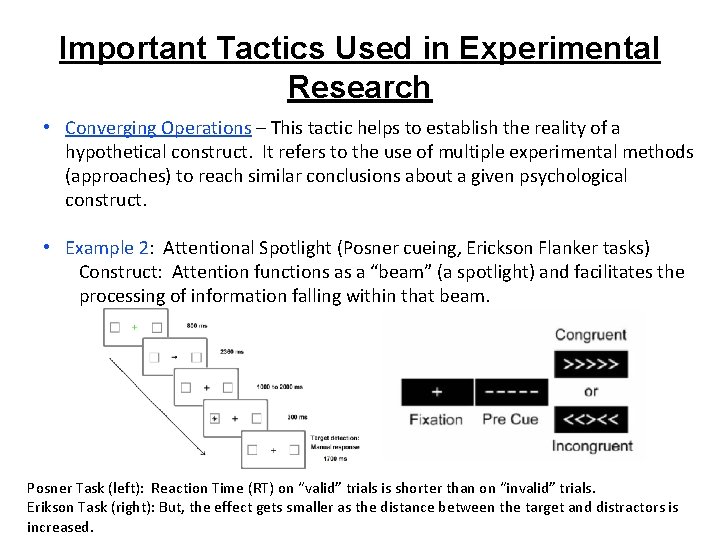
Important Tactics Used in Experimental Research • Converging Operations – This tactic helps to establish the reality of a hypothetical construct. It refers to the use of multiple experimental methods (approaches) to reach similar conclusions about a given psychological construct. • Example 2: Attentional Spotlight (Posner cueing, Erickson Flanker tasks) Construct: Attention functions as a “beam” (a spotlight) and facilitates the processing of information falling within that beam. Posner Task (left): Reaction Time (RT) on “valid” trials is shorter than on “invalid” trials. Erikson Task (right): But, the effect gets smaller as the distance between the target and distractors is increased.
Important Tactics Used in Experimental Research • Converging Operations – This tactic helps to establish the reality of a hypothetical construct. It refers to the use of multiple experimental methods (approaches) to reach similar conclusions about a given psychological construct. • Example 2: Attentional Spotlight (Posner cueing, Erickson Flanker tasks) Construct: Attention functions as a “beam” (a spotlight) and facilitates the processing of information falling within that beam. In BOTH tasks, the same interpretation applies, namely, that a spatially focused “attentional spotlight” facilitates processing of information contained within that region. These two examples illustrate how the tactic of converging operations helps legitimize our constructs.