
Psychology 3450 W Experimental Psychology Fall 2019 Professor

- Slides: 42
Psychology 3450 W: Experimental Psychology Fall, 2019 Professor Delamater
Small N Designs 1. Advantages & Rationale of Small N Designs 2. Examples of small N designs in Psychological Research • Psychophysics • Psychiatric Research 3. Varieties of Small N Designs • A – B Design • A – B – A – B Design • Multiple Baseline, A – B Design • A – B – C – B Design • A – A 1 – B Design 4. Criticisms of these Designs
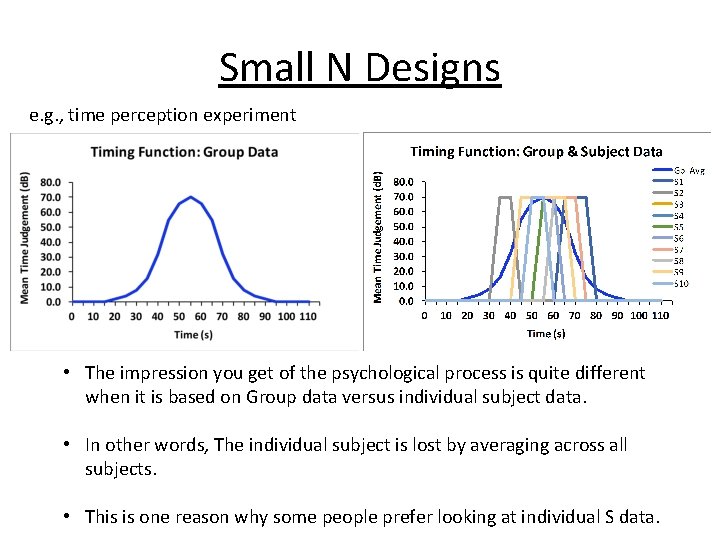
Small N Designs Main Advantages and Rationale: 1. Few Subjects are required 2. Theoretical impressions based on group data and single subject data can be very different.
Small N Designs Main Advantages and Rationale: 1. Few Subjects are required 2. Theoretical impressions based on group data and single subject data can be very different. e. g. , time perception experiment
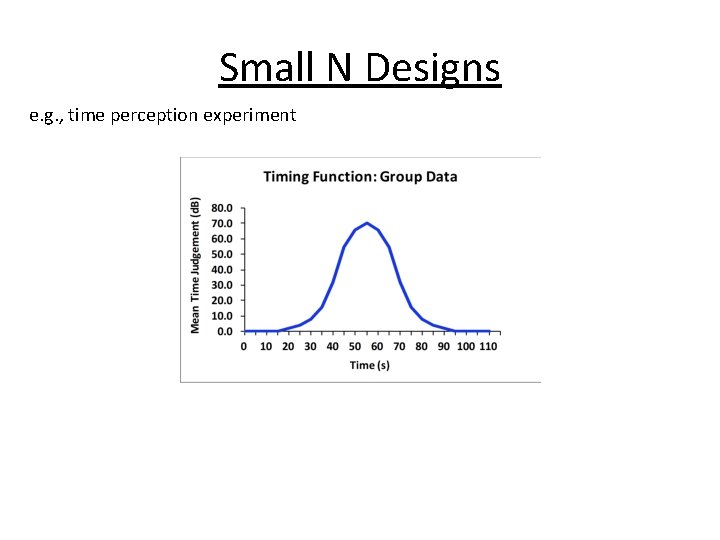
Small N Designs e. g. , time perception experiment
Small N Designs e. g. , time perception experiment • The impression you get of the psychological process is quite different when it is based on Group data versus individual subject data. • In other words, The individual subject is lost by averaging across all subjects. • This is one reason why some people prefer looking at individual S data.
Small N Designs Examples in Psychological Research: 1. Psychophysics – The study of the relationship between the physical world and subject’s sensory/perceptual experience of it. • Sensory Threshold Research (Absolute vs Difference) • Sensitivity Research (Weber’s Law)
Small N Designs Examples in Psychological Research: 1. Psychophysics – The study of the relationship between the physical world and subject’s sensory/perceptual experience of it. • Sensory Threshold Research (Methods) • Ascending method of limits (moving from • • imperceptible stimuli to perceptible ones) Descending method of limits (moving from perceptible stimuli to imperceptible ones) Method of constant stimuli (present the stimuli at random)
Small N Designs Sensory Threshold Research (Methods) Absolute Thresholds – What is the least amount of energy in the world required for our detection of it? Difference Thresholds – What is the smallest amount of change in the stimulus required for us to just notice that difference? This is called a JND.
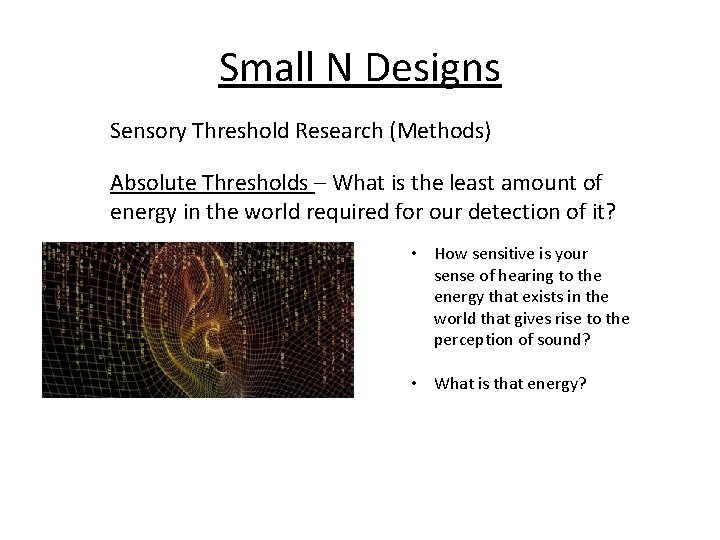
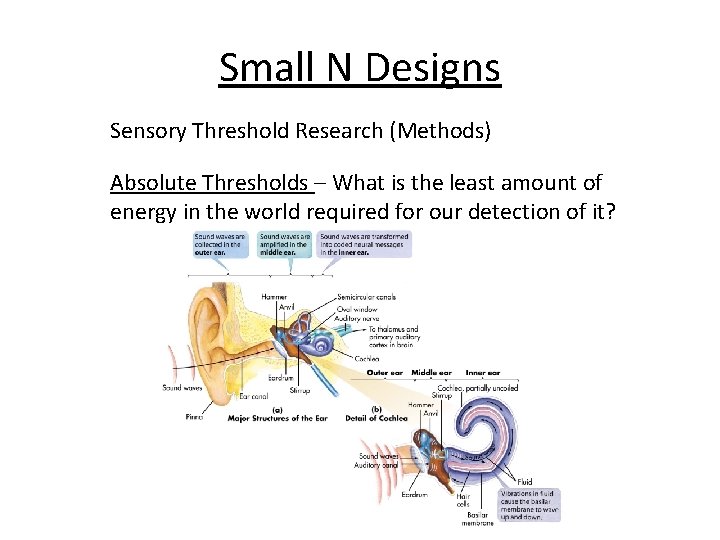
Small N Designs Sensory Threshold Research (Methods) Absolute Thresholds – What is the least amount of energy in the world required for our detection of it? • How sensitive is your sense of hearing to the energy that exists in the world that gives rise to the perception of sound? • What is that energy?
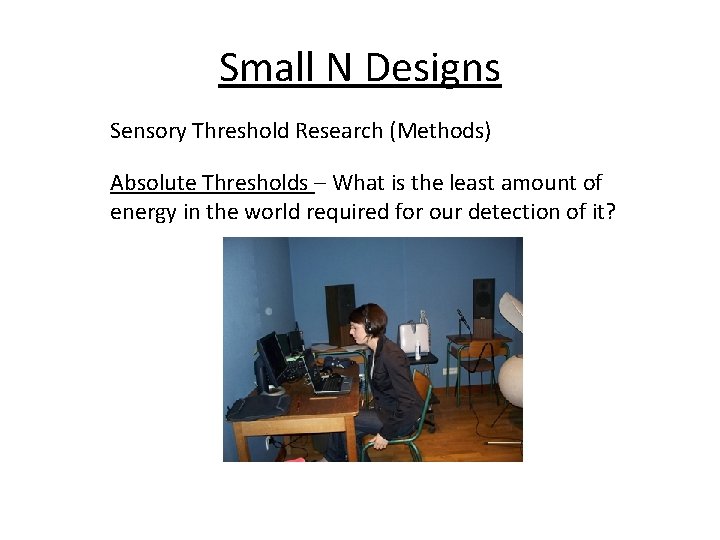
Small N Designs Sensory Threshold Research (Methods) Absolute Thresholds – What is the least amount of energy in the world required for our detection of it?
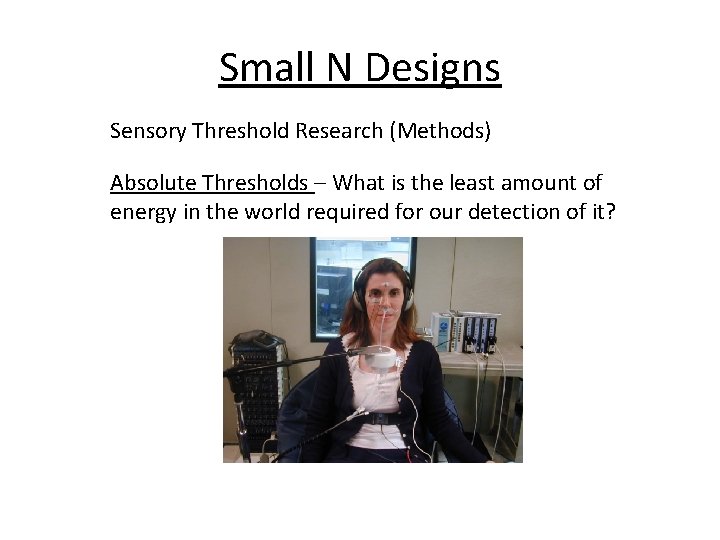
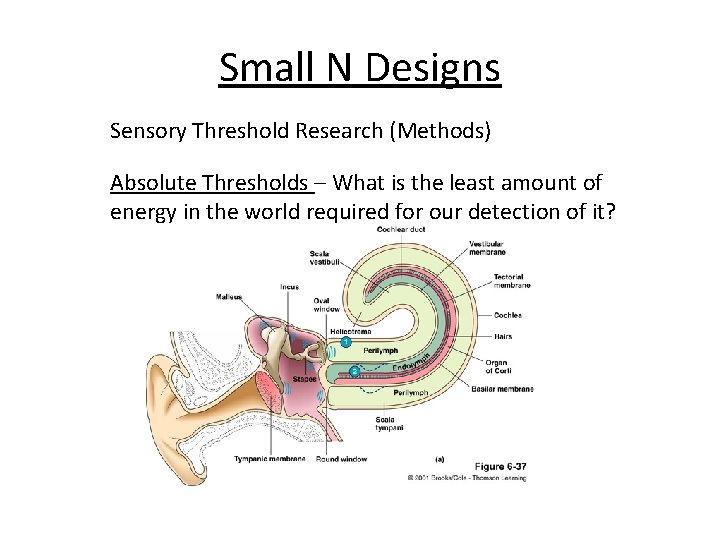
Small N Designs Sensory Threshold Research (Methods) Absolute Thresholds – What is the least amount of energy in the world required for our detection of it?
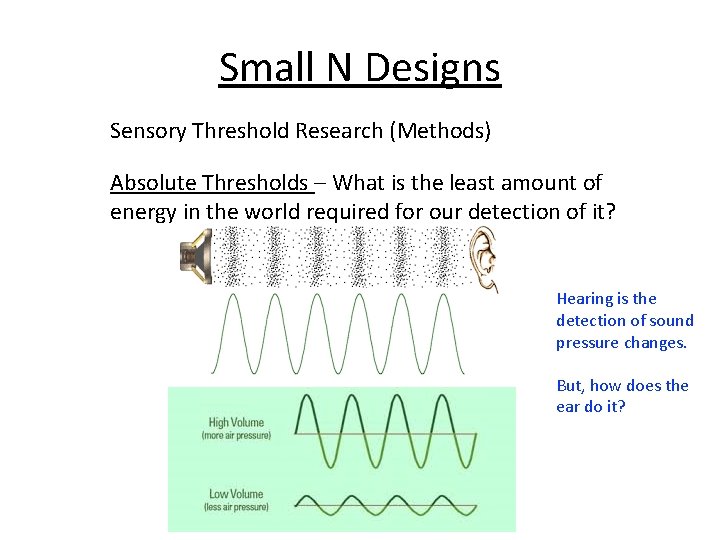
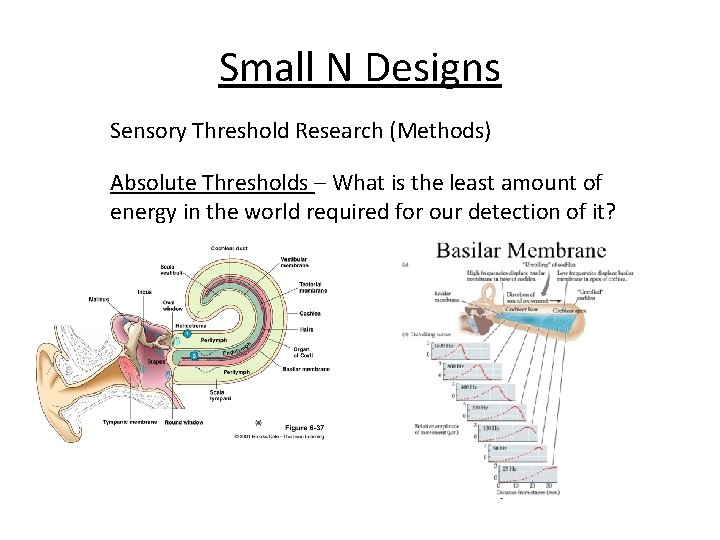
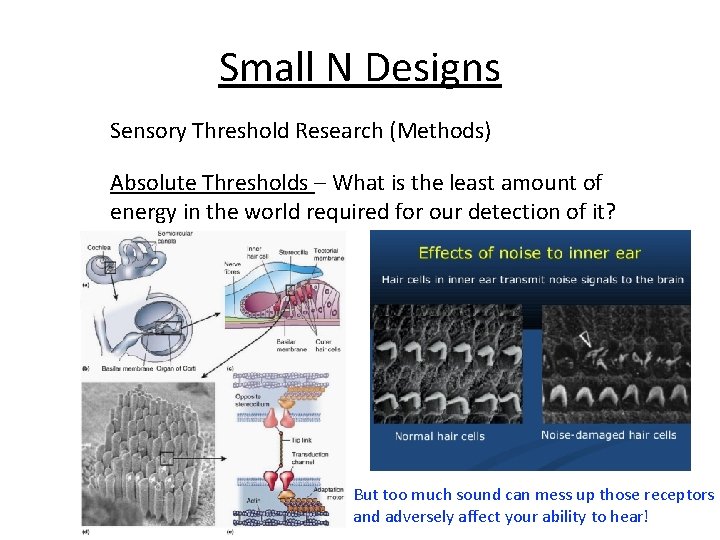
Small N Designs Sensory Threshold Research (Methods) Absolute Thresholds – What is the least amount of energy in the world required for our detection of it? Hearing is the detection of sound pressure changes. But, how does the ear do it?
Small N Designs Sensory Threshold Research (Methods) Absolute Thresholds – What is the least amount of energy in the world required for our detection of it?
Small N Designs Sensory Threshold Research (Methods) Absolute Thresholds – What is the least amount of energy in the world required for our detection of it?
Small N Designs Sensory Threshold Research (Methods) Absolute Thresholds – What is the least amount of energy in the world required for our detection of it?
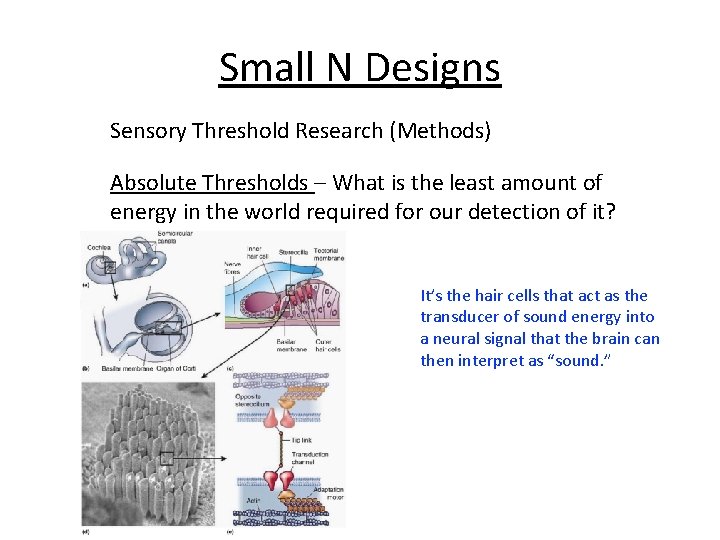
Small N Designs Sensory Threshold Research (Methods) Absolute Thresholds – What is the least amount of energy in the world required for our detection of it? It’s the hair cells that act as the transducer of sound energy into a neural signal that the brain can then interpret as “sound. ”
Small N Designs Sensory Threshold Research (Methods) Absolute Thresholds – What is the least amount of energy in the world required for our detection of it? But too much sound can mess up those receptors and adversely affect your ability to hear!
Small N Designs Sensory Threshold Research (Methods) Absolute Thresholds – What is the least amount of energy in the world required for our detection of it? Back to the Absolute Threshold experiment… • Lets ask our subject to report when they hear a sound stimulus. • But, we’ll present stimuli of a particular loudness that starts out being imperceptible. • Then, we will gradually increase the loudness until they can report hearing it reliably. • This is called an “ascending” method of limits study. • The “descending” method is when we start with clearly perceptible stimuli and work our way down. • The method of “constant stimuli” is where we present all stimuli randomly.
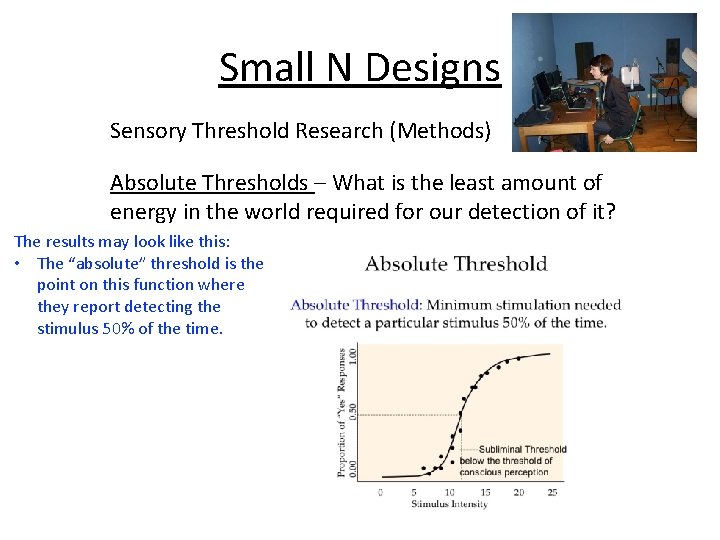
Small N Designs Sensory Threshold Research (Methods) Absolute Thresholds – What is the least amount of energy in the world required for our detection of it? The results may look like this: • The “absolute” threshold is the point on this function where they report detecting the stimulus 50% of the time.
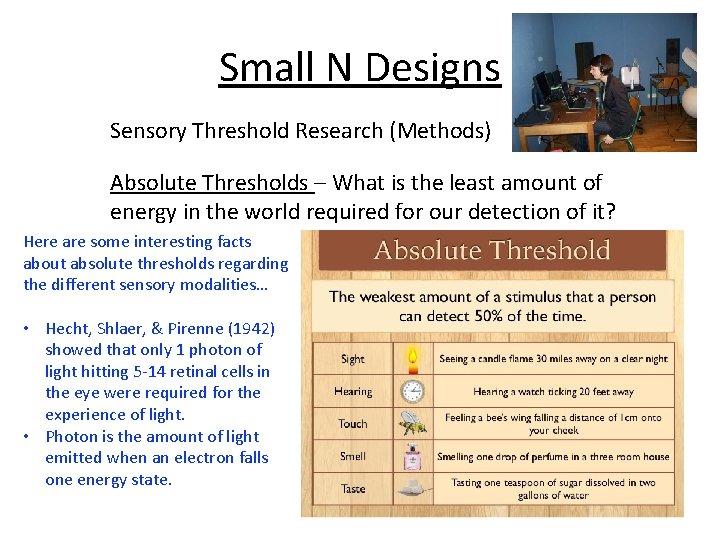
Small N Designs Sensory Threshold Research (Methods) Absolute Thresholds – What is the least amount of energy in the world required for our detection of it? Here are some interesting facts about absolute thresholds regarding the different sensory modalities… • Hecht, Shlaer, & Pirenne (1942) showed that only 1 photon of light hitting 5 -14 retinal cells in the eye were required for the experience of light. • Photon is the amount of light emitted when an electron falls one energy state.
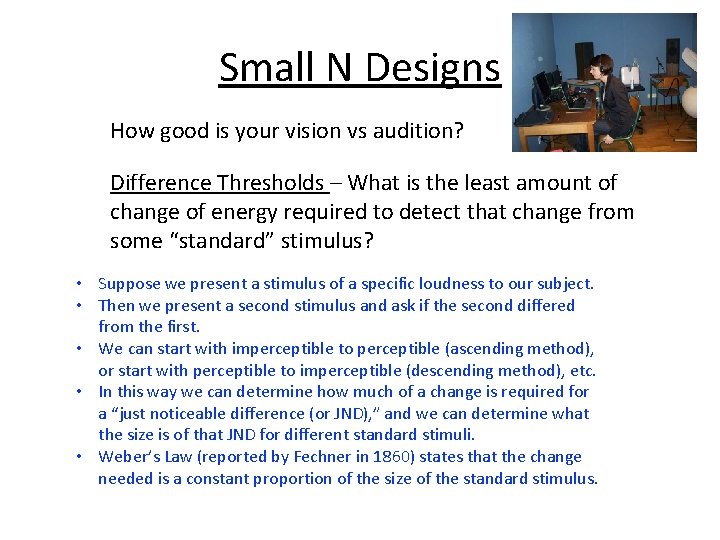
Small N Designs How good is your vision vs audition? Difference Thresholds – What is the least amount of change of energy required to detect that change from some “standard” stimulus? • Suppose we present a stimulus of a specific loudness to our subject. • Then we present a second stimulus and ask if the second differed from the first. • We can start with imperceptible to perceptible (ascending method), or start with perceptible to imperceptible (descending method), etc. • In this way we can determine how much of a change is required for a “just noticeable difference (or JND), ” and we can determine what the size is of that JND for different standard stimuli. • Weber’s Law (reported by Fechner in 1860) states that the change needed is a constant proportion of the size of the standard stimulus.
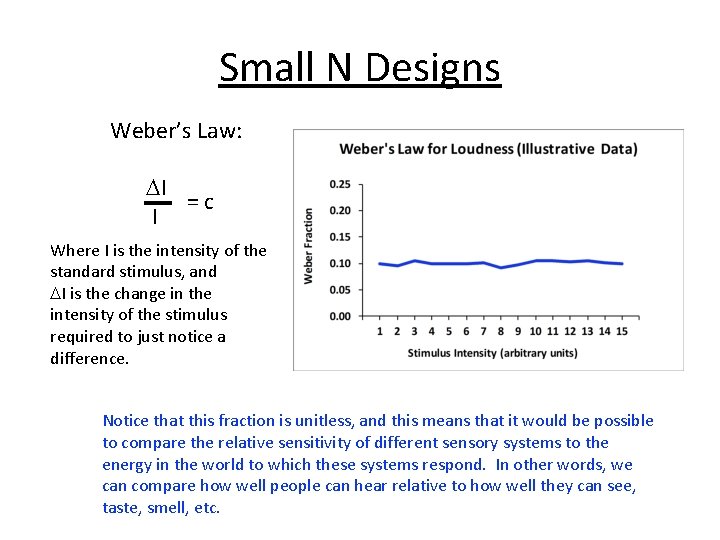
Small N Designs Weber’s Law: DI =c I Where I is the intensity of the standard stimulus, and DI is the change in the intensity of the stimulus required to just notice a difference. Notice that this fraction is unitless, and this means that it would be possible to compare the relative sensitivity of different sensory systems to the energy in the world to which these systems respond. In other words, we can compare how well people can hear relative to how well they can see, taste, smell, etc.
Small N Designs Examples in Psychological Research: 1. Psychophysics – The study of the relationship between the physical world and subject’s sensory/perceptual experience of it. • Sensory Threshold Research (Absolute vs Difference) • Sensitivity Research (Weber’s Law) 2. Psychiatric Research – Study of the relative effectiveness of various treatment types upon peoples’ mental health. • We’ll see some examples as we consider various types of small N designs, but, briefly, this sort of research can be conducted on individual patients.
Small N Designs Varieties of Small N Designs (used often in Applied Behavior Analysis): 1. 2. 3. 4. 5. 6. Baseline – Treatment (A – B) Designs A – B – A Design A – B – A – B Design Multiple Baseline Design (Multiple A – B) A – B – C – B Design A – A 1 – B Design
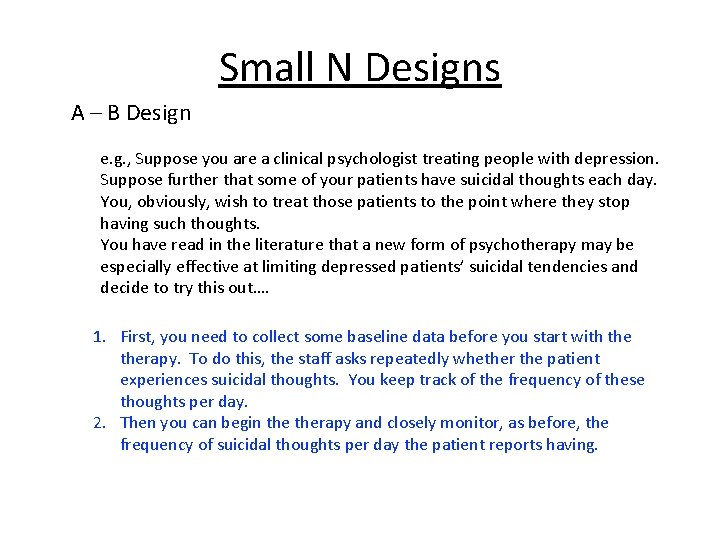
Small N Designs A – B Design e. g. , Suppose you are a clinical psychologist treating people with depression. Suppose further that some of your patients have suicidal thoughts each day. You, obviously, wish to treat those patients to the point where they stop having such thoughts. You have read in the literature that a new form of psychotherapy may be especially effective at limiting depressed patients’ suicidal tendencies and decide to try this out…. 1. First, you need to collect some baseline data before you start with therapy. To do this, the staff asks repeatedly whether the patient experiences suicidal thoughts. You keep track of the frequency of these thoughts per day. 2. Then you can begin therapy and closely monitor, as before, the frequency of suicidal thoughts per day the patient reports having.
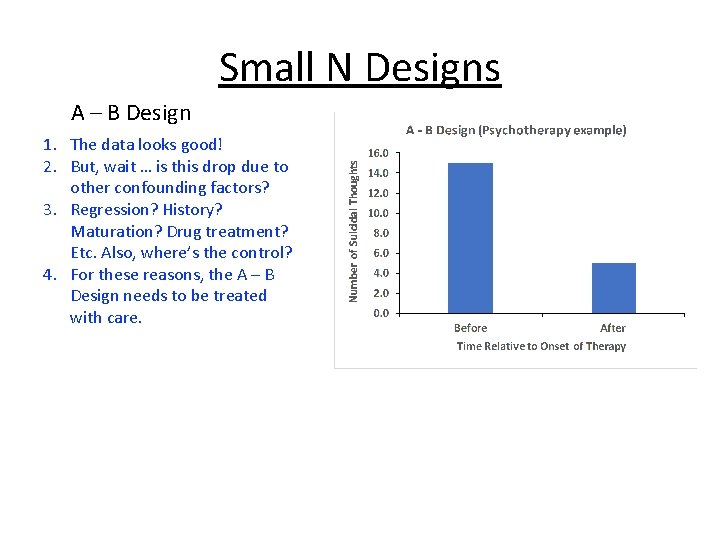
Small N Designs A – B Design 1. The data looks good! 2. But, wait … is this drop due to other confounding factors? 3. Regression? History? Maturation? Drug treatment? Etc. Also, where’s the control? 4. For these reasons, the A – B Design needs to be treated with care.
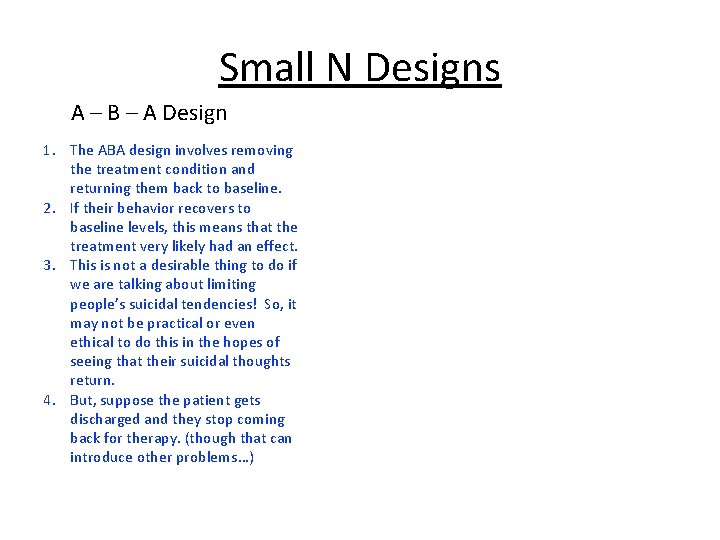
Small N Designs A – B – A Design 1. The ABA design involves removing the treatment condition and returning them back to baseline. 2. If their behavior recovers to baseline levels, this means that the treatment very likely had an effect. 3. This is not a desirable thing to do if we are talking about limiting people’s suicidal tendencies! So, it may not be practical or even ethical to do this in the hopes of seeing that their suicidal thoughts return. 4. But, suppose the patient gets discharged and they stop coming back for therapy. (though that can introduce other problems…)
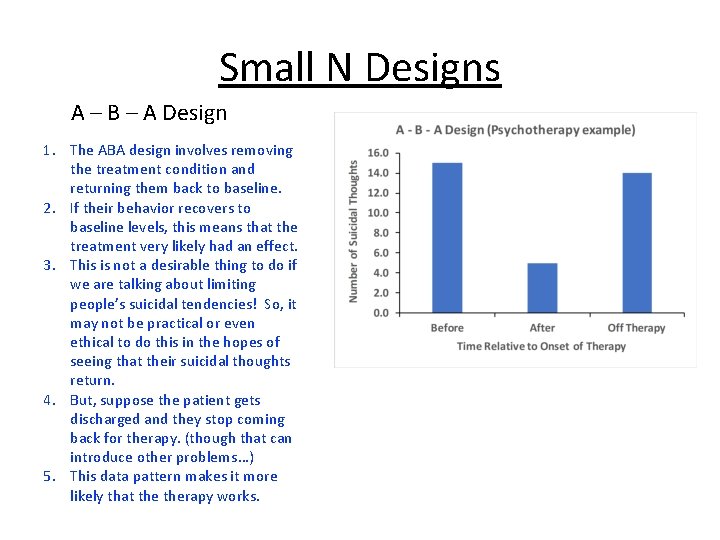
Small N Designs A – B – A Design 1. The ABA design involves removing the treatment condition and returning them back to baseline. 2. If their behavior recovers to baseline levels, this means that the treatment very likely had an effect. 3. This is not a desirable thing to do if we are talking about limiting people’s suicidal tendencies! So, it may not be practical or even ethical to do this in the hopes of seeing that their suicidal thoughts return. 4. But, suppose the patient gets discharged and they stop coming back for therapy. (though that can introduce other problems…) 5. This data pattern makes it more likely that therapy works.
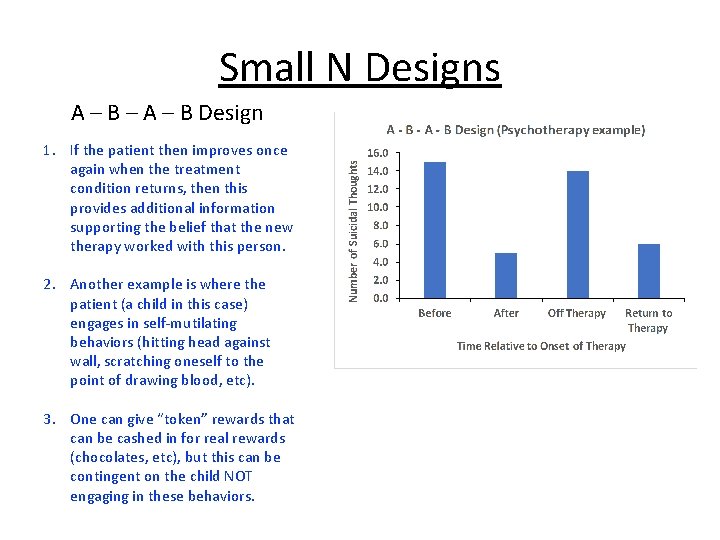
Small N Designs A – B – A – B Design 1. If the patient then improves once again when the treatment condition returns, then this provides additional information supporting the belief that the new therapy worked with this person. 2. Another example is where the patient (a child in this case) engages in self-mutilating behaviors (hitting head against wall, scratching oneself to the point of drawing blood, etc). 3. One can give “token” rewards that can be cashed in for real rewards (chocolates, etc), but this can be contingent on the child NOT engaging in these behaviors.
Small N Designs Multiple Baseline A – B Design 1. As we said, it may not be possible to remove someone from a treatment that works just to rule out various confounds. 2. Instead we can apply the multiple baseline design (sort of similar logic to the time series approach). 3. In this case, we target specific behaviors in a single individual (or a specific behavior in, say 3 different people). 4. The key is that we apply the treatment starting at different times for the different target behaviors (or for the different people). 5. If the improvement in behavior is time-locked to the onset of treatment, then this suggests the treatment works.
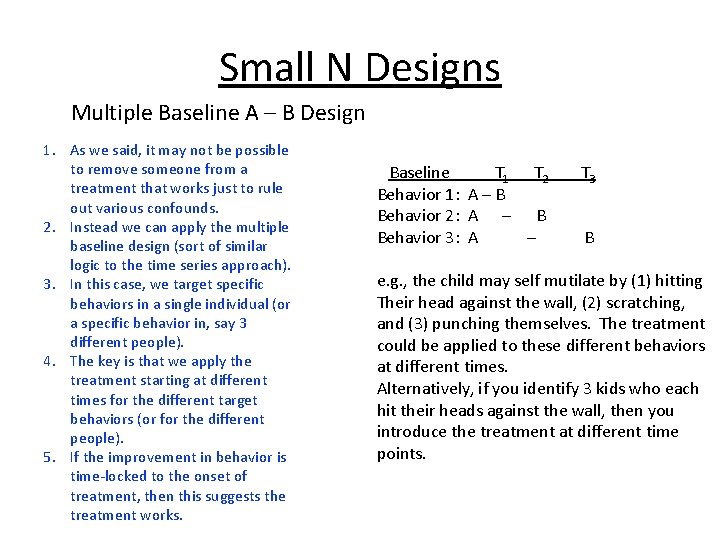
Small N Designs Multiple Baseline A – B Design 1. As we said, it may not be possible to remove someone from a treatment that works just to rule out various confounds. 2. Instead we can apply the multiple baseline design (sort of similar logic to the time series approach). 3. In this case, we target specific behaviors in a single individual (or a specific behavior in, say 3 different people). 4. The key is that we apply the treatment starting at different times for the different target behaviors (or for the different people). 5. If the improvement in behavior is time-locked to the onset of treatment, then this suggests the treatment works. Baseline T 1 T 2 Behavior 1: A – B Behavior 2: A – B Behavior 3: A – T 3 B e. g. , the child may self mutilate by (1) hitting Their head against the wall, (2) scratching, and (3) punching themselves. The treatment could be applied to these different behaviors at different times. Alternatively, if you identify 3 kids who each hit their heads against the wall, then you introduce the treatment at different time points.
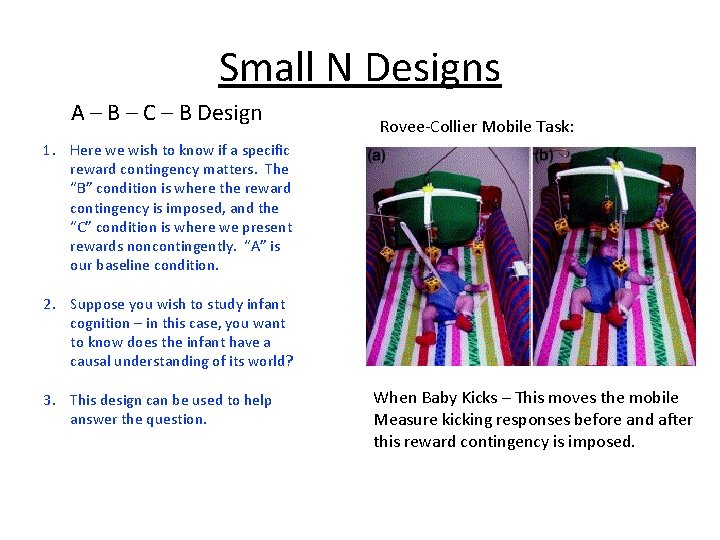
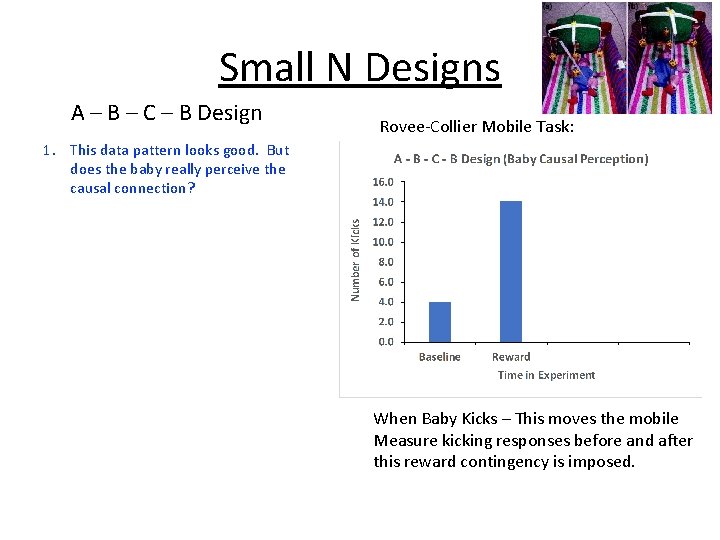
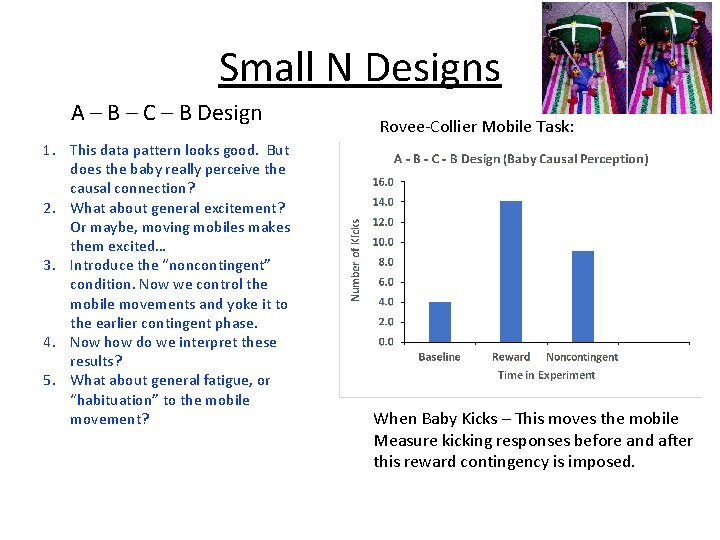
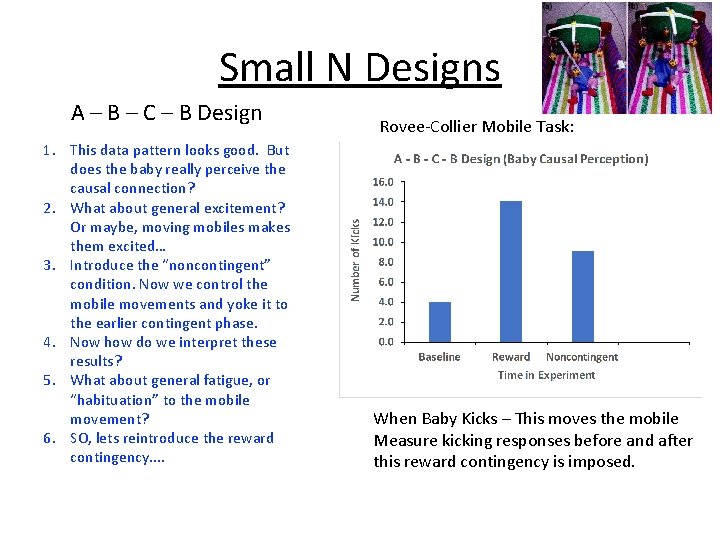
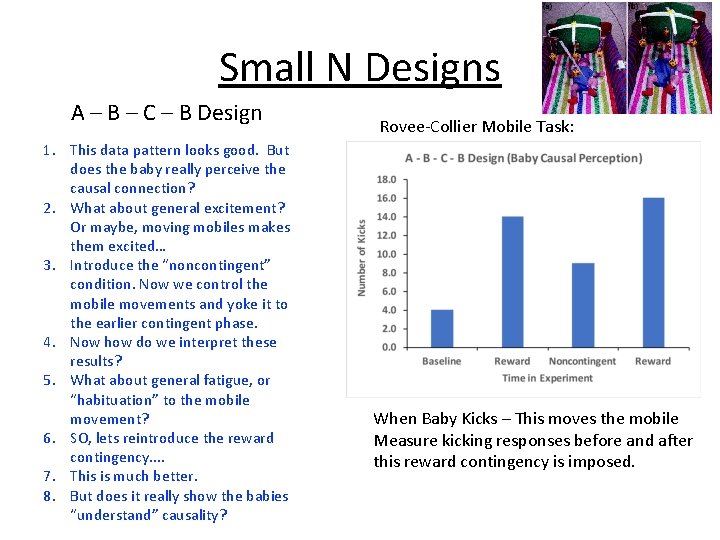
Small N Designs A – B – C – B Design Rovee-Collier Mobile Task: 1. Here we wish to know if a specific reward contingency matters. The “B” condition is where the reward contingency is imposed, and the “C” condition is where we present rewards noncontingently. “A” is our baseline condition. 2. Suppose you wish to study infant cognition – in this case, you want to know does the infant have a causal understanding of its world? 3. This design can be used to help answer the question. When Baby Kicks – This moves the mobile Measure kicking responses before and after this reward contingency is imposed.
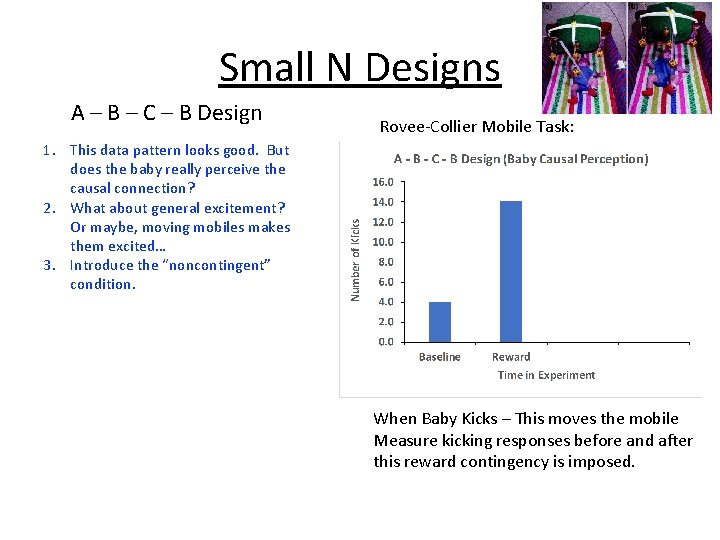
Small N Designs A – B – C – B Design Rovee-Collier Mobile Task: 1. This data pattern looks good. But does the baby really perceive the causal connection? When Baby Kicks – This moves the mobile Measure kicking responses before and after this reward contingency is imposed.
Small N Designs A – B – C – B Design Rovee-Collier Mobile Task: 1. This data pattern looks good. But does the baby really perceive the causal connection? 2. What about general excitement? Or maybe, moving mobiles makes them excited… 3. Introduce the “noncontingent” condition. When Baby Kicks – This moves the mobile Measure kicking responses before and after this reward contingency is imposed.
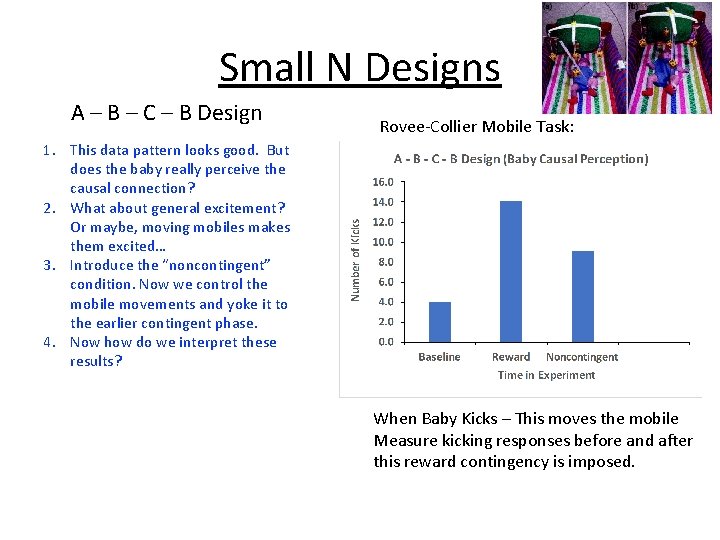
Small N Designs A – B – C – B Design Rovee-Collier Mobile Task: 1. This data pattern looks good. But does the baby really perceive the causal connection? 2. What about general excitement? Or maybe, moving mobiles makes them excited… 3. Introduce the “noncontingent” condition. Now we control the mobile movements and yoke it to the earlier contingent phase. When Baby Kicks – This moves the mobile Measure kicking responses before and after this reward contingency is imposed.
Small N Designs A – B – C – B Design Rovee-Collier Mobile Task: 1. This data pattern looks good. But does the baby really perceive the causal connection? 2. What about general excitement? Or maybe, moving mobiles makes them excited… 3. Introduce the “noncontingent” condition. Now we control the mobile movements and yoke it to the earlier contingent phase. 4. Now how do we interpret these results? When Baby Kicks – This moves the mobile Measure kicking responses before and after this reward contingency is imposed.
Small N Designs A – B – C – B Design 1. This data pattern looks good. But does the baby really perceive the causal connection? 2. What about general excitement? Or maybe, moving mobiles makes them excited… 3. Introduce the “noncontingent” condition. Now we control the mobile movements and yoke it to the earlier contingent phase. 4. Now how do we interpret these results? 5. What about general fatigue, or “habituation” to the mobile movement? Rovee-Collier Mobile Task: When Baby Kicks – This moves the mobile Measure kicking responses before and after this reward contingency is imposed.
Small N Designs A – B – C – B Design 1. This data pattern looks good. But does the baby really perceive the causal connection? 2. What about general excitement? Or maybe, moving mobiles makes them excited… 3. Introduce the “noncontingent” condition. Now we control the mobile movements and yoke it to the earlier contingent phase. 4. Now how do we interpret these results? 5. What about general fatigue, or “habituation” to the mobile movement? 6. SO, lets reintroduce the reward contingency. . Rovee-Collier Mobile Task: When Baby Kicks – This moves the mobile Measure kicking responses before and after this reward contingency is imposed.
Small N Designs A – B – C – B Design 1. This data pattern looks good. But does the baby really perceive the causal connection? 2. What about general excitement? Or maybe, moving mobiles makes them excited… 3. Introduce the “noncontingent” condition. Now we control the mobile movements and yoke it to the earlier contingent phase. 4. Now how do we interpret these results? 5. What about general fatigue, or “habituation” to the mobile movement? 6. SO, lets reintroduce the reward contingency. . 7. This is much better. 8. But does it really show the babies “understand” causality? Rovee-Collier Mobile Task: When Baby Kicks – This moves the mobile Measure kicking responses before and after this reward contingency is imposed.
Small N Designs A – A 1 – B Design 1. In this design, A 1 is the placebo condition in drug research 2. Suppose your child has ADHD and your doctor suggests a new drug treatment. 3. But, before giving the drug, you need to collect baseline data (A phase) on attention problems. 4. Then administer placebo (A 1), followed by drug (B), placebo, and drug again. 5. This helps establish that the drug has an effect.
Small N Designs Criticisms of small n designs 1. The main criticisms are: 1. They lack generality (only a few subjects used – will these apply to others? ) 2. They lack the power of factorial designs in studying multiple variables at once.