
Psychology 242 Introduction to Research Statistics module 4
- Slides: 21
Psychology 242 Introduction to Research Statistics module 4: Calculating a t score 1 ü Click “slide show” to start this presentation as a show. ü Remember: focus & think about each point; do not just passively click. © Dr. David J. Mc. Kirnan, 2014 The University of Illinois Chicago Mc. Kirnan. UIC@gmail. com Do not use or reproduce without permission Dr. David Mc. Kirnan, mckirnanuic@gmail. com Cranach, Tree of Knowledge [of Good and Evil] (1472)
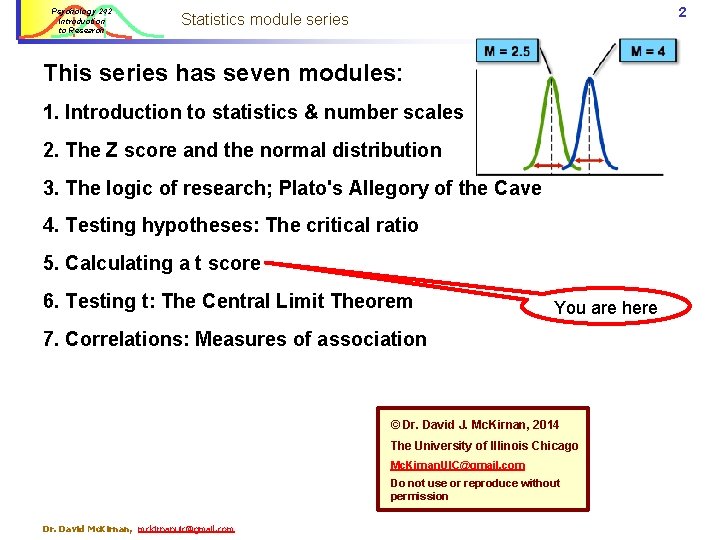
Psychology 242 Introduction to Research 2 Statistics module series This series has seven modules: 1. Introduction to statistics & number scales 2. The Z score and the normal distribution 3. The logic of research; Plato's Allegory of the Cave 4. Testing hypotheses: The critical ratio 5. Calculating a t score 6. Testing t: The Central Limit Theorem You are here 7. Correlations: Measures of association © Dr. David J. Mc. Kirnan, 2014 The University of Illinois Chicago Mc. Kirnan. UIC@gmail. com Do not use or reproduce without permission Dr. David Mc. Kirnan, mckirnanuic@gmail. com
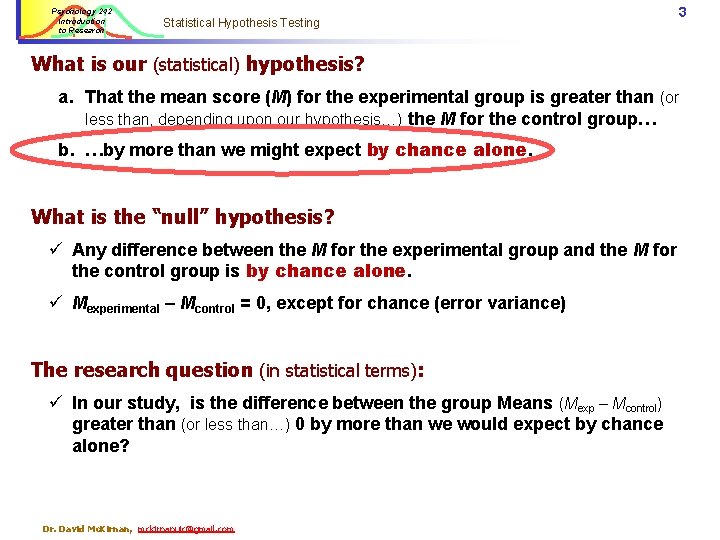
Psychology 242 Introduction to Research Statistical Hypothesis Testing What is our (statistical) hypothesis? a. That the mean score (M) for the experimental group is greater than (or less than, depending upon our hypothesis…) the M for the control group… b. …by more than we might expect by chance alone. What is the “null” hypothesis? ü Any difference between the M for the experimental group and the M for the control group is by chance alone. ü Mexperimental – Mcontrol = 0, except for chance (error variance) The research question (in statistical terms): ü In our study, is the difference between the group Means (Mexp – Mcontrol) greater than (or less than…) 0 by more than we would expect by chance alone? Dr. David Mc. Kirnan, mckirnanuic@gmail. com 3
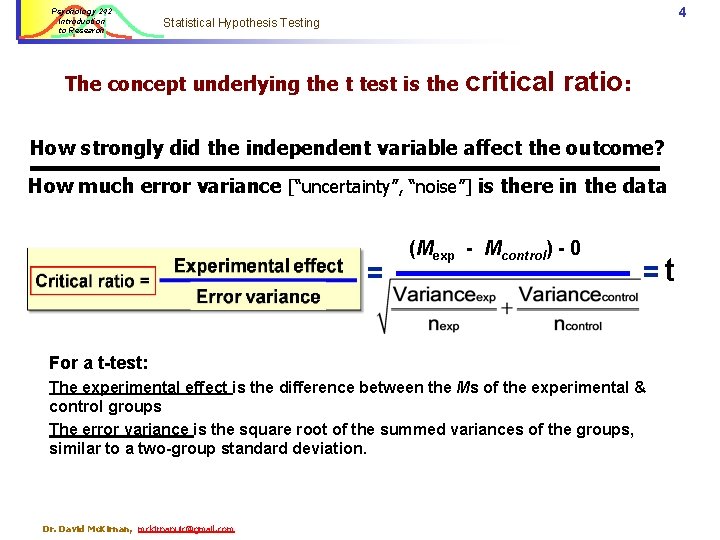
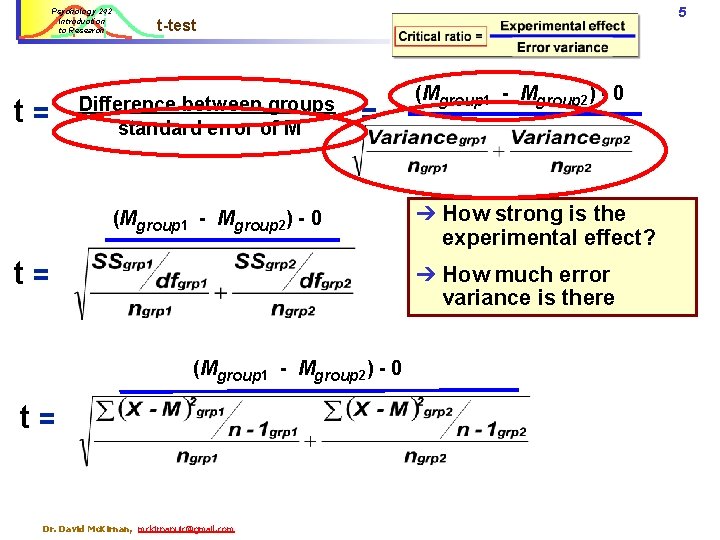
Psychology 242 Introduction to Research 4 Statistical Hypothesis Testing The concept underlying the t test is the critical ratio: How strongly did the independent variable affect the outcome? How much error variance [“uncertainty”, “noise”] is there in the data = (Mexp - Mcontrol) - 0 =t For a t-test: The experimental effect is the difference between the Ms of the experimental & control groups The error variance is the square root of the summed variances of the groups, similar to a two-group standard deviation. Dr. David Mc. Kirnan, mckirnanuic@gmail. com
Psychology 242 Introduction to Research t= 5 t-test Difference between groups standard error of M = (Mgroup 1 - Mgroup 2) - 0 t= (Mgroup 1 - Mgroup 2) - 0 ➔ How strong is the experimental effect? ➔ How much error variance is there (Mgroup 1 - Mgroup 2) - 0 t= Dr. David Mc. Kirnan, mckirnanuic@gmail. com
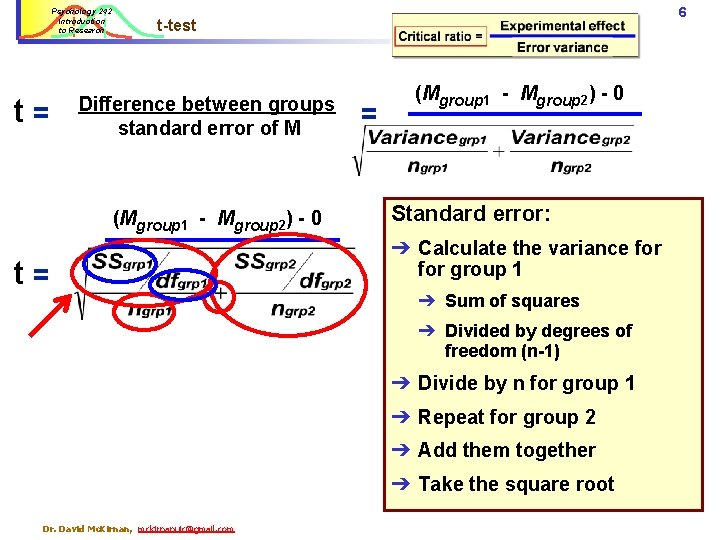
Psychology 242 Introduction to Research t= 6 t-test Difference between groups standard error of M (Mgroup 1 - Mgroup 2) - 0 t= = (Mgroup 1 - Mgroup 2) - 0 Standard error: ➔ Calculate the variance for group 1 ➔ Sum of squares ➔ Divided by degrees of freedom (n-1) ➔ Divide by n for group 1 ➔ Repeat for group 2 ➔ Add them together ➔ Take the square root Dr. David Mc. Kirnan, mckirnanuic@gmail. com
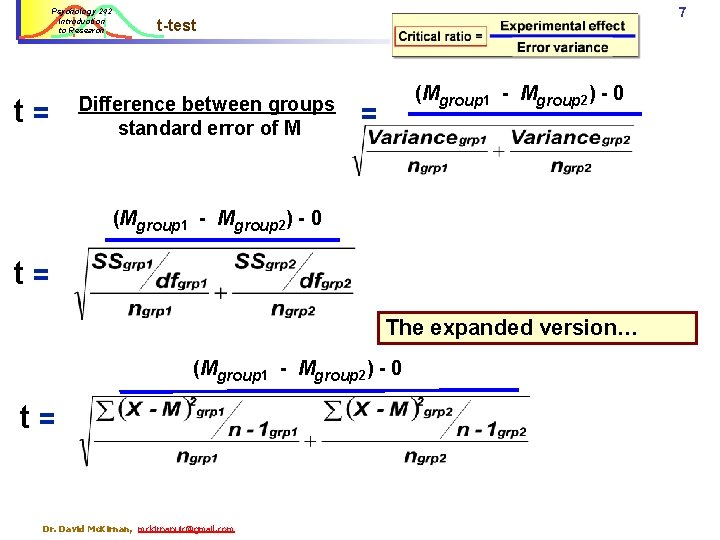
Psychology 242 Introduction to Research t= 7 t-test Difference between groups standard error of M (Mgroup 1 - Mgroup 2) - 0 = (Mgroup 1 - Mgroup 2) - 0 t= The expanded version… (Mgroup 1 - Mgroup 2) - 0 t= Dr. David Mc. Kirnan, mckirnanuic@gmail. com
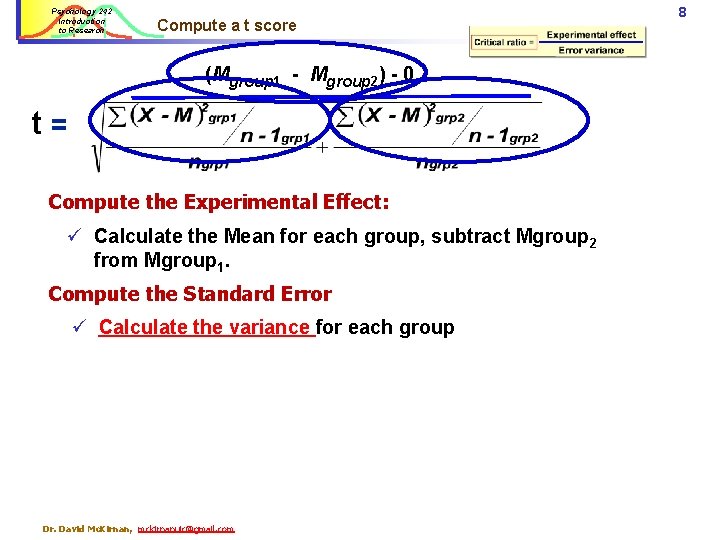
Psychology 242 Introduction to Research Compute a t score (Mgroup 1 - Mgroup 2) - 0 t= Compute the Experimental Effect: ü Calculate the Mean for each group, subtract Mgroup 2 from Mgroup 1. Compute the Standard Error ü Calculate the variance for each group Dr. David Mc. Kirnan, mckirnanuic@gmail. com 8
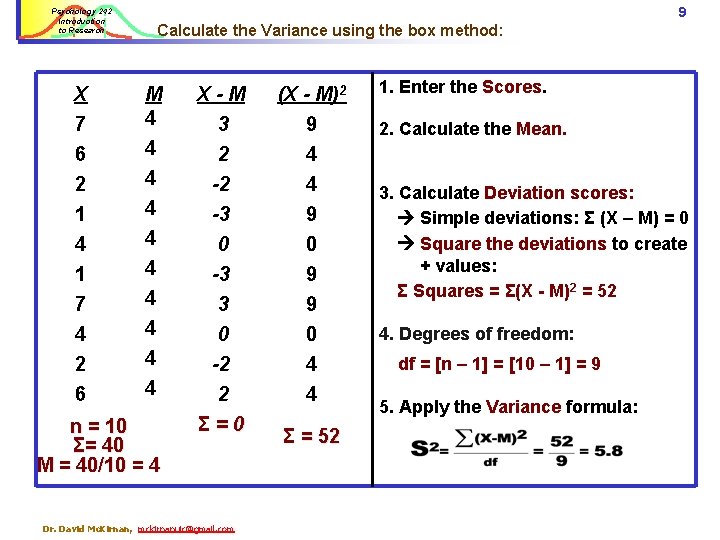
9 Psychology 242 Introduction to Research Calculate the Variance using the box method: X 7 M 4 X-M 3 (X - M)2 9 6 2 1 4 1 7 4 4 4 4 4 2 -2 -3 0 -3 3 4 4 9 0 9 9 0 -2 2 Σ=0 0 4 4 4 2 6 n = 10 Σ= 40 M = 40/10 = 4 Dr. David Mc. Kirnan, mckirnanuic@gmail. com Σ = 52 1. Enter the Scores. 2. Calculate the Mean. 3. Calculate Deviation scores: Simple deviations: Σ (X – M) = 0 Square the deviations to create + values: Σ Squares = Σ(X - M)2 = 52 4. Degrees of freedom: df = [n – 1] = [10 – 1] = 9 5. Apply the Variance formula:
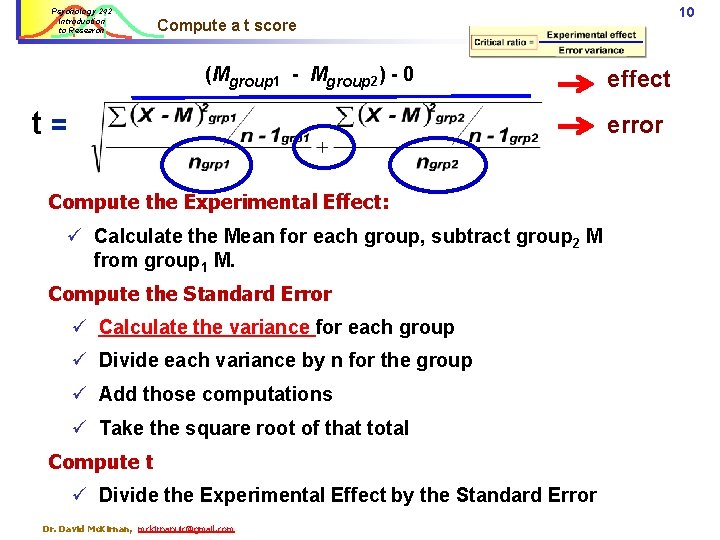
Psychology 242 Introduction to Research 10 Compute a t score (Mgroup 1 - Mgroup 2) - 0 t= effect error Compute the Experimental Effect: ü Calculate the Mean for each group, subtract group 2 M from group 1 M. Compute the Standard Error ü Calculate the variance for each group ü Divide each variance by n for the group ü Add those computations ü Take the square root of that total Compute t ü Divide the Experimental Effect by the Standard Error Dr. David Mc. Kirnan, mckirnanuic@gmail. com
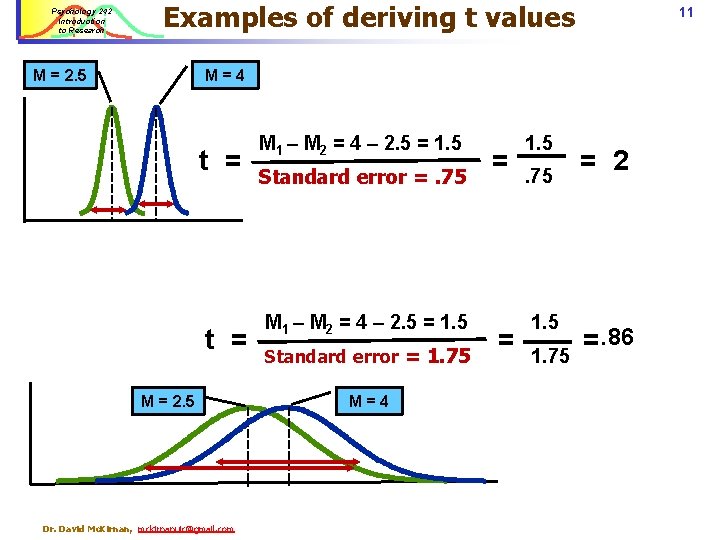
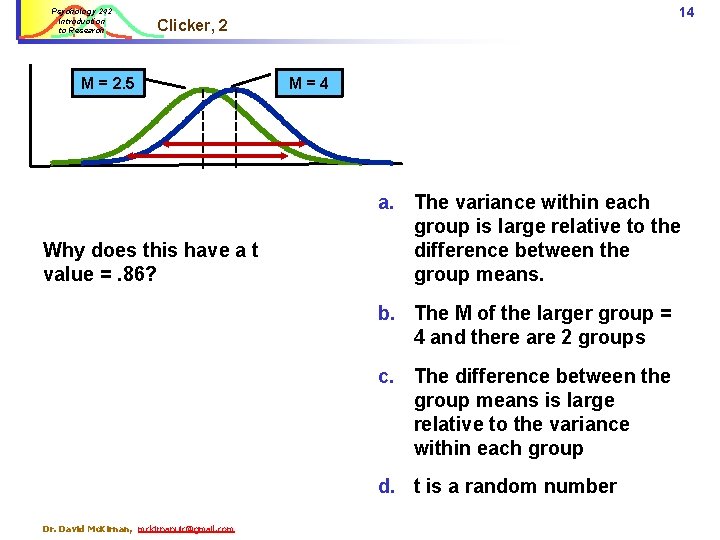
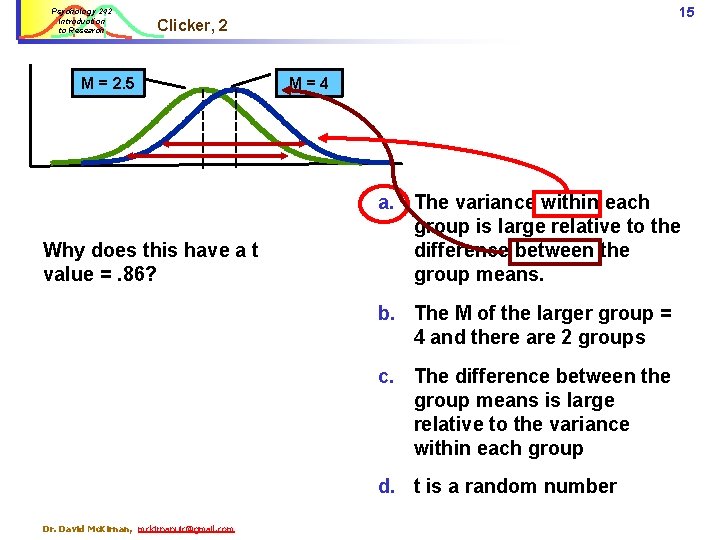
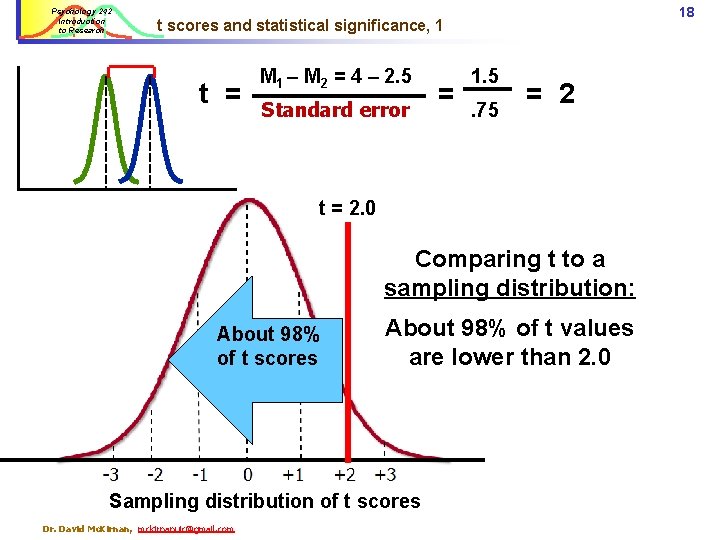
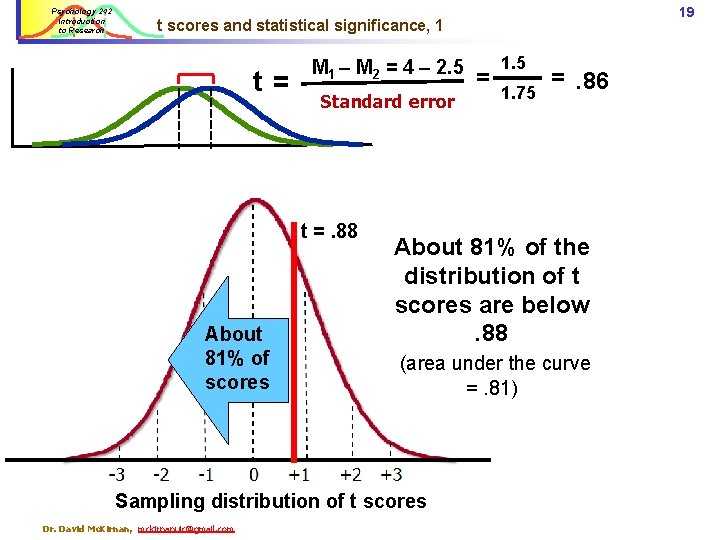
Psychology 242 Introduction to Research Examples of deriving t values M = 2. 5 11 M=4 t = M = 2. 5 Dr. David Mc. Kirnan, mckirnanuic@gmail. com M 1 – M 2 = 4 – 2. 5 = 1. 5 Standard error =. 75 M 1 – M 2 = 4 – 2. 5 = 1. 5 Standard error = 1. 75 M=4 = = 1. 5. 75 1. 75 = 2 =. 86
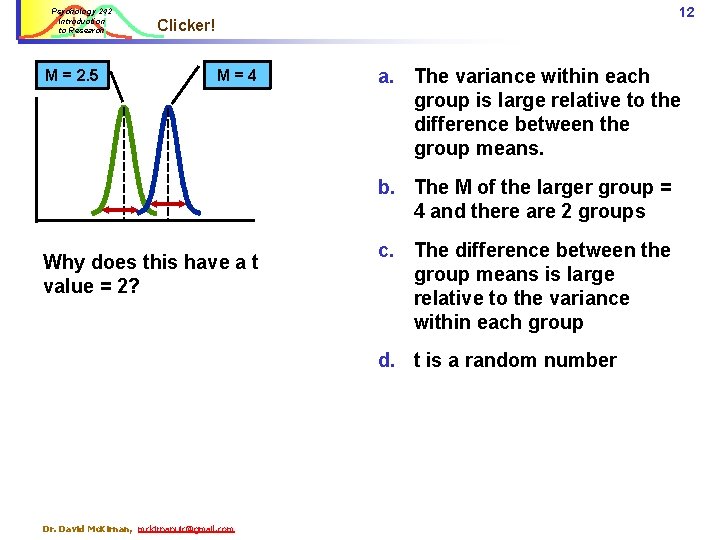
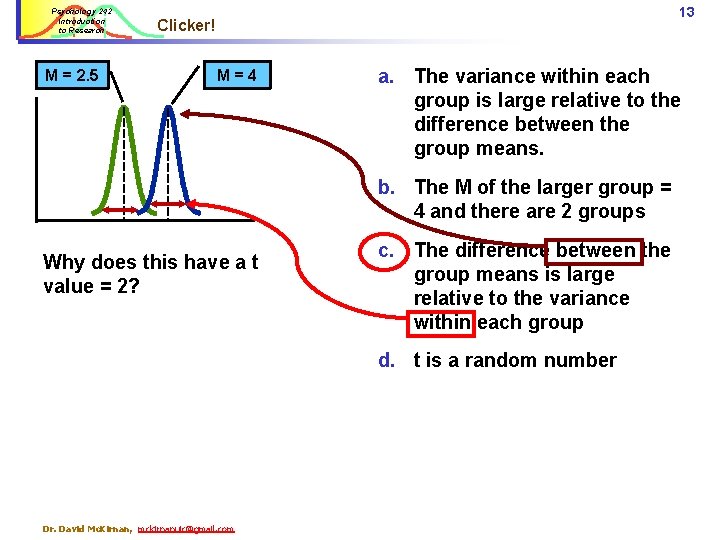
Psychology 242 Introduction to Research M = 2. 5 12 Clicker! M=4 a. The variance within each group is large relative to the difference between the group means. b. The M of the larger group = 4 and there are 2 groups Why does this have a t value = 2? c. The difference between the group means is large relative to the variance within each group d. t is a random number Dr. David Mc. Kirnan, mckirnanuic@gmail. com
Psychology 242 Introduction to Research M = 2. 5 13 Clicker! M=4 a. The variance within each group is large relative to the difference between the group means. b. The M of the larger group = 4 and there are 2 groups Why does this have a t value = 2? c. The difference between the group means is large relative to the variance within each group d. t is a random number Dr. David Mc. Kirnan, mckirnanuic@gmail. com
Psychology 242 Introduction to Research 14 Clicker, 2 M = 2. 5 Why does this have a t value =. 86? M=4 a. The variance within each group is large relative to the difference between the group means. b. The M of the larger group = 4 and there are 2 groups c. The difference between the group means is large relative to the variance within each group d. t is a random number Dr. David Mc. Kirnan, mckirnanuic@gmail. com
Psychology 242 Introduction to Research 15 Clicker, 2 M = 2. 5 Why does this have a t value =. 86? M=4 a. The variance within each group is large relative to the difference between the group means. b. The M of the larger group = 4 and there are 2 groups c. The difference between the group means is large relative to the variance within each group d. t is a random number Dr. David Mc. Kirnan, mckirnanuic@gmail. com
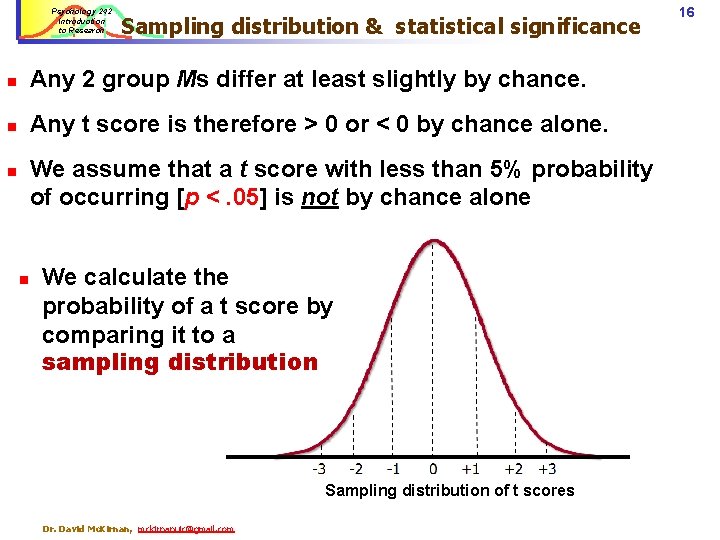
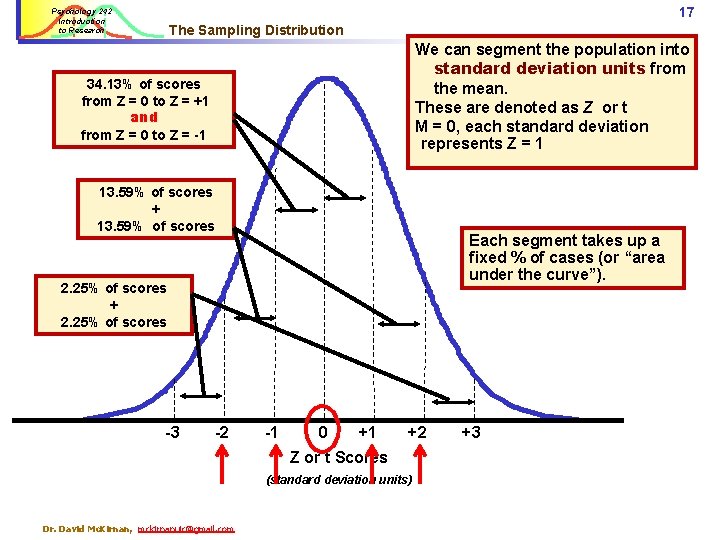
Psychology 242 Introduction to Research Sampling distribution & statistical significance n Any 2 group Ms differ at least slightly by chance. n Any t score is therefore > 0 or < 0 by chance alone. We assume that a t score with less than 5% probability of occurring [p <. 05] is not by chance alone n n We calculate the probability of a t score by comparing it to a sampling distribution Sampling distribution of t scores Dr. David Mc. Kirnan, mckirnanuic@gmail. com 16
17 Psychology 242 Introduction to Research The Sampling Distribution We can segment the population into standard deviation units from the mean. These are denoted as Z or t M = 0, each standard deviation represents Z = 1 34. 13% of scores from Z = 0 to Z = +1 and from Z = 0 to Z = -1 13. 59% of scores + 13. 59% of scores Each segment takes up a fixed % of cases (or “area under the curve”). 2. 25% of scores + 2. 25% of scores -3 -2 -1 0 +1 +2 Z or t Scores (standard deviation units) Dr. David Mc. Kirnan, mckirnanuic@gmail. com +3
Psychology 242 Introduction to Research 18 t scores and statistical significance, 1 t = M 1 – M 2 = 4 – 2. 5 Standard error = 1. 5. 75 = 2 t = 2. 0 Comparing t to a sampling distribution: About 98% of t scores About 98% of t values are lower than 2. 0 Sampling distribution of t scores Dr. David Mc. Kirnan, mckirnanuic@gmail. com
Psychology 242 Introduction to Research 19 t scores and statistical significance, 1 t= M 1 – M 2 = 4 – 2. 5 Standard error t =. 88 About 81% of scores 1. 75 =. 86 About 81% of the distribution of t scores are below. 88 (area under the curve =. 81) Sampling distribution of t scores Dr. David Mc. Kirnan, mckirnanuic@gmail. com = 1. 5
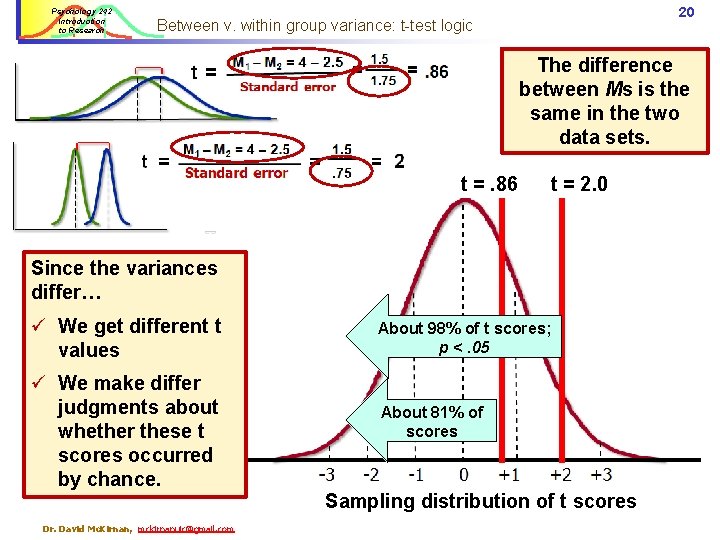
Psychology 242 Introduction to Research 20 Between v. within group variance: t-test logic The difference between Ms is the same in the two data sets. t =. 86 t = 2. 0 Since the variances differ… ü We get different t values ü We make differ judgments about whether these t scores occurred by chance. Dr. David Mc. Kirnan, mckirnanuic@gmail. com About 98% of t scores; p <. 05 About 81% of scores Sampling distribution of t scores
Psychology 242 Introduction to Research Continue… Continue this series by clicking on the module for The Central Limit Theorem. Dr. David Mc. Kirnan, mckirnanuic@gmail. com 21