
PSYCHOLOGY 2 E Chapter 1 INTRODUCTION TO PSYCHOLOGY

- Slides: 31
PSYCHOLOGY 2 E Chapter 1 INTRODUCTION TO PSYCHOLOGY Power. Point Image Slideshow
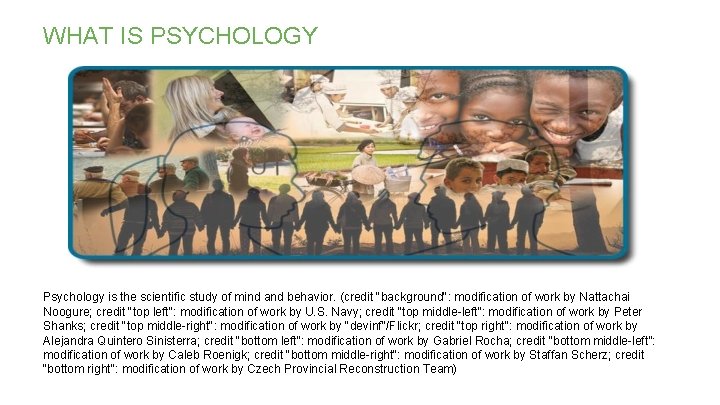
WHAT IS PSYCHOLOGY Psychology is the scientific study of mind and behavior. (credit "background": modification of work by Nattachai Noogure; credit "top left": modification of work by U. S. Navy; credit "top middle-left": modification of work by Peter Shanks; credit "top middle-right": modification of work by "devinf"/Flickr; credit "top right": modification of work by Alejandra Quintero Sinisterra; credit "bottom left": modification of work by Gabriel Rocha; credit "bottom middle-left”: modification of work by Caleb Roenigk; credit "bottom middle-right": modification of work by Staffan Scherz; credit "bottom right": modification of work by Czech Provincial Reconstruction Team)
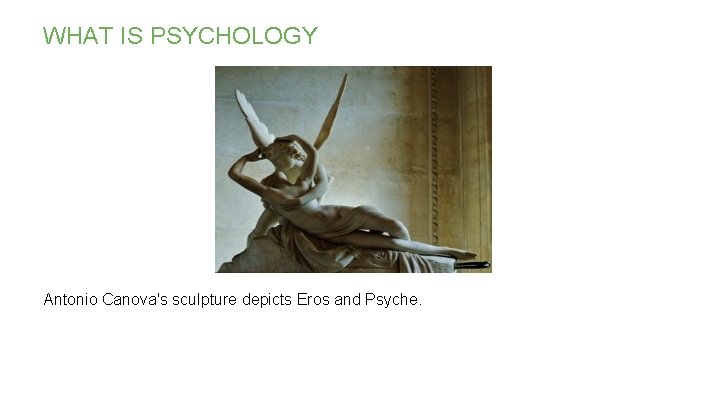
WHAT IS PSYCHOLOGY Antonio Canova's sculpture depicts Eros and Psyche.
WHAT IS PSYCHOLOGY? Psych – Soul Ology – Scientific study of Psychology – Scientific study of the mind and behavior. Psychologists study everything about the human experience from the basic workings of the human brain to consciousness, memory, language, reasoning, personality and mental health.
HISTORY OF PSYCHOLOGY Psychological perspectives Structuralism – understanding the conscious experience through introspection. - Wilhelm Wundt Functionalism – focused on how mental activities helped an organism adapt to its environment. - William James Psychoanalytic Theory – focuses on the role of the unconscious in affecting conscious behavior. - Sigmund Freud Gestalt Psychology – Focuses on humans as a whole rather than individual parts. - Wertheimer, Koffka, Kohler Behaviorism – focuses on observing and controlling behavior. - Pavlov, Watson, Skinner
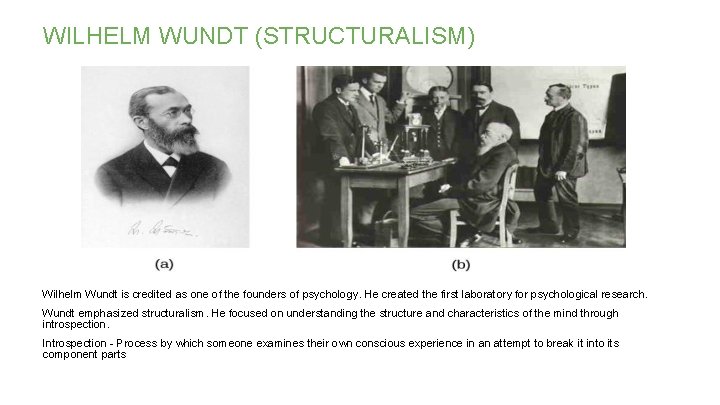
WILHELM WUNDT (STRUCTURALISM) Wilhelm Wundt is credited as one of the founders of psychology. He created the first laboratory for psychological research. Wundt emphasized structuralism. He focused on understanding the structure and characteristics of the mind through introspection. Introspection - Process by which someone examines their own conscious experience in an attempt to break it into its component parts
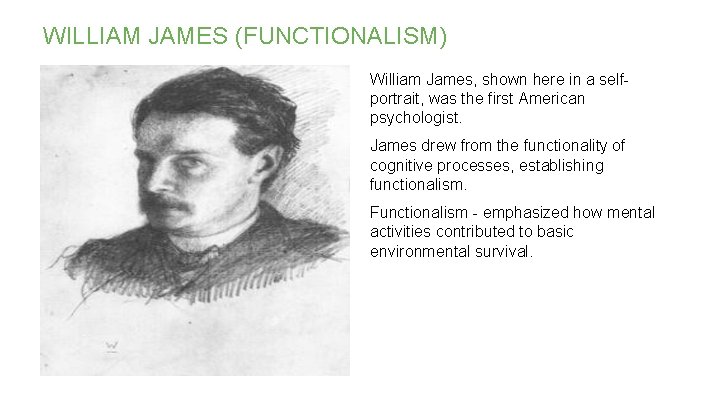
WILLIAM JAMES (FUNCTIONALISM) William James, shown here in a selfportrait, was the first American psychologist. James drew from the functionality of cognitive processes, establishing functionalism. Functionalism - emphasized how mental activities contributed to basic environmental survival.
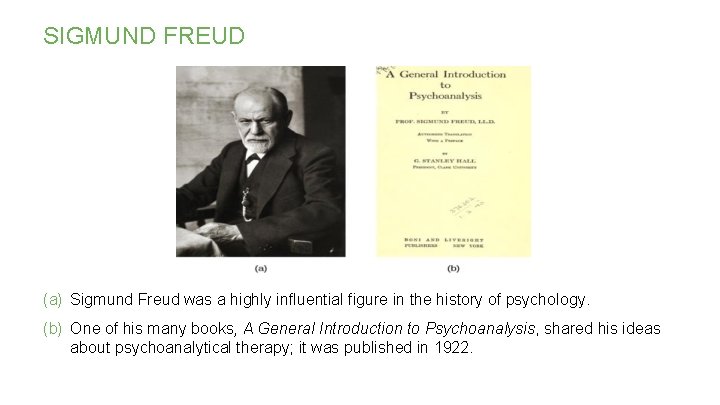
SIGMUND FREUD (a) Sigmund Freud was a highly influential figure in the history of psychology. (b) One of his many books, A General Introduction to Psychoanalysis, shared his ideas about psychoanalytical therapy; it was published in 1922.
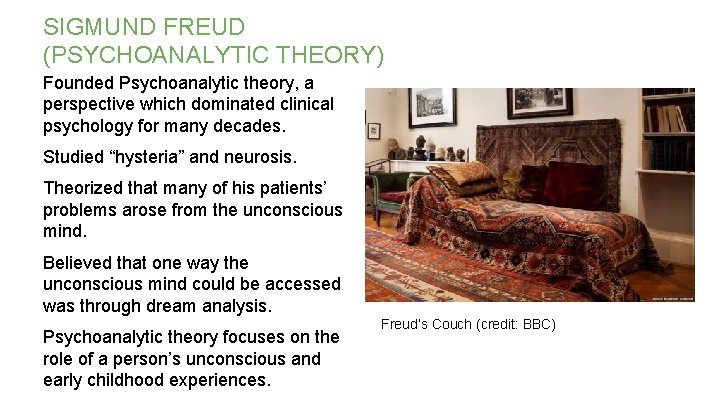
SIGMUND FREUD (PSYCHOANALYTIC THEORY) Founded Psychoanalytic theory, a perspective which dominated clinical psychology for many decades. Studied “hysteria” and neurosis. Theorized that many of his patients’ problems arose from the unconscious mind. Believed that one way the unconscious mind could be accessed was through dream analysis. Psychoanalytic theory focuses on the role of a person’s unconscious and early childhood experiences. Freud’s Couch (credit: BBC)
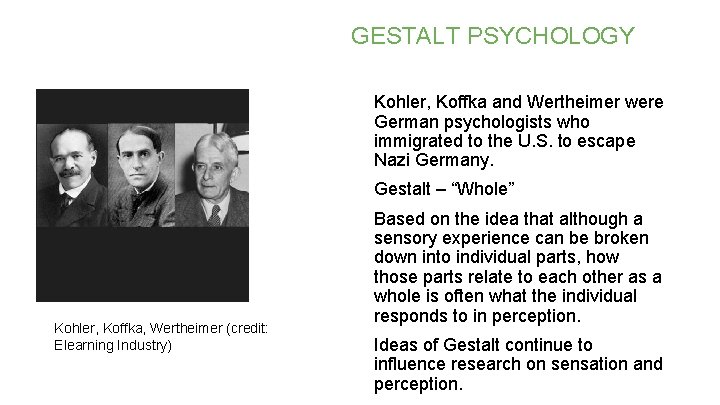
GESTALT PSYCHOLOGY Kohler, Koffka and Wertheimer were German psychologists who immigrated to the U. S. to escape Nazi Germany. Gestalt – “Whole” Kohler, Koffka, Wertheimer (credit: Elearning Industry) Based on the idea that although a sensory experience can be broken down into individual parts, how those parts relate to each other as a whole is often what the individual responds to in perception. Ideas of Gestalt continue to influence research on sensation and perception.
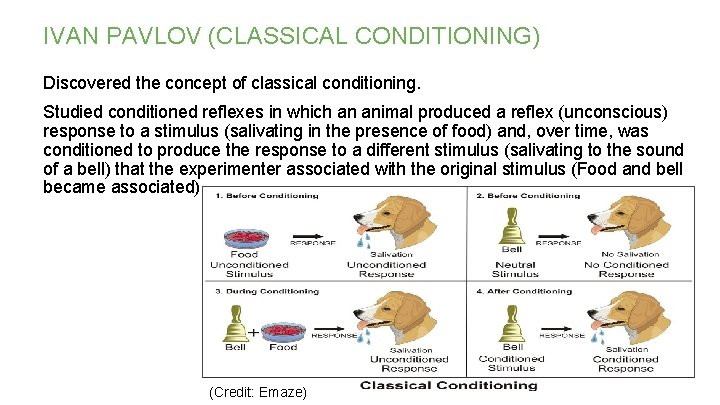
IVAN PAVLOV (CLASSICAL CONDITIONING) Discovered the concept of classical conditioning. Studied conditioned reflexes in which an animal produced a reflex (unconscious) response to a stimulus (salivating in the presence of food) and, over time, was conditioned to produce the response to a different stimulus (salivating to the sound of a bell) that the experimenter associated with the original stimulus (Food and bell became associated). (Credit: Emaze)
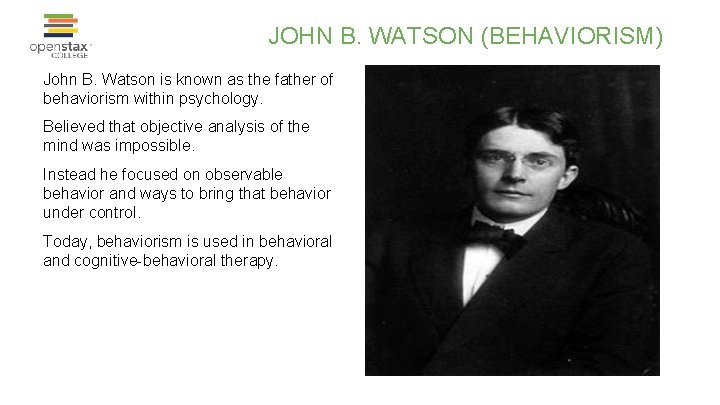
JOHN B. WATSON (BEHAVIORISM) John B. Watson is known as the father of behaviorism within psychology. Believed that objective analysis of the mind was impossible. Instead he focused on observable behavior and ways to bring that behavior under control. Today, behaviorism is used in behavioral and cognitive-behavioral therapy.
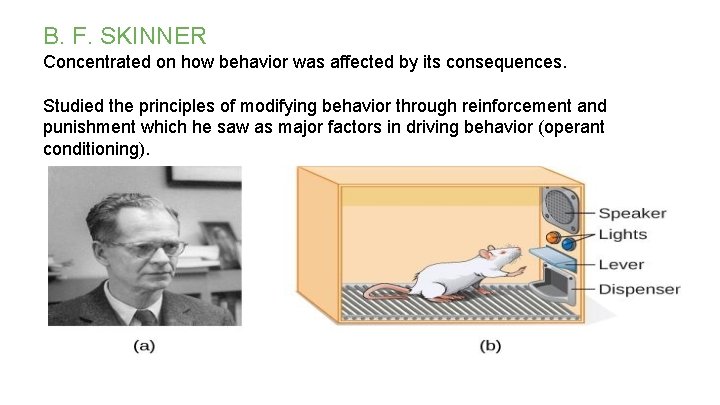
B. F. SKINNER Concentrated on how behavior was affected by its consequences. Studied the principles of modifying behavior through reinforcement and punishment which he saw as major factors in driving behavior (operant conditioning).
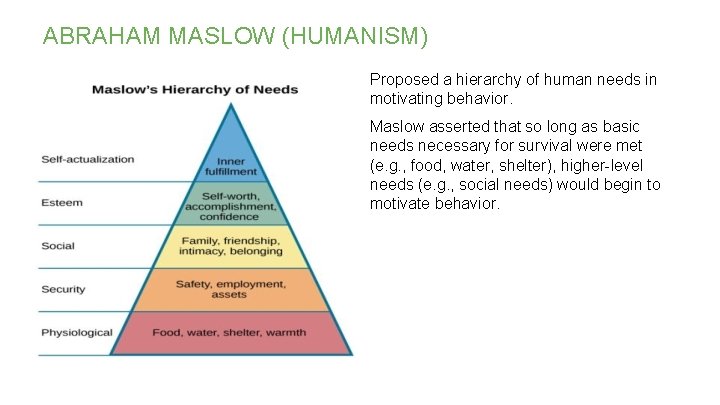
ABRAHAM MASLOW (HUMANISM) Proposed a hierarchy of human needs in motivating behavior. Maslow asserted that so long as basic needs necessary for survival were met (e. g. , food, water, shelter), higher-level needs (e. g. , social needs) would begin to motivate behavior.
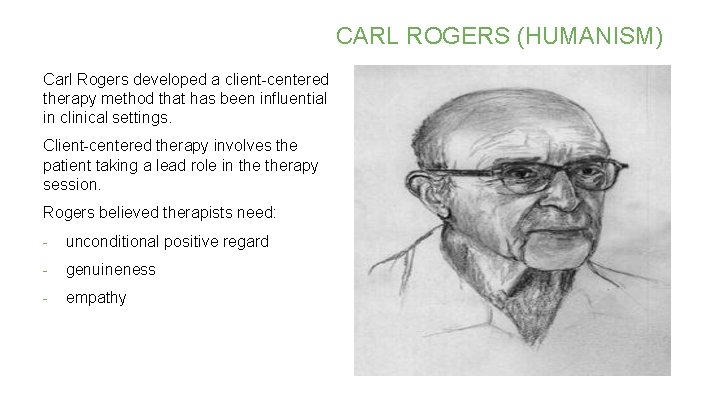
CARL ROGERS (HUMANISM) Carl Rogers developed a client-centered therapy method that has been influential in clinical settings. Client-centered therapy involves the patient taking a lead role in therapy session. Rogers believed therapists need: - unconditional positive regard - genuineness - empathy
THE COGNITIVE REVOLUTION By the 1950’s, new disciplinary perspectives in linguistics, neuroscience, and computer science were emerging. The mind became the new focus of scientific inquiry. Noam Chomsky was very influential in beginning the cognitive revolution. He believed psychology needed to incorporate mental functioning into its focus in order to fully understand human behavior.
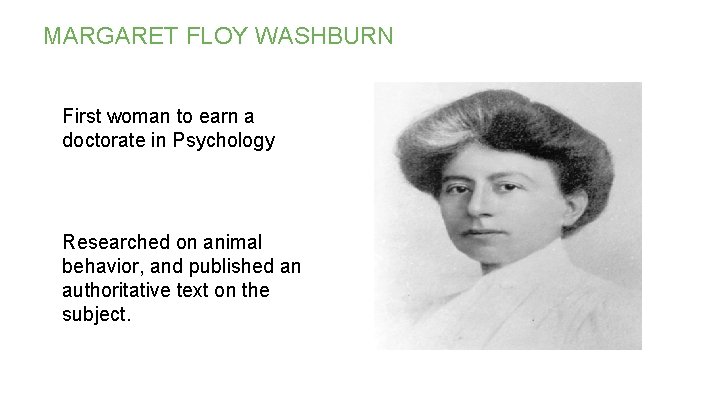
MARGARET FLOY WASHBURN First woman to earn a doctorate in Psychology Researched on animal behavior, and published an authoritative text on the subject.
5 Phenomenal Women of Color in Psychology 1. Inez Beverly Prosser (1895 -1934) The first African American woman to complete a Ph. D in psychology in 1933, she had to leave Texas to pursue her degree because no graduate schools there accepted African Americans. She studied how racially integrated and racially segregated schools impact African American youth. 2. Martha Bernal (1931 -2001) The first Latina to earn a Ph. D in psychology in the United States, she studied ethnic identity and made clinical training more relevant for minorities. She also mentored Latino/a psychologists and founded the National Hispanic Psychology Association. 3. Mamie Phipps Clark (1917 -1983) She and her husband, Kenneth Clark, studied racial preferences and identity in Black children in integrated schools compared to segregated schools. In the famous Doll Studies, children were presented with four dolls, two black and two white. They were asked which doll they liked best. More than 65% of the kids chose a white doll. These findings were used in the Brown v. Board of Education Supreme Court case that dismantled school segregation.
5 Phenomenal Women of Color in Psychology 4. Reiko True Born in Japan, she attended university in Tokyo, one of only 3 women in a class of 80. She remains passionate about equal access to mental health care and lobbied to create the first mental health center in California to serve Asian Americans. She then led the center, ensuring staff were trained in Asian languages and culture. 5. Jennifer Eberhardt Her research shows how subliminal images activate racial stereotypes, changing what and how people see. She investigates the largely unconscious yet deeply ingrained ways that individuals racially code and categorize people, with a particular focus on associations between race and crime. She uses these findings to raise awareness about stereotypes in the criminal justice system and in education. In 2014, she received a Mac. Arthur Foundation award for her groundbreaking work.
CONTEMPORARY PSYCHOLOGY Branches of psychology Biopsychology and Evolutionary Psychology Sensation and Perception Cognitive Psychology Developmental Psychology Personality Psychology Social Psychology Health Psychology Industrial-Organizational Psychology Sports and Exercise Psychology Clinical Psychology Forensic Psychology
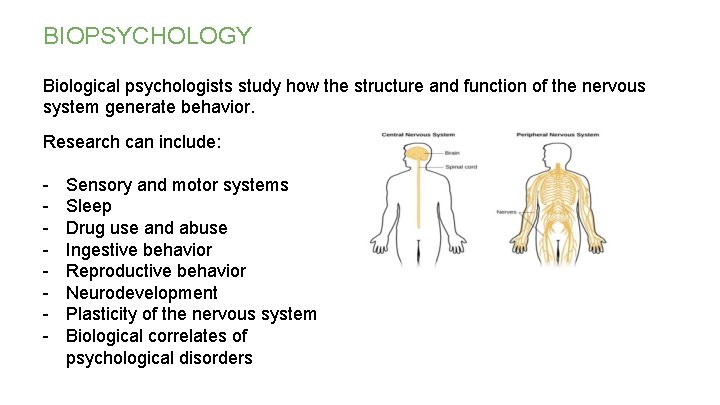
BIOPSYCHOLOGY Biological psychologists study how the structure and function of the nervous system generate behavior. Research can include: - Sensory and motor systems Sleep Drug use and abuse Ingestive behavior Reproductive behavior Neurodevelopment Plasticity of the nervous system Biological correlates of psychological disorders
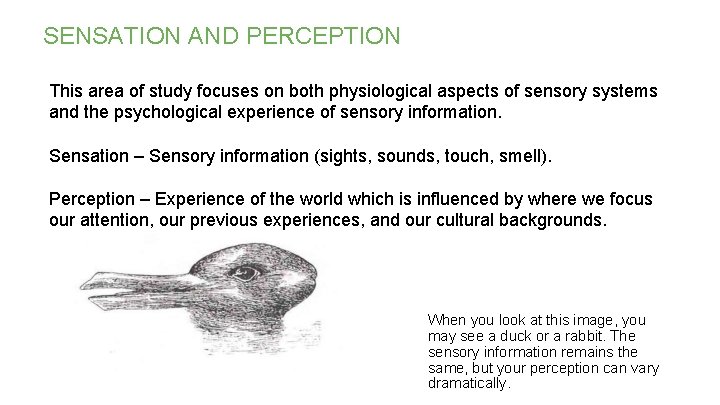
SENSATION AND PERCEPTION This area of study focuses on both physiological aspects of sensory systems and the psychological experience of sensory information. Sensation – Sensory information (sights, sounds, touch, smell). Perception – Experience of the world which is influenced by where we focus our attention, our previous experiences, and our cultural backgrounds. When you look at this image, you may see a duck or a rabbit. The sensory information remains the same, but your perception can vary dramatically.
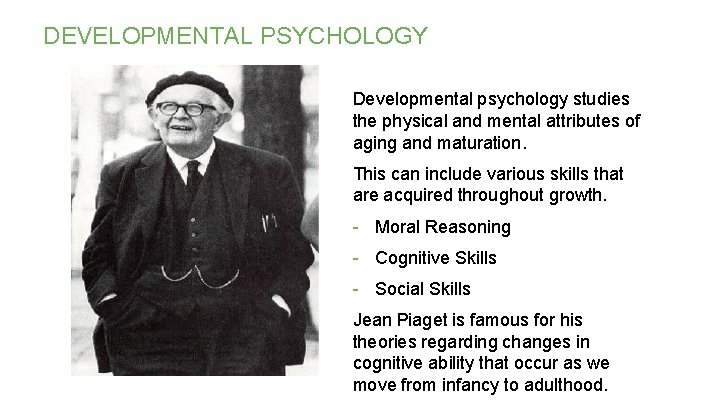
DEVELOPMENTAL PSYCHOLOGY Developmental psychology studies the physical and mental attributes of aging and maturation. This can include various skills that are acquired throughout growth. - Moral Reasoning - Cognitive Skills - Social Skills Jean Piaget is famous for his theories regarding changes in cognitive ability that occur as we move from infancy to adulthood.
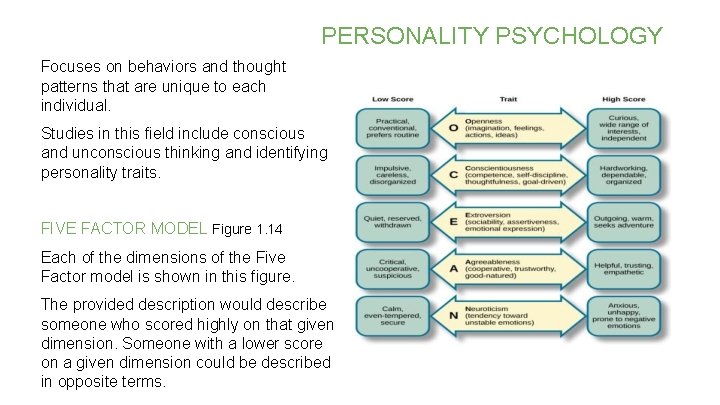
PERSONALITY PSYCHOLOGY Focuses on behaviors and thought patterns that are unique to each individual. Studies in this field include conscious and unconscious thinking and identifying personality traits. FIVE FACTOR MODEL Figure 1. 14 Each of the dimensions of the Five Factor model is shown in this figure. The provided description would describe someone who scored highly on that given dimension. Someone with a lower score on a given dimension could be described in opposite terms.
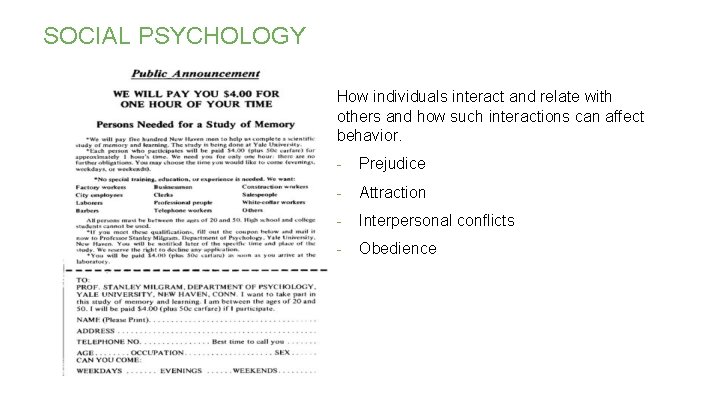
SOCIAL PSYCHOLOGY How individuals interact and relate with others and how such interactions can affect behavior. - Prejudice - Attraction - Interpersonal conflicts - Obedience
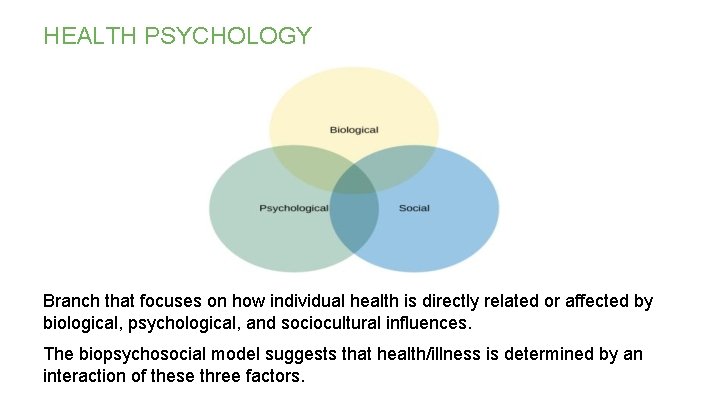
HEALTH PSYCHOLOGY Branch that focuses on how individual health is directly related or affected by biological, psychological, and sociocultural influences. The biopsychosocial model suggests that health/illness is determined by an interaction of these three factors.
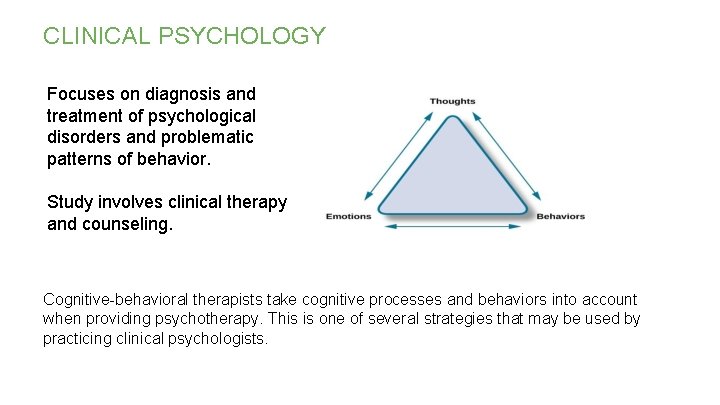
CLINICAL PSYCHOLOGY Focuses on diagnosis and treatment of psychological disorders and problematic patterns of behavior. Study involves clinical therapy and counseling. Cognitive-behavioral therapists take cognitive processes and behaviors into account when providing psychotherapy. This is one of several strategies that may be used by practicing clinical psychologists.
INDUSTRIAL-ORGANIZATIONAL Branch that applies psychological theories, principles and research to industrial and organizational settings. Involves issues related to personnel management, organizational structure and workplace environment. SPORTS & EXERCISE PSYCHOLOGY Focus on psychological aspects regarding sports and physical performance. Study includes motivation, performance related anxiety, and general mental well being. FORENSIC PSYCHOLOGY Branch of psychology dealing with justice system. Tasks of Forensic Psychologists include assessment of individuals' mental competency to stand in trial, sentencing and treatment suggestions, and advisement regarding eyewitness testimonies. This field of psychology requires a strong understanding of the legal system.
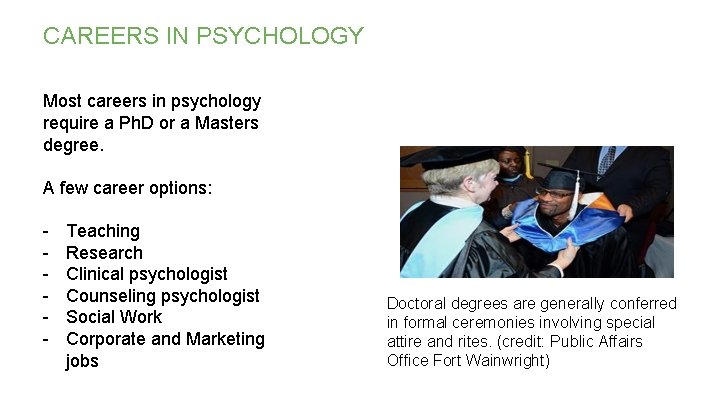
CAREERS IN PSYCHOLOGY Most careers in psychology require a Ph. D or a Masters degree. A few career options: - Teaching Research Clinical psychologist Counseling psychologist Social Work Corporate and Marketing jobs Doctoral degrees are generally conferred in formal ceremonies involving special attire and rites. (credit: Public Affairs Office Fort Wainwright)
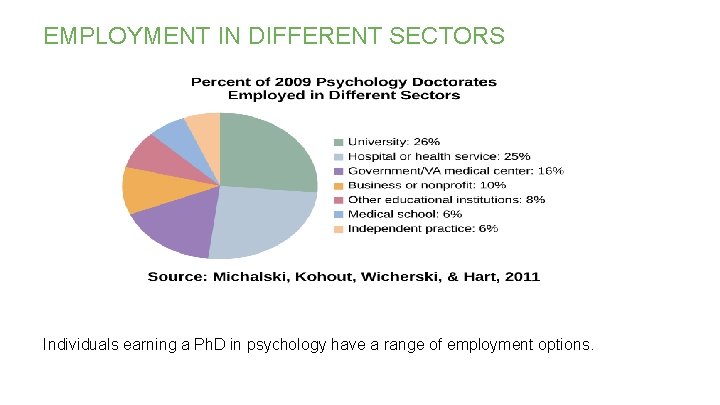
EMPLOYMENT IN DIFFERENT SECTORS Individuals earning a Ph. D in psychology have a range of employment options.
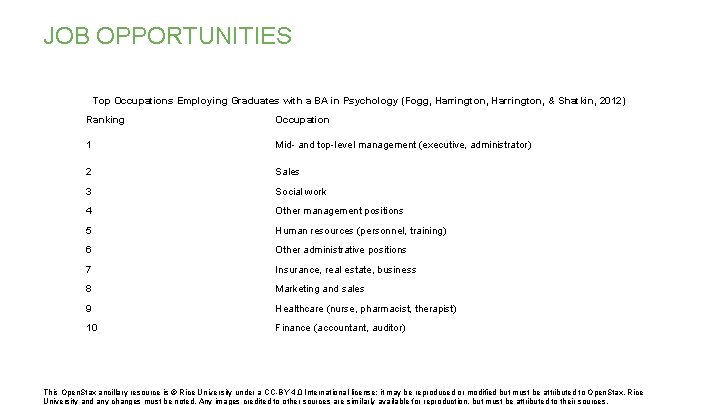
JOB OPPORTUNITIES Top Occupations Employing Graduates with a BA in Psychology (Fogg, Harrington, & Shatkin, 2012) Ranking Occupation 1 Mid- and top-level management (executive, administrator) 2 Sales 3 Social work 4 Other management positions 5 Human resources (personnel, training) 6 Other administrative positions 7 Insurance, real estate, business 8 Marketing and sales 9 Healthcare (nurse, pharmacist, therapist) 10 Finance (accountant, auditor) This Open. Stax ancillary resource is © Rice University under a CC-BY 4. 0 International license; it may be reproduced or modified but must be attributed to Open. Stax, Rice University and any changes must be noted. Any images credited to other sources are similarly available for reproduction, but must be attributed to their sources.