
Psychology 110 Colorless green ideas sleep furiously Noam
- Slides: 54
Psychology 110 Colorless green ideas sleep furiously Noam Chomsky’s theory of Language © Kip Smith, 2003
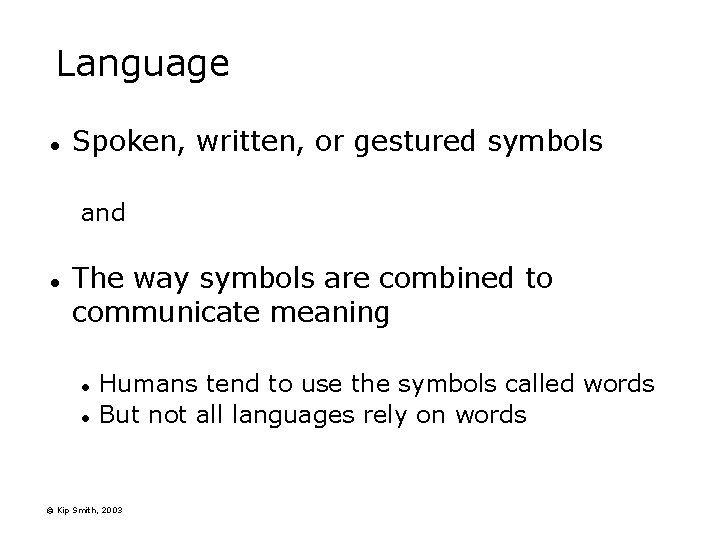
Language l Spoken, written, or gestured symbols and l The way symbols are combined to communicate meaning l l Humans tend to use the symbols called words But not all languages rely on words © Kip Smith, 2003
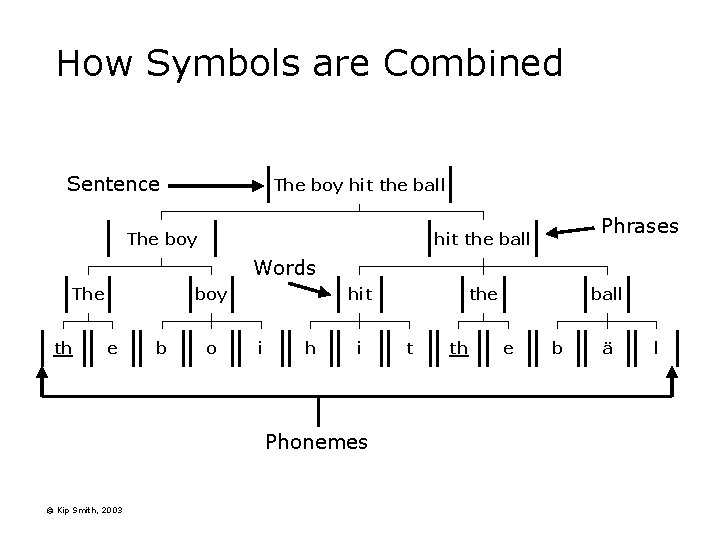
How Symbols are Combined Sentence The boy hit the ball The boy Phrases hit the ball Words The th boy e b o hit i h i Phonemes © Kip Smith, 2003 the t th ball e b ä l
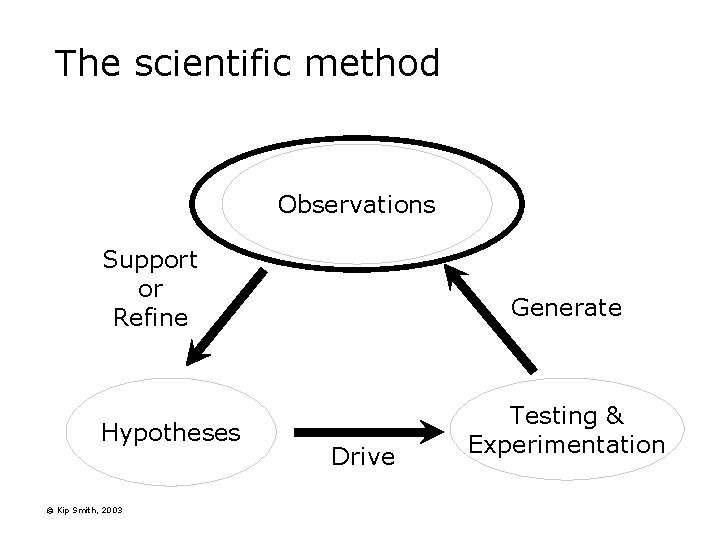
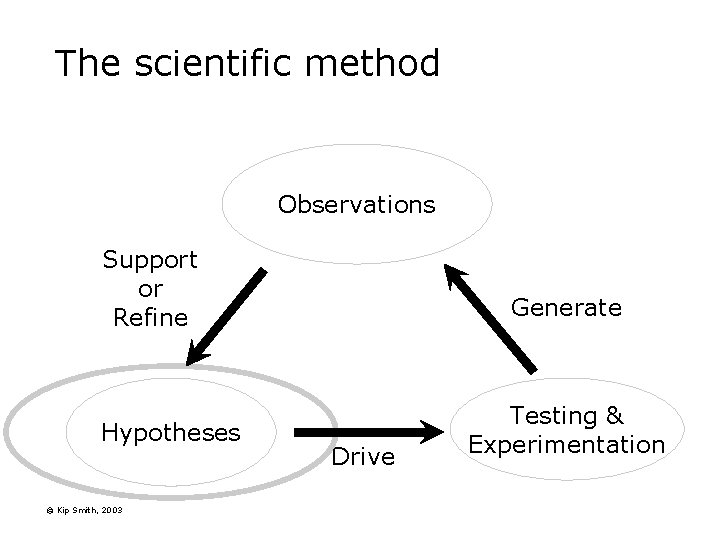
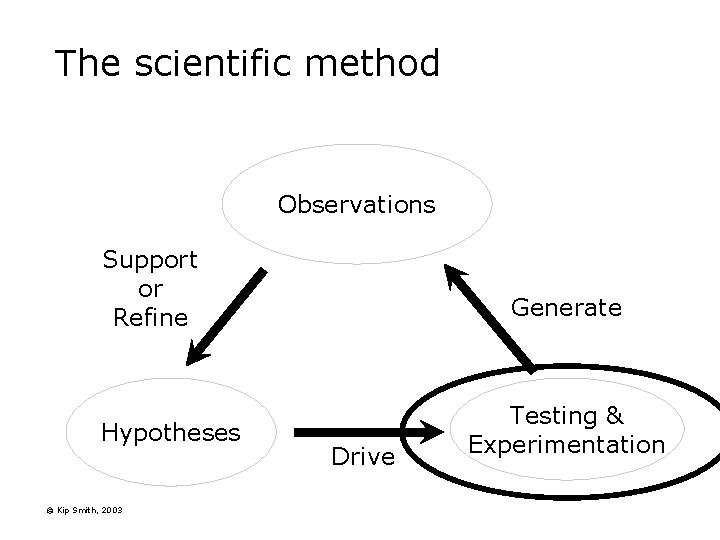
The scientific method Observations Support or Refine Hypotheses © Kip Smith, 2003 Generate Drive Testing & Experimentation
Language acquisition Children are born with a propensity to communicate and will learn a language no matter what © Kip Smith, 2003
Stages 1 -3 of language acquisition l Birth l l Babbling l l “AH” A rich variety of intonations One concrete word l All refer to the here and now © Kip Smith, 2003
Stages 4 -6 l Two words l Many different semantic relationships, e. g. l l l Telegraphic sentences l Function words (the, is, of) omitted l l Agent - Action (“Doggie run”) Attribute – Object (“Red ball”) (“Doggie go bye-bye”) Natural language l Gradual acquisition of vocabulary and grammatical complexity © Kip Smith, 2003
Overgeneralization l When learning the past tense of irregular verbs l E. g. , see saw, go went, sing sang, etc. l First, children use the irregular correctly l Then, they overgeneralize l l seed, goed, singed Then, they go back to the irregular © Kip Smith, 2003
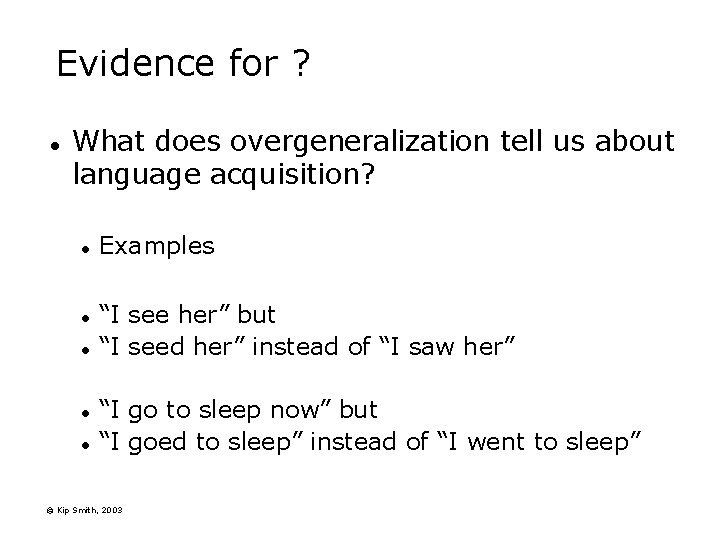
Evidence for ? l What does overgeneralization tell us about language acquisition? l l l Examples “I see her” but “I seed her” instead of “I saw her” “I go to sleep now” but “I goed to sleep” instead of “I went to sleep” © Kip Smith, 2003
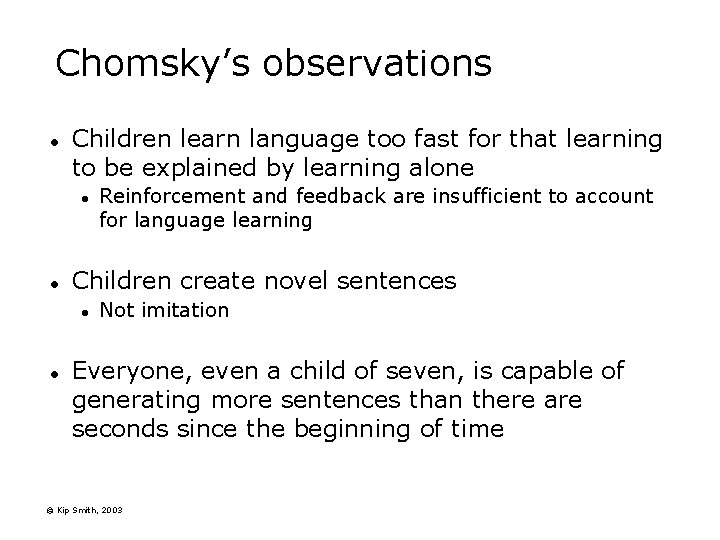
Chomsky’s observations l Children learn language too fast for that learning to be explained by learning alone l l Children create novel sentences l l Reinforcement and feedback are insufficient to account for language learning Not imitation Everyone, even a child of seven, is capable of generating more sentences than there are seconds since the beginning of time © Kip Smith, 2003
The scientific method Observations Support or Refine Hypotheses © Kip Smith, 2003 Generate Drive Testing & Experimentation
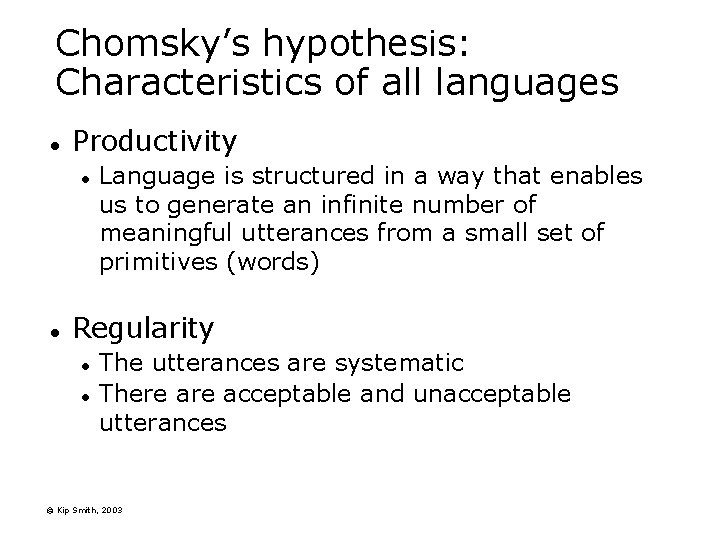
Chomsky’s hypothesis: Characteristics of all languages l Productivity l l Language is structured in a way that enables us to generate an infinite number of meaningful utterances from a small set of primitives (words) Regularity l l The utterances are systematic There acceptable and unacceptable utterances © Kip Smith, 2003
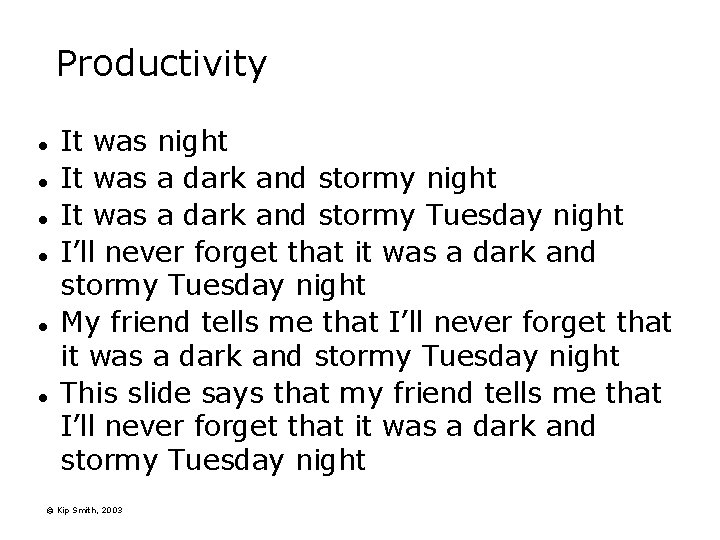
Productivity l l l It was night It was a dark and stormy Tuesday night I’ll never forget that it was a dark and stormy Tuesday night My friend tells me that I’ll never forget that it was a dark and stormy Tuesday night This slide says that my friend tells me that I’ll never forget that it was a dark and stormy Tuesday night © Kip Smith, 2003
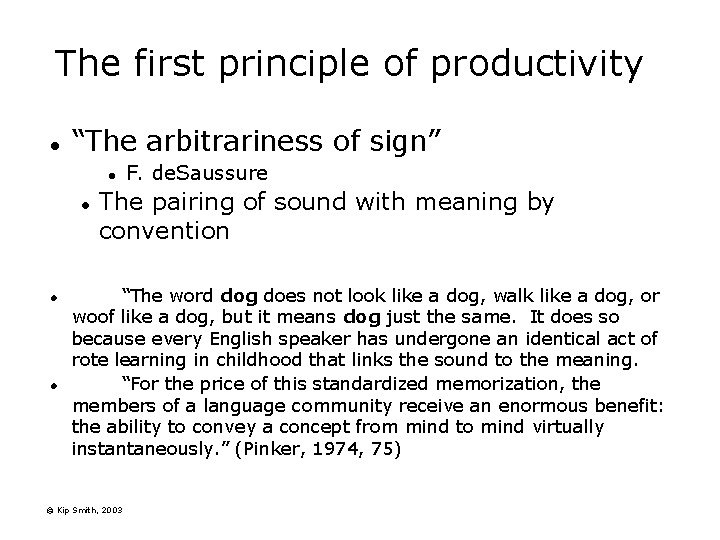
The first principle of productivity l “The arbitrariness of sign” l l F. de. Saussure The pairing of sound with meaning by convention “The word dog does not look like a dog, walk like a dog, or woof like a dog, but it means dog just the same. It does so because every English speaker has undergone an identical act of rote learning in childhood that links the sound to the meaning. “For the price of this standardized memorization, the members of a language community receive an enormous benefit: the ability to convey a concept from mind to mind virtually instantaneously. ” (Pinker, 1974, 75) © Kip Smith, 2003
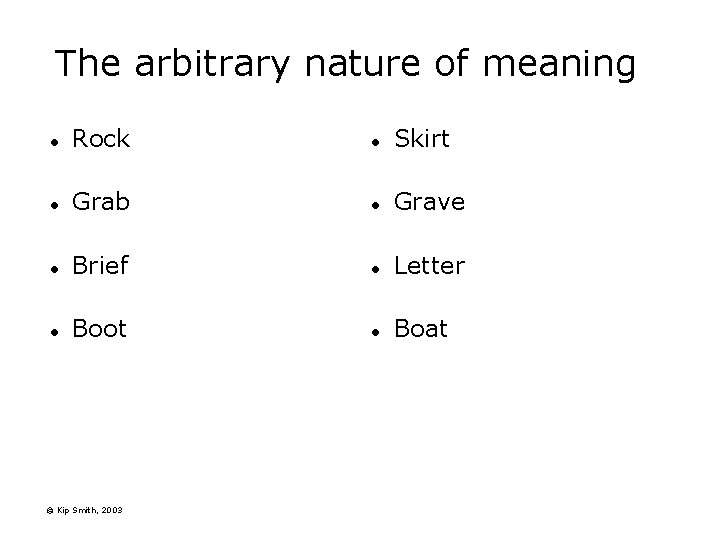
The arbitrary nature of meaning l Rock l Skirt l Grab l Grave l Brief l Letter l Boot l Boat © Kip Smith, 2003
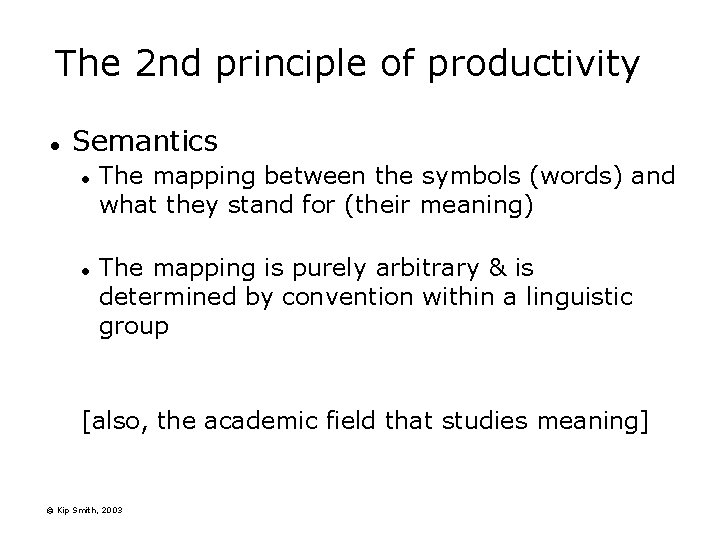
The 2 nd principle of productivity l Semantics l l The mapping between the symbols (words) and what they stand for (their meaning) The mapping is purely arbitrary & is determined by convention within a linguistic group [also, the academic field that studies meaning] © Kip Smith, 2003
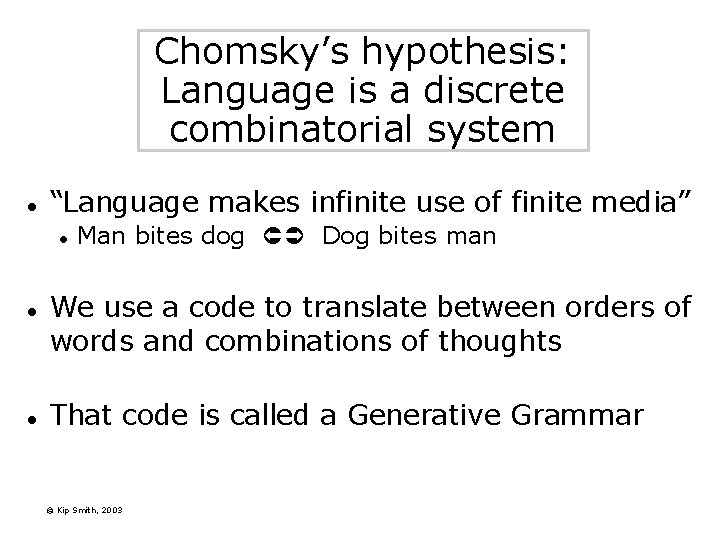
Chomsky’s hypothesis: Language is a discrete combinatorial system l “Language makes infinite use of finite media” l l l Man bites dog Dog bites man We use a code to translate between orders of words and combinations of thoughts That code is called a Generative Grammar © Kip Smith, 2003
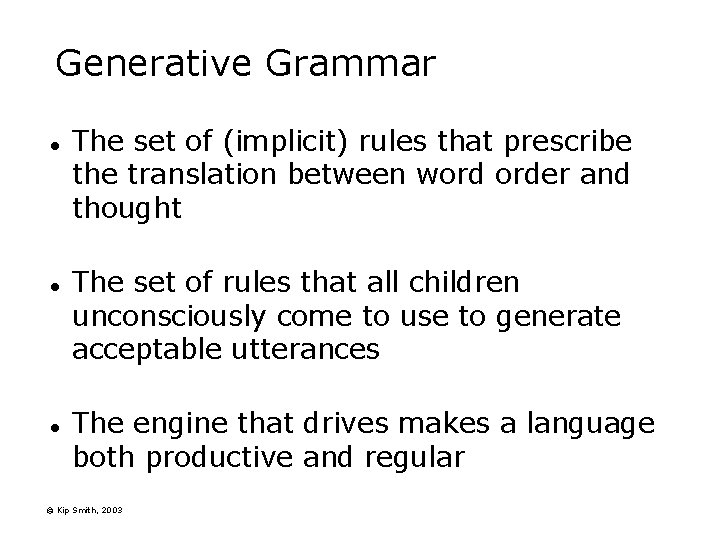
Generative Grammar l l l The set of (implicit) rules that prescribe the translation between word order and thought The set of rules that all children unconsciously come to use to generate acceptable utterances The engine that drives makes a language both productive and regular © Kip Smith, 2003
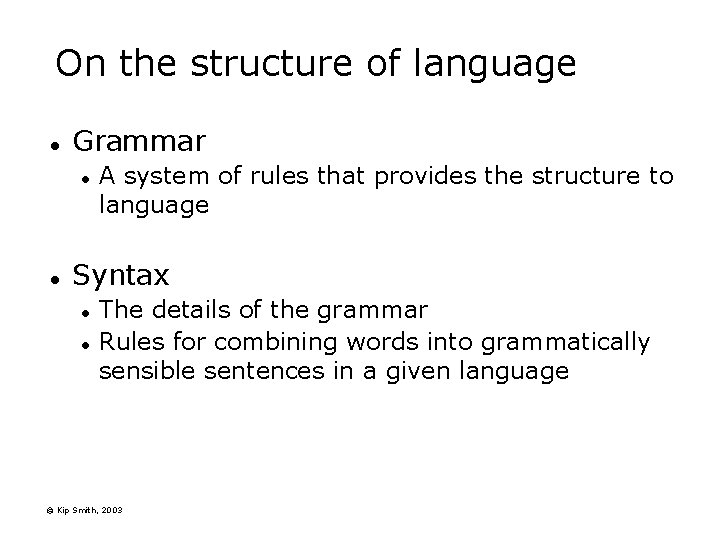
On the structure of language l Grammar l l A system of rules that provides the structure to language Syntax l l The details of the grammar Rules for combining words into grammatically sensible sentences in a given language © Kip Smith, 2003
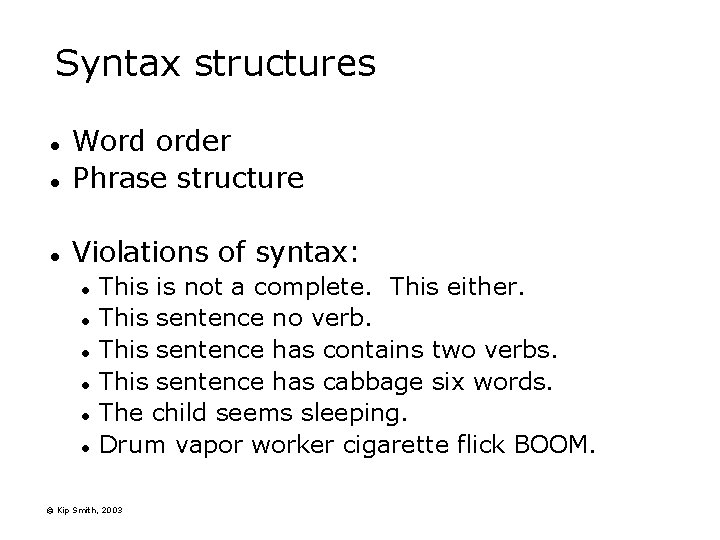
Syntax structures l Word order Phrase structure l Violations of syntax: l l l l This is not a complete. This either. This sentence no verb. This sentence has contains two verbs. This sentence has cabbage six words. The child seems sleeping. Drum vapor worker cigarette flick BOOM. © Kip Smith, 2003
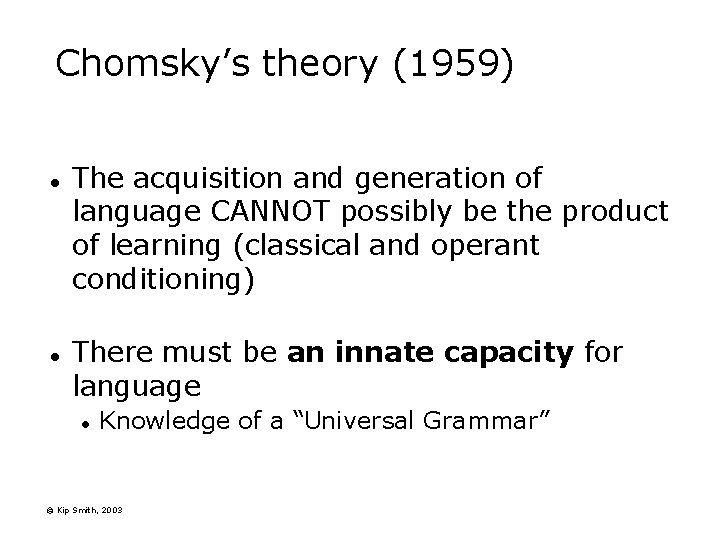
Chomsky’s theory (1959) l l The acquisition and generation of language CANNOT possibly be the product of learning (classical and operant conditioning) There must be an innate capacity for language l Knowledge of a “Universal Grammar” © Kip Smith, 2003
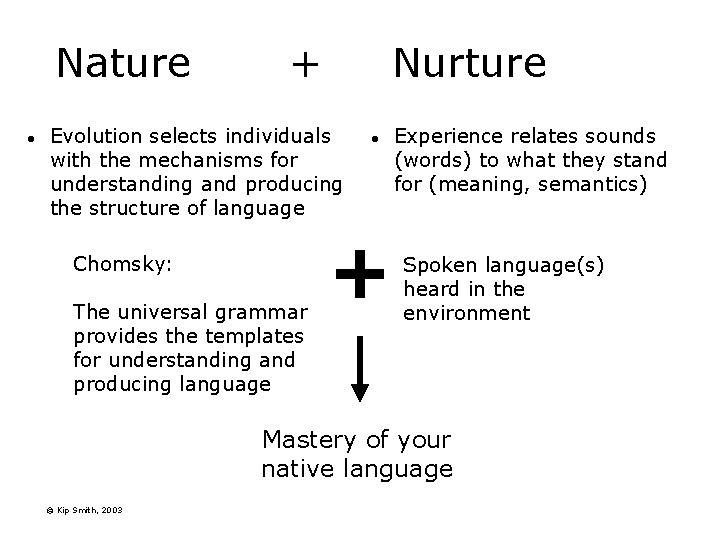
Nature l + Nurture Evolution selects individuals with the mechanisms for understanding and producing the structure of language Chomsky: The universal grammar provides the templates for understanding and producing language l + Experience relates sounds (words) to what they stand for (meaning, semantics) Spoken language(s) heard in the environment Mastery of your native language © Kip Smith, 2003
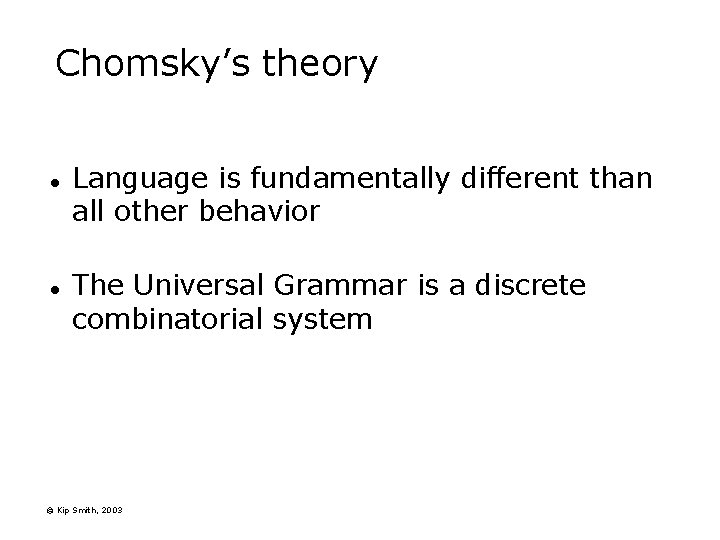
Chomsky’s theory l l Language is fundamentally different than all other behavior The Universal Grammar is a discrete combinatorial system © Kip Smith, 2003
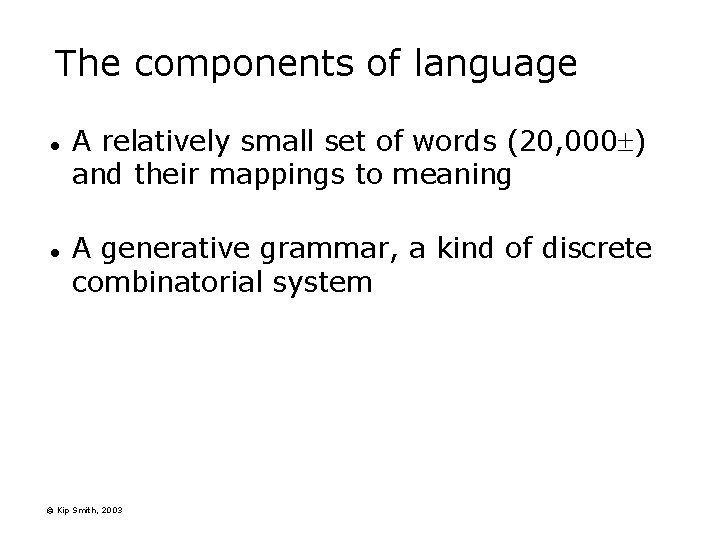
The components of language l l A relatively small set of words (20, 000 ) and their mappings to meaning A generative grammar, a kind of discrete combinatorial system © Kip Smith, 2003
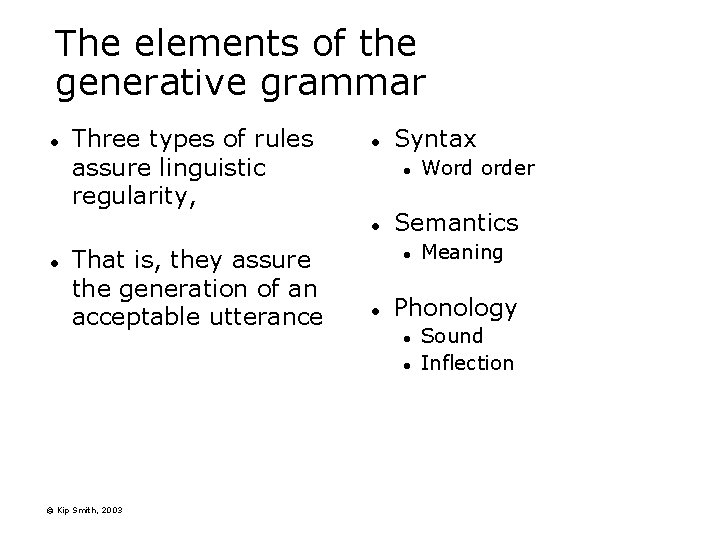
The elements of the generative grammar l Three types of rules assure linguistic regularity, l l That is, they assure the generation of an acceptable utterance Syntax Semantics l l Meaning Phonology l l © Kip Smith, 2003 Word order Sound Inflection
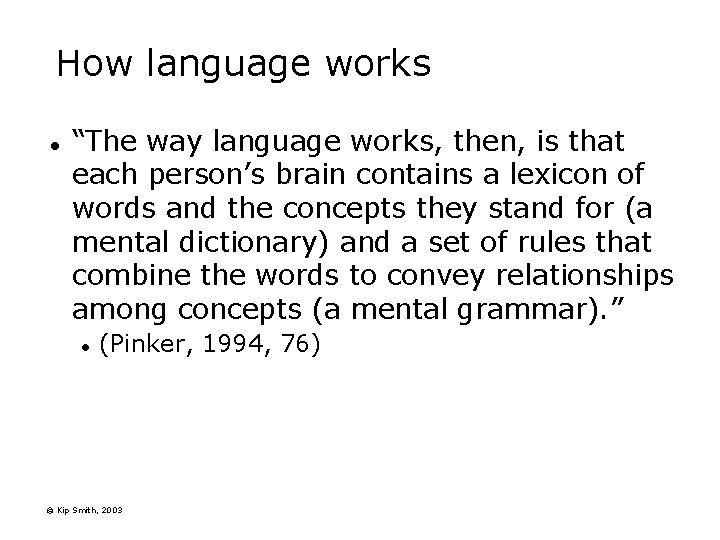
How language works l “The way language works, then, is that each person’s brain contains a lexicon of words and the concepts they stand for (a mental dictionary) and a set of rules that combine the words to convey relationships among concepts (a mental grammar). ” l (Pinker, 1994, 76) © Kip Smith, 2003
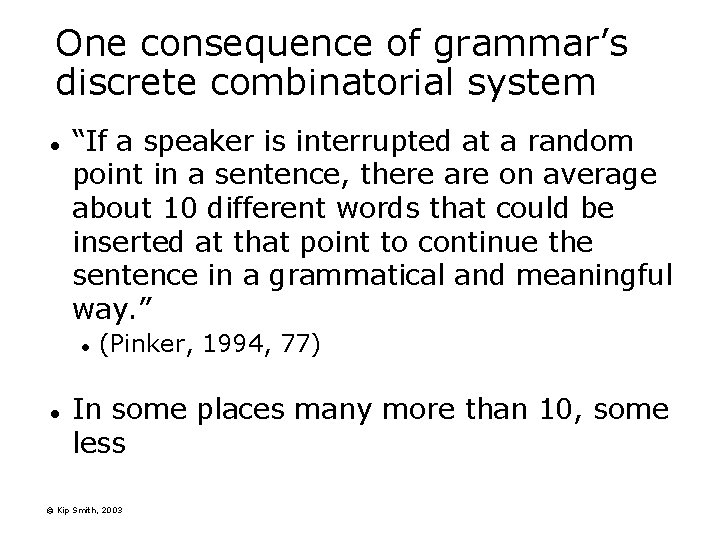
One consequence of grammar’s discrete combinatorial system l “If a speaker is interrupted at a random point in a sentence, there are on average about 10 different words that could be inserted at that point to continue the sentence in a grammatical and meaningful way. ” l l (Pinker, 1994, 77) In some places many more than 10, some less © Kip Smith, 2003
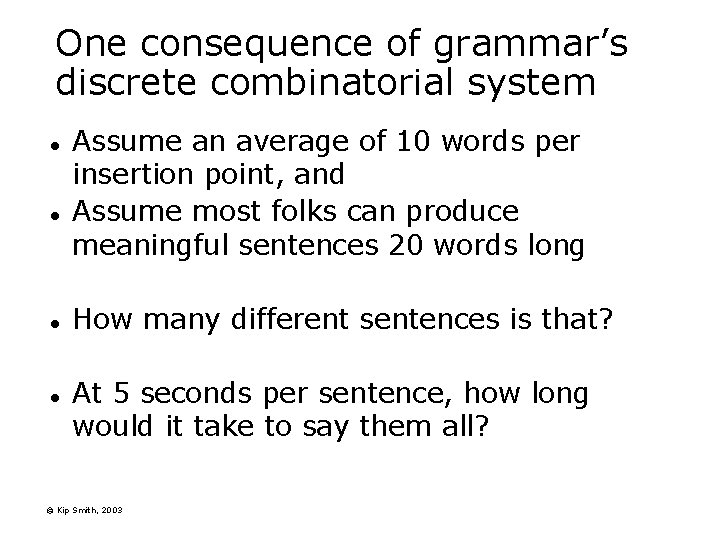
One consequence of grammar’s discrete combinatorial system l l Assume an average of 10 words per insertion point, and Assume most folks can produce meaningful sentences 20 words long How many different sentences is that? At 5 seconds per sentence, how long would it take to say them all? © Kip Smith, 2003
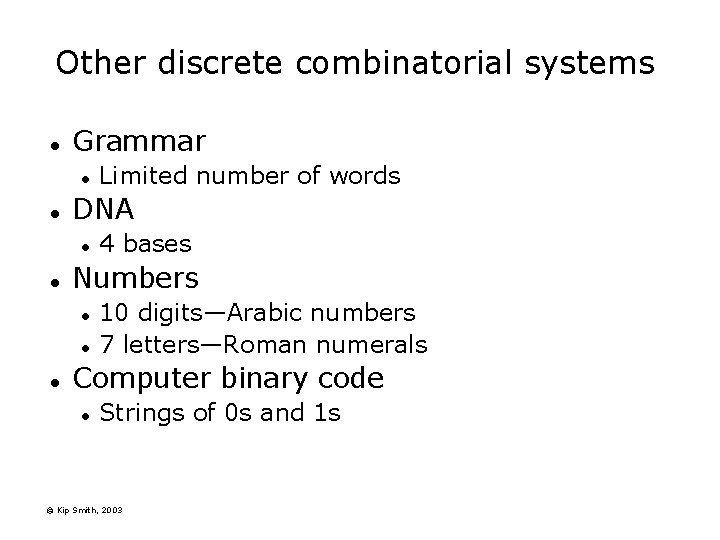
Other discrete combinatorial systems l Grammar l l DNA l l 4 bases Numbers l l l Limited number of words 10 digits—Arabic numbers 7 letters—Roman numerals Computer binary code l Strings of 0 s and 1 s © Kip Smith, 2003
The scientific method Observations Support or Refine Hypotheses © Kip Smith, 2003 Generate Drive Testing & Experimentation
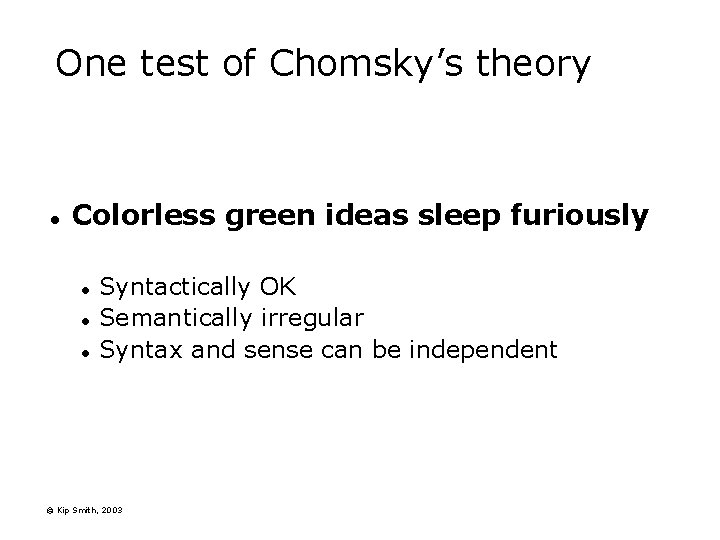
One test of Chomsky’s theory l Colorless green ideas sleep furiously l l l Syntactically OK Semantically irregular Syntax and sense can be independent © Kip Smith, 2003
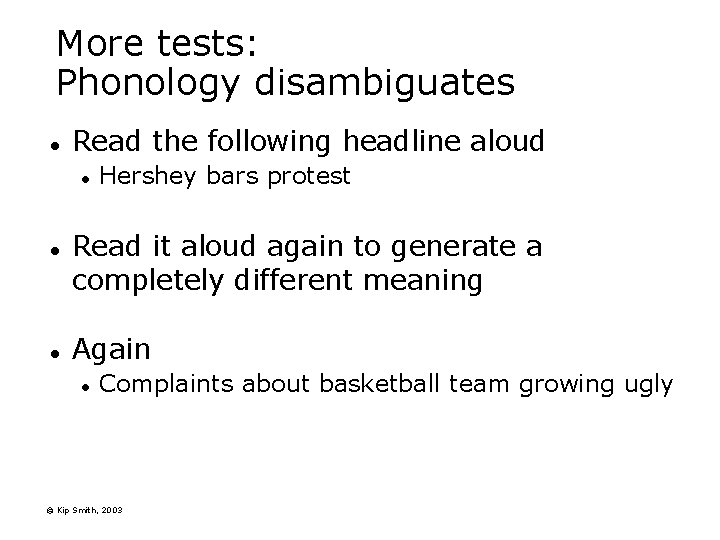
More tests: Phonology disambiguates l Read the following headline aloud l l l Hershey bars protest Read it aloud again to generate a completely different meaning Again l Complaints about basketball team growing ugly © Kip Smith, 2003
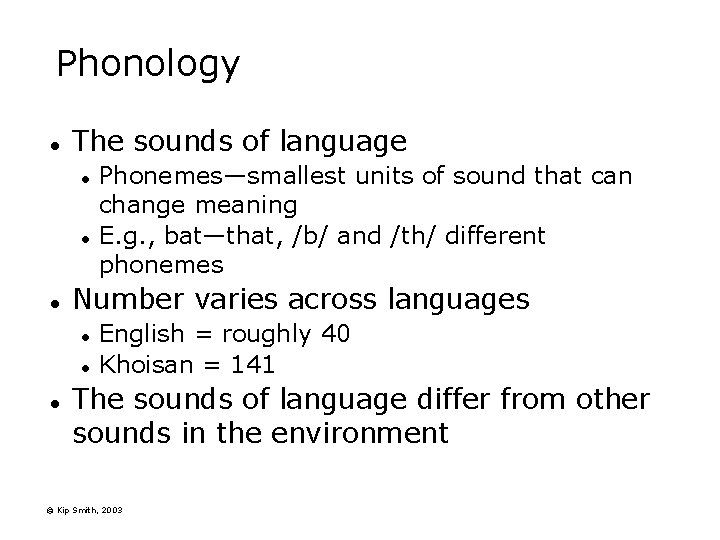
Phonology l The sounds of language l l l Number varies across languages l l l Phonemes—smallest units of sound that can change meaning E. g. , bat—that, /b/ and /th/ different phonemes English = roughly 40 Khoisan = 141 The sounds of language differ from other sounds in the environment © Kip Smith, 2003
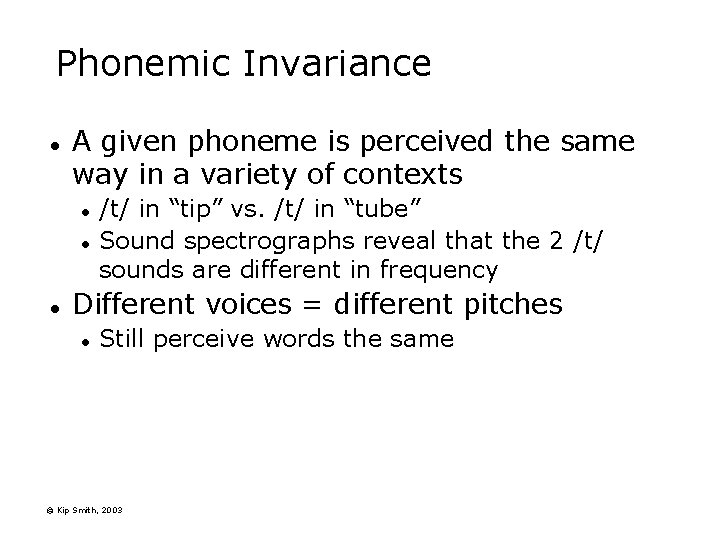
Phonemic Invariance l A given phoneme is perceived the same way in a variety of contexts l l l /t/ in “tip” vs. /t/ in “tube” Sound spectrographs reveal that the 2 /t/ sounds are different in frequency Different voices = different pitches l Still perceive words the same © Kip Smith, 2003
X-Bar Theory of Phrase Structure Chomsky’s 1965 Aspects of a Theory of Syntax © Kip Smith, 2003
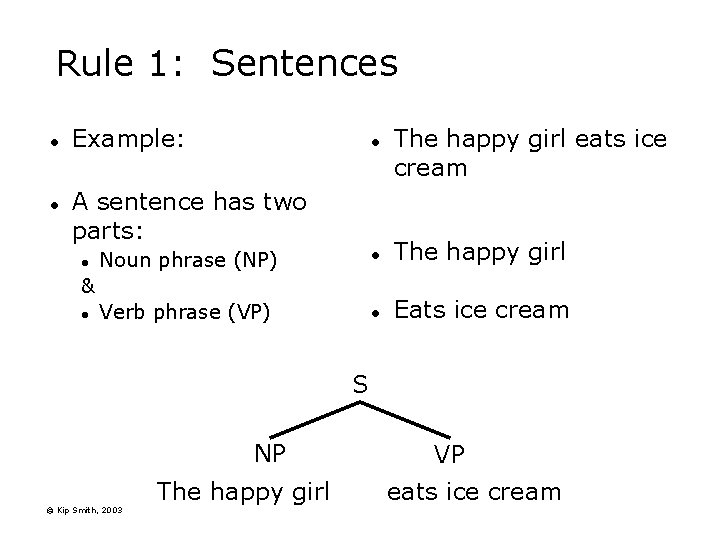
Rule 1: Sentences l l Example: l A sentence has two parts: l Noun phrase (NP) l The happy girl Verb phrase (VP) l Eats ice cream & l The happy girl eats ice cream S NP © Kip Smith, 2003 The happy girl VP eats ice cream
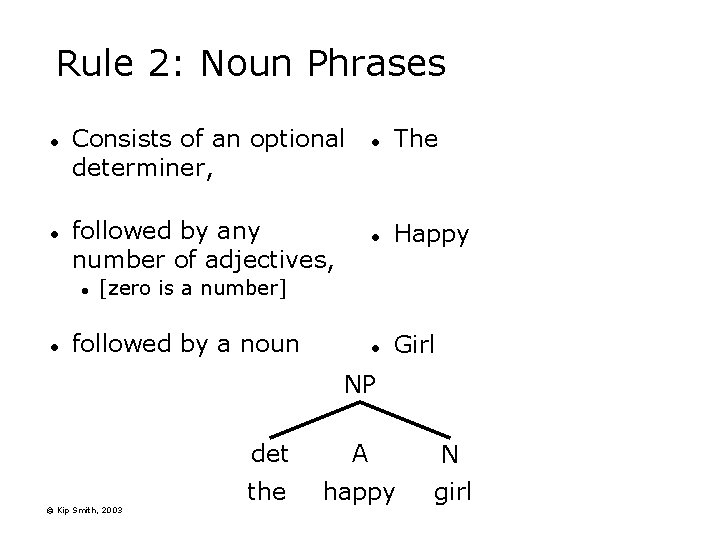
Rule 2: Noun Phrases l l Consists of an optional determiner, followed by any number of adjectives, l l l The l Happy l Girl [zero is a number] followed by a noun NP © Kip Smith, 2003 det A N the happy girl
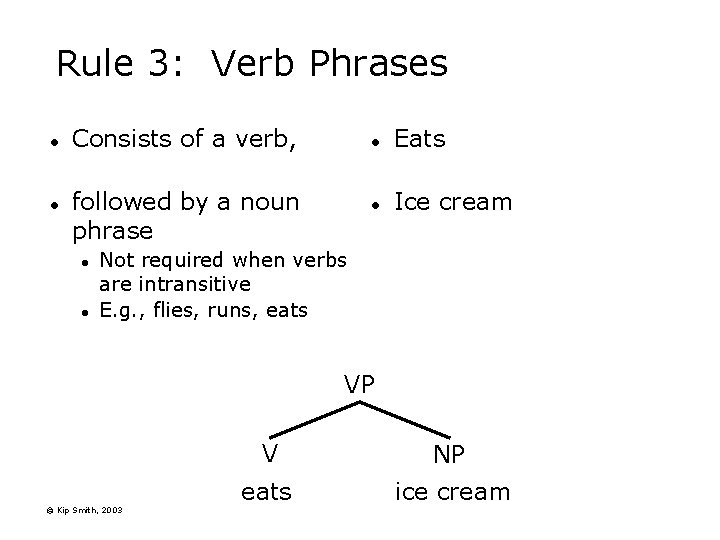
Rule 3: Verb Phrases l l Consists of a verb, followed by a noun phrase l l l Eats l Ice cream Not required when verbs are intransitive E. g. , flies, runs, eats VP © Kip Smith, 2003 V NP eats ice cream
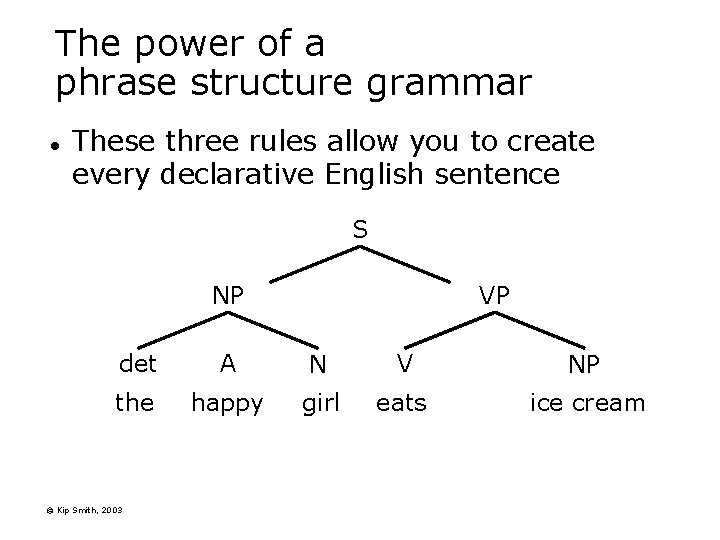
The power of a phrase structure grammar l These three rules allow you to create every declarative English sentence S NP VP det A N V NP the happy girl eats ice cream © Kip Smith, 2003
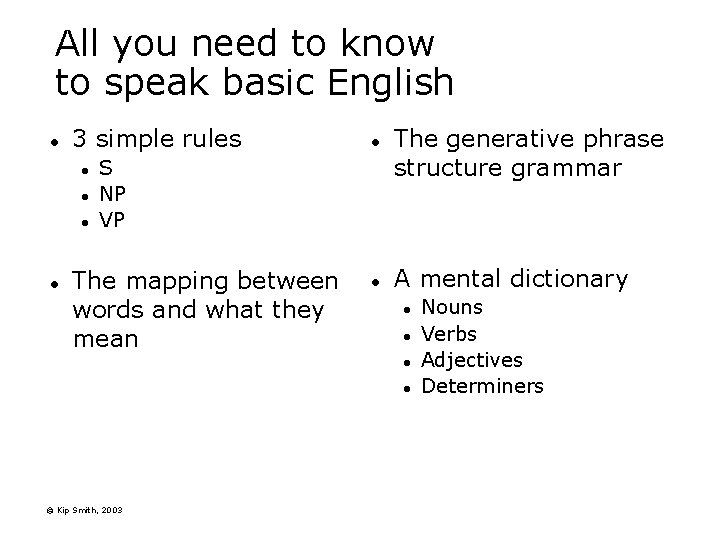
All you need to know to speak basic English l 3 simple rules l l l S NP VP The mapping between words and what they mean l The generative phrase structure grammar A mental dictionary l l © Kip Smith, 2003 Nouns Verbs Adjectives Determiners
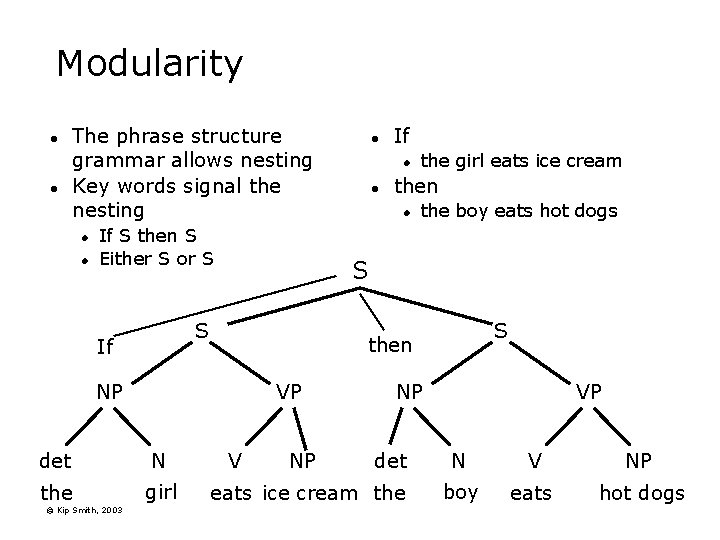
Modularity l l The phrase structure grammar allows nesting Key words signal the nesting l l If S then S Either S or S VP N the girl © Kip Smith, 2003 l l the girl eats ice cream then l the boy eats hot dogs S then NP det If S S If l V NP NP det eats ice cream the VP N V NP boy eats hot dogs
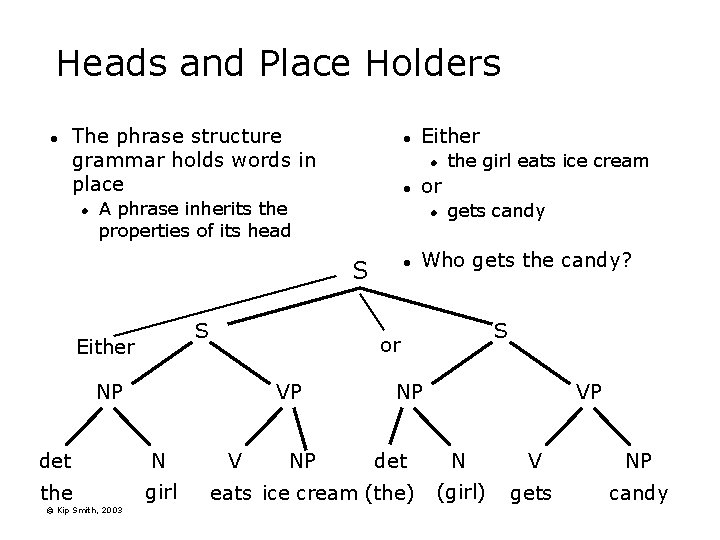
Heads and Place Holders l The phrase structure grammar holds words in place l l A phrase inherits the properties of its head Either VP N the girl © Kip Smith, 2003 gets candy Who gets the candy? S or NP det l the girl eats ice cream or l S S Either V NP NP det eats ice cream (the) VP N V NP (girl) gets candy
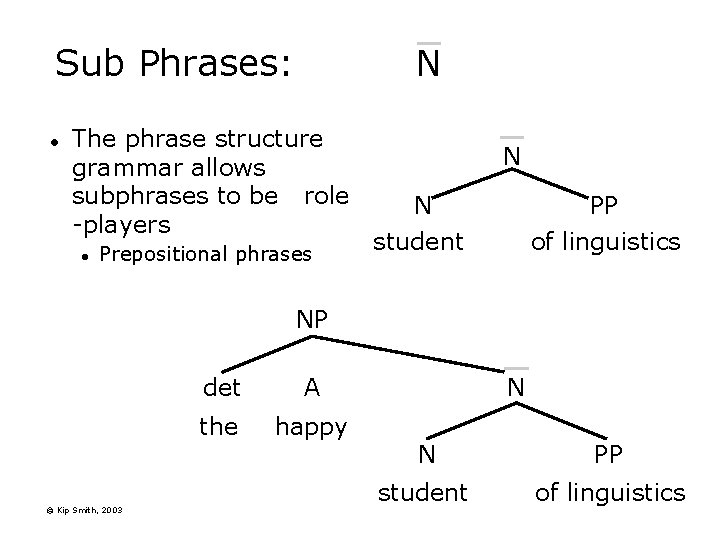
N Sub Phrases: l The phrase structure grammar allows subphrases to be role -players l Prepositional phrases N N student PP of linguistics NP © Kip Smith, 2003 det A the happy N N PP student of linguistics
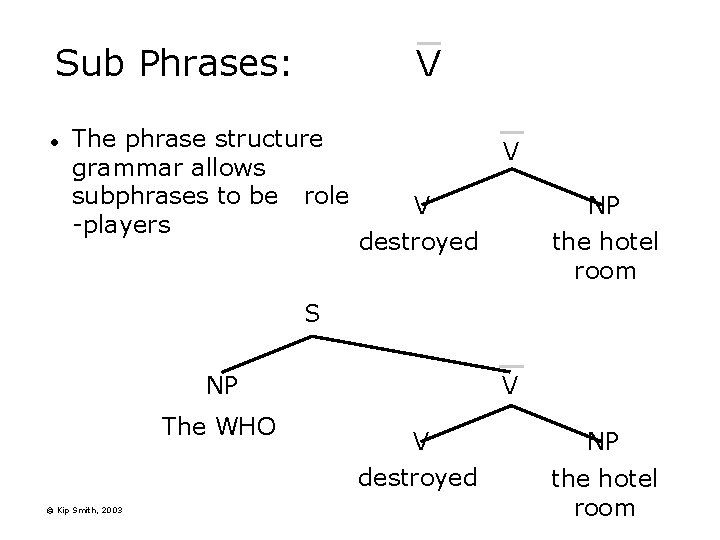
V Sub Phrases: l The phrase structure grammar allows subphrases to be role -players V V destroyed NP the hotel room S NP The WHO © Kip Smith, 2003 V V destroyed NP the hotel room
X-bar l X “With this common design, there is no need to write out a long list of rules to capture what is inside a speaker’s head. There may be just one pair of super-rules for the entire language, where the distinction among nouns, verbs, prepositions, and adjectives are collapsed and all four are specified with a variable like “X. ” l (Pinker, 1994, 103) © Kip Smith, 2003
X l l l An X-bar consists of a head word, followed by any number of role-players. A phrase consists of an optional subject, followed by an X-bar, followed by any number of modifiers This streamlined version of phrase structure is called “the X-bar theory” © Kip Smith, 2003
Categorical Perception l Voice Onset Time (VOT) l l Time between when the sound is released at the lips and when the vocal cords begin to vibrate [ba] vs. [pa] l l l /b/ is voiced, VOT for [ba] typically 0 ms /p/ is not, VOT for [pa] typically around 40 ms Categorical perception l Perceive discrete phonemic categories despite gradual changes in VOT © Kip Smith, 2003
Categorical Perception © Kip Smith, 2003
Categorical Perception Chance Category Boundary © Kip Smith, 2003
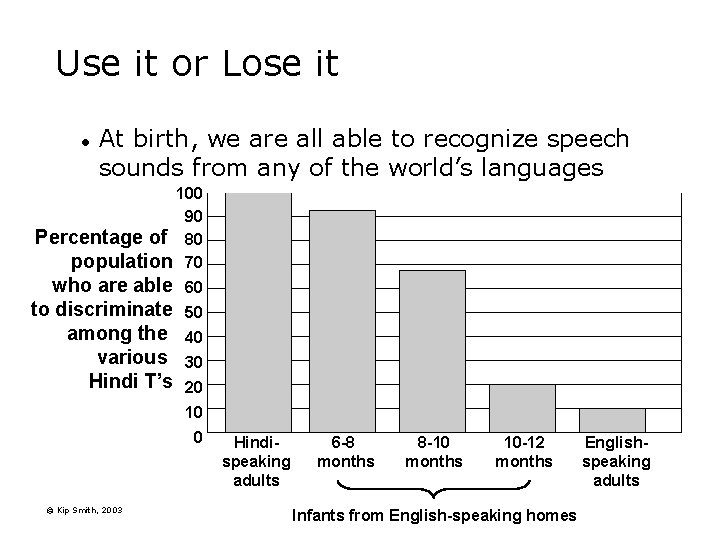
Use it or Lose it l At birth, we are all able to recognize speech sounds from any of the world’s languages 100 90 Percentage of 80 population 70 who are able to discriminate among the various Hindi T’s 60 50 40 30 20 10 0 © Kip Smith, 2003 Hindispeaking adults 6 -8 months 8 -10 months 10 -12 months Infants from English-speaking homes Englishspeaking adults
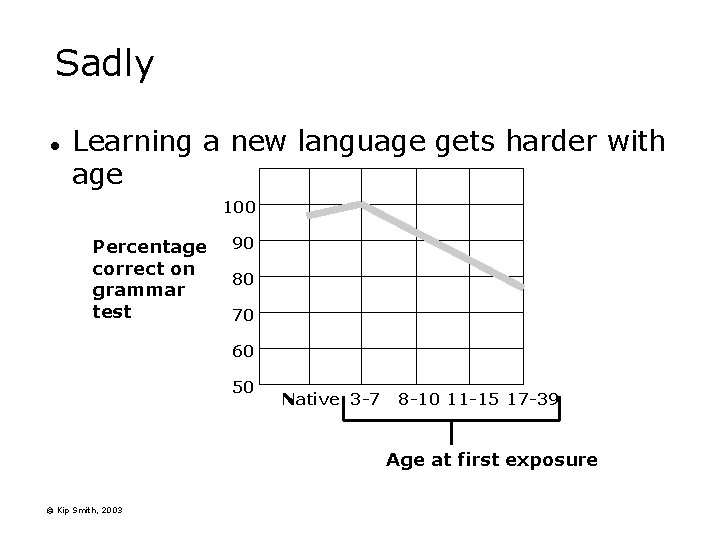
Sadly l Learning a new language gets harder with age 100 Percentage correct on grammar test 90 80 70 60 50 Native 3 -7 8 -10 11 -15 17 -39 Age at first exposure © Kip Smith, 2003
Why? l Critical Period Hypothesis (Lenneberg, 1969) l l l Children must be exposed to language within a given period to learn it correctly Set end of critical period at puberty More supportive environment for children l l l Mistakes tolerated more Adults don’t like to appear Peers in similar situation © Kip Smith, 2003
Why would language evolve? l l To enable the transmission of knowledge from one generation to the next? To establish order in the social group? To assess what others know? To provide a means for revealing your fitness and reproductive potential? l l l A peacock feather? A fitness display? An aid to courtship? © Kip Smith, 2003
Colorless green ideas sleep furiously - Noam Chomsky © Kip Smith, 2003