
Psychological WellBeing Differences Among Atheists Agnostics and Fundamentalists
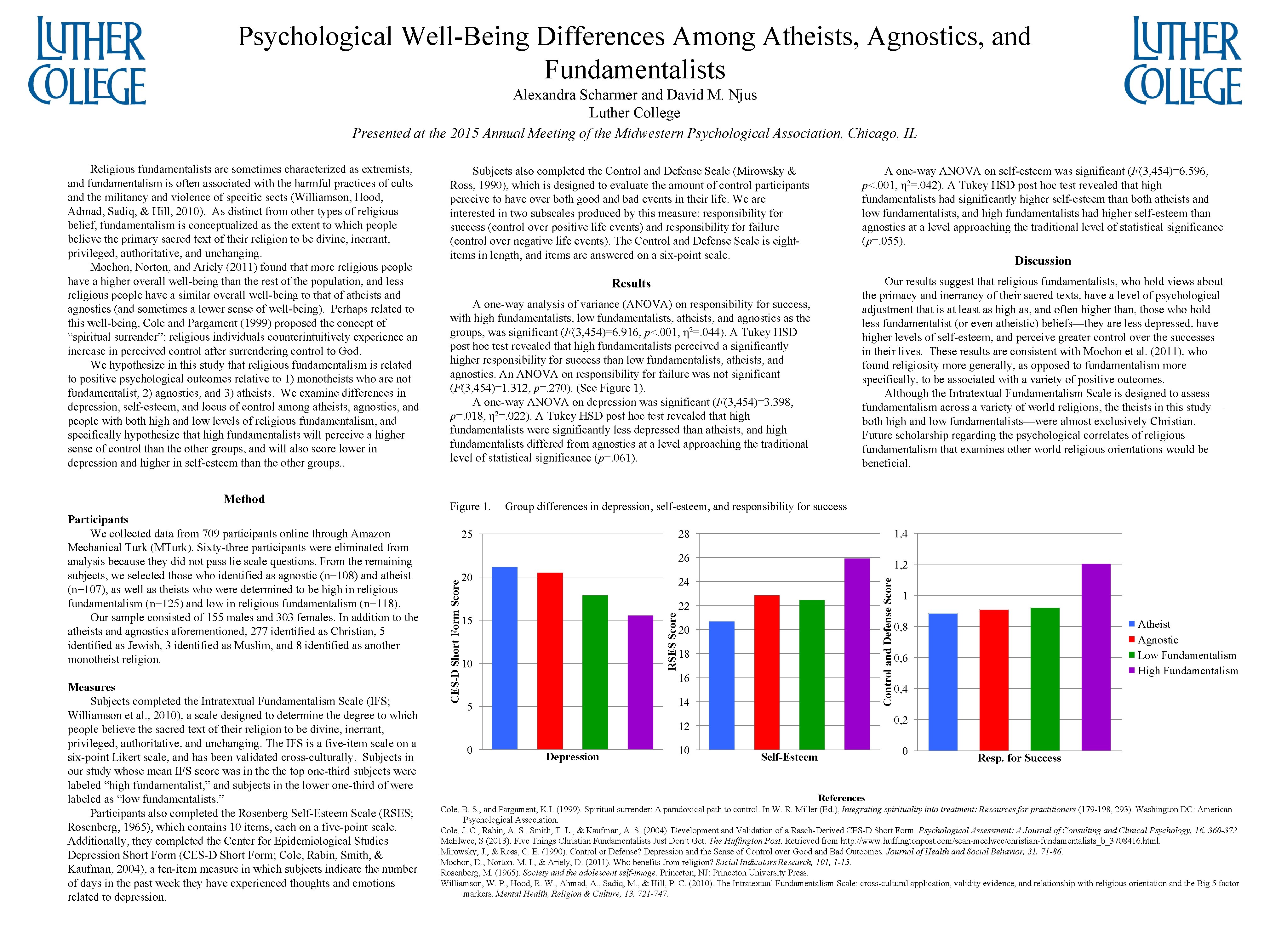
Psychological Well-Being Differences Among Atheists, Agnostics, and Fundamentalists Alexandra Scharmer and David M. Njus Luther College Presented at the 2015 Annual Meeting of the Midwestern Psychological Association, Chicago, IL Measures Subjects completed the Intratextual Fundamentalism Scale (IFS; Williamson et al. , 2010), a scale designed to determine the degree to which people believe the sacred text of their religion to be divine, inerrant, privileged, authoritative, and unchanging. The IFS is a five-item scale on a six-point Likert scale, and has been validated cross-culturally. Subjects in our study whose mean IFS score was in the top one-third subjects were labeled “high fundamentalist, ” and subjects in the lower one-third of were labeled as “low fundamentalists. ” Participants also completed the Rosenberg Self-Esteem Scale (RSES; Rosenberg, 1965), which contains 10 items, each on a five-point scale. Additionally, they completed the Center for Epidemiological Studies Depression Short Form (CES-D Short Form; Cole, Rabin, Smith, & Kaufman, 2004), a ten-item measure in which subjects indicate the number of days in the past week they have experienced thoughts and emotions related to depression. Results Our results suggest that religious fundamentalists, who hold views about the primacy and inerrancy of their sacred texts, have a level of psychological adjustment that is at least as high as, and often higher than, those who hold less fundamentalist (or even atheistic) beliefs—they are less depressed, have higher levels of self-esteem, and perceive greater control over the successes in their lives. These results are consistent with Mochon et al. (2011), who found religiosity more generally, as opposed to fundamentalism more specifically, to be associated with a variety of positive outcomes. Although the Intratextual Fundamentalism Scale is designed to assess fundamentalism across a variety of world religions, theists in this study— both high and low fundamentalists—were almost exclusively Christian. Future scholarship regarding the psychological correlates of religious fundamentalism that examines other world religious orientations would be beneficial. Discussion A one-way analysis of variance (ANOVA) on responsibility for success, with high fundamentalists, low fundamentalists, atheists, and agnostics as the groups, was significant (F(3, 454)=6. 916, p<. 001, η 2=. 044). A Tukey HSD post hoc test revealed that high fundamentalists perceived a significantly higher responsibility for success than low fundamentalists, atheists, and agnostics. An ANOVA on responsibility for failure was not significant (F(3, 454)=1. 312, p=. 270). (See Figure 1). A one-way ANOVA on depression was significant (F(3, 454)=3. 398, p=. 018, η 2=. 022). A Tukey HSD post hoc test revealed that high fundamentalists were significantly less depressed than atheists, and high fundamentalists differed from agnostics at a level approaching the traditional level of statistical significance (p=. 061). Figure 1. Group differences in depression, self-esteem, and responsibility for success 1, 4 28 25 26 20 1, 2 24 Control and Defense Score Participants We collected data from 709 participants online through Amazon Mechanical Turk (MTurk). Sixty-three participants were eliminated from analysis because they did not pass lie scale questions. From the remaining subjects, we selected those who identified as agnostic (n=108) and atheist (n=107), as well as theists who were determined to be high in religious fundamentalism (n=125) and low in religious fundamentalism (n=118). Our sample consisted of 155 males and 303 females. In addition to the atheists and agnostics aforementioned, 277 identified as Christian, 5 identified as Jewish, 3 identified as Muslim, and 8 identified as another monotheist religion. A one-way ANOVA on self-esteem was significant (F(3, 454)=6. 596, p<. 001, η 2=. 042). A Tukey HSD post hoc test revealed that high fundamentalists had significantly higher self-esteem than both atheists and low fundamentalists, and high fundamentalists had higher self-esteem than agnostics at a level approaching the traditional level of statistical significance (p=. 055). 22 RSES Score Method Subjects also completed the Control and Defense Scale (Mirowsky & Ross, 1990), which is designed to evaluate the amount of control participants perceive to have over both good and bad events in their life. We are interested in two subscales produced by this measure: responsibility for success (control over positive life events) and responsibility for failure (control over negative life events). The Control and Defense Scale is eightitems in length, and items are answered on a six-point scale. CES-D Short Form Score Religious fundamentalists are sometimes characterized as extremists, and fundamentalism is often associated with the harmful practices of cults and the militancy and violence of specific sects (Williamson, Hood, Admad, Sadiq, & Hill, 2010). As distinct from other types of religious belief, fundamentalism is conceptualized as the extent to which people believe the primary sacred text of their religion to be divine, inerrant, privileged, authoritative, and unchanging. Mochon, Norton, and Ariely (2011) found that more religious people have a higher overall well-being than the rest of the population, and less religious people have a similar overall well-being to that of atheists and agnostics (and sometimes a lower sense of well-being). Perhaps related to this well-being, Cole and Pargament (1999) proposed the concept of “spiritual surrender”: religious individuals counterintuitively experience an increase in perceived control after surrendering control to God. We hypothesize in this study that religious fundamentalism is related to positive psychological outcomes relative to 1) monotheists who are not fundamentalist, 2) agnostics, and 3) atheists. We examine differences in depression, self-esteem, and locus of control among atheists, agnostics, and people with both high and low levels of religious fundamentalism, and specifically hypothesize that high fundamentalists will perceive a higher sense of control than the other groups, and will also score lower in depression and higher in self-esteem than the other groups. . 15 10 20 18 16 14 5 Depression 10 Atheist Agnostic Low Fundamentalism High Fundamentalism 0, 8 0, 6 0, 4 0, 2 12 0 1 Self-Esteem 0 Resp. for Success References Cole, B. S. , and Pargament, K. I. (1999). Spiritual surrender: A paradoxical path to control. In W. R. Miller (Ed. ), Integrating spirituality into treatment: Resources for practitioners (179 -198, 293). Washington DC: American Psychological Association. Cole, J. C. , Rabin, A. S. , Smith, T. L. , & Kaufman, A. S. (2004). Development and Validation of a Rasch-Derived CES-D Short Form. Psychological Assessment: A Journal of Consulting and Clinical Psychology, 16, 360 -372. Mc. Elwee, S (2013). Five Things Christian Fundamentalists Just Don’t Get. The Huffington Post. Retrieved from http: //www. huffingtonpost. com/sean-mcelwee/christian-fundamentalists_b_3708416. html. Mirowsky, J. , & Ross, C. E. (1990). Control or Defense? Depression and the Sense of Control over Good and Bad Outcomes. Journal of Health and Social Behavior, 31, 71 -86. Mochon, D. , Norton, M. I. , & Ariely, D. (2011). Who benefits from religion? Social Indicators Research, 101, 1 -15. Rosenberg, M. (1965). Society and the adolescent self-image. Princeton, NJ: Princeton University Press. Williamson, W. P. , Hood, R. W. , Ahmad, A. , Sadiq, M. , & Hill, P. C. (2010). The Intratextual Fundamentalism Scale: cross-cultural application, validity evidence, and relationship with religious orientation and the Big 5 factor markers. Mental Health, Religion & Culture, 13, 721 -747.
- Slides: 1