
Psychological Research Methods Why is Research Important Method
- Slides: 14
Psychological Research Methods
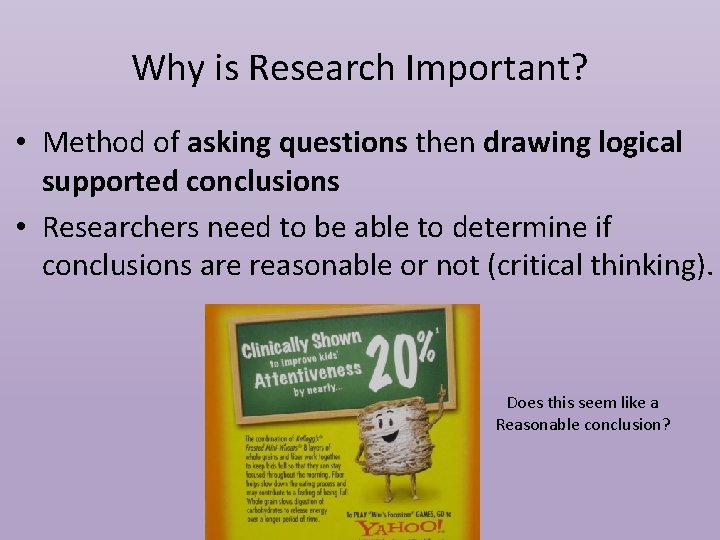
Why is Research Important? • Method of asking questions then drawing logical supported conclusions • Researchers need to be able to determine if conclusions are reasonable or not (critical thinking). Does this seem like a Reasonable conclusion?
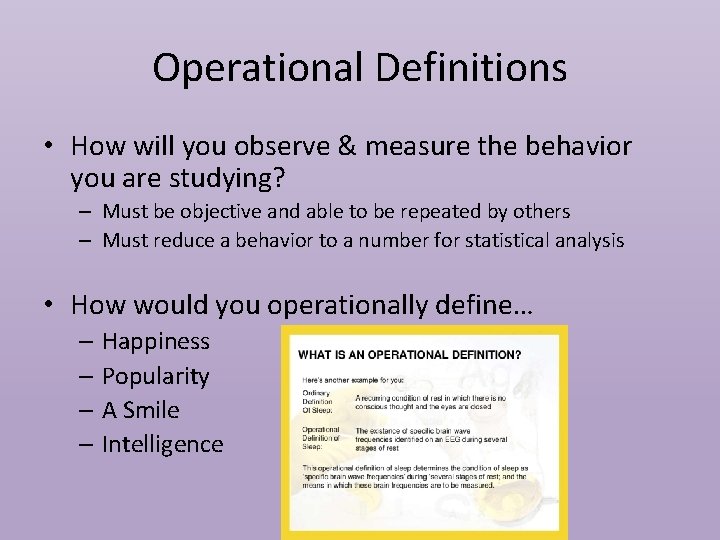
Operational Definitions • How will you observe & measure the behavior you are studying? – Must be objective and able to be repeated by others – Must reduce a behavior to a number for statistical analysis • How would you operationally define… – Happiness – Popularity – A Smile – Intelligence
Replication • For a study to be valid, it must be… • Replicated/Repeated with different people in different situations to determine if the results from the original study are correct • Only then can results be generalized (applied to most people)
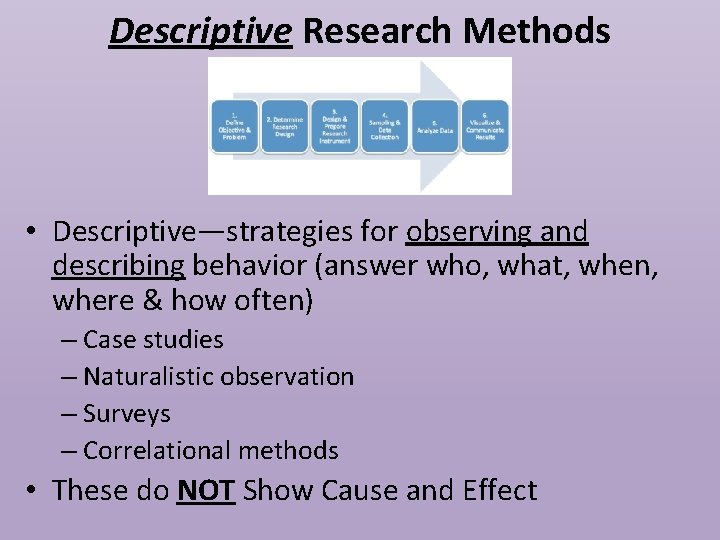
Descriptive Research Methods • Descriptive—strategies for observing and describing behavior (answer who, what, when, where & how often) – Case studies – Naturalistic observation – Surveys – Correlational methods • These do NOT Show Cause and Effect
Case Study • In depth study of one individual with the hopes of determining universal principles • Difficulty of applying data from one person to everyone • Generally used to investigate rare, unusual, or extreme conditions
Naturalistic Observation • Method of observation where subjects are observed in their “natural” environment • Subjects are not aware they are being watched • Could use hidden cameras or two way mirrors • Only describes behavior, NOT explain it.
Enemy to Naturalistic Observation: Participant Bias/ Hawthorne Effect • Tendency of research subjects to respond in certain ways because they know they are being observed • The subjects might try to behave in ways they believe the researcher wants them to behave • Subject can’t know they’re being watched or they’ll change their behavior! • Named after Hawthorne Works study on productivity where every variable looked at (levels of light, listening to music) increased worker productivity? Why?
Survey Method • Research method that relies on self-reports to find out attitudes and behaviors of a particular group. • Usually a very efficient and inexpensive method • Be careful what we take from polling information: • 20 Questions to Ask About Poll/Survey Results • Watch out for Framing/Wording Effects – The way a question is worded can bias the answer.
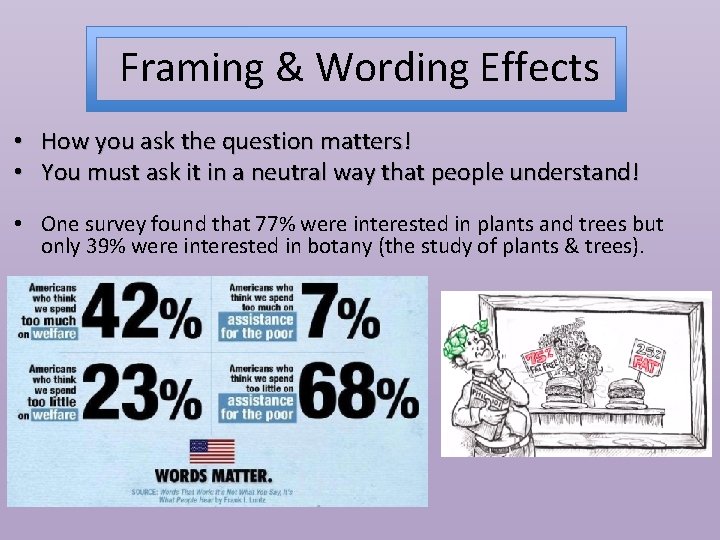
Framing & Wording Effects • How you ask the question matters! • You must ask it in a neutral way that people understand! • One survey found that 77% were interested in plants and trees but only 39% were interested in botany (the study of plants & trees).
Sampling. Terms • Population—large (potentially infinite) group represented by the sample. Findings are generalized to this group. • Sample—selected segment of the population • Random selection—every member of larger group has equal chance of being selected for the study sample • Random Sample – Results from random selection, each member of the population had an equal chance of being included. – If a sample is not random it is said to be biased. • Representative/Stratified sample—closely parallels the population on relevant characteristics – Your goal is to get a representative sample and avoid sampling bias – unrepresentative sample that can’t be generalized on the rest of the population. • Watch this short clip on the difference between these. (3 min)
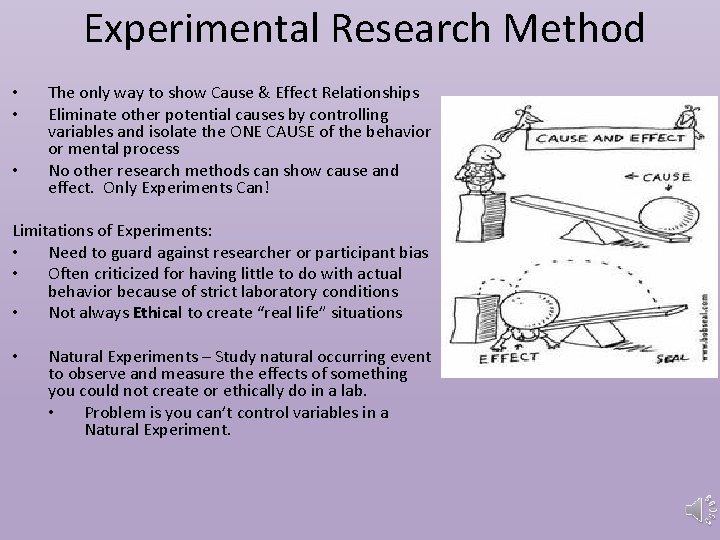
Experimental Research Method • • • The only way to show Cause & Effect Relationships Eliminate other potential causes by controlling variables and isolate the ONE CAUSE of the behavior or mental process No other research methods can show cause and effect. Only Experiments Can! Limitations of Experiments: • Need to guard against researcher or participant bias • Often criticized for having little to do with actual behavior because of strict laboratory conditions • Not always Ethical to create “real life” situations • Natural Experiments – Study natural occurring event to observe and measure the effects of something you could not create or ethically do in a lab. • Problem is you can’t control variables in a Natural Experiment.
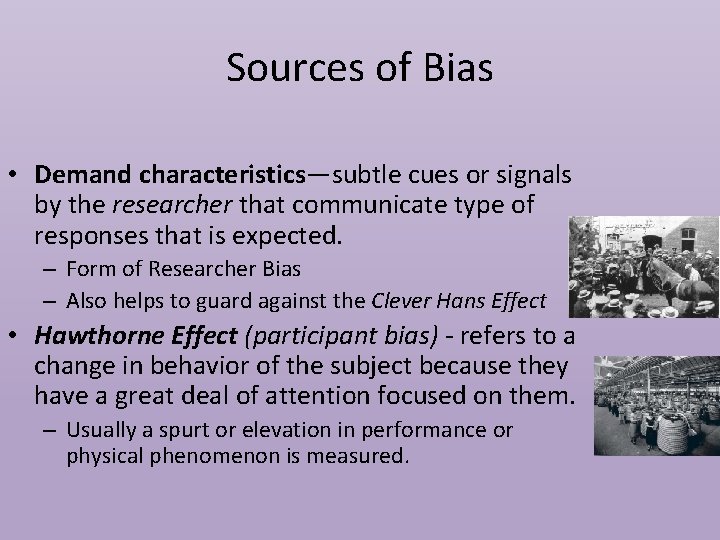
Sources of Bias • Demand characteristics—subtle cues or signals by the researcher that communicate type of responses that is expected. – Form of Researcher Bias – Also helps to guard against the Clever Hans Effect • Hawthorne Effect (participant bias) - refers to a change in behavior of the subject because they have a great deal of attention focused on them. – Usually a spurt or elevation in performance or physical phenomenon is measured.
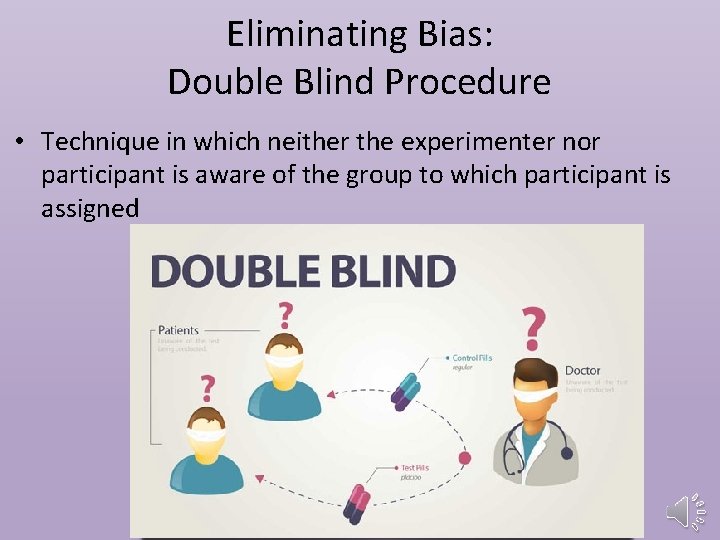
Eliminating Bias: Double Blind Procedure • Technique in which neither the experimenter nor participant is aware of the group to which participant is assigned