
Psychological research Chapter 2 Why is research important


- Slides: 33
Psychological research Chapter 2
Why is research important? Research enables scientists to separate fact from opinions. Opinions- personal judgments, conclusions, or attitudes that may or may not be accurate Facts- objective and verifiable observations
Reasoning and ideas The scientific process is circular, and the types of reasoning within the circle are called deductive reasoning (ideas tested against the empirical world) and inductive reasoning (empirical observations leading to new ideas).
Reasoning and ideas Theory- well-developed set of ideas that purpose an explanation for observed phenomena Hypothesis- tentative and testable statement about the relationship between two or more variables. (Confirm or falsify)
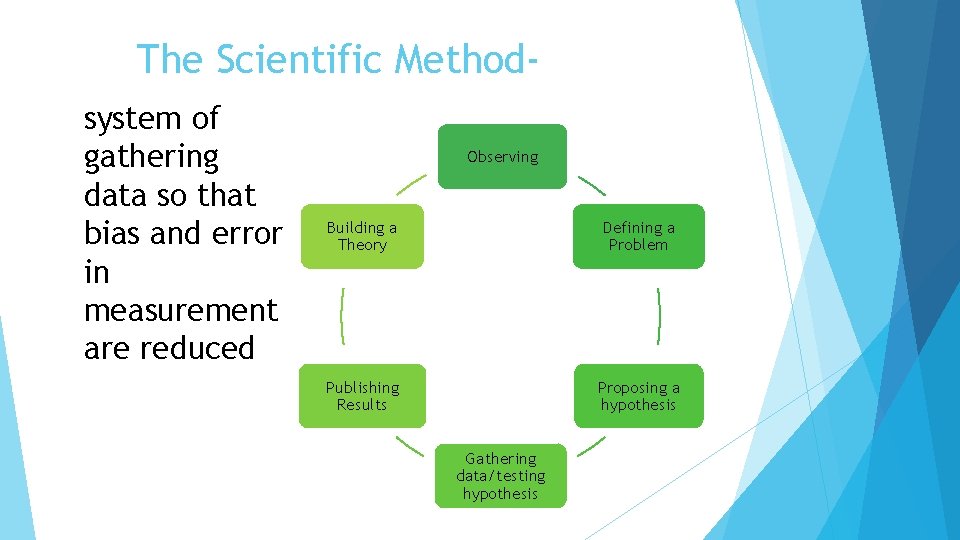
The Scientific Methodsystem of gathering data so that bias and error in measurement are reduced Observing Building a Theory Defining a Problem Publishing Results Proposing a hypothesis Gathering data/testing hypothesis
Descriptive Methods of Research- Methods of research that are used to describe behavior. Naturalistic observation–watching animals or humans behave in their natural setting.
Descriptive Methods of Research Major advantage: realistic picture of behavior Disadvantages Difficult to set up and control, and it can be costly observer effect: tendency of people or animals to behave differently when they know they are being observed observer bias: tendency of observers to see what they expect to see
Figure 2. 8 (a) Jane Goodall made a career of conducting naturalistic observations of (b) chimpanzee behavior. (credit “Jane Goodall”: modification of work by Erik Hersman; “chimpanzee”: modification of work by “Afrika Force”/Flickr. com) This Open. Stax ancillary resource is © Rice University under a CC-BY 4. 0 International license; it may be reproduced or modified but must be attributed to Open. Stax, Rice University and any changes must be noted. Any images credited to other sources are similarly available for reproduction, but must be attributed to their sources.
Descriptive Methods of Research Clinical or Case Studies- observational research study focusing on one individual or a few people. advantage tremendous amount of detail disadvantage cannot apply to others
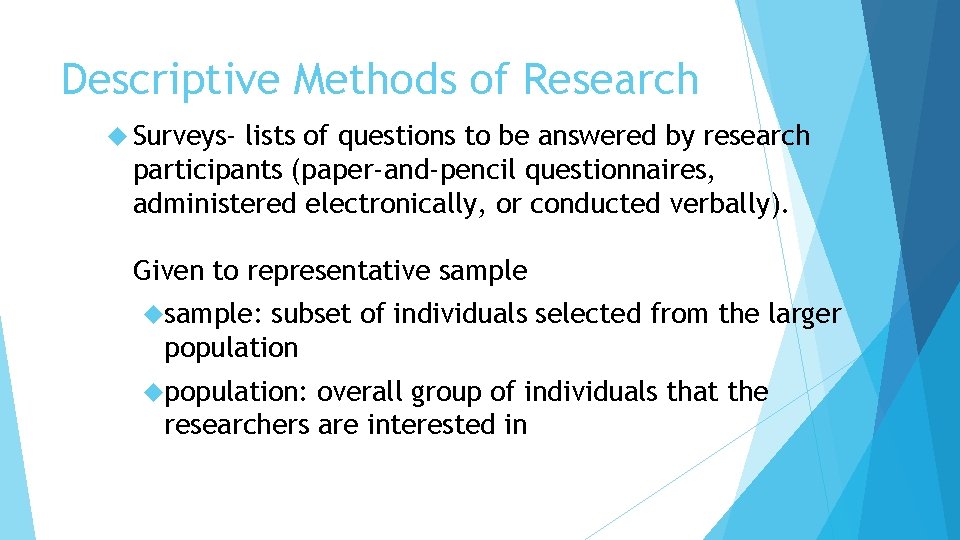
Descriptive Methods of Research Surveys- lists of questions to be answered by research participants (paper-and-pencil questionnaires, administered electronically, or conducted verbally). Given to representative sample: subset of individuals selected from the larger population: overall group of individuals that the researchers are interested in
Survey data advantages from large numbers of people study Survey covert behaviors disadvantages researchers have to ensure representative sample or the results are not meaningful people are not always accurate (courtesy bias)
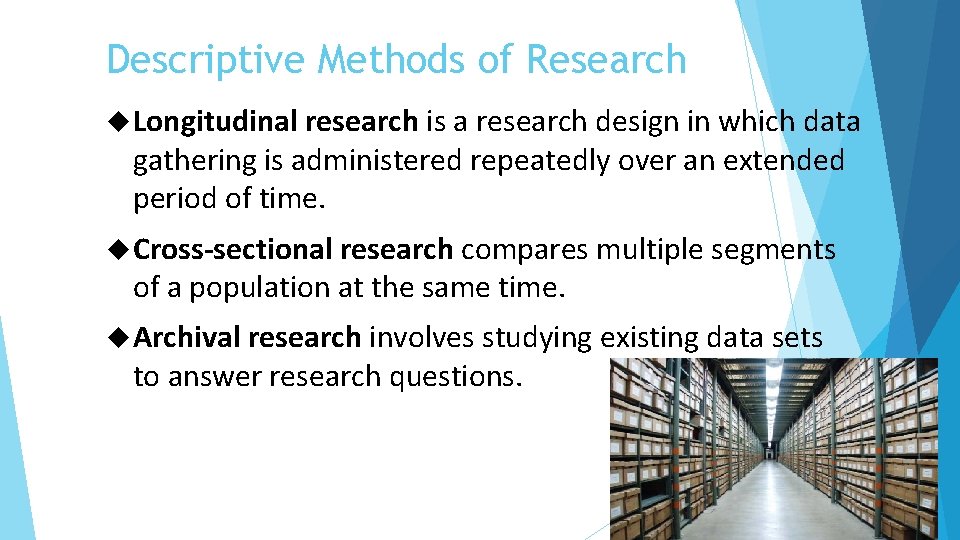
Descriptive Methods of Research Longitudinal research is a research design in which data gathering is administered repeatedly over an extended period of time. Cross-sectional research compares multiple segments of a population at the same time. Archival research involves studying existing data sets to answer research questions.
Correlational research Correlation- relationship between two or more variables. When two variables are correlated, one variable changes as the other does. Relationship allows prediction Cannot infer causation Correlation is measured by calculating a statistic known as a correlation coefficient.
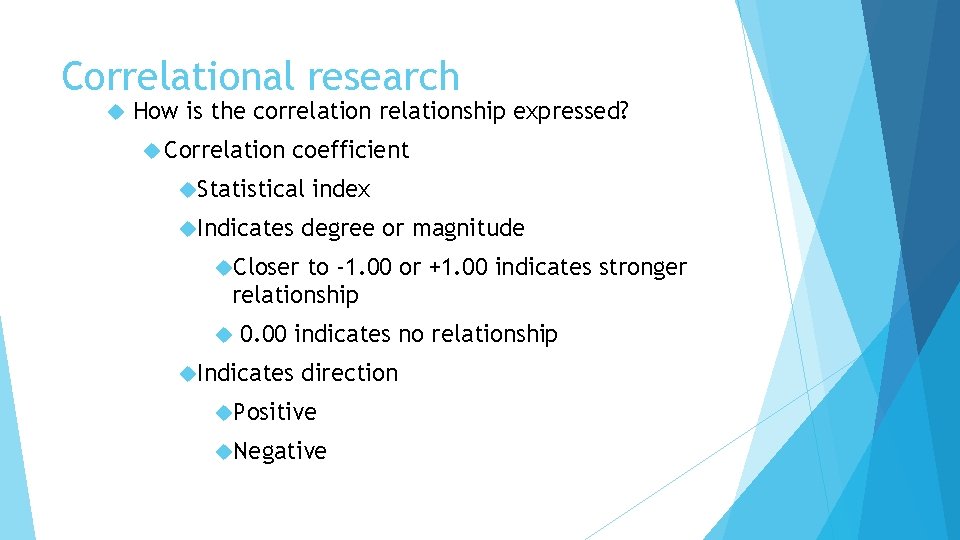
Correlational research How is the correlationship expressed? Correlation coefficient Statistical Indicates index degree or magnitude Closer to -1. 00 or +1. 00 indicates stronger relationship 0. 00 indicates no relationship Indicates direction Positive Negative
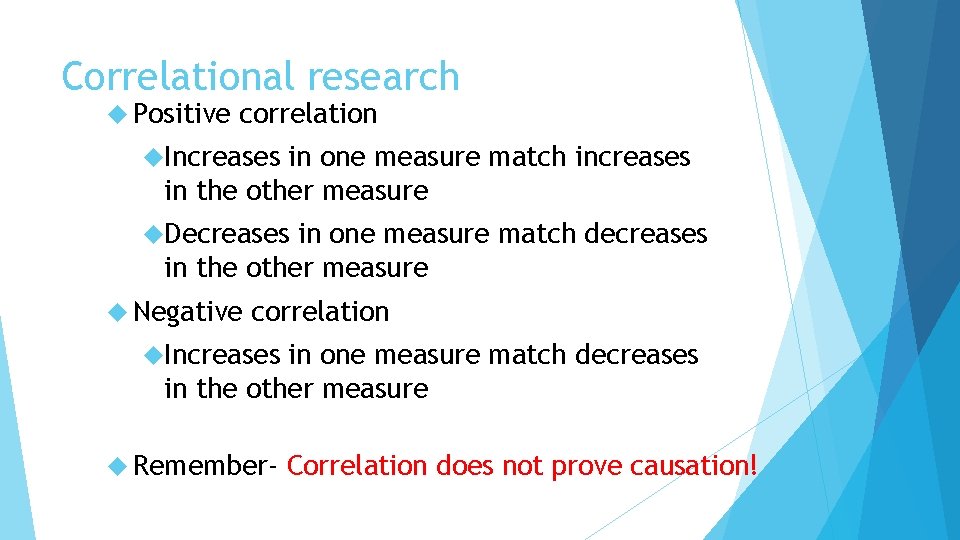
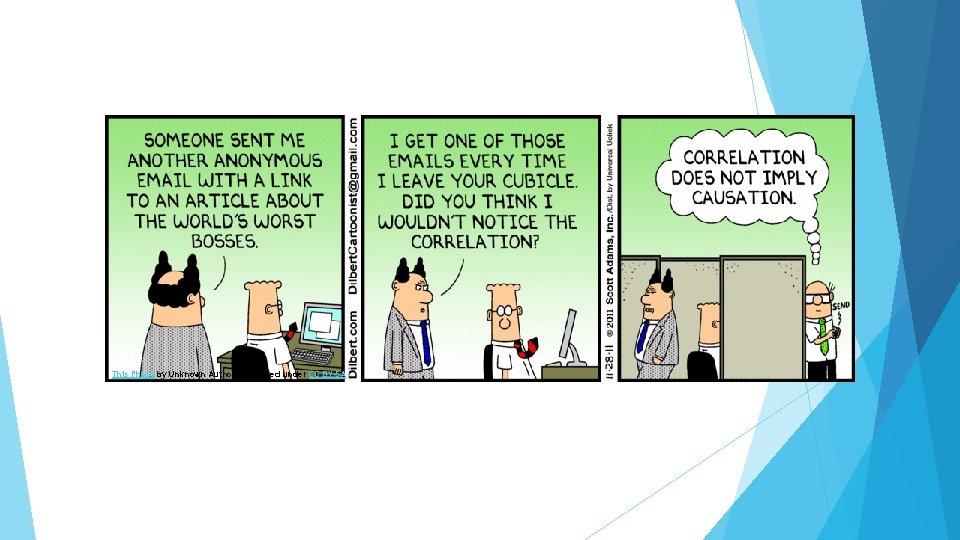
Correlational research Positive correlation Increases in one measure match increases in the other measure Decreases in one measure match decreases in the other measure Negative correlation Increases in one measure match decreases in the other measure Remember- Correlation does not prove causation!
This Photo by Unknown Author is licensed under CC BY-SA
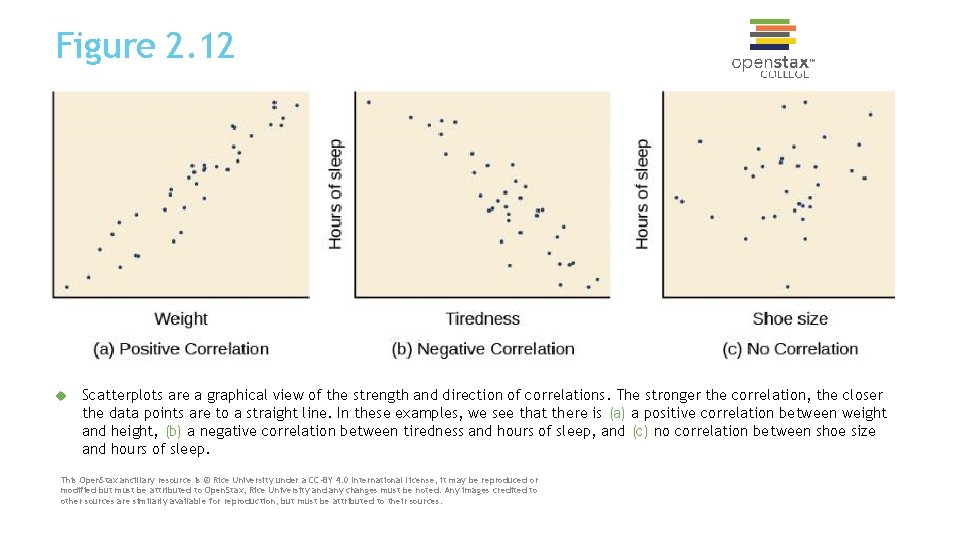
Figure 2. 12 Scatterplots are a graphical view of the strength and direction of correlations. The stronger the correlation, the closer the data points are to a straight line. In these examples, we see that there is (a) a positive correlation between weight and height, (b) a negative correlation between tiredness and hours of sleep, and (c) no correlation between shoe size and hours of sleep. This Open. Stax ancillary resource is © Rice University under a CC-BY 4. 0 International license; it may be reproduced or modified but must be attributed to Open. Stax, Rice University and any changes must be noted. Any images credited to other sources are similarly available for reproduction, but must be attributed to their sources.
Illusory correlations Illusory correlation- seeing relationships between two things when in reality no such relationship exists Confirmation bias- tendency to ignore evidence that disproves ideas or beliefs
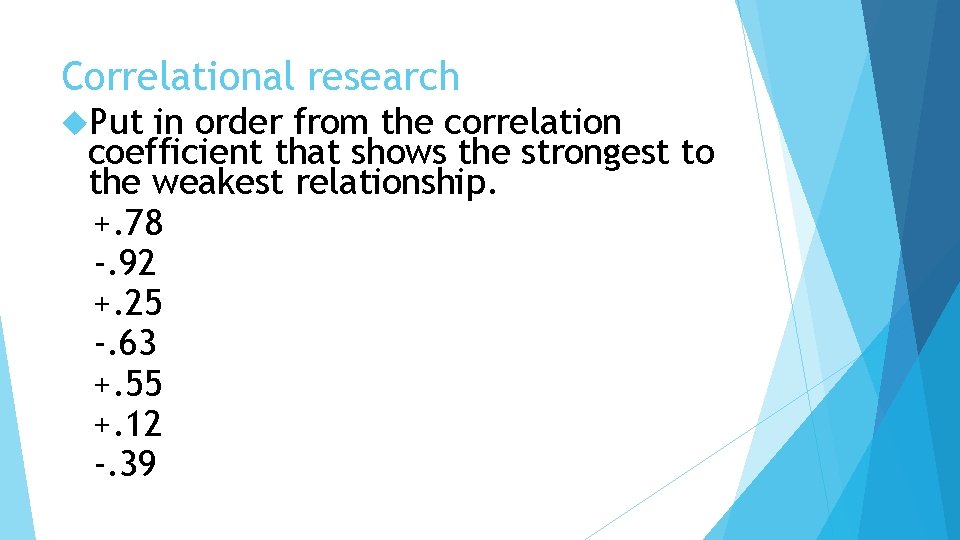
Correlational research Put in order from the correlation coefficient that shows the strongest to the weakest relationship. +. 78 -. 92 +. 25 -. 63 +. 55 +. 12 -. 39
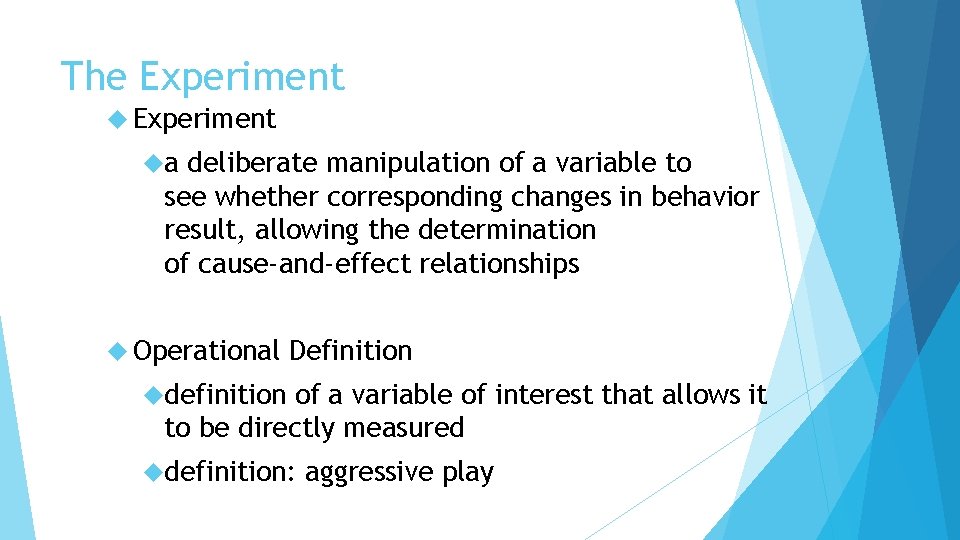
The Experiment a deliberate manipulation of a variable to see whether corresponding changes in behavior result, allowing the determination of cause-and-effect relationships Operational Definition definition of a variable of interest that allows it to be directly measured definition: aggressive play
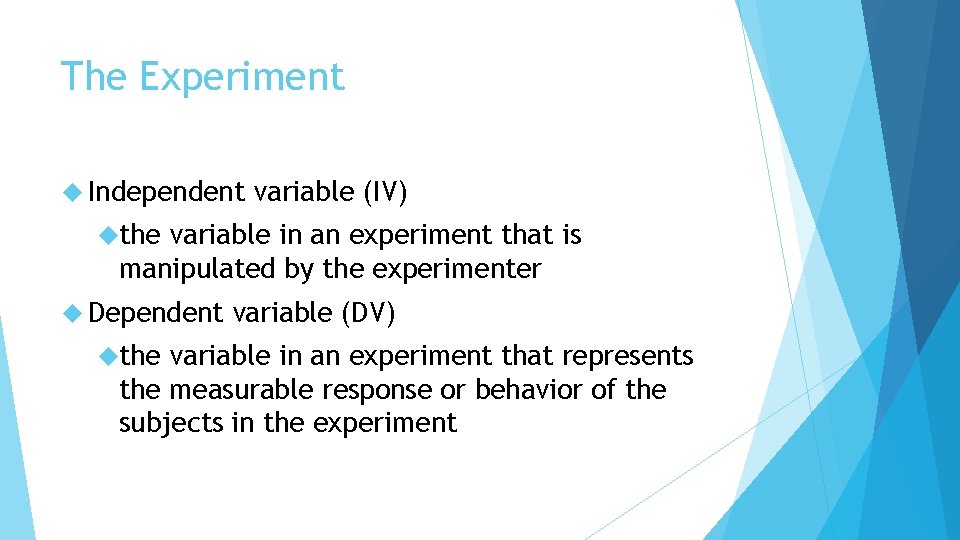
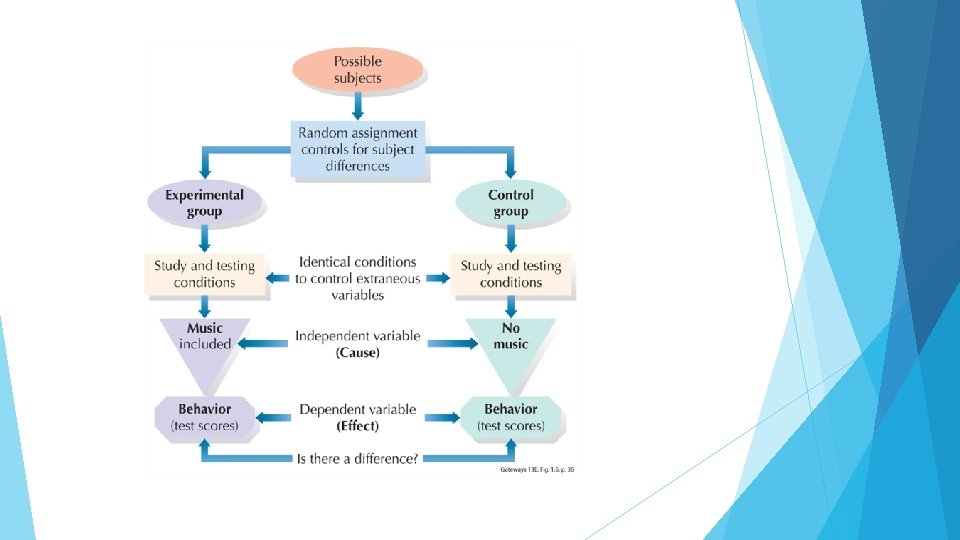
The Experiment Independent variable (IV) the variable in an experiment that is manipulated by the experimenter Dependent the variable (DV) variable in an experiment that represents the measurable response or behavior of the subjects in the experiment
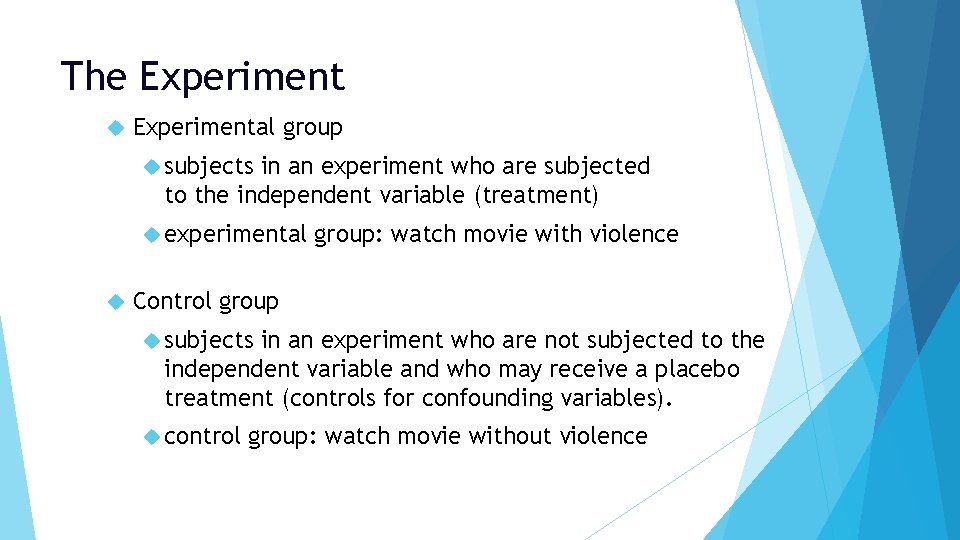
The Experimental group subjects in an experiment who are subjected to the independent variable (treatment) experimental group: watch movie with violence Control group subjects in an experiment who are not subjected to the independent variable and who may receive a placebo treatment (controls for confounding variables). control group: watch movie without violence
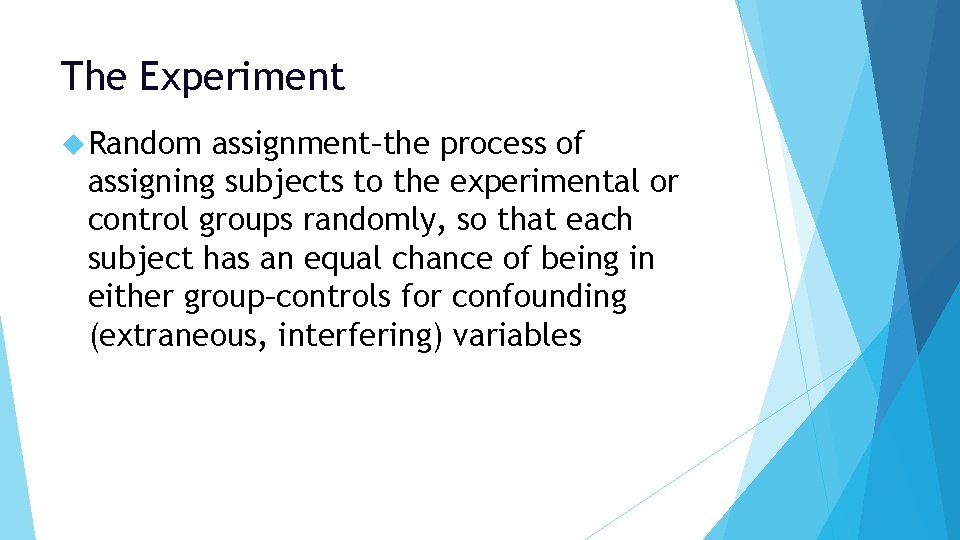
The Experiment Random assignment–the process of assigning subjects to the experimental or control groups randomly, so that each subject has an equal chance of being in either group–controls for confounding (extraneous, interfering) variables
The Experiment Placebo effect the phenomenon in which the expectations of the participants in a study can influence their behavior Single-blind subjects study do not know whether they are in the experimental or the control group (reduces placebo effect)
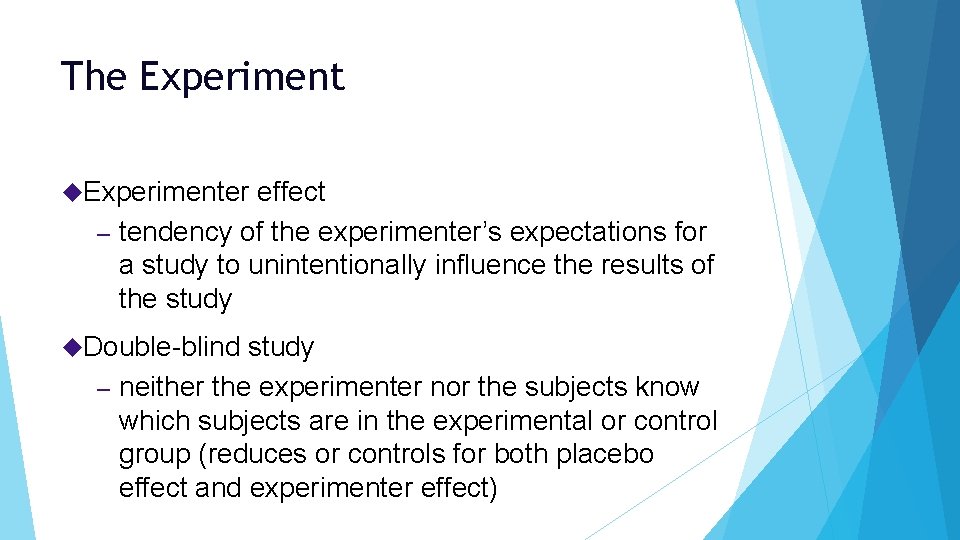
The Experimenter effect – tendency of the experimenter’s expectations for a study to unintentionally influence the results of the study Double-blind study – neither the experimenter nor the subjects know which subjects are in the experimental or control group (reduces or controls for both placebo effect and experimenter effect)
FORMAL EXPERIMENTS Lets say researchers are trying to determine the effectiveness of a new drug on cholesterol levels. One group with high cholesterol receives the new drug everyday for a month. Another group of volunteers with high cholesterol receives a sugar pill everyday for a month. Participants are unaware of what tx. group they are in, and cholesterol levels are taken at the end of the study.
Imagine that you want to do an experiment to determine if listening to music while working out can lead to greater weight loss. After getting together a group of participants, you randomly assign them to one of three groups. Each participant’s weight is taken before the study begins. One group listens to upbeat music while working out, one group listens to relaxing music, and the third group listens to no music at all. All of the participants work out for the same amount of time and the same number of days each week. Participants weight is measured at the end of the study, and results are compared group wise.
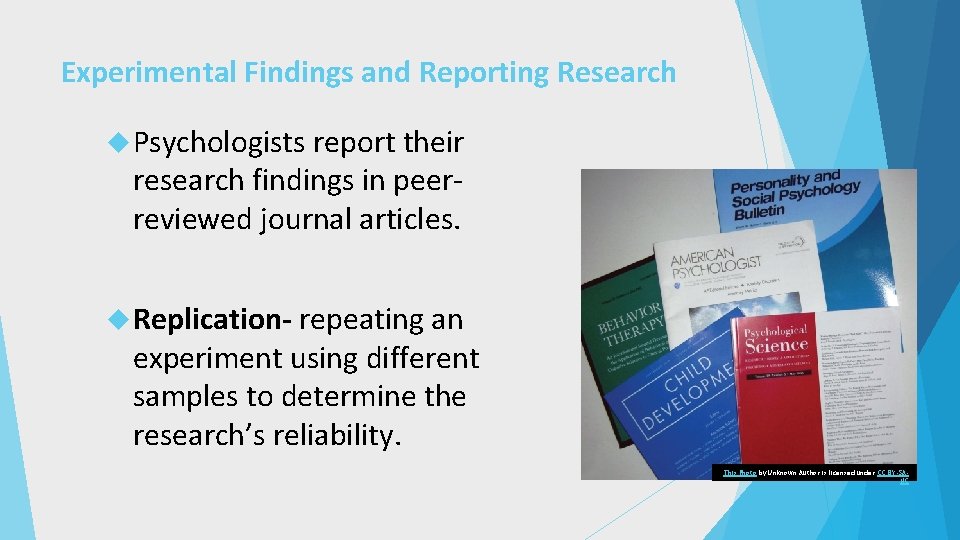
Experimental Findings and Reporting Research Psychologists report their research findings in peerreviewed journal articles. Replication- repeating an experiment using different samples to determine the research’s reliability. This Photo by Unknown Author is licensed under CC BY-SANC
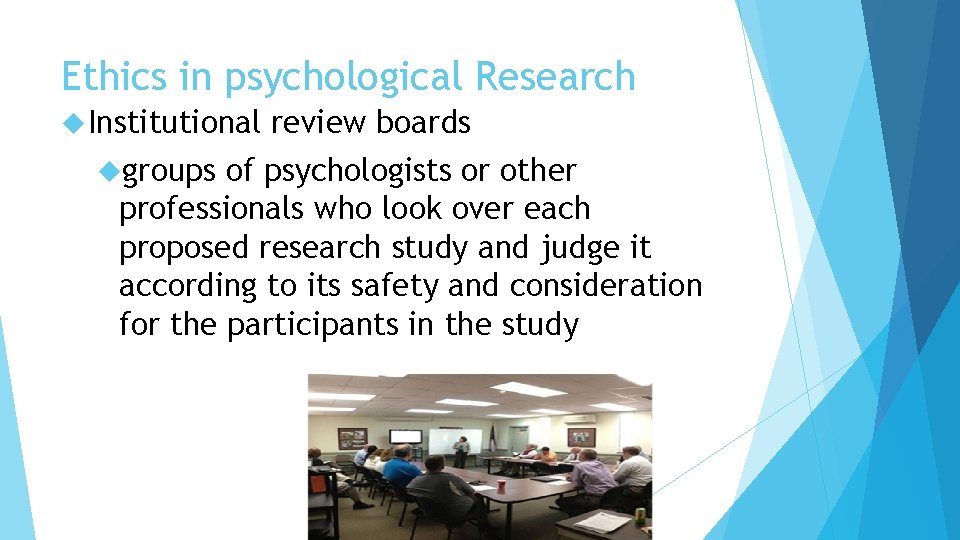
Ethics in psychological Research Institutional groups review boards of psychologists or other professionals who look over each proposed research study and judge it according to its safety and consideration for the participants in the study
Common ethical guidelines: The rights and well-being of participants must be weighed against the study’s value to science. Participants must be allowed to make an informed decision about participation. Deception can be used but must be justified. Participants may withdraw from the study at any time. Participants must be protected from risks or told explicitly of risks.
Common ethical guidelines: Investigators must debrief participants, telling them the true nature of the study and their expectations regarding the results. Data If must remain confidential for any reason a study results in undesirable consequences for the participant, the researcher is responsible for detecting and removing, or correcting, these consequences.
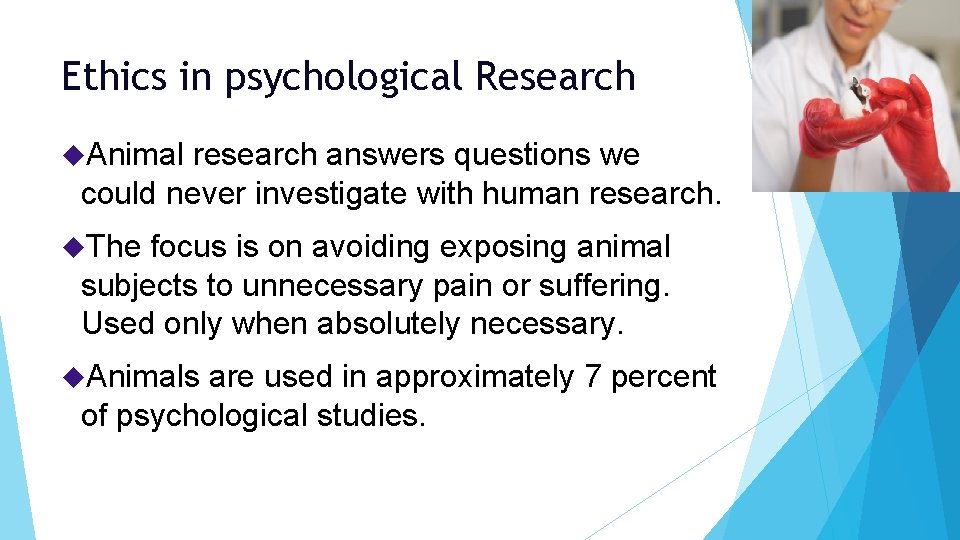
Ethics in psychological Research Animal research answers questions we could never investigate with human research. The focus is on avoiding exposing animal subjects to unnecessary pain or suffering. Used only when absolutely necessary. Animals are used in approximately 7 percent of psychological studies.