
Psychological Disorders Power Point Presentation by Jim Foley
Psychological Disorders Power. Point® Presentation by Jim Foley © 2013 Worth Publishers
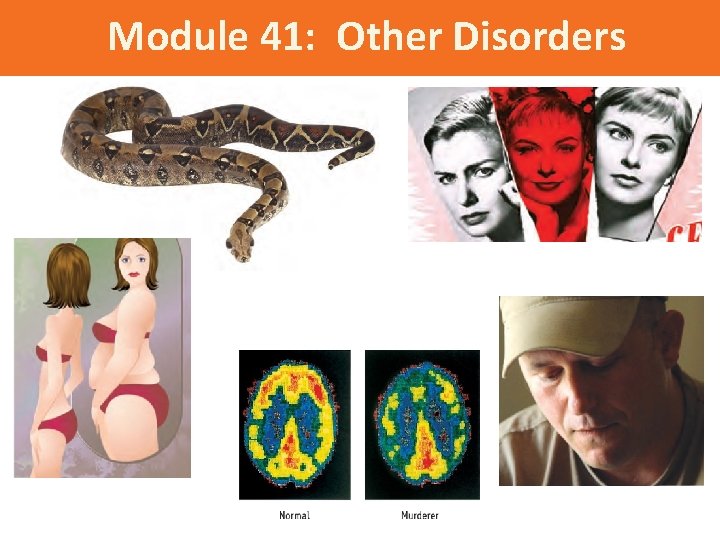
Module 41: Other Disorders
More conditions involving Client distress and dysfunction Anxiety Disorders: § Generalized Anxiety Disorder § Panic Disorder § Phobias § OCD § PTSD § Causes of Anxiety Disorders § Dissociative Identity Disorder § Antisocial Personality Disorder § Eating Disorders § Genetic, biological, social, and cultural influences
Anxiety Disorders: Our self-protective, risk-reduction instincts in overdrive § Generalized Anxiety Disorder: Painful worrying § Panic Disorder: Fear of the next attack § Phobias: Don’t even show me a picture § OCD: I know it doesn’t make sense, but I can’t help it § PTSD: Stuck Reexperiencing Trauma Causes of Anxiety Disorders: § Fear Conditioning § Observational Learning § Genetic/Evolutionary Predispositions § Brain involvement
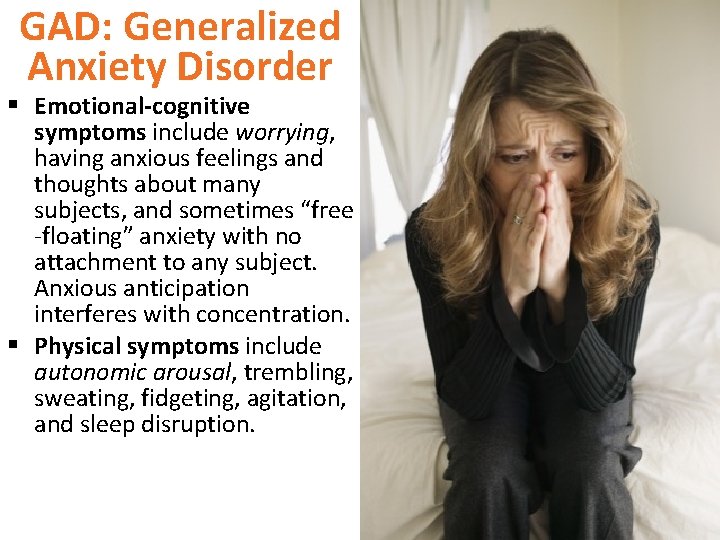
GAD: Generalized Anxiety Disorder § Emotional-cognitive symptoms include worrying, having anxious feelings and thoughts about many subjects, and sometimes “free -floating” anxiety with no attachment to any subject. Anxious anticipation interferes with concentration. § Physical symptoms include autonomic arousal, trembling, sweating, fidgeting, agitation, and sleep disruption.
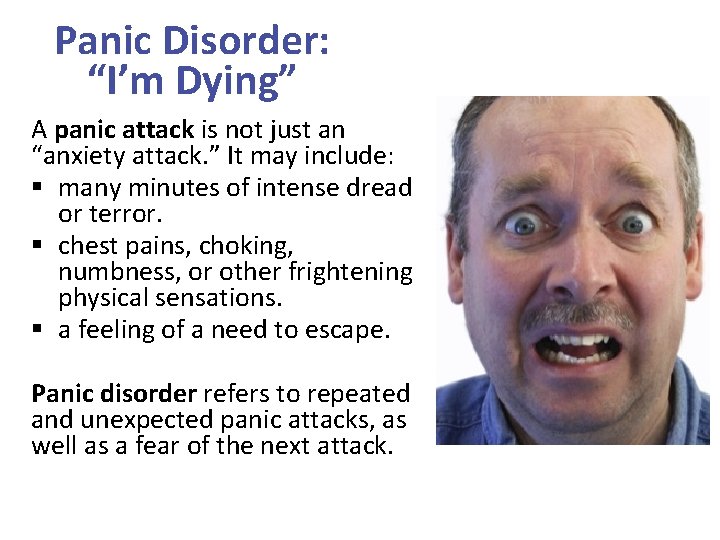
Panic Disorder: “I’m Dying” A panic attack is not just an “anxiety attack. ” It may include: § many minutes of intense dread or terror. § chest pains, choking, numbness, or other frightening physical sensations. § a feeling of a need to escape. Panic disorder refers to repeated and unexpected panic attacks, as well as a fear of the next attack.
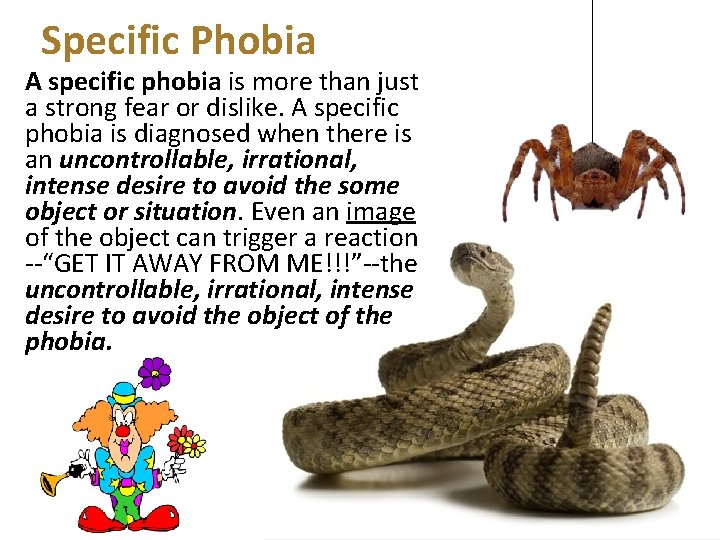
Specific Phobia A specific phobia is more than just a strong fear or dislike. A specific phobia is diagnosed when there is an uncontrollable, irrational, intense desire to avoid the some object or situation. Even an image of the object can trigger a reaction --“GET IT AWAY FROM ME!!!”--the uncontrollable, irrational, intense desire to avoid the object of the phobia.
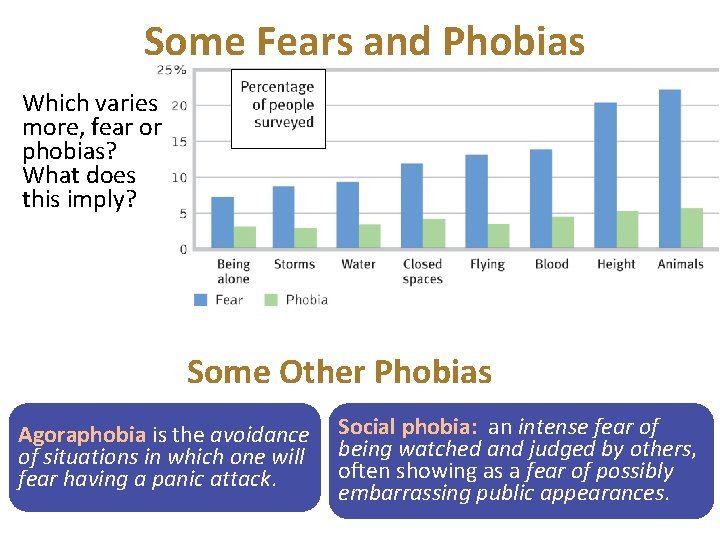
Some Fears and Phobias Which varies more, fear or phobias? What does this imply? Some Other Phobias Agoraphobia is the avoidance of situations in which one will fear having a panic attack. Social phobia: an intense fear of being watched and judged by others, often showing as a fear of possibly embarrassing public appearances.
![Obsessive-Compulsive Disorder [OCD] § Obsessions are intense, unwanted worries, ideas, and images that repeatedly](http://slidetodoc.com/presentation_image_h2/962802a1ecff5d57f99a60eb6aa155b1/image-9.jpg "Obsessive-Compulsive Disorder [OCD] § Obsessions are intense, unwanted worries, ideas, and images that repeatedly")
Obsessive-Compulsive Disorder [OCD] § Obsessions are intense, unwanted worries, ideas, and images that repeatedly pop up in the mind. § A compulsion is a repeatedly strong feeling of “needing” to carry out an action, even though it doesn’t feel like it makes sense. § When is it a “disorder”? § Distress: when you are deeply frustrated with not being able to control the behaviors or § Dysfunction: when the time and mental energy spent on these thoughts and behaviors interfere with everyday life
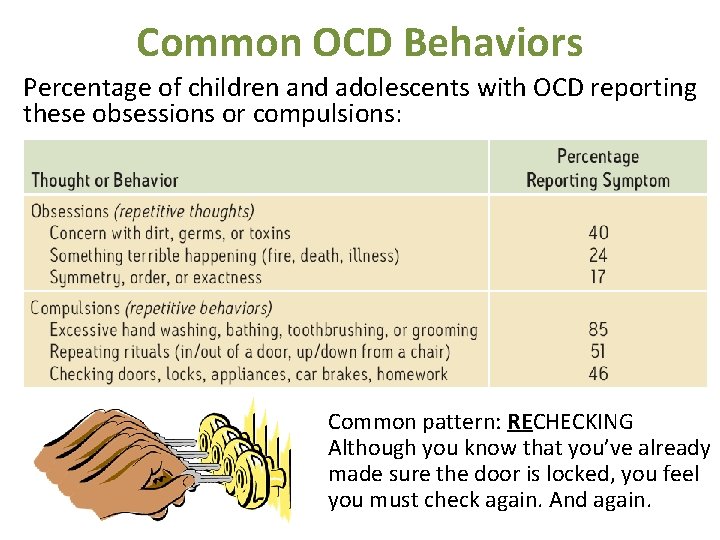
Common OCD Behaviors Percentage of children and adolescents with OCD reporting these obsessions or compulsions: Common pattern: RECHECKING Although you know that you’ve already made sure the door is locked, you feel you must check again. And again.
![Post-Traumatic Stress Disorder [PTSD] About 10 to 35 percent of people who experience trauma](http://slidetodoc.com/presentation_image_h2/962802a1ecff5d57f99a60eb6aa155b1/image-11.jpg "Post-Traumatic Stress Disorder [PTSD] About 10 to 35 percent of people who experience trauma")
Post-Traumatic Stress Disorder [PTSD] About 10 to 35 percent of people who experience trauma not only have burned -in memories, but also four weeks to a lifetime of: § repeated intrusive recall of those memories. § nightmares and other reexperiencing. § social withdrawal or phobic avoidance. § jumpy anxiety or hypervigilance. § insomnia or sleep problems. Which people develop PTSD? § Those with sensitive emotion-processing limbic systems § Those who are asked to relive their trauma as they report it § Those previously traumatized
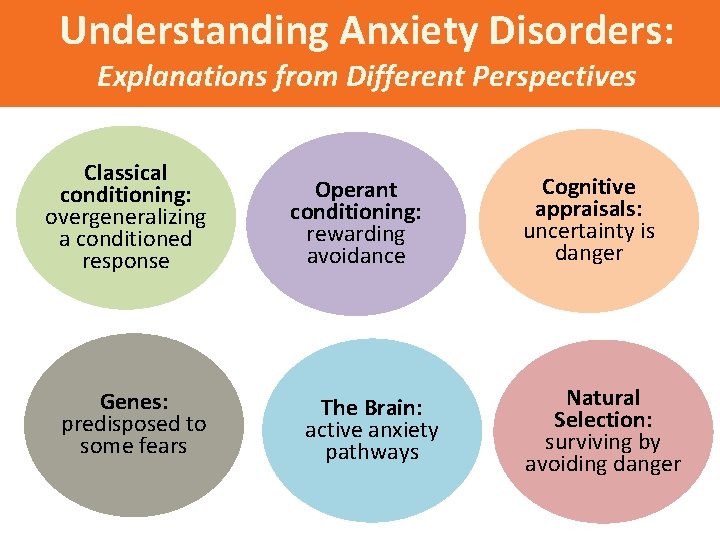
Understanding Anxiety Disorders: Explanations from Different Perspectives Classical conditioning: overgeneralizing a conditioned response Genes: predisposed to some fears Operant conditioning: rewarding avoidance The Brain: active anxiety pathways Cognitive appraisals: uncertainty is danger Natural Selection: surviving by avoiding danger
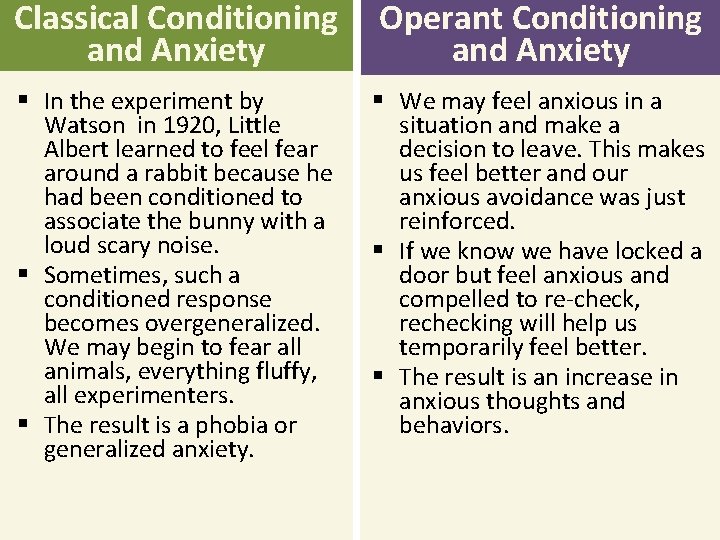
Classical Conditioning and Anxiety Operant Conditioning and Anxiety § In the experiment by Watson in 1920, Little Albert learned to feel fear around a rabbit because he had been conditioned to associate the bunny with a loud scary noise. § Sometimes, such a conditioned response becomes overgeneralized. We may begin to fear all animals, everything fluffy, all experimenters. § The result is a phobia or generalized anxiety. § We may feel anxious in a situation and make a decision to leave. This makes us feel better and our anxious avoidance was just reinforced. § If we know we have locked a door but feel anxious and compelled to re-check, rechecking will help us temporarily feel better. § The result is an increase in anxious thoughts and behaviors.
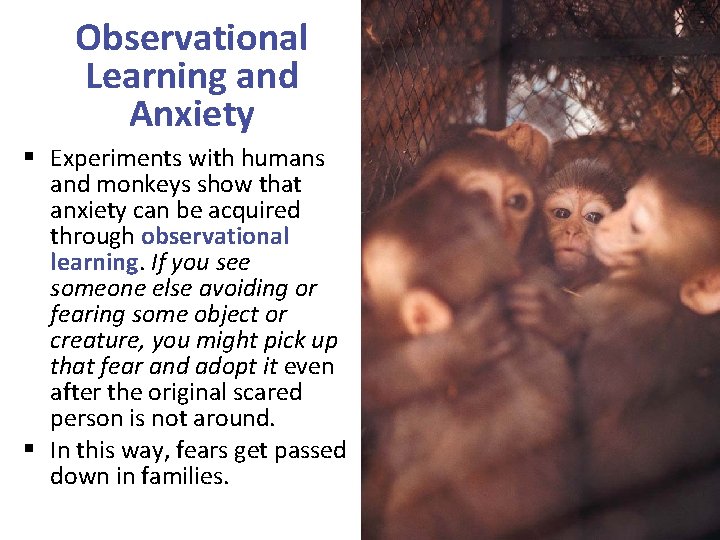
Observational Learning and Anxiety § Experiments with humans and monkeys show that anxiety can be acquired through observational learning. If you see someone else avoiding or fearing some object or creature, you might pick up that fear and adopt it even after the original scared person is not around. § In this way, fears get passed down in families.
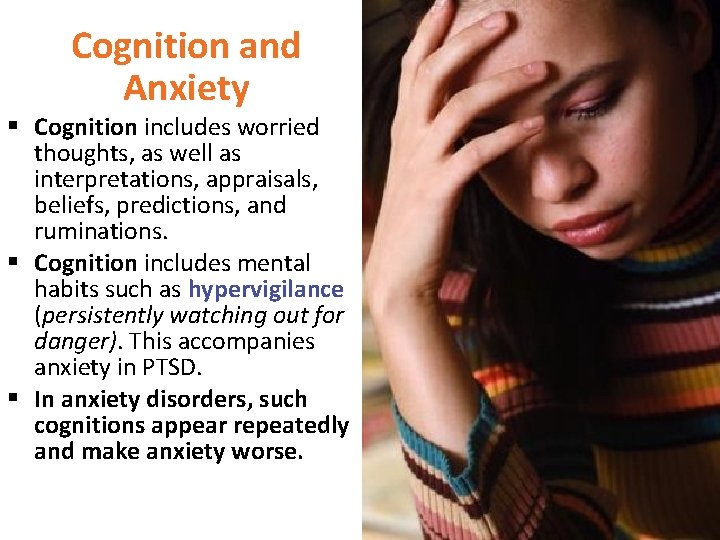
Cognition and Anxiety § Cognition includes worried thoughts, as well as interpretations, appraisals, beliefs, predictions, and ruminations. § Cognition includes mental habits such as hypervigilance (persistently watching out for danger). This accompanies anxiety in PTSD. § In anxiety disorders, such cognitions appear repeatedly and make anxiety worse.
Biology and Anxiety: Genes § Studies show that identical twins, even raised separately, develop similar phobias (more similar than two unrelated people). § Some people seem to have an inborn highstrung temperament, while others are more easygoing. § Temperament may be encoded in our genes. Genes and Neurotransmitters § Genes regulate levels of neurotransmitters. § People with anxiety have problems with a gene associated with levels of serotonin, a neurotransmitter involved in regulating sleep and mood. § People with anxiety also have a gene that triggers high levels of glutamate, an excitatory neurotransmitter involved in the brain’s alarm centers.
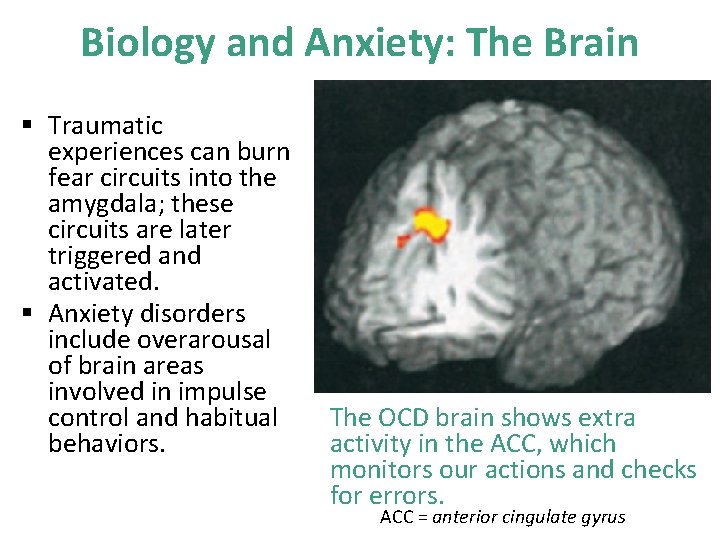
Biology and Anxiety: The Brain § Traumatic experiences can burn fear circuits into the amygdala; these circuits are later triggered and activated. § Anxiety disorders include overarousal of brain areas involved in impulse control and habitual behaviors. The OCD brain shows extra activity in the ACC, which monitors our actions and checks for errors. ACC = anterior cingulate gyrus
Biology and Anxiety: An Evolutionary Perspective 1. Human phobic objects: 2. Similar but non-phobic objects: Snakes Fish Heights Low places Closed spaces Open spaces Darkness Bright light 3. Dangerous yet non-phobic subjects: We are likely to become cautious about, but not phobic about: Guns Electric wiring Cars § Evolutionary psychologists believe that ancestors prone to fear the items on list #1 were less likely to die before reproducing. § There has not been time for the innate fear of list #3 (the gun list) to spread in the population.
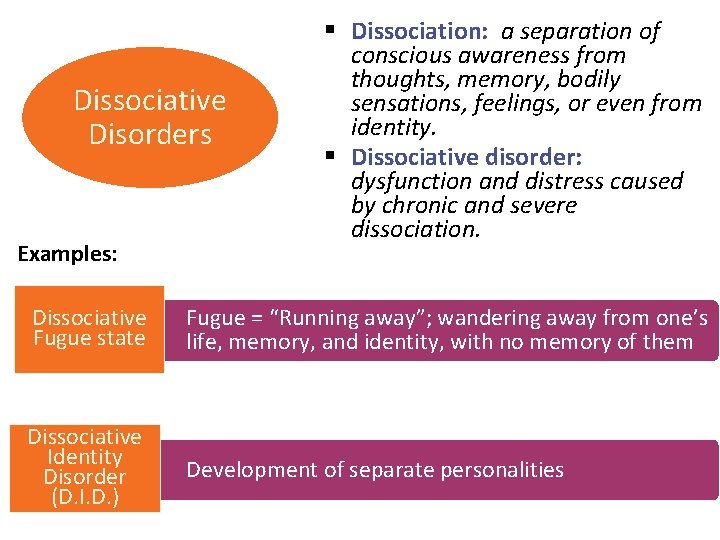
Dissociative Disorders Examples: § Dissociation: a separation of conscious awareness from thoughts, memory, bodily sensations, feelings, or even from identity. § Dissociative disorder: dysfunction and distress caused by chronic and severe dissociation. Dissociative Fugue state Fugue = “Running away”; wandering away from one’s life, memory, and identity, with no memory of them Dissociative Identity Disorder (D. I. D. ) Development of separate personalities
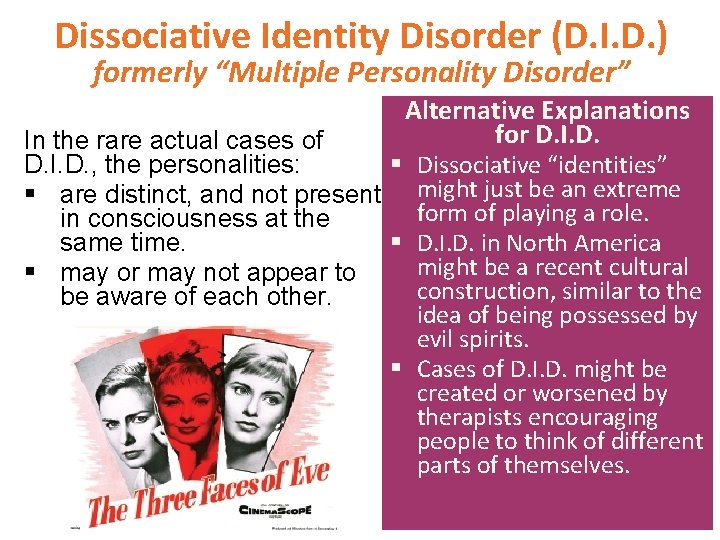
Dissociative Identity Disorder (D. I. D. ) formerly “Multiple Personality Disorder” Alternative Explanations for D. I. D. In the rare actual cases of § Dissociative “identities” D. I. D. , the personalities: § are distinct, and not present might just be an extreme form of playing a role. in consciousness at the § D. I. D. in North America same time. might be a recent cultural § may or may not appear to construction, similar to the be aware of each other. idea of being possessed by evil spirits. § Cases of D. I. D. might be created or worsened by therapists encouraging people to think of different parts of themselves.
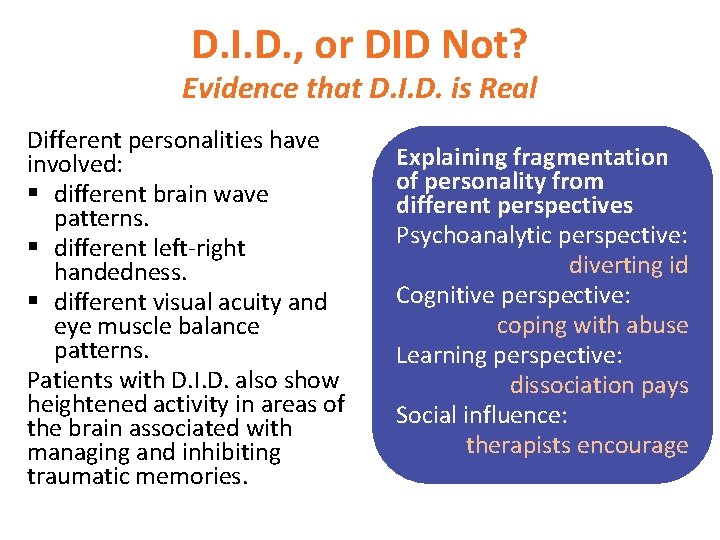
D. I. D. , or DID Not? Evidence that D. I. D. is Real Different personalities have involved: § different brain wave patterns. § different left-right handedness. § different visual acuity and eye muscle balance patterns. Patients with D. I. D. also show heightened activity in areas of the brain associated with managing and inhibiting traumatic memories. Explaining fragmentation of personality from different perspectives Psychoanalytic perspective: diverting id Cognitive perspective: coping with abuse Learning perspective: dissociation pays Social influence: therapists encourage
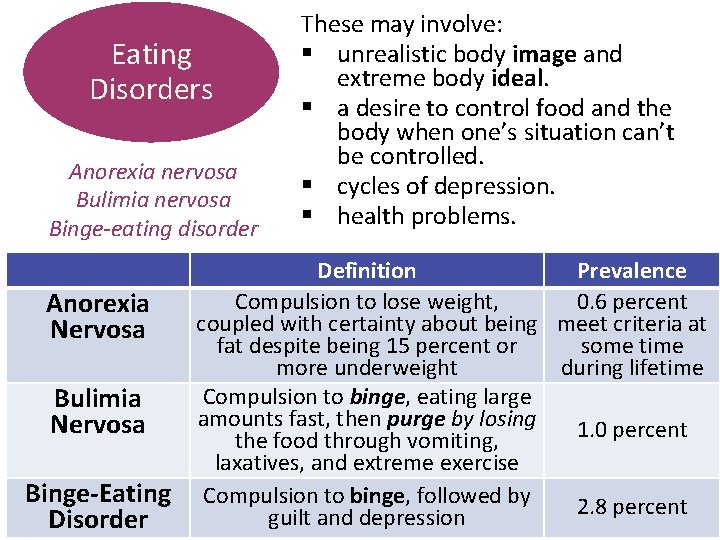
Eating Disorders Anorexia nervosa Bulimia nervosa Binge-eating disorder Anorexia Nervosa Bulimia Nervosa Binge-Eating Disorder These may involve: § unrealistic body image and extreme body ideal. § a desire to control food and the body when one’s situation can’t be controlled. § cycles of depression. § health problems. Definition Prevalence Compulsion to lose weight, 0. 6 percent coupled with certainty about being meet criteria at fat despite being 15 percent or some time more underweight during lifetime Compulsion to binge, eating large amounts fast, then purge by losing 1. 0 percent the food through vomiting, laxatives, and extreme exercise Compulsion to binge, followed by 2. 8 percent guilt and depression
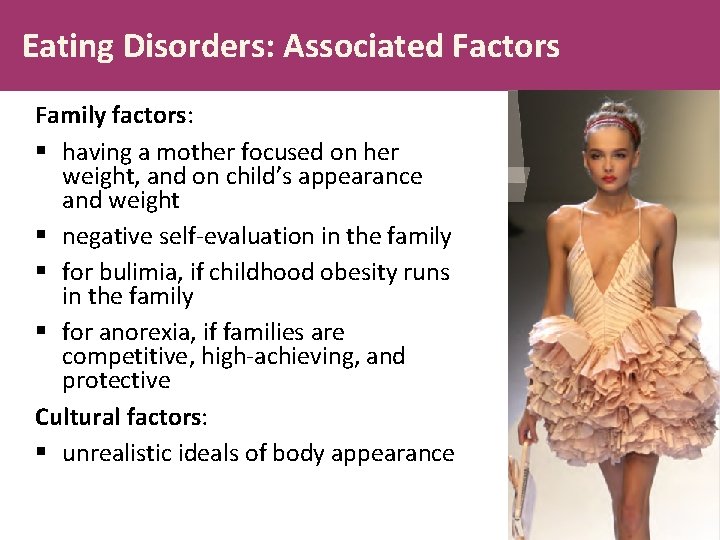
Eating Disorders: Associated Factors Family factors: § having a mother focused on her weight, and on child’s appearance and weight § negative self-evaluation in the family § for bulimia, if childhood obesity runs in the family § for anorexia, if families are competitive, high-achieving, and protective Cultural factors: § unrealistic ideals of body appearance
Personality Disorders Personality disorders are enduring patterns of social and other behavior that impair social functioning. There are three “clusters”/categories of personality disorders. § Anxious: e. g. , Avoidant P. D. , ruled by fear of social rejection § Eccentric/Odd: e. g. Schizoid P. D. , with flat affect, no social attachments § Dramatic: e. g. Histrionic, attention-seeking; narcissistic, self-centered; antisocial, amoral
![Antisocial Personality Disorder [APD] Antisocial personality disorder: Persistently acting without conscience, without a sense](http://slidetodoc.com/presentation_image_h2/962802a1ecff5d57f99a60eb6aa155b1/image-25.jpg "Antisocial Personality Disorder [APD] Antisocial personality disorder: Persistently acting without conscience, without a sense")
Antisocial Personality Disorder [APD] Antisocial personality disorder: Persistently acting without conscience, without a sense of guilt for harm done to others (strangers and family alike). The diagnostic criteria include a pattern of violating the rights of others since age 15, including three of these: Deceitfulness Disregard for safety of self or others Aggressiveness Failure to conform to social norms Lack of remorse Impulsivity and failure to plan ahead Irritability Irresponsibility regarding jobs, family, and money
Which Kids May Develop APD as Adults? About half of children with persistent antisocial behavior develop lifelong APD. Which kids are at risk? Psychological factors: § those who in preschool were impulsive, uninhibited, unconcerned with social rewards, and low in anxiety. § those who endured child abuse, and/or inconsistent, unavailable caretaking. § § § Biological APD Risk Factors Antisocial or unemotional biological relatives increases risk. Some associated genes have been identified. Lower levels of stress hormones and low physiological arousal in stressful situations Fear conditioning is impaired. Reduced prefrontal cortex tissue leads to impulsivity. Substance dependence is more likely.
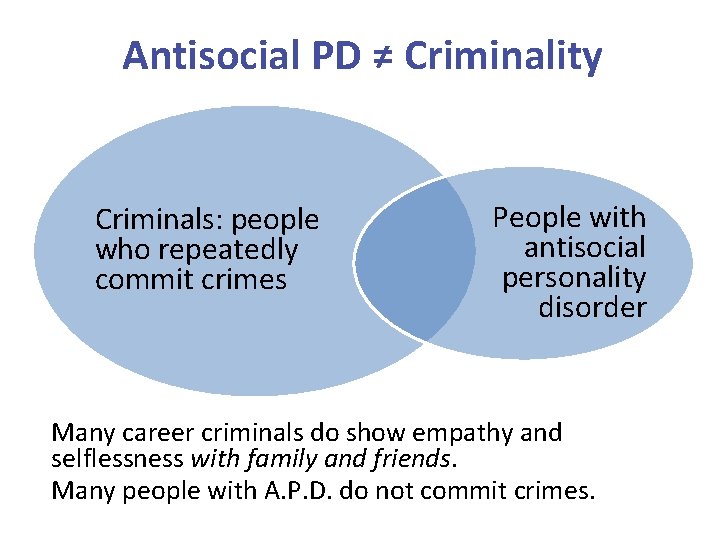
Antisocial PD ≠ Criminality Criminals: people who repeatedly commit crimes People with antisocial personality disorder Many career criminals do show empathy and selflessness with family and friends. Many people with A. P. D. do not commit crimes.
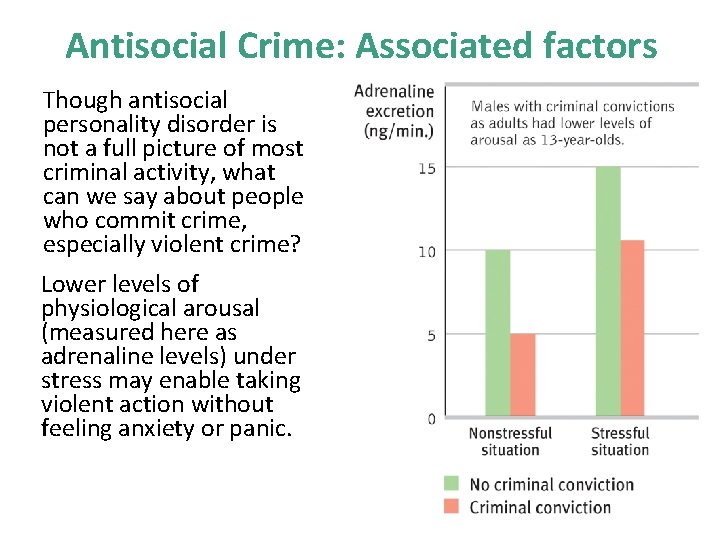
Antisocial Crime: Associated factors Though antisocial personality disorder is not a full picture of most criminal activity, what can we say about people who commit crime, especially violent crime? Lower levels of physiological arousal (measured here as adrenaline levels) under stress may enable taking violent action without feeling anxiety or panic.
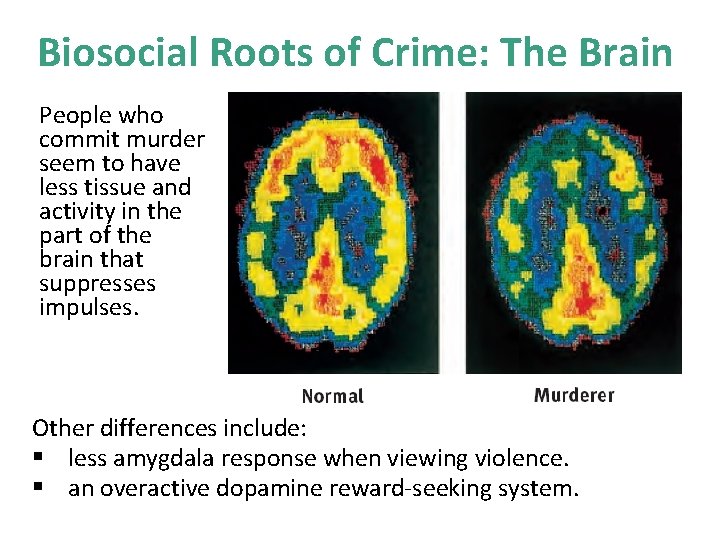
Biosocial Roots of Crime: The Brain People who commit murder seem to have less tissue and activity in the part of the brain that suppresses impulses. Other differences include: § less amygdala response when viewing violence. § an overactive dopamine reward-seeking system.
- Slides: 29