
Psychological development Mahler SeparationIndividuation According to Mahler successful


- Slides: 36
Psychological development
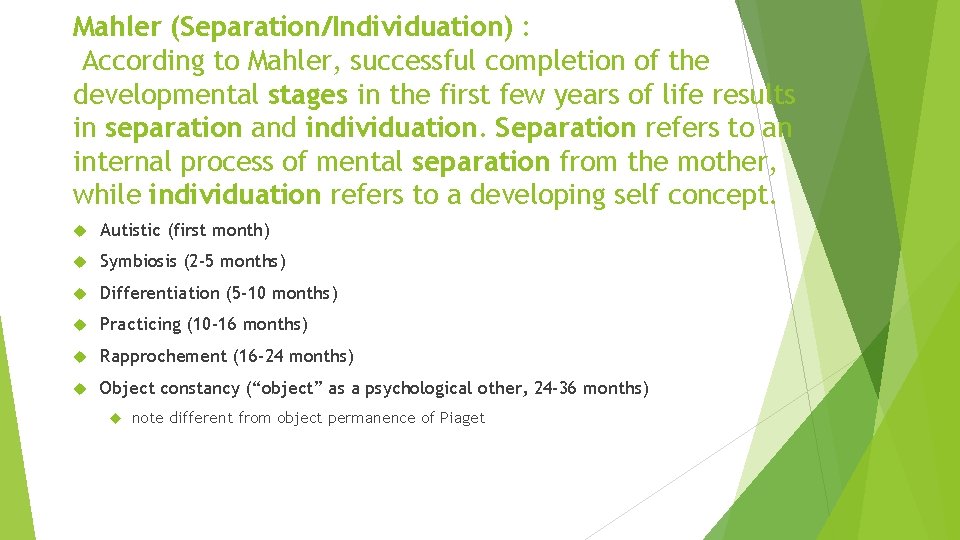
Mahler (Separation/Individuation) : According to Mahler, successful completion of the developmental stages in the first few years of life results in separation and individuation. Separation refers to an internal process of mental separation from the mother, while individuation refers to a developing self concept. Autistic (first month) Symbiosis (2 -5 months) Differentiation (5 -10 months) Practicing (10 -16 months) Rapprochement (16 -24 months) Object constancy (“object” as a psychological other, 24 -36 months) note different from object permanence of Piaget
Mahler: Autistic phase 1 st month of life behavior is instinctive and serves only to satisfy biological needs infant is unaware of “outside” infant and mother are “one”
Mahler: Symbiotic Phase 2 nd through 5 th month infant develops dim awareness that needs are met outside of self social smile develops John Bowlby observed this in greater detail in his study of attachment social smile for all comers
Mahler: Differentiation 5 th through 10 th month compares what is, and what is not mother infant separates from caregiver by pushing away infant develops stranger anxiety more fear common in babies with one caretaker at the approach of a stranger
Mahler: Practicing subphase 10 through ~16 months the infant explores the environment (now able to independently crawl/walk) caregiver serves as “home base” separation anxiety occurs during this time (but requires object permanence) anxiety at physical separation from mother, especially if mother no longer visible
Mahler: Rapprochement crisis 16 -24 months child torn between wanting mother’s soothing support (dependence) and not wanting help (omnipotence) “terrible two’s” where sometimes the child has temper tantrums of frustration
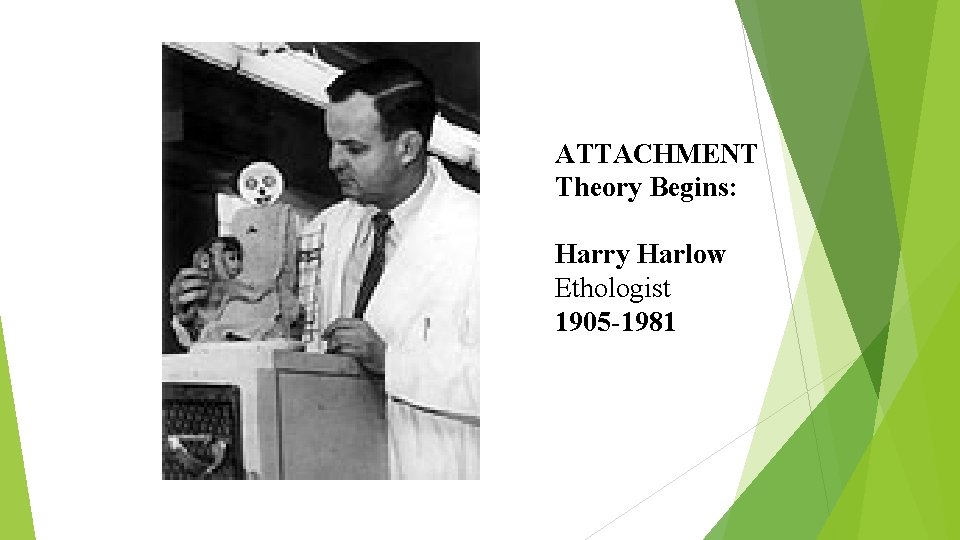
ATTACHMENT Theory Begins: Harry Harlow Ethologist 1905 -1981
Studied infant monkey Harry Harlow andbehavior: the what are the most important features of a mother? Rhesus Monkeys Two “mothering” options for infants: terry cloth covered wire surrogate without food wire only surrogate with food Infants instinctively prefer the “comfort contact” of terry cloth over food Monkeys raised without mothers and peers are socially incompetent
Used ethology to inform human development John Bowlby 1907 -1990
What is Attachment? An enduring emotional bond uniting one creature with another, manifested through efforts to seek proximity and contact with the ‘attachment figure’, especially when under stress Reciprocal relationship gradually built over time Not the same as bonding, which is the mother’s feeling for her child
Bowlby’s Attachment Theory Attachment behavior (proximity seeking, eye contact, smiling) gives an evolutionary advantage by motivating caregiving Attached children may have stayed closer to their mother, and therefore were less susceptible to predators or getting lost Attachment behavior continues to maturity tendency to seek family/friends in anxious situations
Attachment Timeline 0 -7 months: generalized social behavior, somewhat specific to parents 8 -24 months: Attachment to parents with stranger anxiety and protest at separation depression if separation prolonged 2 -12 years: Parents remain primary attachment figures, but network broadens 12 -adult: Peers, romantic interests, and eventually children may become primary
Psychosocial Implications of Attachment Theory Attachment relationships become the template for social relations throughout the life span Therefore, the emotions and expectations arising from the infant-parent relationship are the basis for conceptualization of self and others in later years anticipating soothing from others leads to ability to self sooth (security)
Dangers of Disrupted Attachment Increased separation anxiety, avoidant personality disorder, depressive disorders, delinquency, failure to thrive, learning disorders
René Spitz: Attachment Applied Studied infant behavior/health Observed 123 infants living in a nursery/ shelter with mother as primary caretaker Babies lived there for 2 years 45 developed depressive type symptoms developed over a 3 month period, beginning age 6 -8 months (no earlier)
Spitz’s Depressive Syndrome 5 Stage process 1. Sadness, crying, anxiety 2. Withdrawn, rejecting of attention 3. Motor retardation, decreased responsiveness 4. Loss of appetite and weight (FTT? ) 5. Insomnia, facial rigidity (marasmus)
Why did they get sick? Departure of mother from nursery between age 6 -8 months in each case No children with mothers present developed depression Condition resolved with return of mother Conclusion: syndrome is result of loss of primary caretaker (mother) “anaclitic depression” (Harlow observed this in monkeys as well) thus a disorder of attachment
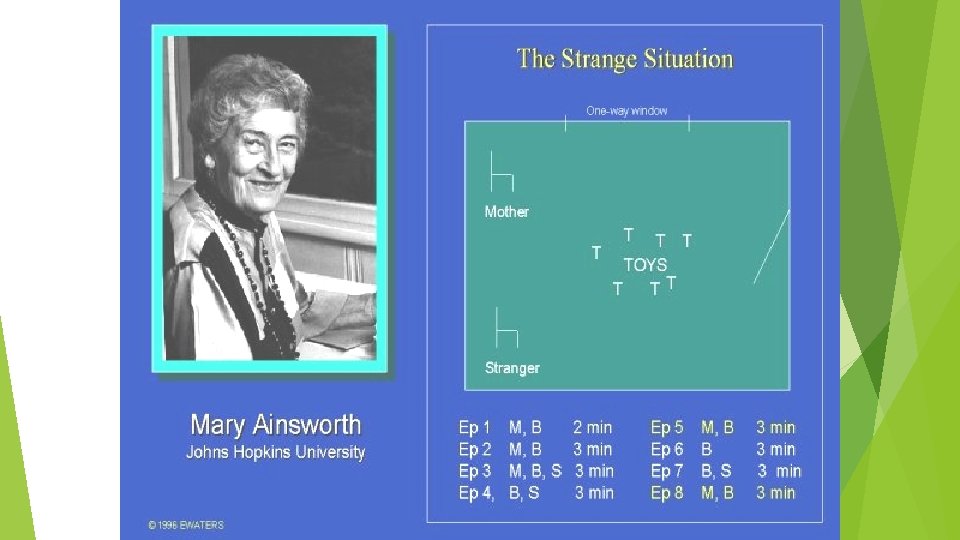
Mary Ainsworth: Laboratory Assessment of Attachment Colleague of John Bowlby 1913 -1999 Studied attachment behavior in Africa, Toronto, England, and Baltimore believed attachment behavior universal Developed “Strange Situation” test to assess attachment behavior
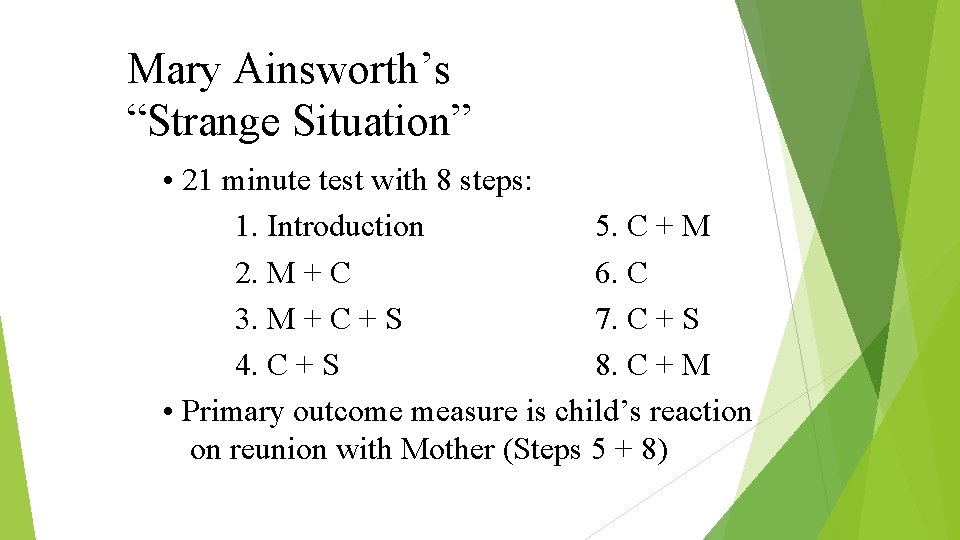
Mary Ainsworth’s “Strange Situation” • 21 minute test with 8 steps: 1. Introduction 5. C + M 2. M + C 6. C 3. M + C + S 7. C + S 4. C + S 8. C + M • Primary outcome measure is child’s reaction on reunion with Mother (Steps 5 + 8)
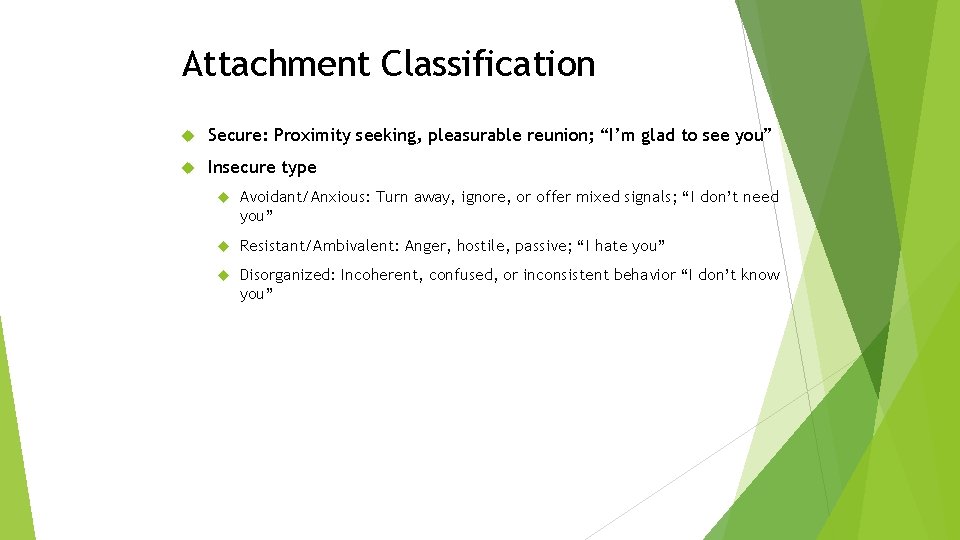
Attachment Classification Secure: Proximity seeking, pleasurable reunion; “I’m glad to see you” Insecure type Avoidant/Anxious: Turn away, ignore, or offer mixed signals; “I don’t need you” Resistant/Ambivalent: Anger, hostile, passive; “I hate you” Disorganized: Incoherent, confused, or inconsistent behavior “I don’t know you”
Secure Attachment Known as Type B 60 -70% of low risk sample Characteristics share positive affect with caregivers seek proximity on reunion return to independent play easily theorized to expect comforting from parents when they show distress
Insecure Avoidant Attachment Avoidant/anxious, or Type A 15 -25% of low risk sample Characteristics share little positive affect with caregivers tend to ignore on reunion, make only brief contact theorized to anticipate rejection from caregiver, thus they inhibit displays to avoid negative outcomes, instead distract themselves
Insecure Resistant Attachment Ambivalent/resistant, or Type C 10 -15% of low risk sample Characteristics preoccupied with caregiver’s presence, play little extended distress on reunion, showing anger and proximity seeking along with resistance theorized to anticipate inadequacy from caregiver, thus they are chronically activated, expressing at a low threshold at high intensity
Insecure Disorganized Attachment Disorganized, or Type D added to classification scheme late 10 -30% of low risk, up to 80% high risk Characteristics demonstrate contradictory behavior: in fearful situation (caregiver gone) typical: exploration, attachment behavior (distress at separation, proximity seeking) abnormal: exploration with parent absent, with little distress
Type D, continued Other characteristics stereotypies, mistimed movements, freezing, stilling, or slowed movements theorized to fear the caregiver, and lack an overall strategy of behavior
Freud Recognized Attachment: “Psychoanalysis has taught us that the individual’s emotional attitudes to other people, which are of such extreme importance to his later behavior, are already established at an unexpectedly young age. The nature and quality of the human child’s relations to people of his own and the opposite sex have already been laid down in the first six years of life. He may afterwards develop and transform them in certain directions but he can no longer get rid of them… All of his later choices of friendship and love follow upon the basis of the memory-traces left behind by these first prototypes”. Some Reflections on Schoolboy Psychology, 1914
Temperament Innate behavior style primarily genetically mediated New York Longitudinal Study (Chess and Thomas) of upper/middle class families
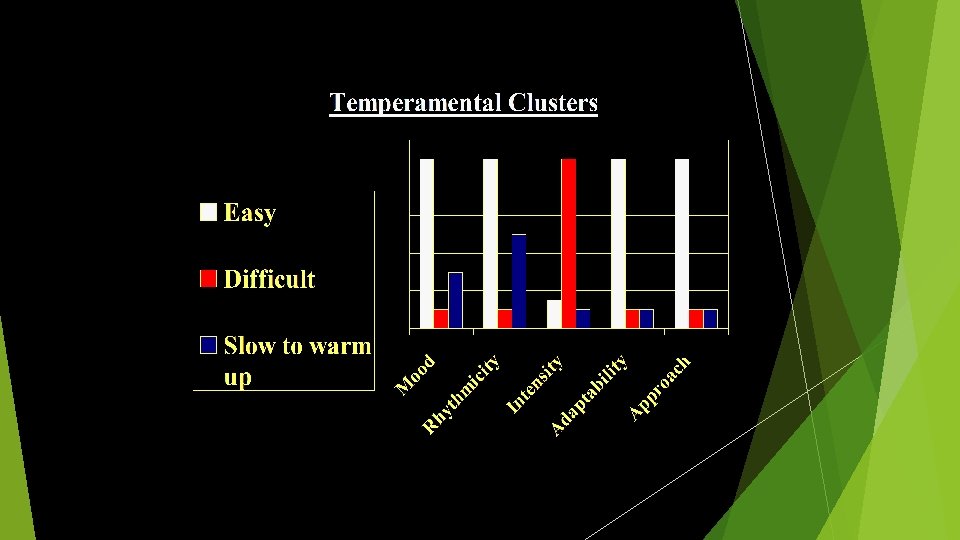
Describing temperament 9 Dimensions measured include baseline activity rhythmicity approach or withdrawal adaptability threshold of responsiveness reaction intensity baseline mood distractibility attention span or persistence
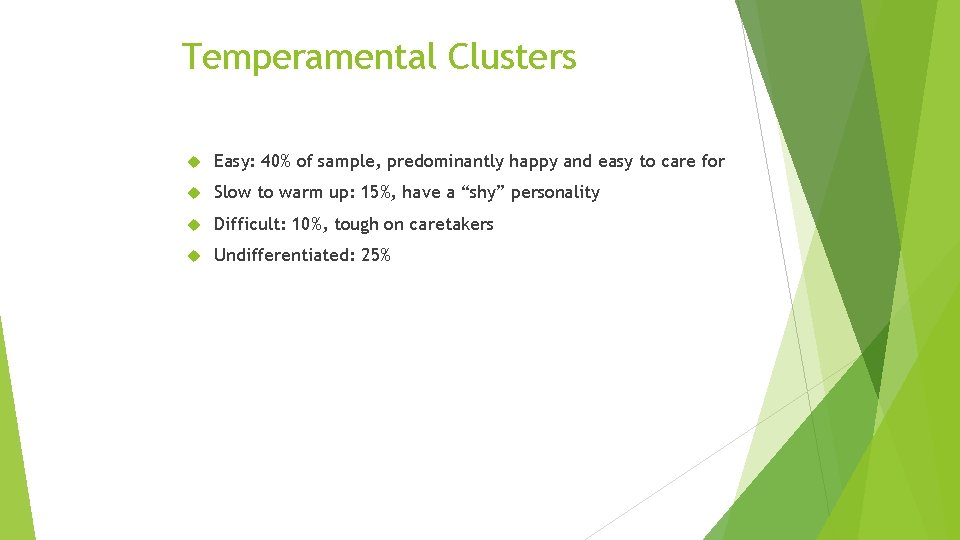
Temperamental Clusters Easy: 40% of sample, predominantly happy and easy to care for Slow to warm up: 15%, have a “shy” personality Difficult: 10%, tough on caretakers Undifferentiated: 25%
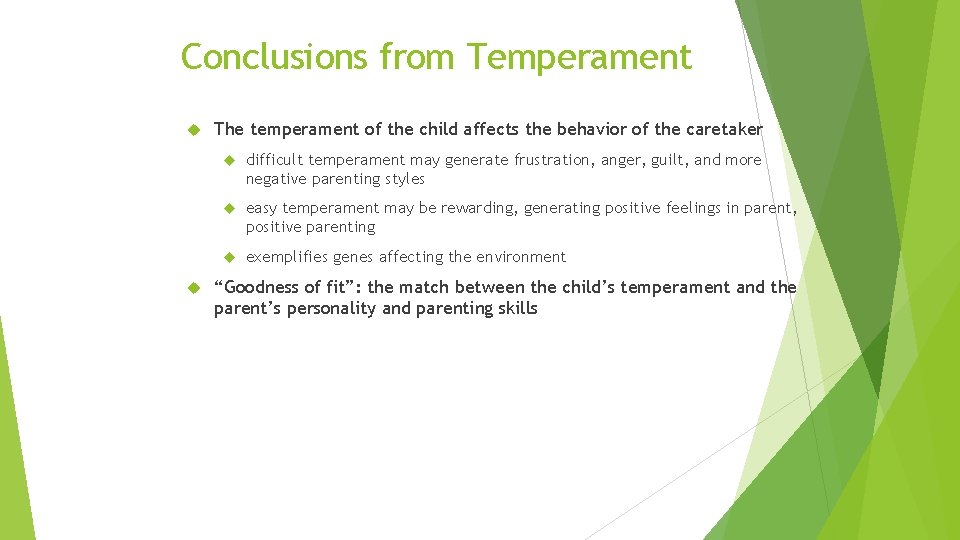
Conclusions from Temperament The temperament of the child affects the behavior of the caretaker difficult temperament may generate frustration, anger, guilt, and more negative parenting styles easy temperament may be rewarding, generating positive feelings in parent, positive parenting exemplifies genes affecting the environment “Goodness of fit”: the match between the child’s temperament and the parent’s personality and parenting skills
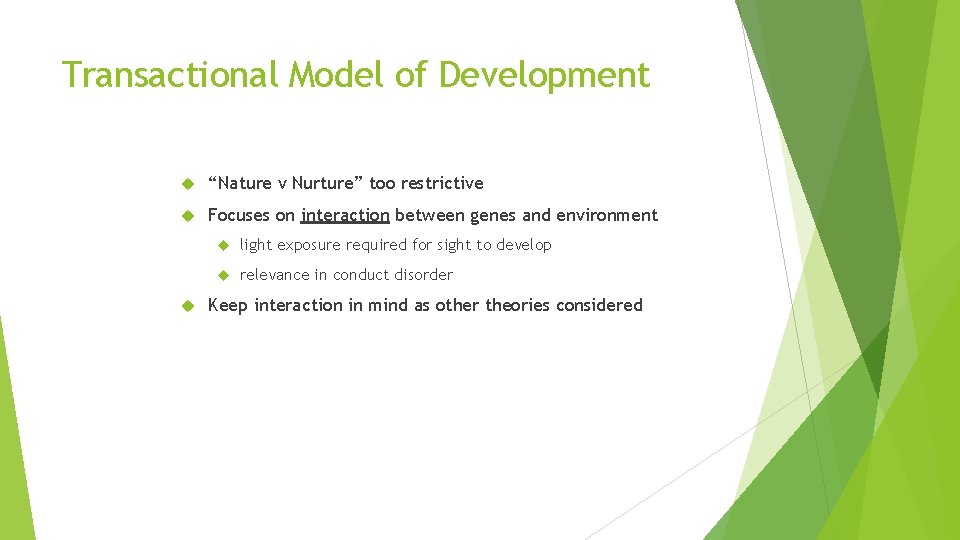
Transactional Model of Development “Nature v Nurture” too restrictive Focuses on interaction between genes and environment light exposure required for sight to develop relevance in conduct disorder Keep interaction in mind as other theories considered
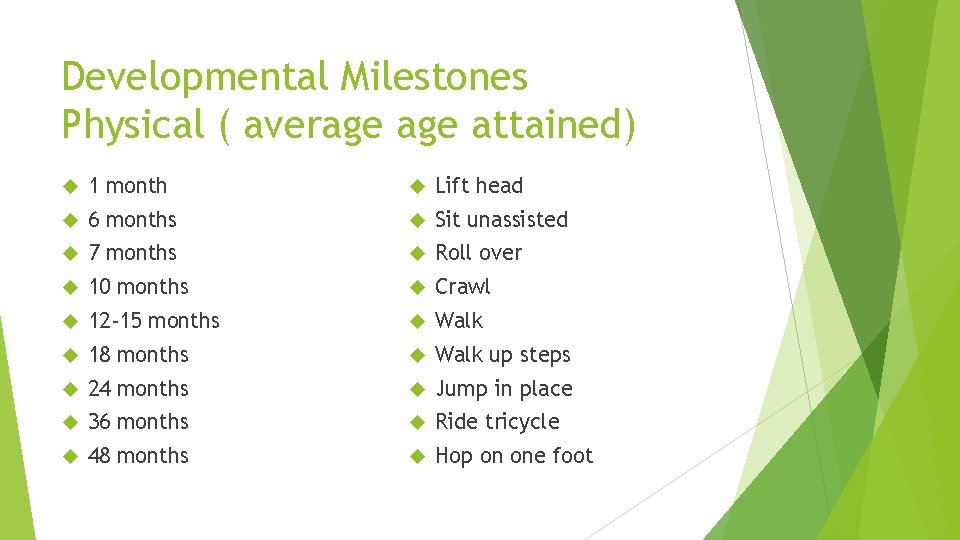
Developmental Milestones Physical ( average attained) 1 month Lift head 6 months Sit unassisted 7 months Roll over 10 months Crawl 12 -15 months Walk 18 months Walk up steps 24 months Jump in place 36 months Ride tricycle 48 months Hop on one foot