
PSYCHOLOGICAL BASIS OF PERSONALITY DEVELOPMENT PD 1 PERSONALITY
PSYCHOLOGICAL BASIS OF PERSONALITY DEVELOPMENT PD 1 (PERSONALITY DEVELOPMENT AND PUBLIC RELATIONS) JONA VICTORIANO, M. A.
OBJECTIVES 1. Define and explain human development 2. Define and explain the structures of our personality by looking through the lens of Sigmund Freud’s theory 3. Analyze the different theories of human development
WHAT IS HUMAN DEVELOPMENT? • “…it is the progressive and continuous change in the individual from conception up to death. ” (Santos, 2010)
MATURATION • “…. refers to the appearance of specie-specific behaviors like talking and walking. ” (Santos, 2010)

STRUCTURES OF PERSONALITY
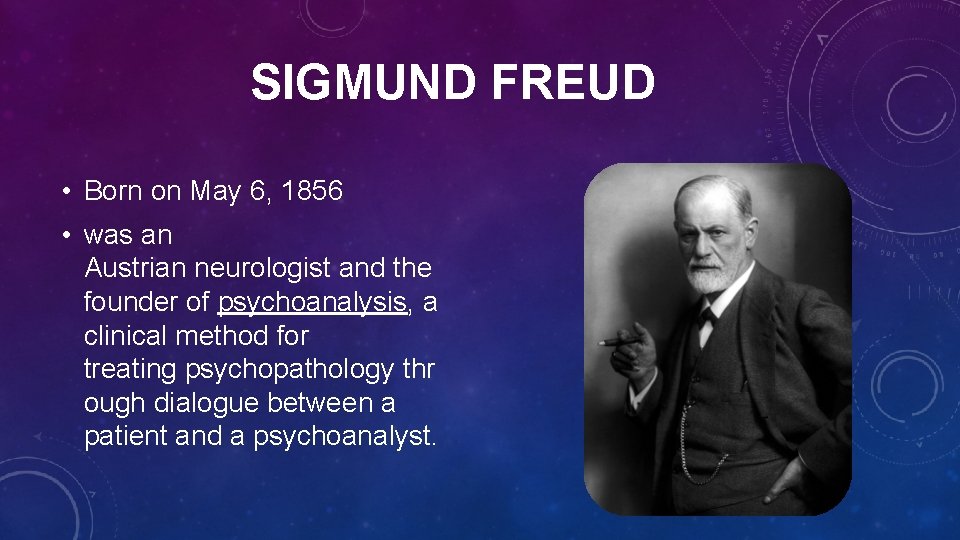
SIGMUND FREUD • Born on May 6, 1856 • was an Austrian neurologist and the founder of psychoanalysis, a clinical method for treating psychopathology thr ough dialogue between a patient and a psychoanalyst.
FREUD’S STRUCTURE OF PERSONALITY 1. Id - is the primitive and instinctive component of personality. It consists of all the inherited (i. e. biological) components of personality present at birth, including the sex (life) instinct – Eros (which contains the libido), and the aggressive (death) instinct - Thanatos. -it is also called the “pleasure principle”. 2. Ego – is that part of the id which has been modified by the direct influence of the external world. - It is the “decision making component” of personality. - it is also called the “reality principle. ”
FREUD’S STRUCTURE OF PERSONALITY 3. Superego - The superego's function is to control the id's impulses, especially those which society forbids, such as sex and aggression. - It also has the function of persuading the ego to turn to moralistic goals rather than simply realistic ones and to strive for perfection.
THEORIES OF HUMAN DEVELOPMENT
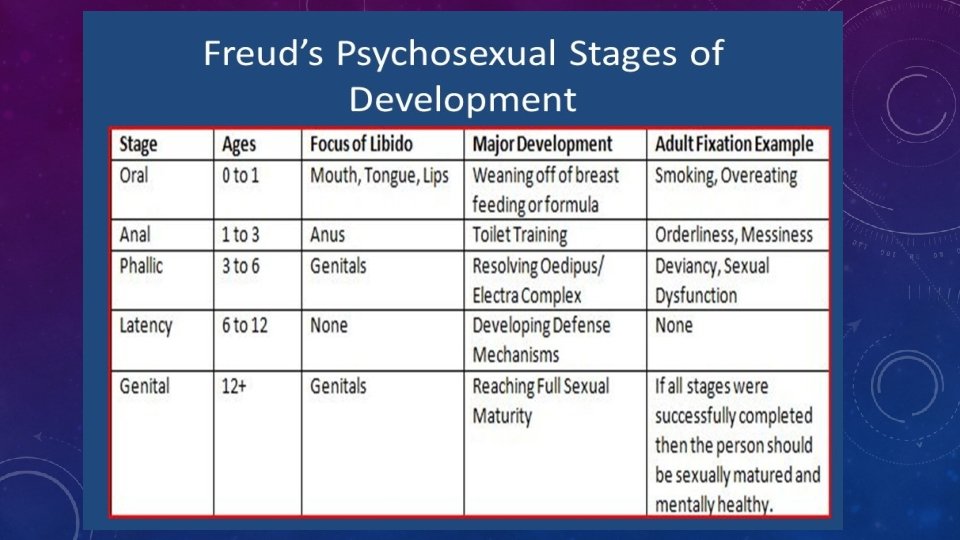
FREUD’S PSYCHOSEXUAL THEORY • The theory of psychosexual development describes how personality develops during childhood. • Freud believed that personality develops through a series of childhood stages in which the pleasureseeking energies of the id become focused on certain erogenous areas. This psychosexual energy, or libido, was described as the driving force behind behavior.
LIBIDO • Is the energy, regarded as a quantitative magnitude. . . of those instincts which have to do with all that may be comprised under the word 'love'. It is the instinct energy or force, contained in what Freud called the id, the strictly unconscious structure of the psyche.
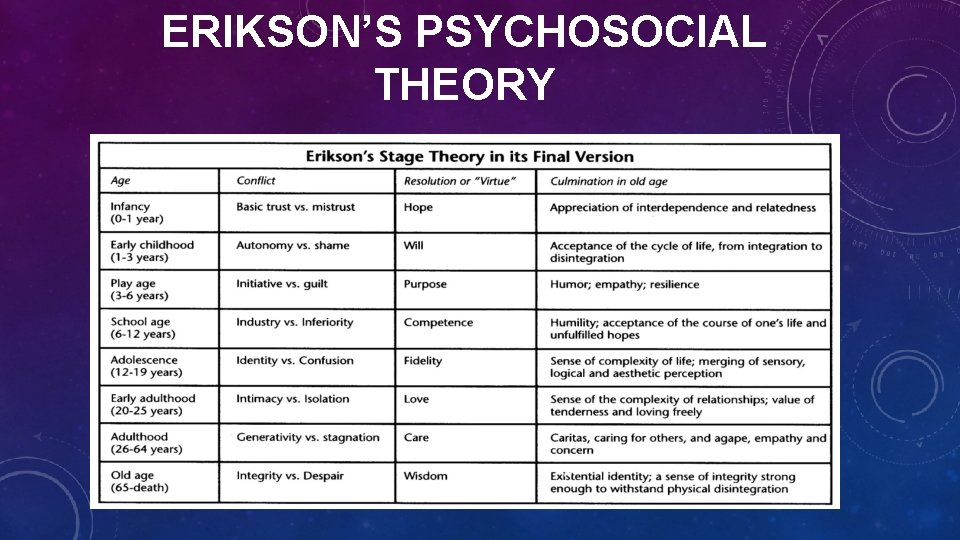
ERIKSON’S PSYCHOSOCIAL THEORY
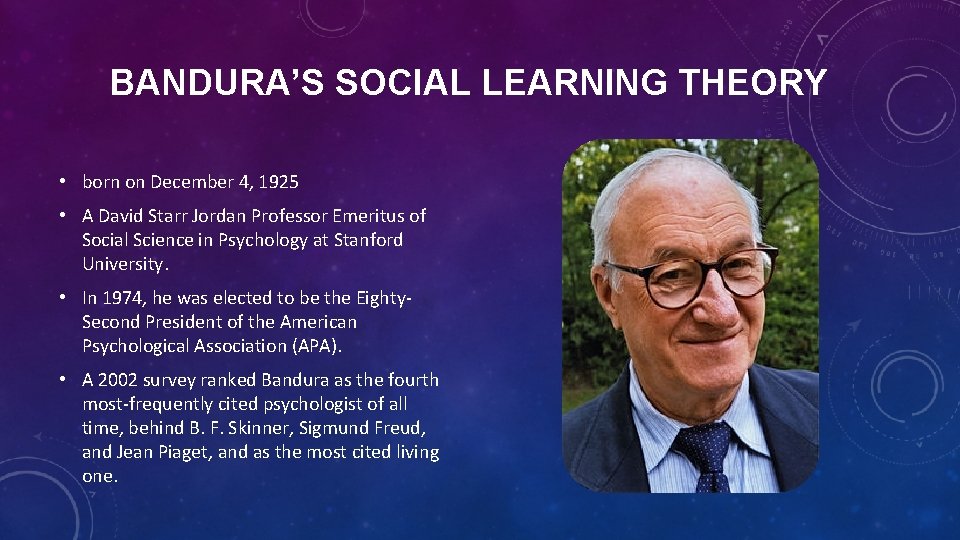
BANDURA’S SOCIAL LEARNING THEORY • born on December 4, 1925 • A David Starr Jordan Professor Emeritus of Social Science in Psychology at Stanford University. • In 1974, he was elected to be the Eighty. Second President of the American Psychological Association (APA). • A 2002 survey ranked Bandura as the fourth most-frequently cited psychologist of all time, behind B. F. Skinner, Sigmund Freud, and Jean Piaget, and as the most cited living one.
BANDURA’S SOCIAL LEARNING THEORY • This theory posits that people learn from one another, via observation, imitation, and modeling.
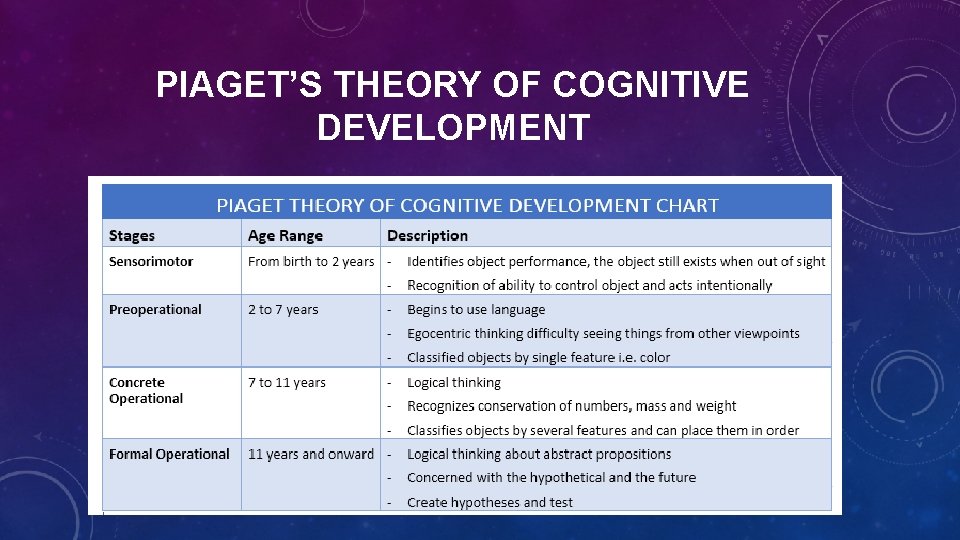
PIAGET’S THEORY OF COGNITIVE DEVELOPMENT
- Slides: 16