
PSYCHOGRAPHIC AND BEHAVIOR RESPONSE SEGMENTATION Psychographic Segmentation Market
PSYCHOGRAPHIC AND BEHAVIOR RESPONSE SEGMENTATION
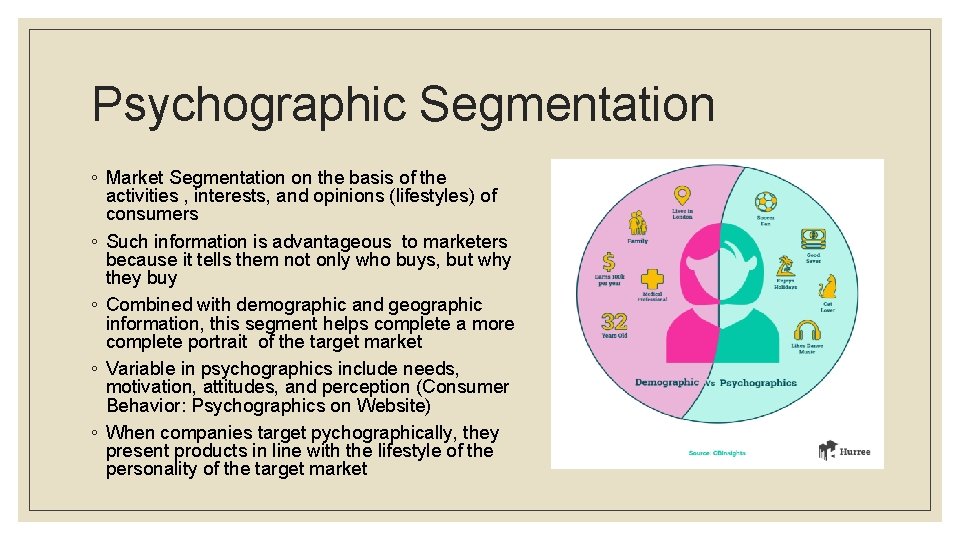
Psychographic Segmentation ◦ Market Segmentation on the basis of the activities , interests, and opinions (lifestyles) of consumers ◦ Such information is advantageous to marketers because it tells them not only who buys, but why they buy ◦ Combined with demographic and geographic information, this segment helps complete a more complete portrait of the target market ◦ Variable in psychographics include needs, motivation, attitudes, and perception (Consumer Behavior: Psychographics on Website) ◦ When companies target pychographically, they present products in line with the lifestyle of the personality of the target market
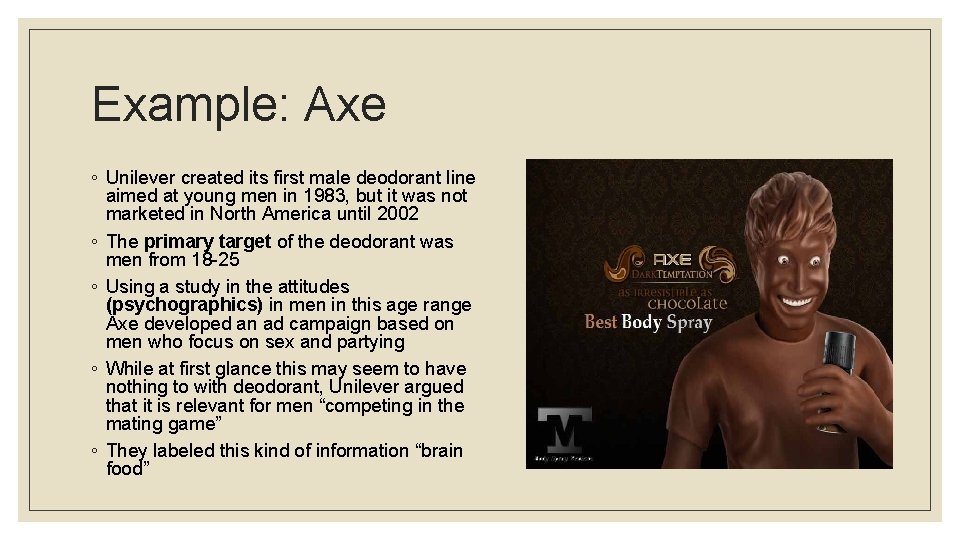
Example: Axe ◦ Unilever created its first male deodorant line aimed at young men in 1983, but it was not marketed in North America until 2002 ◦ The primary target of the deodorant was men from 18 -25 ◦ Using a study in the attitudes (psychographics) in men in this age range Axe developed an ad campaign based on men who focus on sex and partying ◦ While at first glance this may seem to have nothing to with deodorant, Unilever argued that it is relevant for men “competing in the mating game” ◦ They labeled this kind of information “brain food”
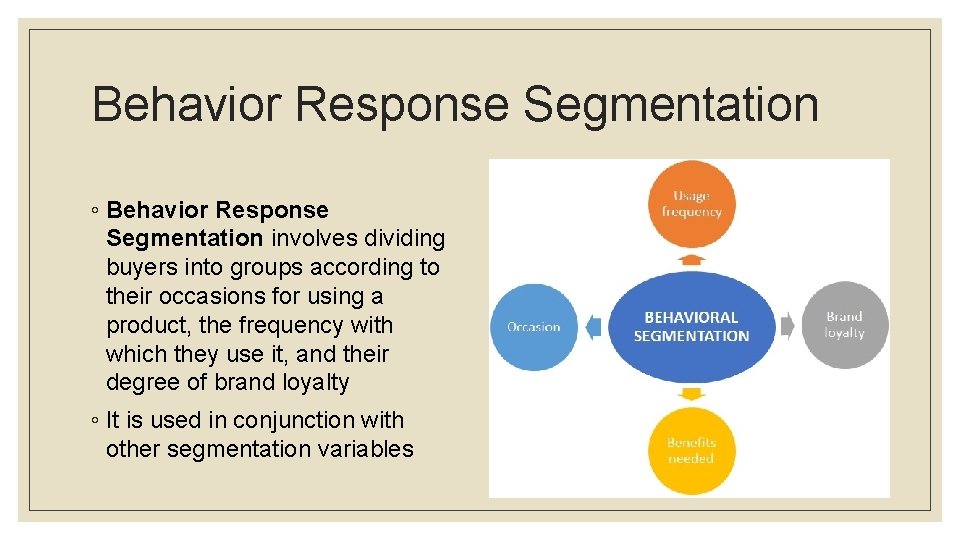
Behavior Response Segmentation ◦ Behavior Response Segmentation involves dividing buyers into groups according to their occasions for using a product, the frequency with which they use it, and their degree of brand loyalty ◦ It is used in conjunction with other segmentation variables
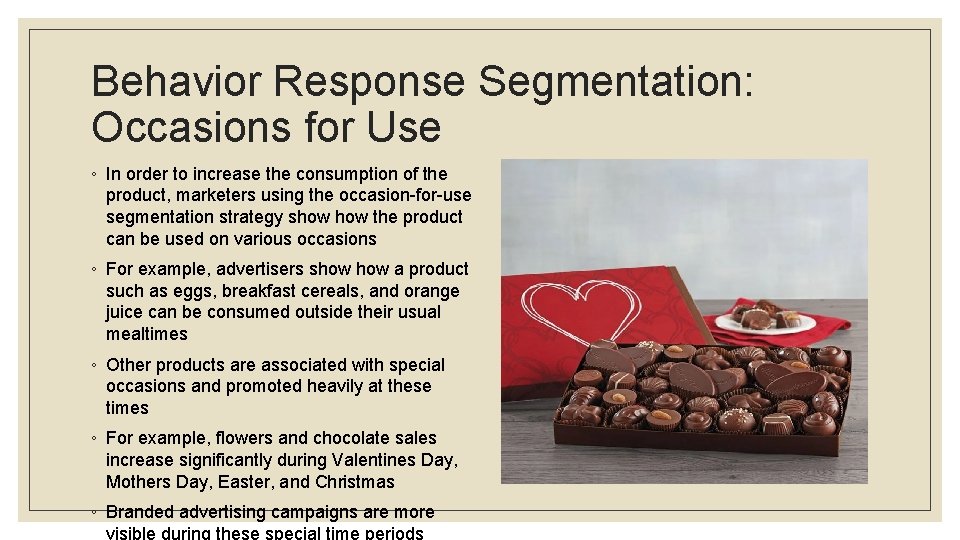
Behavior Response Segmentation: Occasions for Use ◦ In order to increase the consumption of the product, marketers using the occasion-for-use segmentation strategy show the product can be used on various occasions ◦ For example, advertisers show a product such as eggs, breakfast cereals, and orange juice can be consumed outside their usual mealtimes ◦ Other products are associated with special occasions and promoted heavily at these times ◦ For example, flowers and chocolate sales increase significantly during Valentines Day, Mothers Day, Easter, and Christmas ◦ Branded advertising campaigns are more visible during these special time periods
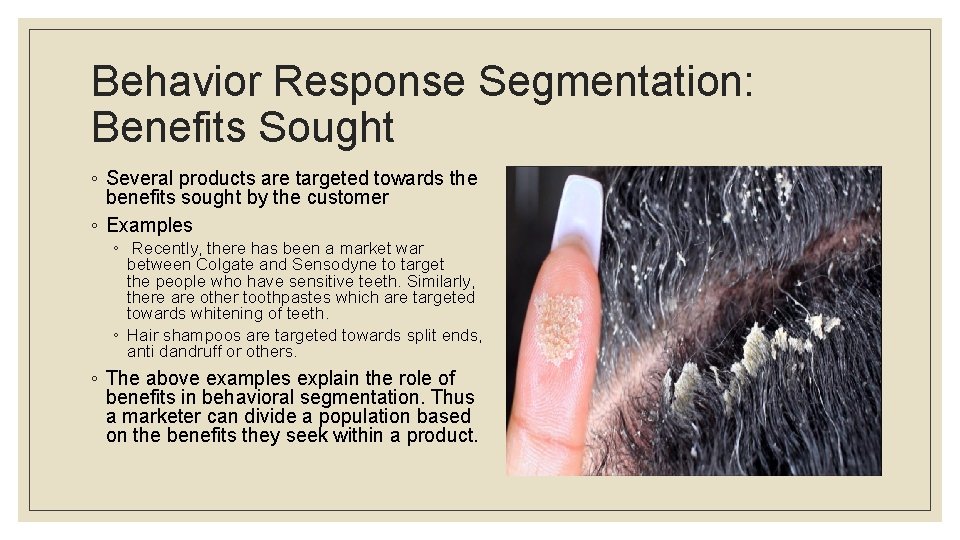
Behavior Response Segmentation: Benefits Sought ◦ Several products are targeted towards the benefits sought by the customer ◦ Examples ◦ Recently, there has been a market war between Colgate and Sensodyne to target the people who have sensitive teeth. Similarly, there are other toothpastes which are targeted towards whitening of teeth. ◦ Hair shampoos are targeted towards split ends, anti dandruff or others. ◦ The above examples explain the role of benefits in behavioral segmentation. Thus a marketer can divide a population based on the benefits they seek within a product.
Behavior Response Segmentation: Usage Rates ◦ In residential or commercial segment, the usage can be demonstrated in the form of heavy usage, moderate usage or lesser usage. ◦ Example: Beauty parlors or personal care. ◦ There are some customers who use a lot of personal care products whereas others do not use personal care products much. ◦ Thus depending on their usage the customers can be targeted. ◦ There are multiple sizes available of any beauty care item. ◦ Heavy usage customers can buy the large containers and medium or small users can buy the smaller container. ◦ Another example of usage rate segmentations can be seen in the electronics as well as the FMCG industry in industrial buying ◦ Example: Fast Moving Consumer Goods (FMCG) and Electronics ◦ Works on the basis of a channel with dealers and distributors. ◦ In these segments, the maximum discount goes to the one who buys the maximum whereas others get lesser profits as they also get lesser discounts. ◦ Any product which is not targeted towards the masses generally uses behavioral segmentation ◦ It is also an excellent form of segmentation for products which are niche in nature and are targeted towards the wants and demands of customers
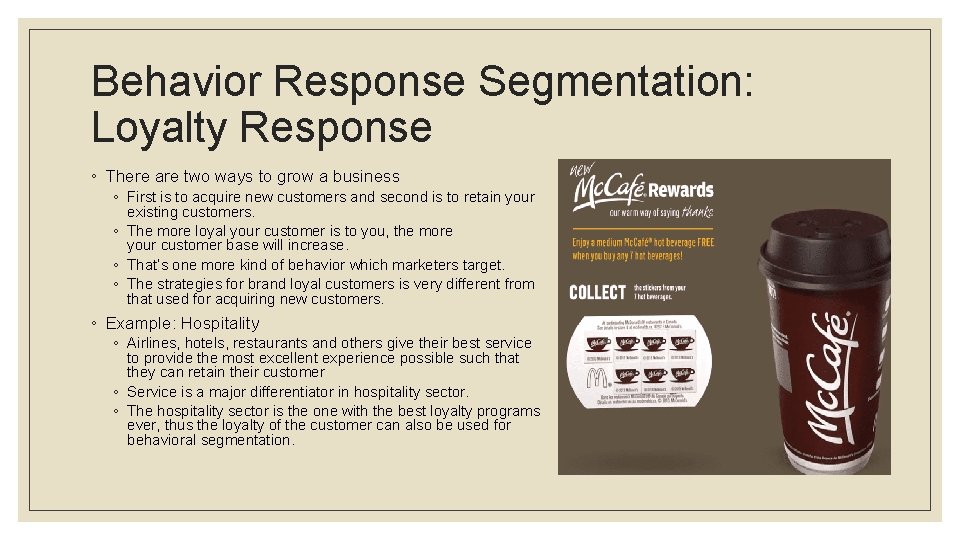
Behavior Response Segmentation: Loyalty Response ◦ There are two ways to grow a business ◦ First is to acquire new customers and second is to retain your existing customers. ◦ The more loyal your customer is to you, the more your customer base will increase. ◦ That’s one more kind of behavior which marketers target. ◦ The strategies for brand loyal customers is very different from that used for acquiring new customers. ◦ Example: Hospitality ◦ Airlines, hotels, restaurants and others give their best service to provide the most excellent experience possible such that they can retain their customer ◦ Service is a major differentiator in hospitality sector. ◦ The hospitality sector is the one with the best loyalty programs ever, thus the loyalty of the customer can also be used for behavioral segmentation.
- Slides: 8