
Psychodynamic Approaches role of the unconscious and defence

- Slides: 10
Psychodynamic Approaches role of the unconscious and defence mechanisms The psychodynamic approach is an approach to treatment that features psychological and psychiatric factors when examining unconscious motives in the moulding of personality, attitudes and emotional disorder (Psychology Dictionary 2017). Freud was the founding father of psychoanalysis, a method for treating mental illness and also a theory which explains human behavior. Freud believed that when we explain our own behaviour to ourselves or others (conscious mental activity) we rarely give a true account of our motivation. (simply psychology 2017).
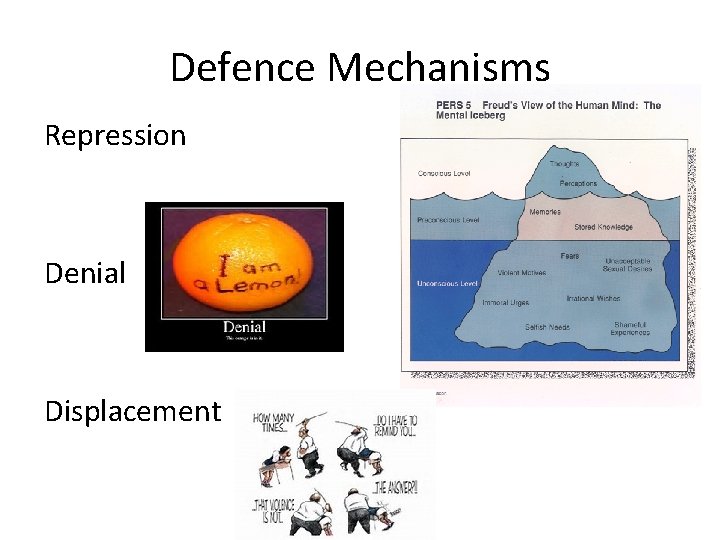
Defence Mechanisms Repression Denial Displacement
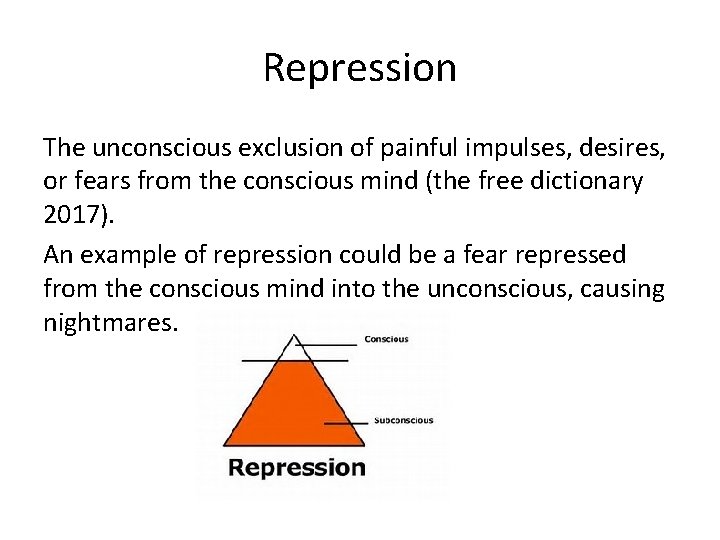
Repression The unconscious exclusion of painful impulses, desires, or fears from the conscious mind (the free dictionary 2017). An example of repression could be a fear repressed from the conscious mind into the unconscious, causing nightmares.
Denial is an unconscious defence mechanism characterized by refusal to acknowledge painful realities, thoughts, or feelings (the free dictionary 2017). An example of denial could be a student not accepting their bad grade on an exam.
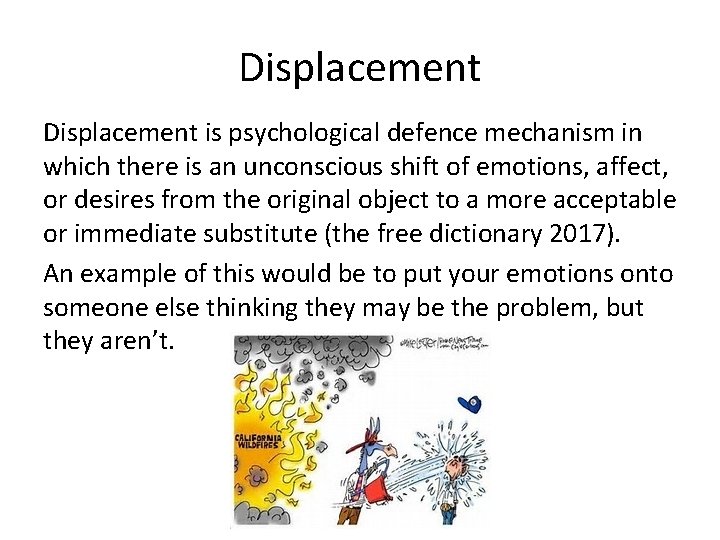
Displacement is psychological defence mechanism in which there is an unconscious shift of emotions, affect, or desires from the original object to a more acceptable or immediate substitute (the free dictionary 2017). An example of this would be to put your emotions onto someone else thinking they may be the problem, but they aren’t.
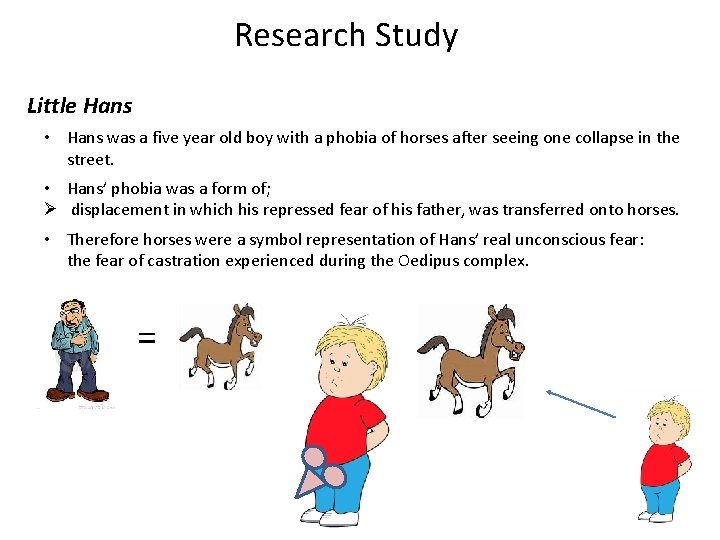
Research Study Little Hans • Hans was a five year old boy with a phobia of horses after seeing one collapse in the street. • Hans’ phobia was a form of; Ø displacement in which his repressed fear of his father, was transferred onto horses. • Therefore horses were a symbol representation of Hans’ real unconscious fear: the fear of castration experienced during the Oedipus complex. =
Strengths Can explain the unexplainable 1. Used to explain personality, abnormal behaviour and moral development. 2. Highlights connection between early experiences in childhood such as parental relationships and later attachment. Useful applications- Psychoanalysis 1. Development of psychoanalysis - brought new methodological procedures, empirical evidence in the use of case studies. 2. Case studies demonstrate the success of psychological rather than biological treatments for disorders such as depression and anxiety.
Limitations Untestable concepts 1. Does not meet the scientific criterion of falsification as it cannot be empirically tested (and possibly disproved). 2. Concepts at an unconscious level = impossible to test. 3. Reduces the validity and usefulness of theory and research in the approach. Generalisability of the case study method 1. Case studies are - rich in qualitative data, carefully recorded and high in ecological validity.
Treatment • Treat the root cause of such disorders RATHER THAN drug treatments (which can be criticized for treating just symptoms. ) • Improvements in symptoms are often maintained in the years after treatment, as biological remedies are usually just a quick short term cure.
References Psychodynamic approach http: //psychologydictionary. org/psychodynamic-approach/ (13 th March 2017) Repression Definition http: //www. thefreedictionary. com/repression (13 th March 2017) Denial Definition http: //www. thefreedictionary. com/denial (13 th March 2017) Displacement Definition 2017) http: //www. thefreedictionary. com/displacement (13 th March 2017) Simply Psychology http: //www. simplypsychology. org/Sigmund. Freud. html (13 th March 2017)