
Psychoanalytic Theory Mackenzie Bohn Sydney Kern Kasy Martell

Psychoanalytic Theory Mackenzie Bohn, Sydney Kern, Kasy Martell
What is Psychoanalytic Theory? The theory of personality developed of which the cornerstone is a focus on repression and unconscious forces. This includes the concepts of infantile sexuality, resistance, transference, and most notably the division of the psyche into the id, ego, and superego. Recalling past experiences to explain one's psychological problems Bringing one’s unconscious material into consciousness
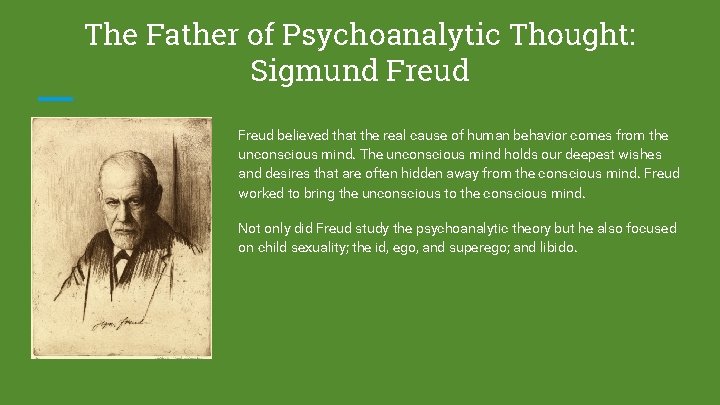
The Father of Psychoanalytic Thought: Sigmund Freud believed that the real cause of human behavior comes from the unconscious mind. The unconscious mind holds our deepest wishes and desires that are often hidden away from the conscious mind. Freud worked to bring the unconscious to the conscious mind. Not only did Freud study the psychoanalytic theory but he also focused on child sexuality; the id, ego, and superego; and libido.
The Psyche: Id, Ego, Superego Id: the instinctive personality, impulsive, operates on pleasure principle. Think of an infant child who cries when it wants something and has no consideration for its exhausted mother. (“I want this now”) Ego: Like the Id, it avoids pain and seeks pleasure but is concerned with devising a realistic strategy to get what is wanted without causing harm is discomfort to itself or the Id. (“I need to work for/earn this”) Superego: avoids feelings of guilt and considers social norms and morals. Controls Id’s impulses. (“I can’t have this”)
Transference Term coined by Freud Concept that refers to the natural tendency to respond to certain situations in unique, predetermined ways Describes the tendency to base perceptions and expectations in present relationships on past attachments with parents (especially to parents) siblings, and significant others. Bad relationships with people in the past affect relationships in the present Ex cheated on you, more cautious and distrusting in future relationships
Resistance The resisting of self exploration of uncomfortable thoughts and keeping them from entering the conscious mind When one experiences resistance, he/she may change the topic very suddenly, become silent, or try to discontinue treatment. A veteran refuses to talk about his experiences in war due to horrific events experienced Psychoanalysis attempts to have one face this experience head on in attempt to make them feel less threatened by these feelings towards this experiences and hopefully, make the patient more capable of facing these uncomfortable feelings on their own
Trauma Severe shock to the system Deep emotional wound Revisiting of traumatic events are common through dreams PTSD Treatment includes medication, facing the feelings with another person, and supporting the ego (the mind responsible for decision making, understanding cause and effect, and discrimination)
Defense Mechanisms They are based on how primitive they are or how well they work. For example: Denial, projection and Acting Out are primitive Repression and Displacement are more mature and less primitive Sublimation and Compensation are mature
Defense Mechanisms Denial: refusing to accept reality or facts. Acting out: An extreme way of expressing thoughts that a person can’t really express it in the right way. Projection: Placing one’s unwanted thoughts and feelings onto another person or situation. Repression: unconsciously blocking unacceptable thoughts, feelings, and impulses. Displacement: redirecting thoughts and feelings about one person onto another. Sublimation: Channeling unacceptable thoughts and feelings into more acceptable ones. Compensation: emphasizing strength in other areas to make up for the weak ones.
What Happens in Psychoanalysis? Free association: reporting every thought without a censor Dream analysis: treating dreams as a metaphor that symbolizes something Interpretation: deciphering the meaning underlying what is said and heard Analysis of Resistance: seeing what topics are uncomfortable to know which places need to be confronted
Examples of Psychoanalytic Thought: Andrew lost his car keys and was late for work. a. A psychoanalytic theorist might say that he lost his keys because, somewhere in his subconscious, he did not want to go to work that day and actually wanted to quit his job. Kathy was driving her daughter around in the van, trying to get the three-month-old to take a nap. She wasn’t paying much attention to where she was going, and realized that she had driven to the house of an old friend with whom she hadn’t spoken in years. a. She wondered if that was her subconscious telling her that it was time to reconcile with her friend. Heather often tells white lies and is known for giving evasive answers to questions. a. Her husband thinks Heather does this because deep down she is afraid of facing the truth about difficult situations, so she avoids the truth in both major and minor circumstances.
Criticisms with Freudian Psychoanalysis Although Freudian psychoanalysis remained the most widely used method of psychotherapy until at least the 1950 s, there were a few criticisms. case-study method (used neurotic wealthy European females) overemphasis on sexual drive time-consuming and expensive therapy low cure rate

Question and Answer Q: What is free association? A: Reporting all thoughts without a censor
- Slides: 13