
PSYCHOANALYTIC THEORIES OF PERSONALITY AP Psychology PERSONALITY PERSPECTIVES
















- Slides: 52
PSYCHOANALYTIC THEORIES OF PERSONALITY AP Psychology
PERSONALITY PERSPECTIVES Psychoanalytic—importance of unconscious processes and childhood experiences Humanistic—importance of self and fulfillment of potential Social cognitive—importance of beliefs about self Trait—description and measurement of personality differences
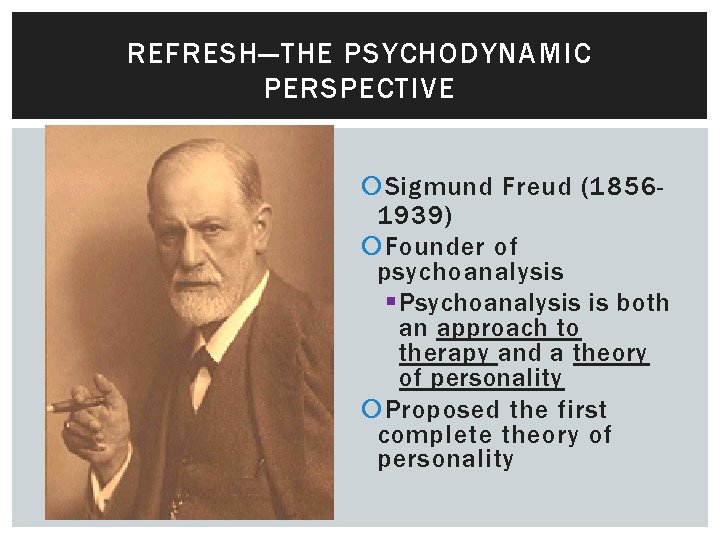
REFRESH—THE PSYCHODYNAMIC PERSPECTIVE Sigmund Freud (18561939) Founder of psychoanalysis § Psychoanalysis is both an approach to therapy and a theory of personality Proposed the first complete theory of personality
REFRESH—THE PSYCHODYNAMIC PERSPECTIVE Psychoanalysis as an Theory Emphasized the role and influence of the unconscious and early childhood memories as influential towards personality development Psychoanalysis as a Therapy A therapeutic technique that attempts to provide insight into one’s thoughts and actions § Does so by exposing and interpreting the underlying unconscious motives and conflicts
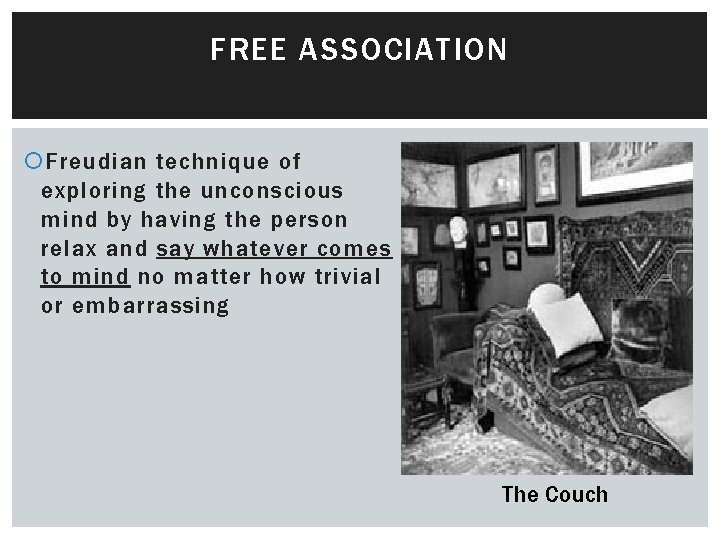
FREE ASSOCIATION Freudian technique of exploring the unconscious mind by having the person relax and say whatever comes to mind no matter how trivial or embarrassing The Couch
REFRESH—THE PSYCHODYNAMIC PERSPECTIVE Freud used projective tests, which are tests designed to project or reveal, unconscious thoughts. § Interpretation of an ambiguous stimulus to trigger projection of one’s inner thoughts and feelings These tests, however, proved to be unreliable as people reported different opinions§ which were often influenced by their mood or present emotions
PERSONALITY ASSESSMENT Two examples of projective tests are: § The Rorschach test, viewing 10 inkblots, § The TAT test, comprising of ambiguous scenes, which patients would then tell a story. § Subjects were asked to report what they saw in each of these tests, which led to unconscious conflicts and motivation.
RORSCHACH INKBLOT TEST Presentation and interpretation of a series of black and white and colored inkblots § Developed in 1921. Personality test that seeks to identify people’s inner feelings by analyzing their interpretations of 10 inkblots § Numerous scoring systems exist
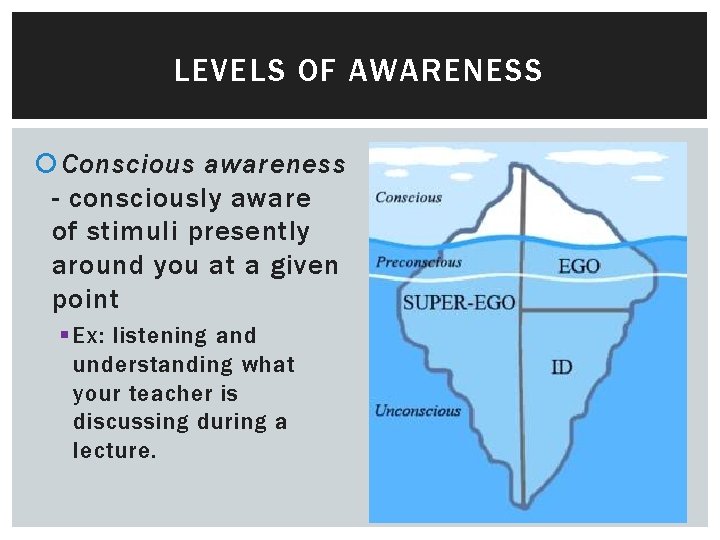
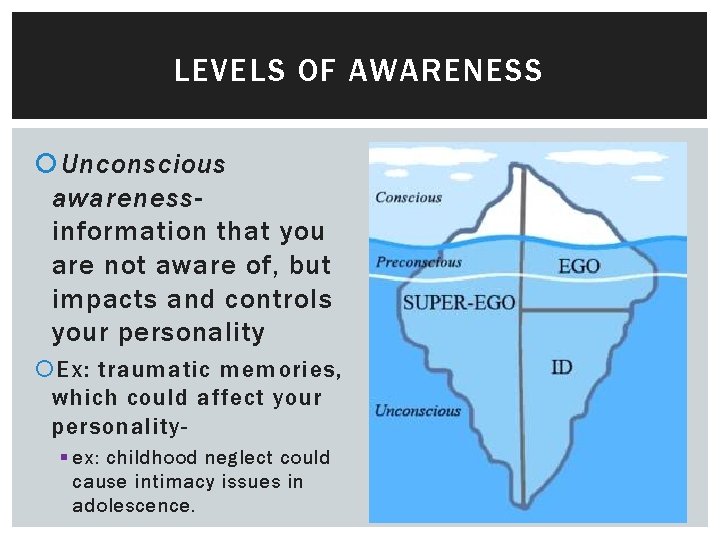
LEVELS OF AWARENESS Conscious awareness - consciously aware of stimuli presently around you at a given point § Ex: listening and understanding what your teacher is discussing during a lecture.
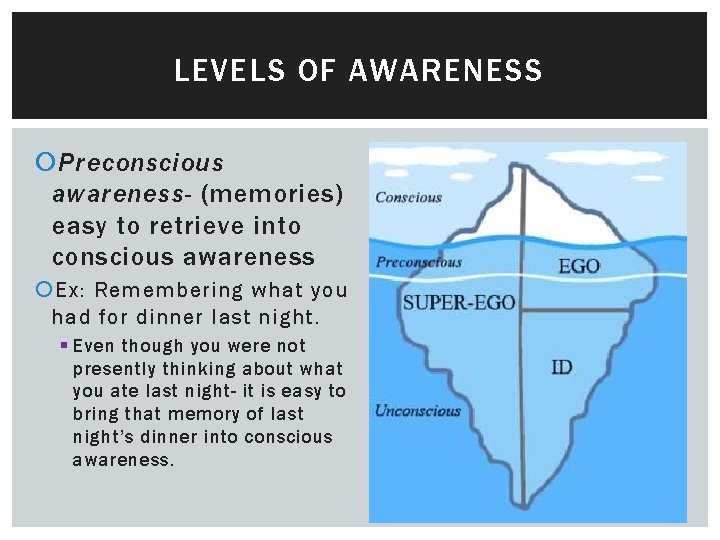
LEVELS OF AWARENESS Preconscious awareness- (memories) easy to retrieve into conscious awareness Ex: Remembering what you had for dinner last night. § Even though you were not presently thinking about what you ate last night- it is easy to bring that memory of last night’s dinner into conscious awareness.
LEVELS OF AWARENESS Unconscious awarenessinformation that you are not aware of, but impacts and controls your personality Ex: traumatic memories, which could affect your personality§ ex: childhood neglect could cause intimacy issues in adolescence.
THE ID, EGO, AND SUPEREGO Sigmund Freud
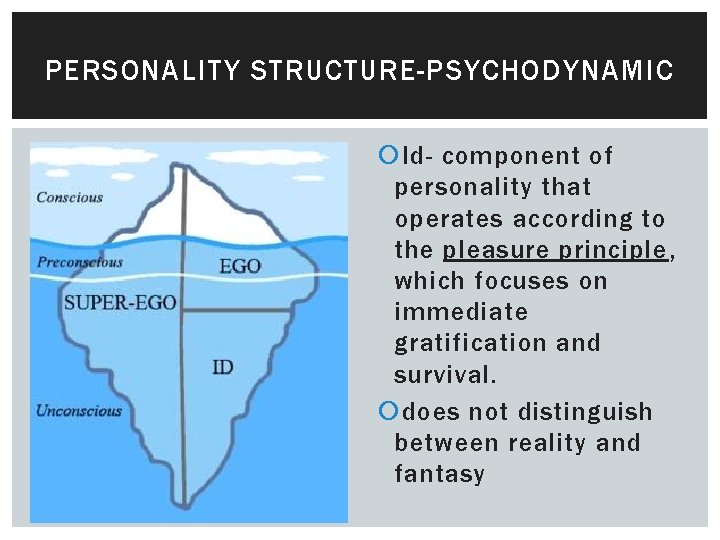
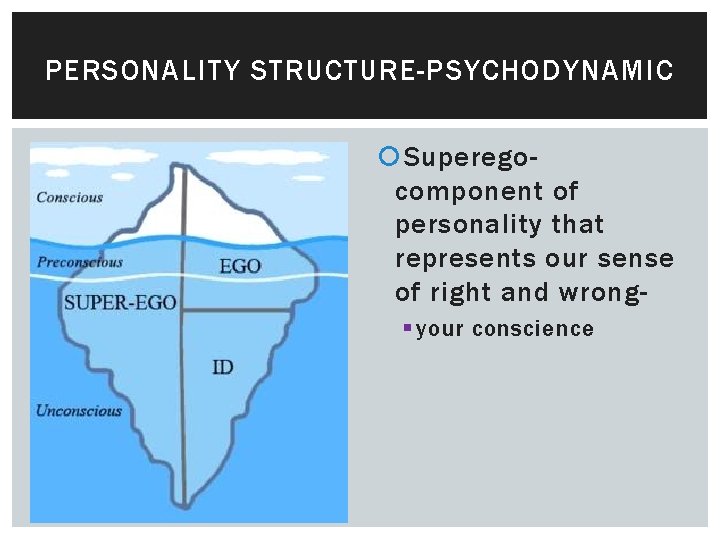
PERSONALITY STRUCTURE-PSYCHODYNAMIC Id- component of personality that operates according to the pleasure principle, which focuses on immediate gratification and survival. does not distinguish between reality and fantasy
THE ID The Id is present at birth and demands immediate gratification § Which is why babies cry hysterically when they want something. An example of the Id would be how animals behave. § The Id is largely instinctual, which is why when animals kill they do not experience remorse or guilt. § They are operating solely on the Id.
THE ID-PLEASURE PRINCIPLE Pleasure principle—drive toward immediate gratification, most fundamental human motive Sources of energy § Eros—life instinct, perpetuates life § Libido—sexual energy or motivation § Thanatos—death instinct, aggression, selfdestructive actions
PERSONALITY STRUCTURE-PSYCHODYNAMIC Id- component of personality that operates according to the pleasure principle, which focuses on immediate gratification and survival. Superegocomponent of personality that represents our sense of right and wrong§ your conscience
THE SUPEREGO The Superego is influenced by how people are raised, which could explain why some people hear their mother’s voice in their head while making a decision.
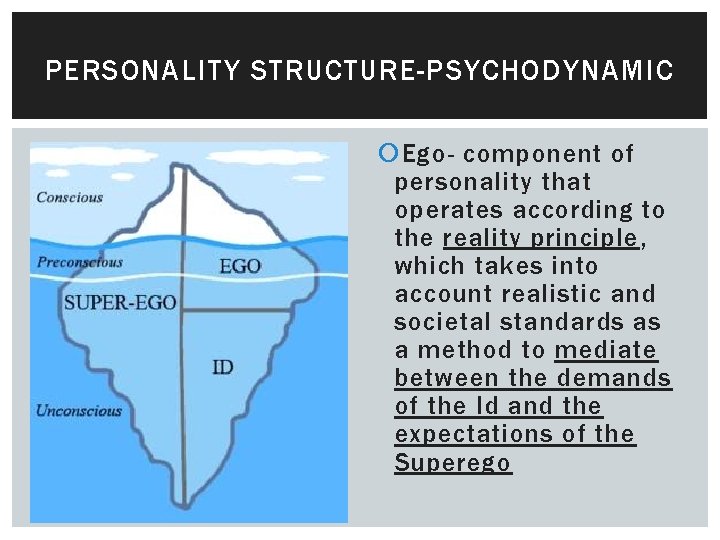
PERSONALITY STRUCTURE-PSYCHODYNAMIC Id- component of personality that operates according to the pleasure principle, which focuses on immediate gratification and survival. Ego- component of personality that operates according to the reality principle, which takes into account realistic and societal standards as a method to mediate between the demands of the Id and the expectations of the Superego
THE EGO The part of personality that mediates the demands of the id without going against the restraints of the superego Rational, organized, logical, mediator to demands of reality § Reality principle—ability to postpone gratification in accordance with demands of reality Can repress desires that cannot be met in an acceptable manner
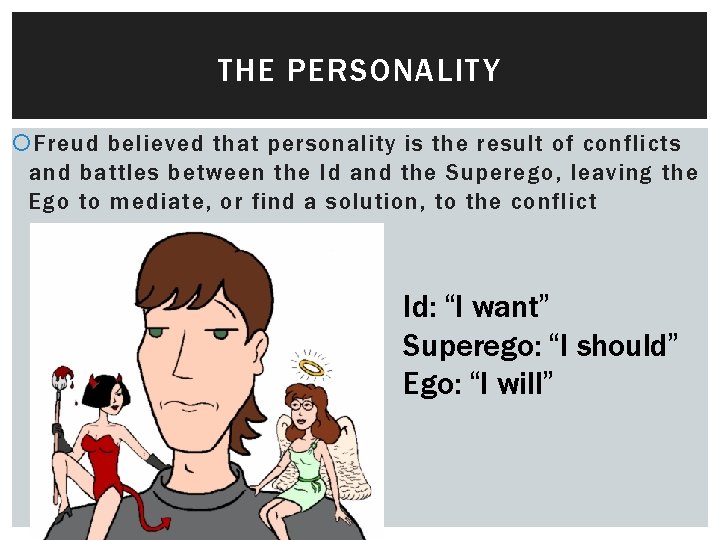
THE PERSONALITY Freud believed that personality is the result of conflicts and battles between the Id and the Superego, leaving the Ego to mediate, or find a solution, to the conflict Id: “I want” Superego: “I should” Ego: “I will”
DEFENSE MECHANISMS Unconscious Self. Deceptions
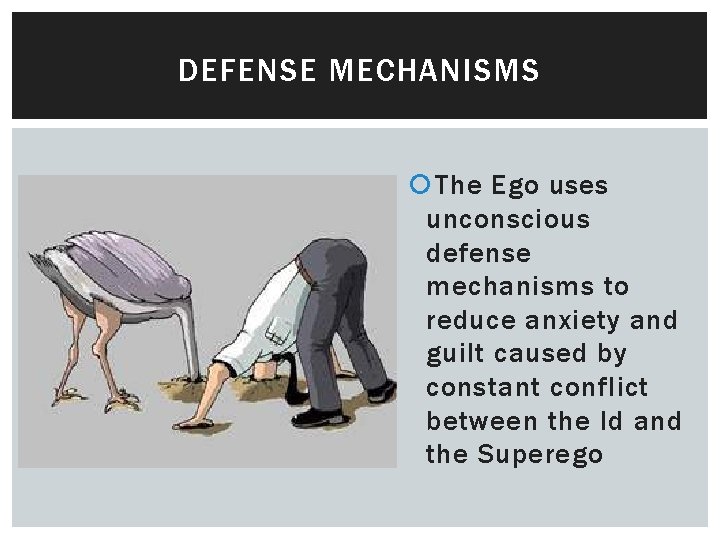
DEFENSE MECHANISMS The Ego uses unconscious defense mechanisms to reduce anxiety and guilt caused by constant conflict between the Id and the Superego
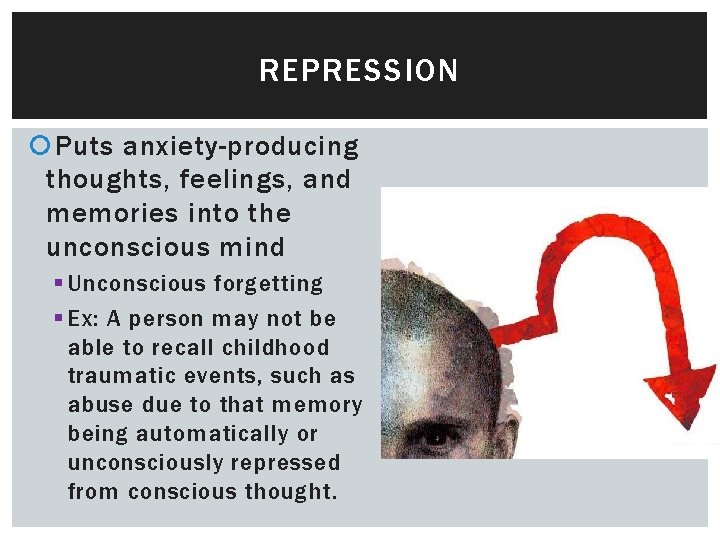
REPRESSION Puts anxiety-producing thoughts, feelings, and memories into the unconscious mind § Unconscious forgetting § Ex: A person may not be able to recall childhood traumatic events, such as abuse due to that memory being automatically or unconsciously repressed from conscious thought.
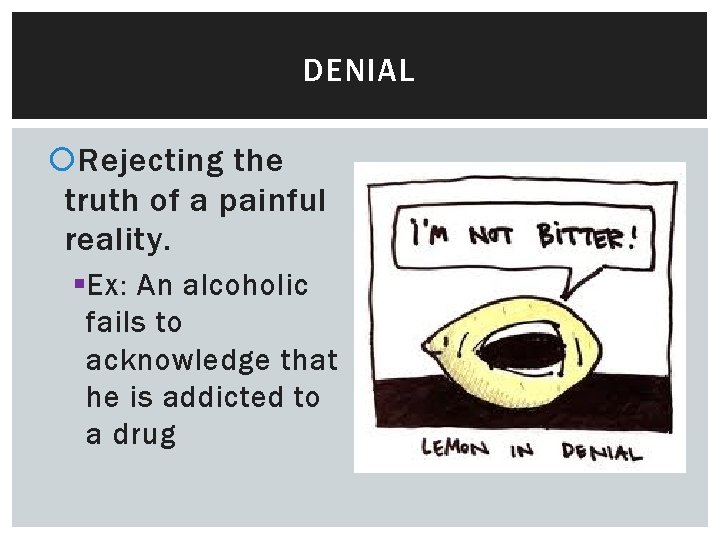
DENIAL Rejecting the truth of a painful reality. § Ex: An alcoholic fails to acknowledge that he is addicted to a drug
REGRESSION Going back to a safer, simpler way of being. Assuming childlike behaviors when facing stress or trauma § Ex: A woman starts to cry when she gets pulled over by a police officer because when she was a little girl she would cry and get out of trouble
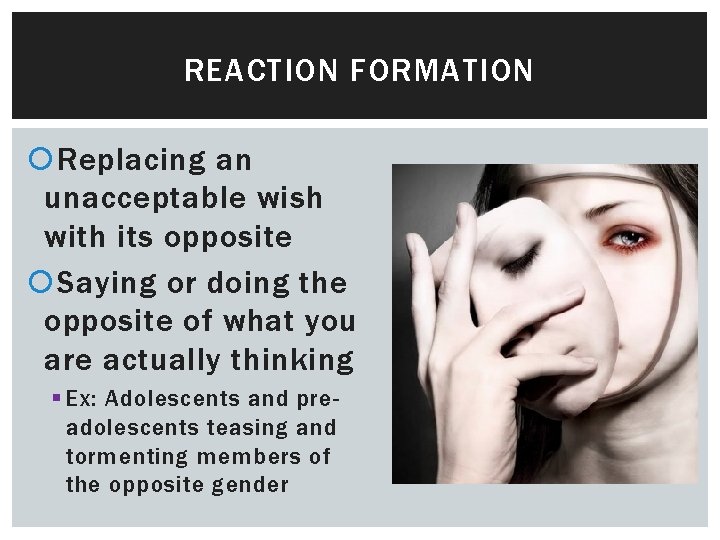
REACTION FORMATION Replacing an unacceptable wish with its opposite Saying or doing the opposite of what you are actually thinking § Ex: Adolescents and preadolescents teasing and tormenting members of the opposite gender
PROJECTION Attributing something that we don’t like about ourselves to someone else. § A married woman who is sexually attracted to her co-worker accuses him of flirting with her
DISPLACEMENT Shifts an unacceptable impulse toward a more acceptable or less threatening object or person “Taking out” an emotion on a safe or more accessible target than the actual source of the emotion.
DISPLACEMENT A person slams their locker because their teacher made them mad. Any hostility towards teacher would have resulted in suspension- but the locker can’t fight back.
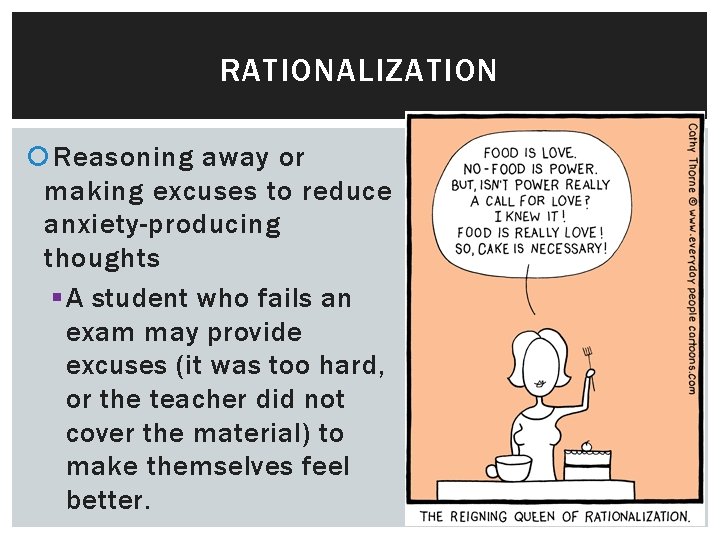
RATIONALIZATION Reasoning away or making excuses to reduce anxiety-producing thoughts § A student who fails an exam may provide excuses (it was too hard, or the teacher did not cover the material) to make themselves feel better.
SUBLIMATION Substitute an undesirable emotion or drive with a socially acceptable one. § An artist works on her painting 13 -14 hours a day while her husband is on an extended business trip
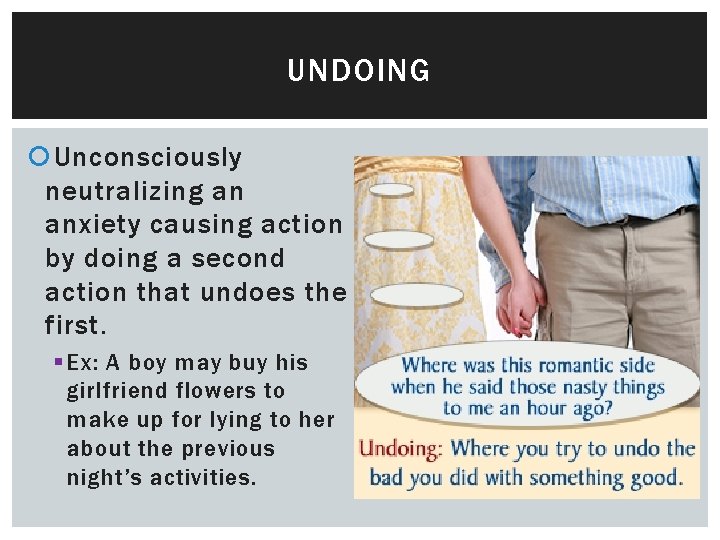
UNDOING Unconsciously neutralizing an anxiety causing action by doing a second action that undoes the first. § Ex: A boy may buy his girlfriend flowers to make up for lying to her about the previous night’s activities.
PSYCHOSEXUAL STAGES OF DEVELOPMENT Sigmund Freud
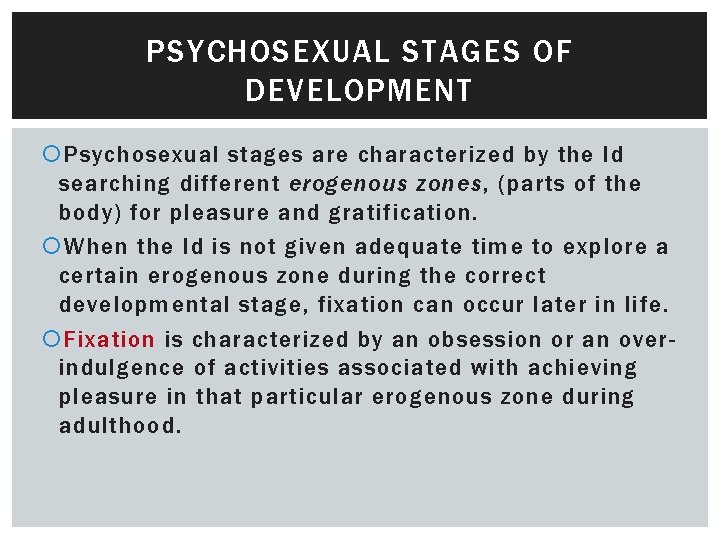
PSYCHOSEXUAL STAGES OF DEVELOPMENT Psychosexual stages are characterized by the Id searching different erogenous zones, (parts of the body) for pleasure and gratification. When the Id is not given adequate time to explore a certain erogenous zone during the correct developmental stage, fixation can occur later in life. Fixation is characterized by an obsession or an overindulgence of activities associated with achieving pleasure in that particular erogenous zone during adulthood.
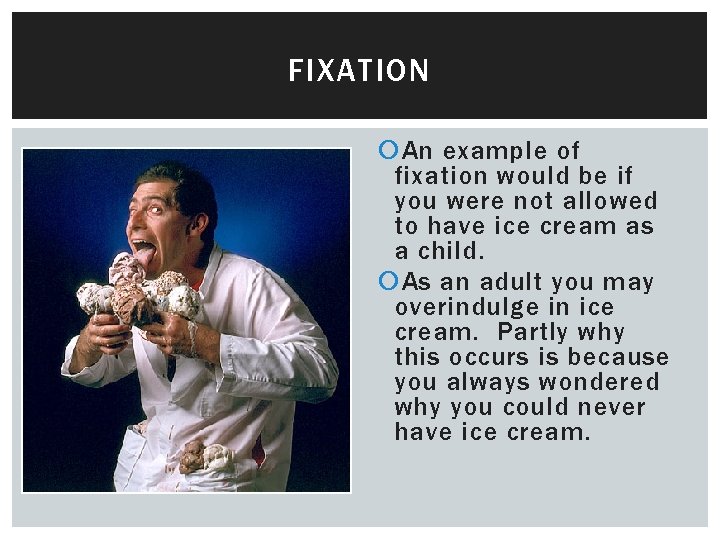
FIXATION An example of fixation would be if you were not allowed to have ice cream as a child. As an adult you may overindulge in ice cream. Partly why this occurs is because you always wondered why you could never have ice cream.
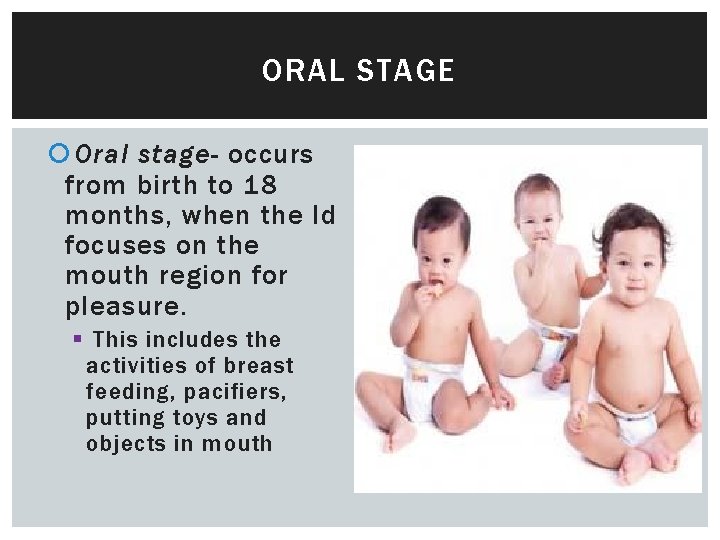
ORAL STAGE Oral stage- occurs from birth to 18 months, when the Id focuses on the mouth region for pleasure. § This includes the activities of breast feeding, pacifiers, putting toys and objects in mouth
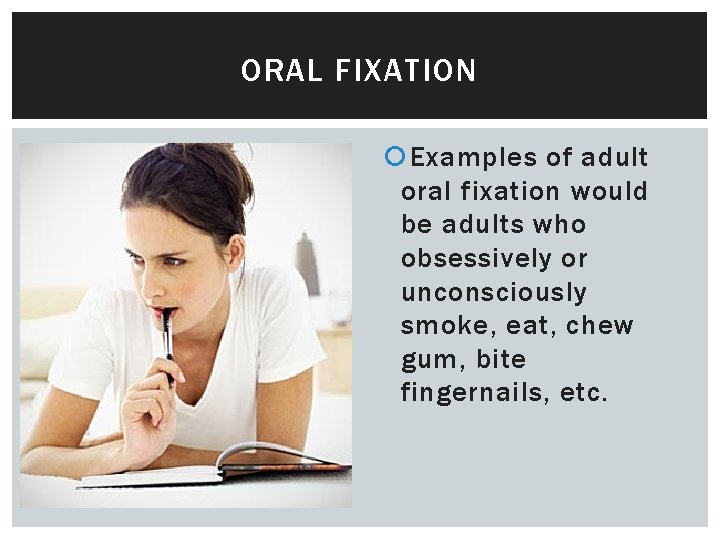
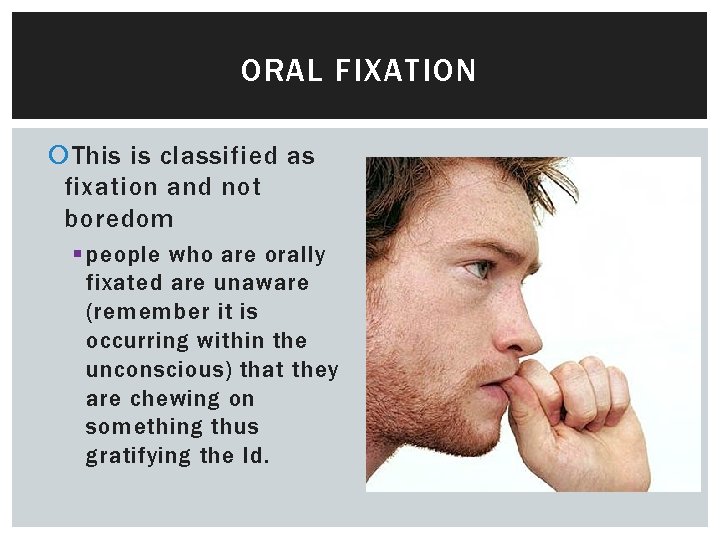
ORAL FIXATION Examples of adult oral fixation would be adults who obsessively or unconsciously smoke, eat, chew gum, bite fingernails, etc.
ORAL FIXATION This is classified as fixation and not boredom § people who are orally fixated are unaware (remember it is occurring within the unconscious) that they are chewing on something thus gratifying the Id.
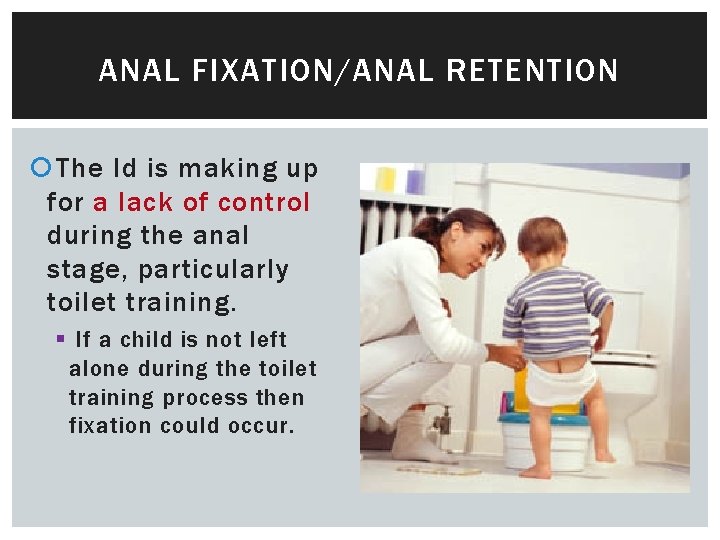
ANAL STAGE Anal stage- occurs from 18 months until 3 years, where the Id focuses on the anal area. This includes applying control and independence in the toilet training process
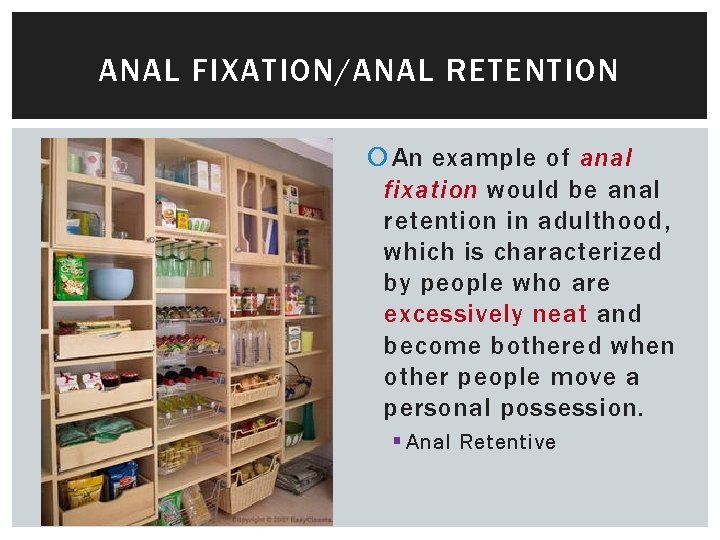
ANAL FIXATION/ANAL RETENTION An example of anal fixation would be anal retention in adulthood, which is characterized by people who are excessively neat and become bothered when other people move a personal possession. § Anal Retentive
ANAL FIXATION/ANAL RETENTION The Id is making up for a lack of control during the anal stage, particularly toilet training. § If a child is not left alone during the toilet training process then fixation could occur.
PHALLIC STAGE Phallic stage- occurs 3 -6 years and the genital area is the Id’s concern § also occurring during this stage is the emergence and resolution of the Oedipus complex and development of the superego Freud did not study women so it is undetermined whether girls go through something similar to the Oedipus complex* § Some theorists in turn suggest that girls go through the Electra complex, but most researcher’s question this event.
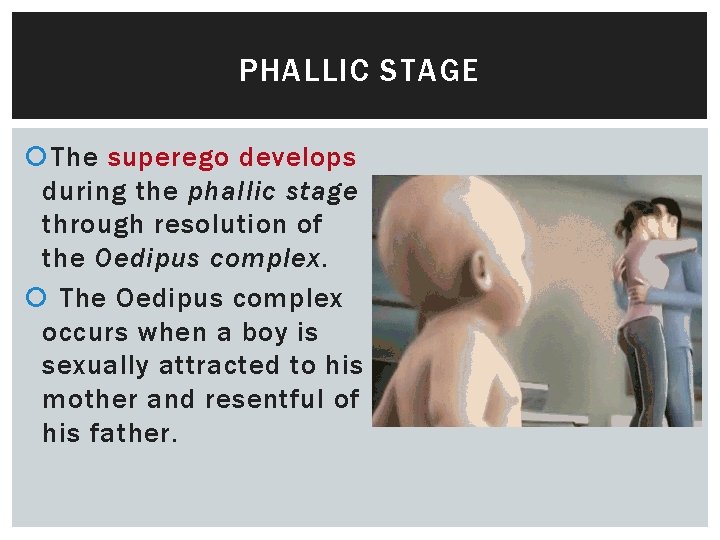
PHALLIC STAGE The superego develops during the phallic stage through resolution of the Oedipus complex. The Oedipus complex occurs when a boy is sexually attracted to his mother and resentful of his father.
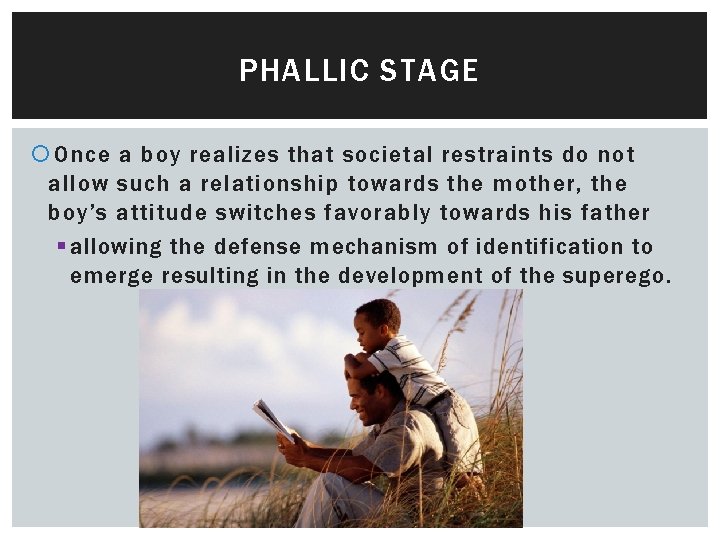
PHALLIC STAGE Once a boy realizes that societal restraints do not allow such a relationship towards the mother, the boy’s attitude switches favorably towards his father § allowing the defense mechanism of identification to emerge resulting in the development of the superego.
PHALLIC STAGE Because the boy identifies with his father, the boy willingly then listens to his father. This relationship allows the superego to develop as the father can now teach the son right and wrong.
PHALLIC STAGE For example, a mom who cannot discipline her son may state, “Go talk to your father- you don’t listen (identify) to me. ” Some theorists believe if a father is not present at home during the phallic stage, the superego may not accurately develop because the identification process does not take place resulting in discipline problems. § The boy could compensate for this by identifying to a male coach or a teacher to develop the superego.
LATENCY STAGE Latency stage occurs from age 6 to puberty and the Id’s sexual energy lays dormant, or does not exist.
LATENCY STAGE During the latent stage, usually upper elementary school time, boys hang out with other boys, and girls interact with just girls. Girls and boys do not have any interest in one another at this point in their life.
GENITAL STAGE Genital stageoccurs from puberty throughout life and sexual energy reemerges directed towards the opposite sex.
GENITAL STAGE Successful completion of the psychosexual stages results in healthy, productive relationships in adulthood, without any type of fixation.
PSYCHOSEXUAL STAGES--MNEMONIC Psych Files Mnemonic
PRACTICE IDENTIFYING FIXATION What evidence of fixation is there in nursery rhymes? § What do they tell us about the author?