
Psy B 07 PROBABILITY BASIC CONCEPTS Chapter 5
Psy B 07 PROBABILITY – BASIC CONCEPTS Chapter 5 1
Psy B 07 Outline § Terminology § Basic Laws of Probability § Joint and Conditional Probabilities Chapter 5 2
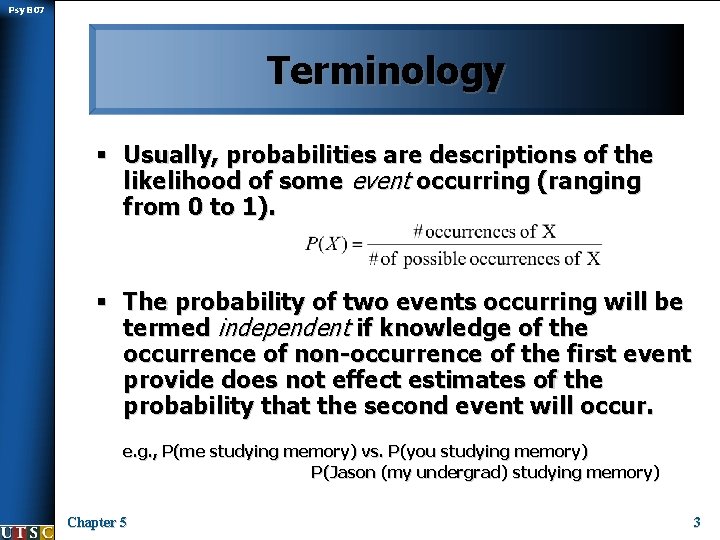
Psy B 07 Terminology § Usually, probabilities are descriptions of the likelihood of some event occurring (ranging from 0 to 1). § The probability of two events occurring will be termed independent if knowledge of the occurrence of non-occurrence of the first event provide does not effect estimates of the probability that the second event will occur. e. g. , P(me studying memory) vs. P(you studying memory) P(Jason (my undergrad) studying memory) Chapter 5 3
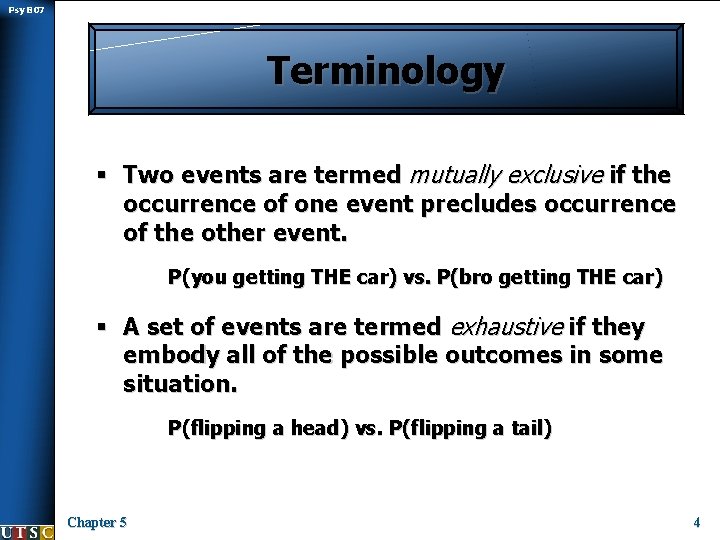
Psy B 07 Terminology § Two events are termed mutually exclusive if the occurrence of one event precludes occurrence of the other event. P(you getting THE car) vs. P(bro getting THE car) § A set of events are termed exhaustive if they embody all of the possible outcomes in some situation. P(flipping a head) vs. P(flipping a tail) Chapter 5 4
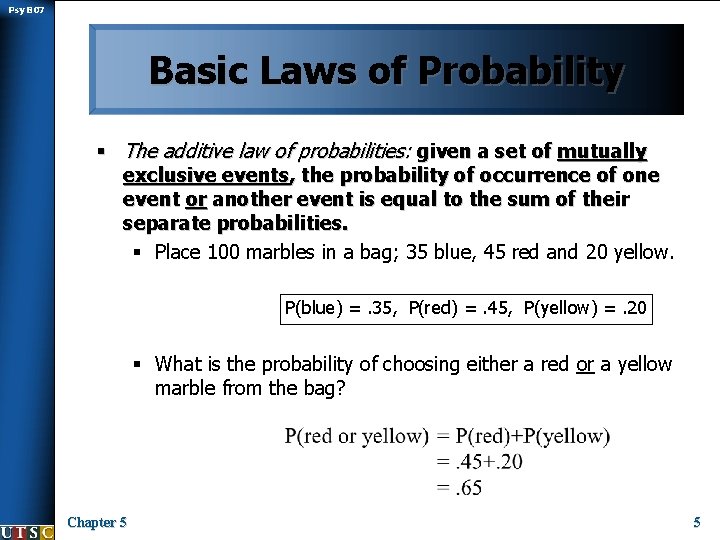
Psy B 07 Basic Laws of Probability § The additive law of probabilities: given a set of mutually exclusive events, the probability of occurrence of one event or another event is equal to the sum of their separate probabilities. § Place 100 marbles in a bag; 35 blue, 45 red and 20 yellow. P(blue) =. 35, P(red) =. 45, P(yellow) =. 20 § What is the probability of choosing either a red or a yellow marble from the bag? Chapter 5 5
Psy B 07 Basic Laws of Probability § The multiplicative law of probabilities: The probability of the joint occurrence of two or more independent events is the product of their individual probabilities. § Say that the probability that I am in my office at any given moment of the typical day is 0. 65. § Also, say that the probability that someone is looking for me in my office at any given moment of the school day is 0. 15. Chapter 5 6
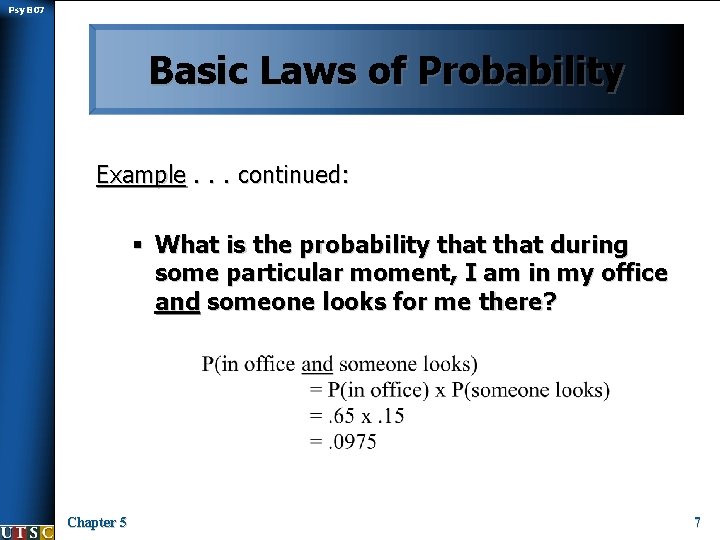
Psy B 07 Basic Laws of Probability Example. . . continued: § What is the probability that during some particular moment, I am in my office and someone looks for me there? Chapter 5 7
Psy B 07 Basic Laws of Probability § Say that Fred takes the car into work with a probability of. 50, walks with a probability of. 20, and takes public transit with a probability of. 30. § Barney, on the other hand, drives into work with a probability of. 20, walks with a probability of. 65, and takes public transit with a probability of. 15. § What is the probability that Fred walked or drove to work and Barney walked or took public transit to work, assuming Fred and Barney’s behaviour to be independent? Chapter 5 8
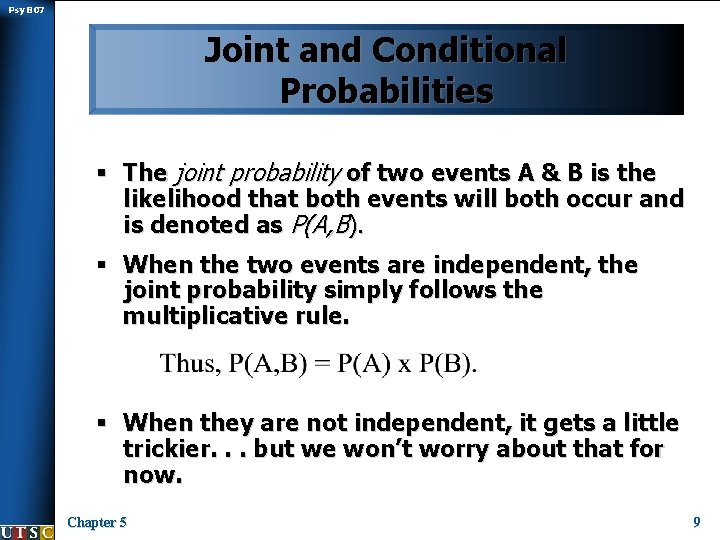
Psy B 07 Joint and Conditional Probabilities § The joint probability of two events A & B is the likelihood that both events will both occur and is denoted as P(A, B). § When the two events are independent, the joint probability simply follows the multiplicative rule. § When they are not independent, it gets a little trickier. . . but we won’t worry about that for now. Chapter 5 9
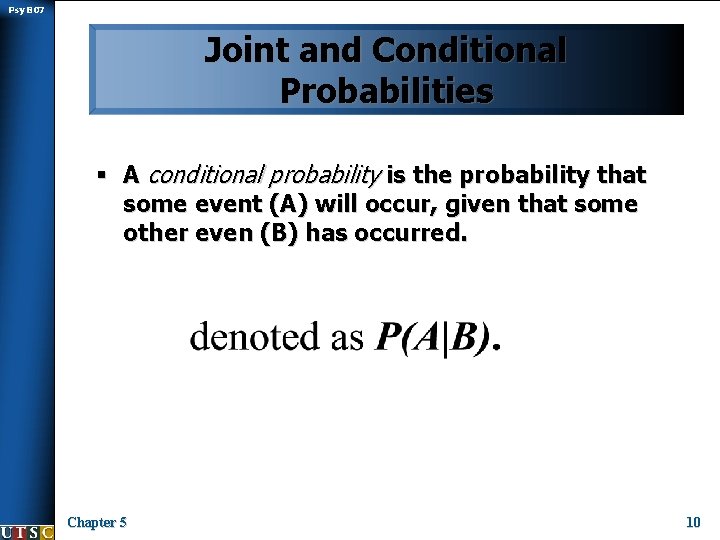
Psy B 07 Joint and Conditional Probabilities § A conditional probability is the probability that some event (A) will occur, given that some other even (B) has occurred. Chapter 5 10
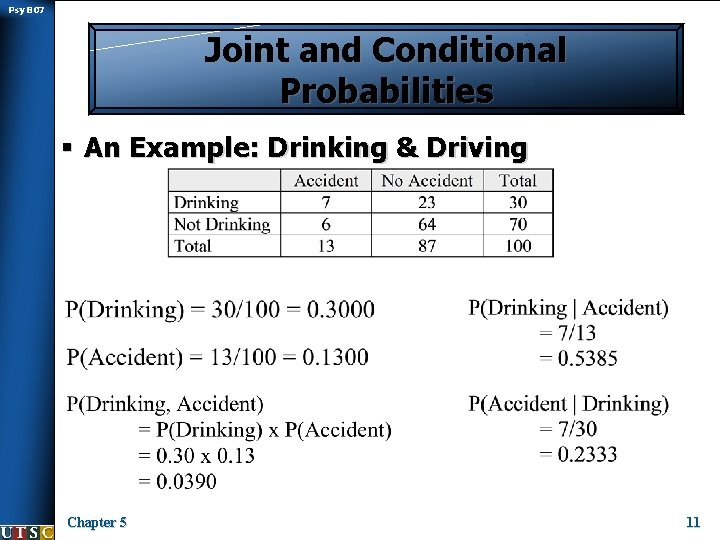
Psy B 07 Joint and Conditional Probabilities § An Example: Drinking & Driving Chapter 5 11
- Slides: 11