
PSY 6669 Behavioral Pathology Lecture 6 Other Conditions
PSY 6669 Behavioral Pathology Lecture 6 Other Conditions That May Be a Focus of Clinical Attention Z – Codes (or what we really get paid for) Personality Disorders

Reminder !!! Term Papers Due Next Week.

Relational Problems (pg 715/355) � Parent-Child � Sibling Relational Problem � Upbringing � Child Relational Problem Away from Parents Affected by Parental Relationship Desires

Other Problems Related to Primary Support Group � Relationship Distress With Spouse or Intimate Partner � Disruption of Family by Separation or Divorce � High Expresses Emotional Level within Family � Uncomplicated Bereavement
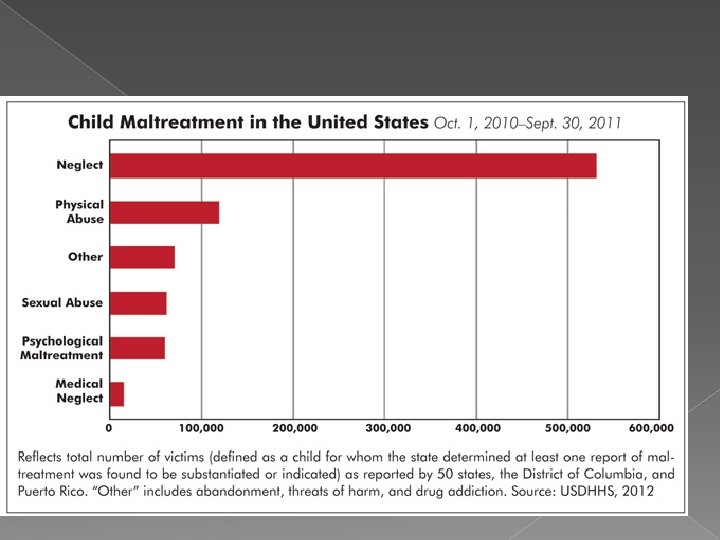
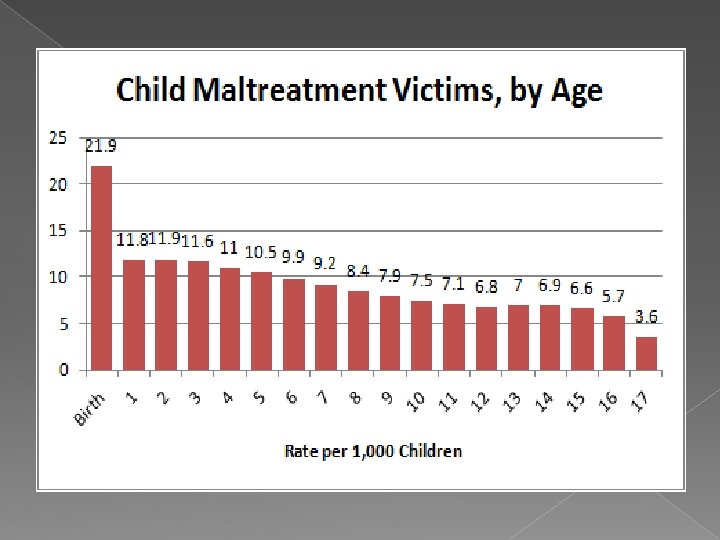
Abuse and Neglect (pg 717/358) � Child Physical Abuse � Child Sexual Abuse � Child Neglect � Child Psychological Abuse � Adult Maltreatment and Neglect Problems › Specify : Suspected or Confirmed › Specify : Initial or Subsequent Encounter
Adult Maltreatment & Neglect Disorders (720/363) � Spouse or Partner Violence, Physical � Spouse or Partner Violence, Sexual � Spouse or Partner Neglect � Spouse or Partner Abuse, Psychological › Specify : Suspected or Confirmed › Specify : Initial or Subsequent Encounter
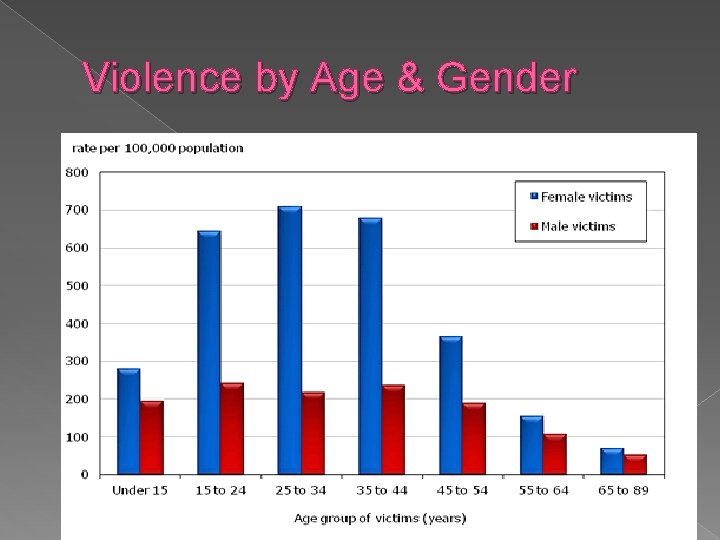
Violence by Age & Gender
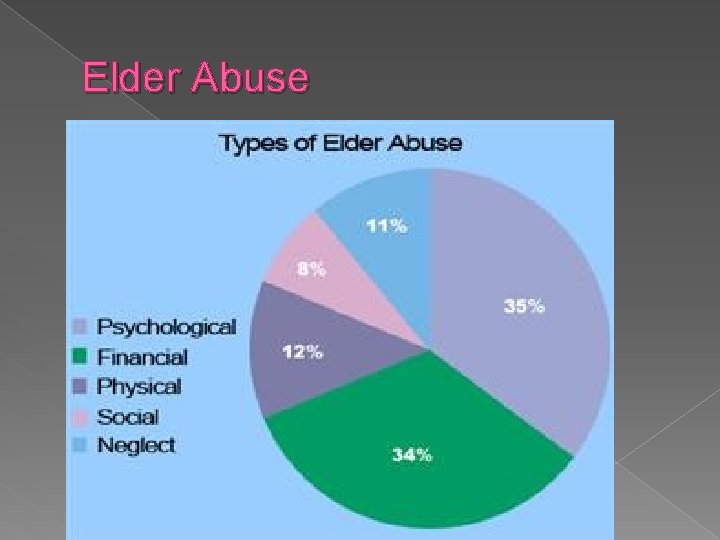
Elder Abuse
Nonspouse or Nonpartner (pg 720/363) � Nonspouse or Nonpartner Violence, Physical � Nonspouse or Nonpartner Violence, Sexual � Nonspouse or Nonpartner Neglect � Nonspouse or Nonpartner Abuse, Psychological › Specify : Suspected or Confirmed › Specify : Initial or Subsequent Encounter
Educational & Occupational (pg 723/367) � Educational Problems � Occupational Problems � Housing and Economic Problems � Other Problems Related to the Social Environment � Problems Related to Crime or Interaction with the Legal System
Other Problems (pg 725/371) � Other Health Service Encounters for Counseling and medical Advice � Problems Related to Other Psychosocial, Personal, and Environmental Circumstances
Other Circumstances of Personal History (pg 726/372) � Other personal history of psychosocial trauma � Personal history of Self-Harm � Personal history of Military Deployment � Other personal risk factors � Problems related to lifestyle � Adult Antisocial behavior � Child or Adolescent Antisocial behavior
� Problems related to Unavailable or Inaccessibility of Health Care � Problems related to Unavailable or Inaccessibility other Helping Agencies � Nonadherence to Medical Treatment � Overweight or Obesity � Malingering � Wandering Associated with a Medical Disorder � Borderline Intellectual Functioning
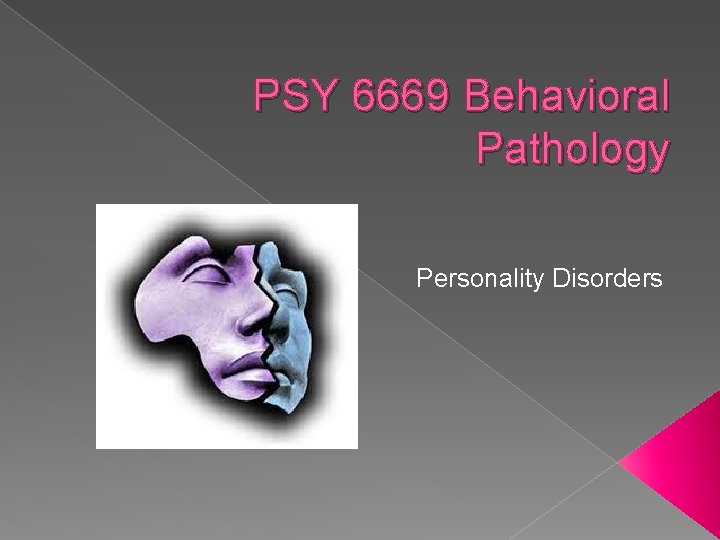
PSY 6669 Behavioral Pathology Personality Disorders
APA Definition of Personality � Personality refers to individual differences in characteristic patterns of thinking, feeling, and behaving. The study of personality focuses on two broad areas: One it the understanding of individual differences in particular personality characteristics, such as sociability or irritability. The other is understanding how the various parts of a person come together as a whole.
Psychiatric Association � Personality is the way of thinking, feeling, and behaving that makes a person different from other people. An individual’s personality is influenced by experiences, environment (surroundings, life situation), and inherited characteristics. � A Personality Disorder is a way of thinking, feeling, and behaving that deviates from the expectations of the culture, causes distress or problems functioning, and lasts over time.
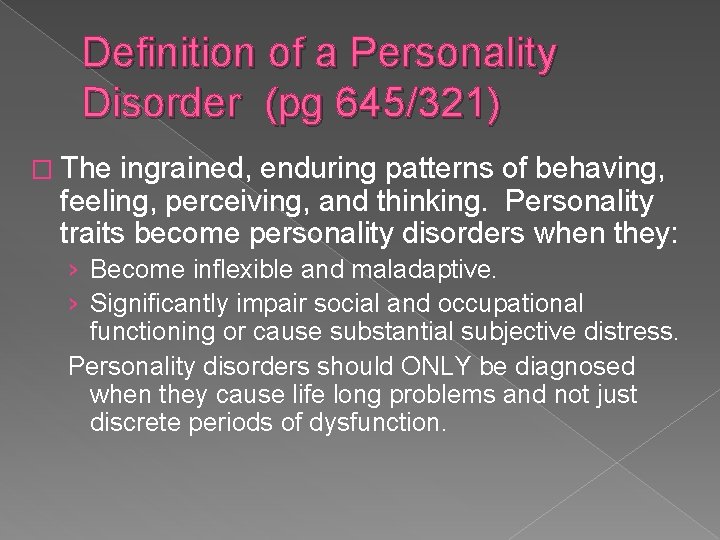
Definition of a Personality Disorder (pg 645/321) � The ingrained, enduring patterns of behaving, feeling, perceiving, and thinking. Personality traits become personality disorders when they: › Become inflexible and maladaptive. › Significantly impair social and occupational functioning or cause substantial subjective distress. Personality disorders should ONLY be diagnosed when they cause life long problems and not just discrete periods of dysfunction.
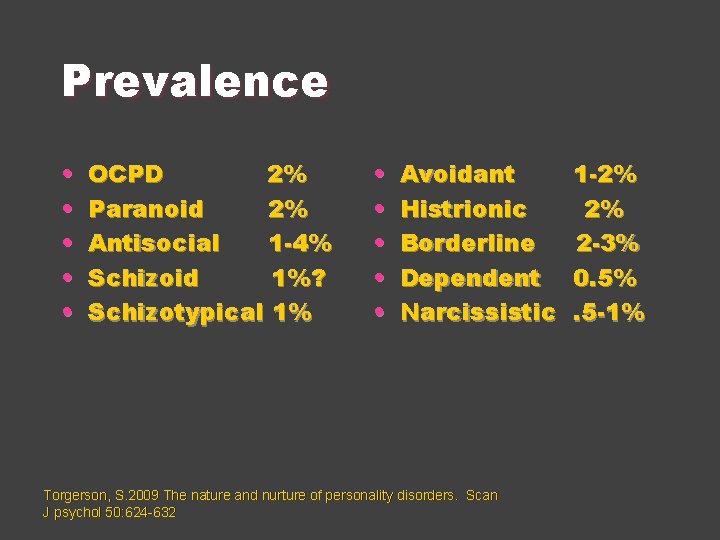
Prevalence • • • OCPD 2% Paranoid 2% Antisocial 1 -4% Schizoid 1%? Schizotypical 1% • • • Avoidant Histrionic Borderline Dependent Narcissistic Torgerson, S. 2009 The nature and nurture of personality disorders. Scan J psychol 50: 624 -632 1 -2% 2% 2 -3% 0. 5%. 5 -1%
Etiology • Likely multi-factorial like almost all other psychiatric diagnoses. • Genetic and environmental factors such as chaotic home environment and abuse have been implicated in development of maladaptive behavioral patterns.
Cultural Considerations Judgments about persistent and pervasive personality traits cannot be made without consideration of a person’s cultural background. n Always use caution!!!!! n Particular care should be exercised in diagnosing members of a minority group with Paranoid Personality Disorder. n
? Cultural influences ? • Studies have found that in Norway compared to US, Germany and UK avoidant personality 3 -4 X more prevalent, dependent personality 2 -3 X more prevalent and schizoid is 2 X more prevalent. Borderline is <½ as frequent and antisocial is ½ has prevalent. • Pattern exhibits increased internalization personality disorders are prevalent and externalization disorders are rarer. Torgerson, S. 2009 The nature and nurture of personality disorders. Scan J psychol 50: 624632
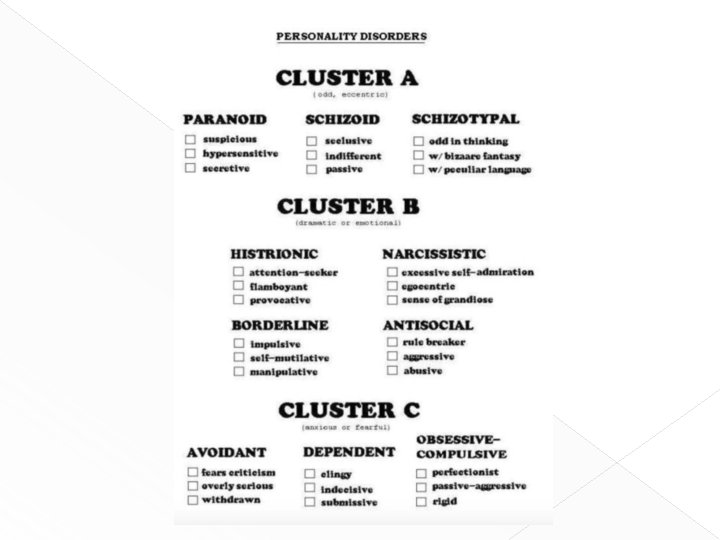
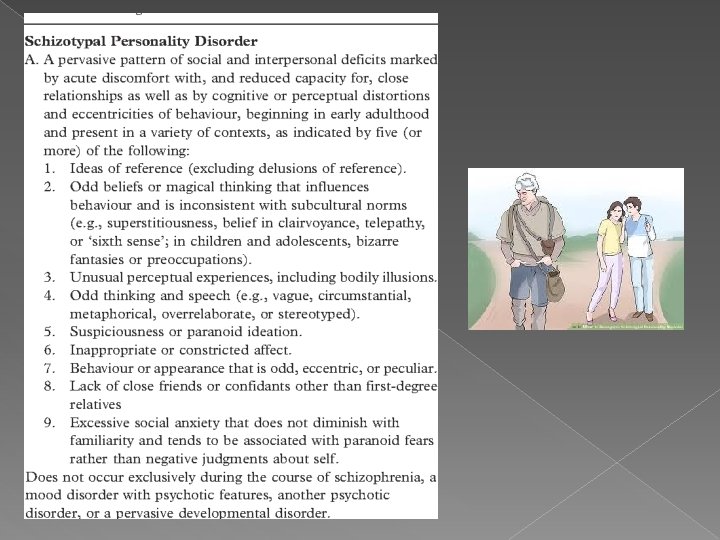
Personality Disorder Clusters � Cluster A: Characterized by odd or eccentric behavior › Paranoid Personality Disorder › Schizotypal Personality Disorder
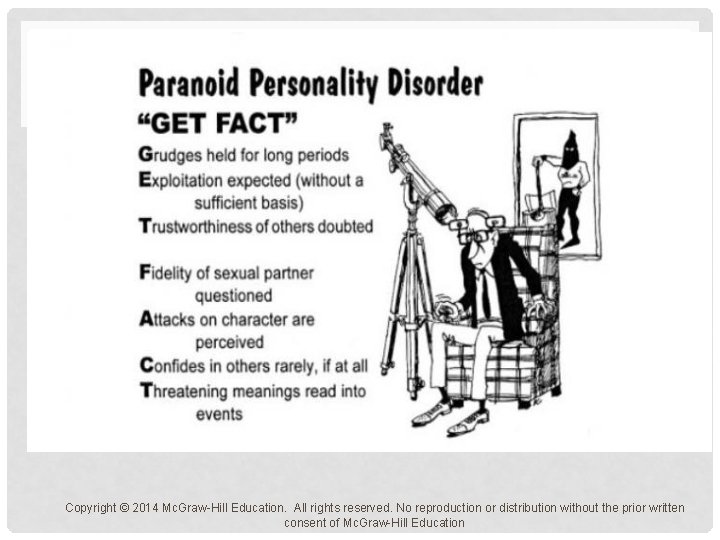
PARANOID PERSONALITY DISORDER • A personality disorder whose outstanding feature is that the individual is unduly suspicious of others and is always on guard against potential danger or harm. • Impossible to trust people • Project blame onto others • Refuse to seek professional help Copyright © 2014 Mc. Graw-Hill Education. All rights reserved. No reproduction or distribution without the prior written consent of Mc. Graw-Hill Education
Copyright © 2014 Mc. Graw-Hill Education. All rights reserved. No reproduction or distribution without the prior written consent of Mc. Graw-Hill Education
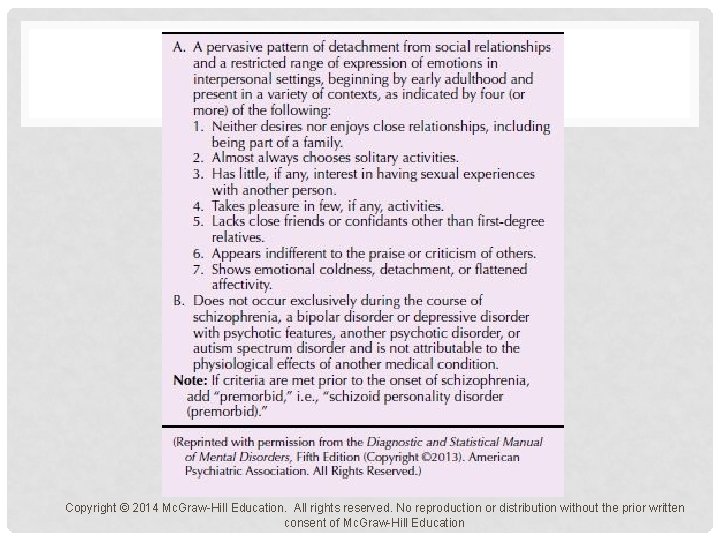
SCHIZOID PERSONALITY DISORDER • • • Indifference to social and sexual relationships Prefer to be alone No desire to love or be loved Cold, reserved, withdrawn Insensitive to feelings of others Copyright © 2014 Mc. Graw-Hill Education. All rights reserved. No reproduction or distribution without the prior written consent of Mc. Graw-Hill Education
Copyright © 2014 Mc. Graw-Hill Education. All rights reserved. No reproduction or distribution without the prior written consent of Mc. Graw-Hill Education
SCHIZOTYPAL PERSONALITY DISORDER • A personality disorder that primarily involves odd beliefs, behavior, appearance, and interpersonal style. • Such individuals lack a clear sense of direction or motivation, and do not have a clear set of standards against which to measure their behavior Copyright © 2014 Mc. Graw-Hill Education. All rights reserved. No reproduction or distribution without the prior written consent of Mc. Graw-Hill Education
SCHIZOTYPAL PERSONALITY DISORDER • • Social isolation Eccentricity Peculiar communication Poor social adaptation • Treatment • Parallels interventions commonly used in treating schizophrenia Copyright © 2014 Mc. Graw-Hill Education. All rights reserved. No reproduction or distribution without the prior written consent of Mc. Graw-Hill Education
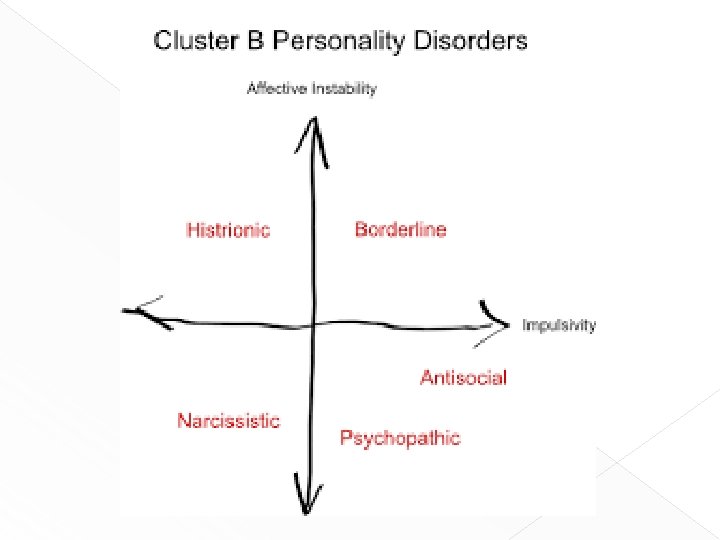
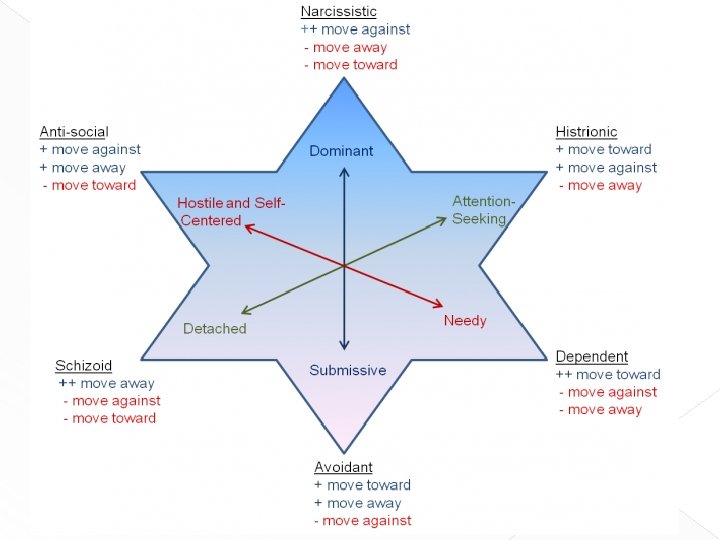
Personality Disorder � Cluster B: Characterized by dramatic, overemotional, and erratic behavior. › Antisocial Personality Disorder › Borderline Personality Disorder › Histrionic Personality Disorder › Narcissistic Personality Disorder
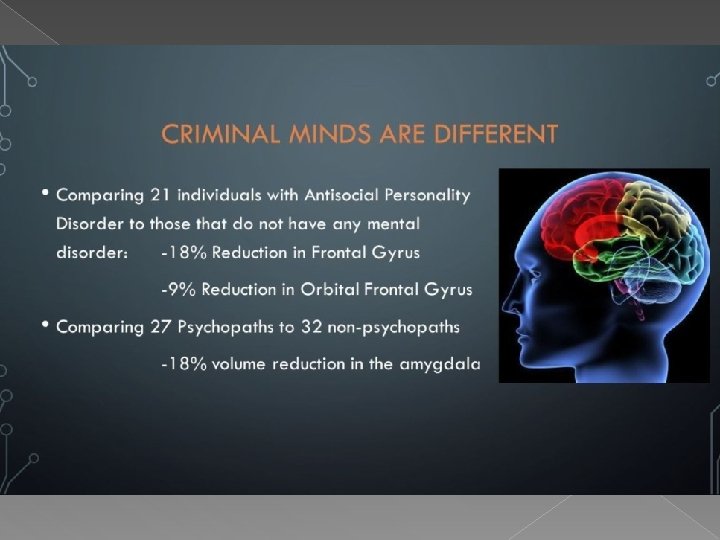
Antisocial � � � � This diagnosis is not given to clients under the age of 18. Usually engage in illegal activities; Routinely practice deceit; Often aggressive and violent; Typically irresponsible Generally ignore the rights and feelings of others. Rarely show remorse
ANTISOCIAL PERSONALITY DISORDER • The diagnostic criteria in the DSM-5 require that an individual show a pervasive pattern of three out of seven possible behaviors: 1. 2. 3. 4. 5. 6. 7. Failure to conform to social norms Deceitfulness Impulsivity Aggressiveness Disregard for safety of self or others Irresponsibility Lack of remorse Copyright © 2014 Mc. Graw-Hill Education. All rights reserved. No reproduction or distribution without the prior written consent of Mc. Graw-Hill Education
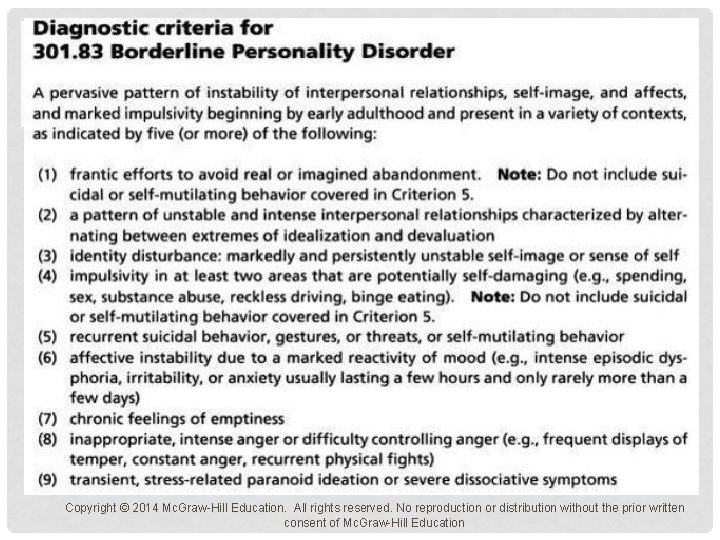
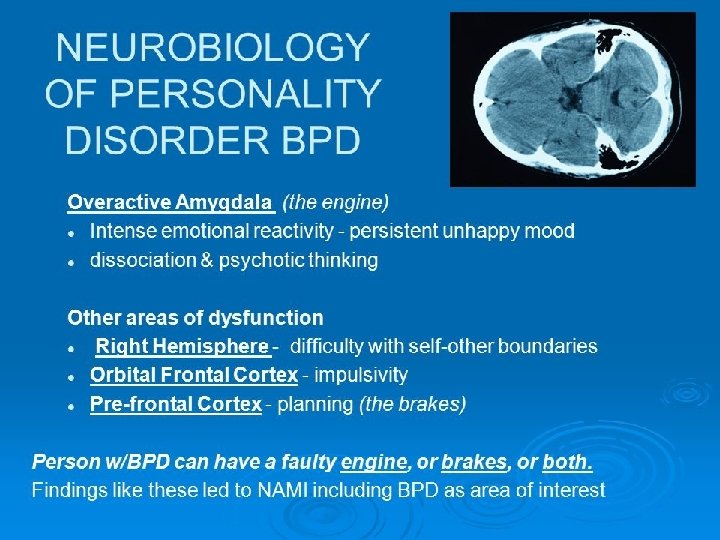
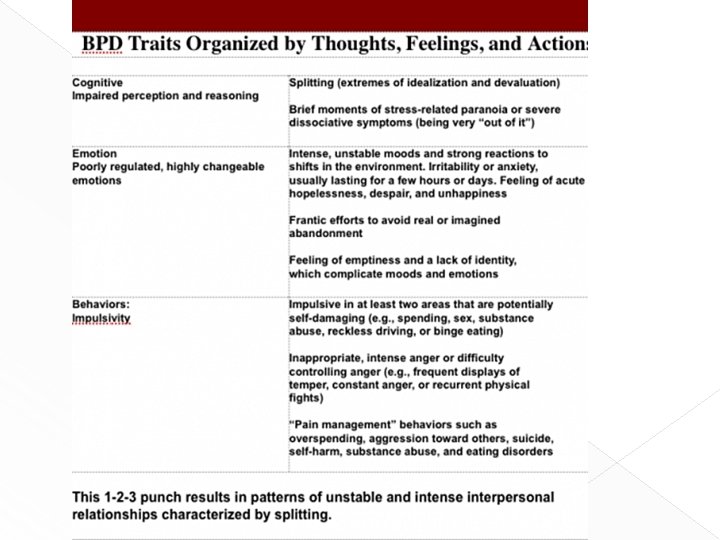
BORDERLINE PERSONALITY DISORDER • Pervasive pattern of poor impulse control and instability in mood, interpersonal relationships, and self-image • BPD’s central feature is that of instability • The way that people with BPD relate to others is termed “splitting” Copyright © 2014 Mc. Graw-Hill Education. All rights reserved. No reproduction or distribution without the prior written consent of Mc. Graw-Hill Education
PERSPECTIVES ON BORDERLINE PERSONALITY • Biological • High heritability • Abnormalities in: • Amygdala and prefrontal cortex • Neurotransmitters and hormones Copyright © 2014 Mc. Graw-Hill Education. All rights reserved. No reproduction or distribution without the prior written consent of Mc. Graw-Hill Education
Copyright © 2014 Mc. Graw-Hill Education. All rights reserved. No reproduction or distribution without the prior written consent of Mc. Graw-Hill Education
Copyright © 2014 Mc. Graw-Hill Education. All rights reserved. No reproduction or distribution without the prior written consent of Mc. Graw-Hill
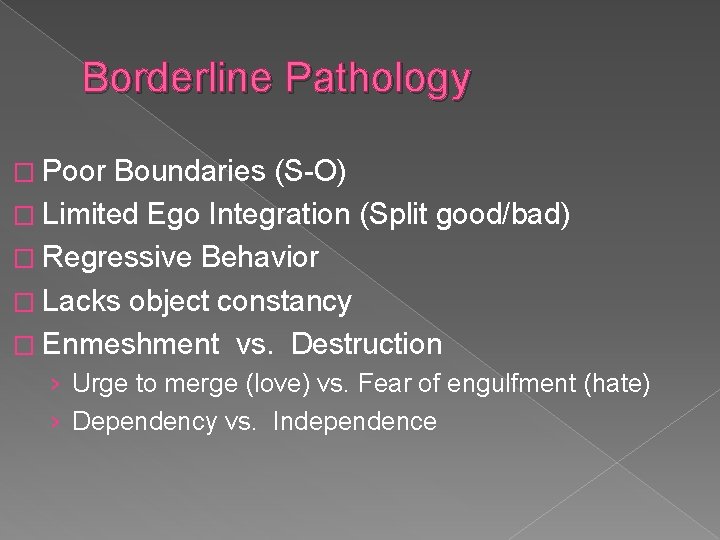
Borderline Pathology � Poor Boundaries (S-O) � Limited Ego Integration (Split good/bad) � Regressive Behavior � Lacks object constancy � Enmeshment vs. Destruction › Urge to merge (love) vs. Fear of engulfment (hate) › Dependency vs. Independence
Borderline They rarely see themselves or others in a balanced way. n These clients are the most likely of people with personality disorders to seek treatment. n
Differential Diagnoses � Cyclothymic Disorder � Posttraumatic � Narcissistic � Substance Stress Disorder Personality Disorder Abuse/Use Disorder
High Functioning: Borderline Personality Traits � Does not Meet the DSM-5 criteria � Over idealized/undervalued interpersonal relationships � Mood Shifts (depression-anxiety) � “Empty” feeling � Possible Abandonment Issues � Both have Identity Disturbance
Borderline Personality Disorder � Low › › › › Functioning BPD: Intense and unstable interpersonal relationships Impulsive (self-destructive behaviors) Mood Shifts (unstable emotions) Anger (inappropriate) Suicidal/Self-mutilating “Emptiness” especially when not in a relationship Abandonment Issues (emotionally left to “die”)
Treatment Issues � Consistent and predictive environment � Tolerate affect without abandonment � Avoid the split � Don’t rescue ! Maintain intolerance to independence � Supportive Interpretations � Build Ego functions
HISTRIONIC PERSONALITY DISORDER • Exaggerated emotional reactions, approaching theatricality, in everyday behavior. • Show extreme pleasure as the center of attention and who behave in whatever way necessary to ensure that this happens. • They are excessively concerned with their physical appearance, often trying to draw attention to themselves in such extreme ways that their behavior seems ludicrous. Copyright © 2014 Mc. Graw-Hill Education. All rights reserved. No reproduction or distribution without the prior written consent of Mc. Graw-Hill Education
HISTRIONIC PERSONALITY DISORDER • • • Flirtatious and seductive Demand reassurance, praise, approval of others Need for immediate gratification Easily influenced by others Lack analytical ability Copyright © 2014 Mc. Graw-Hill Education. All rights reserved. No reproduction or distribution without the prior written consent of Mc. Graw-Hill Education
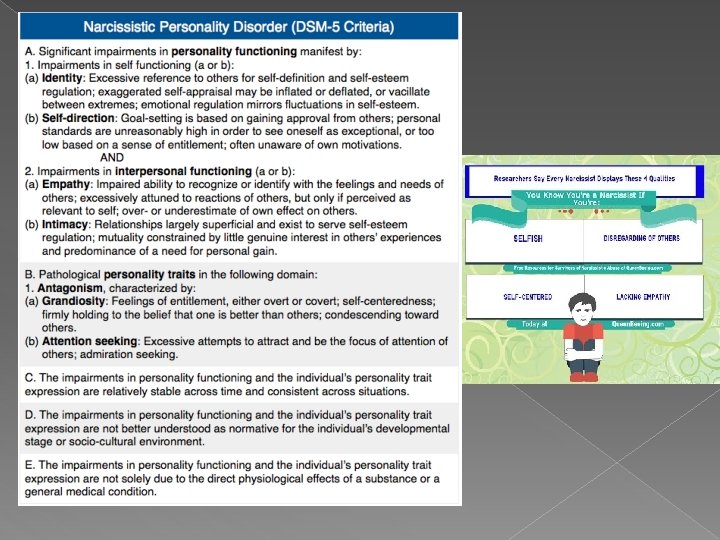
Narcissistic Personality A grandiose sense of self-importance; n A need for attention n A reduced capacity for empathy n Often seem to have an exaggerated sense of entitlement; n Expect to be admired and obeyed by others. n Usually seeks treatment when frustrated by others. n
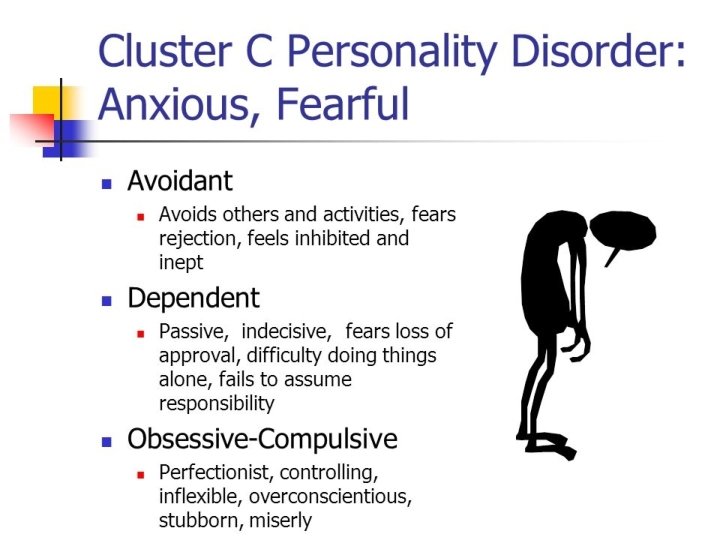
Personality Disorders � Cluster C: Characterized by highly anxious and fearful affect. › Avoidant Personality Disorder › Dependent Personality Disorder › Obsessive Compulsive Personality Disorder
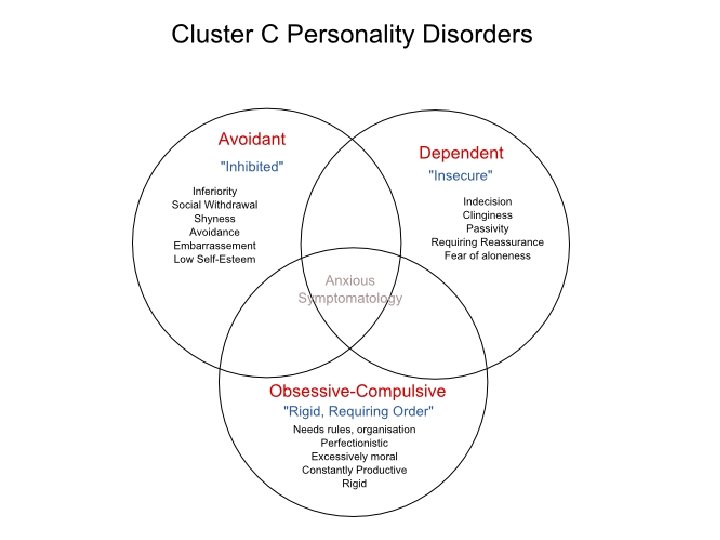
AVOIDANT PERSONALITY DISORDER • The individual desires, but is fearful of, any involvement with other people and is terrified at the prospect of being publicly embarrassed Copyright © 2014 Mc. Graw-Hill Education. All rights reserved. No reproduction or distribution without the prior written consent of Mc. Graw-Hill Education
AVOIDANT - THEORIES • Cognitive-behavioral • • • Hypersensitive due to parental criticism Feel unworthy of other people’s regard Expect not to be liked Avoid getting close to avoid expected rejection Distorted perceptions of experiences with others Copyright © 2014 Mc. Graw-Hill Education. All rights reserved. No reproduction or distribution without the prior written consent of Mc. Graw-Hill Education
Avoidant Personality Disorder n n Demonstrate marked feelings of inadequacy that are associated with hypersensitivity to negative feedback and/or social inhibition. Seldom put themselves in “risky” or even new situations in which they may perform poorly. Seldom develop intimate interpersonal relationships. May constrain occupational choices based on fear of negative judgments.
DEPENDENT PERSONALITY DISORDER • The individual is extremely passive • Tends to cling to other people to the point of being unable to make any decisions Copyright © 2014 Mc. Graw-Hill Education. All rights reserved. No reproduction or distribution without the prior written consent of Mc. Graw-Hill Education
Dependent Personality Seek someone to take care of them, even to the extent of being submissive, clinging, and fearful of separation. n Avoid decisive action and encourage others to make decisions for them. n Subservience makes it quite difficult to express disagreement, even when asked to undertake unpleasant activities. n
Dependent Personality Fear being alone and quickly substitute a new relationship if an old one is lost. n They systematically underestimate themselves and their ability to function independently. n
OBSESSIVE-COMPULSIVE PERSONALITY DISORDER • A personality disorder involving intense perfectionism and inflexibility manifested in worrying, indecisiveness, and behavioral rigidity. • OCPD is a disturbance of personality, not a disturbance involving anxiety or even out-of-control behaviors • OCPD do not experience obsessions and compulsions. OCPD refers to this rigidly compulsive personality tendency and also obsessive concern with perfectionism. Copyright © 2014 Mc. Graw-Hill Education. All rights reserved. No reproduction or distribution without the prior written consent of Mc. Graw-Hill Education
Obsessive-Compulsive PD n n n Have well-controlled perfectionistic patterns of behavior at the expense of spontaneity, flexibility, and even efficiency. There is often such preoccupation with planning and details that tasks are not completed. Difficulty delegating responsibilities and tend to work long hours in order to meet their own standards regarding productivity.
OCPD: Anal-retentive Tend to collect and hoard things even when those things have little value. n Unlike obsessive-compulsive disorder, individuals with OCPD do not necessarily have obsessions or compulsions. n Tendency is to be rigid in their actions and thinking, adhering to strict and controlled patterns of thought and behaviors. n
THEORIES OF OBSESSIVE-COMPULSIVE • Freudian • Fixation at anal psychosexual stage • Cognitive-behavioral • Unrealistic standard of perfection • Ruminative tendency • Metacognitive interpersonal therapy • Think about their thinking Copyright © 2014 Mc. Graw-Hill Education. All rights reserved. No reproduction or distribution without the prior written consent of Mc. Graw-Hill Education
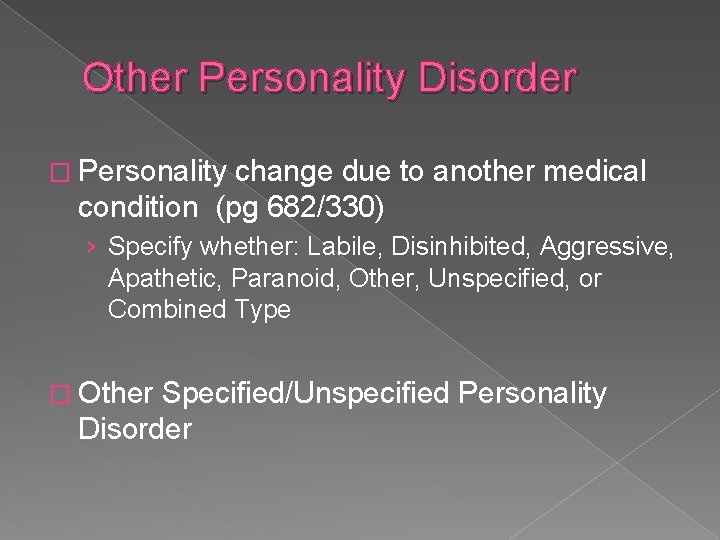
Other Personality Disorder � Personality change due to another medical condition (pg 682/330) › Specify whether: Labile, Disinhibited, Aggressive, Apathetic, Paranoid, Other, Unspecified, or Combined Type � Other Specified/Unspecified Personality Disorder
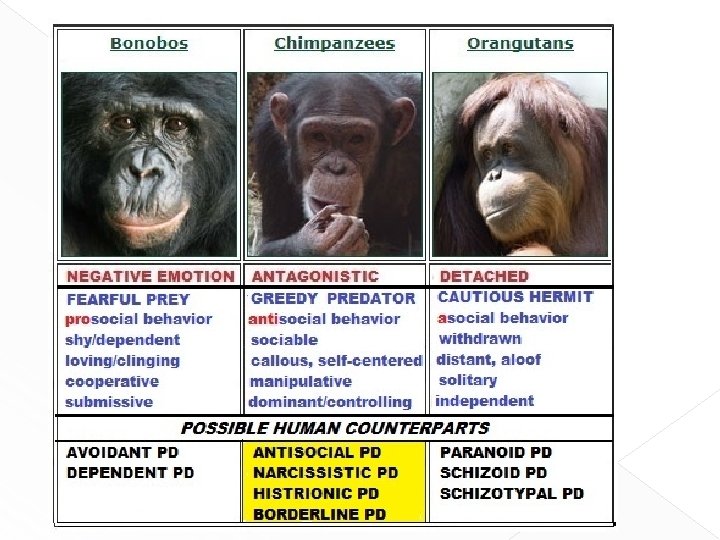

Video Case Study: Gary
Gary F 60. 1 Schizoid Personality Disorder

SNL Case Study
Video Case Study F 60. 1 Obsessive-Compulsive Personality Disorder Verse F 42 Obsessive-Compulsive Disorder
- Slides: 74