
PSY 369 Psycholinguistics Language Production Theories Models Announcements


- Slides: 89
PSY 369: Psycholinguistics Language Production: Theories & Models
Announcements n n n Homework 8 (Due April 29) – Article summary: Griffin & Bock (2000) – using eye-movements to investigate language production processes “Yes” even with the reduced number of homeworks (11 ->8), I still plan to drop the lowest grade in this category (so your top 7 homework grades are what will count). Exam 3 Extra extra credit opportunity: n n Up to 30 points added to your exam score 2 additional journal summaries (due April 29 th) n n Taft and Hambly (1986) – 15 pts Perfetti et al (1987) – 15 pts
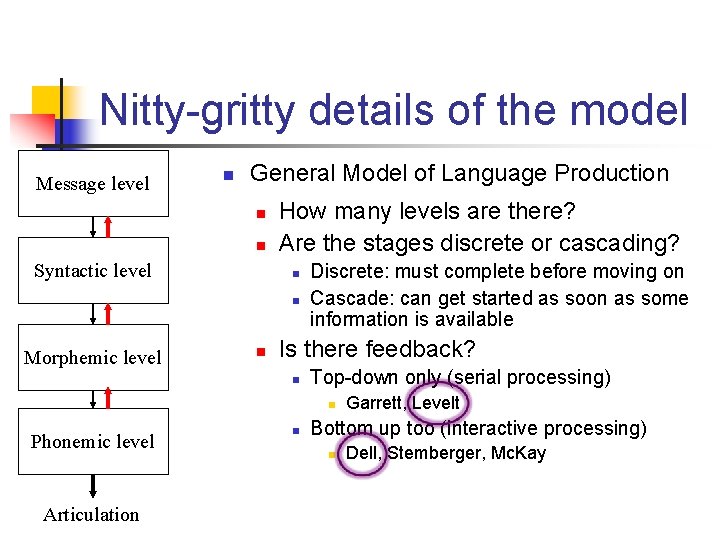
Nitty-gritty details of the model Message level n General Model of Language Production n n Syntactic level How many levels are there? Are the stages discrete or cascading? n n Morphemic level n Discrete: must complete before moving on Cascade: can get started as soon as some information is available Is there feedback? n Top-down only (serial processing) n Phonemic level Articulation n Garrett, Levelt Bottom up too (interactive processing) n Dell, Stemberger, Mc. Kay
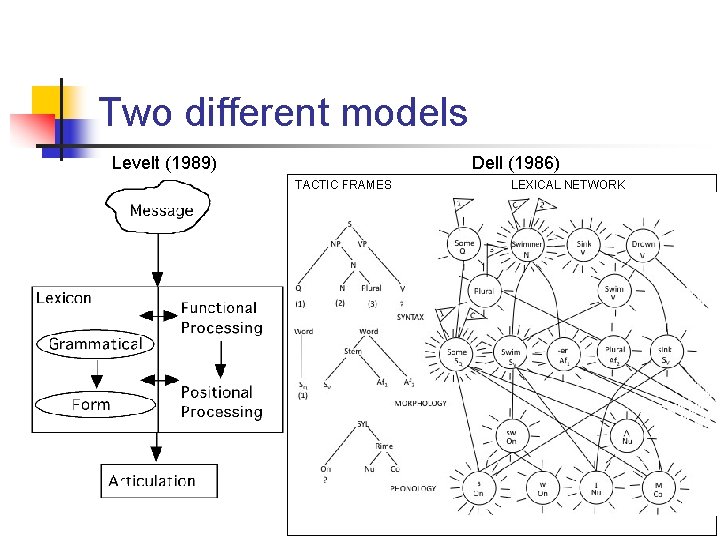
Two different models Levelt (1989) Dell (1986) TACTIC FRAMES LEXICAL NETWORK
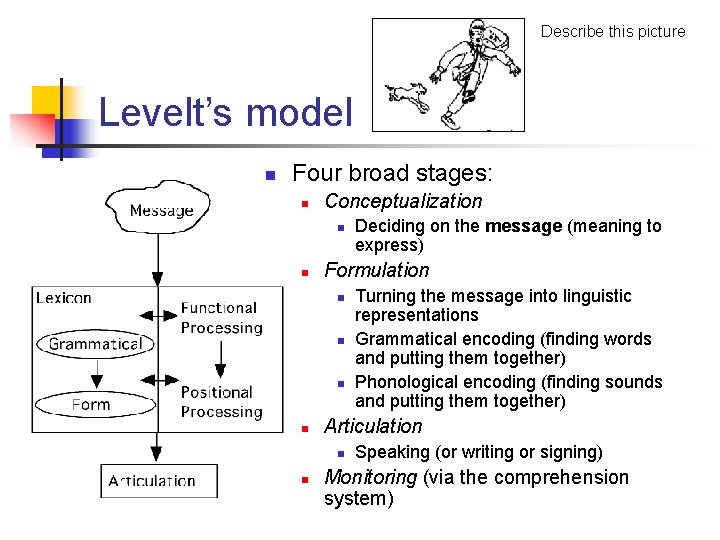
Describe this picture Levelt’s model n Four broad stages: n Conceptualization n n Formulation n n Turning the message into linguistic representations Grammatical encoding (finding words and putting them together) Phonological encoding (finding sounds and putting them together) Articulation n n Deciding on the message (meaning to express) Speaking (or writing or signing) Monitoring (via the comprehension system)
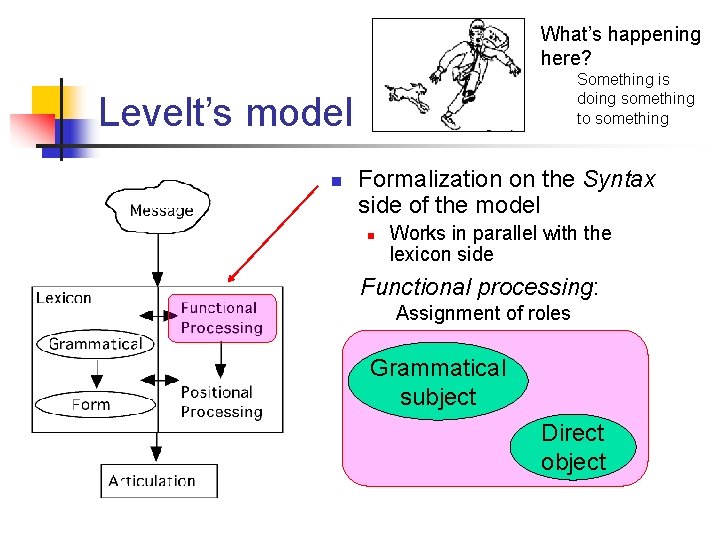
What’s happening here? Something is doing something to something Levelt’s model n Formalization on the Syntax side of the model n Works in parallel with the lexicon side Functional processing: Assignment of roles Grammatical subject Direct object
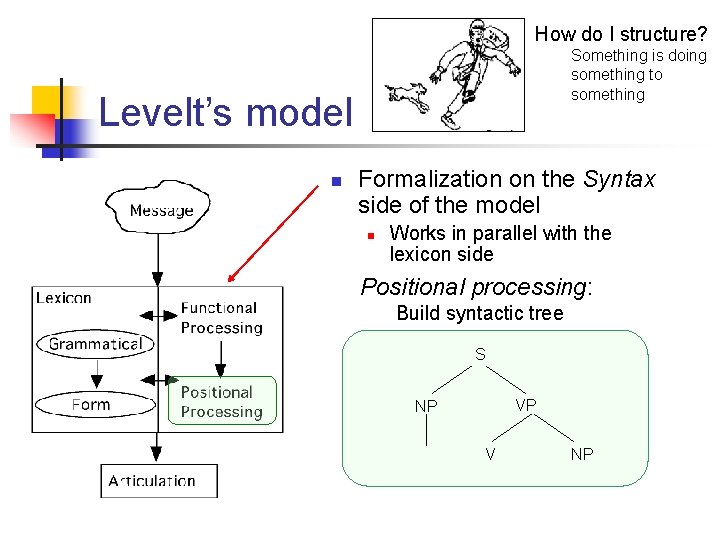
How do I structure? Something is doing something to something Levelt’s model n Formalization on the Syntax side of the model n Works in parallel with the lexicon side Positional processing: Build syntactic tree S VP NP V NP
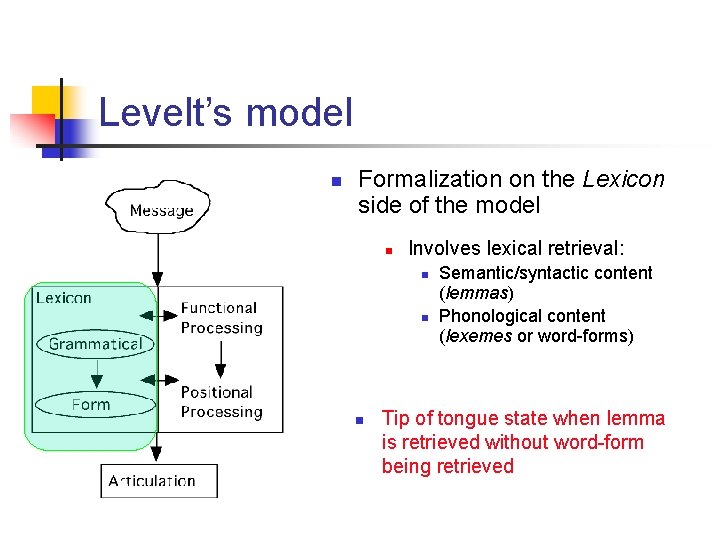
Levelt’s model n Formalization on the Lexicon side of the model n Involves lexical retrieval: n n n Semantic/syntactic content (lemmas) Phonological content (lexemes or word-forms) Tip of tongue state when lemma is retrieved without word-form being retrieved
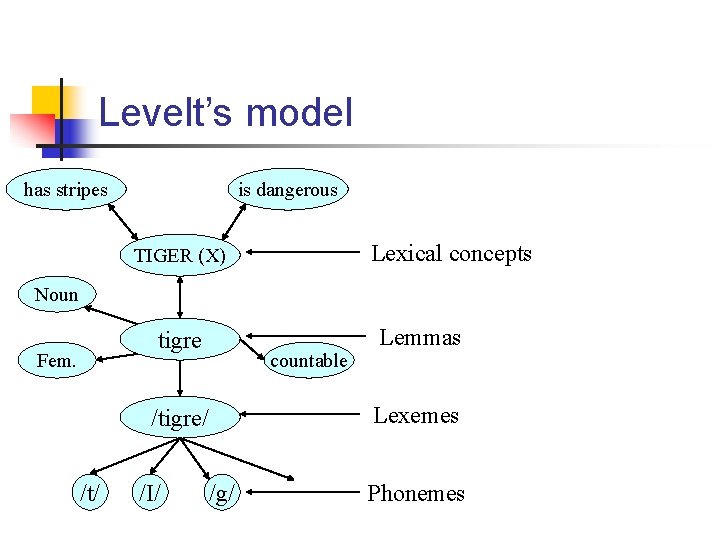
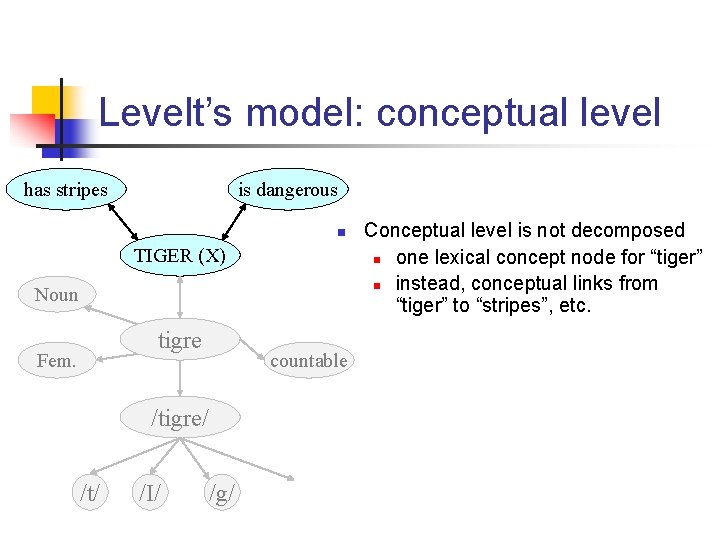
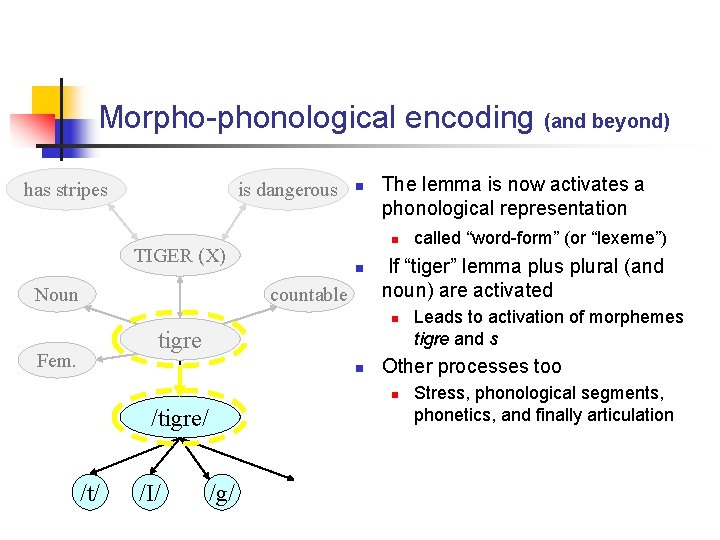
Levelt’s model has stripes is dangerous Lexical concepts TIGER (X) Noun tigre Fem. countable Lexemes /tigre/ /t/ /I/ Lemmas /g/ Phonemes
Levelt’s model: conceptual level has stripes is dangerous n TIGER (X) Noun tigre Fem. countable /tigre/ /t/ /I/ /g/ Conceptual level is not decomposed n one lexical concept node for “tiger” n instead, conceptual links from “tiger” to “stripes”, etc.
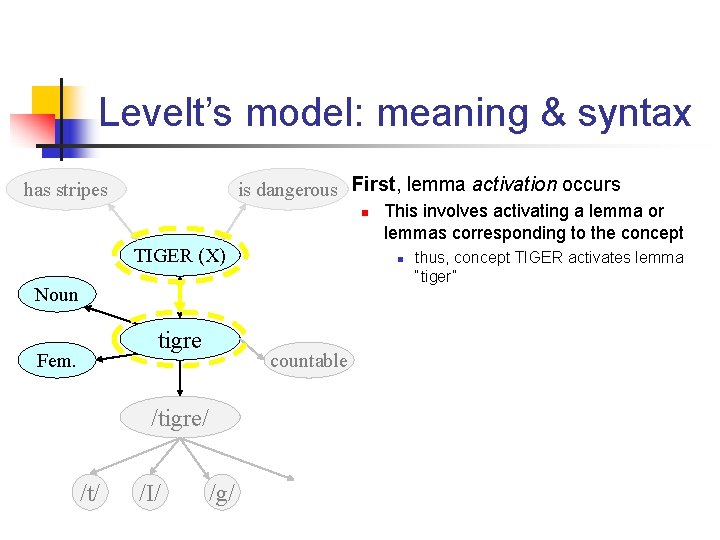
Levelt’s model: meaning & syntax n First, lemma activation occurs is dangerous has stripes n TIGER (X) n Noun tigre Fem. countable /tigre/ /t/ /I/ /g/ This involves activating a lemma or lemmas corresponding to the concept thus, concept TIGER activates lemma “tiger”
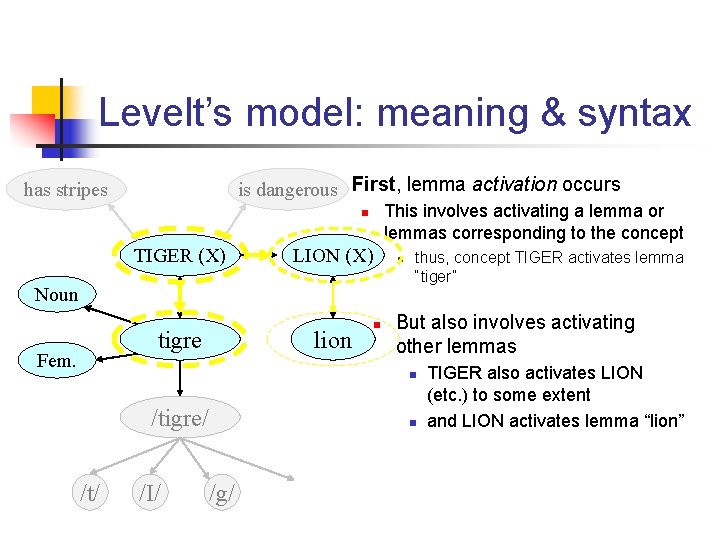
Levelt’s model: meaning & syntax n First, lemma activation occurs is dangerous has stripes This involves activating a lemma or lemmas corresponding to the concept n TIGER (X) LION (X) Noun tigre Fem. lion n n thus, concept TIGER activates lemma “tiger” But also involves activating other lemmas n /tigre/ /t/ /I/ n /g/ TIGER also activates LION (etc. ) to some extent and LION activates lemma “lion”
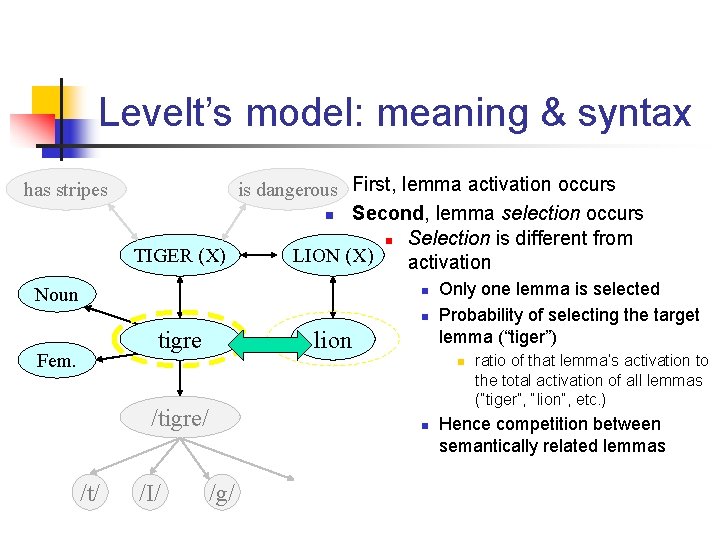
Levelt’s model: meaning & syntax has stripes n First, lemma activation occurs is dangerous n Second, lemma selection occurs n Selection is different from TIGER (X) LION (X) activation Noun n n tigre Fem. lion Only one lemma is selected Probability of selecting the target lemma (“tiger”) n /tigre/ /t/ /I/ n /g/ ratio of that lemma’s activation to the total activation of all lemmas (“tiger”, “lion”, etc. ) Hence competition between semantically related lemmas
Morpho-phonological encoding (and beyond) has stripes is dangerous The lemma is now activates a phonological representation n TIGER (X) Noun n n countable If “tiger” lemma plus plural (and noun) are activated n tigre Fem. n /t/ /I/ /g/ Leads to activation of morphemes tigre and s Other processes too n /tigre/ called “word-form” (or “lexeme”) Stress, phonological segments, phonetics, and finally articulation
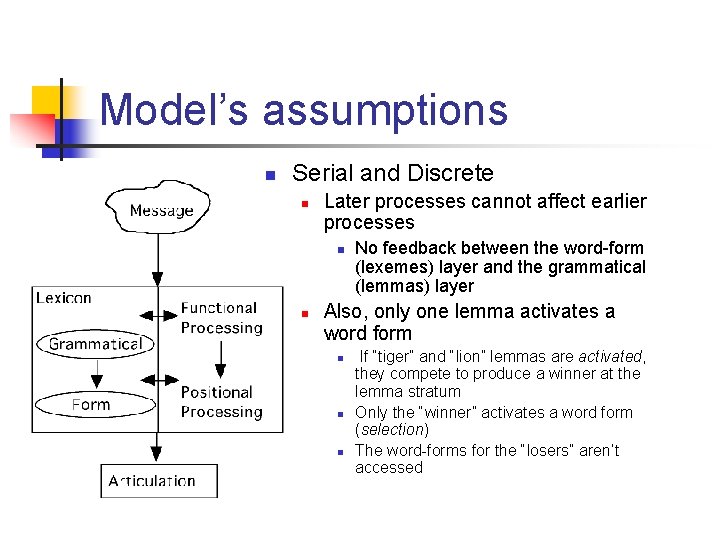
Model’s assumptions n Serial and Discrete n Later processes cannot affect earlier processes n n No feedback between the word-form (lexemes) layer and the grammatical (lemmas) layer Also, only one lemma activates a word form n n n If “tiger” and “lion” lemmas are activated, they compete to produce a winner at the lemma stratum Only the “winner” activates a word form (selection) The word-forms for the “losers” aren’t accessed
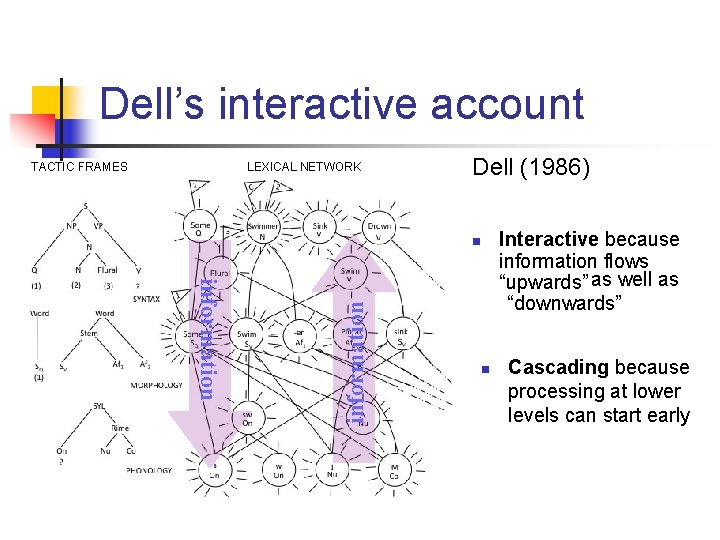
Dell’s interactive account n Dell (1986) presented the one of the best-known interactive accounts n n other similar accounts exist (e. g. , Stemberger, Mc. Kay) Network organization n 3 levels of representation n n Semantics (decomposed into features) Words and morphemes phonemes (sounds) These get selected and inserted into frames
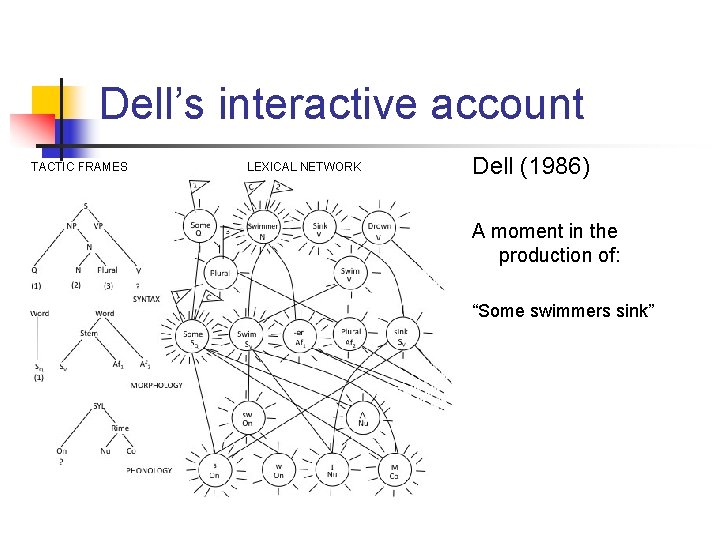
Dell’s interactive account TACTIC FRAMES LEXICAL NETWORK Dell (1986) A moment in the production of: “Some swimmers sink”
Dell’s interactive account TACTIC FRAMES LEXICAL NETWORK Dell (1986) information n n Interactive because information flows “upwards” as well as “downwards” Cascading because processing at lower levels can start early
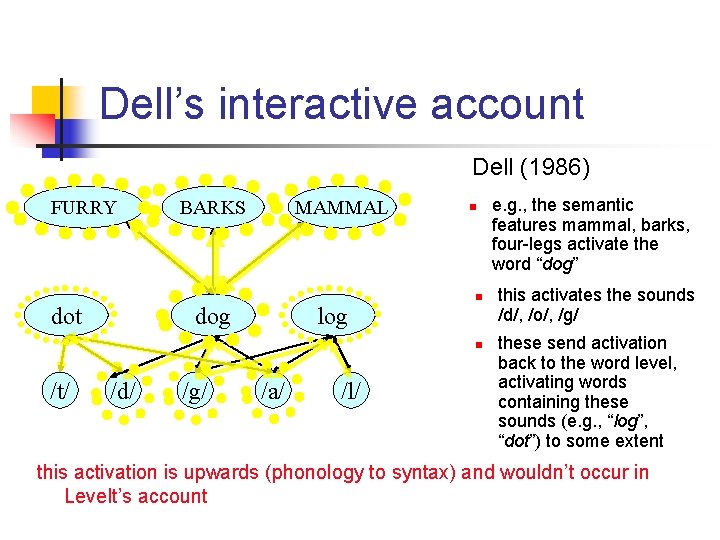
Dell’s interactive account Dell (1986) FURRY dot BARKS MAMMAL dog log n n n /t/ /d/ /g/ /a/ /l/ e. g. , the semantic features mammal, barks, four-legs activate the word “dog” this activates the sounds /d/, /o/, /g/ these send activation back to the word level, activating words containing these sounds (e. g. , “log”, “dot”) to some extent this activation is upwards (phonology to syntax) and wouldn’t occur in Levelt’s account
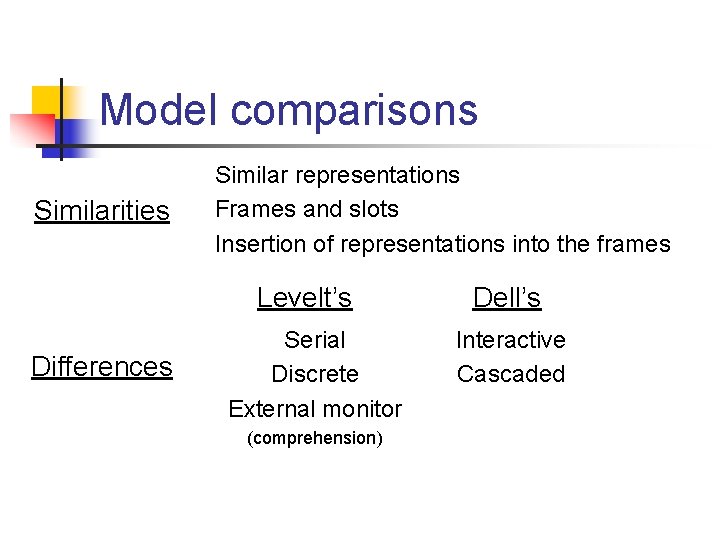
Model comparisons Similarities Similar representations Frames and slots Insertion of representations into the frames Levelt’s Differences Serial Discrete External monitor (comprehension) Dell’s Interactive Cascaded
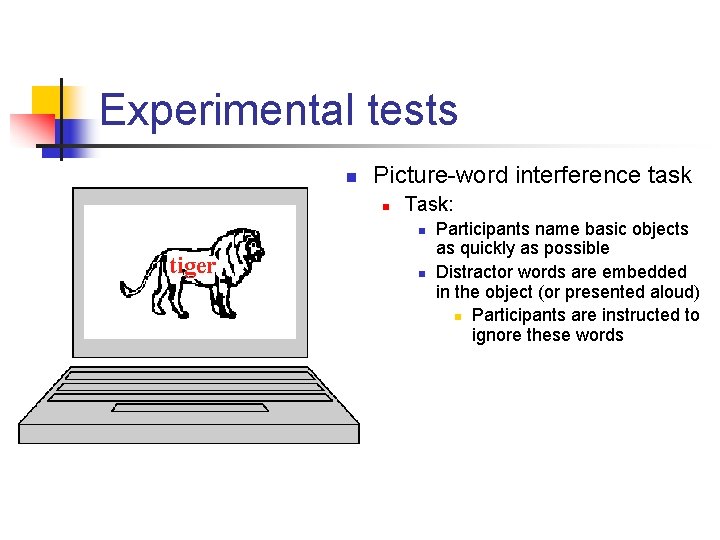
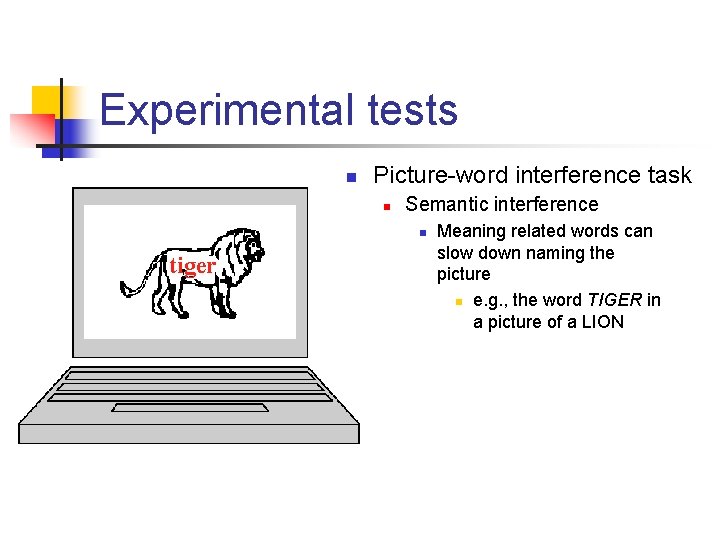
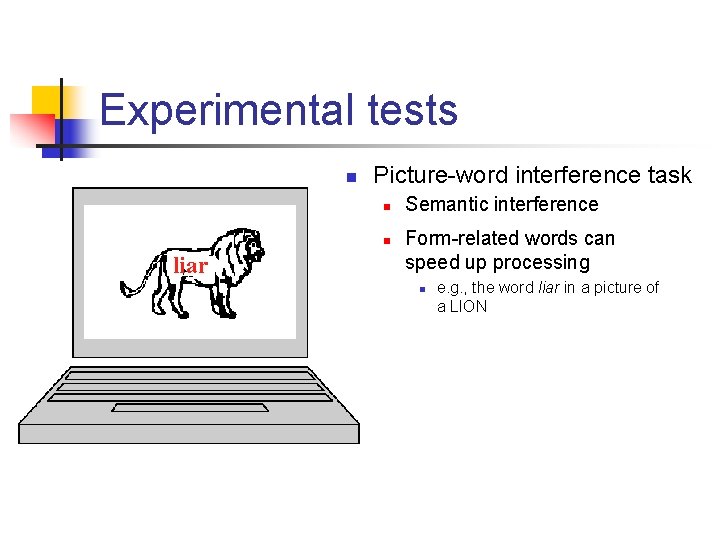
Testing Models of language production n Experimental investigations of some of these issues n Time course - cascading vs serial n n Separation of syntax and semantics n n Picture word interference Subject verb agreement Abstract syntax vs surface form n Syntactic priming
Experimental tests n Picture-word interference task n Task: n tiger n Participants name basic objects as quickly as possible Distractor words are embedded in the object (or presented aloud) n Participants are instructed to ignore these words
Experimental tests n Picture-word interference task n Semantic interference n tiger Meaning related words can slow down naming the picture n e. g. , the word TIGER in a picture of a LION
Experimental tests n Picture-word interference task n n liar Semantic interference Form-related words can speed up processing n e. g. , the word liar in a picture of a LION
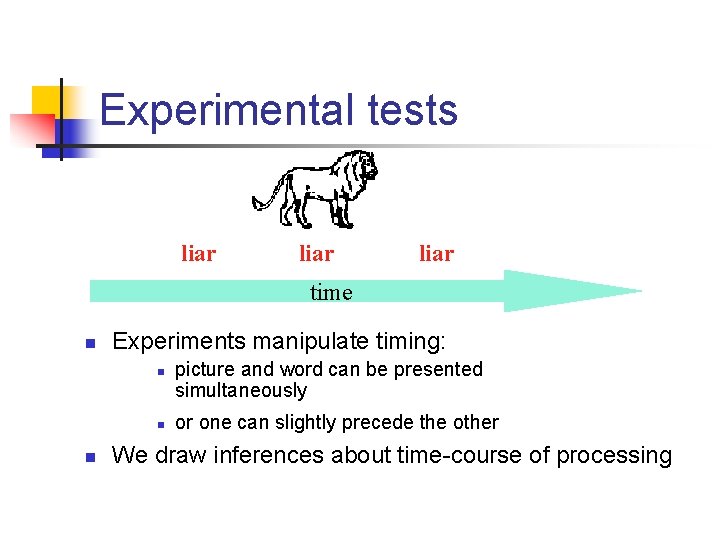
Experimental tests liar time n Experiments manipulate timing: n n n picture and word can be presented simultaneously or one can slightly precede the other We draw inferences about time-course of processing
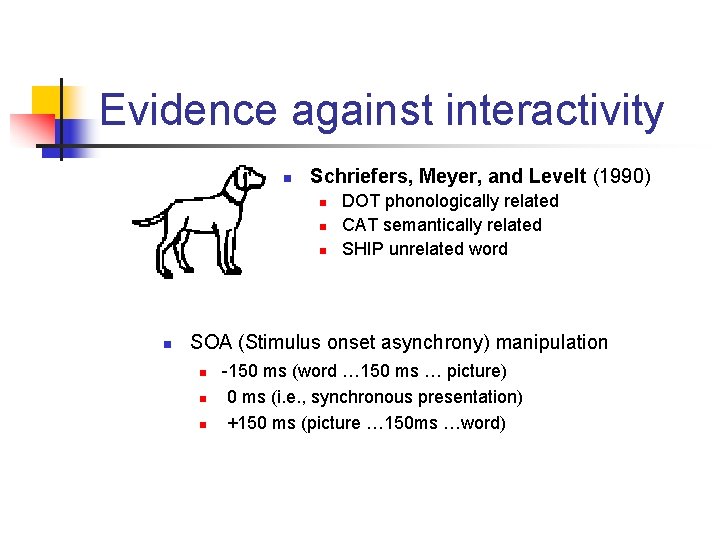
Evidence against interactivity n Schriefers, Meyer, and Levelt (1990) n n DOT phonologically related CAT semantically related SHIP unrelated word SOA (Stimulus onset asynchrony) manipulation n -150 ms (word … 150 ms … picture) 0 ms (i. e. , synchronous presentation) +150 ms (picture … 150 ms …word)
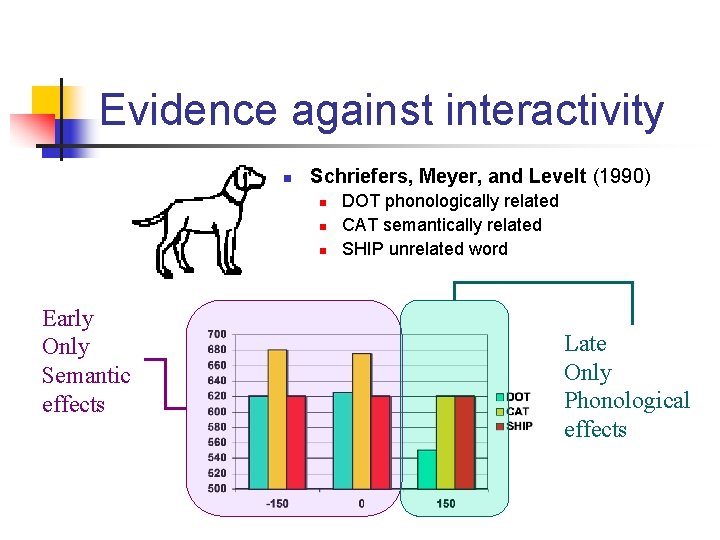
Evidence against interactivity n Schriefers, Meyer, and Levelt (1990) n n n Early Only Semantic effects DOT phonologically related CAT semantically related SHIP unrelated word Late Only Phonological effects
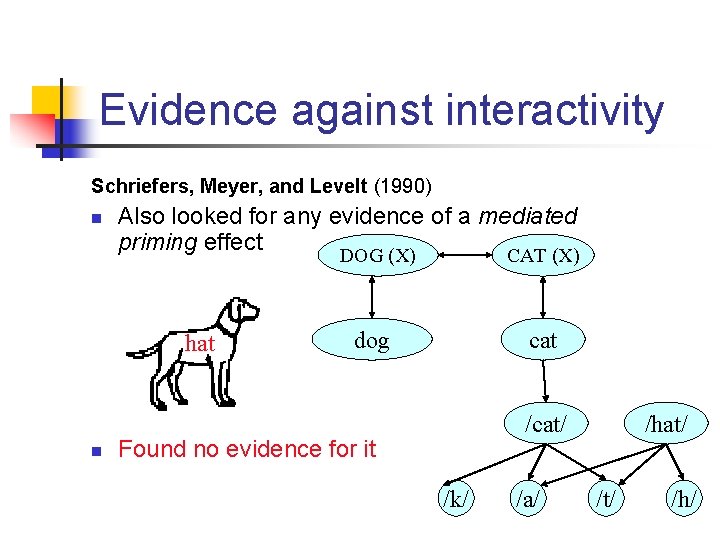
Evidence against interactivity Schriefers, Meyer, and Levelt (1990) n Also looked for any evidence of a mediated priming effect hat n DOG (X) CAT (X) dog cat /cat/ Found no evidence for it /k/ /a/ /hat/ /h/
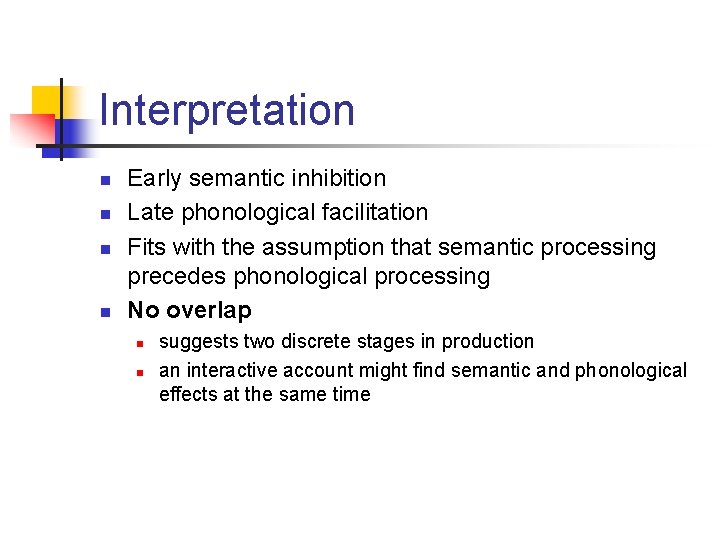
Interpretation n n Early semantic inhibition Late phonological facilitation Fits with the assumption that semantic processing precedes phonological processing No overlap n n suggests two discrete stages in production an interactive account might find semantic and phonological effects at the same time
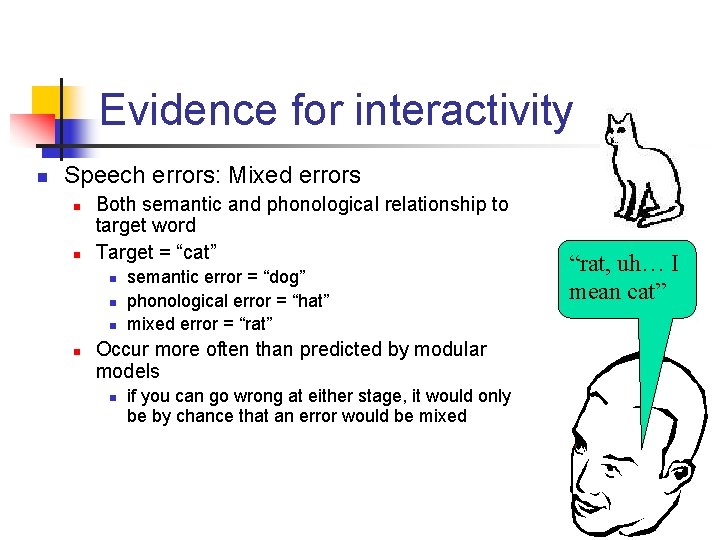
Evidence for interactivity n Speech errors: Mixed errors n n Both semantic and phonological relationship to target word Target = “cat” n n semantic error = “dog” phonological error = “hat” mixed error = “rat” Occur more often than predicted by modular models n if you can go wrong at either stage, it would only be by chance that an error would be mixed “rat, uh… I mean cat”
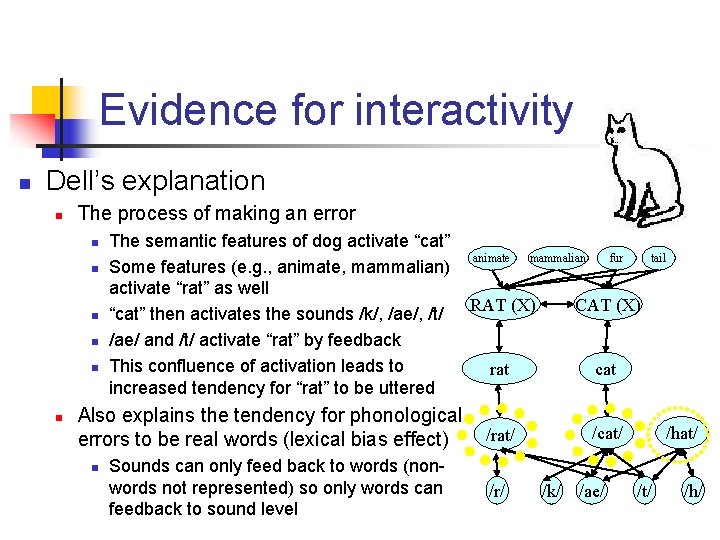
Evidence for interactivity n Dell’s explanation n The process of making an error n n n The semantic features of dog activate “cat” Some features (e. g. , animate, mammalian) activate “rat” as well “cat” then activates the sounds /k/, /ae/, /t/ /ae/ and /t/ activate “rat” by feedback This confluence of activation leads to increased tendency for “rat” to be uttered Also explains the tendency for phonological errors to be real words (lexical bias effect) n Sounds can only feed back to words (nonwords not represented) so only words can feedback to sound level animate mammalian fur tail RAT (X) CAT (X) rat cat /rat/ /cat/ /r/ /k/ /ae/ /hat/ /h/
Evidence for interactivity n A number of recent experimental findings appear to support interaction under some circumstances (or at least cascading models) n n n Damian & Martin (1999) Cutting & Ferreira (1999) Peterson & Savoy (1998)
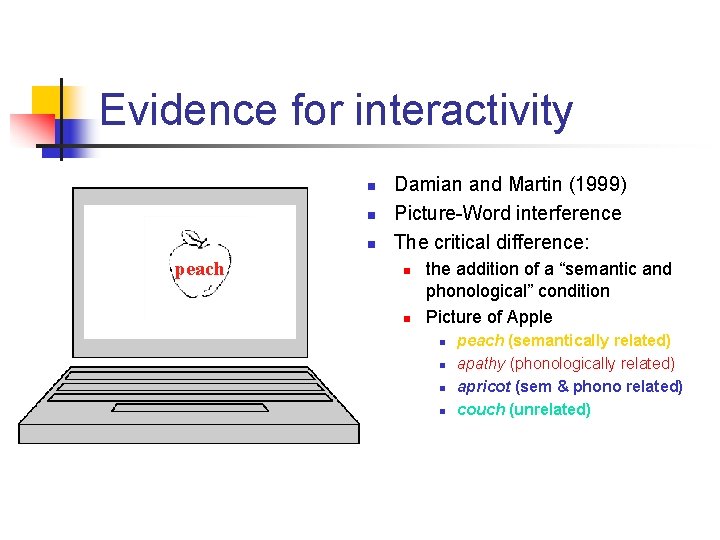
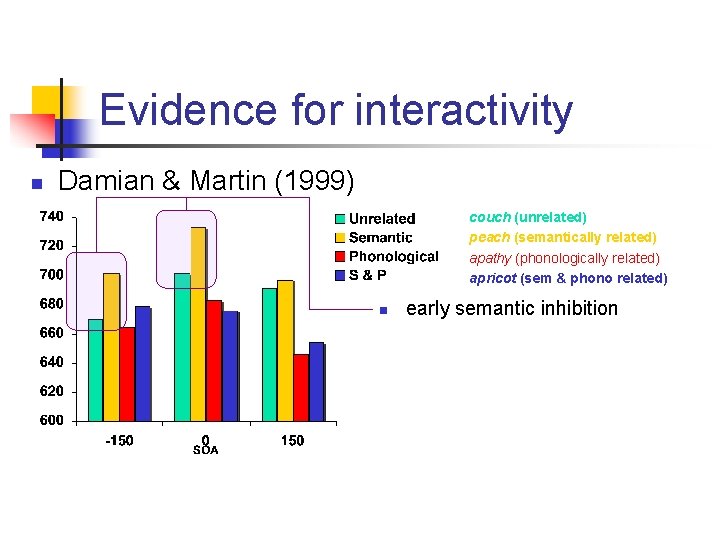
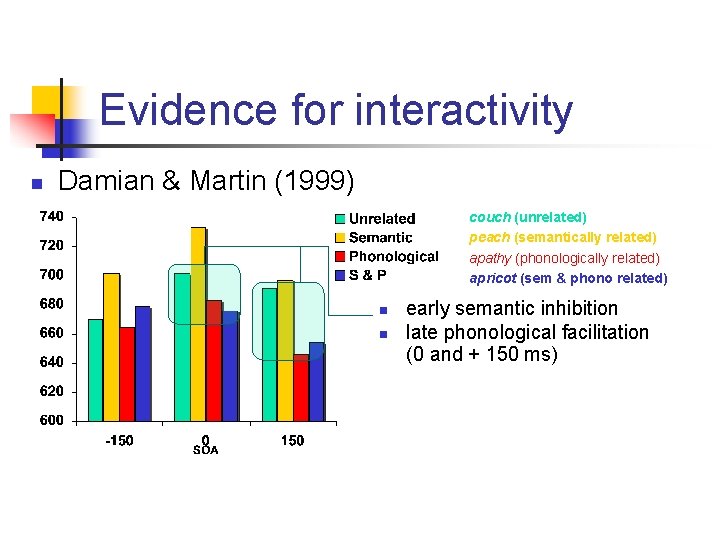
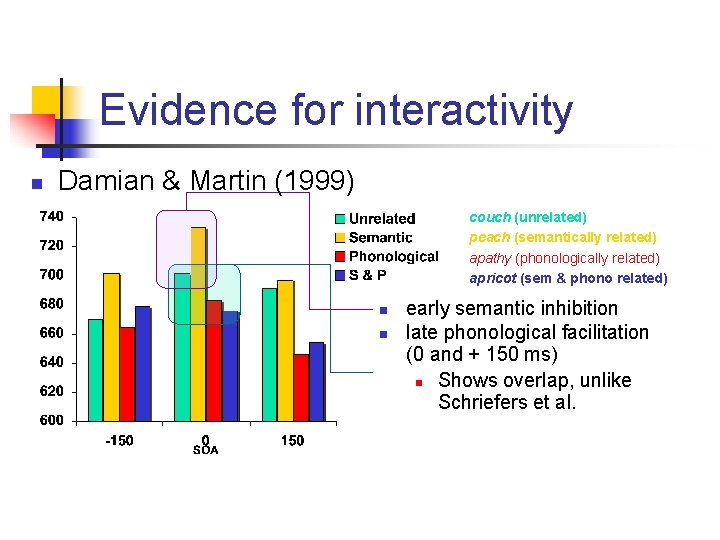
Evidence for interactivity n n n peach Damian and Martin (1999) Picture-Word interference The critical difference: n n the addition of a “semantic and phonological” condition Picture of Apple n n peach (semantically related) apathy (phonologically related) apricot (sem & phono related) couch (unrelated)
Evidence for interactivity n Damian & Martin (1999) couch (unrelated) peach (semantically related) apathy (phonologically related) apricot (sem & phono related) n early semantic inhibition
Evidence for interactivity n Damian & Martin (1999) couch (unrelated) peach (semantically related) apathy (phonologically related) apricot (sem & phono related) n n early semantic inhibition late phonological facilitation (0 and + 150 ms)
Evidence for interactivity n Damian & Martin (1999) couch (unrelated) peach (semantically related) apathy (phonologically related) apricot (sem & phono related) n n early semantic inhibition late phonological facilitation (0 and + 150 ms) n Shows overlap, unlike Schriefers et al.
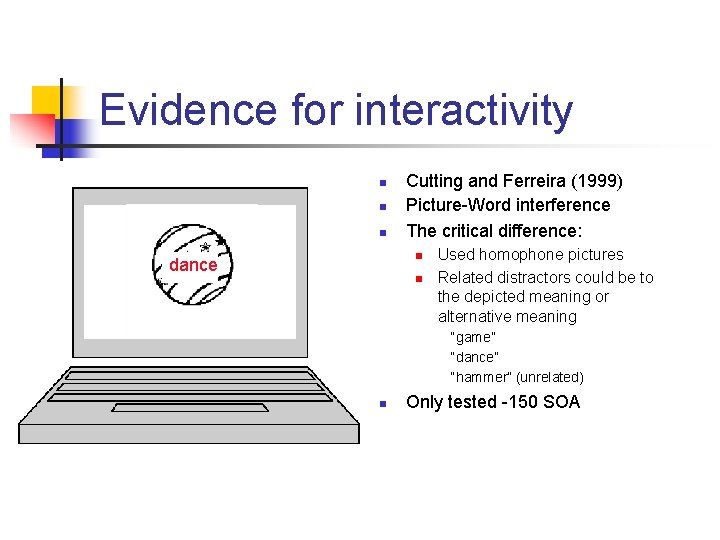
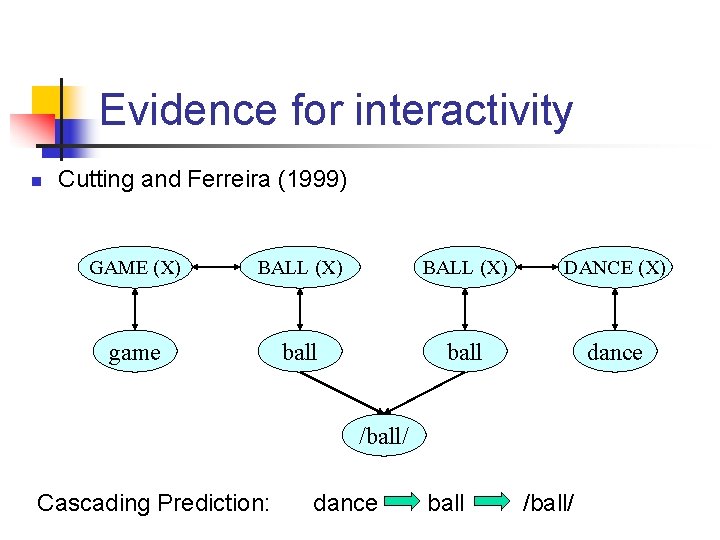
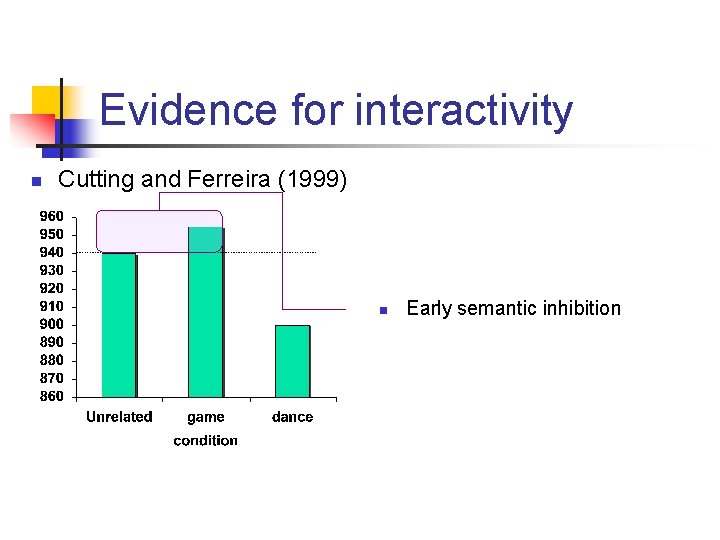
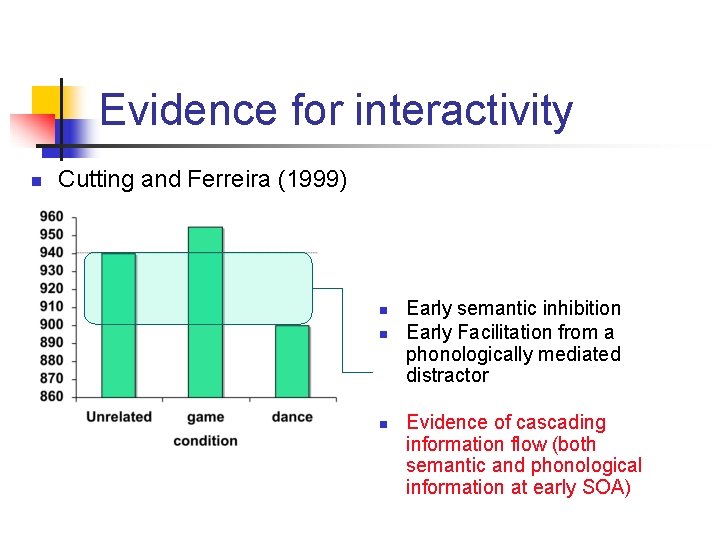
Evidence for interactivity n n n Cutting and Ferreira (1999) Picture-Word interference The critical difference: n dance n Used homophone pictures Related distractors could be to the depicted meaning or alternative meaning “game” “dance” “hammer” (unrelated) n Only tested -150 SOA
Evidence for interactivity n Cutting and Ferreira (1999) GAME (X) BALL (X) DANCE (X) game ball dance /ball/ Cascading Prediction: dance ball /ball/
Evidence for interactivity n Cutting and Ferreira (1999) n Early semantic inhibition
Evidence for interactivity n Cutting and Ferreira (1999) n n n Early semantic inhibition Early Facilitation from a phonologically mediated distractor Evidence of cascading information flow (both semantic and phonological information at early SOA)
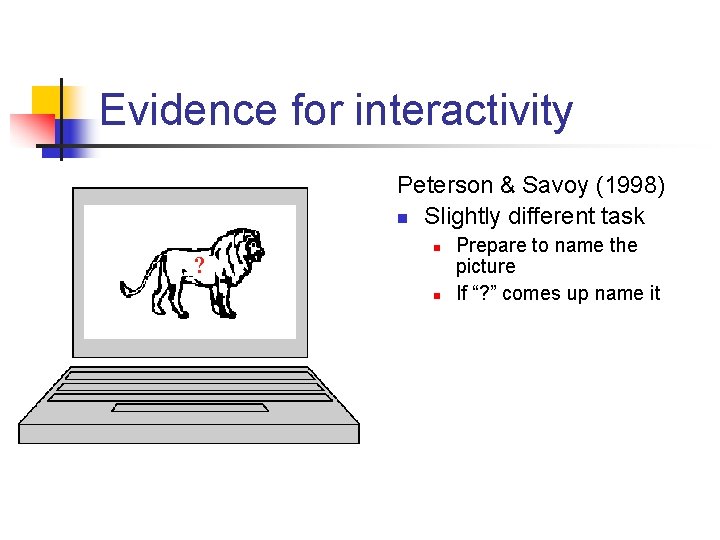
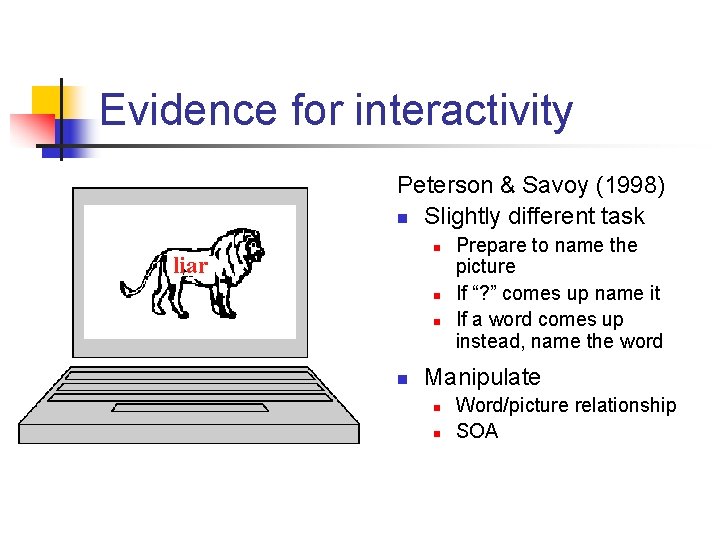
Evidence for interactivity Peterson & Savoy (1998) n Slightly different task ? n n Prepare to name the picture If “? ” comes up name it
Evidence for interactivity Peterson & Savoy (1998) n Slightly different task n liar n n n Prepare to name the picture If “? ” comes up name it If a word comes up instead, name the word Manipulate n n Word/picture relationship SOA
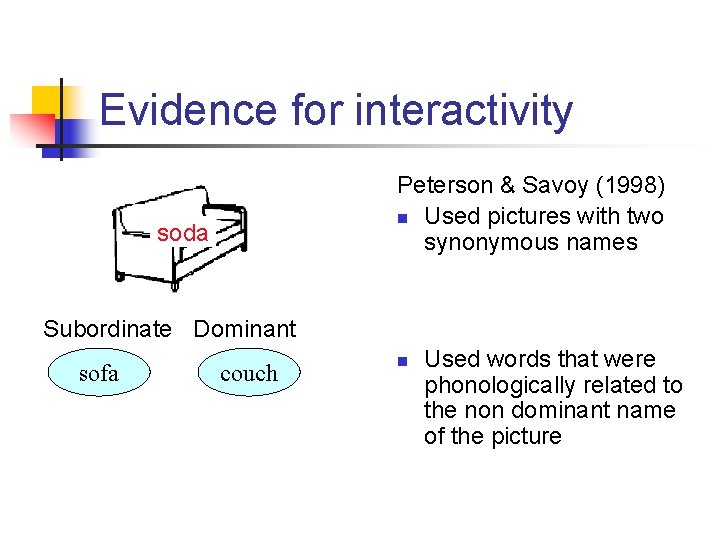
Evidence for interactivity Peterson & Savoy (1998) n Used pictures with two synonymous names soda Subordinate Dominant sofa couch n Used words that were phonologically related to the non dominant name of the picture
Evidence for interactivity n Peterson & Savoy n Found evidence for phonological activation of near synonyms: n n Participants slower to say distractor soda than unrelated distractor when naming couch n Soda is related to non-selected sofa Remember that Levelt et al. assume that only one lemma can be selected and hence activate a phonological form n Levelt et al’s explanation: Could be erroneous selection of two lemmas?
Can the two-stage account be saved? n Evidence for interaction is hard to reconcile with the Levelt account n However, most attempts are likely to revolve around the monitor n n Basically, people sometimes notice a problem and screen it out Levelt argues that evidence for interaction really involves “special cases”, not directly related to normal processing
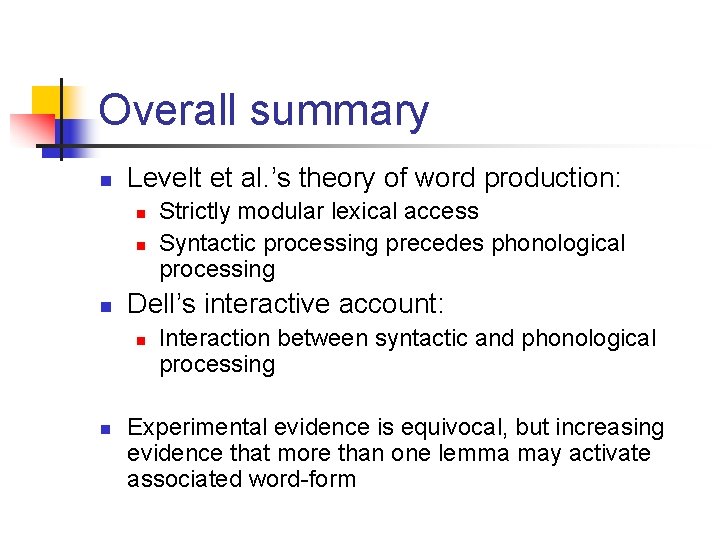
Overall summary n Levelt et al. ’s theory of word production: n n n Dell’s interactive account: n n Strictly modular lexical access Syntactic processing precedes phonological processing Interaction between syntactic and phonological processing Experimental evidence is equivocal, but increasing evidence that more than one lemma may activate associated word-form
Conversational interaction n n n n ABBOTT: Super Duper computer store. Can I help you? COSTELLO: Thanks. I'm setting up an office in my den, and I'm thinking about buying a computer. ABBOTT: Mac? COSTELLO: No, the name is Lou. ABBOTT: Your computer? COSTELLO: I don't own a computer. I want to buy one. ABBOTT: Mac? COSTELLO: I told you, my name is Lou. ABBOTT: What about Windows? COSTELLO: Why? Will it get stuffy in here? ABBOTT: Do you want a computer with windows? COSTELLO: I don't know. What will I see when I look in the windows? ABBOTT: Wallpaper. COSTELLO: Never mind the windows. I need a computer and software. ABBOTT: Software for windows? COSTELLO: No. On the computer! I need something I can use to write proposals, track expenses and run my business. What have you got? ABBOTT: Office.
Conversational interaction n n n n COSTELLO: Yeah, for my office. Can you recommend anything? ABBOTT: I just did. COSTELLO: You just did what? ABBOTT: Recommend something. COSTELLO: You recommended something? ABBOTT: Yes. COSTELLO: For my office? ABBOTT: Yes. COSTELLO: OK, what did you recommend for my office? ABBOTT: Office. COSTELLO: Yes, for my office! ABBOTT: I recommend office with windows. COSTELLO: I already have an office and it has windows!OK, lets just say, I'm sitting at my computer and I want to type a proposal. What do I need? ABBOTT: Word. COSTELLO: What word? ABBOTT: Word in Office. COSTELLO: The only word in office is office. ABBOTT: The Word in Office for Windows.
Conversational interaction n n n n COSTELLO: Which word in office for windows? ABBOTT: The Word you get when you click the blue "W. ” COSTELLO: I'm going to click your blue "w" if you don't start with some straight answers. OK, forget that. Can I watch movies on the Internet? ABBOTT: Yes, you want Real One. COSTELLO: Maybe a real one, maybe a cartoon. What I watch is none of your business. Just tell me what I need! ABBOTT: Real One. COSTELLO: If it’s a long movie I also want to see reel 2, 3 and 4. Can I watch them? ABBOTT: Of course. COSTELLO: Great, with what? ABBOTT: Real One. COSTELLO; OK, I'm at my computer and I want to watch a movie. What do I do? ABBOTT: You click the blue "1. ” COSTELLO: I click the blue one what? ABBOTT: The blue "1. ” COSTELLO: Is that different from the blue "W"? ABBOTT: The blue 1 is Real One and the blue W is Word. COSTELLO: What word?
Conversational interaction n n n ABBOTT: The Word in Office for Windows. COSTELLO: But there are three words in "office for windows"! ABBOTT: No, just one. But it’s the most popular Word in the world. COSTELLO: It is? ABBOTT: Yes, but to be fair, there aren't many other Words left. It pretty much wiped out all the other Words. COSTELLO: And that word is real one? ABBOTT: Real One has nothing to do with Word. Real One isn't even Part of Office. COSTELLO: Stop! Don't start that again. What about financial bookkeeping you have anything I can track my money with? ABBOTT: Money. COSTELLO: That's right. What do you have? ABBOTT: Money. COSTELLO: I need money to track my money? ABBOTT: It comes bundled with your computer. COSTELLO: What's bundled to my computer? ABBOTT: Money.
Conversational interaction n n COSTELLO: Money comes with my computer? ABBOTT: Yes. No extra charge. COSTELLO: I get a bundle of money with my computer? How much? ABBOTT: One copy. COSTELLO: Isn't it illegal to copy money? ABBOTT: Microsoft gave us a license to copy money. COSTELLO: They can give you a license to copy money? ABBOTT: Why not? THEY OWN IT! (LATER) COSTELLO: How do I turn my computer off? ? ABBOTT: Click on "START".
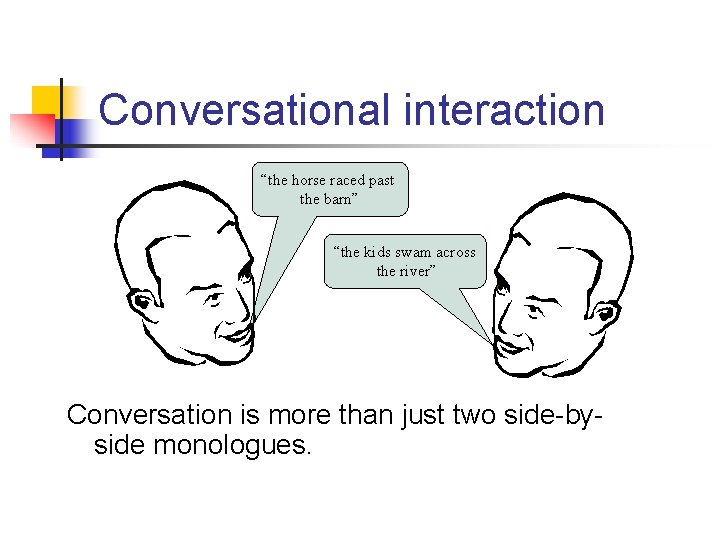
Conversational interaction “the horse raced past the barn” “the kids swam across the river” Conversation is more than just two side-byside monologues.
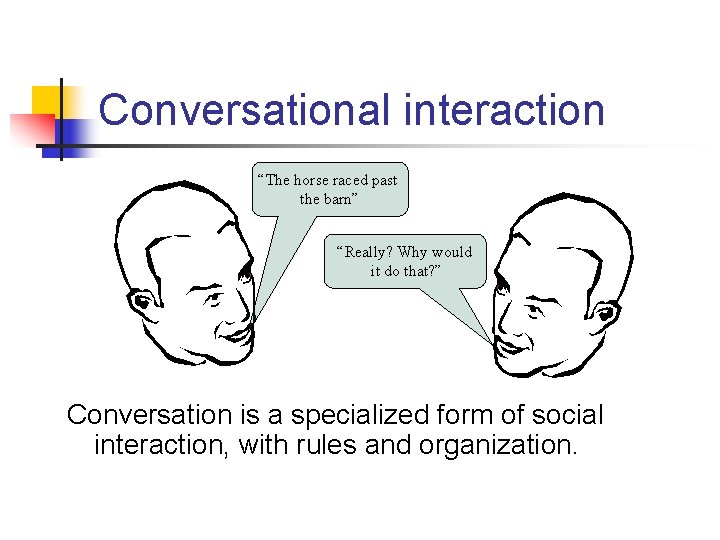
Conversational interaction “The horse raced past the barn” “Really? Why would it do that? ” Conversation is a specialized form of social interaction, with rules and organization.
Conversation n Fillmore (1981) “The language of face-to-face conversation is the basic and primary use of language” (pg. 152) n So all instances of language usage can (should) be compared to conversation n What is the impact of the presence or absence of different features of face-to-face conversation?
Conversation n Herb Clark (1996) n Face-to-face conversation - the basic setting n Features Immediacy n Co-presence Visibility Audibility n Instantaneity n n n Medium n n n Evanescence Recordlessness Simultaneity Control n n n Extemporaneity Self-determination Self-expression Other settings may lack some of these features n e. g. , telephone conversations take away co-presence and visibility, which may change language use
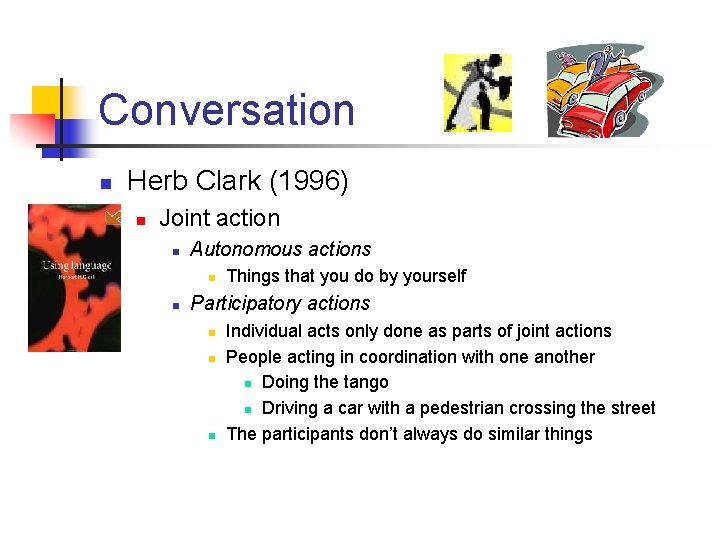
Conversation n Herb Clark (1996) n Joint action n Autonomous actions n n Things that you do by yourself Participatory actions n n n Individual acts only done as parts of joint actions People acting in coordination with one another n Doing the tango n Driving a car with a pedestrian crossing the street The participants don’t always do similar things
Conversation n Herb Clark (1996) n Speaking and listening n Traditionally treated as autonomous actions n n Contributing to the tradition of studying language comprehension and production separately Clark proposed that they should be treated as participatory actions
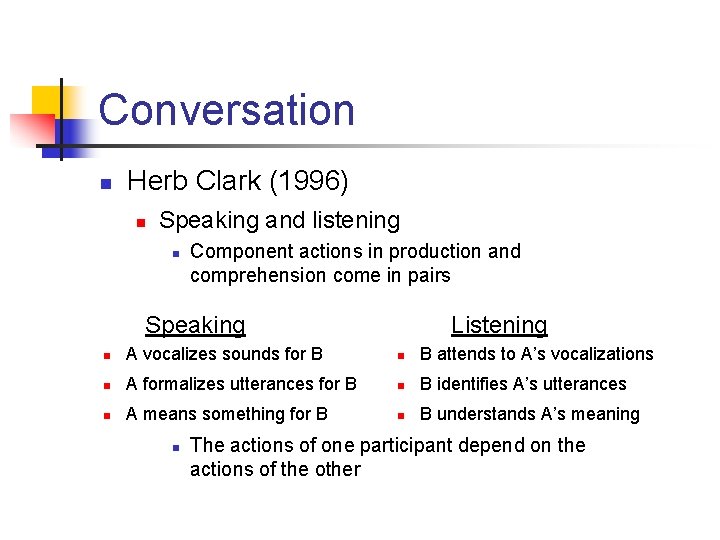
Conversation n Herb Clark (1996) n Speaking and listening n Component actions in production and comprehension come in pairs Speaking Listening n A vocalizes sounds for B n B attends to A’s vocalizations n A formalizes utterances for B n B identifies A’s utterances n A means something for B n B understands A’s meaning n The actions of one participant depend on the actions of the other
Conversation n Herb Clark (1996) n Arena’s of language use - places where people do things with language n Meaning and understanding n n Establishing Common Ground Identifying participants Layers Conversation is structured
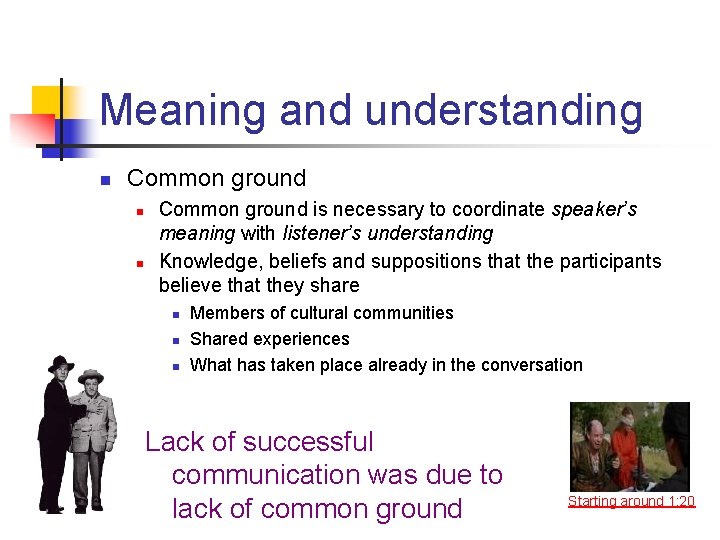
Meaning and understanding n Common ground n n Common ground is necessary to coordinate speaker’s meaning with listener’s understanding Knowledge, beliefs and suppositions that the participants believe that they share n n n Members of cultural communities Shared experiences What has taken place already in the conversation Lack of successful communication was due to lack of common ground Starting around 1: 20
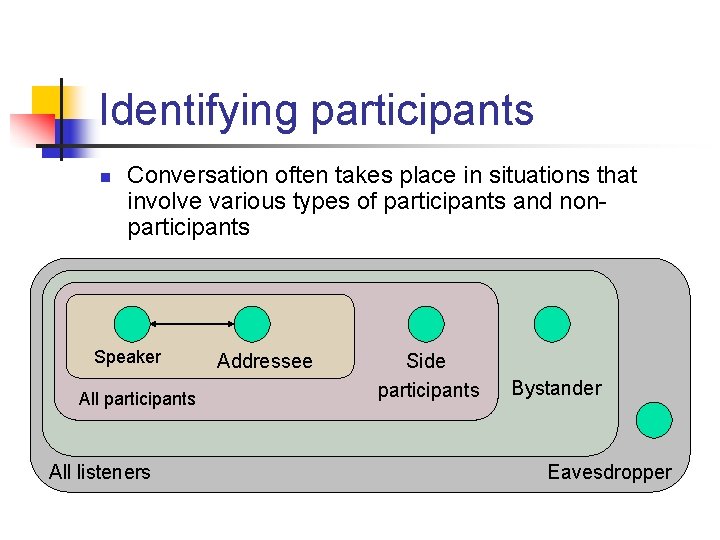
Identifying participants n Conversation often takes place in situations that involve various types of participants and nonparticipants Speaker All participants All listeners Addressee Side participants Bystander Eavesdropper
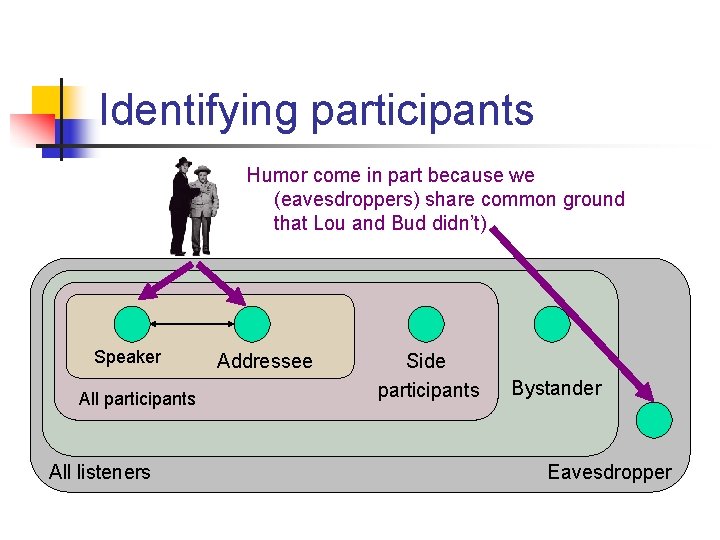
Identifying participants Humor come in part because we (eavesdroppers) share common ground that Lou and Bud didn’t) Speaker All participants All listeners Addressee Side participants Bystander Eavesdropper
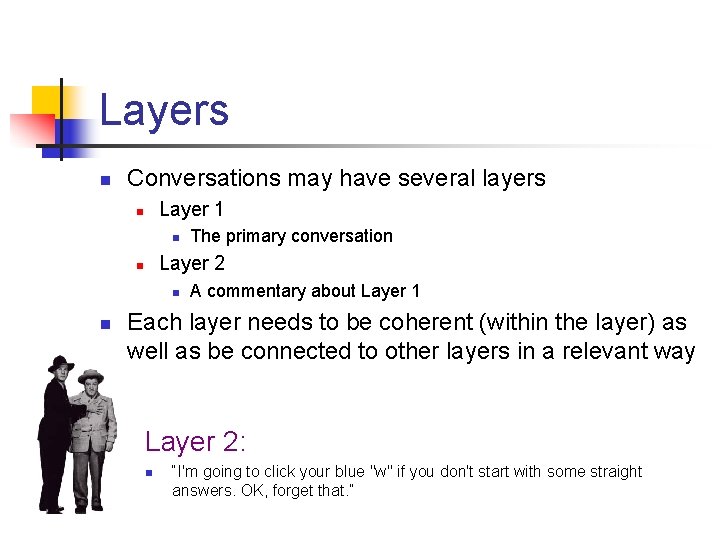
Layers n Conversations may have several layers Layer 1 n n Layer 2 n n n The primary conversation A commentary about Layer 1 Each layer needs to be coherent (within the layer) as well as be connected to other layers in a relevant way Layer 2: n “I'm going to click your blue "w" if you don't start with some straight answers. OK, forget that. ”
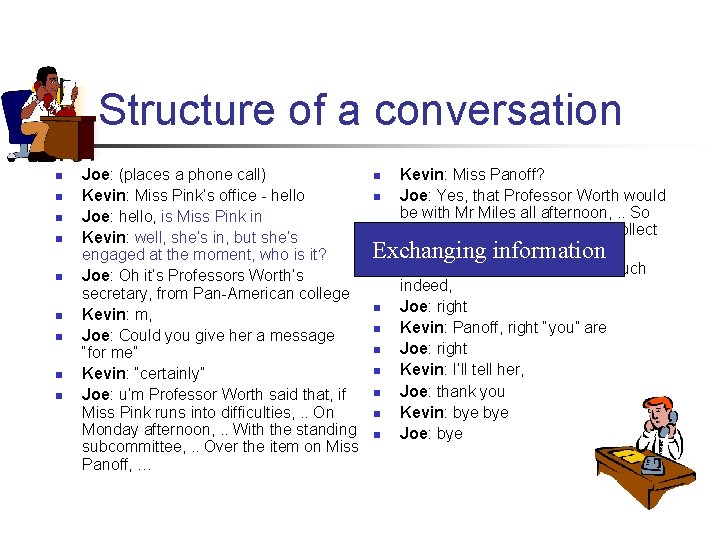
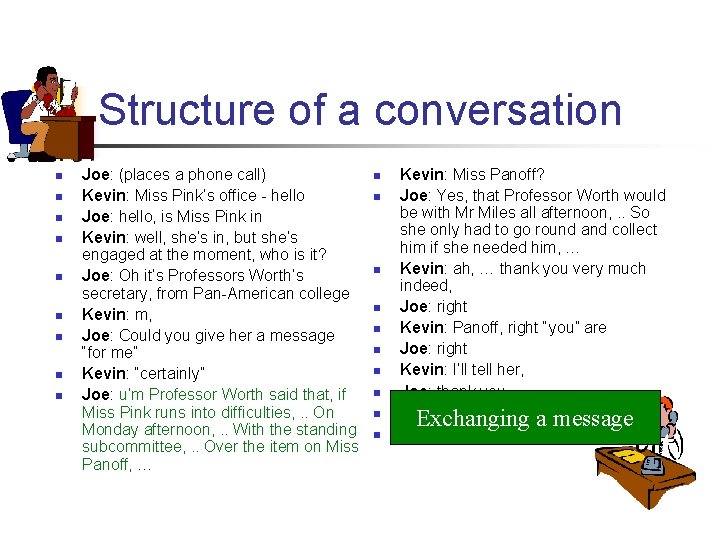
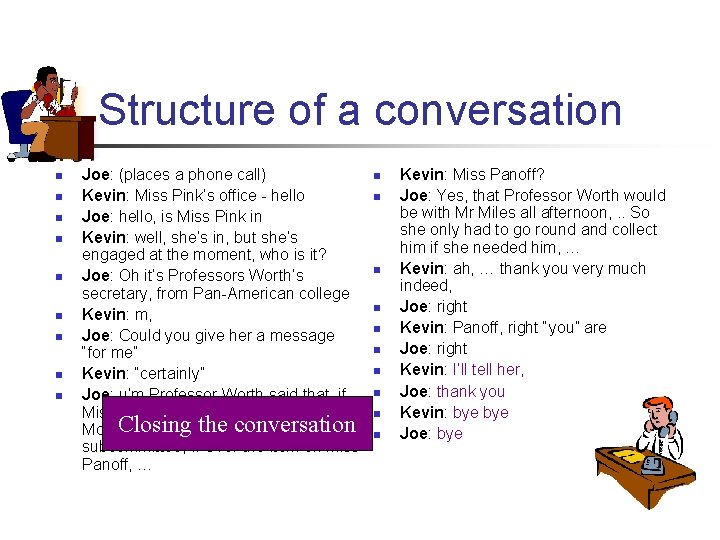
Structure of a conversation n Conversations are purposive and unplanned n n n Typically you can’t plan exactly what you’re going to say because it depends on another participant Conversations look planned only in retrospect Conversations have a fairly stable structure n n n Opening the conversation Identifying participants Taking turns Negotiating topics Closing conversations
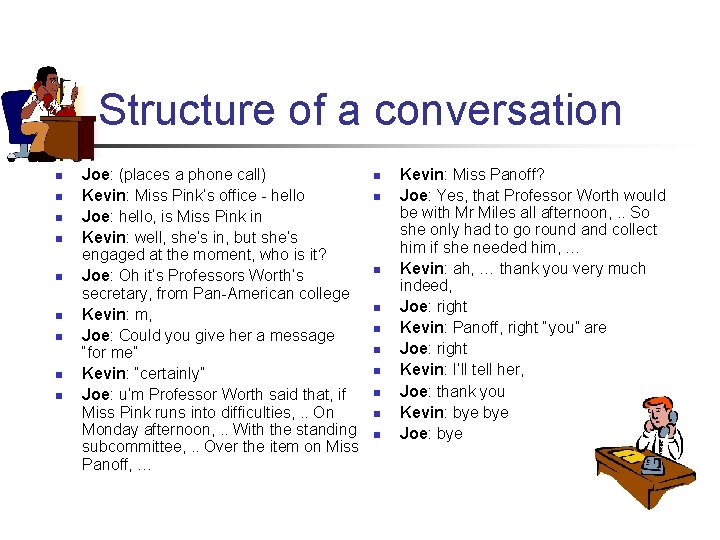
Structure of a conversation n n n n Joe: (places a phone call) Kevin: Miss Pink’s office - hello Joe: hello, is Miss Pink in Kevin: well, she’s in, but she’s engaged at the moment, who is it? Joe: Oh it’s Professors Worth’s secretary, from Pan-American college Kevin: m, Joe: Could you give her a message “for me” Kevin: “certainly” Joe: u’m Professor Worth said that, if Miss Pink runs into difficulties, . . On Monday afternoon, . . With the standing subcommittee, . . Over the item on Miss Panoff, … n n n n n Kevin: Miss Panoff? Joe: Yes, that Professor Worth would be with Mr Miles all afternoon, . . So she only had to go round and collect him if she needed him, … Kevin: ah, … thank you very much indeed, Joe: right Kevin: Panoff, right “you” are Joe: right Kevin: I’ll tell her, Joe: thank you Kevin: bye Joe: bye
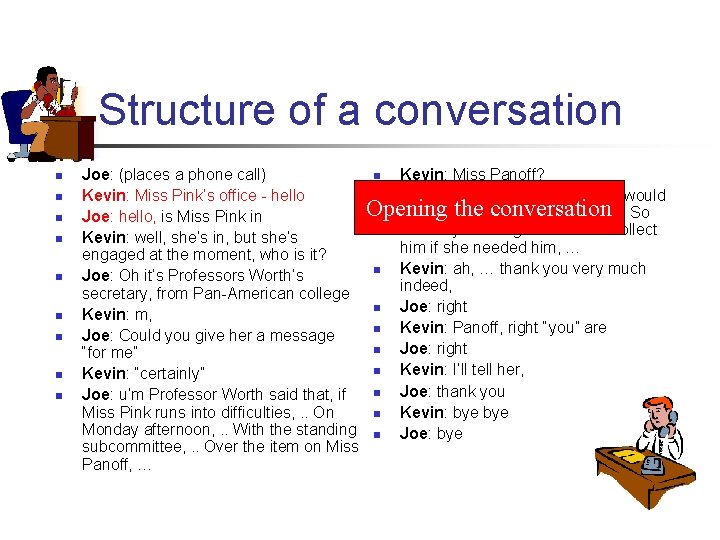
Structure of a conversation n n n n Joe: (places a phone call) Kevin: Miss Pink’s office - hello Joe: hello, is Miss Pink in Kevin: well, she’s in, but she’s engaged at the moment, who is it? Joe: Oh it’s Professors Worth’s secretary, from Pan-American college Kevin: m, Joe: Could you give her a message “for me” Kevin: “certainly” Joe: u’m Professor Worth said that, if Miss Pink runs into difficulties, . . On Monday afternoon, . . With the standing subcommittee, . . Over the item on Miss Panoff, … Kevin: Miss Panoff? n Joe: Yes, that Professor Worth would Opening conversation be with the Mr Miles all afternoon, . . So she only had to go round and collect him if she needed him, … n Kevin: ah, … thank you very much indeed, n Joe: right n Kevin: Panoff, right “you” are n Joe: right n Kevin: I’ll tell her, n Joe: thank you n Kevin: bye n Joe: bye n
Structure of a conversation n n n n Joe: (places a phone call) Kevin: Miss Pink’s office - hello Joe: hello, is Miss Pink in Kevin: well, she’s in, but she’s engaged at the moment, who is it? Joe: Oh it’s Professors Worth’s secretary, from Pan-American college Kevin: m, Joe: Could you give her a message “for me” Kevin: “certainly” Joe: u’m Professor Worth said that, if Miss Pink runs into difficulties, . . On Monday afternoon, . . With the standing subcommittee, . . Over the item on Miss Panoff, … Kevin: Miss Panoff? n Joe: Yes, that Professor Worth would be with Mr Miles all afternoon, . . So she only had to go round and collect him if she needed him, … Exchanging information n Kevin: ah, … thank you very much indeed, n Joe: right n Kevin: Panoff, right “you” are n Joe: right n Kevin: I’ll tell her, n Joe: thank you n Kevin: bye n Joe: bye n
Structure of a conversation n n n n Joe: (places a phone call) Kevin: Miss Pink’s office - hello Joe: hello, is Miss Pink in Kevin: well, she’s in, but she’s engaged at the moment, who is it? Joe: Oh it’s Professors Worth’s secretary, from Pan-American college Kevin: m, Joe: Could you give her a message “for me” Kevin: “certainly” Joe: u’m Professor Worth said that, if Miss Pink runs into difficulties, . . On Monday afternoon, . . With the standing subcommittee, . . Over the item on Miss Panoff, … n n n n n Kevin: Miss Panoff? Joe: Yes, that Professor Worth would be with Mr Miles all afternoon, . . So she only had to go round and collect him if she needed him, … Kevin: ah, … thank you very much indeed, Joe: right Kevin: Panoff, right “you” are Joe: right Kevin: I’ll tell her, Joe: thank you Kevin: bye Exchanging a message Joe: bye
Structure of a conversation n n n n Joe: (places a phone call) Kevin: Miss Pink’s office - hello Joe: hello, is Miss Pink in Kevin: well, she’s in, but she’s engaged at the moment, who is it? Joe: Oh it’s Professors Worth’s secretary, from Pan-American college Kevin: m, Joe: Could you give her a message “for me” Kevin: “certainly” Joe: u’m Professor Worth said that, if Miss Pink runs into difficulties, . . On Closing the. . With conversation Monday afternoon, the standing subcommittee, . . Over the item on Miss Panoff, … n n n n n Kevin: Miss Panoff? Joe: Yes, that Professor Worth would be with Mr Miles all afternoon, . . So she only had to go round and collect him if she needed him, … Kevin: ah, … thank you very much indeed, Joe: right Kevin: Panoff, right “you” are Joe: right Kevin: I’ll tell her, Joe: thank you Kevin: bye Joe: bye
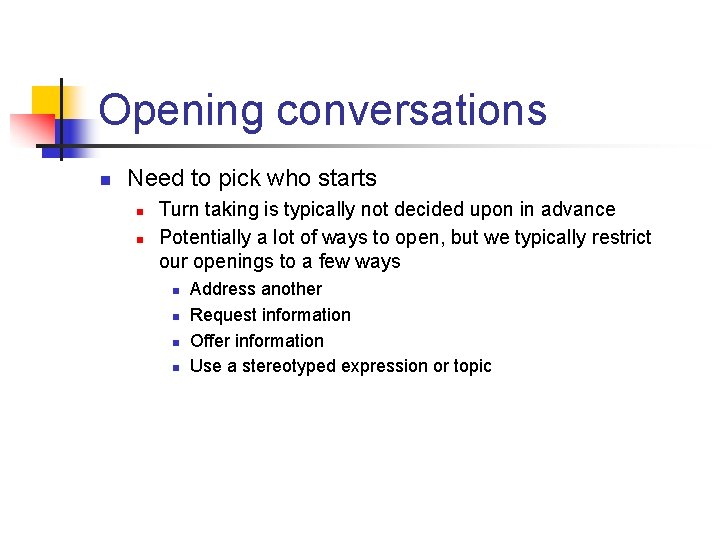
Opening conversations n Need to pick who starts n n Turn taking is typically not decided upon in advance Potentially a lot of ways to open, but we typically restrict our openings to a few ways n n Address another Request information Offer information Use a stereotyped expression or topic
Opening conversations n Need to pick who starts n Turn taking is typically not decided upon in advance Potentially a lot of ways to open n Has to resolve: n n n The entry time n Is now the time to converse? The participants n Who is talking to whom? Their roles n What is level of participation in the conversation? The official business n What is the conversation about?
Taking turns n Typically conversations don’t involve two (or more) people talking at the same time n n n Individual styles of turn-taking vary widely Length of a turn is a fairly stable characteristic within a given individual’s conversational interactions Standard signals indicate a change in turn: a head nod, a glance, a questioning tone
Taking turns n Typically conversations don’t involve two (or more) people talking at the same time n Three implicit rules (Sacks et al, 1974) n n Rule 1: Current speakers selects next speaker Rule 2: Self-selection: if rule 1 isn’t used, then next speaker can select themselves Rule 3: current speaker may continue (or not) These principles are ordered in terms of priority n The first is the most important, and the last is the least important n Just try violating them in an actual conversation (but debrief later!)
Taking turns n Typically conversations don’t involve two (or more) people talking at the same time n Use of non-verbal cues n n n Drop of pitch Drawl on final syllable Termination of hand signals Drop in loudness Completion of a grammatical clause Use of stereotyped phrase n “you know”
Negotiating topics n Keep the discourse relevant to the topic (remember Grice’s maxims) n Coherence again n n Earlier we looked at coherence within a speaker, now we consider it across multiple speakers Must use statements to signal topic shifts
Closing conversations n Closing statements n Must exit from the last topic, mutually agree to close the conversation, and coordinate the disengagement n Signal the end of conversation (or topic) n n Justifying why conversation should end n n “Okay” “I gotta go” Reference to potential future conversation n “Later dude”
Dialog is the key n Why so little research on dialog? n Most linguistic theories were developed to account for sentences in de-contextualized isolation n Dialog doesn’t fit the competence/performance distinction well Hard to do experimentally n Conversations are interactive and largely unplanned Pickering and Garrod (2004) n Proposed that processing theories of language comprehension and production may be flawed because of a focus on monologues
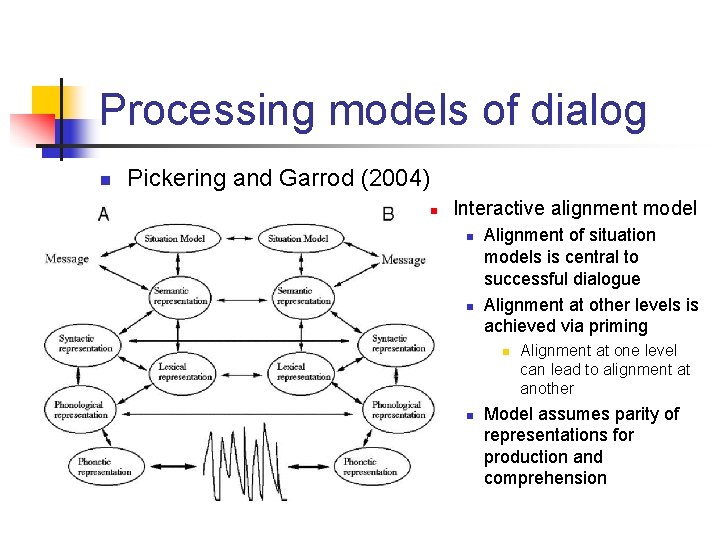
Processing models of dialog n Pickering and Garrod (2004) n Interactive alignment model n n Alignment of situation models is central to successful dialogue Alignment at other levels is achieved via priming n n Alignment at one level can lead to alignment at another Model assumes parity of representations for production and comprehension
Assumptions of the model 1. Alignment of situation models comes about via an automatic, resource-free priming mechanism 2. Representational parity between comprehension and production 3. Alignment at one level leads to alignment at other (interconnected) levels 4. There is no need for explicit perspective-taking in routine language processing
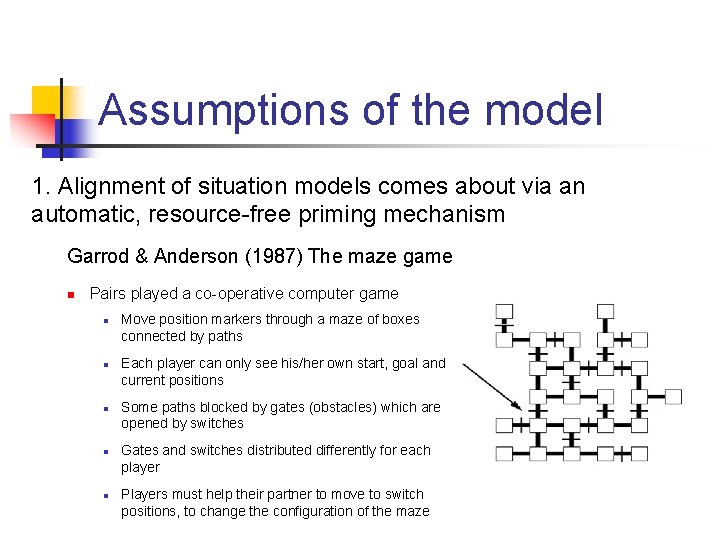
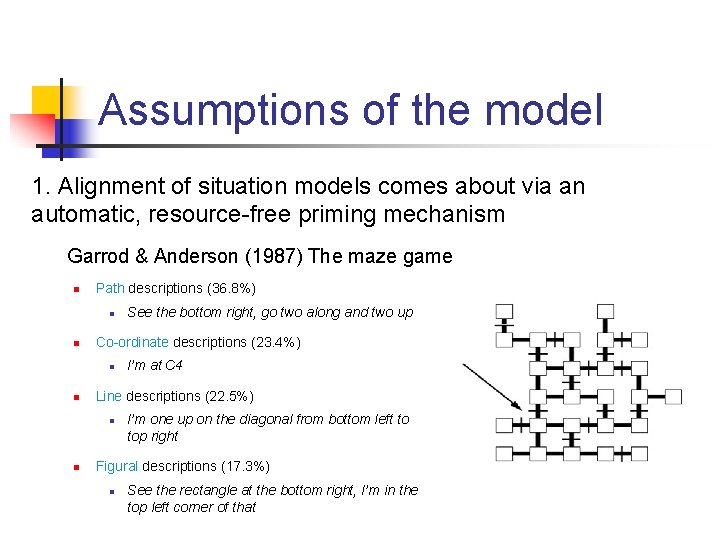
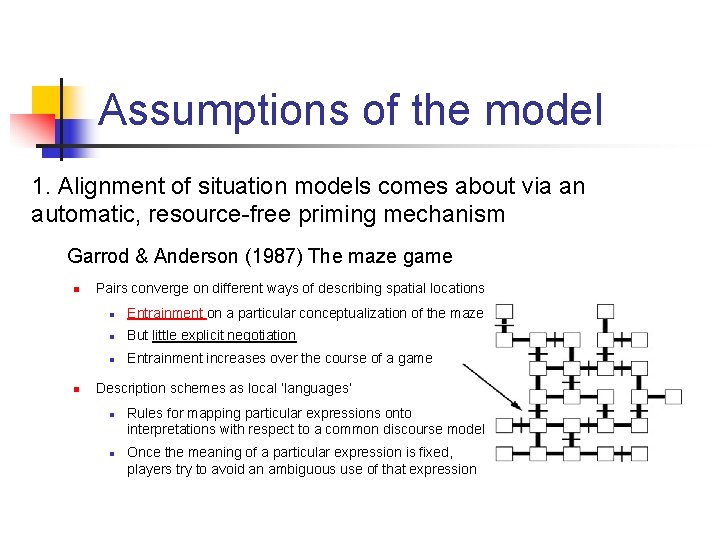
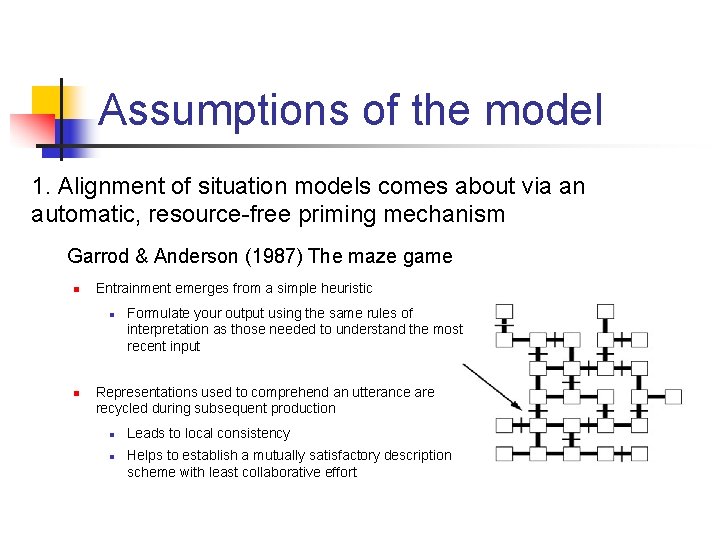
Assumptions of the model 1. Alignment of situation models comes about via an automatic, resource-free priming mechanism Garrod & Anderson (1987) The maze game n Pairs played a co-operative computer game n n n Move position markers through a maze of boxes connected by paths Each player can only see his/her own start, goal and current positions Some paths blocked by gates (obstacles) which are opened by switches Gates and switches distributed differently for each player Players must help their partner to move to switch positions, to change the configuration of the maze
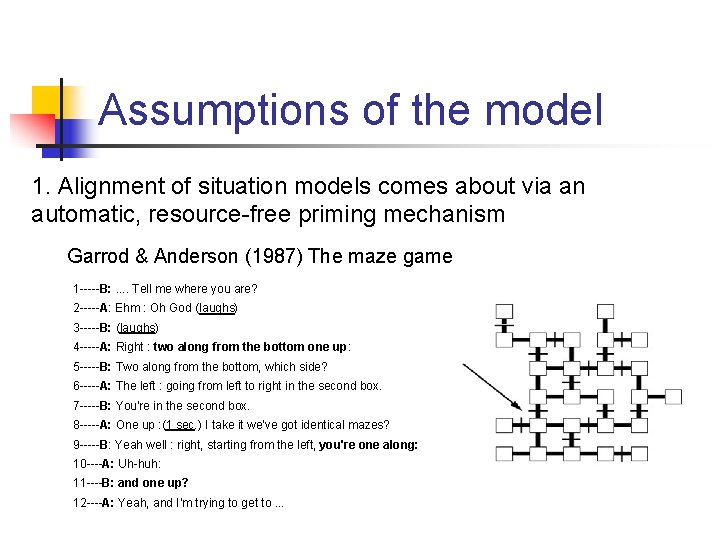
Assumptions of the model 1. Alignment of situation models comes about via an automatic, resource-free priming mechanism Garrod & Anderson (1987) The maze game 1 -----B: . . Tell me where you are? 2 -----A: Ehm : Oh God (laughs) 3 -----B: (laughs) 4 -----A: Right : two along from the bottom one up: 5 -----B: Two along from the bottom, which side? 6 -----A: The left : going from left to right in the second box. 7 -----B: You're in the second box. 8 -----A: One up : (1 sec. ) I take it we've got identical mazes? 9 -----B: Yeah well : right, starting from the left, you're one along: 10 ----A: Uh-huh: 11 ----B: and one up? 12 ----A: Yeah, and I'm trying to get to. . .
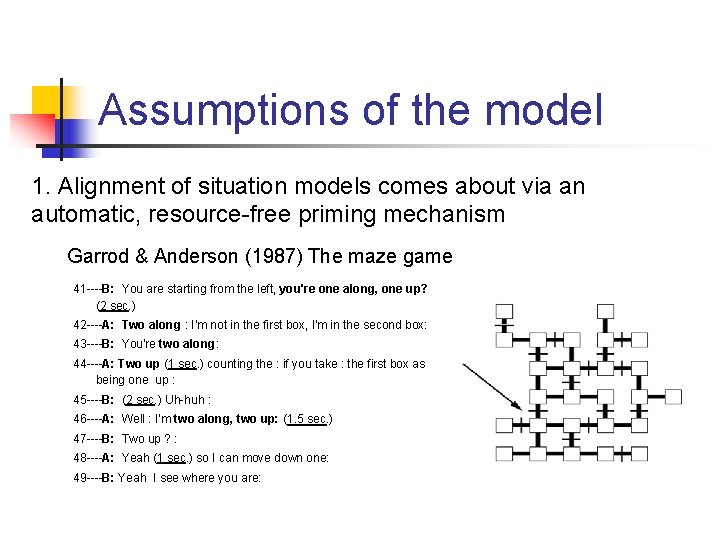
Assumptions of the model 1. Alignment of situation models comes about via an automatic, resource-free priming mechanism Garrod & Anderson (1987) The maze game 41 ----B: You are starting from the left, you're one along, one up? (2 sec. ) 42 ----A: Two along : I'm not in the first box, I'm in the second box: 43 ----B: You're two along: 44 ----A: Two up (1 sec. ) counting the : if you take : the first box as being one up : 45 ----B: (2 sec. ) Uh-huh : 46 ----A: Well : I'm two along, two up: (1. 5 sec. ) 47 ----B: Two up ? : 48 ----A: Yeah (1 sec. ) so I can move down one: 49 ----B: Yeah I see where you are:
Assumptions of the model 1. Alignment of situation models comes about via an automatic, resource-free priming mechanism Garrod & Anderson (1987) The maze game n Path descriptions (36. 8%) n n Co-ordinate descriptions (23. 4%) n n I’m at C 4 Line descriptions (22. 5%) n n See the bottom right, go two along and two up I’m one up on the diagonal from bottom left to top right Figural descriptions (17. 3%) n See the rectangle at the bottom right, I’m in the top left corner of that
Assumptions of the model 1. Alignment of situation models comes about via an automatic, resource-free priming mechanism Garrod & Anderson (1987) The maze game n n Pairs converge on different ways of describing spatial locations n Entrainment on a particular conceptualization of the maze n But little explicit negotiation n Entrainment increases over the course of a game Description schemes as local ‘languages’ n n Rules for mapping particular expressions onto interpretations with respect to a common discourse model Once the meaning of a particular expression is fixed, players try to avoid an ambiguous use of that expression
Assumptions of the model 1. Alignment of situation models comes about via an automatic, resource-free priming mechanism Garrod & Anderson (1987) The maze game n Entrainment emerges from a simple heuristic n n Formulate your output using the same rules of interpretation as those needed to understand the most recent input Representations used to comprehend an utterance are recycled during subsequent production n n Leads to local consistency Helps to establish a mutually satisfactory description scheme with least collaborative effort
Assumptions of the model 2. Representational parity between comprehension and production n Parity important for interactive alignment n n n We don’t go around repeating other people’s utterances! Comprehension-to-production priming (BPC, 2000) n Priming from sentences which were only heard n Suggests that representations shared across modalities Equivalent to production-to-production effects? n E. g. Bock (1986), syntactic priming in language production tasks
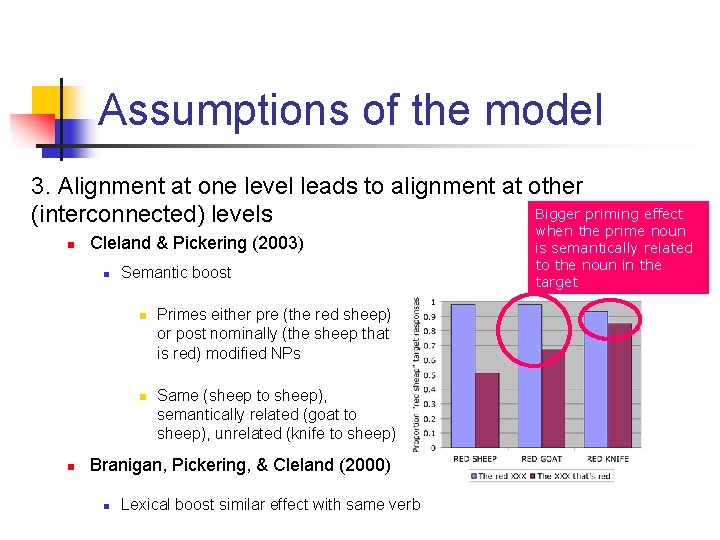
Assumptions of the model 3. Alignment at one level leads to alignment at other Bigger priming effect (interconnected) levels n Cleland & Pickering (2003) n Semantic boost n n n Primes either pre (the red sheep) or post nominally (the sheep that is red) modified NPs Same (sheep to sheep), semantically related (goat to sheep), unrelated (knife to sheep) Branigan, Pickering, & Cleland (2000) n Lexical boost similar effect with same verb when the prime noun is semantically related to the noun in the target
Assumptions of the model 4. There is no need for explicit perspective-taking in routine language processing n If communication is successful, interlocutors’ situation models come to overlap n Implicit common ground n Overlap may be small to begin with n But via alignment, it increases over the course of a conversation n n What looks like audience design is simply a by-product of good alignment Full common ground only consulted when there are sufficient processing resources available
Summary n “People use language for doing things with each other, and their use of language is itself a joint action. ” Clark (1996, pg 387) n Conversation is structured n n But, that structure depends on more than one individual Models of language use (production and comprehension) need to be developed within this perspective n Interactive Alignment model is a new theory attempting to do just this