
PSY 250 Chapter 8 Between Subjects Designs Experimental
PSY 250 Chapter 8: Between Subjects Designs
Experimental Design: The Basic Building Blocks n Experimental design n The general plan for selecting participants, assigning participants to experimental conditions, controlling extraneous variables, and gathering data.
Simple between subjects design n One independent variable (single factor design) n # of groups = # of levels of IV = # treatment conditions n Different participants in different groups n Each participant exposed to only one level of IV n Allows only 1 score per individual (even if average) n Look for differences BETWEEN groups
The Two-Group Design n How many groups? n Although an experiment can have only one IV, it must have at least two groups (levels) n The simplest way to find out whether our IV caused a change in behavior is to compare some research participants who have received our IV to some others who have not received the IV n Thus, the presence of the IV is contrasted with the absence of the IV n If those two groups differ, and we are assured that we controlled potential extraneous variables, then we conclude that the IV caused the participants to differ.
The Two-Group Design n Experimental group n the group of participants that receives the IV. n Control group n the group of participants that does not receive the IV n E. g. n DV: Aggression in child’s behavior with doll n IV: Exposure to : n n Group A: Violent Images on TV Group B: No TV images
The Two-Group Design n Or Compare Two (or more) Experimental Groups n Different levels of violence in images (high or low) or (neutral vs. violent) n Could have 3 groups: No TV, Neutral TV, Violent TV
The Two-Group Design n Equivalent Groups n Random Assignment n each participant has an equal chance of being in any group (created equally) n Composed of equivalent individuals n not the same as random selection n Restricted random assignment – groups must be equal in size n Treated Equally
The Two-Group Design n Independent groups n The participants in one group have absolutely no ties or links to the participants in the other group. n Between-subjects comparison n Refers to a contrast between groups of participants who were randomly assigned to groups.
The Two-Group Design n Confounded experiment n An experiment in which an extraneous variable varies systematically with the IV. n Confounding makes drawing a cause-andeffect relation impossible. n Confounding may occur if participants are not equal before the start of the experiment.
The Two-Group Design n Nonrandom Assignment to Groups. n Random assignment tends to create equal groups in the long run. n As groups get larger (at least 20), we can place more confidence in random assignment achieving what we want it to. n If we are faced with a situation in which we have few potential research participants (5 or less) and we are worried that random assignment may not create equal groups, what can we do?
The Two-Group Design n Holding Variables Constant n Use participants of all one gender or exact same IQ n Restricting Range of Variability n Restrict participants to IQ range of 100 and 110 n But limits…what? ?
Advantages of Between Designs n Each score is independent n Not susceptible to: n Practice or experience gained in other treatments n Fatigue or boredom n Contrast effects
Disadvantages n Large # of participants n Esp. problematic with special populations n Environmental Confounds n Characteristics of environment that might vary between groups n Individual Differences n Can become confounding variables n n Assignment bias Can produce high variability in scores
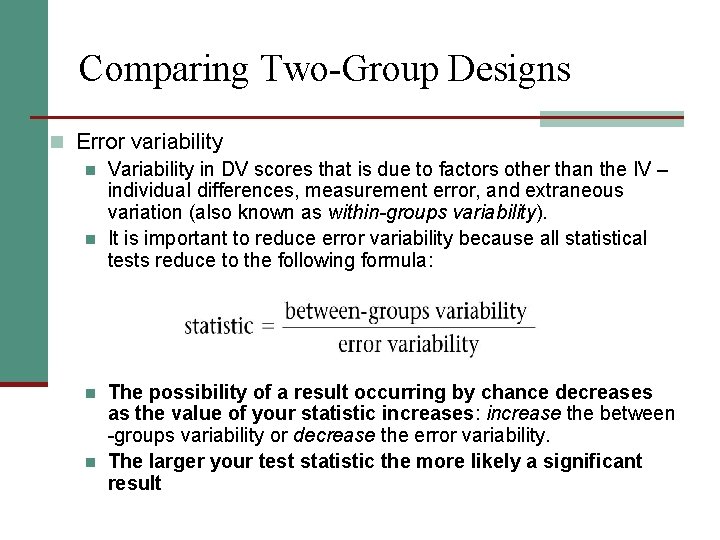
Comparing Two-Group Designs n Error variability n Variability in DV scores that is due to factors other than the IV – individual differences, measurement error, and extraneous variation (also known as within-groups variability). n It is important to reduce error variability because all statistical tests reduce to the following formula: n n The possibility of a result occurring by chance decreases as the value of your statistic increases: increase the between -groups variability or decrease the error variability. The larger your test statistic the more likely a significant result
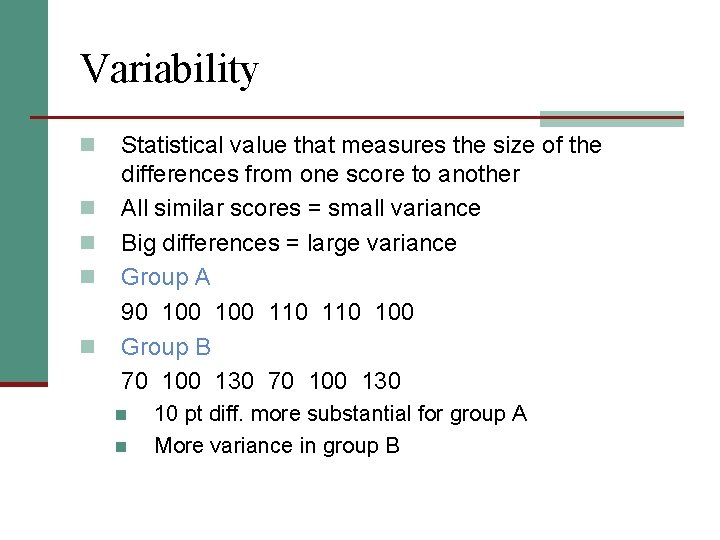
Variability n n n Statistical value that measures the size of the differences from one score to another All similar scores = small variance Big differences = large variance Group A 90 100 110 100 Group B 70 100 130 n n 10 pt diff. more substantial for group A More variance in group B
Variance cont. n Differences BETWEEN groups are desired n So… increase diff. between group conditions n Variance = background noise n Difficult to see real treatment effect with large variance n Individual differences – large variance n So… big differences WITHIN group are bad n Variance must be equal between groups
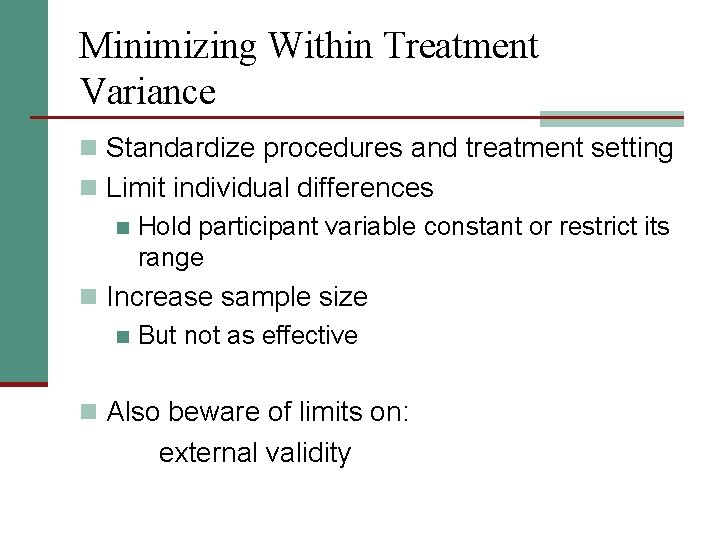
Minimizing Within Treatment Variance n Standardize procedures and treatment setting n Limit individual differences n Hold participant variable constant or restrict its range n Increase sample size n But not as effective n Also beware of limits on: external validity
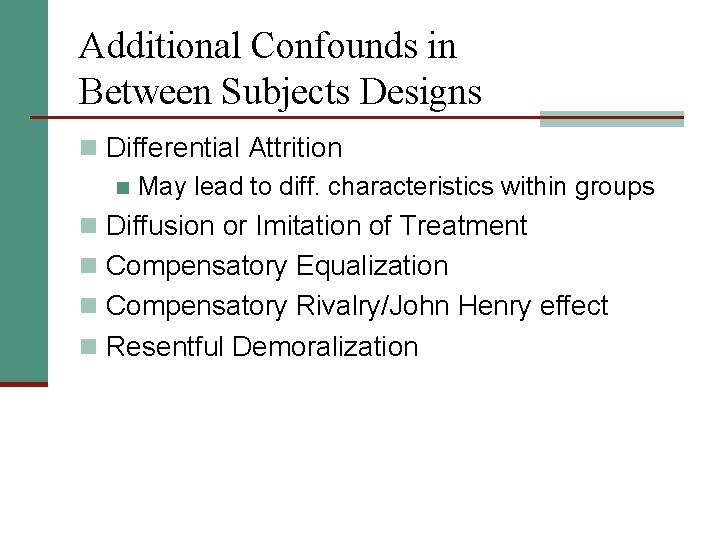
Additional Confounds in Between Subjects Designs n Differential Attrition n May lead to diff. characteristics within groups n Diffusion or Imitation of Treatment n Compensatory Equalization n Compensatory Rivalry/John Henry effect n Resentful Demoralization
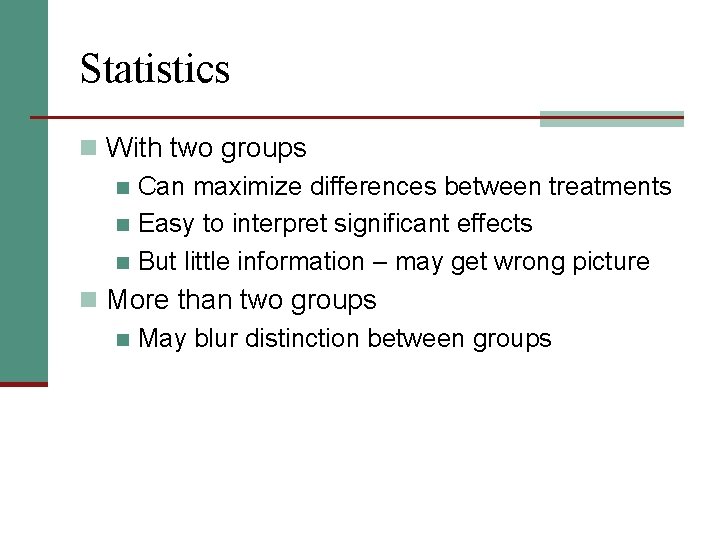
Statistics n With two groups n Can maximize differences between treatments n Easy to interpret significant effects n But little information – may get wrong picture n More than two groups n May blur distinction between groups
Two or More Groups? Exercise Levels
- Slides: 20