
PSSA ELA Item Type Training TextDependent Analysis Jeri

- Slides: 57
PSSA ELA Item Type Training Text-Dependent Analysis Jeri Thompson, Ed. D. . Senior Associate, Center for Assessment Diane Simaska, Pennsylvania Department of Education 2014
Introductions… • Identify three (3) statements about yourself. • Two statements should be TRUE and one statement should be FALSE. • Share your statements in your small group. Group members should try to identify which statement is the FALSE statement. Page 2 • Thompson • Text-dependent Analysis 2014
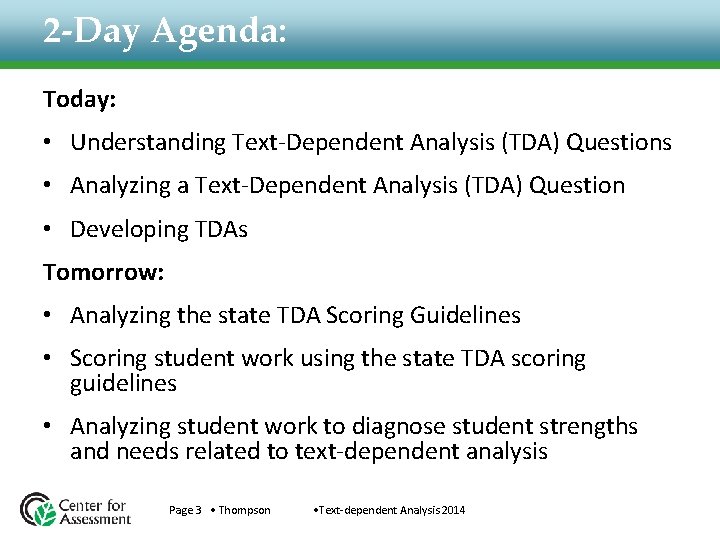
2 -Day Agenda: Today: • Understanding Text-Dependent Analysis (TDA) Questions • Analyzing a Text-Dependent Analysis (TDA) Question • Developing TDAs Tomorrow: • Analyzing the state TDA Scoring Guidelines • Scoring student work using the state TDA scoring guidelines • Analyzing student work to diagnose student strengths and needs related to text-dependent analysis Page 3 • Thompson • Text-dependent Analysis 2014
Before we begin… Text-Dependent Analysis Questions 1. Record your understanding of Text-Dependent Analysis Questions (TDA) in your Notes and Resources document (page 2) by explaining what a student is expected to do when responding to a TDA. 2. Write down as many questions as you can about Text. Dependent Analysis Questions. • Take 10 minutes to discuss your understandings and questions with your table group to gain additional understanding. • Share your discussion with the entire group. Page 4 • Thompson • Text-dependent Analysis 2014
Background: • Pennsylvania Core Standards (PCS) identifies textdependent analysis as the ability to “draw evidence from literary or informational texts to support analysis, reflection, and research”. • Prompts to measure the PCS will move beyond general reading comprehension to specific questions that require the use of text-dependent evidence Page 5 • Thompson • Text-dependent Analysis 2014
Assessment Anchors • Examine the copies of the grade level Assessment Anchors. • Find the section that identifies the Descriptor and Eligible Content for Text-Dependent Analysis. • As a table group, review the anchors along with a previous PSSA reading assessment example (PSSA Item Sampler). • Discuss how the current anchor expectations are the same and/or different from how students have previously been assessed for reading on the PSSA. • Share Page 6 • Thompson • Text-dependent Analysis 2014
PA Core Standards and Shifts for ELA/Literacy 1. Balancing the reading of informational and literary texts so that students can access nonfiction and authentic texts, as well as literature 2. Focusing on close and careful reading of text so that students are learning from the text 3. Supporting writing from sources (i. e. , using evidence from text to inform or make an argument) so that students use evidence and respond to the ideas, events, facts, and arguments presented in the texts they read 4. Stressing an academically focused vocabulary so that students can access more complex texts Page 7 • Thompson • Text-dependent Analysis 2014
Shift #2 & 3: Text-Dependent Analysis Questions: 1. Supports these key shift – point students towards parts of the text most important to pay attention to 2. Questions highlight and scaffold key knowledge and information from texts 3. Requires students to examine and use evidence from the text to analyze core understandings and key ideas 4. Expects students to construct a well-written essay to demonstrate analysis of the text, moving beyond answering open-ended questions about explicit and implicit information, summarizing, and being aware of vocabulary or text structure Page 8 • Thompson • Text-dependent Analysis 2014
What are Text-Dependent Analysis Questions? Text-dependent questions requires close reading of a text. These questions require students to provide evidence from the text and to draw inferences based on what the text says in order to support an analysis. This is different from reading comprehension questions which require students to read to get the “gist” of the text. Page 9 • Thompson • Text-dependent Analysis 2014
What are Text-Dependent Analysis Questions? A text-dependent analysis question does not rely on any particular background information extraneous to the text nor depend on students having other experiences or knowledge; instead it privileges the text itself and what students can extract from what is before them. Page 10 • Thompson • Text-dependent Analysis 2014
Text-Dependent Analysis Questions… • May begin with a literal check for understanding but must also require analysis, synthesis, or evaluation • Emphasize the use of explicit and implicit information from the text to support reasoning and analysis (defined as: detailed examination of the elements or structure of something, typically as a basis for discussion or interpretation) • Focus on word, sentence, paragraph, segment, whole text, or across texts Page 11 • Thompson • Text-dependent Analysis 2014
Text-Dependent Analysis Questions expects students to engage in close reading to… • Analyze paragraphs on a sentence-by-sentence basis and sentences on a word-by-word basis to determine the role played by individual paragraphs, sentences, phrases, or words • Investigate how meaning can be altered by changing key words and why an author may have chosen one word over another • Probe each argument in persuasive text, each idea in informational text, each key detail in literary text, and observe how these build to a whole • Examine how shifts in the direction of an argument or explanation are achieved and the impact of those shifts • Question why authors choose to begin and end when they do • Note and assess patterns of writing and what they achieve • Consider what the text leaves uncertain or unstated Page 12 • Thompson • Text-dependent Analysis 2014
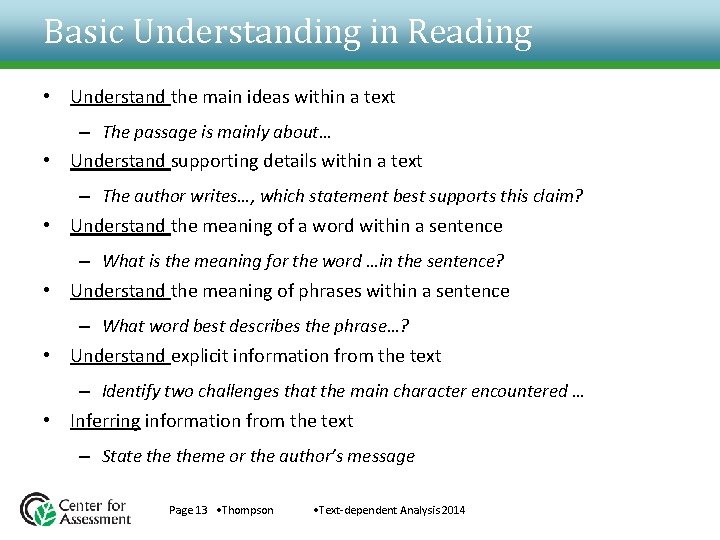
Basic Understanding in Reading • Understand the main ideas within a text – The passage is mainly about… • Understand supporting details within a text – The author writes…, which statement best supports this claim? • Understand the meaning of a word within a sentence – What is the meaning for the word …in the sentence? • Understand the meaning of phrases within a sentence – What word best describes the phrase…? • Understand explicit information from the text – Identify two challenges that the main character encountered … • Inferring information from the text – State theme or the author’s message Page 13 • Thompson • Text-dependent Analysis 2014
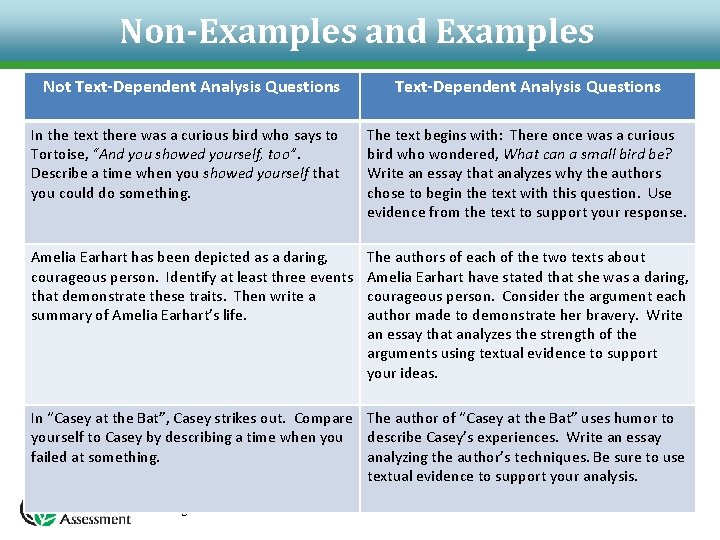
Non-Examples and Examples Not Text-Dependent Analysis Questions In the text there was a curious bird who says to Tortoise, “And you showed yourself, too”. Describe a time when you showed yourself that you could do something. The text begins with: There once was a curious bird who wondered, What can a small bird be? Write an essay that analyzes why the authors chose to begin the text with this question. Use evidence from the text to support your response. Amelia Earhart has been depicted as a daring, courageous person. Identify at least three events that demonstrate these traits. Then write a summary of Amelia Earhart’s life. The authors of each of the two texts about Amelia Earhart have stated that she was a daring, courageous person. Consider the argument each author made to demonstrate her bravery. Write an essay that analyzes the strength of the arguments using textual evidence to support your ideas. In “Casey at the Bat”, Casey strikes out. Compare The author of “Casey at the Bat” uses humor to yourself to Casey by describing a time when you describe Casey’s experiences. Write an essay failed at something. analyzing the author’s techniques. Be sure to use textual evidence to support your analysis. Page 14 •
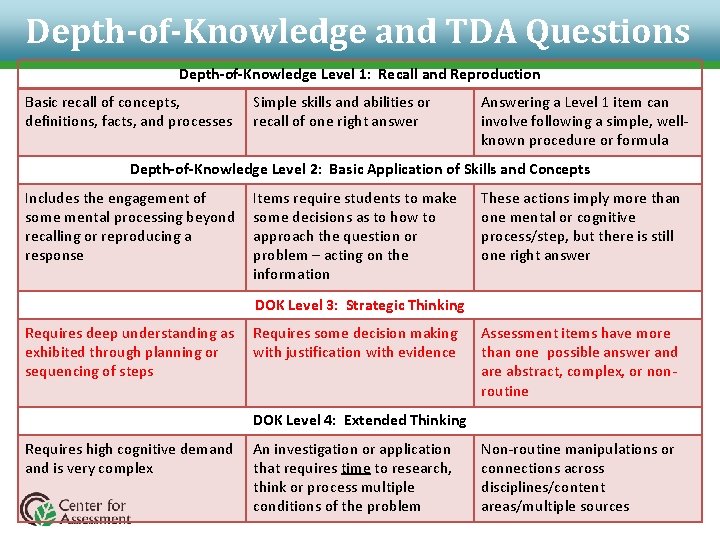
Depth-of-Knowledge and TDA Questions Depth-of-Knowledge Level 1: Recall and Reproduction Basic recall of concepts, definitions, facts, and processes Simple skills and abilities or recall of one right answer Answering a Level 1 item can involve following a simple, wellknown procedure or formula Depth-of-Knowledge Level 2: Basic Application of Skills and Concepts Includes the engagement of some mental processing beyond recalling or reproducing a response Items require students to make some decisions as to how to approach the question or problem – acting on the information These actions imply more than one mental or cognitive process/step, but there is still one right answer DOK Level 3: Strategic Thinking Requires deep understanding as exhibited through planning or sequencing of steps Requires some decision making with justification with evidence Assessment items have more than one possible answer and are abstract, complex, or nonroutine DOK Level 4: Extended Thinking Requires high cognitive demand is very complex An investigation or application that requires time to research, think or process multiple conditions of the problem Non-routine manipulations or connections across disciplines/content areas/multiple sources
Cognitive Rigor Matrix • Examine the Cognitive Rigor Matrix for ELA • What do you notice about DOK Levels 1, 2, and 3; AND what do you notice with regard to Reading Comprehension and Text-Dependent Analysis Questions? Page 16 • Thompson • Text-dependent Analysis 2014
Close Reading & TDA How is close reading connected to Text. Dependent Analysis Questions? Jigsaw Reading –A Primer on “Close Reading of Text” (page 4 -8 in Notes and Resources) Count off by 3 Page 17 • Thompson • Text-dependent Analysis 2014
Close Reading & TDA Groups of 3 Group 1. Introduction Group 2. Close Reading Defined & Attributes of Close Reading Lessons Group 3. Background Knowledge and Close Reading & Additional Considerations When Implementing Close Reading in Practice Answer the following question: 1. What is necessary in classrooms, schools, and districts for students to successfully respond to Text-Dependent Analysis Questions? Use evidence from the text to substantiate your claims. 2. What professional development will need to accompany the understanding of Text-Dependent Analysis? Page 18 • Thompson • Text-dependent Analysis 2014
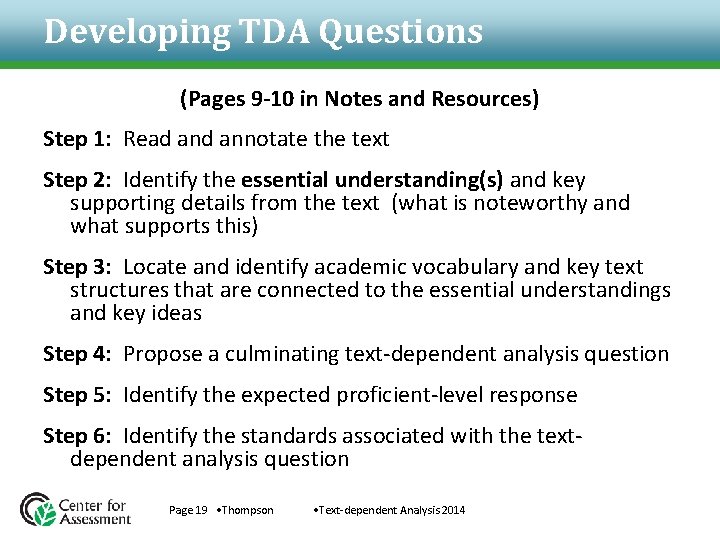
Developing TDA Questions (Pages 9 -10 in Notes and Resources) Step 1: Read annotate the text Step 2: Identify the essential understanding(s) and key supporting details from the text (what is noteworthy and what supports this) Step 3: Locate and identify academic vocabulary and key text structures that are connected to the essential understandings and key ideas Step 4: Propose a culminating text-dependent analysis question Step 5: Identify the expected proficient-level response Step 6: Identify the standards associated with the textdependent analysis question Page 19 • Thompson • Text-dependent Analysis 2014
Developing TDA Questions: Essential Understandings • Clarify your own understanding regarding core understandings and key details. • Literature: essential understandings and big ideas can focus on theme, interactions of characters, events in the story, important events, or any other features that are central • Informational Text: essential understandings and big ideas can be closely aligned to the important ideas, the author’s purpose, claims, or arguments. Page 20 • Thompson • Text-dependent Analysis 2014
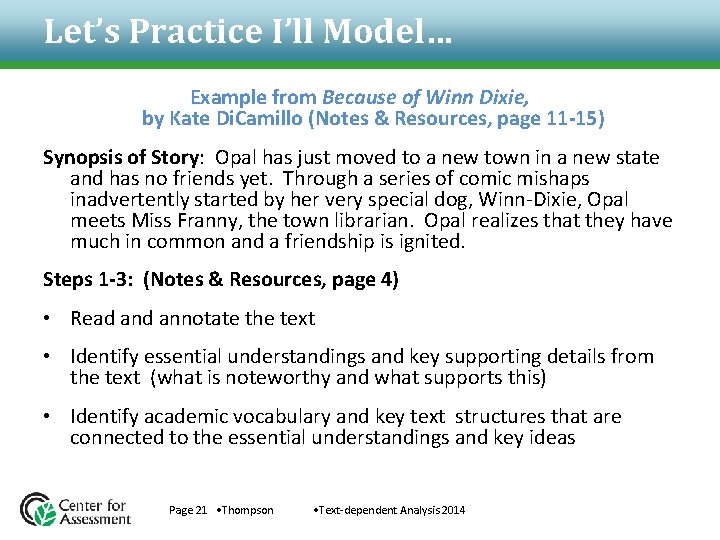
Let’s Practice I’ll Model… Example from Because of Winn Dixie, by Kate Di. Camillo (Notes & Resources, page 11 -15) Synopsis of Story: Opal has just moved to a new town in a new state and has no friends yet. Through a series of comic mishaps inadvertently started by her very special dog, Winn-Dixie, Opal meets Miss Franny, the town librarian. Opal realizes that they have much in common and a friendship is ignited. Steps 1 -3: (Notes & Resources, page 4) • Read annotate the text • Identify essential understandings and key supporting details from the text (what is noteworthy and what supports this) • Identify academic vocabulary and key text structures that are connected to the essential understandings and key ideas Page 21 • Thompson • Text-dependent Analysis 2014
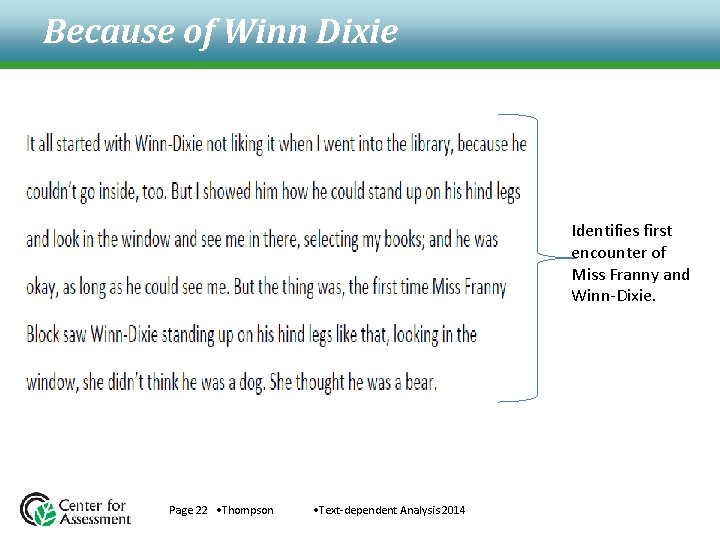
Because of Winn Dixie Identifies first encounter of Miss Franny and Winn-Dixie. Page 22 • Thompson • Text-dependent Analysis 2014
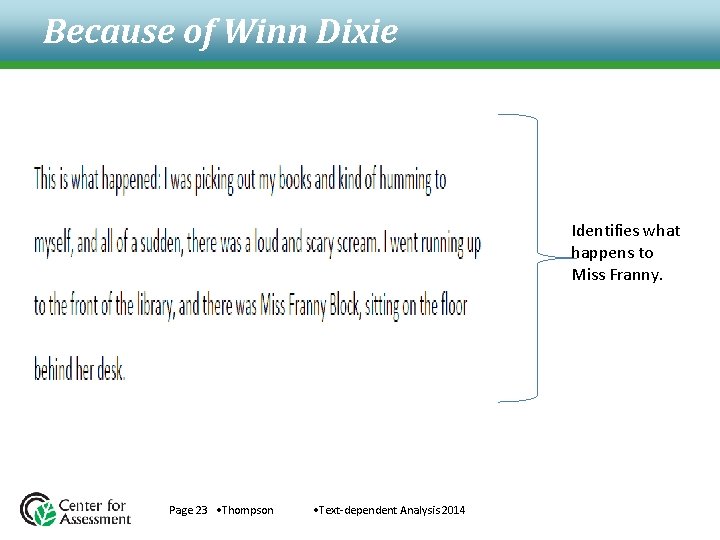
Because of Winn Dixie Identifies what happens to Miss Franny. Page 23 • Thompson • Text-dependent Analysis 2014
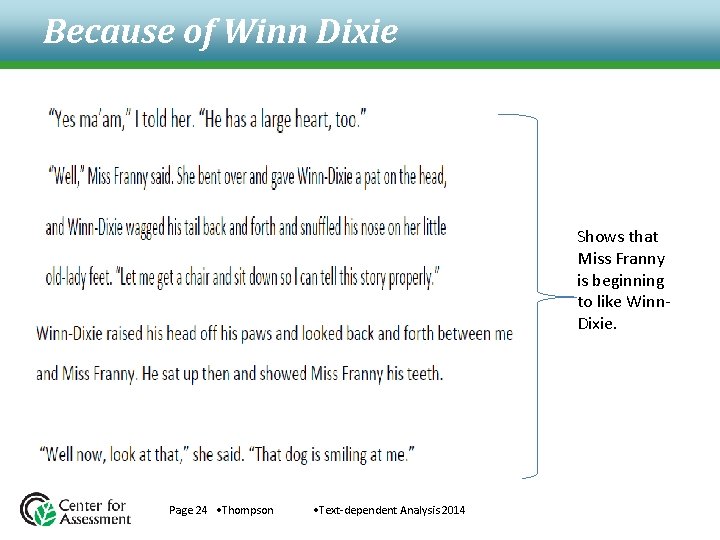
Because of Winn Dixie Shows that Miss Franny is beginning to like Winn. Dixie. Page 24 • Thompson • Text-dependent Analysis 2014
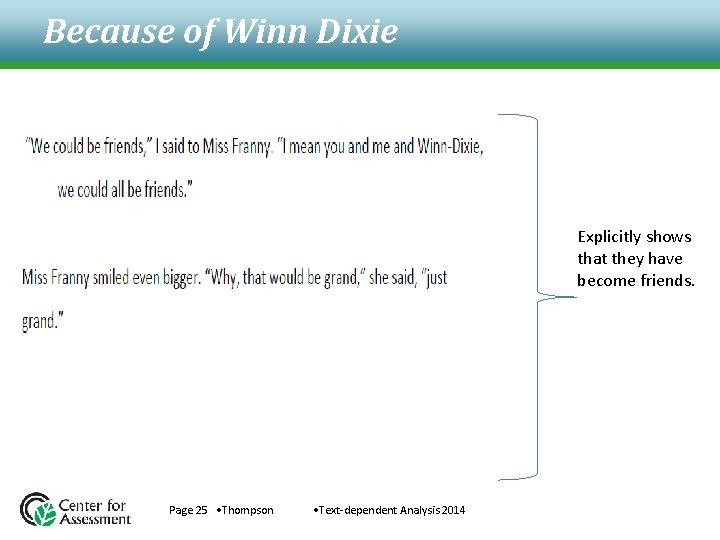
Because of Winn Dixie Explicitly shows that they have become friends. Page 25 • Thompson • Text-dependent Analysis 2014
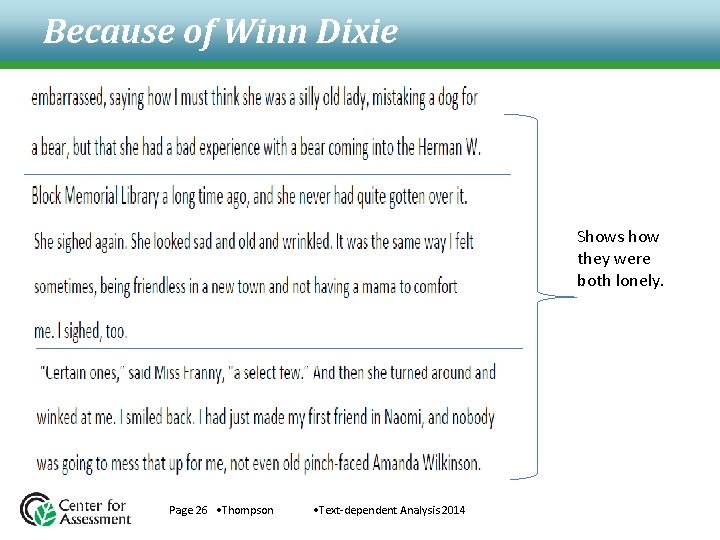
Because of Winn Dixie Shows how they were both lonely. Page 26 • Thompson • Text-dependent Analysis 2014
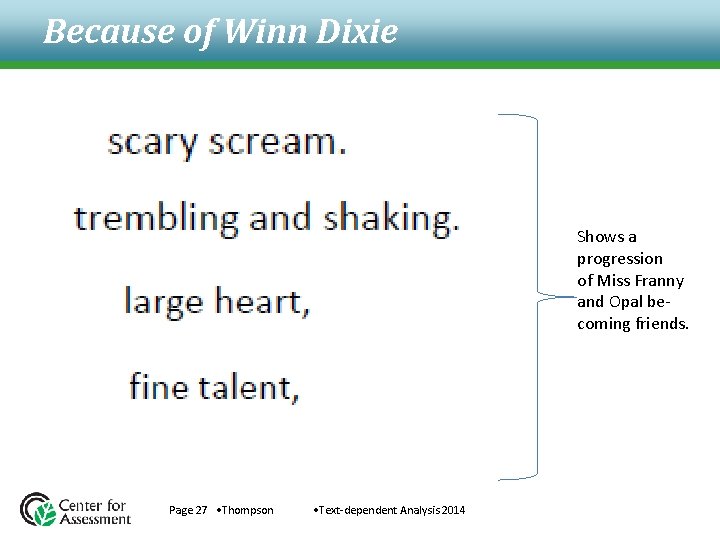
Because of Winn Dixie Shows a progression of Miss Franny and Opal becoming friends. Page 27 • Thompson • Text-dependent Analysis 2014
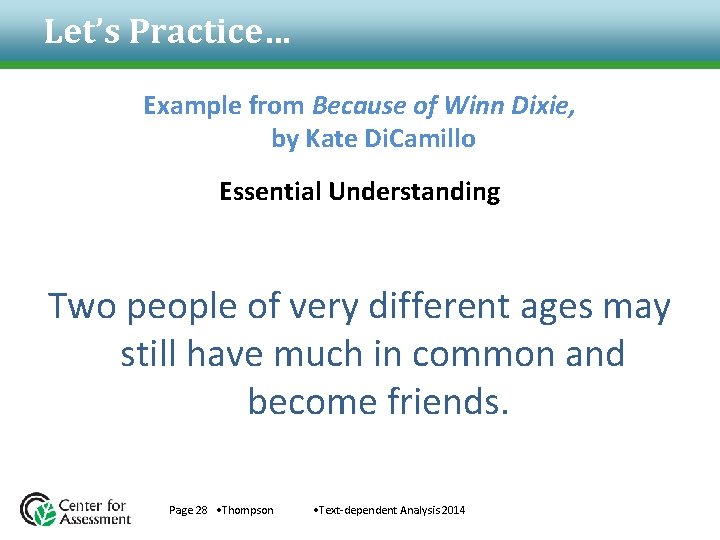
Let’s Practice… Example from Because of Winn Dixie, by Kate Di. Camillo Essential Understanding Two people of very different ages may still have much in common and become friends. Page 28 • Thompson • Text-dependent Analysis 2014
Because of Winn Dixie, by Kate Di. Camillo Based on the Essential Understanding, what are the key supporting details from the text? Step 4: What Text-Dependent Analysis Question could you ask about this text? Page 29 • Thompson • Text-dependent Analysis 2014
Because of Winn Dixie, by Kate Di. Camillo Based on the Essential Understanding what Text. Dependent Analysis Question could you ask about this text? The author of the “Because of Winn Dixie” uses a dog to introduce two people. Write an essay analyzing why “Because of Winn Dixie” is an appropriate title for the passage. Be sure to use evidence from the text to support your analysis. Page 30 • Thompson • Text-dependent Analysis 2014
Because of Winn Dixie, by Kate Di. Camillo Step 5: What would you expect to see in a proficient student response? Consider: Does your question require analysis and for students to demonstrate their analysis through an essay? If not, revise your question. Page 31 • Thompson • Text-dependent Analysis 2014
Because of Winn Dixie, by Kate Di. Camillo Step 5: What would you expect to see in a proficient student response? Students should explain, using explicit and implicit evidence from the text, including: • how Winn-Dixie looking into the library was the cause of Miss Franny falling, which in turn led to the story about the bear and Opal’s realization that she and Miss Franny were both lonely. • relating how Winn-Dixie’s response to Miss Franny (“That dog is smiling at me”) endeared her to Winn-Dixie and led Opal to suggest that they could be friends. • showing a clear understanding of how this progression of events led to the three characters becoming friends using text evidence including words and phrases, such as “talent” and “huge heart” were traits that made all this possible. • an explanation of how the student knows that this text evidence is relevant. Page 32 • Thompson • Text-dependent Analysis 2014
Because of Winn Dixie, by Kate Di. Camillo Step 5: What would you expect to see in a proficient student response? • Students should have a clearly written essay that includes an introduction and conclusion that demonstrates an understanding of the question, focus, and purpose. • Students should include an organizational structure that supports the controlling ideas and details, examples, quotes, and/or facts • Students should include grade level transitions and language • The essay should include grade level grammar, usage, and conventions. Page 33 • Thompson • Text-dependent Analysis 2014
Because of Winn Dixie, by Kate Di. Camillo Step 6: What standards does this text-dependent analysis question address? Examine the PA Core Standards. What is the DOK Level of this question and how do you know? DOK 3: • Explain, generalize, or connect ideas using supporting evidence • Identify/make inferences about explicit or implicit themes • Write multi-paragraph compositions for specific purpose, focus, voice, tone, & audience Page 34 • Thompson • Text-dependent Analysis 2014
Let’s Practice #2 – “We” do… Example from Life in the Limbs and Welcome to Tree-House School by Heather Kaufman-Peter • Read the text in your Notes and Resources (pages 16 -19). Steps 1 - 3: (Notes & Resources, page 9) • Read annotate the text • Identify essential understandings and key supporting details from the text (what is noteworthy and what supports this) • Identify academic vocabulary and key text structures that are connected to the essential understandings and key ideas Discuss these at your table. Page 35 • Thompson • Text-dependent Analysis 2014
Let’s Practice #2 – “We” do… Example from Life in the Limbs, by Heather Kaufman-Peters Based on the Essential Understanding, what are the key supporting details from the text? Step 4: What Text-Dependent Analysis Question could you ask about this text? Discuss at your table. Page 36 • Thompson • Text-dependent Analysis 2014
Let’s Practice #2 – “We” do… Example from Life in the Limbs, by Heather Kaufman-Peters Step 5: What would you expect to see in a proficient student response? Consider: Does your question require analysis and for students to demonstrate their analysis through an essay? If not, revise your question. Page 37 • Thompson • Text-dependent Analysis 2014
Let’s Practice #2 – “We” do… Example from Life in the Limbs, by Heather Kaufman-Peters Essential Understanding The shape of the trees determine the shape of the tree house to be built. Page 38 • Thompson • Text-dependent Analysis 2014
Let’s Practice #2 – “We” do… Example from Life in the Limbs, by Heather Kaufman-Peters Based on the Essential Understanding what Text. Dependent Analysis Question could you ask about this text? Authors choose their words carefully to help readers understand the information. Write an essay analyzing how the author used specific language to communicate the main idea. Be sure to clearly cite evidence from the text to support your answer. Page 39 • Thompson • Text-dependent Analysis 2014
Let’s Practice #2 – “We” do… Example from Life in the Limbs, by Heather Kaufman-Peters What would you expect to see in a proficient student response? • Students should consider the author’s language, such as “letting the trees decide the designs”, “never harm a tree”, and “build a tree house so it helps the tree” as a means to understand that the trees themselves determine the shape of the tree house to be built. • The author uses other language that should be stronger than “hint” or “suggest” since the context makes it clear that the trees are deciding the shape not understanding it. • Based on the information above, the sentence “The trees will dictate how a floor plan lays out” will help them understand the meaning of the main idea and the author’s language because the shape is determined or decided by the tree, not by what a person wants. Page 40 • Thompson • Text-dependent Analysis 2014
Let’s Practice #2 – “We” do… Example from Life in the Limbs, by Heather Kaufman-Peters What would you expect to see in a proficient student response? • Students should have a clearly written essay that includes an introduction and conclusion that demonstrates an understanding of the question, focus, and purpose. • Students should include an organizational structure that supports the controlling ideas and details, examples, quotes, and/or facts • Students should include grade level transitions and language • The essay should include grade level grammar, usage, and conventions. Page 41 • Thompson • Text-dependent Analysis 2014
Let’s Practice #3 – “You” do… Grade Level Examples Develop your TDA Steps 1 - 3: (Notes & Resources, page 9) • Read annotate the grade-level text • Identify essential understandings and key supporting details from the text (what is noteworthy and what supports this) • Identify academic vocabulary and key text structures that are connected to the essential understandings and key ideas Discuss these at your table. Page 42 • Thompson • Text-dependent Analysis 2014
Let’s Practice #3 – “You” do… Grade Level Examples Based on the Essential Understanding, what are the key supporting details from the text? Step 4: What Text-Dependent Analysis Question could you ask about this text? Step 5: What would you expect to see in a proficient student response? Consider: Does your question require analysis? If not, revise your question. Page 43 • Thompson • Text-dependent Analysis 2014
Let’s Practice #3 – “You” do… Grade Level Examples Each group should be prepared to share the grade-level example by: Provide a synopsis of the story Identify the essential understanding Share the Text-Dependent Analysis Question Provide what you would expect to see in a student response Other groups should listen to the information and be prepared to critique by: Providing “warm” and “cool” feedback Page 44 • Thompson • Text-dependent Analysis 2014
TDA Developed Questions… Grade Level Examples Grade 4 Question: • At the end of the passage, Drawing Horses, Marisa states, “But I already know that when this drawing is finished, I’ll be signing it Marisa. ” Write an essay analyzing why she makes this statement. Use evidence from the passage to support your response. Page 45 • Thompson • Text-dependent Analysis 2014
TDA Developed Questions… Grade Level Examples Grade 5 Question: • The passage “Little by Little Piece by Piece, ” is about three brothers who each experience a change in life. Write an essay analyzing which of the three brothers undergoes the most meaningful change in the passage. Use evidence from the passage to support your response. Page 46 • Thompson • Text-dependent Analysis 2014
TDA Developed Questions… Grade Level Examples Grade 6 Question: • Skye’s emotions change throughout “The Perfect Swim. ” Write an essay analyzing how the shifts in Skye’s emotions are revealed in the passage. Use evidence from the passage to support your analysis. Page 47 • Thompson • Text-dependent Analysis 2014
TDA Developed Questions… Grade Level Examples Grade 7 Question: • Authors often use figurative language to describe objects, characters, and situations in their stories. Write an essay analyzing the role that figurative language plays in revealing the significance of the bottled ships in the passage. Use evidence from the passage to support your response. Page 48 • Thompson • Text-dependent Analysis 2014
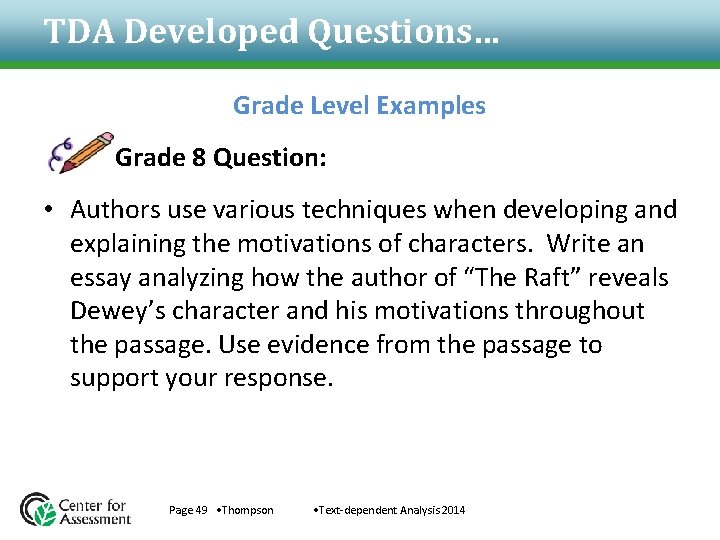
TDA Developed Questions… Grade Level Examples Grade 8 Question: • Authors use various techniques when developing and explaining the motivations of characters. Write an essay analyzing how the author of “The Raft” reveals Dewey’s character and his motivations throughout the passage. Use evidence from the passage to support your response. Page 49 • Thompson • Text-dependent Analysis 2014
Day 1 Wrap-Up Page 50 • Thompson • Text-dependent Analysis 2014
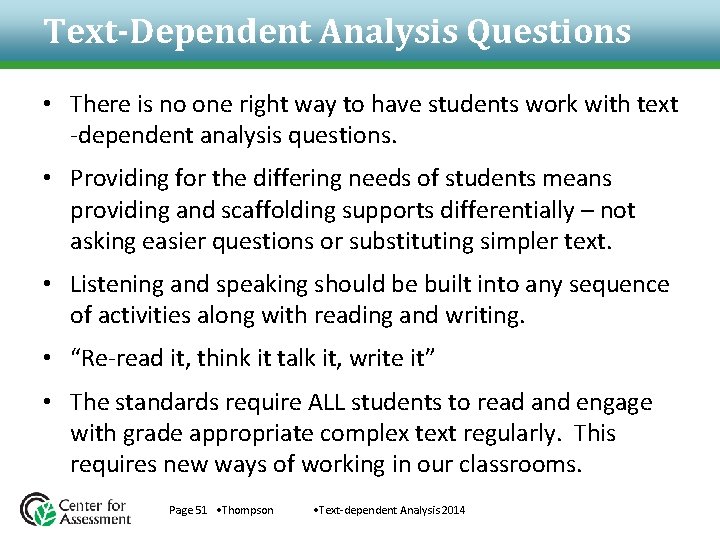
Text-Dependent Analysis Questions • There is no one right way to have students work with text -dependent analysis questions. • Providing for the differing needs of students means providing and scaffolding supports differentially – not asking easier questions or substituting simpler text. • Listening and speaking should be built into any sequence of activities along with reading and writing. • “Re-read it, think it talk it, write it” • The standards require ALL students to read and engage with grade appropriate complex text regularly. This requires new ways of working in our classrooms. Page 51 • Thompson • Text-dependent Analysis 2014
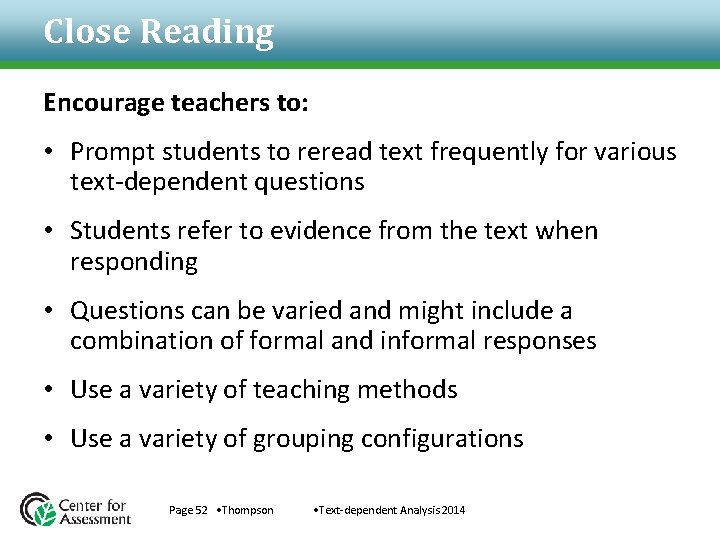
Close Reading Encourage teachers to: • Prompt students to reread text frequently for various text-dependent questions • Students refer to evidence from the text when responding • Questions can be varied and might include a combination of formal and informal responses • Use a variety of teaching methods • Use a variety of grouping configurations Page 52 • Thompson • Text-dependent Analysis 2014
Close Reading • Avoid conducting pre-reading activities; allow students to experience the text on their own • Give brief definitions of words in which context clues do not reveal meanings • Set the stage for the lesson by posing an essential guiding question and stating the title and author • Prepare students for grade level text complexity Page 53 • Thompson • Text-dependent Analysis 2014
What does this look like in the classroom? • Classroom experiences stay deeply connected to the text on the page • Students develop habits for locating evidence in both conversations, as well as in writing, to demonstrate analysis of a text • Teaching elements of well-written essays • Development of text-dependent analysis questions on a consistent basis Page 54 • Thompson • Text-dependent Analysis 2014
Day 2 • Analyzing the Text-Dependent Analysis Rubric • Scoring student work using the state TDA scoring guidelines • Analyzing student work to diagnose student strengths and needs related to text-dependent analysis Page 55 • Thompson • Text-dependent Analysis 2014
Day 1 Ending Notes? ? Page 56 • Thompson • Text-dependent Analysis 2014
For more information: Center for Assessment www. nciea. org Jeri Thompson jthompson@nciea. org 401 -316 -7840 Page 57 • Thompson • Text-dependent Analysis 2014