
PSM Audit Occurrences Randy Bentley Topics 1 AuditsAssessments
PSM Audit Occurrences Randy Bentley
Topics: 1. Audits/Assessments 2. Violations of the OSHA Standard 1910. 119, Process Safety Management. 3. Audit/Assessment Findings 4. Necessities for Successful Audits/Assessments

Why we do them: Audits/Assessments 1. 2. 3. 4. 5. OSHA PSM/EPA RMP, Compliance Audit requirements. Recent OSHA/EPA Visit Management Changes Internal Improvement Exercises Internal/Corporate Standards
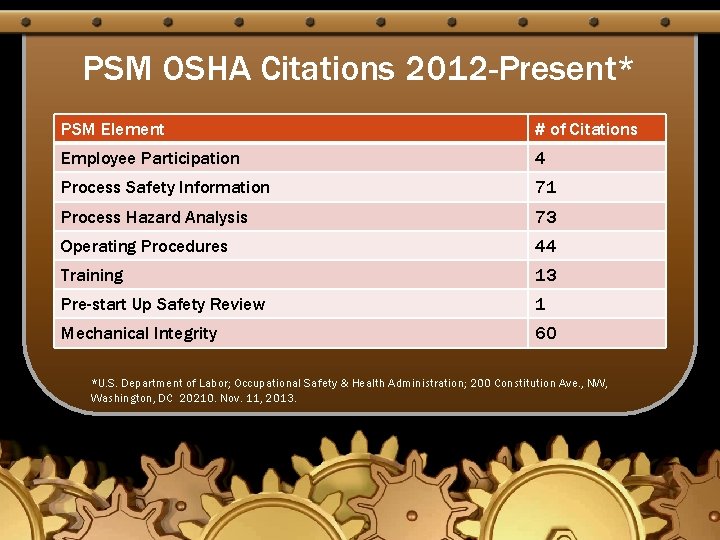
PSM OSHA Citations 2012 -Present* PSM Element # of Citations Employee Participation 4 Process Safety Information 71 Process Hazard Analysis 73 Operating Procedures 44 Training 13 Pre-start Up Safety Review 1 Mechanical Integrity 60 *U. S. Department of Labor; Occupational Safety & Health Administration; 200 Constitution Ave. , NW, Washington, DC 20210. Nov. 11, 2013.
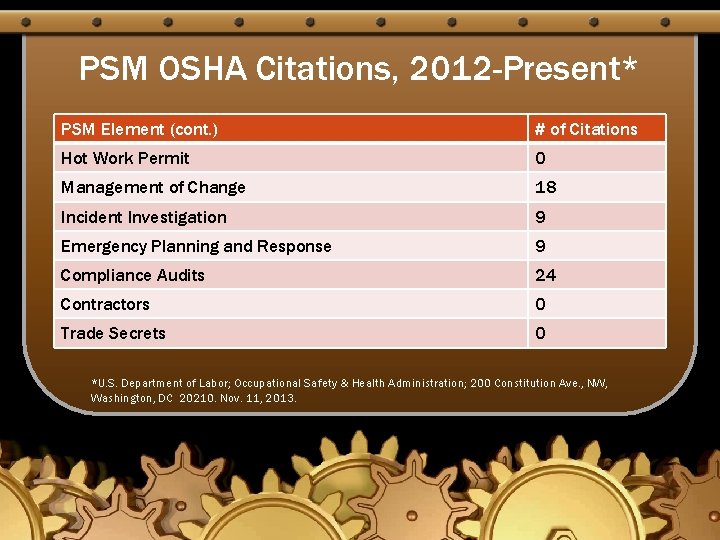
PSM OSHA Citations, 2012 -Present* PSM Element (cont. ) # of Citations Hot Work Permit 0 Management of Change 18 Incident Investigation 9 Emergency Planning and Response 9 Compliance Audits 24 Contractors 0 Trade Secrets 0 *U. S. Department of Labor; Occupational Safety & Health Administration; 200 Constitution Ave. , NW, Washington, DC 20210. Nov. 11, 2013.
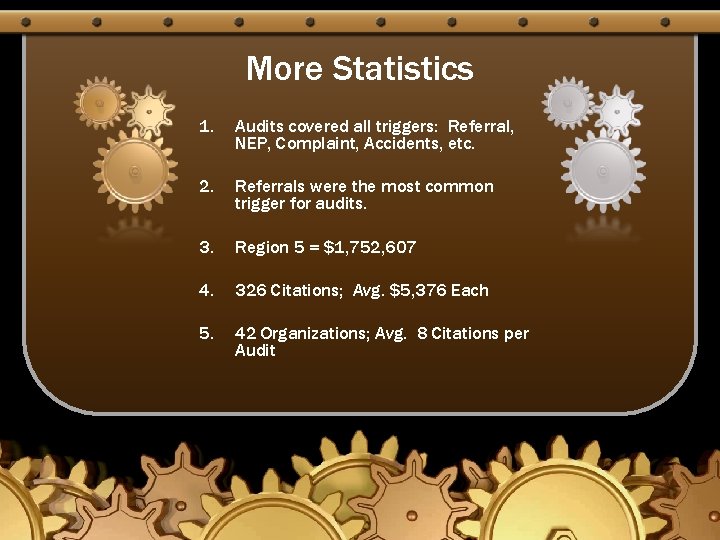
More Statistics 1. Audits covered all triggers: Referral, NEP, Complaint, Accidents, etc. 2. Referrals were the most common trigger for audits. 3. Region 5 = $1, 752, 607 4. 326 Citations; Avg. $5, 376 Each 5. 42 Organizations; Avg. 8 Citations per Audit
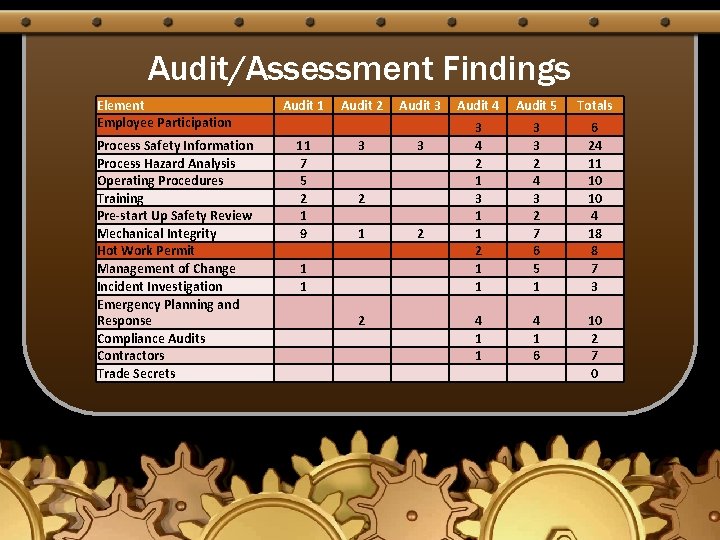
Audit/Assessment Findings Element Employee Participation Process Safety Information Process Hazard Analysis Operating Procedures Training Pre-start Up Safety Review Mechanical Integrity Hot Work Permit Management of Change Incident Investigation Emergency Planning and Response Compliance Audits Contractors Trade Secrets Audit 1 11 7 5 2 1 9 Audit 2 3 Audit 3 3 2 1 1 1 2 2 Audit 4 Audit 5 Totals 3 4 2 1 3 1 1 2 1 1 3 3 2 4 3 2 7 6 5 1 6 24 11 10 10 4 18 8 7 3 4 1 1 4 1 6 10 2 7 0
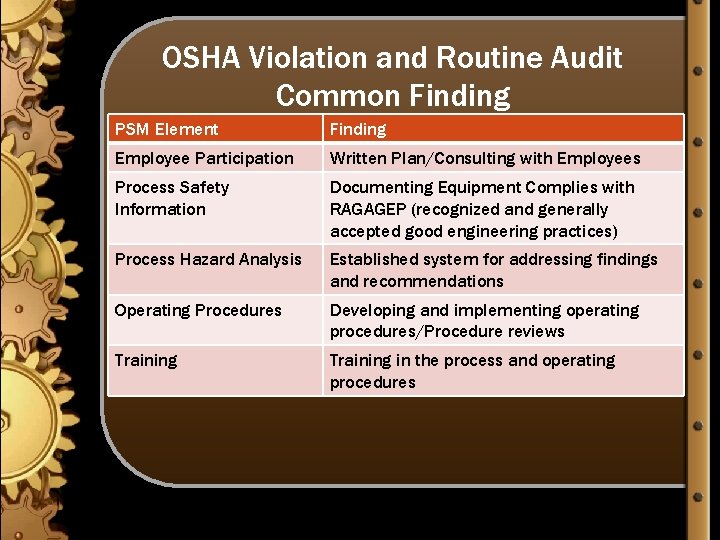
OSHA Violation and Routine Audit Common Finding PSM Element Finding Employee Participation Written Plan/Consulting with Employees Process Safety Information Documenting Equipment Complies with RAGAGEP (recognized and generally accepted good engineering practices) Process Hazard Analysis Established system for addressing findings and recommendations Operating Procedures Developing and implementing operating procedures/Procedure reviews Training in the process and operating procedures
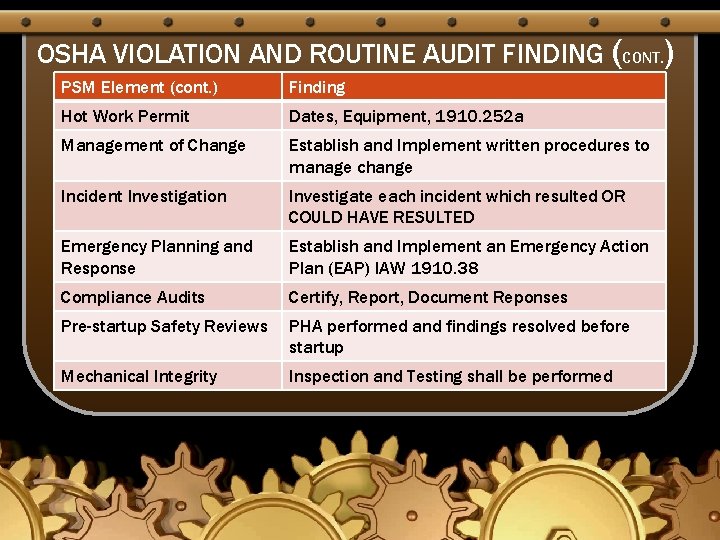
OSHA VIOLATION AND ROUTINE AUDIT FINDING (CONT. ) PSM Element (cont. ) Finding Hot Work Permit Dates, Equipment, 1910. 252 a Management of Change Establish and Implement written procedures to manage change Incident Investigation Investigate each incident which resulted OR COULD HAVE RESULTED Emergency Planning and Response Establish and Implement an Emergency Action Plan (EAP) IAW 1910. 38 Certify, Report, Document Reponses GOLDEN GEARS POWERPOINT Pre-startup Safety Reviews PHA performed and findings resolved before TEMPLATE startup Compliance Audits Mechanical Integrity Inspection and Testing shall be performed
Necessities for Successful Audits /Assessments • Management Support • Site Support • Program Documentation • Program Implementation
Necessities for Successful Audits /Assessments Management Support • Management-Driven Program • Long-Term Support • Corporate and Site Support
Necessities for Successful Audits /Assessments Management Support • PSM is a Management-Driven Program • Top-Down influence and implementation • Dedicated Resources, both personnel and financial • Long-Term Support • PSM is a permanent body of regulation • PSM program impact must be integrated to Cost/Earnings Forecasts • A timetable of years, not business quarters • Corporate and Site Support • Support must come from all levels • If a layer of support is missing, program will fail • A successful program is one factor of site viability
Necessities for Successful Audits /Assessments Site Support • Organization at the Site • Personnel Requirements (Technical/Operations/Clerical)
Necessities for Successful Audits /Assessments Site Support (“Moderate” Size; 300 People; 3 Processes) • Site PSM-Programs Manager • Site Champions for Each PSM Element (14 Element Model) • Process Area Champions for Each Element (14 Element Model)
Necessities for Successful Audits /Assessments Site Support • Site Champions for Each Element • 14 Elements = 14 Champions (can vary per site size) • Calculate the Personnel Needed (“Moderate” sized plant-site): • (14 Elements) X (1 Person/2 Elements) X (0. 25 Fraction of Person’s Time) • = 1. 75 Persons as Site Champions • Call it “ 2 People” • Typically Technical/Salaried Personnel • Include technical and administrative requirements
Necessities for Successful Audits /Assessments Site Support • Process Area Champions for Each Element • Typically salaried personnel • Skills driven by technical needs of the element • Calculation of personnel is similar • Assume three (3) process areas on-site • One person handles several elements in less-demanding areas • Calculate the personnel needed (“Moderate” sized plant-site): • (14 Elements) X (1 Pers/2 Elem) X (0. 1 Fraction of Person’s Time) X (3 Process Areas) • = 2. 1 Persons as Process Area Champion • Call it “ 2 People”
Necessities for Successful Audits /Assessments Site Support (“Moderate” Size; 300 People; 3 Processes) • Site PSM-Programs Support Personnel (Eng. Dept) • “Reliability Engineer” • Calculate the personnel needed (“Moderate” sized plant-site): • (1 Person) X (0. 25 Fraction of Person’s Time) X (3 Process Areas) • = 0. 75 Persons as Reliability Engineer • Call it “ 1 Person” • Process Area PSM-Programs Support Personnel (Tech. Eng. ) • “Process Engineer” • Calculate the personnel needed (“Moderate” sized plant-site): • (1 Person) X (0. 25 Fraction of Person’s Time) X (3 Process Areas) • = 0. 75 Persons as Reliability Engineer • Call it “ 1 Person”
Necessities for Successful Audits /Assessments Site Support (“Moderate” Size; 300 People; 3 Processes) • Summary of Personnel Needs for PSM Programs • • 1 each – Site Programs Manager 2 each, equivalent – Site Element Champions 2 each, equivalent – Process Area Element Champions 1 each, equivalent – Site Engineering - Support 1 each, equivalent – Process Area Engineering – Support Above is for a long-term, continuing PSM program Approximately 1. 5 dedicated persons for every $100 Million of Replacement Investment.
Necessities for Successful Audits /Assessments Program Documentation Specificity and a Requirement Goal: to provide a comprehensive audit trail so government regulators may feel assured that the facility is operating “Safely”.
Necessities for Successful Audits /Assessments Program Documentation Specificity and a Requirement Audit Trail Sampling… Technology: Documented PSI; Updated PHAs; Management of Change documents. Facilities: Operating Procedures; PSSRs; MI; QA. Personnel: Site governance documents, all elements; Contractor Safety Programs; Position Qualification Training Programs and Records; Self-auditing programs and protocols; Incident Investigations, records and analysis. Employees will be interviewed during a third-party audit.
Necessities for Successful Audits /Assessments Program Documentation • Each regulatory reference requires some type of information • This information must be captured by some type of form or information system • The employer must maintain documentation and an audit trail that shows employer compliance with the various regulatory references • Third-party auditors go directly to this audit trail to determine compliance • Verbal comments and discussions do not constitute an audit trail; documents must be presented to verify an audit trail
Necessities for Successful Audits /Assessments Program Implementation • Training of Co-Managed Elements • All contract partners are affected • Facility - maintain audit trail for contractors • Contractor requirements can be audited • Involvement of Workforce • Employee PSM records will be audited • Training records • Certificates (Example – Welding Qualifications) • Employees will be interviewed during an audit • Evidence of employee involvement in PSM program
PSM Audit Occurrences 1. Audits/Assessments 2. Violations of the OSHA Standard 1910. 119, Process Safety Management. 3. Audit/Assessment Findings 4. Necessities for Successful Audits/Assessments Questions? ?
- Slides: 23