
PSIR 307 HISTORY OF POLITICAL THOUGHT WEEK 2
- Slides: 18
PSIR 307 HISTORY OF POLITICAL THOUGHT WEEK 2 Evolution of Political Thought
CLASSICAL AND MODERN POLITICAL THINKERS Classical Political Thinkers are pre-enlightenment philosophers Modern Political Thinkers are those that have been shaped and have themselves shaped the project of modernity Modern period is understood to be starting after ‘Enlightenment’ or Renaissance movement.
What is ‘Modernity’ ? Emergence of the idea that human beings are capable of reasoned thought and moral development Development of a human centric scientific thinking based on rationality Enlightenment thinkers and their commitment to scientific, logical and rational forms of knowledge. Scepticism towards traditional forms of authority (e. g. Church, Monarchy etc. )
Classical Political Thought http: //classics. mit. edu Socrates Plato Aristotle Christian Thought Agustine Aquinas
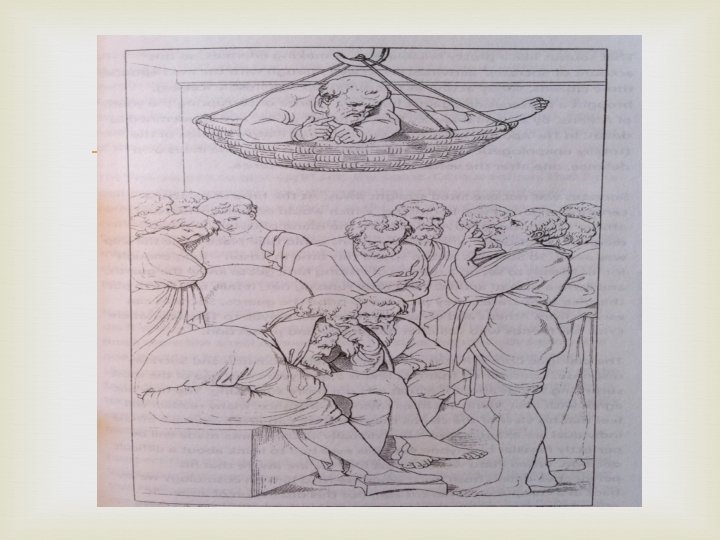
Socrates 469 -399 B. C. Only know of him from the writings of Plato, Xenophon and the plays of Aristophanes Plato’s accounts of him is questioned. Believed to be inflated to make Socrates look grand. Main contribution of Socrates is to epistemology Socratic Method: a series of questions are asked to disclose beliefs and knowledge of the person or group he is in dialogue
Socratic Method Hypothesis elimination: hypothesis containing contradictions are dropped and the best ones are kept. This is very much in line with the deductive method used in scientific study of phenomena including social and political issues. In the scientific method hypothesis is the first stage.
Socratic Question ‘How should I live? ’ The is the same theme that all the rest of the political thinkers address: What is the ‘good life’? Questions of obligation, rights, sovereignty, equality all relate to this question of what a ‘good life’ is. This is why we tend to start with Socrates.
Two philosophical schools on ‘the good life’ Deontological school of thought Consequentialist school of thought Example: NHS has £ 500, 000 to spend on new drugs. What should they do?
PSIR 307 HISTORY OF POLITICAL THOUGHT WEEK 3 SOVEREIGNTY
SOVEREIGNTY The concept of sovereignty originally comes from old French and means “to rule over” or one who is “superior” to others in a given society. It was used to describe the power and position of the French Kings among other persons and institutions in the French society in the middle ages. It could be simply defined as ‘the right and/or ability of a particular body or ruler to exercise ultimate and supreme authority or command within certain defined territorial boundaries’ (Jones 2002, p. 2)
External Sovereignty The concept of sovereignty is mostly used to mean the independence of a state among other states in the world. This is a legal concept that states that a particular state is free from external control and influence.
External Sovereignty In this legal sense every independent state has external sovereignty. In the real world however, there a set of inequalities among `independent states` in terms of economic and military capacity, population, technological and scientific capability. This means that more powerful states have more `sovereignty` in their relations with other states. A state which has external sovereignty does not have absolute freedom to regulate its relations with other states. This is the distinction between legal and political sovereignty!
Sovereignty One of the limitations over the state’s sovereignty is the existence of international laws and regulations. These laws and rules restrict the state’s sovereignty. (consider the role of European Union over member states) Can we therefore talk about an erosion of the term of sovereignty?
Internal Sovereignty Another form of sovereignty is called internal sovereignty which refers to the position of sovereign power inside the country. This is the original meaning of the concept of sovereignty. We know that in the end of middle ages in France this concept was used to identify the power of the French king. The French king was considered as the superior authority in society. To describe his position he was called “the sovereign”. The French king was considered as having absolute power to make any final decision for society. After the French Revolution, monarchy was destroyed and the French nation became the holder of ultimate authority to take decisions (sovereignty).
Internal Sovereignty We may say that internal sovereignty explains the supreme authority inside society. In other words we use this concept to explain which group, individual, or institution inside the country has capacity to control national territory and make collective decisions for entire society.
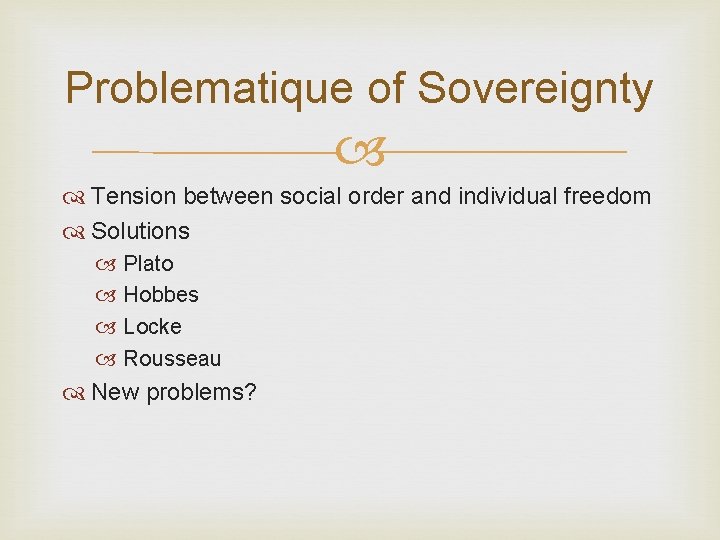
Problematique of Sovereignty Tension between social order and individual freedom Solutions Plato Hobbes Locke Rousseau New problems?
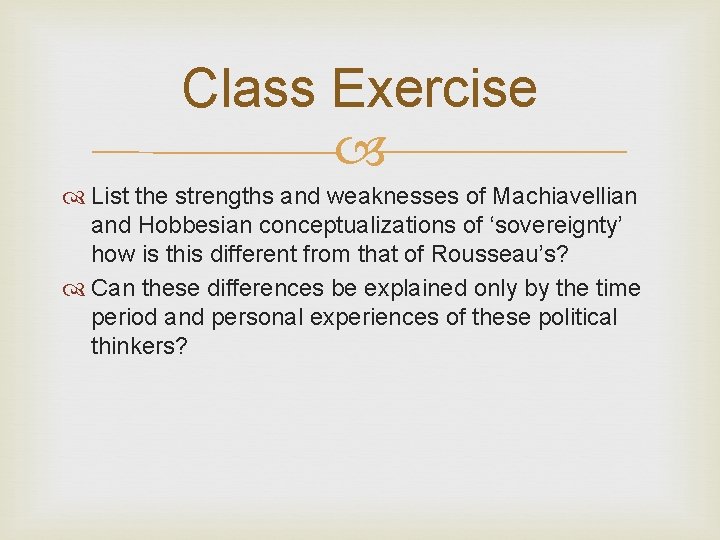
Class Exercise List the strengths and weaknesses of Machiavellian and Hobbesian conceptualizations of ‘sovereignty’ how is this different from that of Rousseau’s? Can these differences be explained only by the time period and personal experiences of these political thinkers?