
PSFQ A Reliable Transport Protocol for Wireless Sensor
PSFQ: A Reliable Transport Protocol for Wireless Sensor Networks Chieh-Yih Wan, Andrew T. Campbell, Lakshman Krishnamurthy Tarun Banka Department of Computer Science Colorado State University 12/3/2020 1
Motivation ? w Most Sensor Network applications don’t need reliable transport w New applications like re-tasking of sensors need reliable transport w Current sensor networks are application specific and optimized for that only w Future Sensor networks may be general purpose to some extent – ability to reprogram the functionality 12/3/2020 2
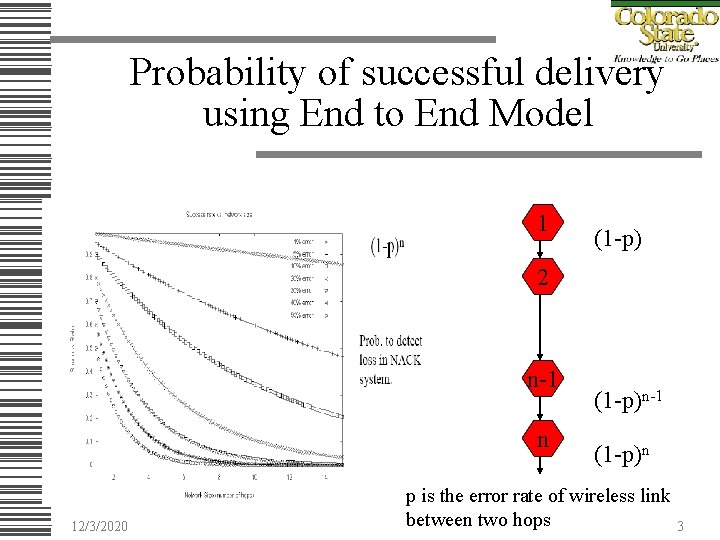
Probability of successful delivery using End to End Model 1 (1 -p) 2 n-1 n 12/3/2020 (1 -p)n-1 (1 -p)n p is the error rate of wireless link between two hops 3
Goals of PSFQ: Pump Slowly and Fetch Quickly w w 12/3/2020 Recover from losses locally Minimum signaling involved for Loss Detection and Recovery To operate correctly in high error prone environment Independent of the underlying routing infrastructure 4
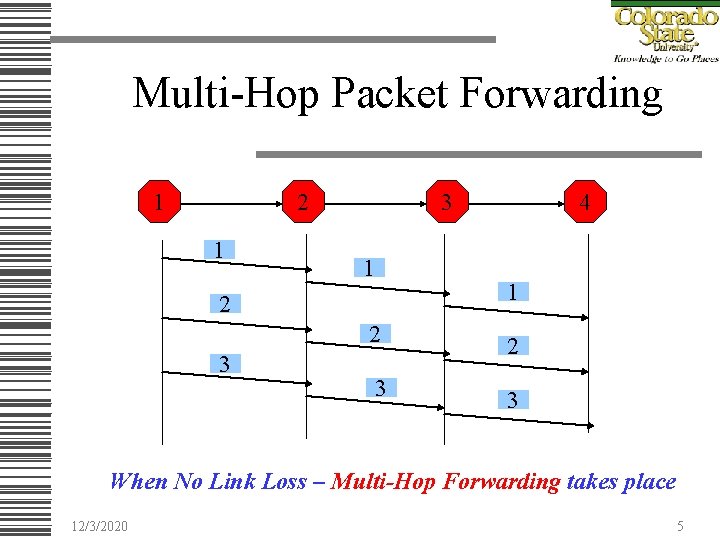
Multi-Hop Packet Forwarding 1 2 1 3 1 1 2 3 4 2 2 3 3 When No Link Loss – Multi-Hop Forwarding takes place 12/3/2020 5
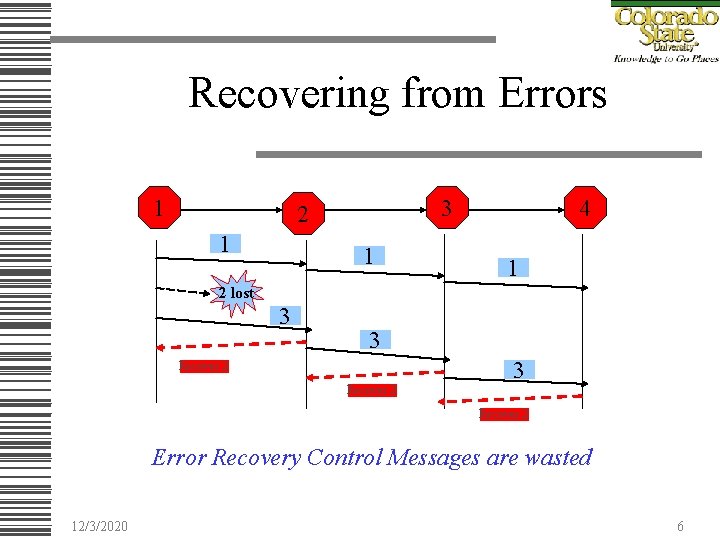
Recovering from Errors 1 3 2 1 1 4 1 2 lost 3 3 3 Recover 2 Error Recovery Control Messages are wasted 12/3/2020 6
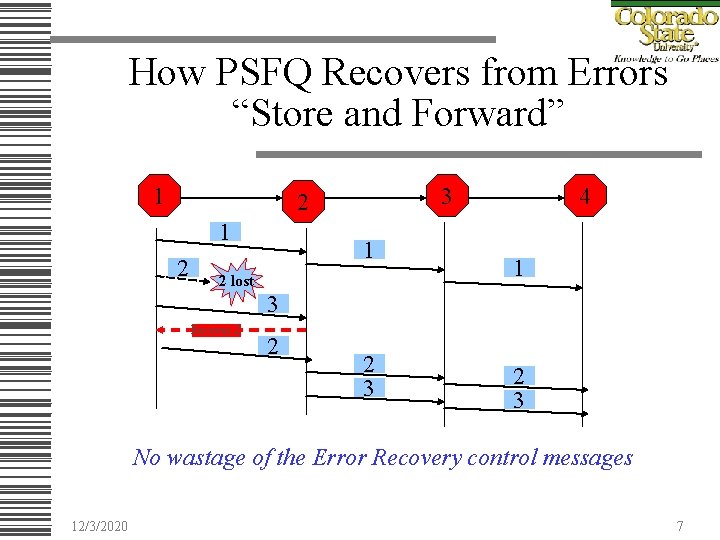
How PSFQ Recovers from Errors “Store and Forward” 1 3 2 1 2 lost 4 1 3 Recover 2 2 2 3 No wastage of the Error Recovery control messages 12/3/2020 7
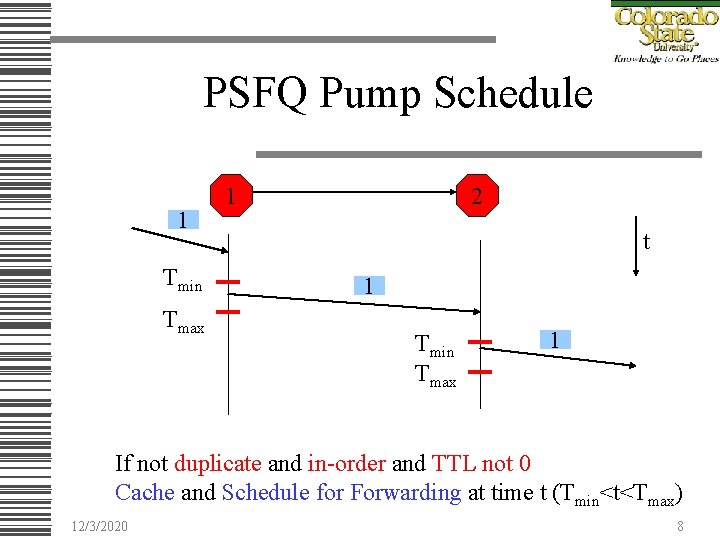
PSFQ Pump Schedule 1 Tmin Tmax 1 2 t 1 Tmin Tmax 1 If not duplicate and in-order and TTL not 0 Cache and Schedule for Forwarding at time t (Tmin<t<Tmax) 12/3/2020 8
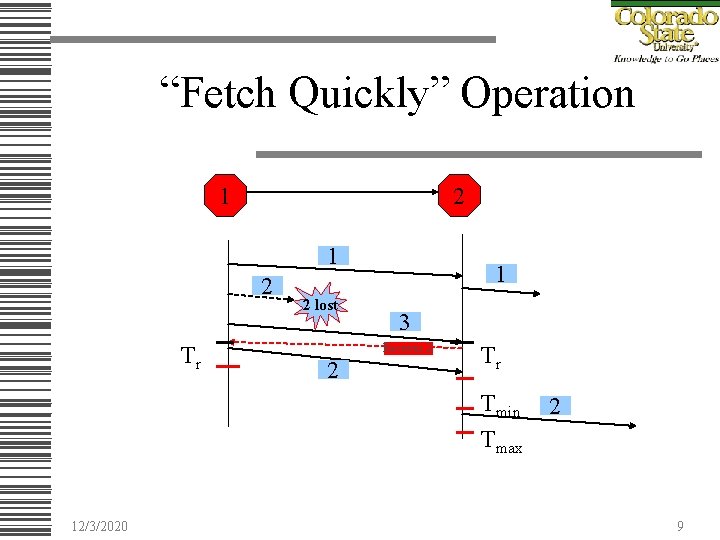
“Fetch Quickly” Operation 1 2 Tr 2 lost 1 3 Recover 2 2 Tr Tmin Tmax 12/3/2020 2 9
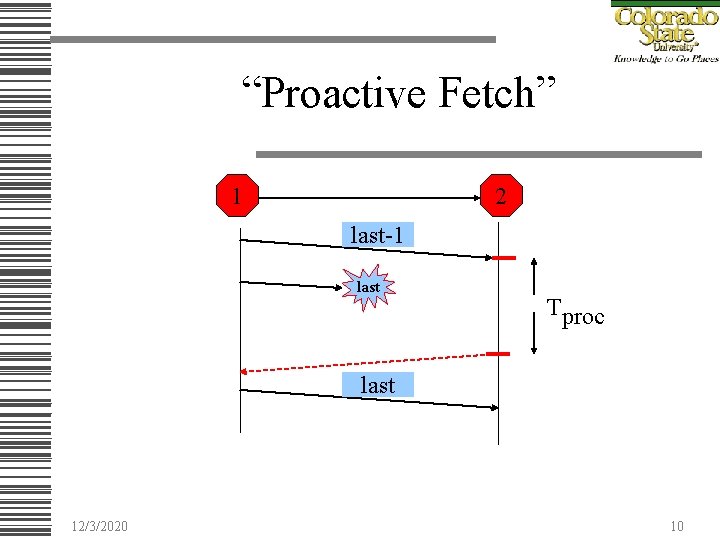
“Proactive Fetch” 1 2 last-1 last Tproc last 12/3/2020 10
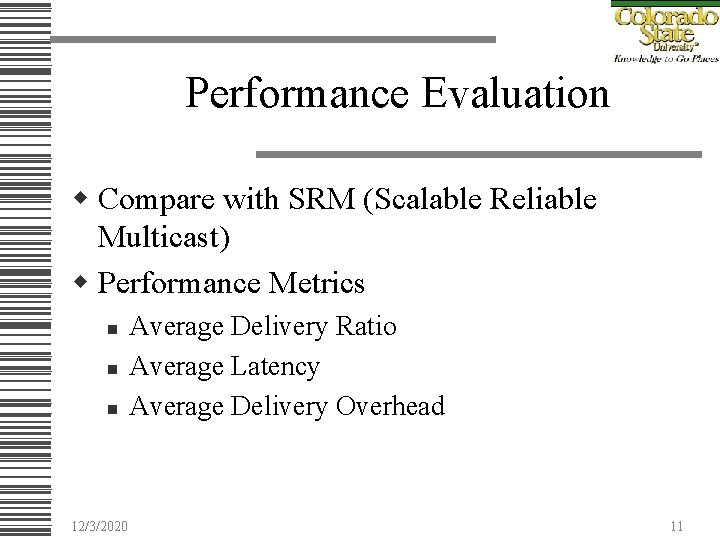
Performance Evaluation w Compare with SRM (Scalable Reliable Multicast) w Performance Metrics n n n 12/3/2020 Average Delivery Ratio Average Latency Average Delivery Overhead 11
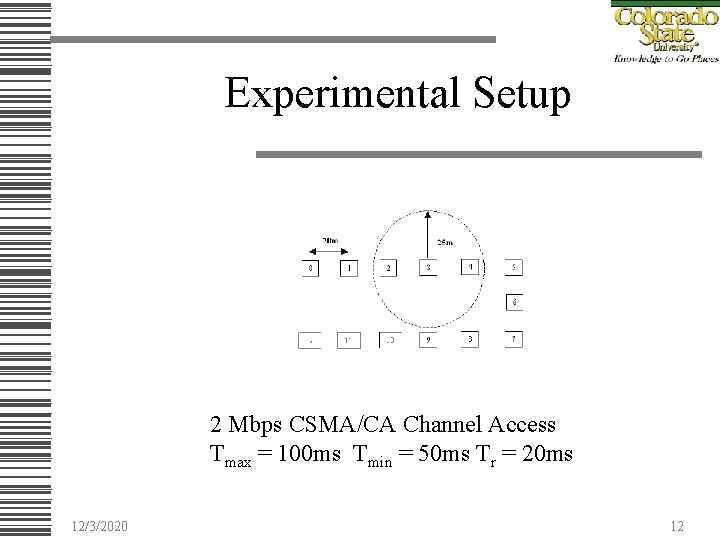
Experimental Setup 2 Mbps CSMA/CA Channel Access Tmax = 100 ms Tmin = 50 ms Tr = 20 ms 12/3/2020 12
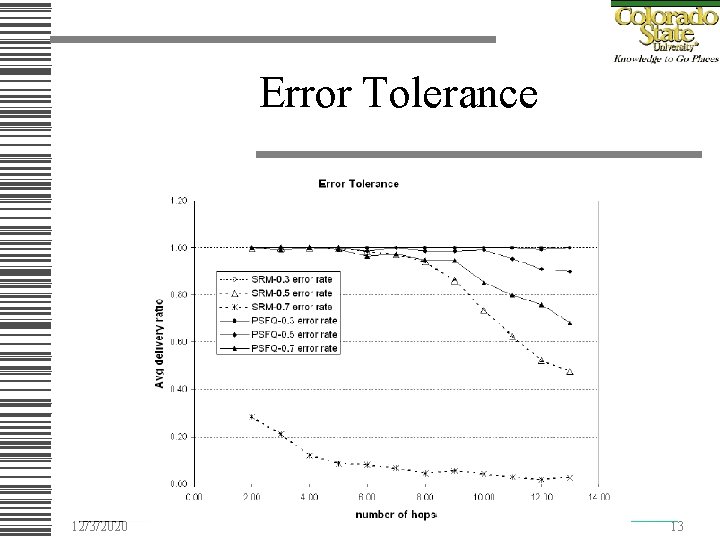
Error Tolerance 12/3/2020 13
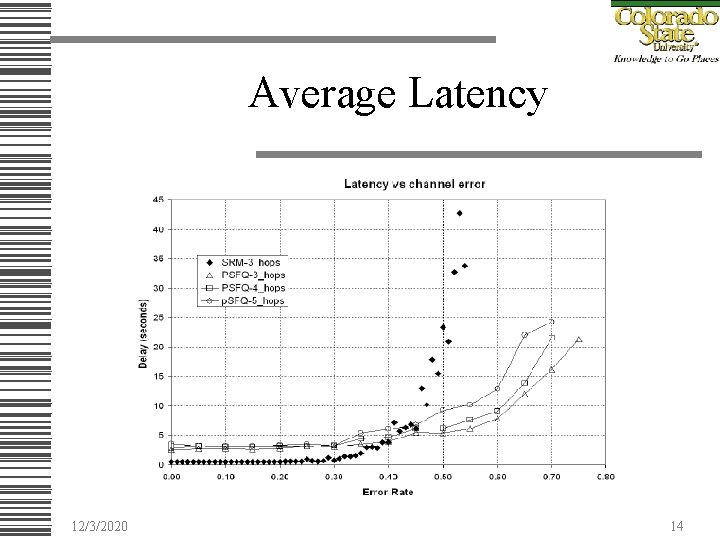
Average Latency 12/3/2020 14
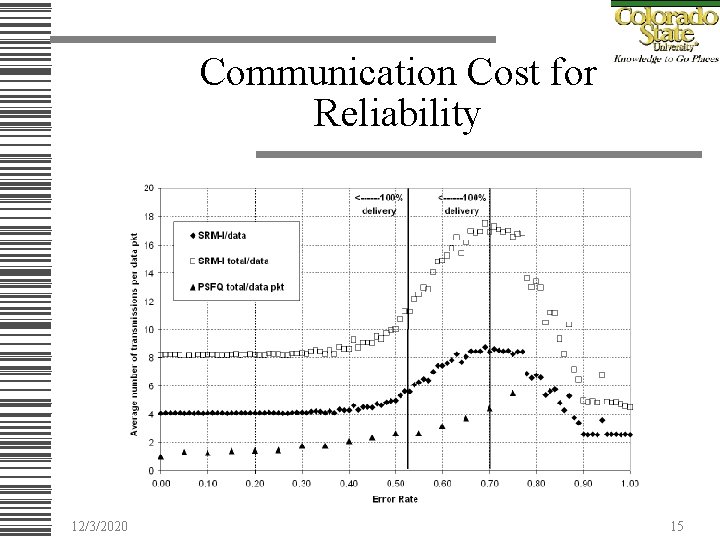
Communication Cost for Reliability 12/3/2020 15
Conclusion - PSFQ w Light weight and Energy efficient w Simple mechanism w Scalable and robust w Need to be tested for high bandwidth applications w Cache size limitation 12/3/2020 16
CODA: Congestion Detection and Avoidance in Sensor Networks Chieh-Yih Wan, Shane B. Eisenman, Andrew T. Campbell Tarun Banka Department of Computer Science Colorado State University 12/3/2020 17
What is CODA ? w Energy efficient congestion control scheme w Three mechanisms are involved n n n 12/3/2020 Congestion Detection Open-loop hop-by-hop backpressure Closed-loop multi-source regulation 18
Congestion Detection w Accurate and efficient congestion detection is important n n n 12/3/2020 Buffer queue length or Buffer occupancy – not a good measure of the congestion. Channel loading – sample channel at appropriate time to detect congestion. Report rate/Fidelity measurement – slow, observed over a longer period 19
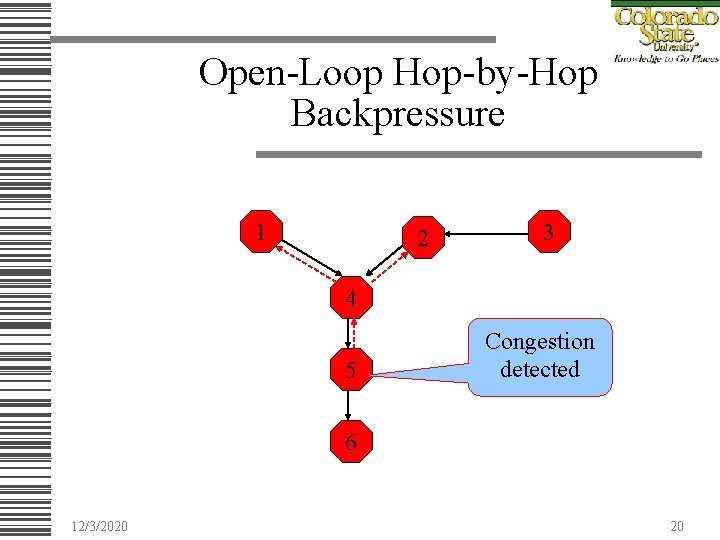
Open-Loop Hop-by-Hop Backpressure 1 2 3 4 5 Congestion detected 6 12/3/2020 20
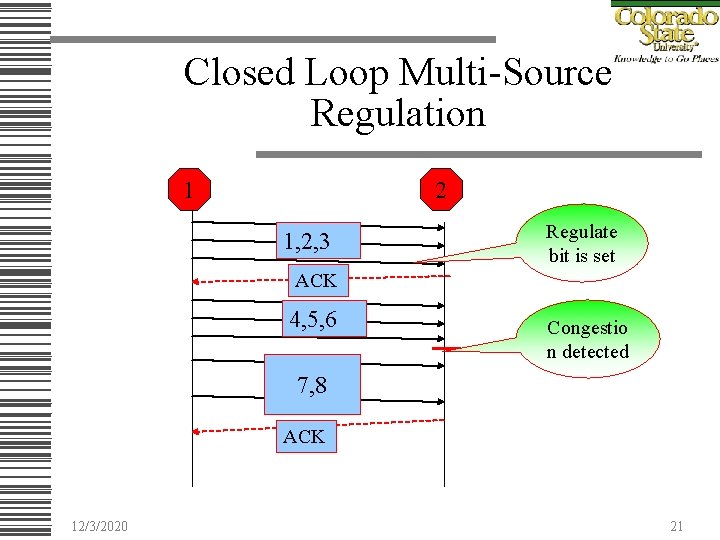
Closed Loop Multi-Source Regulation 1 2 1, 2, 3 Regulate bit is set ACK 4, 5, 6 Congestio n detected 7, 8 ACK 12/3/2020 21
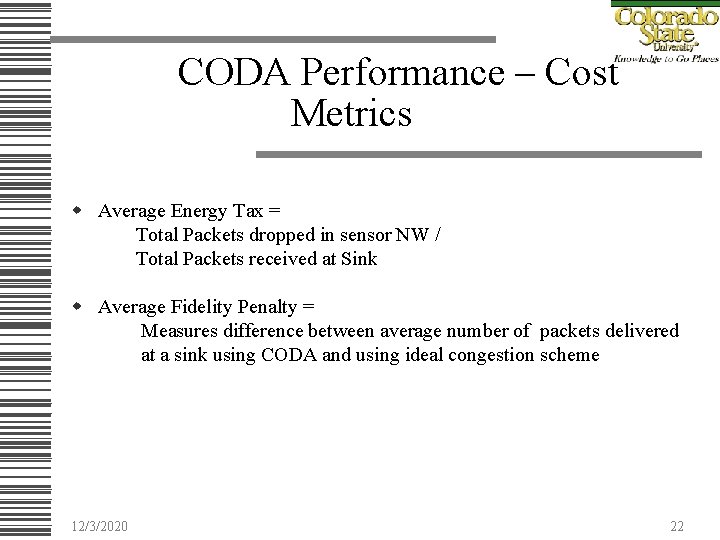
CODA Performance – Cost Metrics w Average Energy Tax = Total Packets dropped in sensor NW / Total Packets received at Sink w Average Fidelity Penalty = Measures difference between average number of packets delivered at a sink using CODA and using ideal congestion scheme 12/3/2020 22
Simulation Setup w Random Network Topologies with network size from 30 to 120 nodes w 2 Mbps IEEE 802. 11 MAC (RTS/CTS are disabled) w Directed Diffusion is used as routing core w Fixed Work load, 6 Sources and 3 Sinks w Source generate data at different rates. w Event Packet is 64 bytes and an interest packet is 36 bytes 12/3/2020 23
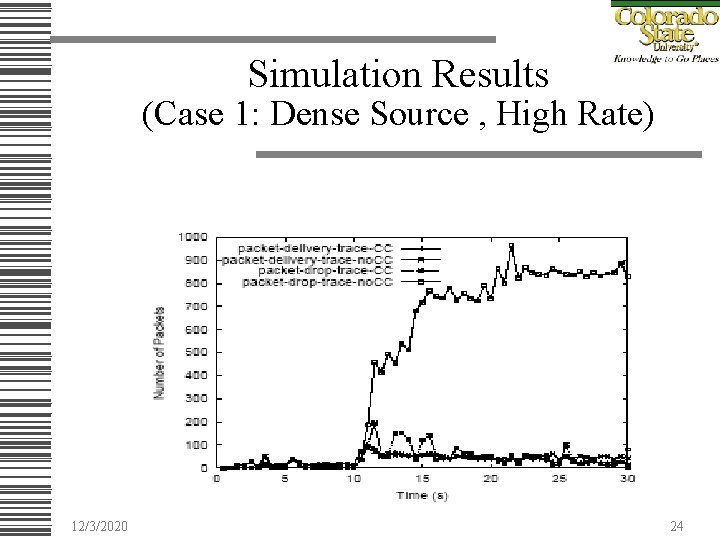
Simulation Results (Case 1: Dense Source , High Rate) 12/3/2020 24
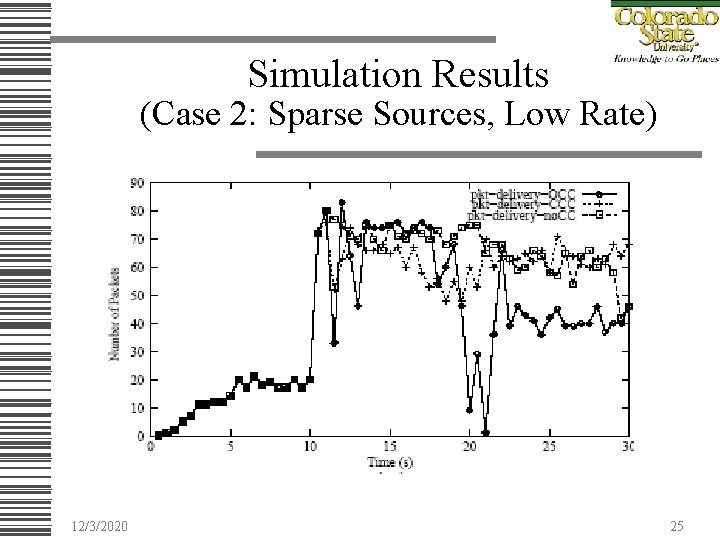
Simulation Results (Case 2: Sparse Sources, Low Rate) 12/3/2020 25
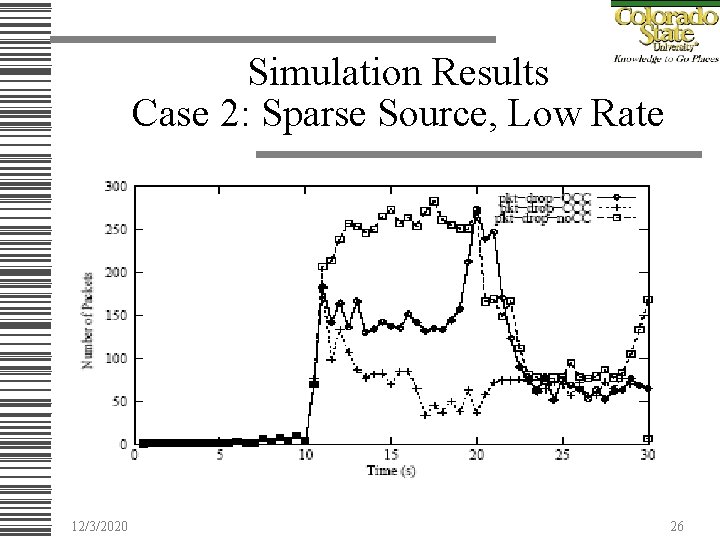
Simulation Results Case 2: Sparse Source, Low Rate 12/3/2020 26
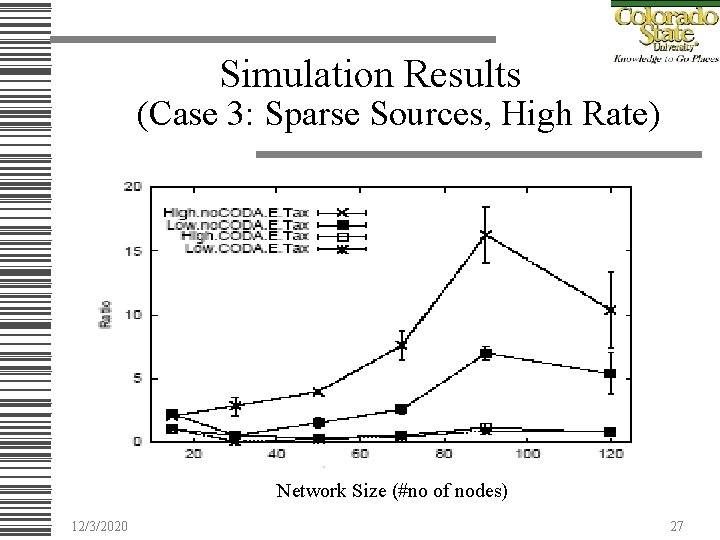
Simulation Results (Case 3: Sparse Sources, High Rate) Network Size (#no of nodes) 12/3/2020 27
Conclusion w CODA is a energy efficient protocol w Can deal with Persistent and Transient Hotspots 12/3/2020 28
Thank you Questions! 12/3/2020 29
- Slides: 29