
PSF inflight calibration PN PSF inflight calibration for
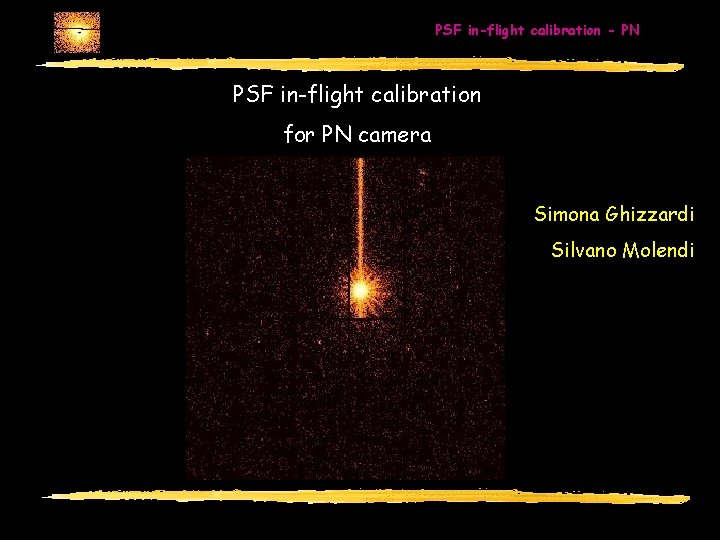
PSF in-flight calibration - PN PSF in-flight calibration for PN camera Simona Ghizzardi Silvano Molendi IFC/CNR Ringberg, April 2 -4, 2002
PSF in-flight calibration - PN DATA SAMPLE: - 110 SOURCES (TARGET) included ENERGY RANGES: 0. 3 ke. V [200 -400] e. V 0. 6 ke. V [400 -800] e. V 1. 0 ke. V [800 -1200] e. V 1. 8 ke. V [1200 -2400] e. V 3. 7 ke. V [2400 -5000] e. V 6. 5 ke. V [5000 -8000] e. V 10. 0 ke. V [8000 -12000] e. V OFF-AXIS ANGLES: from on-axis position up to ~ 10 arcmin - most of them are observed within ~ 2 arcmin. IFC/CNR Ringberg, April 2 -4, 2002

PSF in-flight calibration - PN Analysis procedure and PSF model We adopt the same procedure and the same algorithm used for the two MOS cameras. The pixel size of the PSF images is taken 1. 1”. According to the MOS results, the profile of the PSF is well represented by a King model: PSF = KING + BKG IFC/CNR Ringberg, April 2 -4, 2002
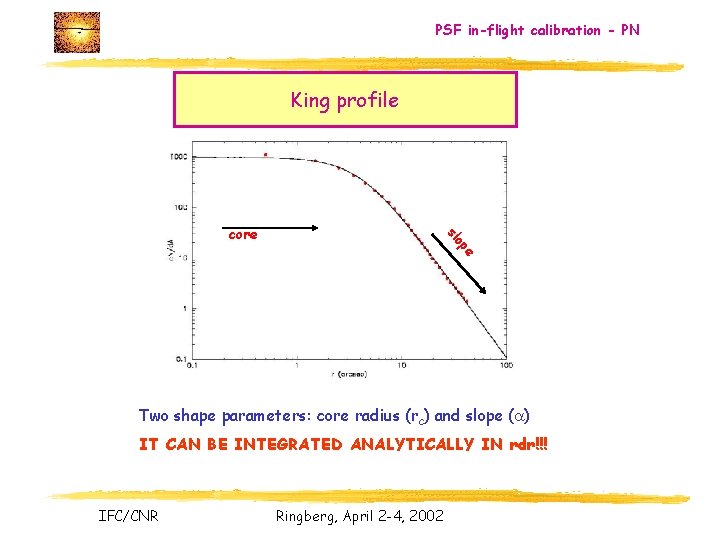
PSF in-flight calibration - PN King profile e op sl core Two shape parameters: core radius (rc) and slope (a) IT CAN BE INTEGRATED ANALYTICALLY IN rdr!!! IFC/CNR Ringberg, April 2 -4, 2002
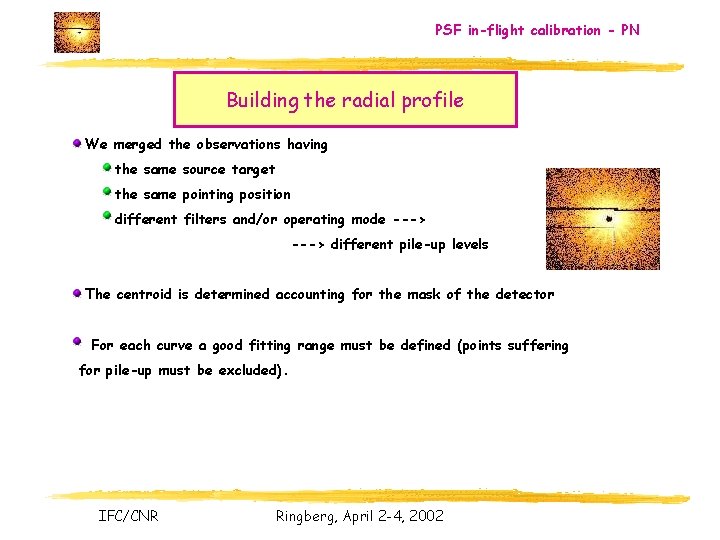
PSF in-flight calibration - PN Building the radial profile We merged the observations having the same source target the same pointing position different filters and/or operating mode ---> different pile-up levels The centroid is determined accounting for the mask of the detector For each curve a good fitting range must be defined (points suffering for pile-up must be excluded). IFC/CNR Ringberg, April 2 -4, 2002

PSF in-flight calibration - PN Algorithm for the averaged radial profile • Energy selection and pattern (0 -12) selection BASIC METHOD We bin the image (with larger bins at larger radii) RADIAL PROFILE: d. N/d. A (the area is not 2 pr dr because of the mask) each (squared) pixel is assigned to the (round) bin to which its CENTER belongs for these pixels it works fairly these pixels belong to two different bins in comparable fractions the effect is less important at larger radii ADDITIONAL RECIPE ADDED TO THE BASIC PROCEDURE We enclose each pixel in a circle. If the circle is fully enclosed in the bin the pixel is too. If the circle is partly enclosed in another bin, the pixel may belong to two bins: we divide such pixels in NSUBPIXELS IFC/CNR Ringberg, April 2 -4, 2002
PSF in-flight calibration - PN The physical pixel size is 4. 1”, not much smaller than the core radius of the PSF. The calibration of the core is quite tricky The frame time is smaller than the MOS one. The pile-up effect is less important The effective area is larger than the MOS one. Good statistics IFC/CNR Ringberg, April 2 -4, 2002
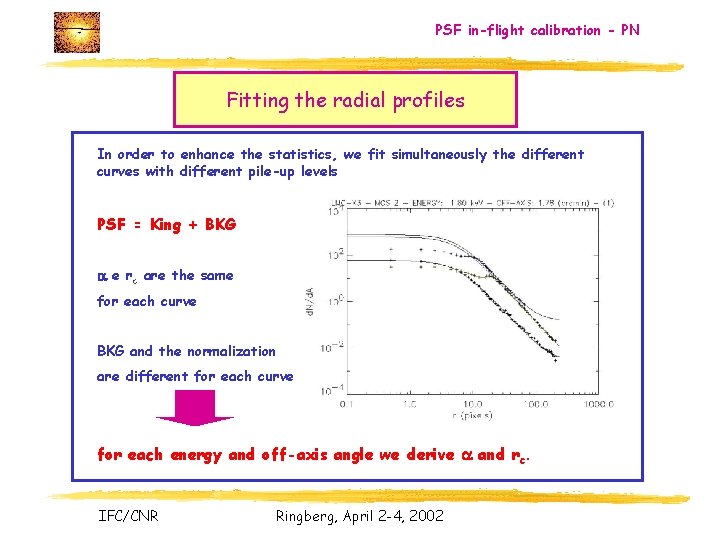
PSF in-flight calibration - PN Fitting the radial profiles In order to enhance the statistics, we fit simultaneously the different curves with different pile-up levels PSF = King + BKG a e rc are the same for each curve BKG and the normalization are different for each curve for each energy and off-axis angle we derive a and rc. IFC/CNR Ringberg, April 2 -4, 2002
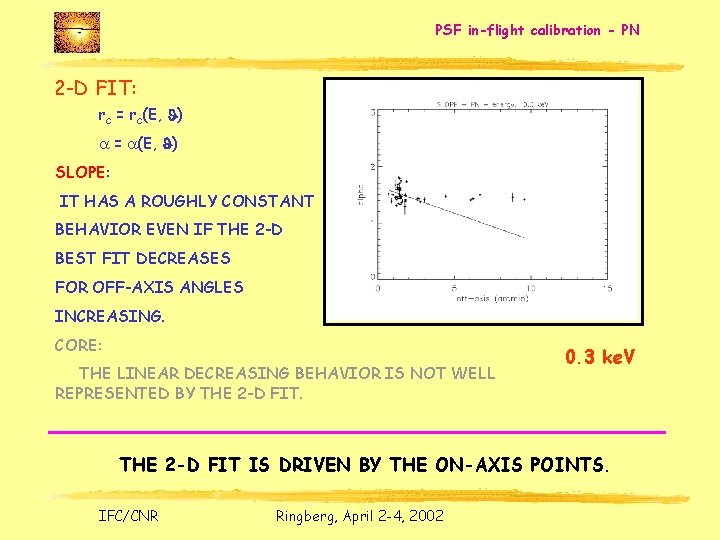
PSF in-flight calibration - PN 2 -D FIT: rc = rc(E, J) a = a(E, J) SLOPE: IT HAS A ROUGHLY CONSTANT BEHAVIOR EVEN IF THE 2 -D BEST FIT DECREASES FOR OFF-AXIS ANGLES INCREASING. CORE: THE LINEAR DECREASING BEHAVIOR IS NOT WELL REPRESENTED BY THE 2 -D FIT. 0. 3 ke. V THE 2 -D FIT IS DRIVEN BY THE ON-AXIS POINTS. IFC/CNR Ringberg, April 2 -4, 2002
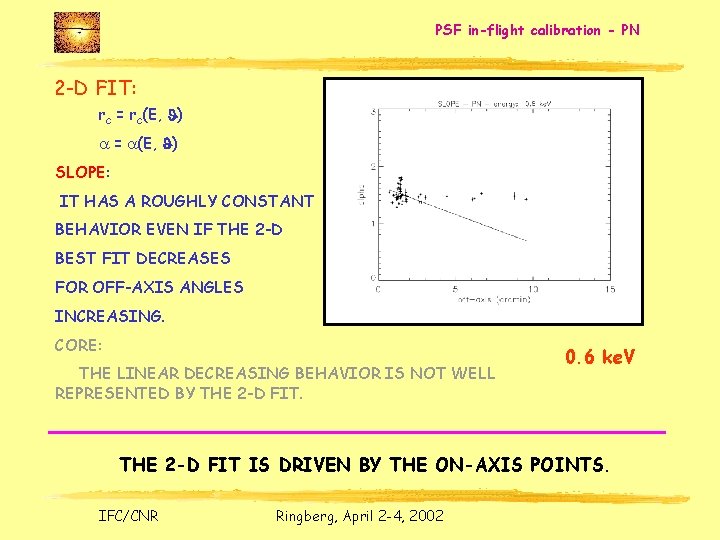
PSF in-flight calibration - PN 2 -D FIT: rc = rc(E, J) a = a(E, J) SLOPE: IT HAS A ROUGHLY CONSTANT BEHAVIOR EVEN IF THE 2 -D BEST FIT DECREASES FOR OFF-AXIS ANGLES INCREASING. CORE: THE LINEAR DECREASING BEHAVIOR IS NOT WELL REPRESENTED BY THE 2 -D FIT. 0. 6 ke. V THE 2 -D FIT IS DRIVEN BY THE ON-AXIS POINTS. IFC/CNR Ringberg, April 2 -4, 2002
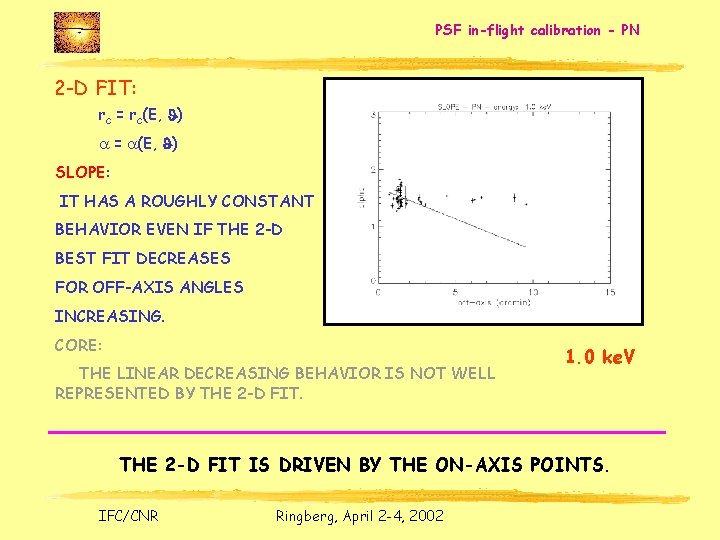
PSF in-flight calibration - PN 2 -D FIT: rc = rc(E, J) a = a(E, J) SLOPE: IT HAS A ROUGHLY CONSTANT BEHAVIOR EVEN IF THE 2 -D BEST FIT DECREASES FOR OFF-AXIS ANGLES INCREASING. CORE: THE LINEAR DECREASING BEHAVIOR IS NOT WELL REPRESENTED BY THE 2 -D FIT. 1. 0 ke. V THE 2 -D FIT IS DRIVEN BY THE ON-AXIS POINTS. IFC/CNR Ringberg, April 2 -4, 2002
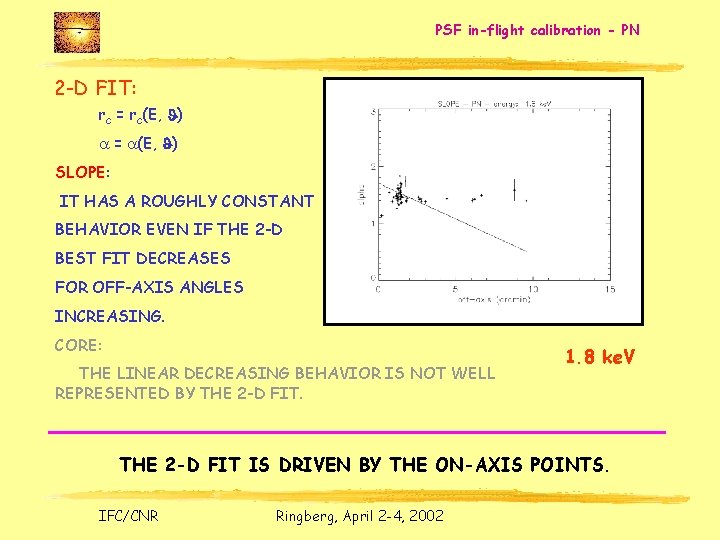
PSF in-flight calibration - PN 2 -D FIT: rc = rc(E, J) a = a(E, J) SLOPE: IT HAS A ROUGHLY CONSTANT BEHAVIOR EVEN IF THE 2 -D BEST FIT DECREASES FOR OFF-AXIS ANGLES INCREASING. CORE: THE LINEAR DECREASING BEHAVIOR IS NOT WELL REPRESENTED BY THE 2 -D FIT. 1. 8 ke. V THE 2 -D FIT IS DRIVEN BY THE ON-AXIS POINTS. IFC/CNR Ringberg, April 2 -4, 2002
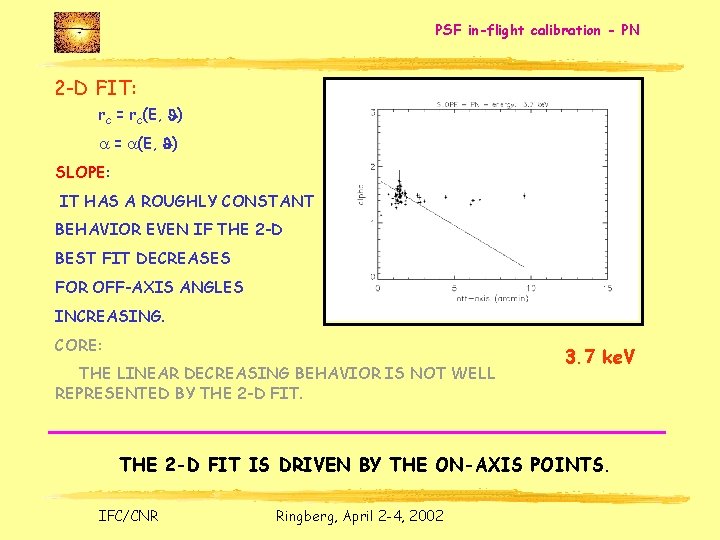
PSF in-flight calibration - PN 2 -D FIT: rc = rc(E, J) a = a(E, J) SLOPE: IT HAS A ROUGHLY CONSTANT BEHAVIOR EVEN IF THE 2 -D BEST FIT DECREASES FOR OFF-AXIS ANGLES INCREASING. CORE: THE LINEAR DECREASING BEHAVIOR IS NOT WELL REPRESENTED BY THE 2 -D FIT. 3. 7 ke. V THE 2 -D FIT IS DRIVEN BY THE ON-AXIS POINTS. IFC/CNR Ringberg, April 2 -4, 2002
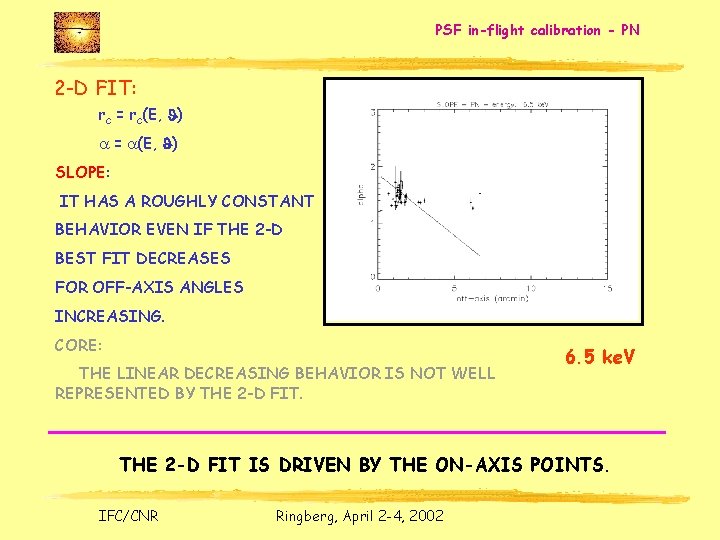
PSF in-flight calibration - PN 2 -D FIT: rc = rc(E, J) a = a(E, J) SLOPE: IT HAS A ROUGHLY CONSTANT BEHAVIOR EVEN IF THE 2 -D BEST FIT DECREASES FOR OFF-AXIS ANGLES INCREASING. CORE: THE LINEAR DECREASING BEHAVIOR IS NOT WELL REPRESENTED BY THE 2 -D FIT. 6. 5 ke. V THE 2 -D FIT IS DRIVEN BY THE ON-AXIS POINTS. IFC/CNR Ringberg, April 2 -4, 2002
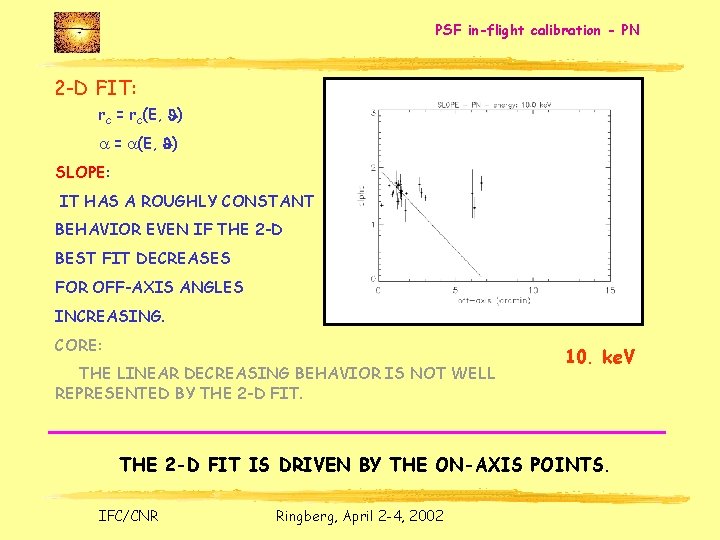
PSF in-flight calibration - PN 2 -D FIT: rc = rc(E, J) a = a(E, J) SLOPE: IT HAS A ROUGHLY CONSTANT BEHAVIOR EVEN IF THE 2 -D BEST FIT DECREASES FOR OFF-AXIS ANGLES INCREASING. CORE: THE LINEAR DECREASING BEHAVIOR IS NOT WELL REPRESENTED BY THE 2 -D FIT. 10. ke. V THE 2 -D FIT IS DRIVEN BY THE ON-AXIS POINTS. IFC/CNR Ringberg, April 2 -4, 2002
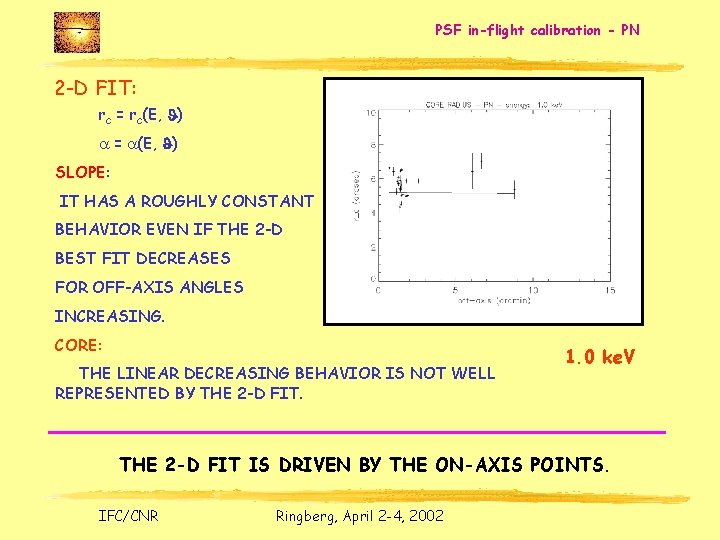
PSF in-flight calibration - PN 2 -D FIT: rc = rc(E, J) a = a(E, J) SLOPE: IT HAS A ROUGHLY CONSTANT BEHAVIOR EVEN IF THE 2 -D BEST FIT DECREASES FOR OFF-AXIS ANGLES INCREASING. CORE: THE LINEAR DECREASING BEHAVIOR IS NOT WELL REPRESENTED BY THE 2 -D FIT. 1. 0 ke. V THE 2 -D FIT IS DRIVEN BY THE ON-AXIS POINTS. IFC/CNR Ringberg, April 2 -4, 2002
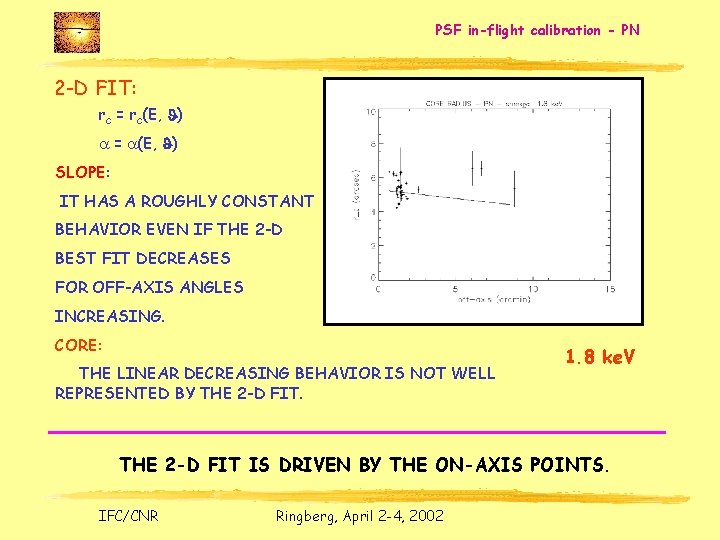
PSF in-flight calibration - PN 2 -D FIT: rc = rc(E, J) a = a(E, J) SLOPE: IT HAS A ROUGHLY CONSTANT BEHAVIOR EVEN IF THE 2 -D BEST FIT DECREASES FOR OFF-AXIS ANGLES INCREASING. CORE: THE LINEAR DECREASING BEHAVIOR IS NOT WELL REPRESENTED BY THE 2 -D FIT. 1. 8 ke. V THE 2 -D FIT IS DRIVEN BY THE ON-AXIS POINTS. IFC/CNR Ringberg, April 2 -4, 2002
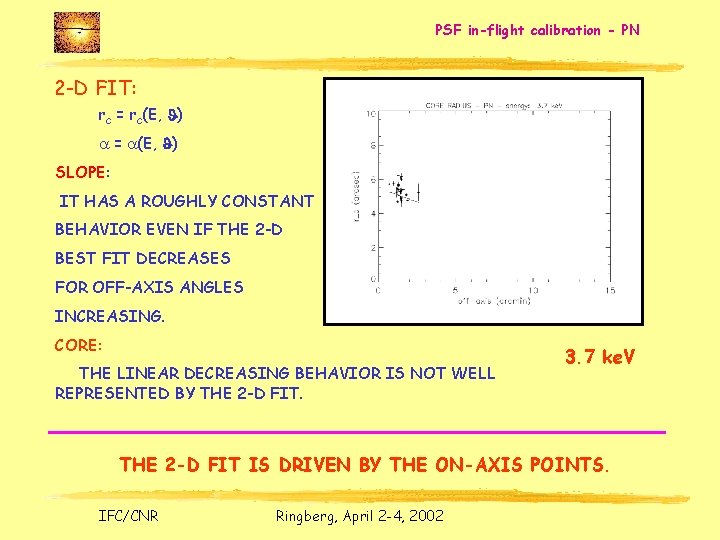
PSF in-flight calibration - PN 2 -D FIT: rc = rc(E, J) a = a(E, J) SLOPE: IT HAS A ROUGHLY CONSTANT BEHAVIOR EVEN IF THE 2 -D BEST FIT DECREASES FOR OFF-AXIS ANGLES INCREASING. CORE: THE LINEAR DECREASING BEHAVIOR IS NOT WELL REPRESENTED BY THE 2 -D FIT. 3. 7 ke. V THE 2 -D FIT IS DRIVEN BY THE ON-AXIS POINTS. IFC/CNR Ringberg, April 2 -4, 2002
PSF in-flight calibration - PN BINNING Data are not well represented by the 2 -D data because they present a very large scatter. The 2 -D fit ( but also each 1 -D fit for any fixed energy) is completely driven by the on-axis data. We bin on the off-axis angle variable with bin 12” wide. IFC/CNR Ringberg, April 2 -4, 2002
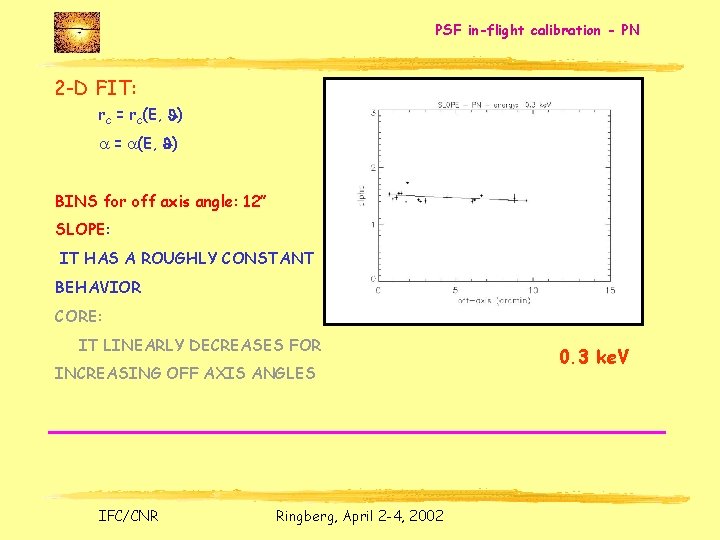
PSF in-flight calibration - PN 2 -D FIT: rc = rc(E, J) a = a(E, J) BINS for off axis angle: 12” SLOPE: IT HAS A ROUGHLY CONSTANT BEHAVIOR CORE: IT LINEARLY DECREASES FOR INCREASING OFF AXIS ANGLES IFC/CNR Ringberg, April 2 -4, 2002 0. 3 ke. V
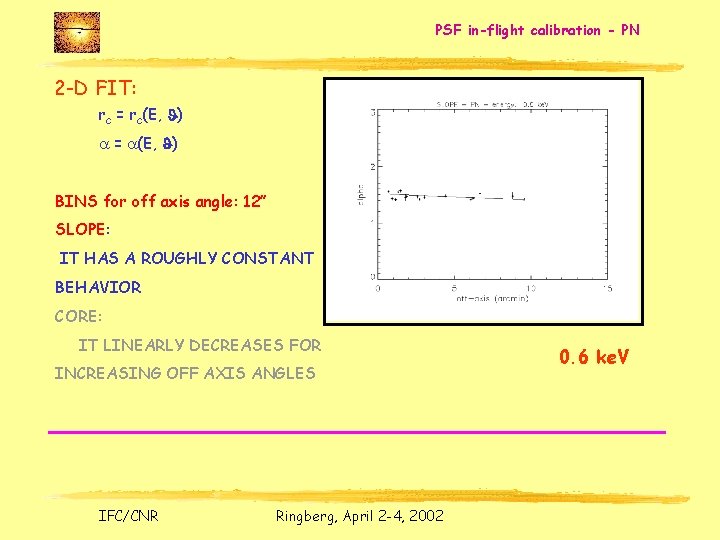
PSF in-flight calibration - PN 2 -D FIT: rc = rc(E, J) a = a(E, J) BINS for off axis angle: 12” SLOPE: IT HAS A ROUGHLY CONSTANT BEHAVIOR CORE: IT LINEARLY DECREASES FOR INCREASING OFF AXIS ANGLES IFC/CNR Ringberg, April 2 -4, 2002 0. 6 ke. V
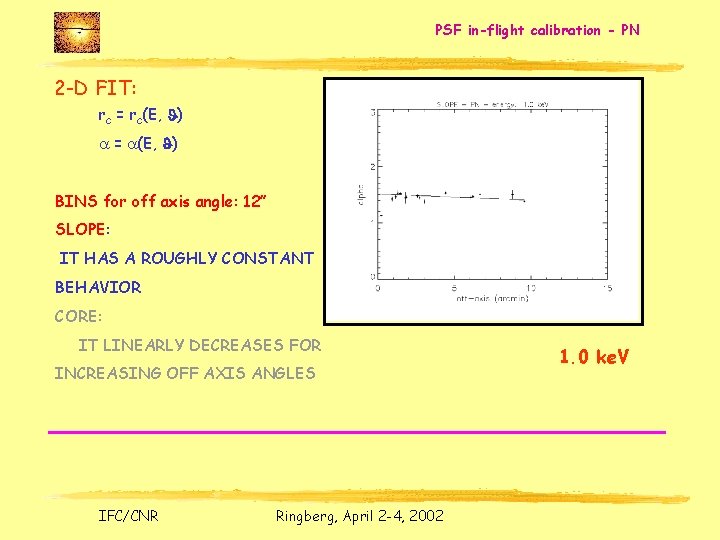
PSF in-flight calibration - PN 2 -D FIT: rc = rc(E, J) a = a(E, J) BINS for off axis angle: 12” SLOPE: IT HAS A ROUGHLY CONSTANT BEHAVIOR CORE: IT LINEARLY DECREASES FOR INCREASING OFF AXIS ANGLES IFC/CNR Ringberg, April 2 -4, 2002 1. 0 ke. V
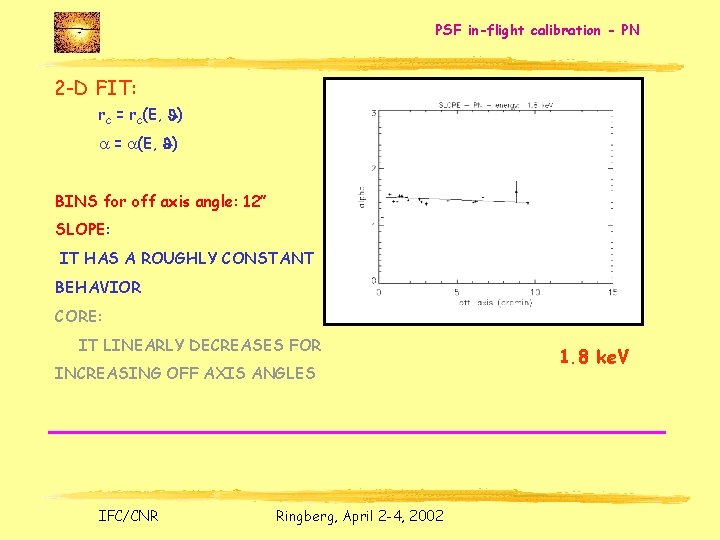
PSF in-flight calibration - PN 2 -D FIT: rc = rc(E, J) a = a(E, J) BINS for off axis angle: 12” SLOPE: IT HAS A ROUGHLY CONSTANT BEHAVIOR CORE: IT LINEARLY DECREASES FOR INCREASING OFF AXIS ANGLES IFC/CNR Ringberg, April 2 -4, 2002 1. 8 ke. V
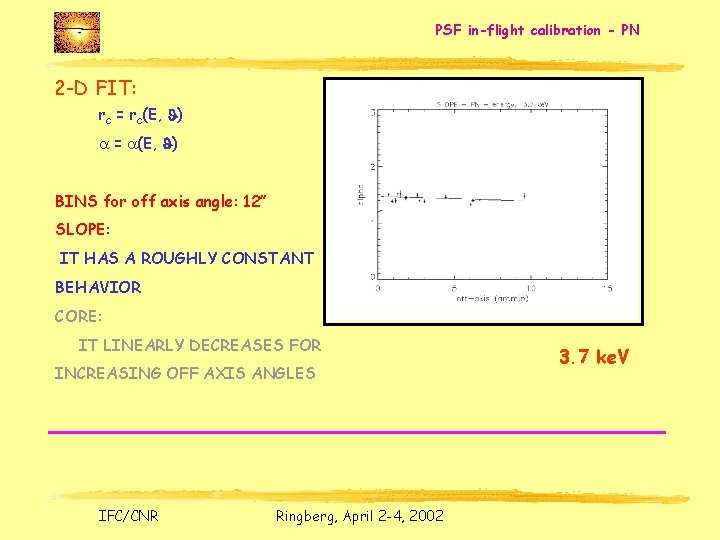
PSF in-flight calibration - PN 2 -D FIT: rc = rc(E, J) a = a(E, J) BINS for off axis angle: 12” SLOPE: IT HAS A ROUGHLY CONSTANT BEHAVIOR CORE: IT LINEARLY DECREASES FOR INCREASING OFF AXIS ANGLES IFC/CNR Ringberg, April 2 -4, 2002 3. 7 ke. V
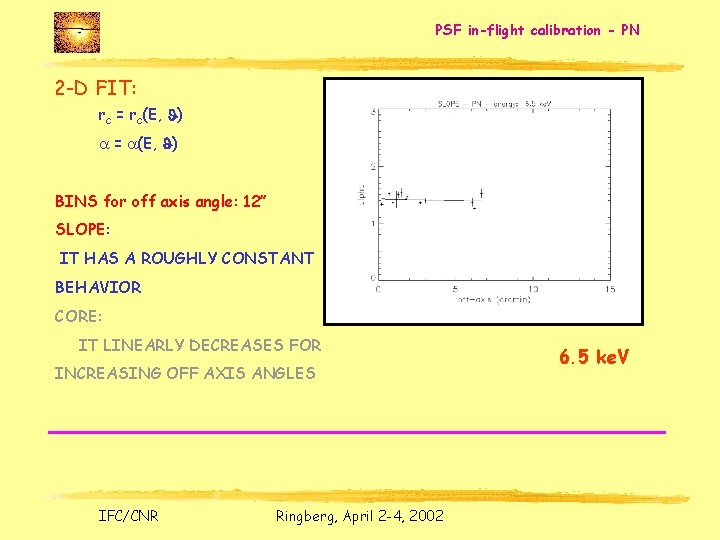
PSF in-flight calibration - PN 2 -D FIT: rc = rc(E, J) a = a(E, J) BINS for off axis angle: 12” SLOPE: IT HAS A ROUGHLY CONSTANT BEHAVIOR CORE: IT LINEARLY DECREASES FOR INCREASING OFF AXIS ANGLES IFC/CNR Ringberg, April 2 -4, 2002 6. 5 ke. V
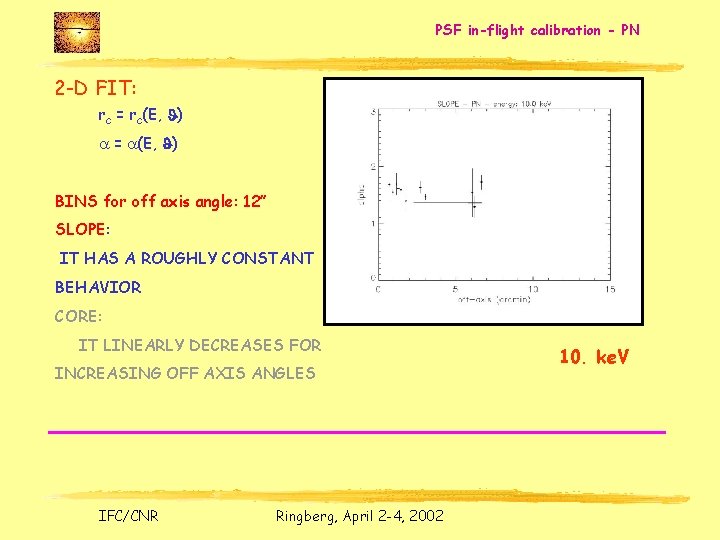
PSF in-flight calibration - PN 2 -D FIT: rc = rc(E, J) a = a(E, J) BINS for off axis angle: 12” SLOPE: IT HAS A ROUGHLY CONSTANT BEHAVIOR CORE: IT LINEARLY DECREASES FOR INCREASING OFF AXIS ANGLES IFC/CNR Ringberg, April 2 -4, 2002 10. ke. V
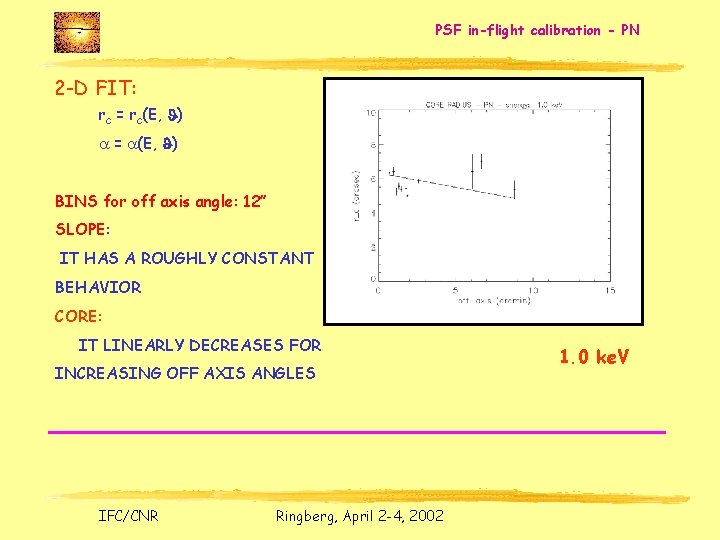
PSF in-flight calibration - PN 2 -D FIT: rc = rc(E, J) a = a(E, J) BINS for off axis angle: 12” SLOPE: IT HAS A ROUGHLY CONSTANT BEHAVIOR CORE: IT LINEARLY DECREASES FOR INCREASING OFF AXIS ANGLES IFC/CNR Ringberg, April 2 -4, 2002 1. 0 ke. V
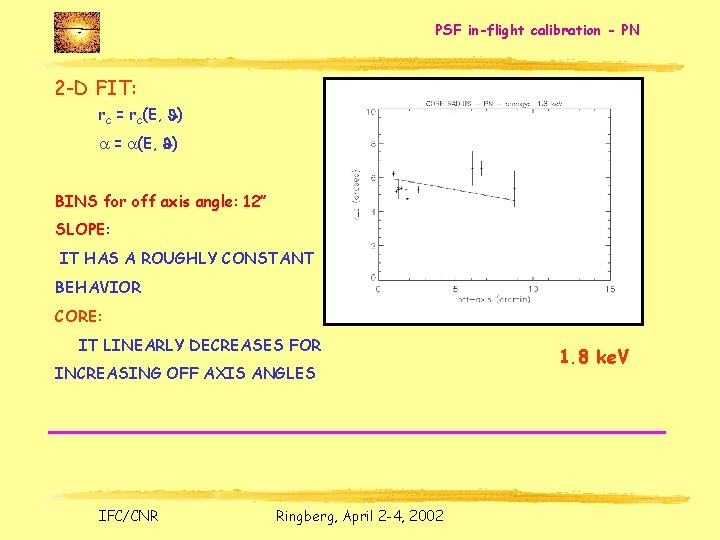
PSF in-flight calibration - PN 2 -D FIT: rc = rc(E, J) a = a(E, J) BINS for off axis angle: 12” SLOPE: IT HAS A ROUGHLY CONSTANT BEHAVIOR CORE: IT LINEARLY DECREASES FOR INCREASING OFF AXIS ANGLES IFC/CNR Ringberg, April 2 -4, 2002 1. 8 ke. V
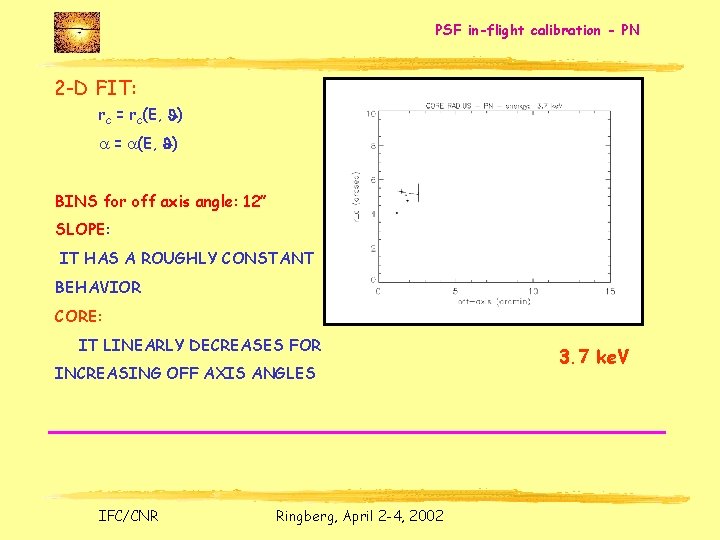
PSF in-flight calibration - PN 2 -D FIT: rc = rc(E, J) a = a(E, J) BINS for off axis angle: 12” SLOPE: IT HAS A ROUGHLY CONSTANT BEHAVIOR CORE: IT LINEARLY DECREASES FOR INCREASING OFF AXIS ANGLES IFC/CNR Ringberg, April 2 -4, 2002 3. 7 ke. V
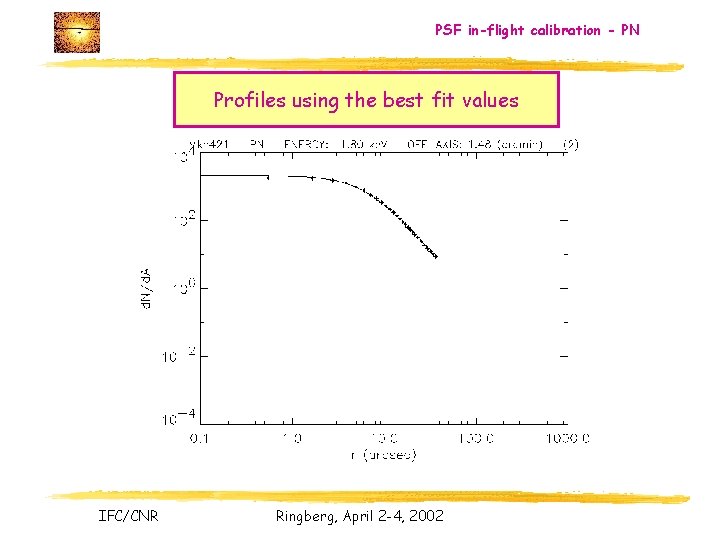
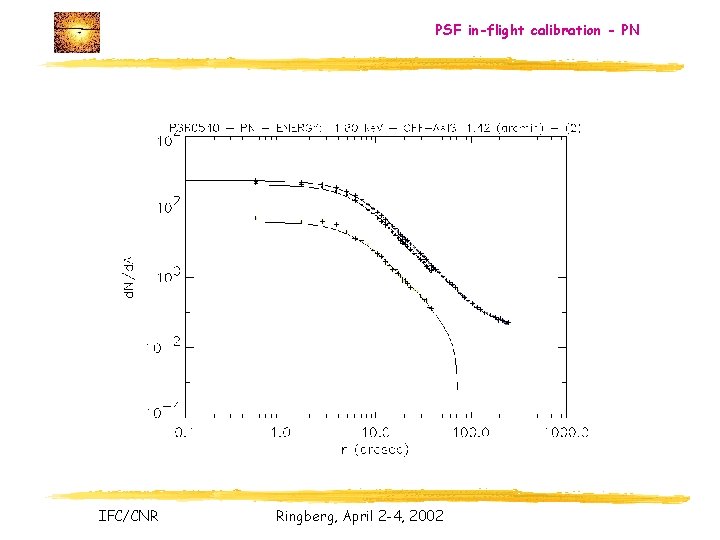
PSF in-flight calibration - PN Profiles using the best fit values IFC/CNR Ringberg, April 2 -4, 2002
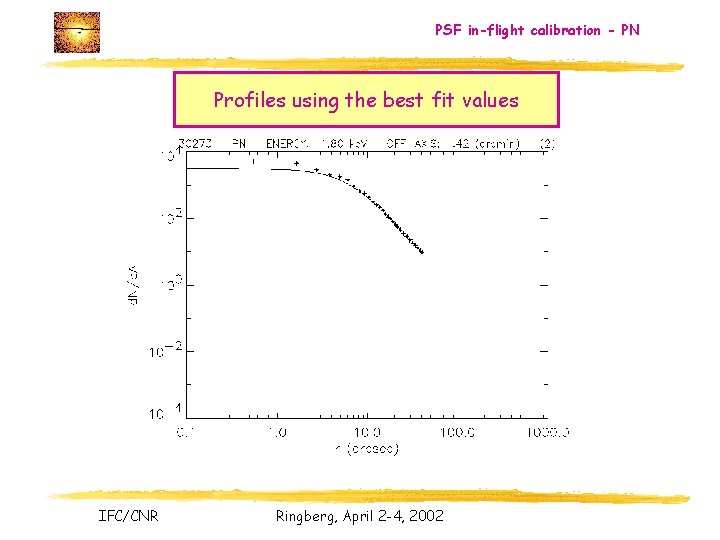
PSF in-flight calibration - PN Profiles using the best fit values IFC/CNR Ringberg, April 2 -4, 2002
PSF in-flight calibration - PN WHY SUCH A SCATTER ? Out of time events can affect the slope of the profile Pile up is less evident in the PN data. Are we neglecting a pile up effect? Centroiding is very difficult because of the large size of the pixels. This makes the determination of the core uncertain especially for the Small Window op. mode. …TO BE INVESTIGATED IFC/CNR Ringberg, April 2 -4, 2002
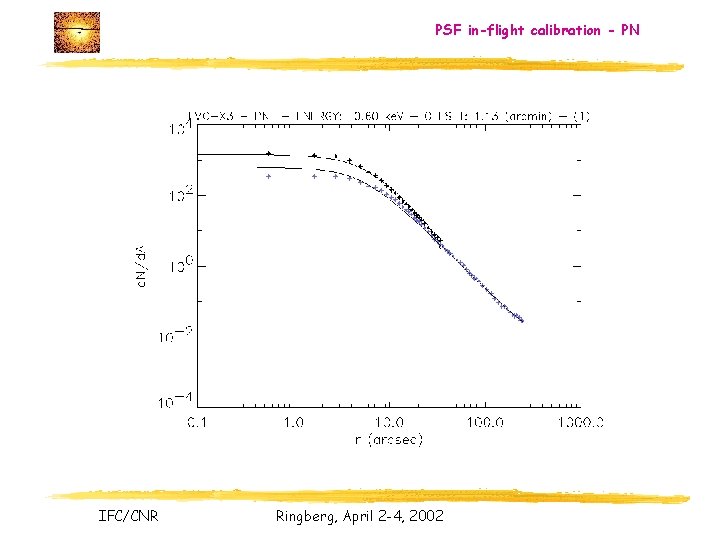
PSF in-flight calibration - PN IFC/CNR Ringberg, April 2 -4, 2002
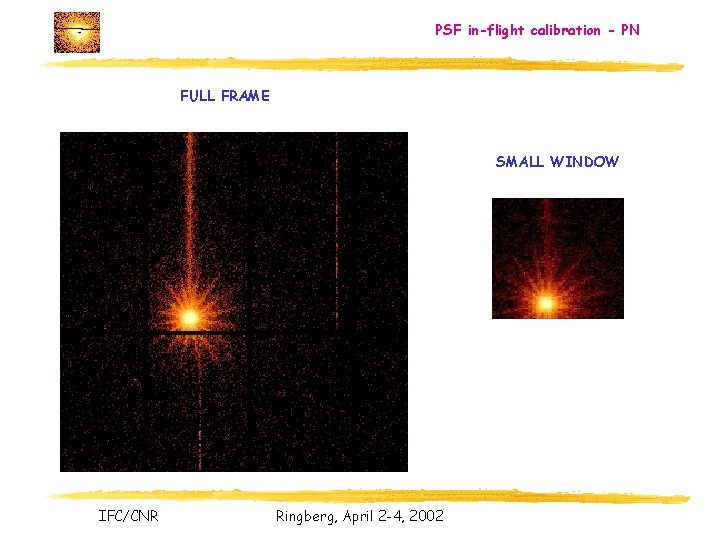
PSF in-flight calibration - PN FULL FRAME SMALL WINDOW IFC/CNR Ringberg, April 2 -4, 2002
PSF in-flight calibration - PN WHY SUCH A SCATTER ? Out of time events can affect the slope of the profile Pile up is less evident in the PN data. Are we neglecting a pile up effect? Centroiding is very difficult because of the large size of the pixels. This makes the determination of the core uncertain especially for the Small Window op. mode. …TO BE INVESTIGATED IFC/CNR Ringberg, April 2 -4, 2002
PSF in-flight calibration - PN IFC/CNR Ringberg, April 2 -4, 2002
PSF in-flight calibration - PN WHY SUCH A SCATTER ? Out of time events can affect the slope of the profile Pile up is less evident in the PN data. Are we neglecting a pile up effect? Centroiding is very difficult because of the large size of the pixels. This makes the determination of the core uncertain especially for the Small Window op. mode. …TO BE INVESTIGATED IFC/CNR Ringberg, April 2 -4, 2002
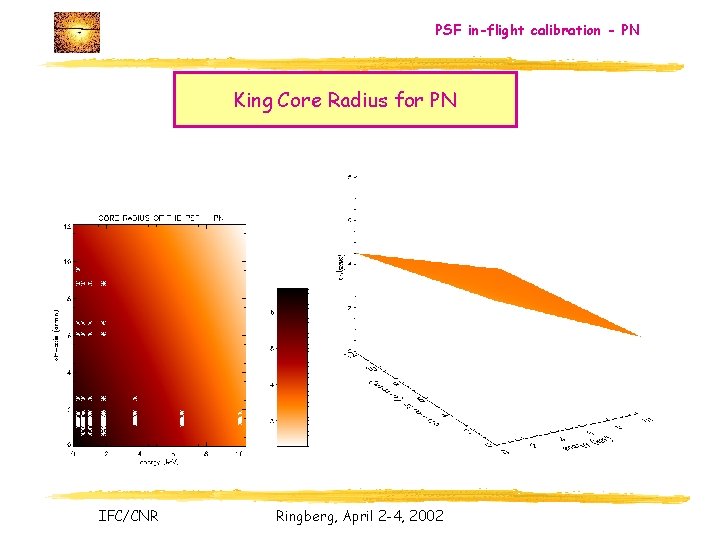
PSF in-flight calibration - PN King Core Radius for PN IFC/CNR Ringberg, April 2 -4, 2002
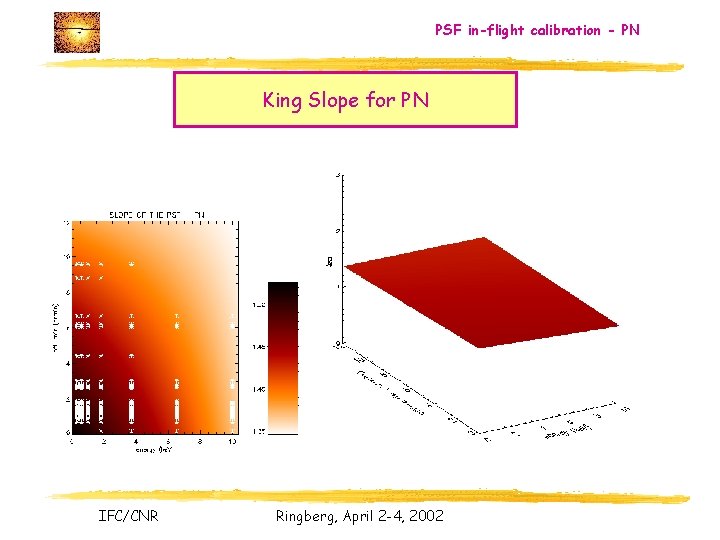
PSF in-flight calibration - PN King Slope for PN IFC/CNR Ringberg, April 2 -4, 2002
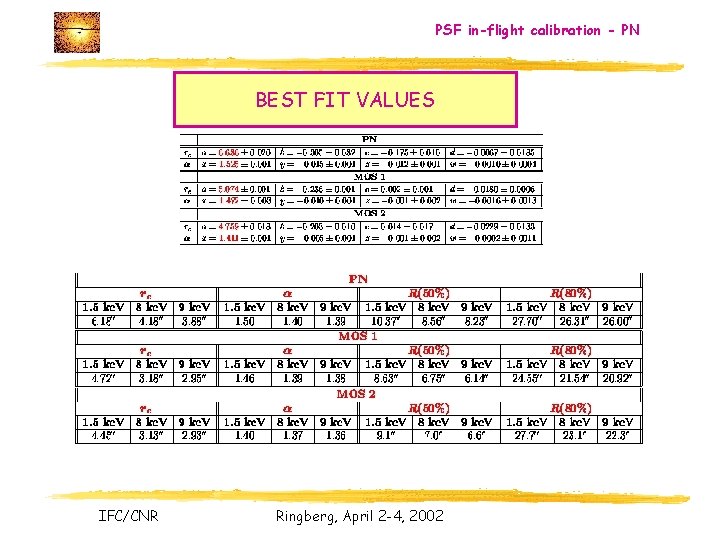
PSF in-flight calibration - PN BEST FIT VALUES IFC/CNR Ringberg, April 2 -4, 2002
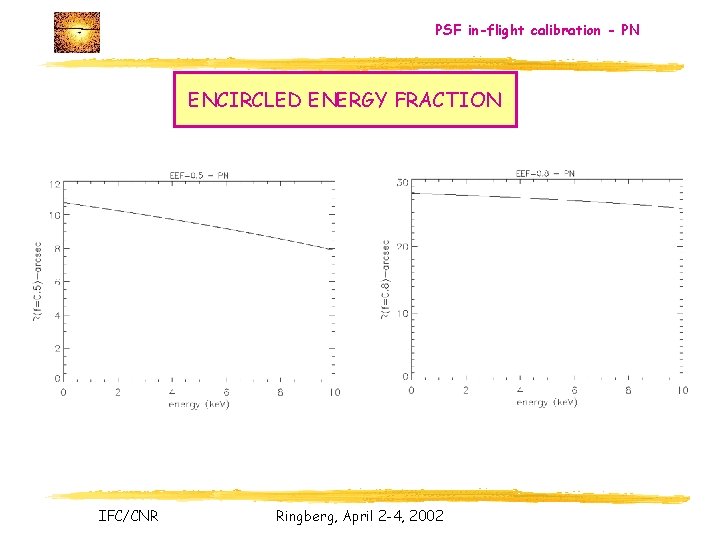
PSF in-flight calibration - PN ENCIRCLED ENERGY FRACTION IFC/CNR Ringberg, April 2 -4, 2002
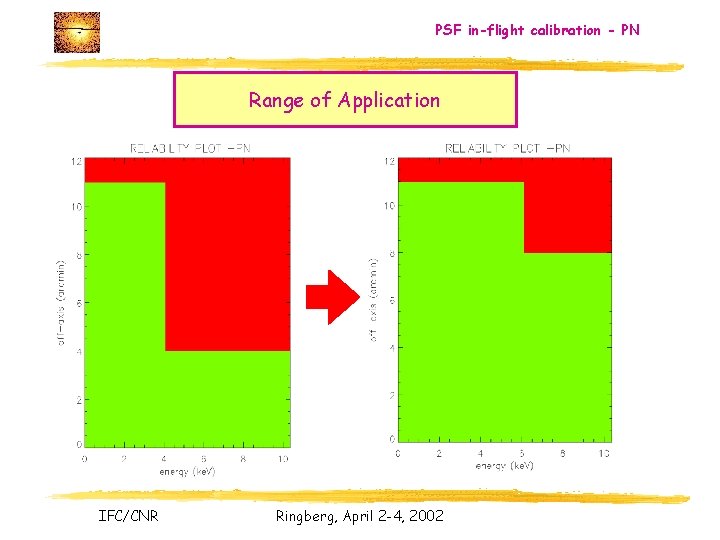
PSF in-flight calibration - PN Range of Application IFC/CNR Ringberg, April 2 -4, 2002
PSF in-flight calibration - PN CONCLUSIONS By using a large set of data we modeled the PSF profile with a King function and provided the best fit values of the core and of the slope as functions of the energy and of the off-axis angle. To be done … We must include in the sample some other off-axis sources to enlarge the region of the range of application. Check on : evaluation of the background in the Small Window measures out of time events pile-up centroiding procedures in order to reduce the scatter of the points IFC/CNR Ringberg, April 2 -4, 2002
- Slides: 43