
PseudoSkeleton based ARAP Mesh Deformation M Zollhfer A
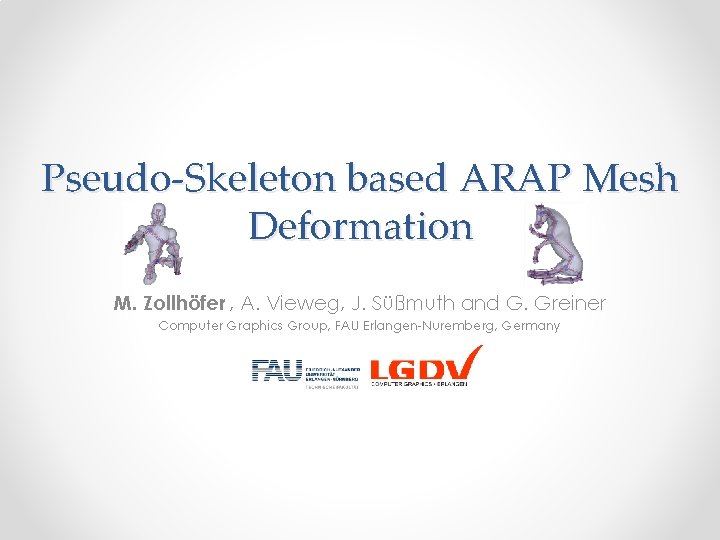
Pseudo-Skeleton based ARAP Mesh Deformation M. Zollhöfer , A. Vieweg, J. Süßmuth and G. Greiner Computer Graphics Group, FAU Erlangen-Nuremberg, Germany
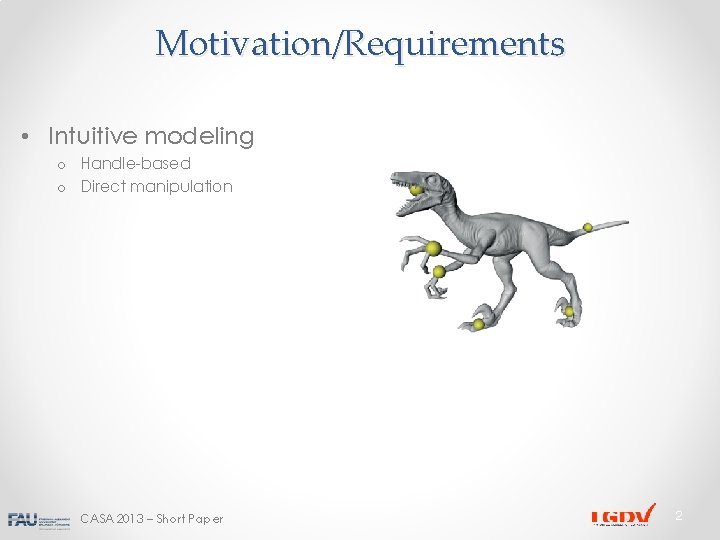
Motivation/Requirements • Intuitive modeling o Handle-based o Direct manipulation CASA 2013 – Short Paper 2
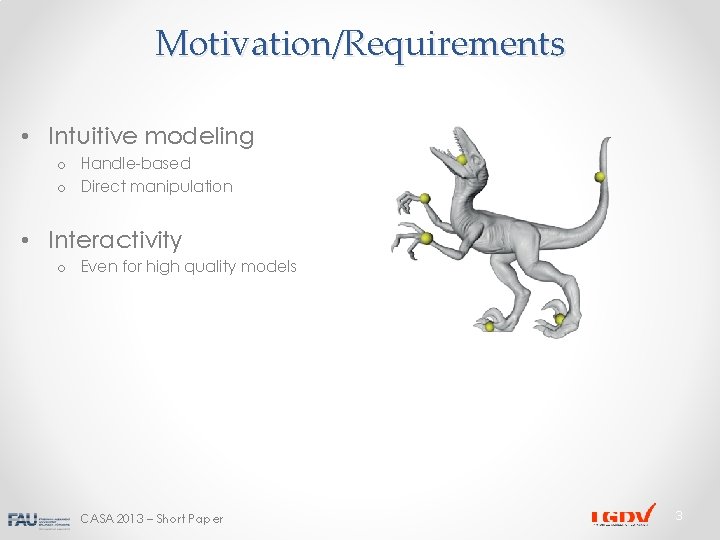
Motivation/Requirements • Intuitive modeling o Handle-based o Direct manipulation • Interactivity o Even for high quality models CASA 2013 – Short Paper 3
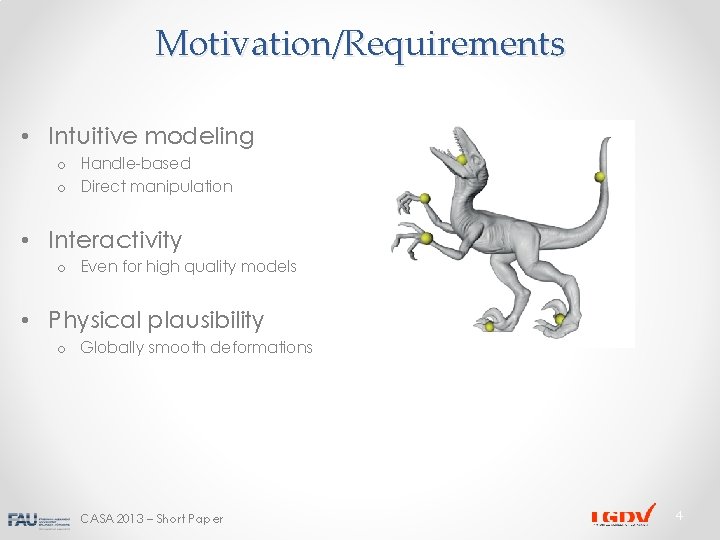
Motivation/Requirements • Intuitive modeling o Handle-based o Direct manipulation • Interactivity o Even for high quality models • Physical plausibility o Globally smooth deformations CASA 2013 – Short Paper 4

Related Work • ARAP Surface Modeling CASA 2013 – Short Paper [SA 07] 5

Related Work • ARAP Surface Modeling • GPU based Volumetric ARAP CASA 2013 – Short Paper [SA 07] [ZSGS 12] 6

Related Work • ARAP Surface Modeling • GPU based Volumetric ARAP • Hybrid Mesh Editing CASA 2013 – Short Paper [SA 07] [ZSGS 12] [BHZN 10] 7
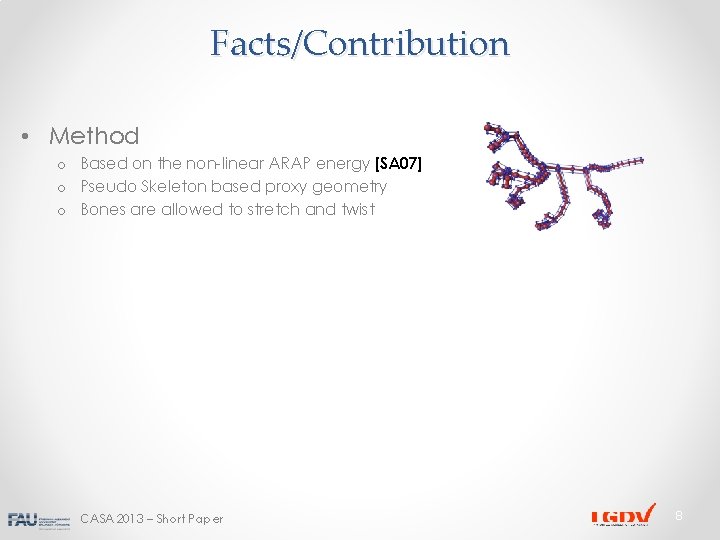
Facts/Contribution • Method o Based on the non-linear ARAP energy [SA 07] o Pseudo Skeleton based proxy geometry o Bones are allowed to stretch and twist CASA 2013 – Short Paper 8
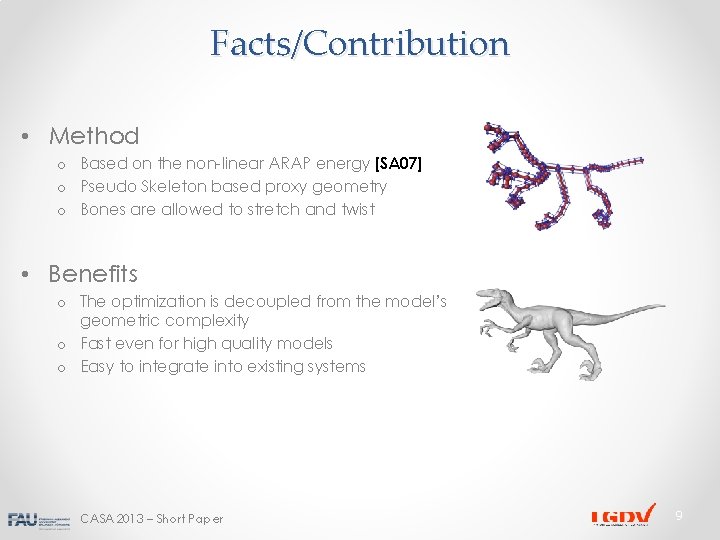
Facts/Contribution • Method o Based on the non-linear ARAP energy [SA 07] o Pseudo Skeleton based proxy geometry o Bones are allowed to stretch and twist • Benefits o The optimization is decoupled from the model’s geometric complexity o Fast even for high quality models o Easy to integrate into existing systems CASA 2013 – Short Paper 9

Overview • Preprocessing o Automatically create pseudo skeleton • Decouple problem from model complexity • Transparent for the user CASA 2013 – Short Paper 10
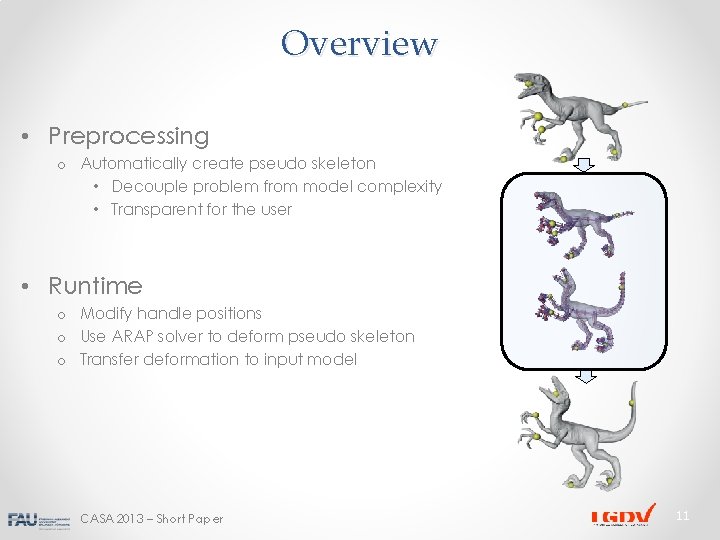
Overview • Preprocessing o Automatically create pseudo skeleton • Decouple problem from model complexity • Transparent for the user • Runtime o Modify handle positions o Use ARAP solver to deform pseudo skeleton o Transfer deformation to input model CASA 2013 – Short Paper 11

Proxy Geometry • Pseudo Skeleton • Mesh Contraction [ACCTL 08] o Skinning weights • Diffusion based [BP 07 ] o Add Pseudo bones • Local rotations under-determined CASA 2013 – Short Paper 12

Proxy Geometry • Pseudo Skeleton • Mesh Contraction [ACCTL 08] o Skinning weights • Diffusion based [BP 07 ] o Add Pseudo bones • Local rotations under-determined • Bone to vertex mapping o Linear Blend Skinning (LBS) CASA 2013 – Short Paper 13

Proxy Geometry • Pseudo Skeleton • Mesh Contraction [ACCTL 08] o Skinning weights • Diffusion based [BP 07 ] o Add Pseudo bones • Local rotations under-determined • Bone to vertex mapping o Linear Blend Skinning (LBS) • Adjust skeleton complexity o Only keep neccessary Do. Fs CASA 2013 – Short Paper 14
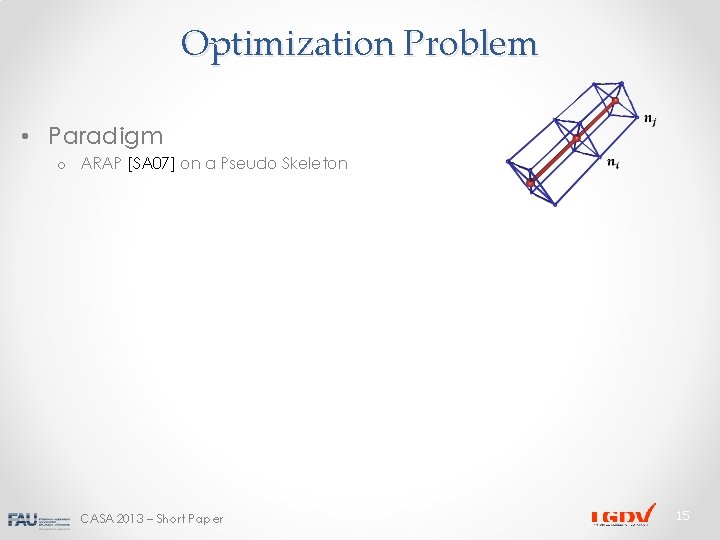
Optimization Problem • Paradigm o ARAP [SA 07] on a Pseudo Skeleton CASA 2013 – Short Paper 15

Optimization Problem • Paradigm o ARAP [SA 07] on a Pseudo Skeleton o Objective function • Plausibility of deformation o Rigidity of local transformations CASA 2013 – Short Paper 16

Optimization Problem • Paradigm o ARAP [SA 07] on a Pseudo Skeleton o Objective function • Plausibility of deformation o Rigidity of local transformations • Fulfillment of user constraints o Distance between vertices and handles CASA 2013 – Short Paper 17

Optimization Problem • Paradigm o ARAP [SA 07] on a Pseudo Skeleton o Objective function • Plausibility of deformation o Rigidity of local transformations • Fulfillment of user constraints o Distance between vertices and handles Ø Non-linear optimization problem CASA 2013 – Short Paper 18
Minimizing the Objective Function • Why do we use the ARAP paradigm? o Non-linear rotation-aware objective function o Minimization does not require a general-purpose non-linear solver CASA 2013 – Short Paper 19
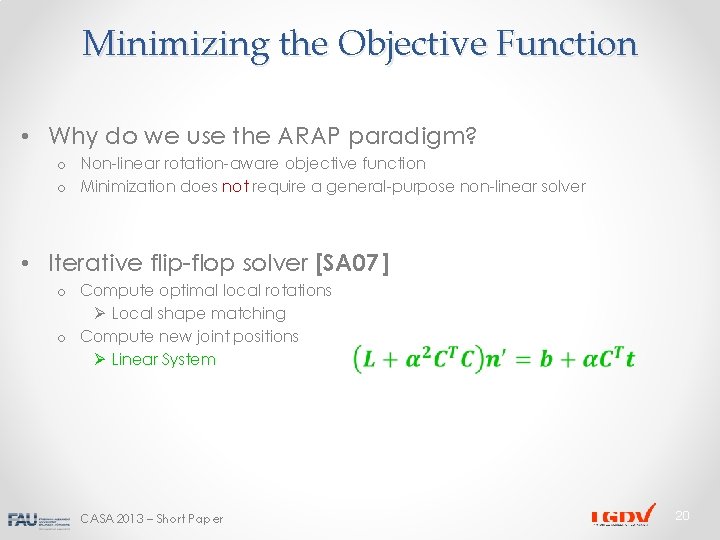
Minimizing the Objective Function • Why do we use the ARAP paradigm? o Non-linear rotation-aware objective function o Minimization does not require a general-purpose non-linear solver • Iterative flip-flop solver [SA 07] o Compute optimal local rotations Ø Local shape matching o Compute new joint positions Ø Linear System CASA 2013 – Short Paper 20
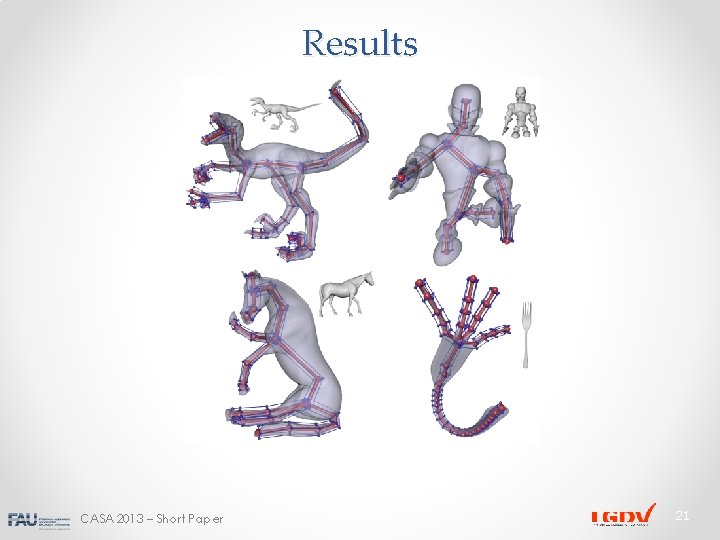
Results CASA 2013 – Short Paper 21
Video CASA 2013 – Short Paper 22

Facts • Evaluation o Core 2 Quad Q 9450 CPU @2. 66 GHz, NVidia Ge. Force GTX 285 GPU o 11. 1 ms to deform a 10 k polygon model (47 joints) o Pseudo geometry gives a 24 x speedup compared to ARAP Ø Most time spend in LBS Ø Could be easily computed on the GPU CASA 2013 – Short Paper 23
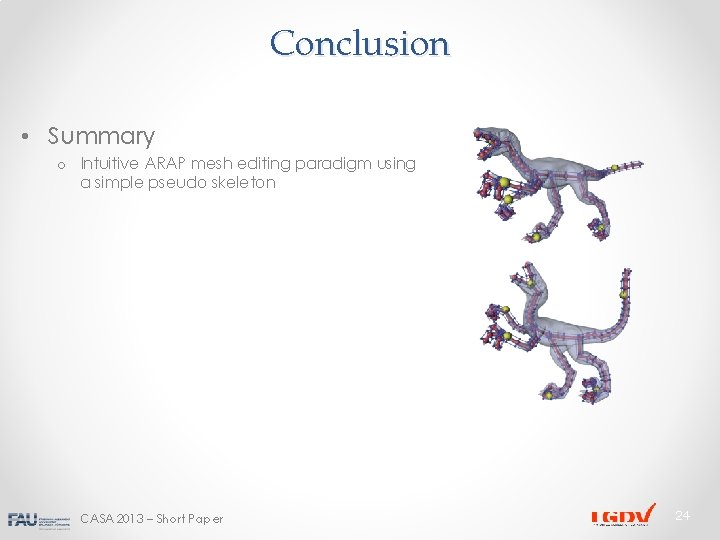
Conclusion • Summary o Intuitive ARAP mesh editing paradigm using a simple pseudo skeleton CASA 2013 – Short Paper 24
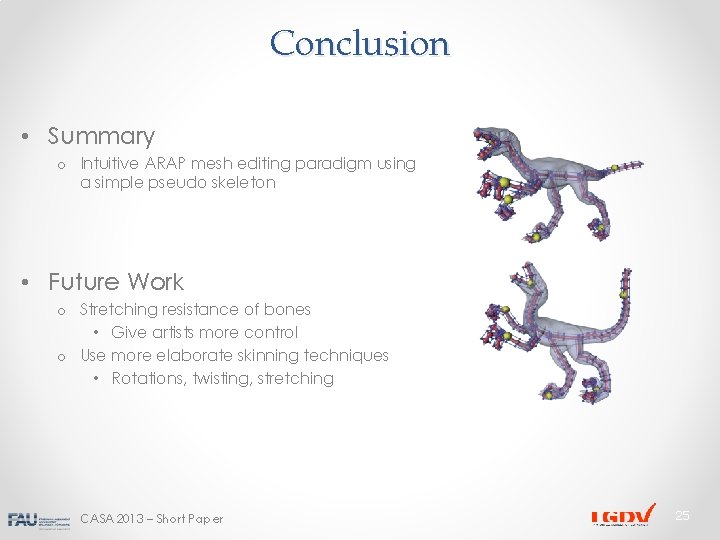
Conclusion • Summary o Intuitive ARAP mesh editing paradigm using a simple pseudo skeleton • Future Work o Stretching resistance of bones • Give artists more control o Use more elaborate skinning techniques • Rotations, twisting, stretching CASA 2013 – Short Paper 25

Thanks for your attention! Questions? 26
- Slides: 26