
Pseudoscience and Junk Science Mrs Karen Baranoski Wilkes
Pseudoscience and Junk Science Mrs. Karen Baranoski Wilkes University Ed 370 & 371 2015; Revised 2020
Scientific Method • • • Define problem. Perform research. Form a hypothesis. Perform experiment. Observe, collect data. Arrive at conclusion. Does it support your hypothesis? • Purpose for using: It helps a person think logically about the world.
“Critical Thinking” • “Critical thinking means correct thinking in the pursuit of relevant and reliable knowledge about the world”. A person who thinks critically can ask appropriate questions, gather relevant information, efficiently and creatively sort through this information, reason logically from this information, and come to reliable and trustworthy conclusions about the world that enable one to live and act successfully in it. ” • Schafersman, Steven D. An introduction to critical thinking. June, 1991. www. freeinquiry. com/critical thinking. html.
Junk Science • Definition: Faulty scientific data and analysis used to further a special agenda, such as the “Ab Rocket” or “Wu. Yi Tea Diet Plan” • Who uses it? The media, personal injury lawyers, social activists, government regulators, businesses, politicians, individual self-motivated scientists, individuals selling consumer products (From Union of Concerned Scientists)

Pseudoscience • Definition: Beliefs or practices mistakenly regarded as being based on the scientific method (Compact Oxford English Dictionary, 2003), such as “Big Foot” • It “sounds scientific, ” but is not based on extensive, peer reviewed research that is reproducible.
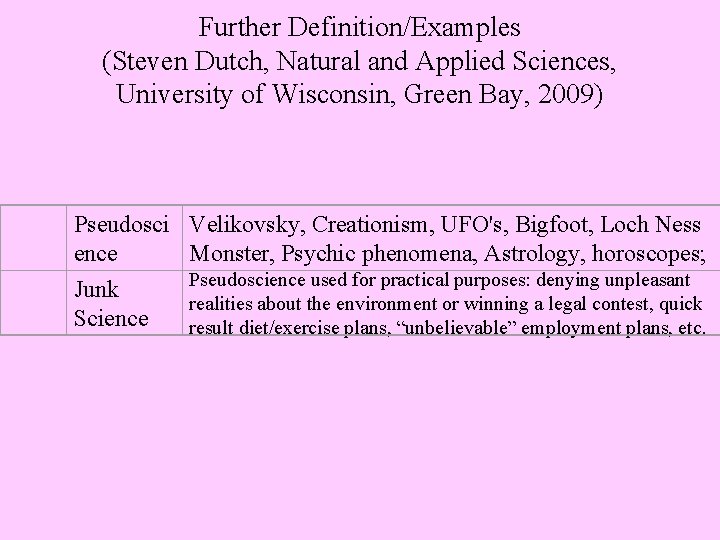
Further Definition/Examples (Steven Dutch, Natural and Applied Sciences, University of Wisconsin, Green Bay, 2009) Pseudosci ence Junk Science Velikovsky, Creationism, UFO's, Bigfoot, Loch Ness Monster, Psychic phenomena, Astrology, horoscopes; Pseudoscience used for practical purposes: denying unpleasant realities about the environment or winning a legal contest, quick result diet/exercise plans, “unbelievable” employment plans, etc.
Why should this lesson be taught to elementary and secondary students? *To help students: 1. 1. 2. 3. Develop critical thinking skills. Become intelligent consumers. Avoid losing money in scams. Recognize false statements by politicians or those in authority about diseases, use of vaccines, climate change, etc. and rely on scientific evidence when choosing leaders, lifestyles, etc. 4. Avoid damaging health with faulty diet plans, nutritional supplements, or exercise regimens. * Starting by 3 rd -4 th grade.
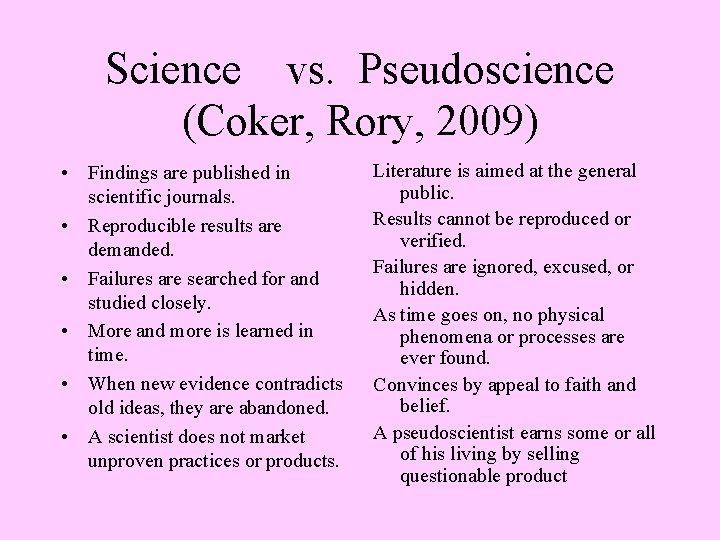
Science vs. Pseudoscience (Coker, Rory, 2009) • Findings are published in scientific journals. • Reproducible results are demanded. • Failures are searched for and studied closely. • More and more is learned in time. • When new evidence contradicts old ideas, they are abandoned. • A scientist does not market unproven practices or products. Literature is aimed at the general public. Results cannot be reproduced or verified. Failures are ignored, excused, or hidden. As time goes on, no physical phenomena or processes are ever found. Convinces by appeal to faith and belief. A pseudoscientist earns some or all of his living by selling questionable product
Sample Lesson Plan 1. After discussing the scientific method, use examples of pseudoscience and junk science such as Big Foot and a fantastic diet plan from a newspaper or magazine. 2. Have students read and discuss pros and cons of the topic in groups or as an individual writing assignment if working from home. 3. Have students bring examples to class for a group collage, or if working from home make an individual collage or hand drawn poster from examples of this topic.
References • Baranoski, K. 2015. Information on scientific method, sample lesson plan, etc. • King’s College; Biology 111 Lab information. 2009. Pseudoscience and junk science (some sources embedded within Power. Point).
- Slides: 10