
PSCYCHIATRIC EMERGENCIES Dr Miada Mahmoud Rady Definitions Behavioral
PSCYCHIATRIC EMERGENCIES Dr. Miada Mahmoud Rady
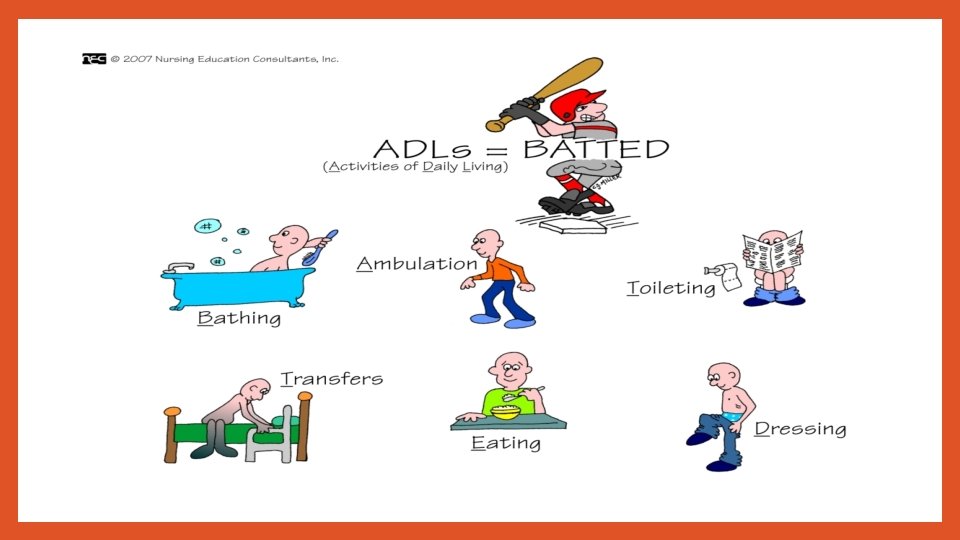
Definitions • Behavioral emergency : disorder of mood, thought, or behavior that interferes with ADLs • Psychiatric emergency : Behavior that threatens a person’s health or safety and the health and safety of another person.
Medicolegal Considerations q When behavior, speech, and thoughts are erratic, it can be difficult to communicate so in order to avoid medicolegal issues , you should : 1. Spend time with the patient. 2. Obtain consent when possible. 3. Be clear in your explanations.
Causes of Abnormal Behavior q Four broad categories: 1. Biologic or organic in nature 2. Resulting from the environment 3. Resulting from acute injury or illness 4. Substance-related
Causes of Abnormal Behavior A. Biologic or organic : Conditions alter the functioning of the brain (Organic brain syndrome) B. Environmental ( Psychosocial and sociocultural influences) : Sociological factors affect biology, behavior, and responses to the stress of emergencies also when consistently exposed to stressful events patients develop abnormal reactions.
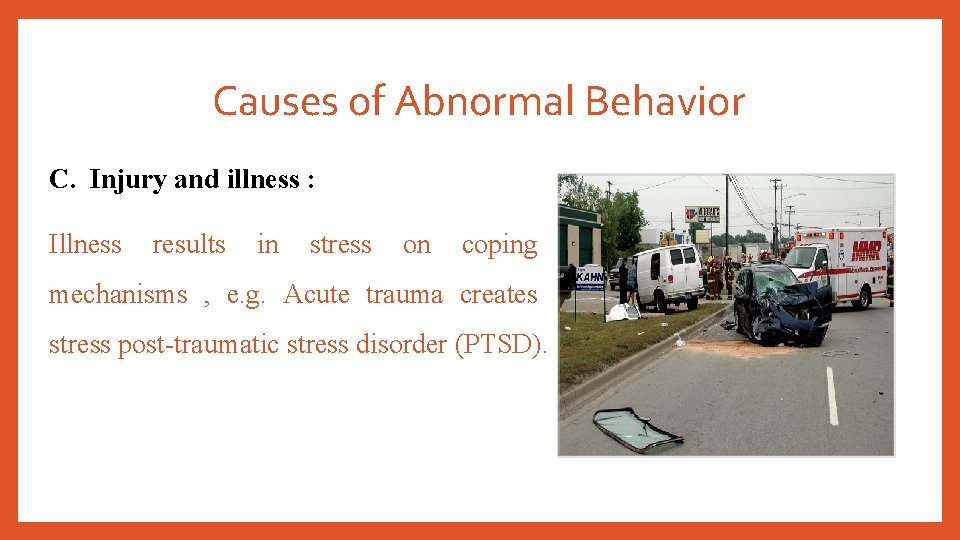
Causes of Abnormal Behavior C. Injury and illness : Illness results in stress on coping mechanisms , e. g. Acute trauma creates stress post-traumatic stress disorder (PTSD).
Causes of Abnormal Behavior D. Substance-related : Abnormal behavior can be induced by consumption of : a. Alcohol b. Illicit drugs c. Other psychoactive substances
Scene Size-Up q. The environment can give clues. 1) Social history 2) Living conditions 3) Availability of support 4) Activity level 5) Medications 6) Overall appearance 7) Attitude/well-being
Primary Assessment 1. Clearly identify yourself. 2. Form a general impression: • Assess • Limit appearance, posture, and pupils. the number of people around the patient and Stay alert to potential danger. 3. Airway and breathing : • Assess the airway and evaluate breathing. • Provide interventions based on your findings
Primary Assessment 4. Circulation • Assess the pulse rate, quality, and rhythm. • Obtain systolic and diastolic blood pressures. • Evaluate • Assess for shock and bleeding. the patient’s perfusion level.
Primary Assessment 5. Transport decision a. Disturbed patients should see a physician. b. If a patient withholds consent, they may be taken against their will at the request of Police and County mental health physician c. In order to use of forcible restraint 1. Law enforcement officers should be summoned. 2. Consult medical command as necessary.
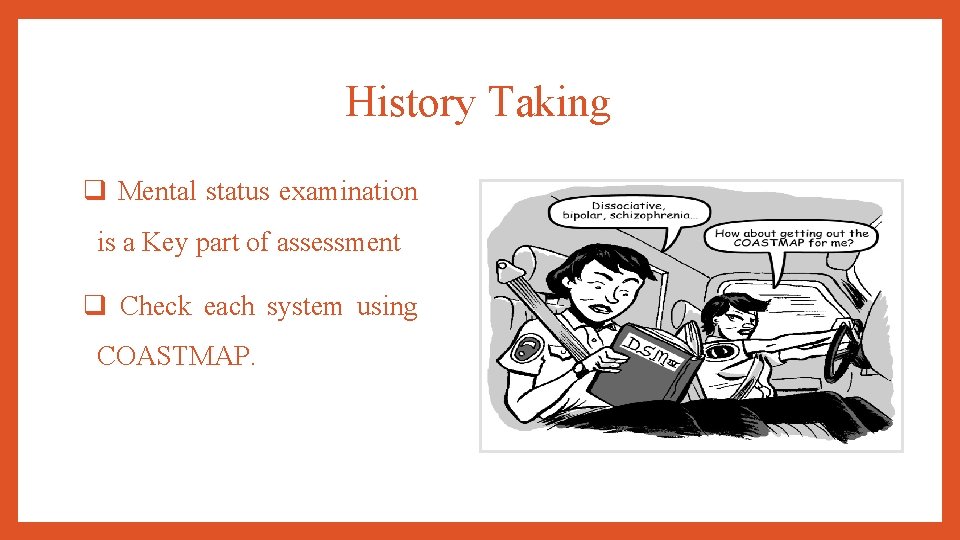
History Taking q Mental status examination is a Key part of assessment q Check each system using COASTMAP.
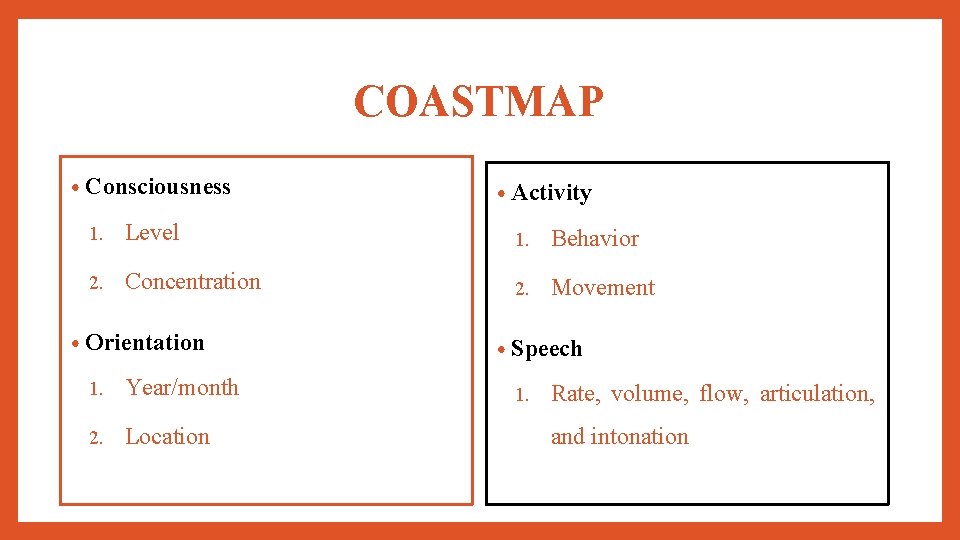
COASTMAP • Consciousness • Activity 1. Level 1. Behavior 2. Concentration 2. Movement • Orientation 1. Year/month 2. Location • Speech 1. Rate, volume, flow, articulation, and intonation
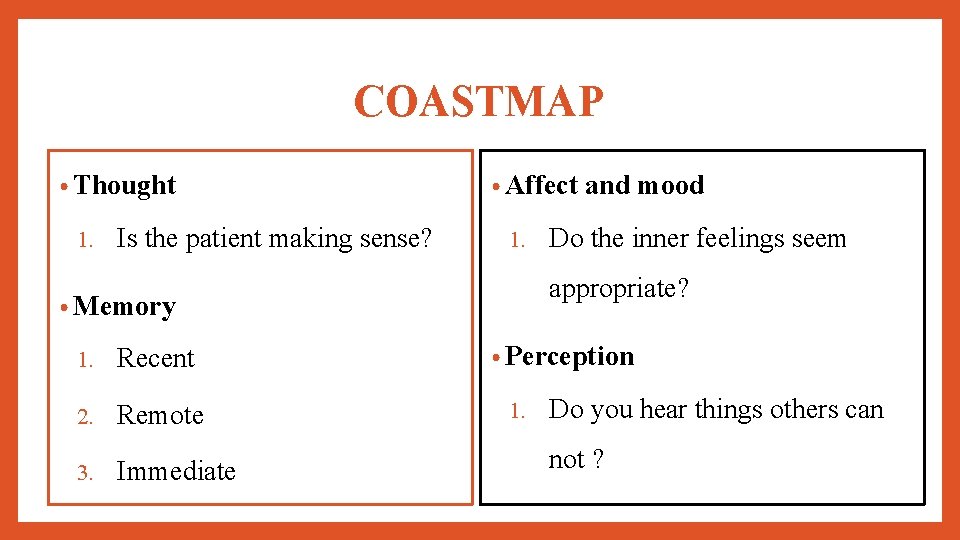
COASTMAP • Thought 1. Is the patient making sense? • Affect 1. Recent 2. Remote 3. Immediate Do the inner feelings seem appropriate? • Memory 1. and mood • Perception 1. Do you hear things others can not ?
Definitions q Mood : sustained emotion that in the extreme, markedly affects the person's perception of the world. q Affect : the expression of emotion or feelings displayed to others through facial expressions, hand gestures, voice tone, and other emotional signs. q Cognition : the mental action or process of acquiring knowledge and understanding through thought, experience, and the senses.
Secondary Assessment 1. Obtain vital signs. 2. Examine skin temperature and moisture. 3. Inspect the head and pupils. 4. Note unusual odors on the breath. 5. In examining the extremities always check for Needle tracks , Tremors and Unilateral weakness or loss of sensation
Reassessment 1. Routinely performed during transport 2. Your radio report should include: a. Medical and mental health history b. Medications prescribed c. Assessment findings d. Information from the mental status examination
Reassessment 3. Discuss with the hospital the need for restraints or medications. 4. If the patient is aggressive or violent, provide advance notice to the emergency department.
Emergency Medical Care • If the erratic behavior could be caused by a medical disorder treat that before presuming the behavior is due to an emotional or psychiatric cause.
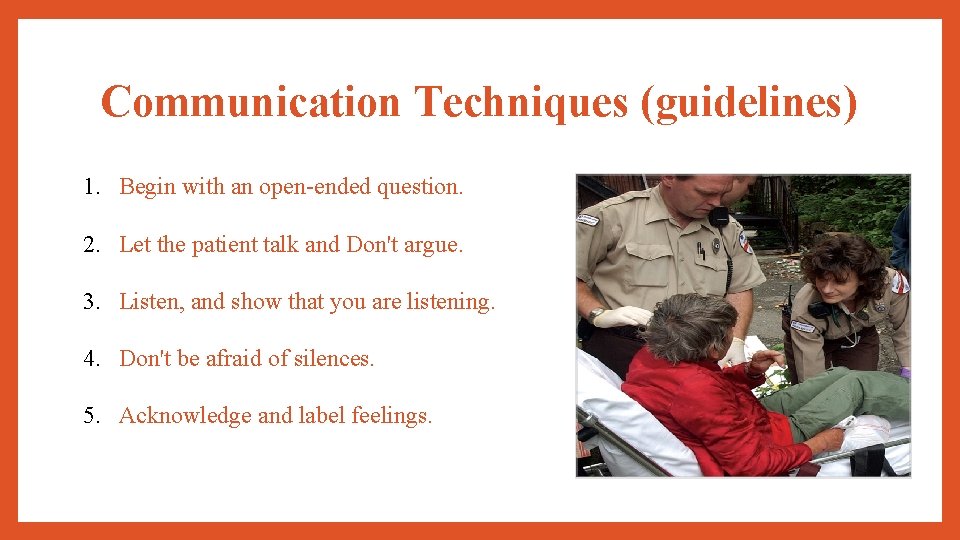
Communication Techniques (guidelines) 1. Begin with an open-ended question. 2. Let the patient talk and Don't argue. 3. Listen, and show that you are listening. 4. Don't be afraid of silences. 5. Acknowledge and label feelings.
Communication Techniques (guidlines) 6. Facilitate communication. 7. Direct the patient’s attention 8. Ask questions ( Avoid “yes-no” or leading questions and Use “how” and “what” questions) 9. Adjust your approach as needed.
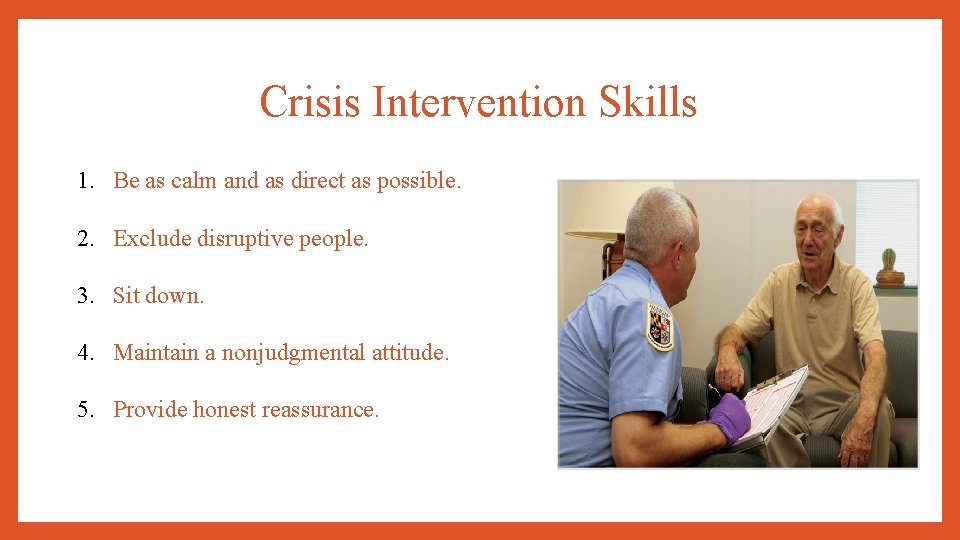
Crisis Intervention Skills 1. Be as calm and as direct as possible. 2. Exclude disruptive people. 3. Sit down. 4. Maintain a nonjudgmental attitude. 5. Provide honest reassurance.
Crisis Intervention Skills 6. Develop a plan of action. 7. Once the plan is set, allow the patient to exercise some control. 8. Be careful if a combative patient suddenly becomes calm. 9. Document everything in the patients chart. 10. You may defend yourself against an attack.
Restrains
PHYSICAL RESTRAINTS
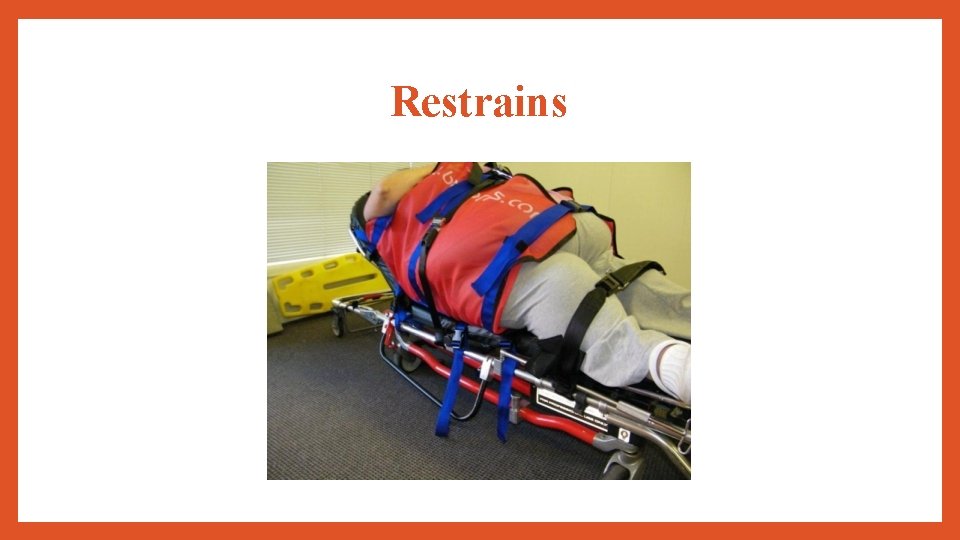
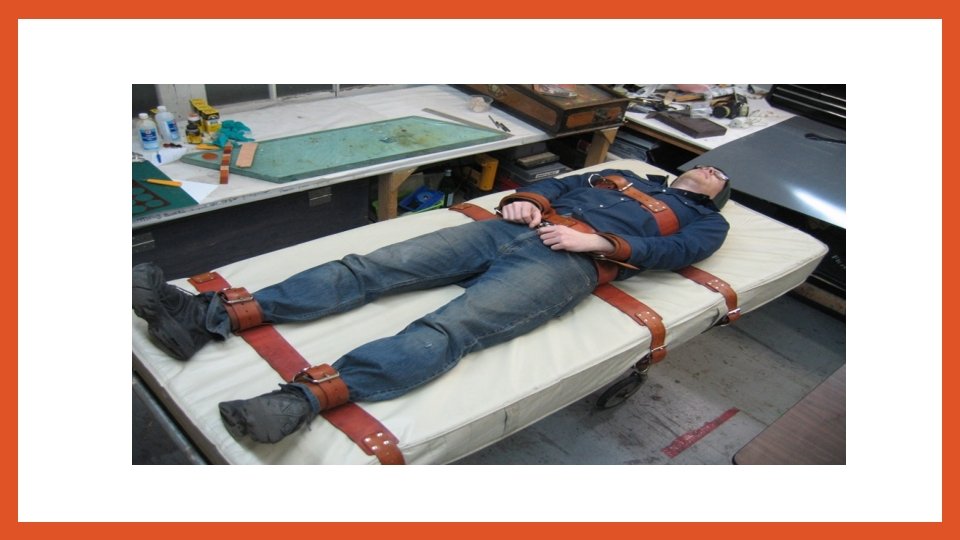
Guidelines for using physical Restraint q Physical restrains are either improvised or commercially made devices 1. Discuss the plan of action before you begin and include law enforcement. 2. Use the minimum force necessary. 3. Don't immediately move toward the patient. 4. Make sure you have sufficient personnel ( Minimum of four trained, able-bodied people)
5. If the show of force doesn't calm the patient, move quickly. • Grasp • The at the elbows, knees, and head , apply restraints to all four extremities. best position is supine 6. Never Tie ankles and wrists together or place a patient facedown in a stretcher 7. Once placed don't remove restraints, don't negotiate or make deals and place a mask over the face of a spitting patient. 8. Continuously monitor the patient and check peripheral circulation every few minutes.
CHEMICAL RESTRAINTS
Chemical Restraint • Definition : use of medication to subdue a patient. • Guidelines for use of chemical restrains : 1. Only use with approval from medical control 2. Follow local protocols and guidelines. 3. Closely monitor the Pulse rate , Blood pressure and Respiratory rate 4. Be prepared to support ventilation.
Chemical Restraint types A. Haloperidol q Administered either IM or IV q Contraindications: a. Patients younger than 14 years. b. Those with a suspected head injury. c. Those who may be pregnant
A. Benzodiazepines q Shorter-acting ones may be given intranasal. q Only midazolam and lorazepam have reliable intramuscular absorption. q Side effects are usually mild and easily treated.
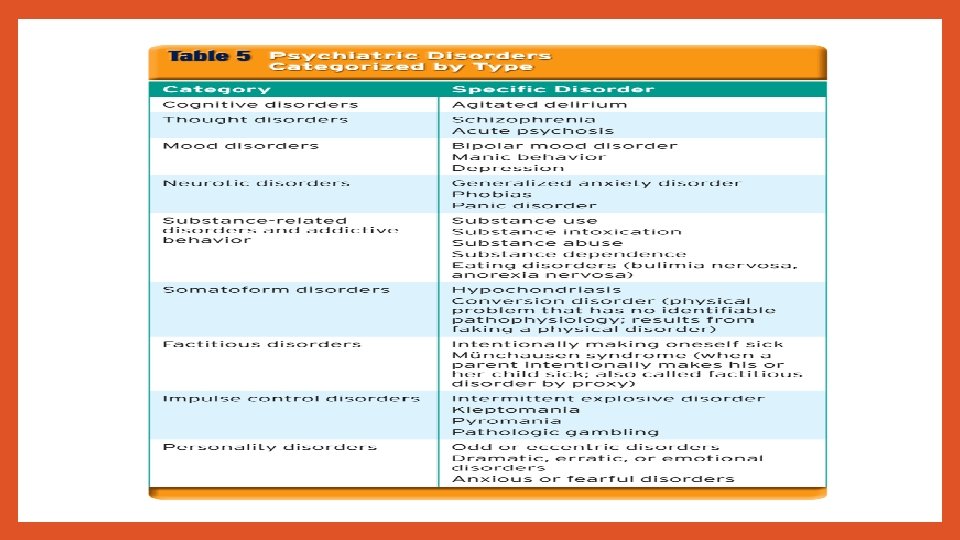
Acute Psychosis I. Definition : a state of delusion characterized by 1. Person is out of touch with reality. 2. Occur for many reasons 3. Episodes can be brief or last a lifetime.
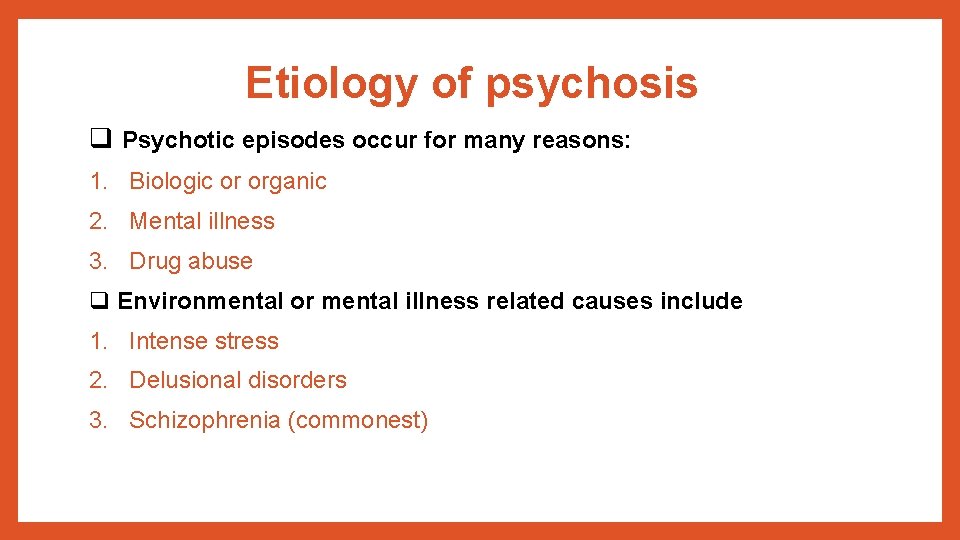
Etiology of psychosis q Psychotic episodes occur for many reasons: 1. Biologic or organic 2. Mental illness 3. Drug abuse q Environmental or mental illness related causes include 1. Intense stress 2. Delusional disorders 3. Schizophrenia (commonest)
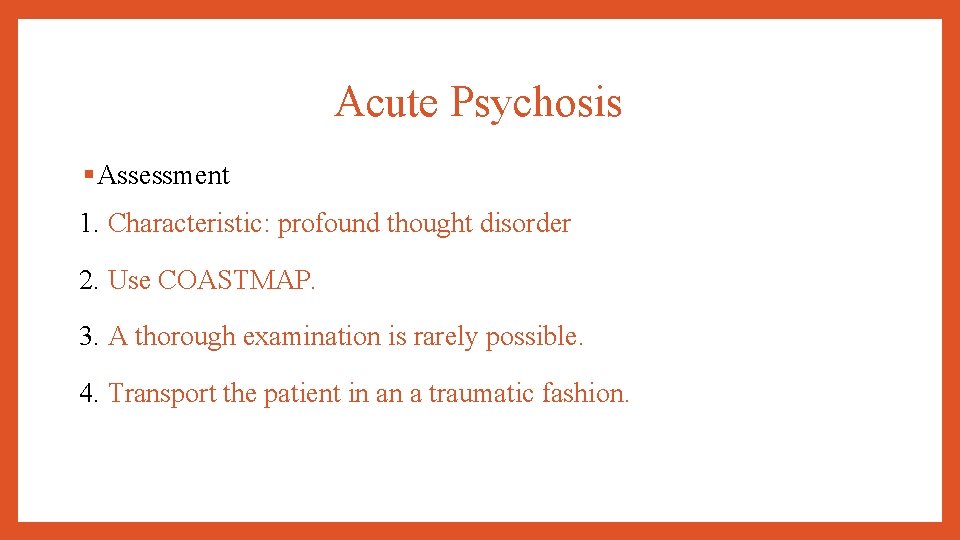
Acute Psychosis § Assessment 1. Characteristic: profound thought disorder 2. Use COASTMAP. 3. A thorough examination is rarely possible. 4. Transport the patient in an a traumatic fashion.
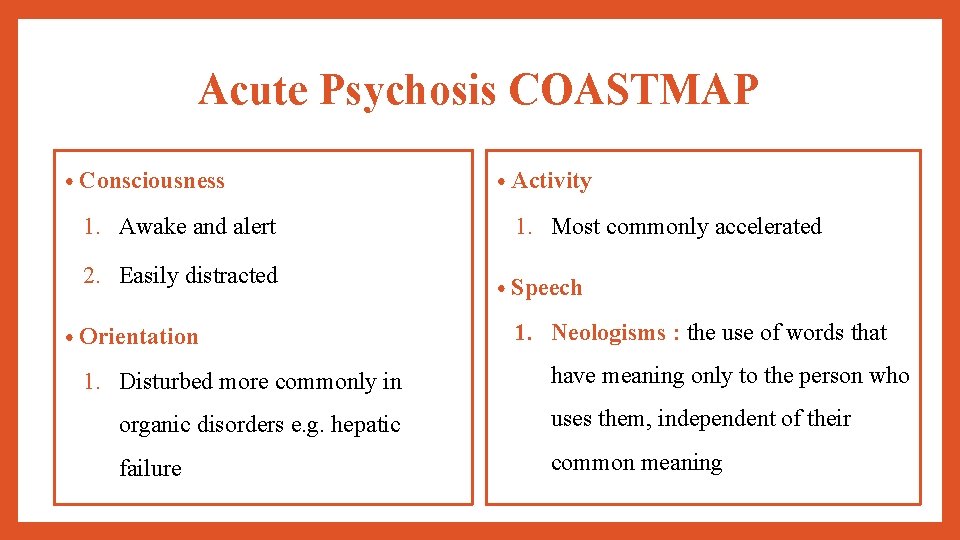
Acute Psychosis COASTMAP • Consciousness 1. Awake and alert 2. Easily distracted • Orientation 1. Disturbed more commonly in • Activity 1. Most commonly accelerated • Speech 1. Neologisms : the use of words that have meaning only to the person who organic disorders e. g. hepatic uses them, independent of their failure common meaning
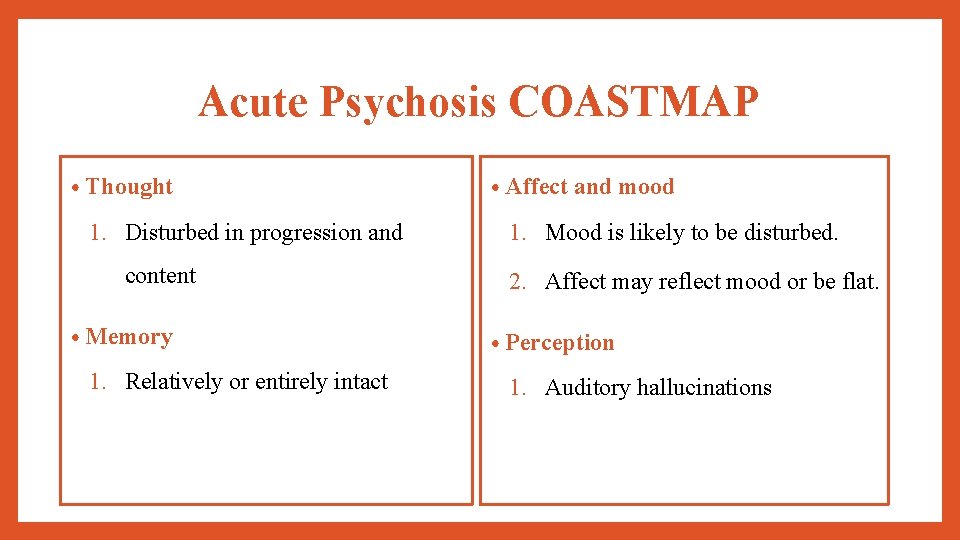
Acute Psychosis COASTMAP • Thought 1. Disturbed in progression and content • Memory 1. Relatively or entirely intact • Affect and mood 1. Mood is likely to be disturbed. 2. Affect may reflect mood or be flat. • Perception 1. Auditory hallucinations
Acute Psychosis management 1. Reasoning doesn‘t always work. 2. Explain what is being done. 3. Directions should be simple and consistent. 4. Keep orienting the patient.
Acute Psychosis management 1. Before pharmacologic treatments, try: Ø Maintaining an emotional distance Ø Explaining each step of the assessment Ø Involving people the patient trusts 2. When these methods fail : Ø Safely restrain the patient. Ø Administer a medication to help the behavior
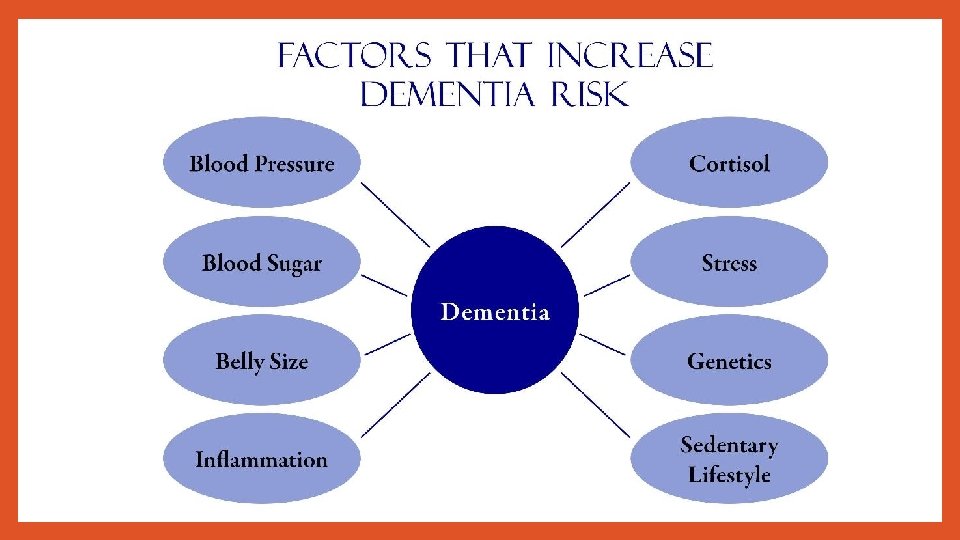
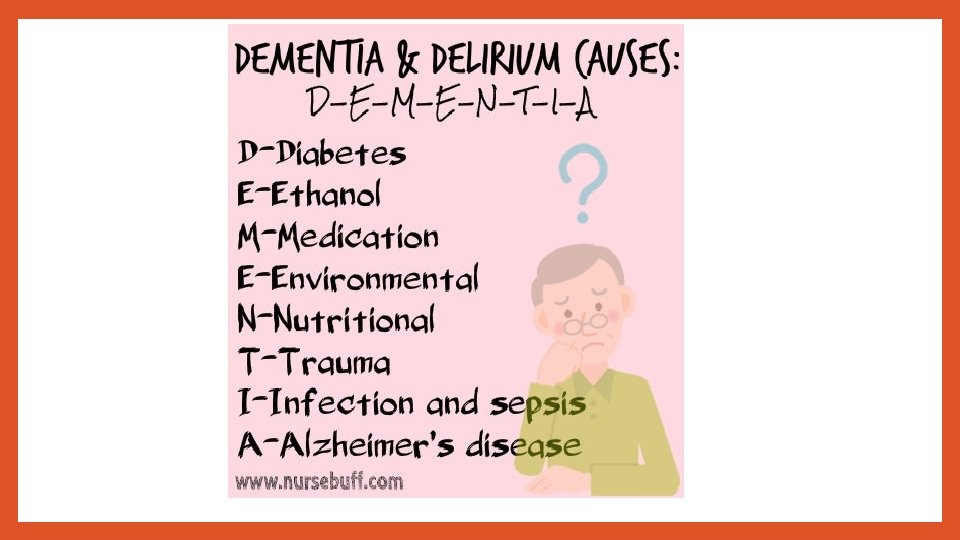
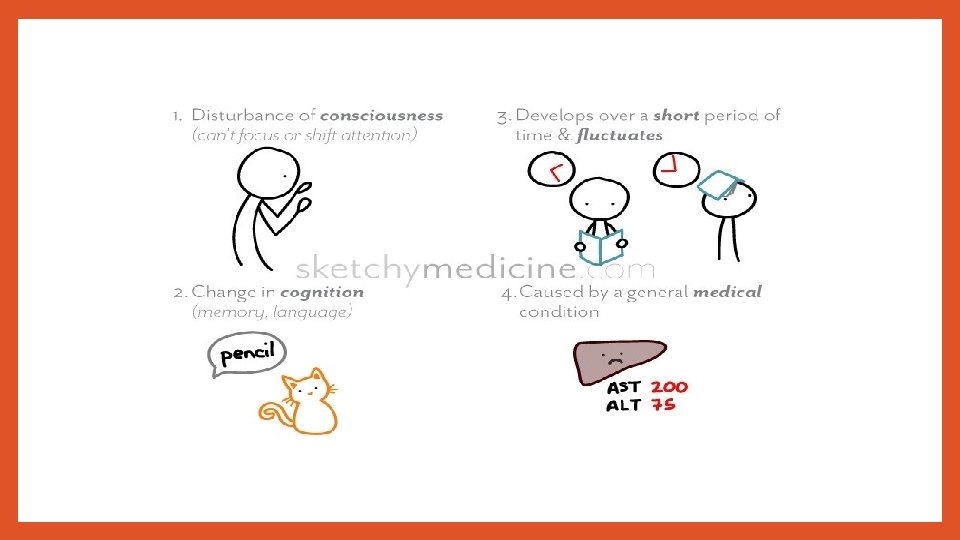
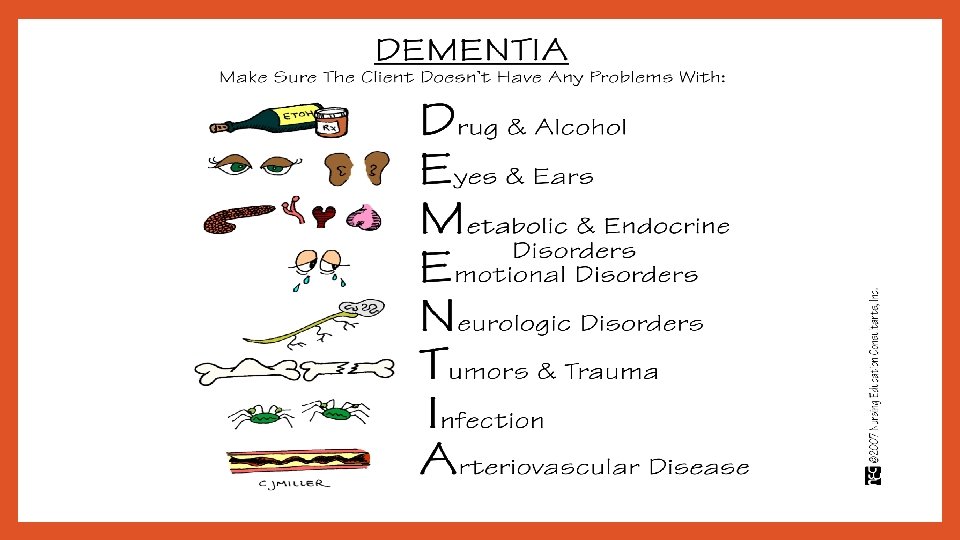
Delirium and dementia q. Delirium: a state of global cognitive impairment of acute onset characterized by: I. Fluctuations in mental status and behavior. II. Disorganized thinking. III. An altered level of consciousness. q. Dementia: Chronic process that produces severe deficits in memory, thinking, and judgment.
Causes of dementia and delirium q Common risk factors that may preclude delirium include medical histories of : 1. Hypertension 2. COPD 3. Alcohol abuse 4. Smoking
Agitated Delirium ØAssessment 1. Try to reorient patients. 2. Perform a thorough assessment. ØManagement 1. Identify the stressor or metabolic problem.
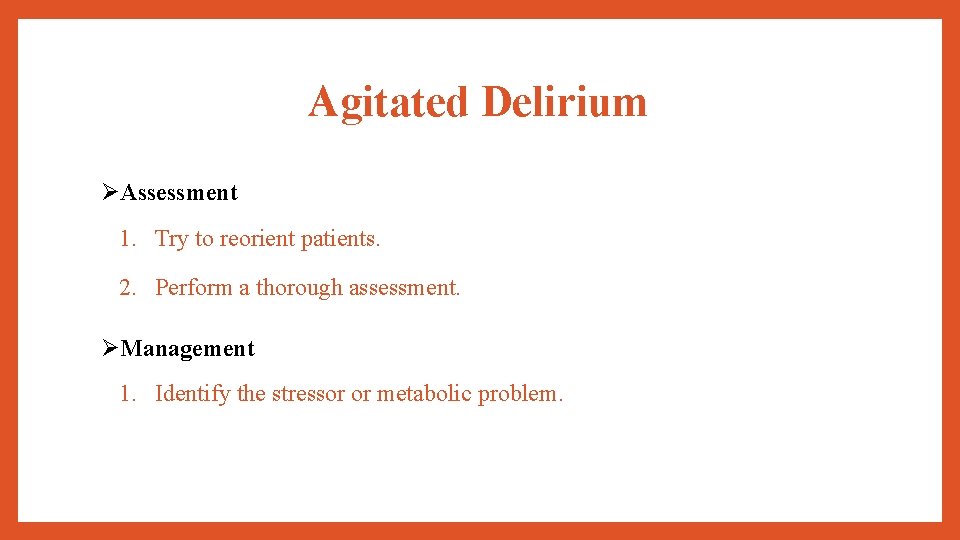
Assessment 1. First try to reorient patients to surroundings and circumstances. 2. Perform a thorough assessment including asking about past medical history and medications. 3. Management is mainly supportive. 4. Definitive treatment is directed towards etiology. 5. Be cautious when administering morphine or antipsychotics to patients with a known history of dementia.
Suicidal ideation q Suicide: Any willful act designed to end one’s life. q More common among men. q Risk also high among alcoholics and depressed patients. q More than half of all suicides have made a previous attempt.
Predisposing factor 1. Close emotional attachments are endangered. 2. Losing someone or something important in life. 3. Feelings characteristic of depression : § Worthlessness § Lack of self-esteem § Sense of not being able to manage life
Assessment A. The assessment of every depressed patient must include an evaluation of the suicide risk. B. Broach the subject of suicide in a stepwise fashion: a. Have you ever thought that life wasn’t worth living? b. Did you ever feel that you would be better off dead? c. Have you ever thought of harming yourself? d. Do you feel that way now?
e. Do you have a plan of how you would go about it? f. Do you have things you need to carry out the plan? g. Has anyone in your family ever committed suicide? Have you ever tried to kill yourself before?
A. The following indicate higher-risk patients who must be evaluated at the hospital: a. Patients who have made previous attempts b. Patients who have detailed, concrete plans c. Patients who have a history of suicide among close relatives
Management A. Do not leave the patient alone. B. Collect objects of potential self-destruction and bring them with you to the hospital. C. Identify the patient’s feelings. D. Encourage transport and if the patient refuses : 1. Try to get the people who are close to the patient to help with cooperation. 2. It may be necessary to obtain law enforcement assistance.
E. When a person has attempted suicide : 1. Medical treatment has priority. 2. If the patient is conscious, try to establish communication, and ask the patient to talk about the situation.
Abuse and neglect 1. Victims and criminals of violence and abuse may themselves have a mental illness. 2. Assess the following for anything that suggests abuse, neglect or patterns of violence: a. The patient and other persons involved b. The environment 3. Document your findings and report your concerns according to local protocols. 4. Your priorities is safety and Management of acute medical and trauma concerns.
Violence q Risk factors for violence : 1. Scenarios in which violence is more likely 2. People who are more likely to be violent 3. Warning signs
§ Scenarios in which violence is more likely include: 1. Any situation where alcohol or illicit drugs are being consumed 2. Crowd incidents 3. Incidents in which violence has already occurred
• People who are more likely to be violent include: A. Those intoxicated with alcohol or drugs B. Those experiencing withdrawal from alcohol or drugs C. Those who are psychotic D. Those who are delirious from any cause
• Look for the following warning signs. 1. Posture: Sitting tensely at the edge of a chair, gripping at the armrest 2. Speech: Loud, critical, threatening, full of profanity 3. Motor activity: Unable to sit still, pacing back and forth or in circles, easily startled. 4. Other body language: Clenched fists, avoidance of eye contact, turning away when spoken
Management of the violent patient 1. Assess the whole situation. 2. Observe your surroundings. 3. Maintain a safe distance. 4. Try verbal interventions first.
1. Assess the whole situation. ØAre factors in the surroundings contributing to the escalation of violence? ØCan those factors be removed? ØDoes ØCan evidence suggest drug use, alcohol use, head injury, or diabetes? anyone present give you some background information?
• Observe your surroundings: 1. Make sure you have an escape route. 2. Place yourself between the patient and the door. 3. Don’t turn your back on the patient, even for a moment. 4. Note any furniture or potential barriers. 5. Note anything that could be used as a weapon (e. g. , heavy or sharp objects). 6. If the patient is armed with a weapon, back off and notify law enforcement.
Mood disorders • • Include: 1. Manic-depressive illness 2. Major depression Unipolar mood disorder: Mood remains at only one pole of the depression or mania side • Bipolar mood disorder: Mood alternates between mania and depression
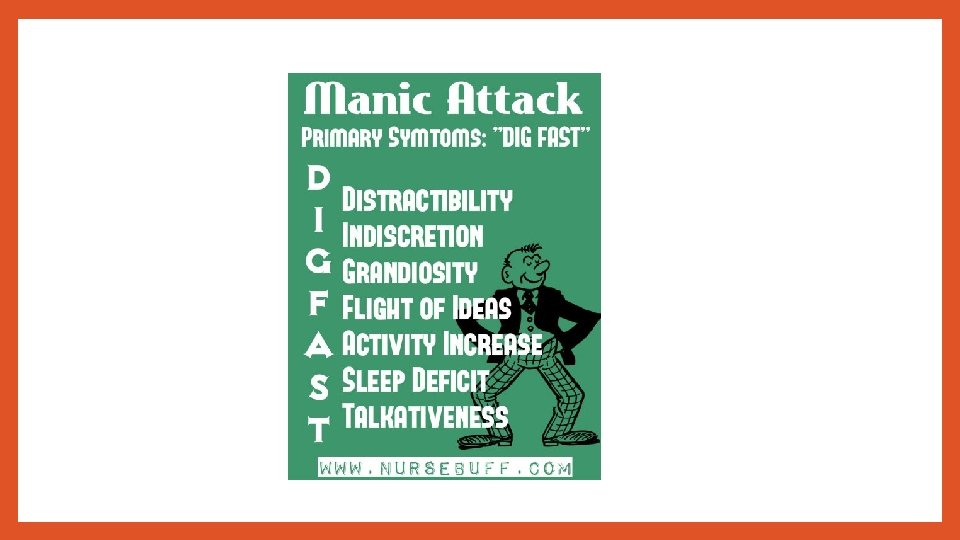
Mania § Patients typically have abnormally exaggerated happiness, joy, or euphoria with hyperactivity and insomnia. 1. Patients are typically awake and alert but easily distracted. 2. Almost all report a significantly decreased need for sleep. 3. Manic patients are talkative with pressured and rapid speech. 4. Their monologues may skip rapidly from one topic to another (“tangential thinking”).
Management 1. Patients are unlikely to consider themselves ill and may not agree they need treatment. 2. Be calm, firm, and patient. 3. Minimize external stimulation. 4. If the patient refuses transport, consult medical control. 5. Obtain law enforcement assistance if your medical director indicates hospital evaluation is needed.

- Slides: 70