
PS 210 Political Economy How politics and economics
- Slides: 38
PS 210 Political Economy How politics and economics are related Shane Stevens
Components of Political Economy: Markets and Property • Markets: Interaction between forces of supply and demand. Creates value for goods and services. Decentralized • Property: Ownership of goods and services. • Property rights—what can I do with my property? • Regulation: States regulate and protect markets and property
Components of Political Economy: Public Goods • Non-Rival and Non-Excludable • Available to everyone • These goods don’t function well in market or in private hands • Examples? • Public goods: used by society, not privately owned • These vary widely from country to country
Components of Political Economy: Social Expenditures • “Welfare” • State provision of public benefits • For example: Education, healthcare, transportation • Redistributive power placed in hands of state • Often controversial—who benefits?
Taxation • Who pays for public goods and social expenditures? • Taxation varies in who is taxed (income tax, workers, employees) • Taxation varies in how much is taxed
Money and Inflation • • Money is a medium of exchange A form of IOU Legitimacy backed by the state Central banks control its supply, typically through interest rates • Oversupply can lead to inflation • Extreme cases: Hyperinflation—inflation of more than 50% a month!
Regulation • Orders that set the boundaries of given procedure • States manage markets and property through regulations • Examples: – Monopoly (Microsoft) – Cartel (OPEC)
Trade • States manage sale of goods and services between themselves and other countries • How open or closed should this be? • Tools of trade regulation: – Tariffs – Quota – Non-tariff barriers
Political Economic Systems Discussed various institutions that link politics and economics How do these differ across countries? Political economic systems: actual relationship between political and economic institutions in a particular country, and the outcomes they create
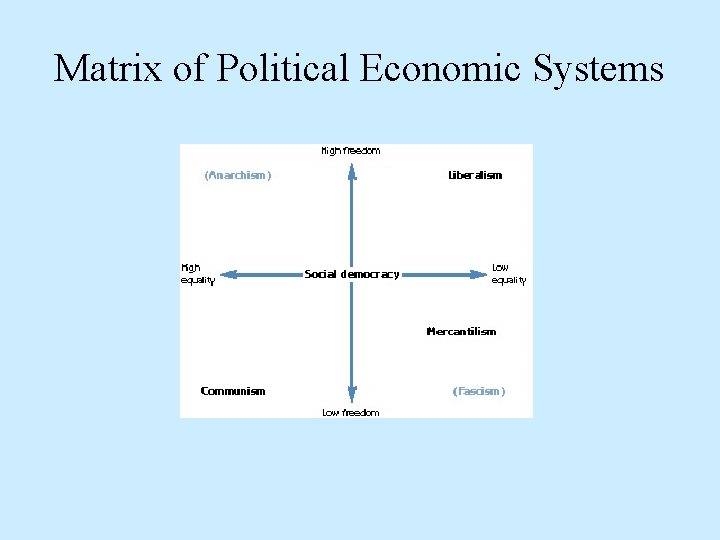
Matrix of Political Economic Systems
Liberalism • Related to ideology of the same name • High priority on individual political and economic freedom, less on equality • Pro-capitalism • Democracy requires a free market • US and other former British colonies
Liberal Policies • • • Best state is a weak one Limited regulations Fewer public goods Lower taxes Free trade Laissez-faire—allow economy to function as it wishes • Greater tolerance for inequality and poverty
Social Democracy • Attempts to balance individual freedom and collective equality • Accepts private property and markets, but seeks to regulate • Many European countries fall into this category
Social Democratic Policies • More public goods than in liberalism—less tolerance for inequality, poverty • Trade and competition under state management • Outright ownership of some industries by state seen as acceptable or necessary • Neo-corporatism: state, labor and business set policy in concert, not through conflict (like strikes)
Communism • Attempt to realize communist theory of Marx • Emphasis on collective equality over individual freedom • Property, markets viewed as instruments of exploitation • Soviet Union and much of Eastern Europe until 1989 -91. Cuba, North Korea, China(? )
Communist Policies • • • No private property—nationalized No markets—directed by state No unemployment Trade restricted Wide range of public goods
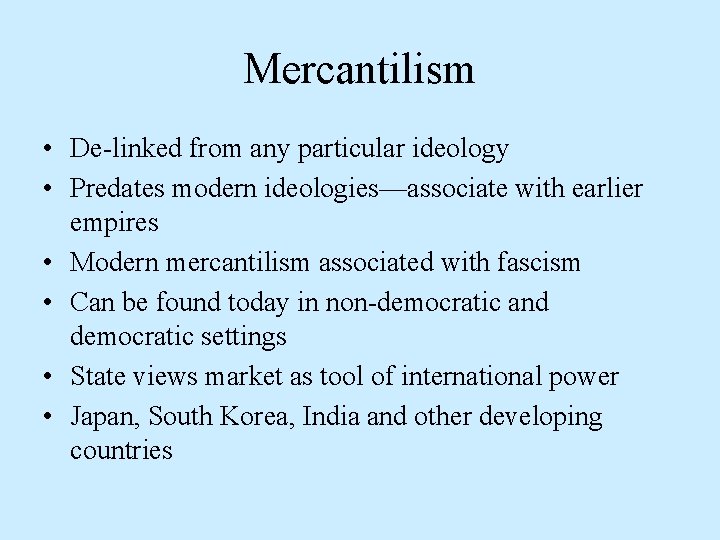
Mercantilism • De-linked from any particular ideology • Predates modern ideologies—associate with earlier empires • Modern mercantilism associated with fascism • Can be found today in non-democratic and democratic settings • State views market as tool of international power • Japan, South Korea, India and other developing countries
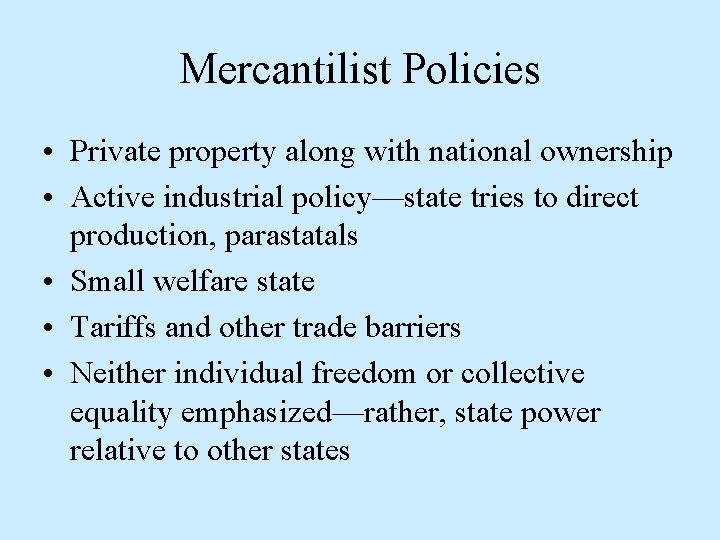
Mercantilist Policies • Private property along with national ownership • Active industrial policy—state tries to direct production, parastatals • Small welfare state • Tariffs and other trade barriers • Neither individual freedom or collective equality emphasized—rather, state power relative to other states
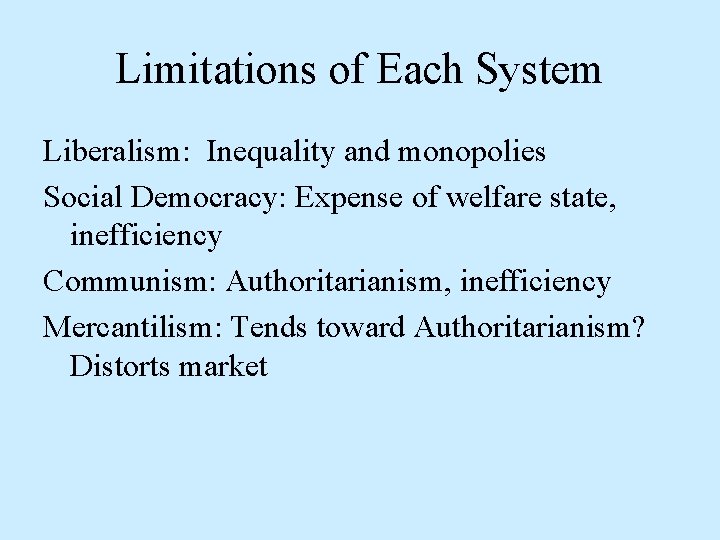
Limitations of Each System Liberalism: Inequality and monopolies Social Democracy: Expense of welfare state, inefficiency Communism: Authoritarianism, inefficiency Mercantilism: Tends toward Authoritarianism? Distorts market
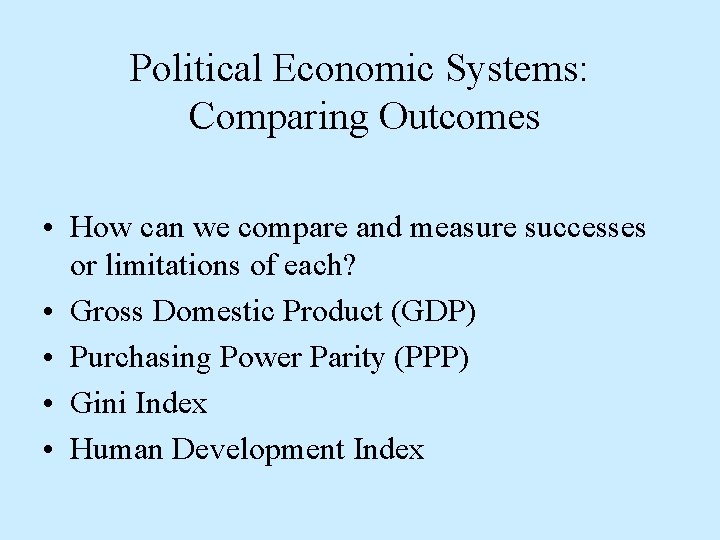
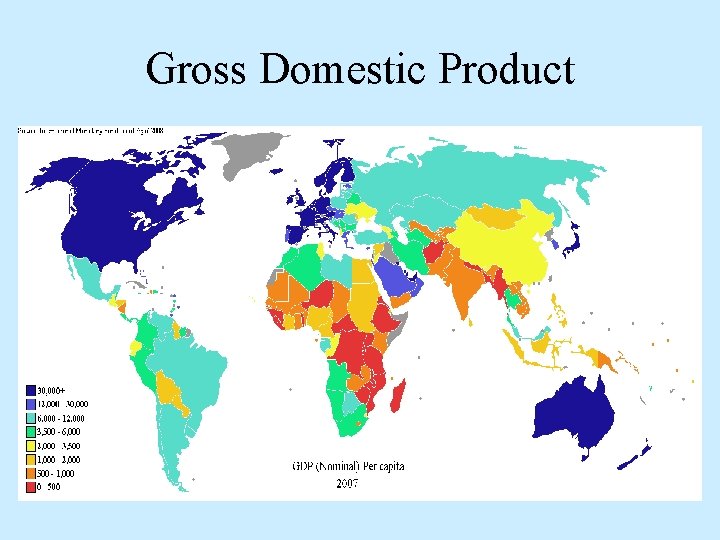
Political Economic Systems: Comparing Outcomes • How can we compare and measure successes or limitations of each? • Gross Domestic Product (GDP) • Purchasing Power Parity (PPP) • Gini Index • Human Development Index
Gross Domestic Product
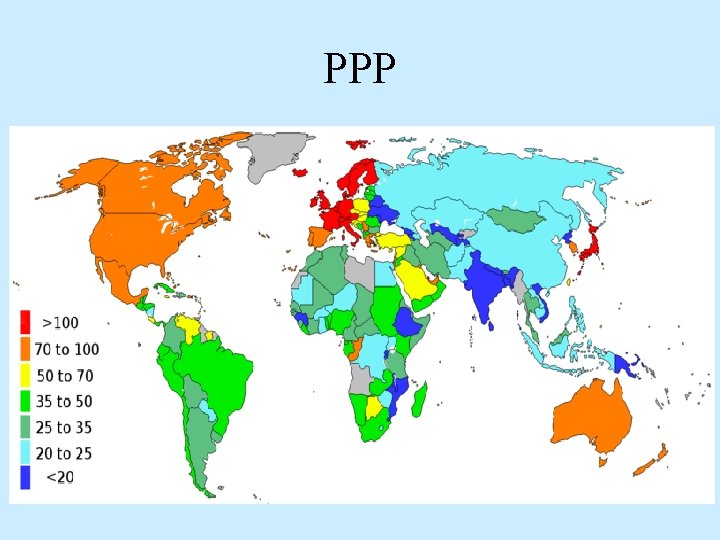
Purchasing Power Parity • Limits of GDP in that it does not take into account costs of living in different countries • PPP looks at GDP in terms of buying power • In countries where costs are low, GDP is increased when adjusted for PPP • In countries where costs are high, GDP is lowered when adjusted for PPP
PPP
Limits of GDP and PPP • Captures all economic transactions, including bad ones! • For example, disasters, expenditures based on crime prevention • Costs of economic growth not factored in, such as pollution • Economic distribution not measured—who gets the wealth?
Gini Index • Mathematical formula that measures inequality (not poverty) in countries • Perfect equality = 0 Perfect inequality = 100 • What percent of the population owns what percent of the country’s total wealth? • Higher inequality in liberal countries than social democratic ones • Higher inequality in poorer than richer countries
Human Development Index • Emphasis on poverty/development over inequality • Not focused on wealth, but rather outcome of that wealth • What is the quality of life? – Literacy and education – Life expectancy and health • Strong correlation between GDP and HDI
Future of Political Economy? • World has become more liberal over time • Neo-liberalism: return/resurgence of liberal policies and institutions • Decline of communism, roll-back of social democratic institutions and policies
Review • The shift in political science toward seeking causality and using quantitative methods is known as the • • A. ) mathematical revolution. B. ) behavioral revolution. C. ) statistical revolution. D. ) analytical revolution.
• Modernization theory can be defined as the view that • A. )few countries will ever modernize and embrace democracy. • B. )as societies develop they will become capitalist democracies. • C. )each country and region will modernize in a different way, each with a different result. • D. )significant change is possible only through revolution.
• A greater focus on collective equality is associated with • • A. )a smaller state. B)a larger state. C. )political violence. D. )civic responsibility.
• Sovereignty is defined as the ability of • A. ) individuals to vote freely in elections. • B. ) individuals to depend on laws and regulations. • C. ) states to carry out actions or policy independent of outside actors or rivals. • D. ) states to function without the need of an army or other coercive apparatus.
• Regimes are defined as • • A. ) legitimate political systems. B. ) the elected officials of a country. C. ) an organization that maintains a monopoly of violence over a territory. D. ) the basic rules and norms of politics.
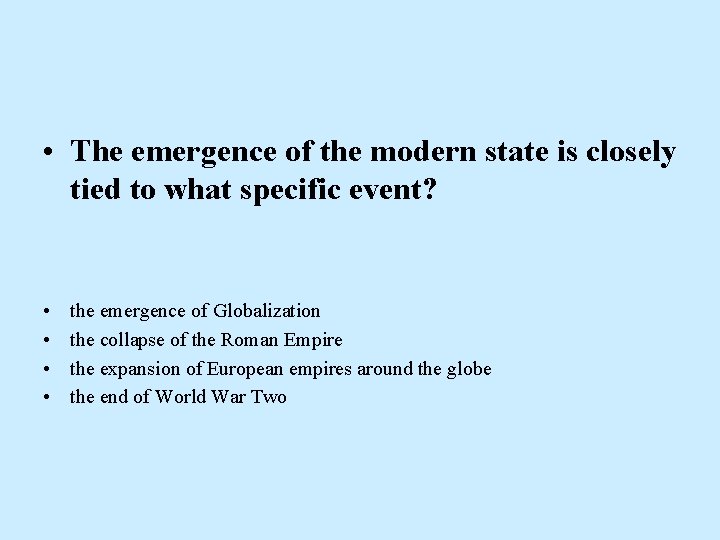
• The emergence of the modern state is closely tied to what specific event? • • the emergence of Globalization the collapse of the Roman Empire the expansion of European empires around the globe the end of World War Two
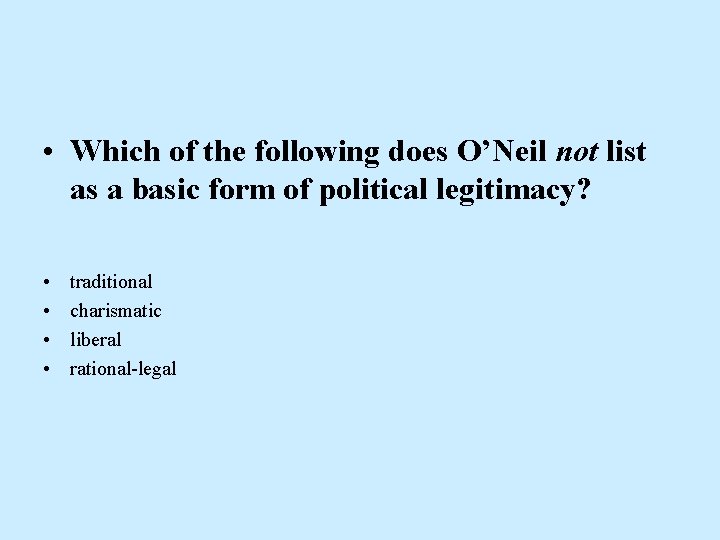
• Which of the following does O’Neil not list as a basic form of political legitimacy? • • traditional charismatic liberal rational-legal
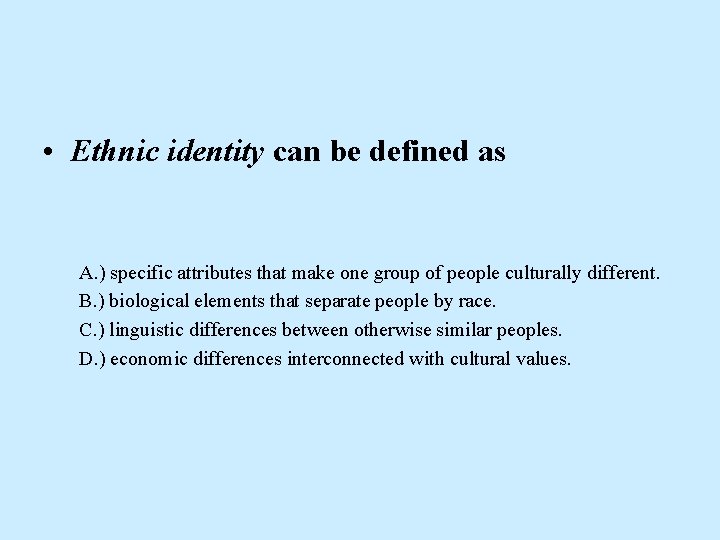
• Ethnic identity can be defined as A. ) specific attributes that make one group of people culturally different. B. ) biological elements that separate people by race. C. ) linguistic differences between otherwise similar peoples. D. ) economic differences interconnected with cultural values.
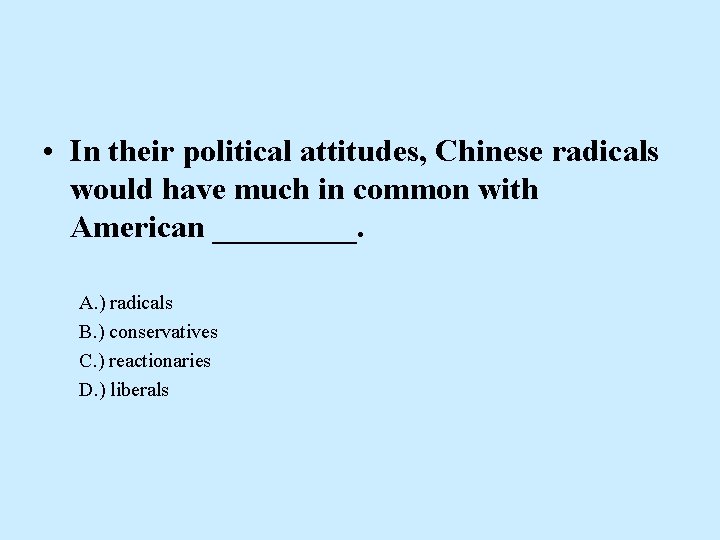
• In their political attitudes, Chinese radicals would have much in common with American _____. A. ) radicals B. ) conservatives C. ) reactionaries D. ) liberals
• Mercantilism is best associated with which of the following policies? A. ) free trade B. ) tariff barriers C. ) elimination of all private property D. ) social expenditures
• Neocorporatism is an example of which political economic system? A. ) social democracy B. ) communism C. ) mercantilism D. ) liberalism