
PS 2 single particle dynamics H Bartosik Y
PS 2 – single particle dynamics H. Bartosik, Y. Papaphilippou
Machine parameters – main characteristics • PS 2 meant as potential replacement of existing PS • PS 2 main characteristics given by LHC requirements – Circumference defined by optimized filling pattern of subsequent SPS: C=1346. 4 m (=15/77 of SPS) – Negative Momentum Compaction (NMC) lattice (imaginary γt) for avoiding crossing of transition energy – Basic requirement is very high intensity • LHC: 4 E 11 p/b, εx, norm=3π. mm. mrad, εy, norm=3π. mm. mrad • fixed target: 6 E 11 p/b, εx, norm=9π. mm. mrad, εy, norm=6π. mm. mrad – Injection energy 4 Ge. V kinetic (to compensate increased space charge tuneshift compared to PS) – Extraction energy 50 Ge. V • Injection/extraction located in the same long straight section • Zero dispersion in straight sections to ease beam transfer • Nominal lattice has superperiodicity of 2 (alternative option has 3)
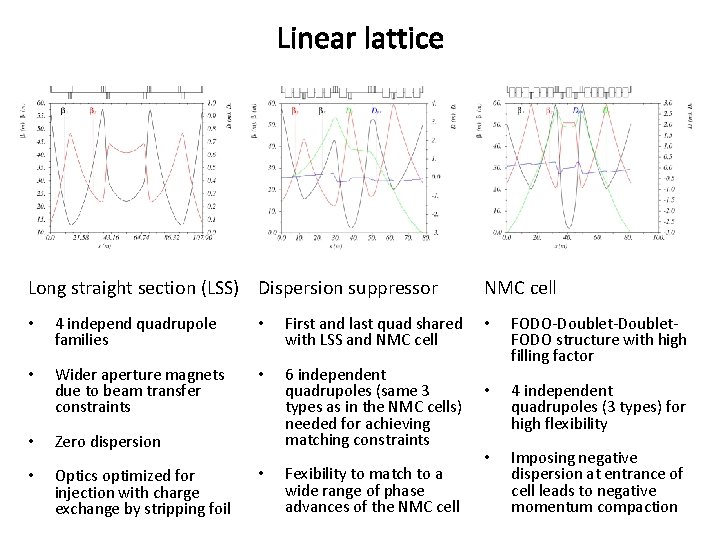
Linear lattice Long straight section (LSS) Dispersion suppressor • 4 independ quadrupole families • First and last quad shared with LSS and NMC cell • Wider aperture magnets due to beam transfer constraints • • Zero dispersion 6 independent quadrupoles (same 3 types as in the NMC cells) needed for achieving matching constraints • Optics optimized for injection with charge exchange by stripping foil • Fexibility to match to a wide range of phase advances of the NMC cell • FODO-Doublet. FODO structure with high filling factor • 4 independent quadrupoles (3 types) for high flexibility • Imposing negative dispersion at entrance of cell leads to negative momentum compaction
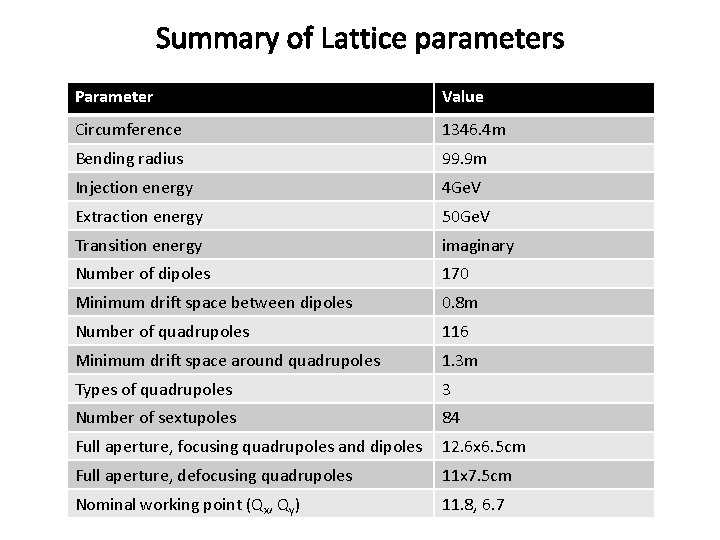
Summary of Lattice parameters Parameter Value Circumference 1346. 4 m Bending radius 99. 9 m Injection energy 4 Ge. V Extraction energy 50 Ge. V Transition energy imaginary Number of dipoles 170 Minimum drift space between dipoles 0. 8 m Number of quadrupoles 116 Minimum drift space around quadrupoles 1. 3 m Types of quadrupoles 3 Number of sextupoles 84 Full aperture, focusing quadrupoles and dipoles 12. 6 x 6. 5 cm Full aperture, defocusing quadrupoles 11 x 7. 5 cm Nominal working point (Qx, Qy) 11. 8, 6. 7
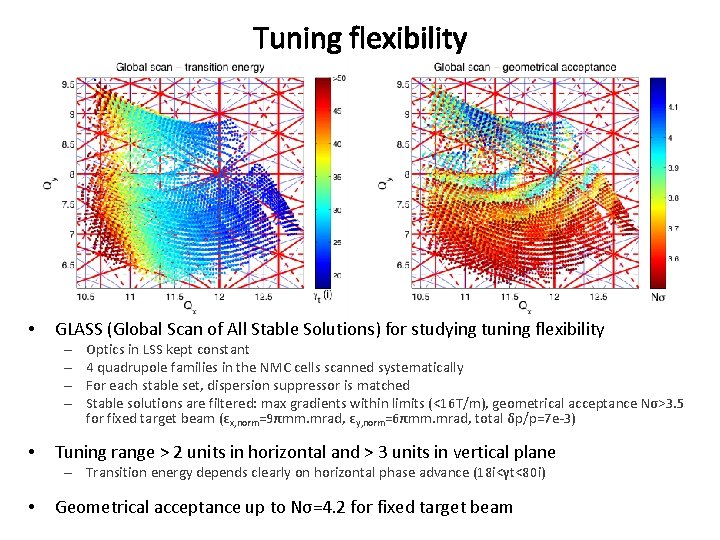
Tuning flexibility • GLASS (Global Scan of All Stable Solutions) for studying tuning flexibility – – • Optics in LSS kept constant 4 quadrupole families in the NMC cells scanned systematically For each stable set, dispersion suppressor is matched Stable solutions are filtered: max gradients within limits (<16 T/m), geometrical acceptance Nσ>3. 5 for fixed target beam (εx, norm=9πmm. mrad, εy, norm=6πmm. mrad, total δp/p=7 e-3) Tuning range > 2 units in horizontal and > 3 units in vertical plane – Transition energy depends clearly on horizontal phase advance (18 i<γt<80 i) • Geometrical acceptance up to Nσ=4. 2 for fixed target beam
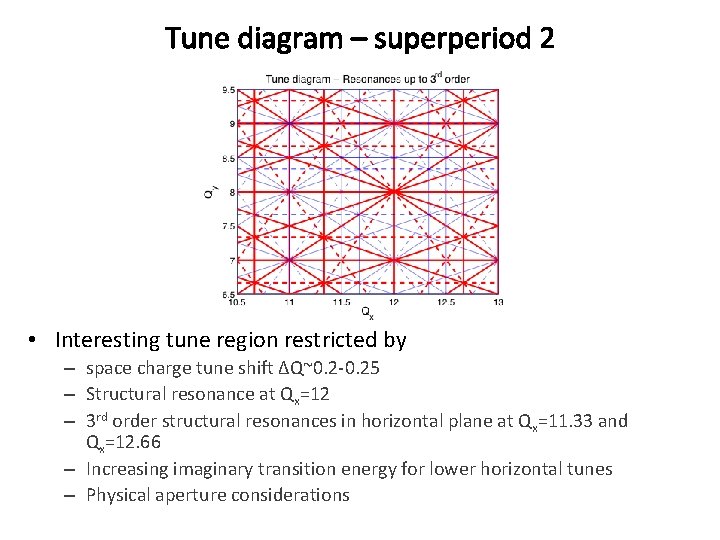
Tune diagram – superperiod 2 • Interesting tune region restricted by – space charge tune shift ΔQ~0. 2 -0. 25 – Structural resonance at Qx=12 – 3 rd order structural resonances in horizontal plane at Qx=11. 33 and Qx=12. 66 – Increasing imaginary transition energy for lower horizontal tunes – Physical aperture considerations
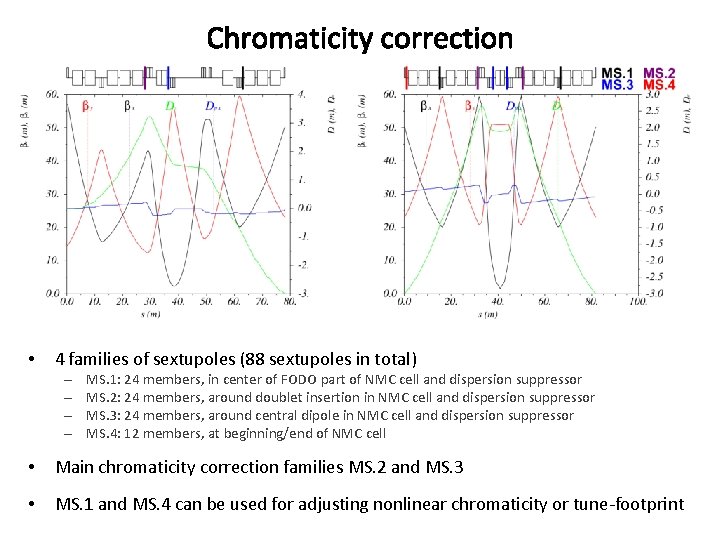
Chromaticity correction • 4 families of sextupoles (88 sextupoles in total) – – MS. 1: 24 members, in center of FODO part of NMC cell and dispersion suppressor MS. 2: 24 members, around doublet insertion in NMC cell and dispersion suppressor MS. 3: 24 members, around central dipole in NMC cell and dispersion suppressor MS. 4: 12 members, at beginning/end of NMC cell • Main chromaticity correction families MS. 2 and MS. 3 • MS. 1 and MS. 4 can be used for adjusting nonlinear chromaticity or tune-footprint
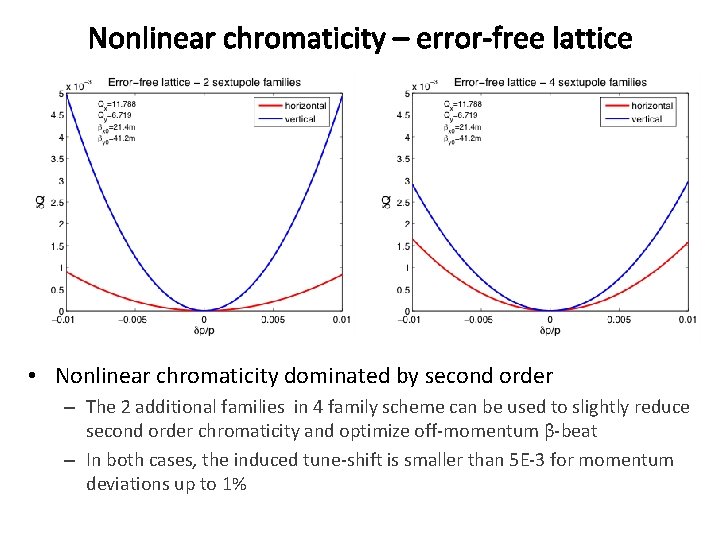
Nonlinear chromaticity – error-free lattice • Nonlinear chromaticity dominated by second order – The 2 additional families in 4 family scheme can be used to slightly reduce second order chromaticity and optimize off-momentum β-beat – In both cases, the induced tune-shift is smaller than 5 E-3 for momentum deviations up to 1%
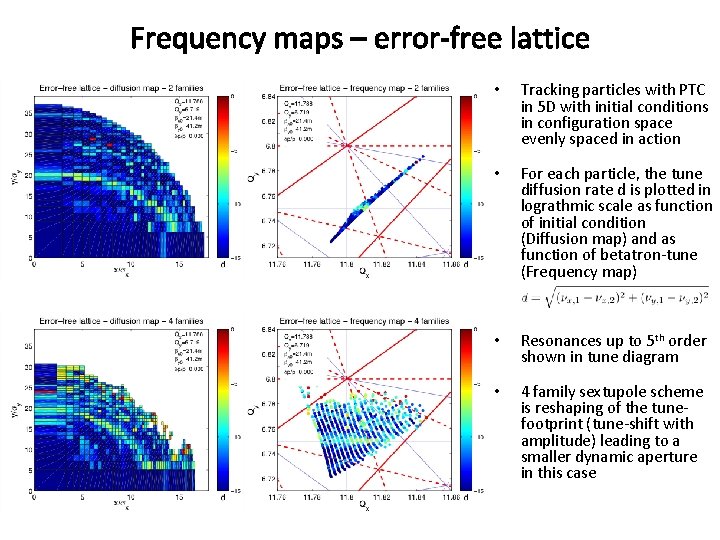
Frequency maps – error-free lattice • Tracking particles with PTC in 5 D with initial conditions in configuration space evenly spaced in action • For each particle, the tune diffusion rate d is plotted in lograthmic scale as function of initial condition (Diffusion map) and as function of betatron-tune (Frequency map) • Resonances up to 5 th order shown in tune diagram • 4 family sextupole scheme is reshaping of the tunefootprint (tune-shift with amplitude) leading to a smaller dynamic aperture in this case
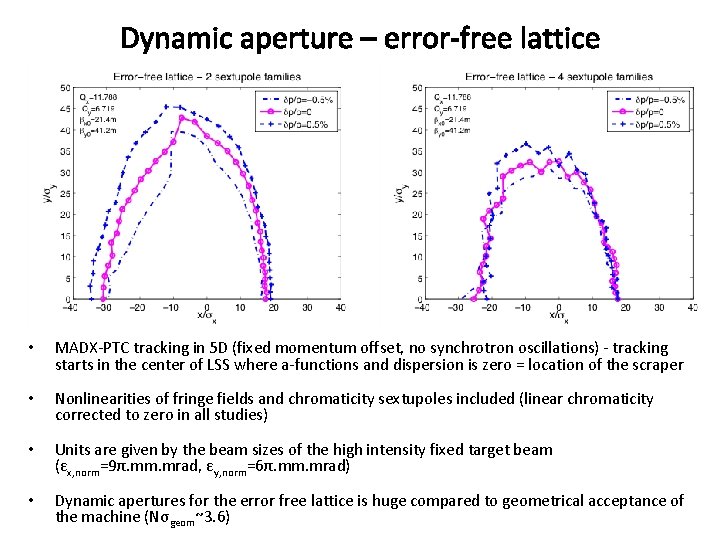
Dynamic aperture – error-free lattice • MADX-PTC tracking in 5 D (fixed momentum offset, no synchrotron oscillations) - tracking starts in the center of LSS where a-functions and dispersion is zero = location of the scraper • Nonlinearities of fringe fields and chromaticity sextupoles included (linear chromaticity corrected to zero in all studies) • Units are given by the beam sizes of the high intensity fixed target beam (εx, norm=9π. mm. mrad, εy, norm=6π. mm. mrad) • Dynamic apertures for the error free lattice is huge compared to geometrical acceptance of the machine (Nσgeom~3. 6)
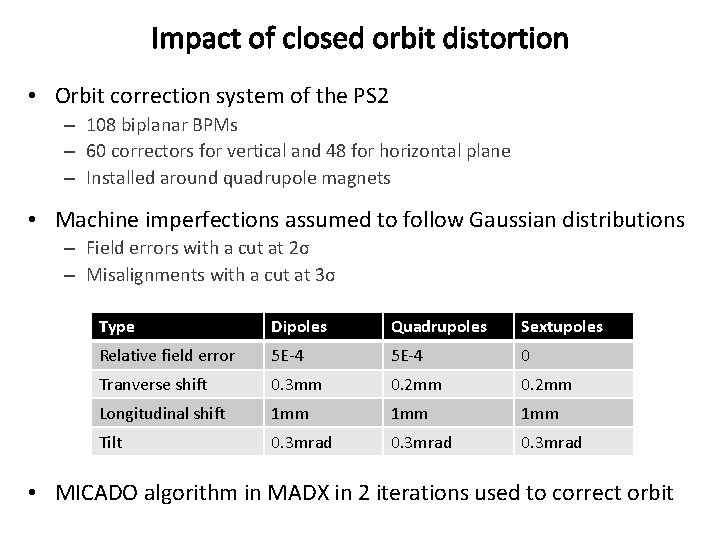
Impact of closed orbit distortion • Orbit correction system of the PS 2 – 108 biplanar BPMs – 60 correctors for vertical and 48 for horizontal plane – Installed around quadrupole magnets • Machine imperfections assumed to follow Gaussian distributions – Field errors with a cut at 2σ – Misalignments with a cut at 3σ Type Dipoles Quadrupoles Sextupoles Relative field error 5 E-4 0 Tranverse shift 0. 3 mm 0. 2 mm Longitudinal shift 1 mm 1 mm Tilt 0. 3 mrad • MICADO algorithm in MADX in 2 iterations used to correct orbit
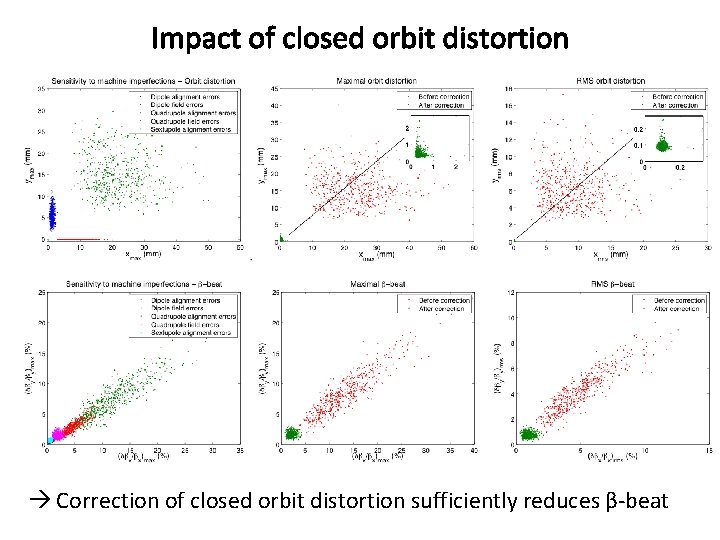
Impact of closed orbit distortion Correction of closed orbit distortion sufficiently reduces β-beat
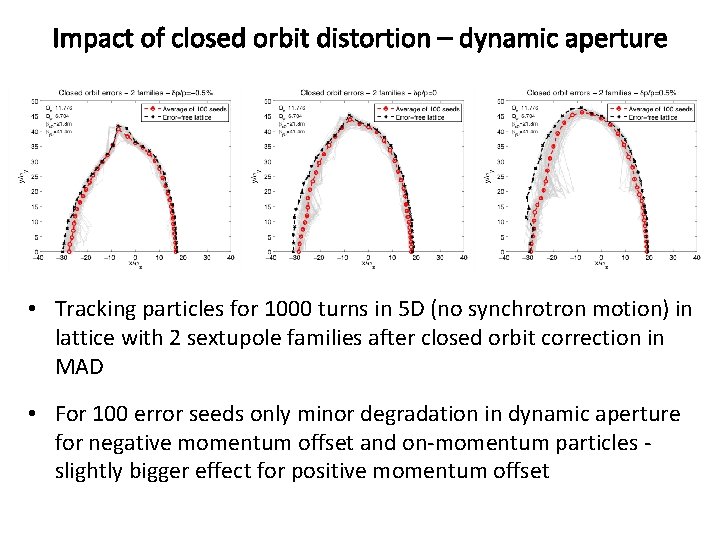
Impact of closed orbit distortion – dynamic aperture • Tracking particles for 1000 turns in 5 D (no synchrotron motion) in lattice with 2 sextupole families after closed orbit correction in MAD • For 100 error seeds only minor degradation in dynamic aperture for negative momentum offset and on-momentum particles slightly bigger effect for positive momentum offset
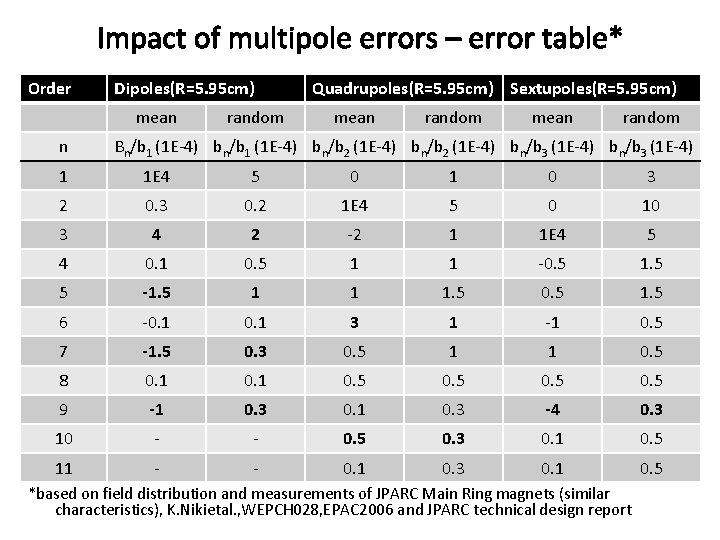
Impact of multipole errors – error table* Order Dipoles(R=5. 95 cm) mean n random Quadrupoles(R=5. 95 cm) Sextupoles(R=5. 95 cm) mean random Bn/b 1 (1 E-4) bn/b 2 (1 E-4) bn/b 3 (1 E-4) 1 1 E 4 5 0 1 0 3 2 0. 3 0. 2 1 E 4 5 0 10 3 4 2 -2 1 1 E 4 5 4 0. 1 0. 5 1 1 -0. 5 1. 5 5 -1. 5 1 1 1. 5 0. 5 1. 5 6 -0. 1 3 1 -1 0. 5 7 -1. 5 0. 3 0. 5 1 1 0. 5 8 0. 1 0. 5 9 -1 0. 3 0. 1 0. 3 -4 0. 3 10 - - 0. 5 0. 3 0. 1 0. 5 11 - - 0. 1 0. 3 0. 1 0. 5 *based on field distribution and measurements of JPARC Main Ring magnets (similar characteristics), K. Nikietal. , WEPCH 028, EPAC 2006 and JPARC technical design report
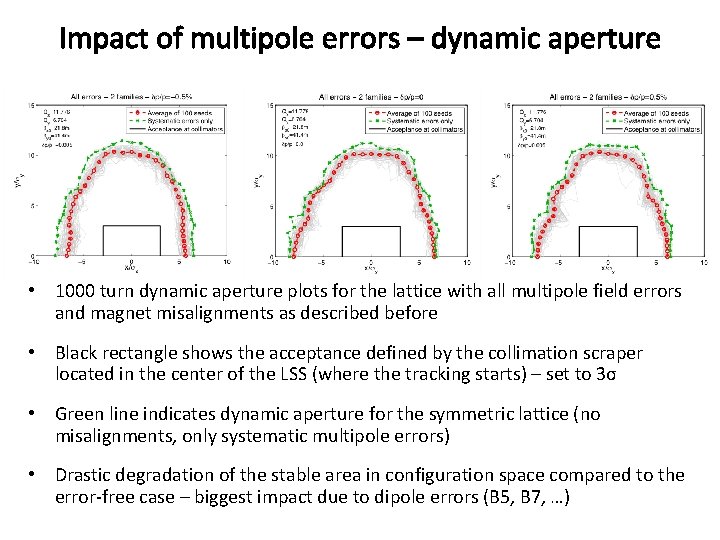
Impact of multipole errors – dynamic aperture • 1000 turn dynamic aperture plots for the lattice with all multipole field errors and magnet misalignments as described before • Black rectangle shows the acceptance defined by the collimation scraper located in the center of the LSS (where the tracking starts) – set to 3σ • Green line indicates dynamic aperture for the symmetric lattice (no misalignments, only systematic multipole errors) • Drastic degradation of the stable area in configuration space compared to the error-free case – biggest impact due to dipole errors (B 5, B 7, …)
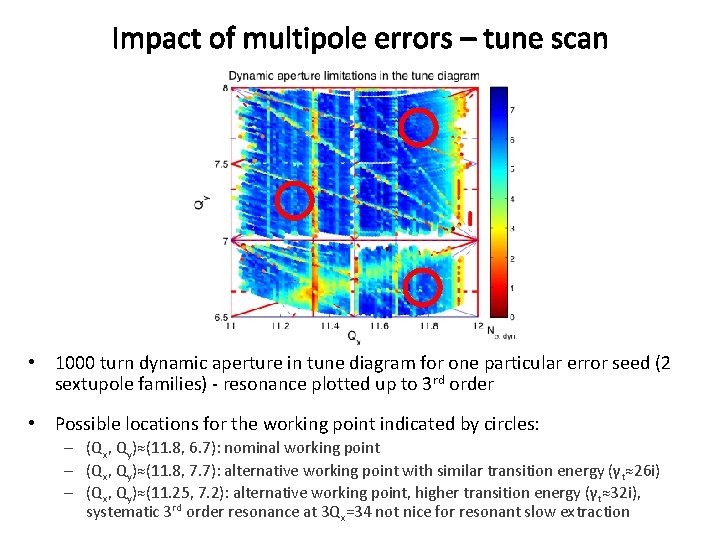
Impact of multipole errors – tune scan • 1000 turn dynamic aperture in tune diagram for one particular error seed (2 sextupole families) - resonance plotted up to 3 rd order • Possible locations for the working point indicated by circles: – (Qx, Qy)≈(11. 8, 6. 7): nominal working point – (Qx, Qy)≈(11. 8, 7. 7): alternative working point with similar transition energy (γ t≈26 i) – (Qx, Qy)≈(11. 25, 7. 2): alternative working point, higher transition energy (γ t≈32 i), systematic 3 rd order resonance at 3 Qx=34 not nice for resonant slow extraction
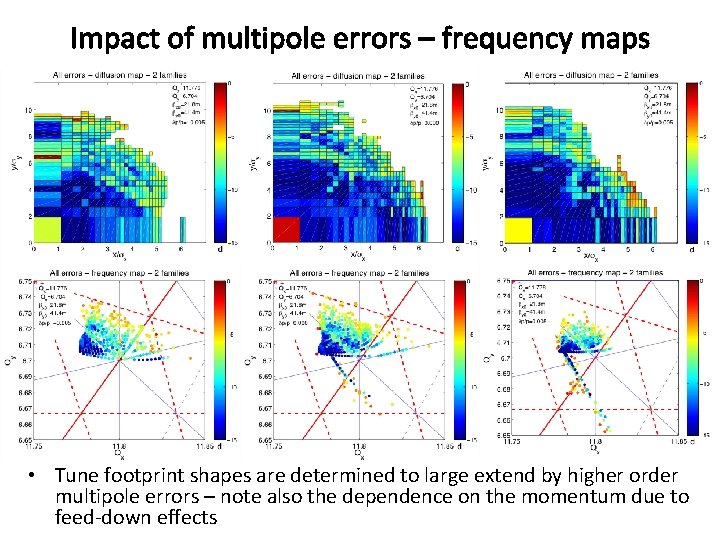
Impact of multipole errors – frequency maps • Tune footprint shapes are determined to large extend by higher order multipole errors – note also the dependence on the momentum due to feed-down effects
Impact of multipole errors – beam survival • Dynamic aperture bigger than physical acceptance is not sufficient for small particle losses – Particles may cross resonances causing transverse emittance blow-up – Particle survival in the presence of aperture limitations is important • PTC-tracking simulation – Particles with initial conditions within the aperture limitation defined by the scraper at 3 σ of the fixed target beam – Particle survival is defined by amplitude of betatron oscillation at the location of the scraper
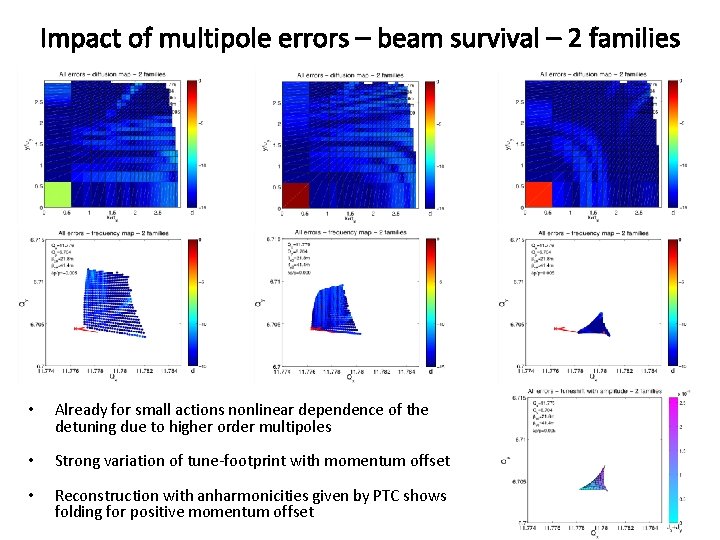
Impact of multipole errors – beam survival – 2 families • Already for small actions nonlinear dependence of the detuning due to higher order multipoles • Strong variation of tune-footprint with momentum offset • Reconstruction with anharmonicities given by PTC shows folding for positive momentum offset
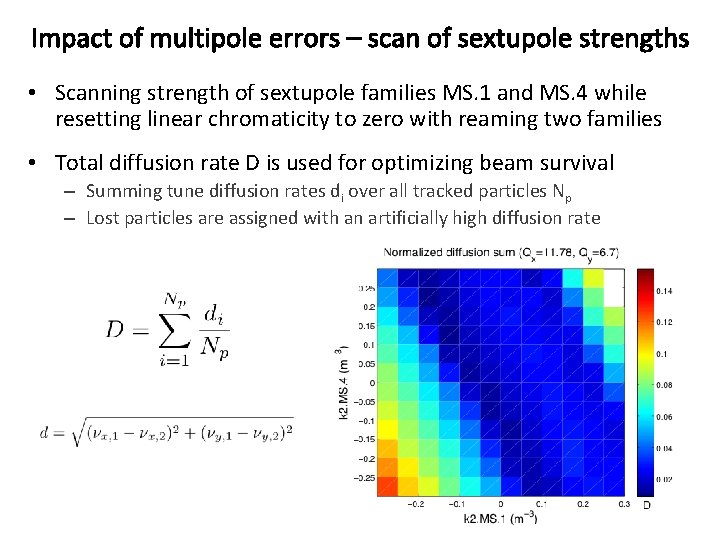
Impact of multipole errors – scan of sextupole strengths • Scanning strength of sextupole families MS. 1 and MS. 4 while resetting linear chromaticity to zero with reaming two families • Total diffusion rate D is used for optimizing beam survival – Summing tune diffusion rates di over all tracked particles Np – Lost particles are assigned with an artificially high diffusion rate
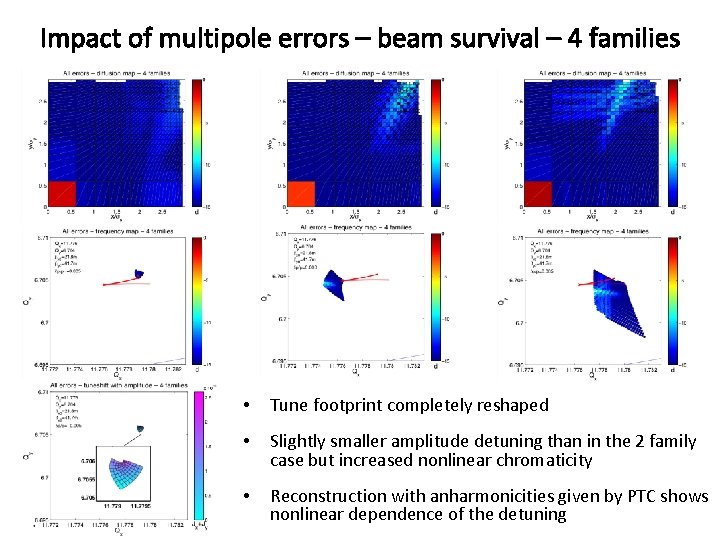
Impact of multipole errors – beam survival – 4 families • Tune footprint completely reshaped • Slightly smaller amplitude detuning than in the 2 family case but increased nonlinear chromaticity • Reconstruction with anharmonicities given by PTC shows nonlinear dependence of the detuning
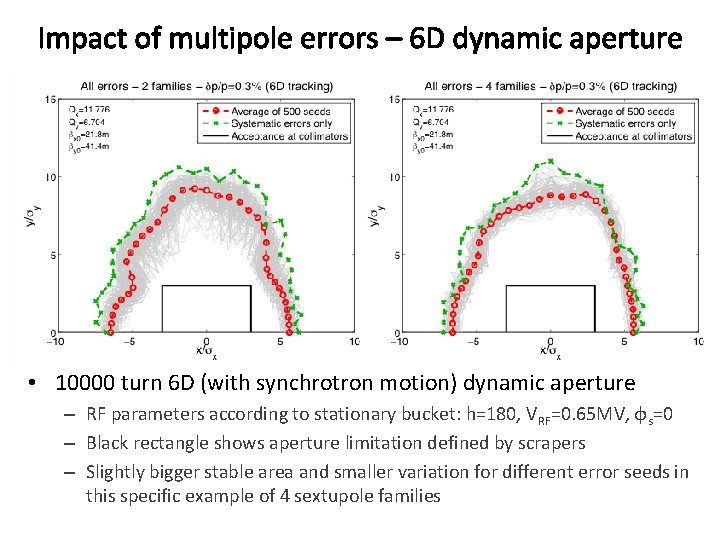
Impact of multipole errors – 6 D dynamic aperture • 10000 turn 6 D (with synchrotron motion) dynamic aperture – RF parameters according to stationary bucket: h=180, VRF=0. 65 MV, φs=0 – Black rectangle shows aperture limitation defined by scrapers – Slightly bigger stable area and smaller variation for different error seeds in this specific example of 4 sextupole families
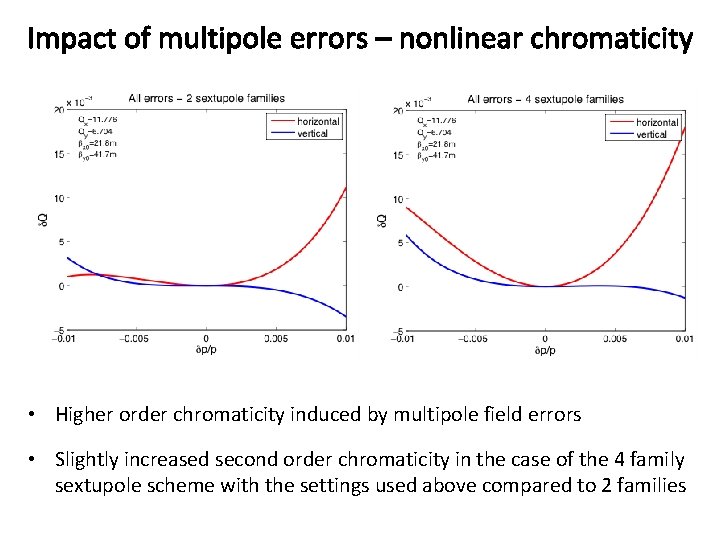
Impact of multipole errors – nonlinear chromaticity • Higher order chromaticity induced by multipole field errors • Slightly increased second order chromaticity in the case of the 4 family sextupole scheme with the settings used above compared to 2 families
Summary - Conclusions • Linear lattice of PS 2 provides good tuning flexibility without changing optics in the straight sections • Dynamic aperture and nonlinear dynamics of the racetrack PS 2 lattice studied with two chromaticity correction schemes – Dynamic aperture in the error-free lattice huge compared to the physical acceptance of the machine for both schemes – comparably small betatron amplitude detuning – Adding misalignments and errors in the strength of the main magnets have minor effect on dynamic aperture – Multipole errors lead to drastic degradation of dynamic aperture – stable area more or less given by good field region of the main magnets, amplitude detuning determined to large extend by high order multipoles • 4 family sextupole scheme provides some flexibility for adjusting detuning effects and slightly increasing dynamic aperture
- Slides: 24